Monet’s Minutes: Impressionism and the Industrialization of Time by André Dombrowski
Reviewed by Marnin YoungMarnin Young
Stern College for Women
Yeshiva University
Email the author: myoung2[at]yu.edu
Citation: Marnin Young, book review of Monet’s Minutes: Impressionism and the Industrialization of Time by André Dombrowski, Nineteenth-Century Art Worldwide 24, no. 1 (Spring 2025), https://doi.org/10.29411/ncaw.2025.24.1.17.
This work is licensed under a Creative Commons Attribution-NonCommercial 4.0 International License  unless otherwise noted.
Your browser will either open the file, download it to a folder, or display a dialog with options.
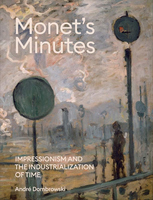
André Dombrowski,
Monet’s Minutes: Impressionism and the Industrialization of Time.
New Haven: Yale University Press, 2023.
264 pp.; 91 color and 41 b&w illus.; index.
$65.00 (hardcover)
ISBN: 9780300270662
“I do not like him,” wrote Otto Modersohn, “Monet is one of those who draw the ultimate consequences from Naturalism, I think, who paint outdoors with their watches in their hand, calculate precisely the shift by the hour and the day, and then never paint longer than half an hour because the sun moves too much.”[1] Addressed to his more progressive wife, Paula, in March 1900, the German painter’s critique of Claude Monet is telling. The temporal precision of the artistic production of Impressionism was already—or so it would seem—a commonplace presumption in the European art world. And it was becoming something of the past. Only a few years later, for example, Maurice Denis celebrated Paul Cezanne’s transcendence of “the chronometric notation of appearances.”[2] Any attempt to comprehend Monet’s drive to represent such appearances soon evaporated, replaced now and again only with a summary acknowledgement of the painter’s interest in “instantaneity.”
André Dombrowski now offers a timely rejoinder to these dismissive criticisms of chronometric painting. Monet’s Minutes: Impressionism and the Industrialization of Time constitutes the first fully historical account of Monet’s concern with pictorial temporality and its relation to the modern culture of time. While art historians such as John House, Steven Z. Levine, and Virginia Spate have made much of Monet’s concerns with temporality, no one has previously delved so deeply into the broad historical shifts in the measurement, perception, and experience of time in the painter’s lifetime.[3] And while Monet’s continued popularity surely has something profoundly to do with his (largely unacknowledged) harmonization with the modern temporal order, Dombrowski elaborates a (largely implicit) defense of the painter’s critical engagement with this order. In chapter after chapter of densely researched contextualization, analysis of critical reception, and careful descriptions of pictures, he shows how Monet mimicked the new organization of time under modernity while also commenting on its limits and possibilities for artistic, political, and philosophical understanding.
The book is organized in roughly chronological order, beginning in the mid-nineteenth century and proceeding into the twentieth. At every turn, Dombrowski proposes a connection between Monet’s artistic production and “the social history of time” (2). Paintings of the 1860s and early 1870s are set alongside developments in the psychology of reaction times and the “specious present” (12). Work time reforms of the 1870s help make sense of a painting like Unloading Coal (1875; Musée d’Orsay, Paris). A series of pictures depicting the Gare Saint-Lazare from 1877—on the front and back cover, and the subject of an earlier essay in The Art Bulletin—grapple with the newly coordinated railroad time in France.[4] Later paintings of haystacks, water lilies, cathedrals, and mornings on the Seine are understood in relation to the “universal time” that followed from an international treaty of 1884. The subject of Belle-Île-en-Mer in 1886 brings in the peculiar, and peculiarly anti-chronometric, concept of eternal return. Finally, a film showing Monet at work from 1915 conjoins Impressionism and photographic time. The proliferation of coincidences bringing Monet into dialogue with contemporary developments in “the emerging cultures and technologies of time” is overwhelming, as each of the six chapters and a coda amply demonstrate (1).
Chapter 1, “Reaction Time: Painting at the Velocity of Vision,” shows how the very concept of Impressionism depended on a preceding scientific definition of time. As Dombrowski puts it, “broad cultural shifts in the psychophysiological understandings of an ‘impression,’ and its putative length, inform the birth of impressionism” (27). Crucially, from the 1840s onwards, new techniques of measuring and graphically representing the fraction of a second between the bodily intake of sensations and their cognitive registration—known as a “reaction time”—made it clear that human perception was not instantaneous. Moreover, when Monet began painting pictures like Le Déjeuner (1868; Städel Museum, Frankfurt) the understanding that the time of perception could be represented was widespread: machines like the kymograph, for instance, offered the visual display of such temporal data. An “impression” was thus already a “form of representation, not a natural or reflexive occurrence” (39). Dombrowski’s description of the facture of Monet’s painting and its narrative depiction of reactions shows how much his early work participated in a parallel pursuit of the representation of the speed of perception, or what one popular author known to the artist called “The Speed of the Will” (35). Art critics in the early 1870s seem to have recognized something of the scientific grounding of what came to be called Impressionism, but, paradoxically, the new style made the instant of perception central precisely when science had shown that experience itself is not instantaneous.
The next chapter, “Now Time: Impressionism’s Specious Present,” tracks a similar trajectory. While the first chapter placed Monet’s work in dialogue with the physical temporality of perception, chapter 2 elaborates its relation to the psychological concern with the perception of the present. Sometimes called the “specious present,” the “capacity to hold the present within consciousness” had been opened to experimental verification in the mid-nineteenth century (53). As Vierordt’s law established, the perception of time passing varies greatly, and it approaches the accuracy of clock time only in spans of two to four seconds. Thus a difference emerges between the perceived and actual duration of time. Monet’s interest in “instantaneity”—declared in a letter to Gustave Geffroy in 1890—combines a very short measurement of time and the “now time” of perception (56). Importantly, Monet does not refer to le maintenant (the present), although his paintings seem to insist on bringing the present and the now into harmony with the passing instant. Here, as Dombrowski shows, the temporalities of Monet’s paintings—the Beach at Trouville (1870; National Gallery, London) is exemplary—become quite complex. As House and Robert L. Herbert have shown, such pictures were never actually produced that quickly.[5] They nonetheless, as Dombrowski notes, offer “a new kind of aesthetic present” (54). It is “as if the painting took place within a brief span of time” (57). Interpretations have nevertheless differed greatly as to how long the moment in a Monet painting might be: seven minutes for Lilla Cabot Perry, fifteen minutes for Jules Laforgue, thirty minutes for Octave Mirbeau (55–56). Such timeframes also create problems for distinguishing “the temporalities of painting, looking, and representation” (54). If each brushstroke corresponds to a single instant of an impression, how long is the total act of painting? Can the scene represented be understood, consequently, as condensed to an analogous moment? Does the time of viewing an Impressionist painting, moving back and forth in front of the canvas, equate to the same now? Usefully in this regard, Dombrowski lays out a very instructive temporal index of the various ways painters conceived of the sketch—étude, ébauche, pochade, etc.—as managing the moment, the instant, the now. The key problem, as it had long been in French painting, was to obtain pictorial, aesthetic unity. For Monet and his colleagues, the distinct challenge—the defining challenge—was to produce unity within the practice of plein-air painting. For critics, the temporal unity of brushwork and motif, fictional as it might be, thus emerged as the defining characteristic of Impressionism. As such, “Impressionism acted as a psychic balm, smoothing over the temporal gaps between world and self, impression and consciousness, body and mind, that the sciences had opened” (69).
The third chapter introduces the politics of time. “Labor Time: The Instant and the Workday” focuses extensively on a single painting, Unloading Coal, produced in the mid-1870s. Somewhat unusual in its representation of workers laboring, Monet’s picture clearly undertakes an examination of the relation between the impressionist instant and the increasingly disciplined time of labor. As Dombrowski shows, debates in France about the regulation of work time were widely covered in the press in the early 1870s, and the brother of the first owner of the painting wrote extensively about such reforms. Monet himself managed his workday in shifts, scheduling activities by the quarter hour. He did indeed paint with his watch in hand. Such temporal coordination was widespread in European culture of the time, and a painting showing the hyperbolic regularity of labor—the men unloading coal are aligned rhythmically across the picture—surely must have assimilated such understandings into its form. Even paintings of leisure time offer only the flip side of this measured, autonomous sense of temporal coordination. As Dombrowski freely admits, Monet was “naturalizing the politics of labor time as much as he was exposing them” (88). Central to the problem was the analogous quantification of the time of artistic production. Famously, James Whistler can be found celebrating the marked brevity of artistic labor in 1878, while Georges Seurat insisted a decade later on its day-in-day-out production. The contrast of the two raises all sorts of questions, still unanswered in art history, about artistic value: two hundred guineas for two days’ work or seven francs a day for a year? For Dombrowski, “Monet straddles the gap that had opened between the expectations around modern work time and the special freedoms from those same expectations that the ‘work’ of art promised” (96). Perhaps so, but the limits of Monet’s representation of the instant of work in Unloading Coal—notably, its inability to represent any countervailing duration—helps explain why artists as various as Jules Bastien-Lepage, Jean-François Raffaëlli, Alfred Roll, Léon Lhermitte, and Vincent van Gogh turned deliberately away from Impressionism in their representations of labor and rest.
Chapter 4, “Standard Time: Monet at Gare Saint-Lazare,” treats twelve paintings of a Parisian train station produced in early 1877. Here the conjunction of painting and context is most apparent. There is no escaping the fact, obvious once pointed out, that the subject of Monet’s paintings must have been understood within the newly rigorous temporal order of the railroad, an order known as “unified time.” In the nineteenth century, the synchronization of time across the whole of a railroad network—abandoning local solar time—pushed the broader “regularization and homogenization of time” (113). New time centers in Paris provided “time distribution” (132), in turn facilitating a wider “intersubjective agreement” (114) about the possibilities of universal time. Painted in front of the arriving and departing trains, the Gare Saint-Lazare pictures forced Monet to contend not only with a newly rigorous temporal order, but also with a persistent “double temporality” (137). In fact, time was not wholly unified in 1877, and even the clocks in the train station were not yet synced with Parisian time. France did not achieve legally unified time throughout the country until 1891. This period of what Peter Galison calls “temporal chaos” (133) also ties into what Fredric Jameson calls the “two socioeconomic temporalities” that undergird and frame the emergence of modernist representations of time, one firmly placed in an older peasant economy and one fully within the frame of industrial capitalism.[6] When seven of the paintings of the Gare Saint-Lazare appeared at the Impressionist exhibition of 1877, critics noted that the group depicted different moments in the timetables and schedules of the railroad. They did not quite grasp, however, that “Monet conceived it as containing pairs of sequentially phased paintings with similar viewpoints, through which concrete time comparisons were disclosed” (129).
The fifth chapter, “Universal Time: Monet Painting in Series,” takes in a broad sweep of work in the 1890s, situating their seriality within “the bureaucratic, industrial temporalities that underwrote” their production (150). This chapter is in some senses the most counterintuitive; it is also, I believe, the most convincing. Perhaps because Monet’s series paintings have previously been understood in relation to Symbolism and the philosophy of Henri Bergson, with its concept of durée (duration), the undergirding framework of standardized clock time has not been brought to the fore.[7] As Dombrowski argues, “Monet’s formidable achievement was to redirect modern time frames back into the landscape, helping viewers naturalize what were then still novel and largely unfamiliar industrial temporalities within their visual field and chronometric consciousness” (151). Beginning with the Haystacks in 1890 and continuing through the Poplars and Rouen Cathedral, Monet began painting systematic repetitions of a single motif in series. These were exhibited as groups in the gallery of Paul Durand-Ruel in 1891, 1892, and 1895. They thus follow from Monet’s expressed interest in “instantaneity” and the legal unification of time in France in 1891. Perhaps more significantly, they came into being in the wake of the 1884 International Meridian Conference in Washington, DC, which recognized Greenwich as the prime meridian and divided the globe into twenty-four time zones, establishing a “universal time.” Although it is a magnificent detail to note, as Dombrowski does, that the Rouen cathedral had a clock above its west portal in 1895, the more important fact is that Monet painted the canvases “from hour to hour” (162). The various paintings were thus conceived as representations of a series of discrete units of time, more expansive than a moment but delimited nonetheless, that could be compared and understood in terms of the “autonomy of time from nature” (173). The Mornings on the Seine paintings from later in the 1890s offer the best example of the time frames undergirding the series. Here the consistency of format and composition—square, horizon line in the middle—emphasizes the temporal shifts from picture to picture, functioning as the “aesthetic equivalent of universal time” (177). They thus serve to naturalize, in a distinctly ideological fashion, the emergence of the modern, global temporal order. Or, in other words, “Monet’s series are about the cultural processes of correlating, synchronizing, and making uniform a plurality of endlessly varied temporal effects” (185).
The final chapter, “The Eternal Return: Monet on Belle-Île,” backtracks slightly in chronological order, perhaps deliberately, to introduce a “counter-temporality” in the “time discourse” of the late nineteenth century (188). In September 1886, Monet painted thirty-eight paintings on Belle-Île-en-Mer in a “proto-serial” manner (188). The repetition of motifs such as distinctive rock formations off the coast of Brittany would suggest, after the previous chapter, a series premised on the representation of separate moments in time and over time. However, Monet’s stated intention was to “redo” the motif (191), or as Dombrowski emphasizes the point, “to redo the same motif” in ways serving “to herald the conceptual value of the iterative for representation” (194). Here enters the provocative concept of eternal recurrence, most famously articulated in Friedrich Nietzsche’s Also sprach Zarathustra (Thus Spoke Zarathustra, 1883–85). The deep geological time of rock formations points to the possibility, even the necessity, of any given moment in time repeating itself exactly within the unfolding of the infinity of the universe. Such an ambition for an artist like Monet seems far-fetched, to say the least, until one learns a telling detail. While on Belle-Île, the painter met Geffroy, who happened to be there working on a biography of Louis Blanqui, a revolutionary imprisoned on the island and author of Éternité par les astres (Eternity By the Stars, 1872), a book about eternal return. Even if the paintings do not quite offer such extraordinarily expansive time frames, the connection to Blanqui suggests a “cultural and historical temporality replete with social meanings and specific political connotations associated with revolutionary thought—a counter-time to bourgeois industrial and universal time frames, and to overall notions of historical progress” (205).
The last section of Monet’s Minutes consists of a coda, “Shutter Speed: Monet, Photography, Film.” Centering on a very short film by Sacha Guitry depicting Monet at work in 1915, it demonstrates how filmic time (and, more broadly, photographic instantaneity) “literalized the temporal promises contained within Impressionism” (208). The film itself shows Monet painting Water Lilies (1914–17; Museum Barberini, Potsdam) in such a way that emphasizes, somewhat deceptively, the speed with which he worked. Instantaneous photography—film is still photography projected faster than a tenth of a second—correlates definitively with Monet’s instantaneity. Guitry’s film was an ideological production meant to showcase the superiority of French culture during World War I, and Georges Clemenceau’s famous visit to Giverny in 1918 did nothing to dispel the associations of Monet’s work with the natural triumph of France. What Dombrowski shows—and this is implicit throughout—is the extent to which the painter’s concerns with temporality also rested on ideology processes. “Monet had built a whole career on turning the technical aspects of time into something natural,” the book concludes, “technologically coded, through and through, conditioned by clocks and cameras, and their respective speeds” (223).
Roland Barthes once wrote that “myth has the task of giving an historical intention a natural justification, and making contingency appear eternal. Now this process is exactly that of bourgeois ideology.” Or more pointedly, he continued, “A conjuring trick has taken place; [myth] has turned reality inside out, it has emptied it of history and has filled it with nature.”[8] This, I think, is the ultimate point of Monet’s Minutes. In its representation of the instant, Impressionism can be understood to offer a psychic balm or a “salve” for the gap between “human temporality and a natural one” (144). I have come to doubt that such a gap is wholly historical, but it would be fatuous to insist that modernity has not intensified the agonizing tension between the cultural and economic forces of temporal coordination and the older biorhythms oriented toward the sun and the seasons. Our 24/7 world of hyperproductivity and burnout rests on the same temporal matrix that came into being in Monet’s lifetime. How exactly Monet’s paintings stood in relation to that matrix remains, ultimately, somewhat ambiguous in Dombrowski’s account. At moments, it would appear they served a straightforward ideological function of making the structuring of time under capitalism appear natural. At other moments, it would seem they pull apart from that function to reflect critically on the emergent tension between historical and natural time. If Monet’s Minutes occasionally fails to clarify the political stakes of the painter’s intervention within the time discourses of modernity, it more than makes up for such ambiguity by providing a richly detailed contextual account of Impressionism’s place within “the industrialization of time, by which is meant the full rationalization and standardization of the temporal experience, (individual) time’s complete permeation by industry and capital” (10).
Notes
[1] Otto Modersohn to Paula Modersohn, March 25, 1900, in Paula Modersohn-Becker, The Letters and Journals, ed. Günter Busch, Liselotte von Reinken, and Arthur S. Wensinger, trans. Carole Clew Hoey and Arthur S. Wensinger (Evanston, IL: Northwestern University Press, 1990), 174.
[2] Maurice Denis, “Cézanne,” The Burlington Magazine 16, no. 82 (January 1910): 214.
[3] See John House, Monet: Nature into Art (New Haven: Yale University Press, 1986); John House, “Time’s Cycles,” Art in America 80, no. 10 (October 1992): 127–35; Steven Z. Levine, “The ‘Instant’ of Criticism and Monet’s Critical Instant,” Arts Magazine 55, no. 7 (March 1981): 114–21; Steven Z. Levine, Monet, Narcissus, and Self-Reflection: The Modernist Myth of the Self (Chicago: The University of Chicago Press, 1994); and Virginia Spate, The Colour of Time: Claude Monet (London: Thames and Hudson, 1992).
[4] André Dombrowski, “Impressionism and the Standardization of Time: Claude Monet at Gare Saint-Lazare,” The Art Bulletin 102, no. 2 (June 2020): 91–120.
[5] House, Monet, 63–108; Robert L. Herbert, “Method and Meaning in Monet,” Art in America 67, no. 5 (September 1979): 90–108.
[6] Fredric Jameson, “The End of Temporality,” Critical Inquiry 29 (Summer 2003): 699.
[7] See Paul Hayes Tucker, Monet in the ‘90s: The Series Paintings, exh. cat. (Boston: Museum of Fine Arts, 1989), 101.
[8] Roland Barthes, “Myth Today,” in Mythologies, trans. Annette Lavers (New York: The Noonday Press, 1972), 142.