Women in the Nineteenth-Century Art Market: The Case of Helene Schemel
by Evelien de VisserEvelien de Visser is curator of nineteenth-century art at the RKD – Netherlands Institute for Art History. Her research interests focus on the art trade and the history of collecting in the Netherlands during the long nineteenth century. Evelien has written contributions for exhibition catalogues on nineteenth-century artists Bernard Blommers, Willem Bastiaan Tholen, and Kate and Christoffel Bisschop. In 2022, she was awarded an NWO Museum Grant for her research on female art dealers and collectors in the Netherlands. Evelien is currently preparing an online publication that will be hosted by the RKD, focusing on women and the art market in the Netherlands between 1860 and 1930.
Email the author: devisser[at]rkd.nl
Citation: Evelien de Visser, “Women in the Nineteenth-Century Art Market: The Case of Helene Schemel,” Nineteenth-Century Art Worldwide 24, no. 1 (Spring 2025), https://doi.org/10.29411/ncaw.2025.24.1.5.
This work is licensed under a Creative Commons Attribution-NonCommercial 4.0 International License  unless otherwise noted.
Your browser will either open the file, download it to a folder, or display a dialog with options.
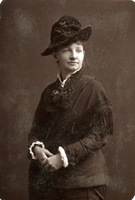
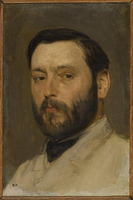
Helene Schemel (1850–1907) traded in paintings and watercolors by artists of The Hague School between 1893 and 1907 (fig. 1).[1] After the death of her husband, the well-known Dutch painter David Adolphe Constant Artz (1837–90), hereafter Adolphe Artz (fig. 2), she initially sold artworks from her home in The Hague and eventually expanded her activities as an agent. In 1897, together with her second husband, Gustav Friedrich Julius Sues (1862–1916), she founded the art gallery Maison Artz. This article explores how Schemel, a woman, conducted business and what strategies she used to navigate the national and trans-Atlantic market. Though its approach is monographic, the article is intended as a case study, which, by taking a close look at the activities of one female dealer operating at the middle range of the market, contributes to our knowledge not only of the role and modus operandi of female art dealers at the turn of the nineteenth century but also of the diversity of the late nineteenth- and early twentieth-century art market.
Perceptions of dealers of contemporary art in the nineteenth century have long been shaped by a scholarly focus on “the enlightened dealer who promotes cutting-edge art or uses advanced commercial and financial techniques.”[2] As examples we might mention such men as Ernest Gambart (1814–1902), Adolphe Goupil (1806–93), Paul Durand-Ruel (1831–1922), and Ambroise Vollard (1866–1939). These high-profile, male dealers of the nineteenth and early twentieth century operated at the high end of the market, trading paintings by famous artists for high prices, and were skilled in generating public interest in their businesses. But as famous, fascinating, and thoroughly researched as they are, “enlightened dealers” hardly represent the diversity of the art market and its players. There were numerous other dealers, several of them women, both in Europe and America as well as in the colonies, who traded not at the high end but in the middle range or at the low end of the market and whose practices may well have been quite different from the Goupils or the Durand-Ruels. They operated less publicly than well-known, high-profile dealers and can be characterized as dealing “in canvases, not careers.”[3] Many of them have left barely a trace, because unlike high-end dealers, middle-range and low-end dealers often did not keep ledgers and stock books or, if they did, these have not survived. Researching them is much more complicated and requires a variety of sources, such as letters, newspaper articles, and exhibition catalogs.
Recently, scholarly attention has turned to individuals who were active in the market not primarily as dealers but rather as agents. A helpful definition of agency is provided by Bénédicte Miyamoto, who, referring to the eighteenth-century art market, describes it as “an offer of services attached not only to the position of the art dealer but also to that of a painter, a collector, as well as a critic.” In addition, it was “not strictly a profession, but a social link. . . . Many . . . agents’ skills were first and foremost in sociability—a distinct ability to persistently curate social contacts, rather than just ‘social graces.’” [4] The fluid and informal character of this role, which continued into the nineteenth and even the early twentieth century, allowed it to be taken on by men and women, but I would argue that it was especially important for women, for whom it was difficult to own a business, open a bank account, and so on.
In this article I argue that Schemel, similar to other women active in the art market, was, in essence, an art dealer-agent, operating in the middle range of the market. Her engagement with the art market was entrepreneurial, as she took advantage of all opportunities that presented themselves for earning money from the sale of artworks. She sold paintings and prints she owned as well as works she managed to acquire at a low price. She also sold many works on consignment and acted as an agent for other dealers as well as collectors. No administrative records of Schemel and Maison Artz have survived, but the combination of a number of different sources, especially correspondence, has made it possible to reconstruct Schemel’s activities.
The Art Market in The Hague and Its Stratification
Before discussing Schemel as an art dealer-agent, a brief overview of the art market in The Hague at the end of the nineteenth century is called for. The focus here is on the stratification of the market into “high,” “middle,” and “low,” terms often used but not always clearly defined. In this section I propose a framework for each segment, based on features such as the quality and exclusivity of a segment’s artworks, its business model, and its location and physical premises, in order to support this argument for stratification.[5]
Shops at the low end of the market are those that, in addition to artworks, sold books, paper, picture frames, or painting and drawing supplies. These seemed to be mostly local (instead of national or even international) and were located in a downtown area or outside of it, often in the vicinity of other shops. Examples of such establishments in The Hague include Kunstzaal M. L. Delboy, Firma Alexander S. Meijer, C. van Doorn en Zn., G. L. Nijenhuis, W. F. Nollée, and Firma M. M. Couvée.
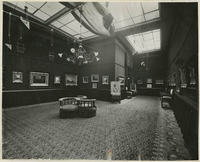
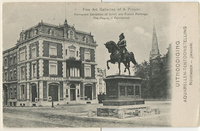
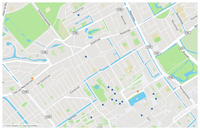
At the other extreme, galleries at the high end of the market can be called market leaders, as they had the ability to influence the market. Vast financial resources allowed these galleries to hold a large stock over a longer period of time and make investments such as acquisitions of famous works exhibited at world expositions or the Salons in Paris and acquisitions en bloc from private collectors. The high-end galleries specialized in high-quality, exclusive artworks by well-known artists and used a variety of methods to make money. The branch of the Goupil Gallery in The Hague, for instance, was not only backed by the firm’s international network, which included branches in Paris, London and New York, and its resources, but could also count on extra revenue from auctions they organized, which amounted to 10 percent of the total profit of an auction.[6] This also held true for the galleries of Johannes Josephus Biesing (1856–1927) and Abraham Preyer (1862–1927). Publicity, an important feature for these types of galleries, was generated by organizing in-house exhibitions, which were often accompanied by (illustrated) catalogues, and by their participation in loan exhibitions.[7] Close relations with art critics ensured (inter)national attention in newspapers and magazines. The Goupil, Biesing and Preyer galleries were located in the center of The Hague, in the area of luxury stores, museums, and the royal palace, and had impressive premises with window displays, skylights, or both (figs. 3, 4, 5). These galleries attracted newly wealthy customers from the upper-middle classes such as politicians, manufacturers, bankers, and lawyers.
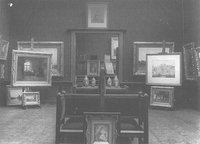
Maison Artz, an example of a gallery in the market’s middle range,[8] exerted less influence than high-end galleries and seems to have responded to existing trends in the market. As noted, during Schemel’s early years as an art dealer, she often sold works on consignment, a practice that brought in less revenue than creating a stock and selling at a profit.[9] She aimed for a fast turnover. Illustrative of this is one of Schemel’s letters to William Macbeth (1851–1917). After he had sold a painting for her, she wrote: “Yet I should be very glad to receive money. . . . I have a very small profit then for myself, but as I have things on view by [Anton] Mauve which I should like to buy, I want the money as soon as it can be.”[10] Even after the gallery’s formal establishment, Maison Artz’s financial resources appear to have been limited, as, for years, its main source of income was the selling of artworks. This made it difficult to invest in more expensive, exclusive artworks. The gallery did sell paintings and drawings by some well-known Dutch artists, but, in contrast to high-end galleries, most of what was offered were less exceptional, lower-quality works by artists who were less widely known. Maison Artz probably had a clientele of modest means, but it also had some wealthy customers who frequented high-end galleries, such as Jean Charles Joseph Drucker (1862–1944), Jacob Theodoor Cremer (1847–1923), and the couple James G. Shepherd (1867–1935) and Nettie Jane Matthers (or Mathers) (b. 1865). Maison Artz organized at least twenty-six exhibitions between 1899 and 1907, for which only four catalogues have been found.[11] The exhibitions did not receive much attention in the press. In addition, compared to Goupil, Biesing and Preyer, Maison Artz was less often represented at the numerous loan exhibitions held in the Netherlands near the turn of the century.
In terms of its location, Schemel’s gallery before 1897 reminds one of the low-end galleries which were sometimes found outside the city center, while the establishment in 1899 of Schemel and Sues’s gallery at the Lange Vijverberg (discussed below) placed it in the territory of high-end galleries. The premises had less floor space than those of Goupil, Biesing and Preyer but its three salons, its window displays, and the luxurious, homelike atmosphere provided a suitable setting for selling art.
Helene Schemel and Adolphe Artz
Helene Wilhelmina Ottilie Adelheid Schemel was born in 1850 near Löhne (North Rhine-Westphalia, Germany), the youngest of five children of Friedrich August Schemel (1807–56) and Auguste Sues (1823–50).[12] Her father was a politician and tenant farmer of the Beck estate where Schemel was born. Her mother, who came from an artistic family,[13] died soon after Helene was born. A few years later, her father was murdered in a possibly politically motivated attack. After this, Helene and her older sister Marie (1848–1925) eventually went to live with their paternal uncle Gustav Schemel (dates unknown), who owned the Trischin-estate in Posen (now Poznan in Poland). While Marie married into a wealthy family, Schemel enrolled at the Royal Academy of Music in Berlin and trained as a pianist and singer. During her studies, she befriended Anna Martina Mouton (1855–1947) from The Hague. Schemel probably met Adolphe Artz during her stay with the Mouton family, as Artz was friends with Anna’s brothers. A student of Jozef Israëls (1824–1911), Artz was a successful painter of fishing scenes and exhibited in the Netherlands and internationally.[14] By the time Artz and Schemel met in 1878 or early 1879, he had just become a widower with three sons, aged nine, seven, and four.[15] Artz and Schemel shared a love for music and art, and married in June 1880. A year later, Schemel gave birth to their son Walter (1881–85), followed by Tony (1883–1941) and Helene (1888–1924).
Aside from these personal events and the couple’s friendship with Dutch artists Anton Lodewijk George Offermans (1854–1911) and Willem Martens (1856–1927), there is hardly any information about Schemel’s activities and associations between 1880 and 1891. One exception is her contribution to a charity event organized by the artists’ association Pulchri Studio in The Hague in 1889,[16] when Artz was its president.[17] In 1890, after ten years of marriage, Artz died unexpectedly of kidney failure. He left Schemel with two children (Tony and Helene) and a third on the way;[18] his three sons from his first marriage; a studio filled with artworks; and a mountain of debt.[19] An auction of selected works by Artz was held in January 1891 and turned out to be successful.[20] The total proceeds were over 37,000 guilders, exceeding Artz’s outstanding debt of 17,635 guilders. Later that year and early in 1892, Schemel sold thirteen more of Artz’s paintings to Goupil in The Hague, the proceeds from which allowed Schemel and her children to live comfortably for a while.
Kunsthandel Mevr. de Wed. Artz-Schemel: 1893–97
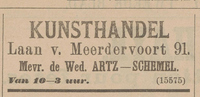
With the proceeds from the auction and the additional sale of Artz’s other works, Schemel founded Kunsthandel Mevr. de Wed. Artz-Schemel (Art Dealership Mrs. Dow.[ager] Artz-Schemel) in October 1893 (fig. 6). She ran the business from her home at Laan van Meerdervoort 91, where two salons on the ground floor were open to visitors between ten o’clock in the morning and three in the afternoon. The “gallery” sold paintings, watercolors, etchings, and drawings by artists of The Hague School as well as their predecessors and followers. The best-represented Hague School artists were family friend Martens; Maria Philippina Bilders-van Bosse (1872–1900) (fig. 7); Hendrik Willem Mesdag (1831–1915) and his wife Sientje Mesdag-van Houten (1834–1909); and Johannes Bosboom (1817–91). Works by members of a younger generation of Hague School artists, including Willem Cornelis Rip (1856–1922) (fig. 8), Willem Hamel (1860–1924), and Johannes van Rhijnnen (1859–1927), were also found in the gallery.
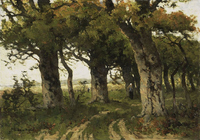
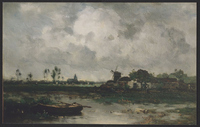
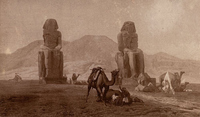
Schemel’s business model during these years consisted of sales she made from a small stock she held and sales from artworks she had on consignment. When she founded the gallery, she wrote to various artists, including Nicolaas Bastert (1854–1939), Paul Joseph Constantin Gabriël (1828–1903), and Arina Hugenholtz (1847–1934), asking whether they would consign their works to her. She also sought and accepted consignments from private collectors. In 1896, for example, she sought an American buyer for several paintings (fig. 9) from the collection of the late Fop Smit (1815–92) on the request of one of Smit’s nephews. A shipping magnate from Rotterdam, Smit had assembled one of the most extensive collections of contemporary art in the Netherlands in the late nineteenth century, consisting of 240 paintings of the Barbizon School and European genre painting.[21] Schemel’s commission percentage has not been determined. In correspondence, she mentions profits a few times but only indirectly.[22] She may have charged between 10 and 30 percent commission per sale, which was the standard percentage for art dealers.
Once things were up and running, Schemel began buying works for her stock from Frans Buffa & Sons and E. J. van Wisselingh & Co. as well as the Goupil branch in The Hague.[23] She also bought works directly from artists, and from time to time, she bought at auctions.[24] In March 1896, Mesdag and Mesdag-van Houten, who were not only artists but also major collectors, sold Schemel some drawings by artists from their collection. Between 1894 and 1896, Frans Buffa & Sons and E. J. van Wisselingh & Co. had several works from Schemel’s stock on consignment.
No special exhibitions were held at the gallery on Laan van Meerdervoort, but Schemel took part in art viewings (kunstbeschouwingen) at venues in Leiden, The Hague, Amsterdam, and Arnhem between December 1893 and 1897. Collectors and art dealers could send in their albums (portefeuilles) to the viewings, which received attention in national newspapers. These events were a welcome opportunity for Schemel to sell works and meet potential clients. The exposure was much needed, as Schemel did not take part in official loan exhibitions that were organized in the 1890s.[25] As a result, her name and portfolio are absent from the press, in which the well-known galleries Goupil, Van Wisselingh, and Buffa are often mentioned.
Schemel and the American Market
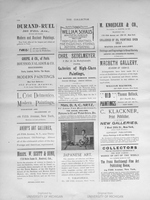
Immediately after Schemel founded her picture trade business in October 1893, she became interested in getting a foothold in the thriving American market for The Hague School (fig. 10).[26] Her main contact was the New York art dealer Macbeth, who founded the Macbeth Galleries in 1892. Macbeth is especially known for promoting and selling the work of US artists, but early on he also exhibited works by modern Dutch masters, which were very popular in North America and Canada at that time.[27] For Macbeth, Schemel was a vital link in procuring the right works by the right artists at good prices. Some of the exhibitions held at the Macbeth Galleries—of works by Artz in December 1893, of a collection of old masters from the former collection of J. L. Muijser (1818–1904) in October 1895, and of Hague School watercolors in May 1896—were the result of Schemel and Macbeth’s cooperation.[28]
With Macbeth’s help, Schemel expanded her network in the United States. In the summer of 1896, Samuel Putnam Avery (1847–1920) visited Schemel, as did art dealer Henry Bass Pettes (d. 1916) of the firm of Pettes and Leith in St. Louis.[29] The latter visited her on Macbeth’s recommendation and, according to Schemel, acquired “a good deal of water colors” from her.[30] One year earlier, William Kingston Vickery (1851–1925) of the art gallery Vickery, Atkins & Torrey in San Francisco, stopped by Schemel’s gallery. The artist John Singer Sargent (1856–1925) also met with Schemel at her house.[31] To American dealers, Schemel was not the first or foremost dealer in The Hague selling works by artists of the modern Dutch School; Pettes and Vickery also acquired watercolors from Goupil in The Hague from at least 1883 until 1912. This also holds true for Schemel’s other American contacts, such as J. J. Gillespie & Co. (Pittsburgh) and W. Scott Thurber (Chicago).[32] Correspondence shows Schemel and Macbeth’s collaboration was most frequent between 1893 and 1899.
Maison Artz: 1897–1907[33]
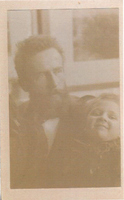
On November 25, 1897, Schemel married Gustav Sues (fig. 11) in The Hague. Sues was Schemel’s first cousin, whom she had known since childhood. He was born in Frankfurt am Main (Germany) but had emigrated to Chicago in 1880, where he worked as a merchant or clerk (possibly a picture dealer). He enjoyed painting in his spare time. Sues became a US citizen in 1887 and married the Swiss-born Elise Gutknecht (1867–91) in Chicago three years later. Gutknecht died a few days after the birth of their only daughter, Elisa Ida (1891–1907). It is not known how the marriage between Sues and Schemel came about. Sues and his daughter moved in with Schemel and her two children in the house at Laan van Meerdervoort.[34] Soon, the gallery Kunsthandel Mevr. de Wed. Artz-Schemel was renamed Maison Artz. Schemel’s name disappeared from the gallery’s official communications and Sues was listed as its principal owner.
Without surviving stock books, it is difficult to determine the number of artworks sold by Maison Artz and their sale prices; nor do we know much about the gallery’s profits and its clientele.[35] Based on the gallery’s newspaper advertisements, it can be calculated that more than 550 artworks (mostly paintings) were offered by the gallery between 1893 and 1907.
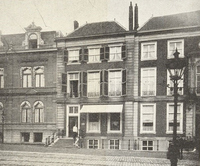
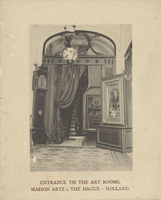
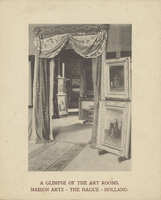
In May 1899, Maison Artz moved its premises to Lange Vijverberg 14, a central and prestigious location in The Hague’s city center, between the shopping and museum districts (figs. 12, 13).[36] It was near the Mauritshuis and the Steengracht Gallery with its acclaimed collections of paintings by the Dutch old masters.[37] The prestige of this location, according to a contemporary newspaper article, would give “rich tourists” (rijke toeristen) the impression that Maison Artz delivered only works of the best quality.[38] Its new headquarters provided ample space for organizing exhibitions. On the ground floor were two large salons and a smaller room at the back, specially equipped for watercolors (figs. 14, 15). Along the stairwell, old master paintings by Gerard ter Borch (1617–81), Aert van der Neer (1603–77), and David Teniers (1610–90) were on display. Sues and Schemel rented the three-story house from the old aristocratic Fagel family. Before moving, Maison Artz cleared out some of its inventory in order to have more financial resources.[39]
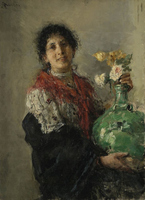
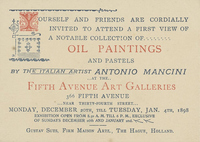
The first exhibition to open in the new premises, in June 1899, was dedicated to Antonio Mancini (1852–1930), an Italian artist who had an important Dutch following. Maison Artz was Mancini’s foremost dealer in the Netherlands,[40] with a collection of about twenty of his paintings and pastels (fig. 16). These works came from Mesdag and Mesdag-van Houten, who had supported Mancini financially since 1885 (and would continue to do so at least until 1900) in exchange for everything the artist created.[41] It is not clear whether Maison Artz acquired the collection for its own stock or had it on consignment from Mesdag and Mesdag-van Houten. Other sale exhibitions of Mancini’s work by Maison Artz soon followed in Glasgow and the Dutch cities of Dordrecht (January 1899), Utrecht (March–April 1899), Rotterdam (September 1900), and The Hague (July–August 1902). While only a fraction of Mancini’s work found its way to Dutch private and public collections, these exhibitions were good publicity for Maison Artz.[42] Two years earlier, in 1897–98, the Mancini collection had also been taken abroad to New York (fig. 17), Boston, Philadelphia, and Chicago, probably by Sues.[43] In a letter to Macbeth, Sues reflected on the American exhibitions, stating: “They [American art dealers] did’nt [sic] care much for our Mancinis.”[44]
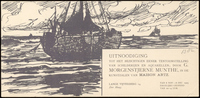
In 1899 and 1900, the gallery organized a new exhibition every other month. From 1901 onward, there were usually about three a year, including solo exhibitions by Dutch artists Albert Roelofs (1877–1920), Sophie Grothe (1852–1926), and Frans Smissaert (1826–1944); and foreign artists Gerhard Munthe (1875–1927) (fig. 18) and Charles P. Gruppé (1860–1940). The exhibitions were only occasionally accompanied by a catalogue and were not widely reviewed in national newspapers, but the gallery found friendly critics in Grada Hermina Marius (1854–1919) and Anton Cornelis Loffelt (1841–1906). Marius, who had known Artz well, wrote favorable reviews about the exhibitions at Maison Artz on more than one occasion.[45]
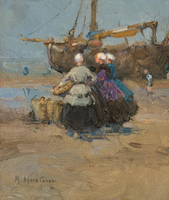
During this period, Maison Artz still offered works by Bilders-van Bosse, Martens, and Mesdag, in addition to other artists such as Théophile de Bock (1851–1904), Jacobus Simon Hendrik Kever (1854–1922), and Thamine Tadama-Groeneveld (1871–1938). Foreign artists working in Holland in the style of The Hague School, such as Gruppé and Minnie Agnes Cohen (1864–1940) (fig. 19), were also represented by the gallery. Works by established artists such as Jacob Maris (1839–99) were offered alongside those of a new generation of Hague School artists, such as Johannes Weiland (1856–1909). Maison Artz continued to do business with Goupil but less frequently than before.[46] The gallery also continued to buy at auctions.[47] In 1901 and 1902, Maison Artz held sales exhibitions at the Kunstverein in Basel and Zurich, and at the Kunstsalon Andreas Schneider in Frankfurt am Main.[48]
Maison Artz validated its expertise in art of the modern Dutch School through the publication of two booklets. The first, published in 1901 and entitled Souvenir Dedicated to Dutch Art and Her Host of Diligent Works at the Close of the 19th Century, was a softcover reference book in pocket-size format. It included information on nearly 270 (mostly) Dutch artists, such as their dates of birth, specializations, education, prizes and awards, and a short list of their important works and their whereabouts (i.e., private or public collections). The information was provided by the artists themselves (unless they were deceased) on forms created by Schemel and Sues.[49] This was reliable information, straight from the source. Through this self-published “standard” work, Maison Artz intended to influence collectors’ tastes by broadening the canon of the modern Dutch School as well as including artists who were not usually mentioned by the American press but were part of Maison Artz’s stock. This made Schemel and Sues less reliant on the limited scope of artists mentioned in Clarence Cook’s influential chapter on Dutch art in his Art and Artists of Our Time, published in 1888. A second publication from Maison Artz followed in 1903: an album of portrait photographs of a selection of the artists who had been featured in the 1901 publication, apparently in response to readers who had expressed disappointment about not being able to put faces to names.[50]
Schemel as Transatlantic Agent
Between early January and mid-April 1903, Schemel, accompanied by Helen Elizabeth Mitchell (1868–1948), wife of the American artist Gruppé, organized a tour with a group of twenty-seven paintings by Mesdag.[51] The two women traveled to Chicago, Detroit, Hartford, New York, Boston, and Philadelphia and tried to arrange shows of Mesdag’s works at the most prominent museum or art club in each city. They also negotiated sales with museum directors and private collectors. The paintings were owned by Mesdag, and he had paid for their transport to the United States as well as their insurance. Several institutions paid for the expenses of their transportation from one city to another. Schemel had power of attorney to act on Mesdag’s behalf and handled negotiations and sales for him. Only four paintings were sold, all to private collectors. Unfortunately, there is no indication of the financial arrangements between Mesdag and Schemel and Gruppé. They possibly received a percentage of the sale price of each painting.
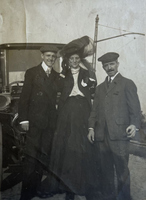
In addition to trying to make sales, Schemel also used her time in the United States to reconnect with dealers and collectors for her own business. Before going back to The Hague, Schemel visited Macbeth in New York. Though Macbeth, by then, had turned his attention to selling the works of American artists, he and Schemel would remain on good terms. In 1905, he introduced Schemel to Shepherd, president of the People’s Coal Company, and his wife, who lived in Scranton, Pennsylvania, and visited the Netherlands in August of that year (fig. 20). Schemel accompanied them on their four-day shopping spree in The Hague and Amsterdam. From Maison Artz, the couple acquired drawings or watercolors of sheep by Anton Mauve (1838–88) and a painting by Gabriël,[52] as well as paintings by Adolphe Monticelli (1824–86), Jean-Baptiste-Camille Corot (1796–1875), and Israëls from Van Wisselingh in Amsterdam. Later that month, the Shepherds visited London—to see “some important London things”—where they were again accompanied by Schemel.[53] While there, the Shepherds acquired paintings by Henri Joseph Harpignies (1819–1916), Jan Hendrik Weissenbruch (1824–1903), and Jacob Maris from Arthur Tooth & Sons.[54] Schemel’s precise role during these visits is not known, but it appears she advised the couple on their purchases and received some remuneration for this. We do know that after their trip to the Netherlands and England, the couple had a collection of about forty paintings by contemporary French, American, and Dutch artists, which were displayed in the gallery they had built for its presentation.
Schemel devoted much of her time and attention to building relationships with private clients such as the Shepherds. In addition to accompanying visitors from abroad on trips to cities like Amsterdam, Rotterdam, and The Hague to buy art, she also took them to the picturesque places where Dutch artists liked to work, such as Katwijk, Zandvoort, and Nunspeet.[55] After his visit, Shepherd wrote Macbeth: “My assistance from Mrs. Sues was invaluable and I have fallen in love with her sincerity and true graciousness and she seems more like one of my own family than a friend.”[56] Just three months later, Schemel crossed the Atlantic and went on to Chicago, where she and her son Tony stayed until the end of the year, meeting again with Shepherd. After that, she and Tony went to Buffalo, Toronto, Ottawa, and Montreal to visit clients. By the end of February, they were back in New York where they met Shepherd one last time before heading home.
Sues’s Mental Decline and Schemel’s Death
In 1899, two years into their marriage, Schemel had become increasingly concerned about Sues’s mental health. According to one of her letters, he was hallucinating and suffering from paranoia.[57] It is uncertain to what extent Sues remained involved in the business. It is known that he received treatment and required long periods of rest. In the course of 1906, Sues’s health rapidly deteriorated. According to Schemel’s daughter Helene, “this time it was not auditory but visual hallucinations. . . . His judgment was completely gone. The ugliest things he found sublimely beautiful and vice versa. As a result, he bought a mass of ugly unsalable items at very high prices and gave away the good ones far too cheaply.”[58] Between July and September, Sues had to rest at home. In a letter, Schemel wrote how stressful this situation was for her: “You understand that for me there was no rest at all, so that in the end I myself was completely upset by the agitation, the sleepless nights, the nursing and in addition the hustle and bustle of the household, guests, the business etc. etc.”[59] In September 1906, Schemel had Sues committed at the house of a specialist in The Hague for a month.[60] She visited him there every day.
For too long, Schemel had turned a blind eye to her husband’s decline. According to her daughter’s recollection, Schemel did not have the heart to put him in an asylum, but, at the same time, he also had appeared quite normal.[61] Now, his position in the business had become untenable, as he had made financial missteps. Schemel presented him with the choice of giving her power of attorney over Maison Artz or having him placed under guardianship. Sues refused both, and allegedly stated that he did not consider her able to manage the business.[62] Thus, Schemel filed for receivership with the court, although this caused her much pain.
Without Sues’s cooperation it became difficult to continue running the gallery. Business decisions, such as sales exhibitions to be held in the United States and Canada, all had to be approved by Sues. It is unknown whether the court had reached a decision regarding the receivership when the situation took a tragic turn. In February 1907, Schemel perished on the SS Berlin at the age of 57, after returning from a business trip to London. In order to arrive at a settlement between Sues and the Schemel-Artz family, an auction was held of 150 paintings and over 250 watercolors.[63] At least 123 works were part of the gallery’s stock, including twenty-seven works by Artz. The auction also included Schemel and Sues’s personal possessions such as Cottier & Co. furniture from their living quarters and Artz’s portrait by Matthijs Maris (see fig. 2). Sues moved to Italy permanently, where he had been since November 1906.[64] Tony continued the business under the same name and at the same address.[65] Maison Artz finally closed in 1914, when Tony moved to London with his family.
Other Female Art Dealer-Agents in the Netherlands
Apart from Schemel, the names of only a handful of other female art dealer-agents active in the Netherlands in the late nineteenth and early twentieth centuries are known. Margaretha Oldenzeel-Schot (1836–1912), for instance, continued the successful Oldenzeel Gallery in Rotterdam after the death of her husband in 1896, and Ermina Kleykamp (1868–1931) worked alongside her husband in their well-known Gallery Kleykamp.[66] Research is required to discover if more women were active in this capacity, and to establish their activities.
At present, I have come across only one other woman in the Netherlands who, like Schemel, single-handedly founded a gallery specializing in contemporary art, namely Gerarda Henriëtte Matthijssen (1830–1907) from Leeuwarden (almost two hundred kilometers from The Hague). The daughter of a well-known portrait painter, Matthijssen was an artist and drawing teacher and exhibited her work twice at the Dutch national exhibitions of Living Masters (Levende Meesters). In 1867 she founded a photography studio in Leeuwarden, and in 1878 she established the Modern Art Salon (Salon van/voor Moderne Kunst).[67] It hosted sale exhibitions by artists’ associations in The Hague and Amsterdam and by Dutch art dealers. Other exhibitions at Matthijssen’s art rooms, visits to which often required an entrance fee, were by Philip Zilcken (1857–1930) in 1896, Frits Mondriaan (1853–1932) in 1897 (Piet Mondrian’s uncle), and Mesdag in 1899. Occasionally, exhibitions were centered around a single painting or a handful of paintings by foreign artists from the juste-milieu (middle way) such as Alexandre Calame (1810–64) in 1890, Mihály Munkácsy (1844–1900) in 1898, and Sir Lawrence Alma-Tadema (1836–1912) in 1901.
As almost nothing is known about Matthijssen and her gallery, it is unclear whether these exhibitions were assembled from her own stock, or if she even had one. Preliminary research shows she was a customer of Goupil’s in The Hague, and she was very active at Dutch auctions as a buyer and seller of contemporary art. These activities suggest she may have acted as an agent and/or a liaison between dealers and art associations in The Hague and Amsterdam on one hand, and potential customers from Leeuwarden and its vicinity on the other. Many aristocratic families lived in that area and had collections of family portraits, old master paintings, or both. Possibly, Matthijssen attempted to interest them in buying contemporary art by bringing the art to their doorsteps. Apart from her exhibitions, Matthijssen and her gallery remain under the radar. No exhibition catalogs have been found (it is questionable whether these were ever issued), and Matthijssen did not leave stock books or correspondence.
Conclusion
Critical to Schemel’s success as a female art dealer in an art world dominated by men was her entrepreneurial spirit, which allowed her to seize different opportunities that came her way. She took advantage of her status as a respected art dealer and gallery owner to operate as an agent, in particular by accessing the American market. She was well-suited to the latter, as she was charming and had a way with people, as Shepherd’s letter after her visit in 1905 makes clear. In addition, she loved to travel and enjoyed being in artistic environments, whether the home of a collector, a gallery, a museum, or the company of artists. Her son Tony described her as “a very energetic and enterprising personality,”[68] and her great-granddaughter characterized her as a “reasonable woman who coped well with complaints, swearing and grumbling” (especially from artists, such as Matthijs Maris).[69]
The fact that she entered the art trade as the widow of a respected and well-known artist was key to her initial success and added a noncommercial dynamic to her activities. She built a trustworthy reputation around her widowhood, which gave the impression that she was not in the business to make large profits but out of a necessity to support herself and her children. Once she expanded her activity from selling not just her husband’s work but also that of other artists, this trustworthy image made her an interesting party to do business with, for both buyers and sellers. Collectors did not worry about paying prices that were too high, and artists might have trusted her more than other dealers, as most artists were close acquaintances of her and her late husband.
But how do we define Schemel’s success? She clearly operated in the middle range of the market, where profits were small and dealers had to be opportunistic to make a living. She made a go of it through her contacts, many established during her marriage with Artz, but especially thanks to her wits and strong and enthusiastic personality. Indeed, after her death in 1907, the gallery survived for only seven more years, even if it was now run by a man—her son Tony, who had inherited her gallery as well as her contacts. As a reporter for Land en Volk wrote shortly after her passing, “With it [Schemel’s death] the soul went out of Maison Artz.”[70]
Acknowledgments
I would like to thank Martine Claessen-Artz, Jan Dirk Baetens (Radboud University, Nijmegen), Tiny de Liefde-van Brakel, Adrienne Quarles van Ufford (Panorama Mesdag, The Hague), Marja Stijkel (formerly Rijksmuseum, Amsterdam), and Manon van der Mullen (Dordrechts Museum) for their help. I also thank the anonymous reader for NCAW, Renske Suijver (Van Gogh Museum/The Mesdag Collection), and Petra Chu for their helpful suggestions regarding my manuscript. This research was made possible by the NWO Museum Grant program (2022–23).
Notes
All translations are by the author.
[1] I have chosen to refer to Schemel by her maiden name, although she is also referred to as Helene Artz-Schemel and, after her second marriage, as Helene Sues-Schemel.
[2] Jan Dirk Baetens, Susan Bracken, and Adriana Turpin, introduction to Art Markets, Agents and Collectors: Collecting Strategies in Europe and the United States, 1550–1950, ed. Susan Bracken and Adriana Turpin (London: Bloomsbury Visual Arts, 2021), 7.
[3] David W. Galenson and Robert Jensen, “Careers and Canvases: The Rise of the Market for Modern Art in Nineteenth-Century Paris,” in Current Issues in 19th-Century Art: Van Gogh Studies 1 (Zwolle: Waanders; Amsterdam: Van Gogh Museum, 2007), 147. This quote is taken from a description of the French dealer Pierre Firmin Martin (also known as père Martin).
[4] Bénédicte Miyamoto, “Hidden Figures—Agents in the Long Eighteenth Century,” in Bracken and Turpin, Art Markets, Agents and Collectors, 89, 93.
[5] It should be noted that the divisions between these three segments allow for flexibility in terms of how I have classified a gallery’s position in the market. A gallery is counted within a certain segment if it possesses most of the characteristics of that segment.
[6] These profits are mentioned in the stock books from 1889 onwards. See Goupil Archives, RKD – Netherlands Institute for Art History, The Hague. A sample shows that in 1896, 1906, and 1909 the commission remained 10 percent.
[7] Based on copies of exhibition catalogs in the collection of the RKD, Biesing organized thirty-five in-house exhibitions between 1893 and 1921. Preyer held thirteen exhibitions at his premises in Amsterdam and The Hague between 1894 and 1912. Goupil in The Hague organized twelve exhibitions between 1905 and 1916 that were accompanied by catalogues. Interestingly, the exhibitions at Goupil commenced after Jan Tersteeg had taken over the business from his father Hermanus, who had been the manager from 1867 until he retired in 1905.
[8] Other examples of galleries in The Hague in this period that were among those in the market’s middle range are L. J. Krüger and D. Sala & Sons.
[9] Chris Stolwijk, Uit de schilderswereld: Nederlandse kunstschilders in de tweede helft van de negentiende eeuw (Leiden: Primavera Pers, 1998), 199.
[10] Helene Schemel to William Macbeth, April, 5, 1895, folder 18, box 6, Macbeth Gallery Records 1838–1968, Archives of American Art, Smithsonian Institution, Washington, DC [hereafter, Macbeth Gallery Records 1838–1968].
[11] Copies of these catalogues are in the collection of the RKD – Netherlands Institute for Art History.
[12] For information on Schemel’s background, see Martine Claessen-Artz, Geschiedenis van de familie Artz (n.p., n.d.), 9–20.
[13] Schemel’s uncle was Gustav Sues (1823–81), a fairly well-known artist from Düsseldorf.
[14] For a detailed account of Artz’s life and career, see Tiny de Liefde-van Brakel, Tussen Katwijk en Parijs: David Adolphe Constant Artz (1837–1890), exh. cat. (Katwijk: Katwijks Museum, 2001).
[15] Artz had been married to Joséphine Jouanin (1841?–78), whom he had met while living in Paris between 1866 and 1874. Their sons, Adolphe George Léonard (1868–1922), Constant David Ludovic (1870–1951), and Marcel David Léonard (1873–1954) were born before their marriage on March 15, 1874. The Artz family settled in The Hague in the spring of 1874. Jouanin died there four years later.
[16] For a small fee, one could attend tableaux vivants (literally, “living pictures”) and musical performances. In addition, one hundred fans were available for purchase, decorated by twenty-eight male and nine female artists, including Schemel. See advertisement in Dagblad van Zuidholland en ’s Gravenhage, February 4, 1889.
[17] Artz’s first term as president was from October 1878 until October 1881; his second term was from October 1884 to October 1889.
[18] Maria Daniela Anna Adolphine Artz was born on April 4, 1891, but died seven months later.
[19] D. A. C. Artz Memorandum of Estate, inv. no. 3821, 3.06-05, Memories van Successie van Zuid-Holland, National Archives, The Hague; and notarial deed, July 2, 1891, inv. no. 2668, 0373-01 Notarial Archives The Hague II, Municipal Archives, The Hague. The total amount of the debt was 17,635 guilders. The largest amount (13,313 guilders) was owed to Boussod, Valadon & Cie in Paris. It is unclear how and when Artz accumulated this debt; it may have been incurred after the birth of Artz and Jouanin’s three sons.
[20] Atelier Artz: Catalogue des tableaux, études, aquarelles, estampes, livres d’art, mobilier artistique, tapisseries, faïences et porcelains, provenant de l’atelier de l’artiste, auction cat. (The Hague: Boussod, Valadon, 1891). Artz’s works included twenty-five paintings, twenty sketches, twenty-three studies, and twelve watercolors. In addition to Artz’s work, the auction included the couple’s collection of works by other artists as well as some household furniture and books. Not everything they owned was auctioned.
[21] On Fop Smit and his collection, see Evelien de Visser, “Collecting Contemporary Art in Rotterdam between 1870 and 1892: The International Taste of Fop Smit Jr. (1815–1892),” Oud Holland 136, no. 1 (2023): 49–68, https://doi.org/10.1163/18750176-13601003 [login required].
[22] Helene Schemel to William Macbeth, October 30, 1893; April 5, 1895; and October 28, 1896, Correspondence Helene Artz and Maison Artz, 1893–1911, folder 18, box 6, Macbeth Gallery Records 1838–1968.
[23] Between 1894 and 1898, Schemel purchased five paintings and fifteen watercolors from Goupil’s in The Hague. During this period, she only sold one watercolor (by Artz) and one painting (by Jozef Israëls) to Goupil. From Van Wisselingh & Co., Schemel purchased five etchings by Marius Alexander Jacques Bauer (1867–1932) in 1894 and 1895.
[24] At the auction of the estate of the artist Fridolin Becker (1830–95) in The Hague on May 21, 1895, Schemel purchased four works. On April 14, 1896, she purchased two watercolors at the auction of the Salomonson collection.
[25] Schemel’s name is only mentioned three times as a lender: in 1895 at the Mauve exhibition in Rotterdam organized by the Rotterdamsche Kunstkring; at a loan exhibition in Utrecht organized by the art association Voor de Kunst; and in 1897 on the occasion of the fiftieth anniversary of Pulchri Studio. Interestingly, the first two exhibitions were organized by institutions that included women on the organizing committees.
[26] Helene Schemel to William Macbeth, October 30, 1893, box 6, folder 18, Macbeth Gallery Records 1838–1968.
[27] Malcolm Goldstein, Landscape with Figures: A History of Art Dealing in the United States (Oxford: Oxford University Press, 2000), 61–76.
[28] The collection of Artz’s works was given by Schemel on consignment, as was the watercolor collection.
[29] Helene Schemel to William Macbeth, July 22, 1896, box 6, folder 18, Macbeth Gallery Records 1838–1968.
[30] Helene Schemel to William Macbeth, September 22, 1896, box 6, folder 18, Macbeth Gallery Records 1838–1968. On Pettes’s collection (stock) of watercolors, see Henry B. Pettes Collection of High Class Watercolors, exh. cat. (Boston: Williams & Everett’s Galleries, 1896). Along with many works from artists of The Hague School, Pettes also acquired watercolors at the exhibitions of the Dutch Water Color Society in The Hague.
[31] Copy of a letter from Helene Schemel to John Singer Sargent, April 1, 1903, Panorama Mesdag Archives, The Hague.
[32] Other American dealers who acquired watercolors from Goupil in The Hague include C. W. Kraushaar (New York); the Rosenbach Company (Philadelphia); Henry Reinhardt (Milwaukee); Julius Oehme and William Schauss (New York); J. E. Caldwell & Co. (Philadelphia); Williams & Everett & Co. and Noyes & Blakeslee (Boston); and Wunderlich & Co. (New York). These names are listed in the Goupil stock book of watercolors, 1883–1914, inv. no. 3, Goupil Archives, RKD – Netherlands Institute for Art History, The Hague.
[33] Parts of this section were previously published in Evelien de Visser, “Een huis van aristocratie en kunst: De bewonersgeschiedenis van Lange Vijverberg 14 (1806–1990),” in Jaarboek geschiedkundige vereniging Die Haghe (The Hague: Geschiedkundige Vereniging Die Haghe, 2024), 106–23.
[34] At the time of Schemel and Sues’s marriage, Schemel’s three stepsons were old enough to take care of themselves, as they were twenty-nine, twenty-seven, and twenty-four years old.
[35] Two clients have been identified, namely Jean Charles Joseph Drucker and Jacob Theodoor Cremer. Both collectors frequented Van Wisselingh and Goupil as well.
[36] On the history of the house, see Kees Stal, “The House Lange Vijverberg 14,” in Kennerschap: Bredius, Jan Steen en het Mauritshuis, ed. Guido Jansen (The Hague: Stichting Bredius Genootschap, 2014), 14–15.
[37] The Steengracht Gallery, located at Lange Vijverberg 3, was the private collection of the Steengracht family and consisted of Dutch and Flemish old master paintings and nineteenth-century paintings by French, Belgian, and Dutch artists. The museum was open to the public and was praised in travel guides of the time. The collection was dispersed in 1913. See Annette de Vries and Quentin Buvelot, Passie voor schilderijen: De verzameling Steengracht van Duivenvoorde (Leiden: Primavera Pers, 2012).
[38] G. [Grada Hermina Marius], Haagsche Kroniek, Algemeen Handelsblad, May 14, 1899.
[39] Sues offered Macbeth fifteen watercolors for sale before the move. See Gustav Sues to William Macbeth, February 15, 1899, folder 18, box 6, Macbeth Gallery Records 1838–1968.
[40] G. [Grada Hermina Marius], Haagsche Kroniek, Algemeen Handelsblad, June 25, 1899.
[41] According to Hanna Pennock, the Mesdag-van Houtens received at least thirty-two paintings from Mancini. Pennock estimates that over 150 works by Mancini were brought to the Netherlands on Mesdag’s account. See Hanna Pennock, Antonio Mancini en Nederland (Haarlem: Joh. Enschedé en Zonen, 1987); Fred Leeman and Hanna Pennock, Museum Mesdag: Catalogue of Paintings and Drawings (Amsterdam: Van Gogh Museum, 1996); and Adrienne Quarles van Ufford, Mesdag & Mancini, exh.cat. (The Hague: The Mesdag Collection, 2020).
[42] Mancini’s work was bought by collectors Jan Daniel Cornelis Titsingh (1821–99) and Willem Hendrik van Bilderbeek (1855–1918) and by members of Mesdag’s extended family. Five paintings and thirty-eight studies on paper were in Mesdag’s home when he died in 1915. Tentoonstelling van schilderijen, aquarellen, teekeningen, etsen, gobelins en kunstvoorwerpen grootendeels uit het woonhuis van wijlen den Heer H.W. Mesdag, exh. cat. (The Hague: Panorama Mesdag, 1916); and Lijst van schetsen, studies en aquarellen uit den inboedel van wijlen den heer H. W. Mesdag, auction cat. (The Hague: Panorama Mesdag, 1916).
[43] The exhibition consisted of fourteen paintings and three pastels. It was held in New York at the Fifth Avenue Art Galleries between December, 20, 1897, and January 4, 1898; in Boston at the St. Botolph Club between January 10 and January 20, 1898; in Philadelphia (venue and dates unknown); and in Chicago at W. Scott Thurber (dates unknown).
[44] Gustav Sues to William Macbeth, March 9, 1899, folder 18, box 6, Macbeth Gallery Records 1838–1968.
[45] Marius also wrote a column called Haagsche Kroniek in the newspaper Algemeen Handelsblad, in which Maison Artz is often mentioned.
[46] The number of works bought from and sold to Goupil was halved. Before November 1897, thirty-five works were exchanged, while between November 1897 and February 1907 the total was eighteen. Maison Artz purchased four paintings and four watercolors from Goupil and sold five watercolors and five paintings. Purchases by Maison Artz cease entirely after February 1903.
[47] For example, Maison Artz bought works at the estate sale of the widow E. A. van Vloten in 1899 and at the estate sale of the artist Marie Bilders-van Bosse in 1901, acquiring eight and two lots respectively.
[48] This is known exclusively from two newspaper clippings in Dagblad van Zuidholland en ‘s-Gravenhage, February 27, 1901; and De Nieuwe Courant, March 17, 1902.
[49] All completed forms are kept in 8002-01, Schildersbrieven Collectie Artz-de Waard – Bijzondere Collecties – OV 2, City Archives, The Hague.
[50] Maison Artz: Art Dealers in Oil and Water Color Paintings; 14, Lange Vijverberg, The Hague, Holland (The Hague: Maison Artz, 1903).
[51] Mesdag’s activities in America are being researched by Suzanne Veldink.
[52] Gustav Sues to William Macbeth, August, 9, 1905, folder 18, box 6, Macbeth Gallery Records 1838–1968.
[53] James G. Shepherd to William Macbeth, August, 17(?), 1905, folder 43, box 73, Macbeth Gallery Records 1838–1968.
[54] For the provenance records for Arthur Tooth & Sons, see Important Paintings [. . .] The James G. Shepherd Collection, auction cat. (New York: American Art Association, Anderson Galleries, 1935), n.p., lot 45 (Weissenbruch), lot 75 (Harpignies), lot 79 (Maris).
[55] Helene Schemel to Marcel Artz, August 23, 1903, Artz family archive, Rijksmuseum, Amsterdam.
[56] James G. Shepherd to William Macbeth, August, 17(?), 1905, folder 43, box 73, Macbeth Gallery Records 1838–1968.
[57] Helene Schemel to Marcel Artz, December 31, 1899, as quoted in Claessen-Artz, Geschiedenis van de familie Artz, 16.
[58] “’t Waren deze keer geen gehoors-maar gezichtshalucinaties [sic] zooals de dokters zeiden. Zijn oordeel was hij geheel kwijt, ‘t leelijkste vond hij subliem-mooi, en omgekeerd; daardoor kocht hij een massa leelijke onverkoopbare dingen voor een heel hoogen prijs en gaf de goeie veel te goedkoop weg.” Helene Artz to Marcel Artz, December 31, 1906, private collection.
[59] “je begrijpt dat er voor mij in ‘t geheel geen rust bij overschoot zoo dat ik op ’t laatst zelf geheel van streek kwam door de agitatie, de slapelooze nachten, het verplegen en daarbij de drukte van de huishouding, logées, de zaak etc. etc.” Helene Schemel to Marcel Artz, September 13, 1906, private collection.
[60] Helene Schemel to Marcel Artz, September 13, 1906, private collection.
[61] Helene Artz to Marcel Artz, December 31, 1906, private collection.
[62] Helene Artz to Marcel Artz, December 31, 1906, private collection.
[63] Vente “Maison Artz,” La Haye: Tableaux et aquarelles modernes, tableaux anciens, meubles, antiquités, etc., auction cat. (Amsterdam: C. F. Roos, 1907).
[64] In Terni in August 1908, Sues married Anna Bigi, a native of Italy. Two years later, their son Waldemar or Walter (1910–95) was born. In 1909, they welcomed another son, Gugliemo Enrico (1909–?). In 1914, Sues and his family moved to Hoboken, New Jersey. While there, he repeatedly contacted Macbeth and tried to sell his paintings. See Correspondence Anna and Gustav Sues, folder 71, box 76, Macbeth Gallery Records 1838–1968. Sues died in Hoboken in December 1916, leaving his wife in desperate financial straits. In a letter, Gruppé writes to Macbeth about the situation: “I was going to give her [Anna] some posing to do but have not had a chance yet. . . . I think if you can help her in any way you would be doing a charity. She had to put one of her children in a home or orphanage.” Charles Gruppé to William Macbeth, December 1, 1917, folder 86, box 41, Macbeth Gallery Records 1838–1968.
[65] In November 1911, Tony associated himself with art dealer J. H. de Bois as Artz & De Bois. In July 1913 they went their separate ways, and Tony continued under the former name Maison Artz. On Artz & De Bois, see J. F. Heijbroek, Kunst, kennis en commercie: De kunsthandelaar J. H. de Bois (1878–1946) (Amsterdam: Contact, 1993), 36.
[66] On Kleykamp, see J. F. Heijbroek, Kleykamp: De geschiedenis van een kunsthandel ca. 1900–1968 (Zwolle: Waanders Uitgevers, 2008).
[67] On Matthijssen, see Dineke Dam, “Leeuwarder ‘photographistes’ rond 1900,” Leovardia, no. 8 (June 2002): 25–26; and Paul Bron, “Nijverheid en kunst door vrouwen vervaardigd; het leven van Gerharda Matthijssen,” Leovardia, no. 39 (September 2012): 11–15. The gallery is alternately mentioned in the newspaper Leeuwarder Courant as Salon “of” or “for” modern art.
[68] “Zij was een zeer energieke en ondernemende persoonlijkheid.” Claessen-Artz, Geschiedenis van de familie Artz, 11.
[69] “een redelijke vrouw die goed was opgewassen tegen geklaag, gescheld en gemopper.” Claessen-Artz, Geschiedenis van de familie Artz, 15.
[70] “Daarmee was de ziel uit Maison Artz weg.” “Maison Artz,” Land en Volk, April 30, 1907.