Painting with Monet by Harmon Siegel
Reviewed by Richard ThomsonRichard Thomson
University of Edinburgh
Email the author: r.thomson[at]ed.ac.uk
Citation: Richard Thomson, book review of Painting with Monet by Harmon Siegel, Nineteenth-Century Art Worldwide 24, no. 1 (Spring 2025), https://doi.org/10.29411/ncaw.2025.24.1.13.
This work is licensed under a Creative Commons Attribution-NonCommercial 4.0 International License  unless otherwise noted.
Your browser will either open the file, download it to a folder, or display a dialog with options.
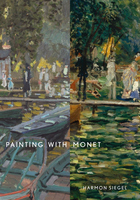
Harmon Siegel,
Painting with Monet.
Princeton: Princeton University Press, 2024.
300 pp.; 193 color and 5 b&w illus.; bibliography; index.
$65.00 (hardcover)
ISBN: 9780691257433
Painting with Monet takes its title aptly from its central theme. While Claude Monet is the pivotal artist—and the book deals with the first decade and a half of his career until the mid-1870s—it focuses on work done by him in the company of fellow artists working on the same motifs. Harmon Siegel opens with two paintings of the same motif from 1873, one by Monet and the other by Pierre Auguste Renoir. Representing a view across a duck pond to a house in trees, one of these canvases caused confusion over forty years later as to which of the two artists had painted it. This amusing mix-up raises issues about the nature of creative partnership in Impressionism. After all, the painters’ friend Émile Zola defined naturalism as nature seen through a temperament. How did that manifest itself in the friendships and practices of such artists? Temperament is personal, so how might such individuality be articulated in painting and how might it interplay with the creativity of friends and collaborators in similar practice? Siegel’s attentive exploration of the instances in which Monet worked alongside one or more of his close artistic friends—painting the same motifs and no doubt looking at each other’s progress and discussing together their aims, practice, and results—is an original step, so this is a valuable and insightful text.
That said, the early sections are hard for the theory weary. We hear about “cascading skepticism,” but the crucial term sensation—central to these artists’ language—is not defined. To Monet and his colleagues, sensation meant both an individual’s perceptual response to nature and also their personal articulation of that response: for a painter, the particular articulation of forms, choice of color, pressure, and shape of touch was that individual’s artistic handwriting. Siegel’s chief point is that when artists worked side-by-side, they “disclosed the reality of others” (13). In other words, they shared the experience of looking and working with their friends and colleagues, and each learned from that collaborative activity. This would have been a verbal and practical exchange. Conversation about subject matter, the choice of specific motifs, the distance or angle at which those motifs might be viewed, the selection of medium and its application, the density or fluidity of pigment—these would have been typical of their conversations. Although Siegel acknowledges that biographical material should not be avoided, that kind of practicality is only part of the matter; the theoretical theme of the book is that “artistic practice can count as philosophical enterprise” (13). Whether that was in Monet’s and Renoir’s minds as they painted their duck ponds, we might well ask.
Siegel rightly says that there is scant evidence about incidences of the Impressionist circle working together, either in terms of witness accounts from moments when easels were set up side-by-side or what creative conversation probably ensued. But he has imaginatively and practically garnered a good number of occasions when two or more painters worked alongside each other on the same motif. Often these were landscapes—like the duck ponds—but figurative subjects and still-lifes also occur. The reader is sometimes agreeably surprised to be reminded of yet another instance of painters working in parallel. It is a relief to be told that “Monet painted with others to affirm their common experience of a shared world” (57), which returns us to the immediately social, practical, and creative, distancing us from the philosophical.
The text is very attentive to works of art: how they were painted, and how they look. Clearly Siegel has visited many collections and studied individual paintings with scrupulous attention and a perceptive eye; the reader greatly benefits from this. He begins with Monet’s very early collaboration with Eugène Boudin, painting motifs in the countryside at Ruelles near Le Havre in 1858. Siegel adds to his close study of the surface of Monet’s landscape that the line of far poplars was added later to give some verticality to an otherwise flattish landscape, and that this could have been done either from a drawing or from memory rather than onsite. Such detailed analysis of the picture reveals the tyro painter’s consciousness of the requirements of a satisfying landscape composition and an early willingness to manipulate nature. In the final chapter, Siegel’s reading of Camille Monet in Édouard Manet’s 1874 canvas of her sitting on the lawn at the Monet home at Argenteuil sensitively explains how the painter draws attention to her inexpressive face by her bonnet and ribbons, which Siegel describes as “inscrutability in intimacy” (230). This is as shrewd and persuasive as is his suggestion that in Renoir’s version of the same motif more attention is given to the boy Jean because he seems so conscious of being painted, while his mother understands how to pose and interest the artist for whom she sits. The book is studded with acute and sensitive picture analysis, both in terms of how paintings were made and look and of how their expressive qualities may be interpreted.
That said, Siegel occasionally misreads motifs. For example, in Monet’s La Pointe de la Hève at Low Tide (1865; Kimbell Art Museum, Fort Worth), it is not a “mass of shadowed planks” (98) to the lower right, but a broken breakwater. And one does not always agree with Siegel’s analysis of Monet’s compositions. To argue, for example, that La Chapelle de Notre-Dame-de-Grâce (1864; private collection) “is uncompromising in his refusal of the view” over the expansive estuary of the Seine (104–5), is to misread what one might rather see as a deliberate choice on Monet’s part. The strong value contrast between the dark trunks of the dense screen of trees to left and center and the pale expanse of sea glimpsed through them gives a sense of the vast space over the water as well as setting the somber structures of nature against the pale stone of the chapel’s structured architecture. In a later chapter, Monet’s Red Cape (Cleveland Museum of Art, Cleveland)—which Siegel dates to ca. 1868 rather than the more conventional 1873—is discussed in terms of “aspectual oscillation” and “corpselikeness” (209, 228) rather than more simply and humanely as a record of a glimpse through the window, a rapidly painted affectionate encapsulation of “my woman, our home.”
Biographical material does sometimes press emphatically. This comes out in the chapter on an artistic interplay in which Monet did not immediately participate. In 1867, his friends Frédéric Bazille and Alfred Sisley each set about painting a still life featuring a dead heron and other birds. While they worked, Renoir, looking across the studio from a different angle, made a portrait of Bazille busy with brush and palette in hand, behind whom hangs a snowscape probably by Monet. These canvases register a moment of creative fraternity. Painting with Monet closes by telling the reader that at the 1876 Impressionist exhibition, Renoir showed that portrait he had made nine years earlier of Bazille painting. Bazille had been killed during the Franco-Prussian War at the battle of Beaune-la-Rolande in November 1870. Visiting the exhibition, Bazille’s father came across the portrait of his dead son and burst into tears, begging Manet, who owned the picture, to sell it to him. Manet would not take money from the grieving father, who could also not bear to part with one of his son’s canvases in exchange, so it was agreed that Manet would give the Bazille family the portrait of their late son in exchange for a Monet. Here was truly human interplay.
The important chapter on Monet and Renoir working together at La Grenouillère in 1869 argues that the experience of that louche bathing-place, with its reputation for free-for-all sexual exchange, made them ask “how natural are the social relationships that underlie society?” Siegel provides some fascinating historical material, noting that nudity was banned there from 1852 and that commentators made amusing comparisons between the bathers and the natives of Tahiti. He aptly points out that such a venue was a typical topic for popular imagery, but while the schematic depiction of types by the two painters is sufficient to give an approximate sense of gender and even class—Monet had after all started his artistic career drawing caricatures—it is far from being specific enough to go further in its social observation, as Siegel would like. The schematic depiction of two men talking to a woman hardly makes them “an erotic triangle” (174). Indeed, after more imaginative speculation about the sexuality and interplay of these very succinctly brushed figures, Siegel pulls himself up short, suggesting that such readings are “overly narrative” (174)—as indeed they are. His distinction that, for Monet, La Grenouillère showed “naturalized society and socialized nature” (156) while for Renoir it was a place where he could reimagine “the naturalness of sexuality” (156), makes a contrast that their shared motifs of the so-called camembert island and its denizens simply do not bear out. And while Renoir also painted a life-size nude female bather by the riverside (which he submitted to the 1870 Salon), he posed her like the classical Venus Pudica—hardly a pose possessing “naturalness” (156). Monet painted no such subject, concentrating on the landscape painter’s challenge of representing sunlight filtered through foliage and caught on the rippling surface of the Seine.
On occasion, more might have been done to locate the discussion of collaboration and fraternity within the political context of the period. Stéphane Mallarmé’s 1876 article “The Impressionists and Édouard Manet” is cited, placing the new painting in the context of the “hitherto ignored people in the political life of France” (142), but this could usefully have been developed. Mallarmé was transliterating the phase les nouvelles couches sociales (the new social strata), coined by Léon Gambetta, a charismatic leading figure of the progressive Opportunist grouping in the new Third Republic, at that time still struggling to take the political lead. By effectively using the language of radical politics, Mallarmé was aligning emergent Impressionism with reformist republicanism and bringing into play notions of égalité and fraternité, which Siegel might have usefully picked up. After all, these were Monet’s politics, as his honorable position over the Dreyfus Affair exemplified two decades later. Such sociopolitical issues recur in the chapter on the paintings Manet and Renoir made of Monet’s wife Camille and their son Jean in the garden at Argenteuil in the summer of 1874. Here Siegel asks why Manet did not join the Impressionist group—a “central mystery” (201) to its history—and follows by philosophizing about being human. Another way forward might be to consider that, while no certain motive for Manet’s consistent independence can be offered, one might have been class distinctions felt by the haut bourgeois Manet, even though these were not shared by his social peers Berthe Morisot (who perhaps set them aside given the opportunity to exhibit) or Edgar Degas (whose part-Italian heritage perhaps gave him a degree of distance from French social sensibilities). In addition, Manet had been engaged with the official Salon since 1859; why should he back off after fifteen years, especially when he could battle to prove his artistic mettle in that forum? He may have felt no need to appear an insurgent; after all, the Gambettist Opportunism to which he also subscribed sought to infiltrate the system to innovate, an instinct he could follow in the art world. Motives, one might argue, can be interpreted in terms of personality, social formation, and practicality, without resort to speculation about “being good at being human” (204), as the philosopher Jonathan Lear apparently puts it.
Another chapter shows Monet and Sisley working alongside each other at Argenteuil in 1872, painting street scenes. Their pair of paintings of the rue de la Chaussée adopts disjointed perspectives because the layout of buildings and streets in front of the two artists was old, cramped, and haphazard. By contrast, their two views down the boulevard Héloïse are strictly perspectival. Siegel uses this contrast to introduce optical evidence. Physiologists tell us that most eyes do not see precisely straight because retinas are not straight. This was something the photographer William Henry Fox Talbot had worked out by 1844. The perspective on Sisley’s view down the boulevard Héloïse pushes the road to the left, orientated to where Monet was standing at his easel and so giving a sense, we are told, of the world “experienced collectively” (199). Perhaps a more helpful way of looking at these four canvases would be in the wider sense of modernity. As Siegel tells us, the newly completed boulevard was on the model of Georges Eugène Haussmann’s recent rebuilding of Paris, designed to ease transit. Indeed, both artists painted pedestrians and road traffic progressing down the boulevard. As such, the two canvases were almost a deliberate contrast with the pair of the rue de la Chaussée, with its higgledy-piggledy houses and impractically narrowing street. One might argue that the two pairs were almost a conscious contrast chosen by Monet and Sisley to come to terms with the process of progress—the transformation of the daily environment—that was part of their shared everyday experience.
It was out of the book’s remit to discuss Monet’s later competitiveness, which would have been a contrast to the collaborative character of the work discussed. In 1884, for example, Monet slipped off to paint on the Mediterranean coast alone and without Renoir, with whom he had scouted the region only weeks before. This was a confirmation of the individuality of sensation but also an assertion of creative ego, an expression of Monet’s confidence in his early forties as well as a tacit awareness that independent artistic identity was essential to make one’s work marketable, to give one’s paintings the collectable cachet of the personal. But as a young man, consciously developing his art, highly aware of the notion of personal sensation, and determined to articulate and refine his own, fraternal interplay with colleagues and friends was crucial to his development as well as to his confidence in his independence as an artistic personality. This is illuminatingly explored in Painting with Monet. Richly illustrated, and with a helpful use of details to support Siegel’s close picture analysis, the book draws us closely into Monet’s apparently effortless but ultimately complex practice: choosing motifs and effets (effects), deciding on composition, selecting canvas sizes, mixing colors, opting for a particular weight and shape of touch, and knowing when to stop. That this process also involved conversation and comparison with artist friends working alongside him, that this fraternity confirmed aim, direction, and difference, that artistic individuality thrived with friendship, Siegel energetically and illuminatingly explores.