Arte y transformaciones sociales en España 1885–1910 (Art and Social Transformations in Spain 1885–1910)
Reviewed by Andrew GingerAndrew Ginger
Northeastern University
Email the author: a.ginger[at]northeastern.edu
Citation: Andrew Ginger, exhibition review of Arte y transformaciones sociales en España 1885–1910 (Art and Social Transformations in Spain 1885–1910), Nineteenth-Century Art Worldwide 24, no. 1 (Spring 2025), https://doi.org/10.29411/ncaw.2025.24.1.19.
This work is licensed under a Creative Commons Attribution-NonCommercial 4.0 International License  unless otherwise noted.
Your browser will either open the file, download it to a folder, or display a dialog with options.
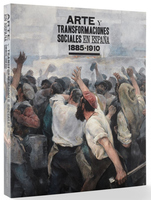
Arte y transformaciones sociales en España 1885–1910 (Art and Social Transformations in Spain 1885–1910)
Museo Nacional del Prado, Madrid
May 21, 2024–September 22, 2024
Catalogue:
Javier Barón, ed.,
Arte y transformaciones sociales en España 1885–1910.
Madrid: Museo Nacional del Prado, 2024.
445 pp.; 337 color illus.; bibliography.
€30.27 (softcover)
ISBN: 9788484806103
When most people think of art in Spain in the final years of the nineteenth century and the first years of the twentieth, they doubtless think of Pablo Picasso’s early work and his trajectory from initial training through to the first Cubist experiments. Those more familiar with artists born within the frontiers of the Spanish state will know this instead as a time of remarkable artistic flourishing, when (arguably) a greater number of talented creators coexisted than at any previous point in history. These years saw the light-filled paintings of Joaquín Sorolla—from Valencia on the eastern seaboard—the often severe, dark images of the Basque Ignacio de Zuloaga; the looming grotesques of José Gutiérrez Solana; the stark, staring, statuesque enigmas of the Andalusian Julio Romero de Torres; and the luminous visions and disorienting, eerie caricatures of Darío de Regoyos—famous for his collaboration with the Belgian writer Émile Verhaeren on the text and image travelogue España negra (Black Spain; 1899). Barcelona, the capital of Catalonia to the northeast, experienced an extraordinary explosion of visual creativity coinciding with a rise in Catalan nationalist sentiment. The famous café Els Quatre Gats hosted a range of artists, among them the Andalusian Picasso. The fin-de-siėcle movement known as modernisme emerged. Santiago Rusiñol produced haunting images of historic gardens; Isidre Nonell created near two-dimensional outlines of the socially excluded, often in modulated monochrome; Hermen Anglada-Camarasa proffered hallucinatory depictions of Bohemian life in sweeps of lurid color. The wave of innovation spread far beyond painting. The architect Antonio Gaudí laid out his fantastical creations in Barcelona, including the Park Güell and his early work on the Sagrada Familia, which only in our time is reaching its final stages of construction. Segundo de Chomón rivaled Georges Méliès with cinematic wonders such as El hotel eléctrico (Electric Hotel, 1908), a playful fantasy-turned-nightmare of mechanization. The sculptor Carles Mani displayed Los degenerados (The Degenerates, 1907; now preserved only in maquette, Fundación Junta Constructora del Temple Expiatori de la Sagrada Familia, Barcelona), reducing the human form to atavistic blankness drawn out of stone. Most of these artists (saving Gaudí) have fallen behind the international reputation of their successors—notably Joan Miró, Salvador Dalí, and Luis Buñuel—and of Picasso. The capacity of Miró, Dalí, Buñuel, and Picasso to fashion even more eye-catching imagery than fin-de-siėcle artists no doubt played its part. So too did the increasingly dominant modernist interpretation of art history, which eclipsed more apparently descriptive artists such as Sorolla, whose lifetime of American and European fame did not obviate that fate. Merit aside, Miró, Dalí, and Picasso combined their (supposed) European modernist credentials with deeper integration into the art world of pre-World War II Paris and of the increasingly influential US cultural scene. In consequence, they were simply better known to collectors and art historians in hegemonic regions of the West, with whose aesthetic outlook they (more or less) “fit” while offering a dose of southern exoticism.
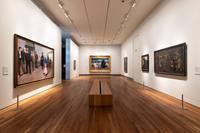
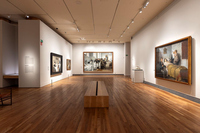
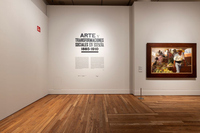
The Prado’s vast exhibition, Art and Social Transformations in Spain 1885–1910 (figs. 1–3), included many of the late nineteenth- and early twentieth-century artists mentioned above. But its scope was far wider. The display’s bold gambit was to gather the full range of visual culture made in response to socioeconomic developments from 1885—when a crucial political pact was made to stabilize the ostensibly democratic liberal system—to the 1910 Canalejas ministry, which sought to restabilize the system after the violent events of 1909 in Barcelona known as the “Tragic Week.” The concern with “social transformations” brings together—without conflating them—art as apparently disparate as Laureà Barrau’s softly painted, figurative image of peasant toil, Escardadoras (Women Weeding the Field, 1891; Prado Museum, Madrid); Antonio Fillol’s photographically cropped painting of a slaughtered protestor, El hijo de la revolución (The Son of the Revolution, 1904; Museo de Bellas Artes de Valencia, Valencia); Picasso’s aggressively lurid, roughly painted La espera (Margot) (The Waiting [Margot], 1901; Museu Picasso, Barcelona), with its rhythmic blotches of abstract background color; and Regoyos’s Víctimas de la fiesta (Victims of the Fiesta, 1894; Museu Abelló, Barcelona), where scattered horses—deathly caricatures in unnatural post-mortem poses—seem to float, dislocated, in a landscape of void. (Viewers will recognize the ghastly equine head cropped to the bottom right from Picasso’s recreation of the image in his Guernica [1937; Museo Reina Sofía, Madrid].) The exhibition contained sculptures ranging from Miquel Blay’s muscular pair of bronze proletarian heroes—Barrenador y fundidor (Borer and Smelter, 1903; Museu de la Garrotxa, Olot)—through Josep Monserrat’s half-dressed heterosexual couple idealized in allegorical plaster—Amor y trabajo (Love and Work, 1899; Prado Museum, Madrid)—to Pablo Gargallo’s En la artesa (In the Trough, 1898; Museo Pablo Gargallo, Zaragoza), a bronze bas-relief in which the outlines of a moment in the working day emerge from and disappear into the rough, industrial-looking metal. There were a multitude of photographs of very different kinds: group portraits, newsworthy snaps of executions, terrorist attacks, religious processions, ID photographs documenting emigrants and prisoners, erotica (supposedly artistic and otherwise), ethnographic colonial images, and medical records of sick and wounded bodies. There was poster art, including Ramon Casas’s famous warning of syphilis in the decaying art-nouveau shape of a wasting woman gazing wistfully upon a single flower. The exhibition stretched over two floors and eleven spaces of the Prado, culminating in a cinema room where early moving images played on a loop, including the first movie made in Spain: the Jimeno brothers’ Salida de la misa de doce del Pilar de Zaragoza (Departure from the Twelve O’Clock Mass in the Cathedral of Our Lady of the Pillar, Zaragoza, 1897; Filmoteca de Zaragoza, Zaragoza). The catalogue is correspondingly substantial, with no fewer than 295 catalogue entries—each with lengthy informative text—along with an additional forty-two high-quality figures that accompany four essays. Javier Barón’s essay provides an overview, followed by discussions of social realism in sculpture (Leticia Azcue Brea), photography as a medium to show social transformation (Beatriz Sánchez Torija), and the social dimension of Catalan art at the turn of the century (Francesc Fontbona). The catalogue also contains a list of the movies shown, though no stills or discussion of them.
The exhibition offered—as it were—a museological jolt, leading the viewer through webs of connections, similarities, and contrasts among images—and kinds of images—that are habitually displayed quite separately if displayed at all. Likewise, the display cut across the established divide between the prescribed domain of the Prado’s historic collections and that of modern art assigned to the Reina Sofía. The border—drawn in somewhat messianic fashion at Picasso’s birth in 1881—is pointedly ignored here, and to salutary effect. The Reina Sofía has since returned the compliment in its exhibition on the Esperpento—a key twentieth-century aesthetic of the grotesque—by tracing a genealogy back through the great mid-nineteenth-century painter Eugenio Lucas Velázquez. In practice, the date-line boundary between these two national museums of art is rather awkward: it leaves chronologically simultaneous or near-simultaneous works stranded in two different holdings. Barón, curator of nineteenth-century art, notes in his catalogue essay that the Prado is the inheritor of state purchases previously held by the Museum of Modern Art (Museo del Arte Moderno, which was founded in 1894 and closed in 1971). The Prado thus owns a rich collection of what Barón—borrowing from the French peinture sociale—calls pintura social (social painting): works, often on a large scale, depicting contemporary social realities, many acquired through the system of National Exhibitions. Until a recent rehang in the Prado in 2021, this sort of art was hardly visible on the museum’s walls. Now, it has its own room within the nineteenth-century section (15–16).
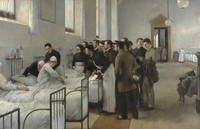
Many of these paintings from the former Museum of Modern Art exhibit similarities with the kinds of images that, in neighboring France, are typically classified as “Naturalist,” and which Barón contrasts with the more general nineteenth-century vogue for depictions of popular customs and moeurs (morals). As Barón observes, French enthusiasm for Naturalist art had a decisive effect on tastes among many Spaniards, even if the change was far from uniformly welcomed. In 1889, Luis Jiménez Aranda unexpectedly triumphed at the Universal Exhibition in Paris with his nearly thirteen-square-meter Una sala del hospital durante la visita del médico en jefe (A Hospital Ward During the Chief Physician’s Round; fig. 4), in stark contrast to the reception of large history paintings sent by then-admired painters such as Francisco Pradilla (himself much lauded across Europe as late as the 1910s). Jiménez Aranda gained French nationality, indicating the depth of his immersion in Gallic trends. His success unleashed a flood of social painting in Spain, that, to a significant degree, displaced history painting as the dominant large-scale genre in National Exhibitions. Eleven years later, Sorolla enjoyed a parallel victory with his ¡Triste herencia! (Sad Inheritance!; see fig. 1), an image of disabled boys on the Valencian seaboard that merged social painting with the obsession for maritime light that prevailed in much of the artist’s subsequent work. This was far from the end of the vogue: Barón points to the many artists who persisted with it, including Antonio Fillol and Ventura Álvarez Sala. The latter’s La promesa, después del temporal, Asturias (The Promise, After the Storm, Asturias, 1903; Prado Museum, Madrid, deposited in Museo de Bellas Artes de Asturias, Oviedo)—a bunched line of distraught fisher people, at a shallow diagonal to the viewer, leading to a stone cross—is one of several such post-1900 works that appeared in the exhibition (17). It is a reminder of the coexistence of those tendencies with the formal provocations of Picasso and others, who likewise shared the spaces of “art and social transformations.”
The years covered by the exhibition fall squarely within the period known as the Restoration, when Spain experienced its longest period of parliamentary rule under a single constitution until 1978. The Restoration’s primary—and still much debated—achievement was to combine liberal parliamentarism with a stable constitutional régime. The price paid was the turno pacífico (peaceful turn-taking), which began in earnest in 1885, the year with which Art and Social Transformations begins. Following King Alfonso XII’s death, the two largest political parties made informal arrangements to take turns winning elections to protect the constitutional monarchy from uprisings by the disgruntled losing party and to fend off enemies from the left and the right. Universal male suffrage and political pluralism were thus fused with result-fixing. Like some fragile pressure cooker, the Restoration sought to combine a lively internal dynamic with careful containment. Previously, Spain had lived through one of the longest continuous periods of parliamentary constitutional government in nineteenth-century Europe—longer than in neighboring France—its pluralism expressed in violent instability through a succession of uprisings, numerous different constitutions, major civil wars between liberals and Carlists (absolutists who backed a rival claimant to the Bourbon throne), and, almost by mishap, a brief republic (1873–74) during which further uprisings turned federalism into cantonalism. The new settlement with a restored Bourbon monarchy sought a way out of the collapse of consensus over social and political legitimacy that had followed the definitive end of the ancien régime in 1834. The turno pacífico aimed to express a balance of forces: to hold the ring between the monarchy, the largest liberal parties, and the whirl storm dynamic of contemporary Spain, while keeping the military out of politics and giving some succor to the Church.
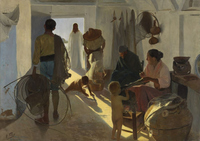
This was nearly impossible to sustain: the years of the turno pacífico were fraught with strains between its constitutional formula and the turbulent vortex of the territories it governed, which threw out ever more divergent and resistant forces. The régime’s corruption was met with growing opposition by Republicans, by emergent organized Socialism, and by Anarchism and related terrorism. In the exhibition, viewers encountered Ramón Cifuentes’s newspaper snap of the founder of the Spanish socialist party (PSOE), Pablo Iglesias, haranguing supporters in 1910, Manuel Benedito’s oil La familia del anarquista el día de su ejecución (The Family of the Anarchist on the Day of His Execution, 1899; Museo Sorolla, Madrid), and Sorolla’s famous design (1900; National Museum of Art of Catalonia, Barcelona) for the banner of the Valencian republican newspaper El Pueblo (The People), launched by his friend, the popular novelist Vicente Blasco Ibáñez. (The latter would later author Los cuatro jinetes del apocalipsis [The Four Horsemen of the Apocalypse, 1916], which was made into a well-known movie starring a tangoing Rudolph Valentino in 1921.) These developments were not simply a response to economic failure, as a “myth of backwardness” once held. Following earlier land and structural reforms, metropolitan Spain saw growth in areas of opportunity, including viticulture and mining; the country played a key role in the world supply of minerals. Railways and telegraphs were laid out, and urban centers reconstructed. As the catalogue observes, controversy raged around some artists—notably Zuloaga, whose somber images of the country might play, some worried, to foreign prejudice about Spain. Conversely, other critics defended such art on the grounds that its literally dark aesthetic highlighted persistent deprivation, injustice, and obscurantism. The catalogue notes such remarks in response to Gutiérrez Solana’s Los desechados (The Outcasts; see fig. 1), a grotesque fusion of the Goyesque with El Greco-like elongated priests who preside over a shallow line of disabled and wounded boys made of strokes of thick impasto (294, 354–55). (In fact, even more than Goya, the facture recalls Lucas Velázquez.) Such anti-clerical commentary intensified even as Catholic irredentism resurged and as many anti-Spanish nationalists proclaimed themselves to be truer Catholics. The declaration of Papal Infallibility in 1870 made life difficult for the many independently minded reformists who had previously identified as Catholic. In one of Spain’s great nineteenth-century novels, La Regenta (The Regent’s Wife, 1884–85), by Leopoldo Alas, the cleric Fermín de Pas describes the doctrine as a “terrible but most valiant dogma: a formidable challenge thrown down by faith, surrounded as it was by the incredulity of a laughing century.”[1] Even then, many liberal and republican opponents of the Church continued to trace their leftist thoughts in Christian imagery, or, like the philosopher and author Miguel de Unamuno, redescribed that imagery as a narrative founded on humanity’s existential void. In Antonio Fillol’s enigmatic Los amigos de Jesús (The Friends of Jesus; fig. 5), painted in rural Valencia, we look outward from deep in the interior of a poor dwelling to a doorway off-center at the back from which a diagonal of sunlight extends. There, against a flattened, painting-like backdrop stands a Christ figure in white, his face entirely shadowed and blank, unknowable to our sight. The catalogue notes how critics associated the work with leftist claims that Jesus of Nazareth was one of their own. Equally, there is much in Luis Pardo’s contemporaneous remark that the gnomic work contains “strange symbols” (200).
The Restoration saw an exacerbation of the Spanish state’s perennial, constitutive tensions. It had always been a conglomeration of older kingdoms, but now regionalists and autonomists on the left and right in Catalonia and the Basque Country battled with centralists as more fervent nationalisms took lasting shape. In 1894, Sabino Arana founded the Basque nationalist party, EAJ/PNV. In 1901, Franscesc Cambó formed the rightist Lliga Regionalista de Catalunya (Regionalist League of Catalonia). As Fontbona notes in his catalogue essay on social concerns in Catalan art, modernisme emerged in Catalonia to assert and modernize a distinct culture. A dispute quickly arose whether this could be achieved only by art for art’s sake or whether more direct engagement with subject matter was required. The latter view, Fontbona argues, came to prevail due to the influence of the critic Raimon Casellas (79–80). Modernisme was amply represented in the exhibition by artists such as Ramon Casas and Santiago Rusiñol. The state was most profoundly reconfigured in 1898 when the United States seized Puerto Rico, the Philippines, and Cuba—where rebellions had long raged—swiftly defeating Spanish forces and spurring much self-reflection among intellectuals in the metropolis. One of the vanquished soldiers, now returned to Catalonia, appeared in the exhibition in Nonell’s melancholic Repatriado de Cuba en el muelle (Repatriated from Cuba on the Pier, 1898; National Museum of Art of Catalonia, Barcelona). Even then, Spain remained an imperialist state, still occupying and fighting for its limited domains in Africa. In acknowledgement that Spanish imperialism continued long after the loss of mainland American territories in 1826, Art and Social Transformations took care to display, for example, numerous images from and of the Philippines, including astonishing wood sculptures—boldly outlined figures of contained suffering—by Ciriaco Gaudínez y Javier and Domingo Teotico y Eugenio, as well as colonialist photography, such as an anonymous stereotype of members of the Ysembu tribe of Equatorial Guinea (1912; Royal Collections, Madrid).
For Barón, the tension between radical aspirations and Spain’s realities is key to the revolutions in art that brought naturalist and modernist forms of expression to the country. Ultimately the stresses led to Picasso’s “liquidation of all previous art” (15–17).[2] What Barón says of turn-of-the-century art may be said of the Restoration as a whole: it struggled to find a means of expression that adequately linked reformist aspirations to Spain’s diverse and strained social realities. In the most literal sense, the Restoration claimed to be a “representative” system, and in every sense—as the Hispanist Jo Labanyi has remarked of the realist novel—it suffered a crisis of representation.[3] The exhibition’s visual power derived from gathering such a range of art together around a common impulse: to explore the adequacy of forms and media to mutating social dynamics. The exhibition suggested that this drive cut across divides between a supposedly nineteenth-century realism and a supposedly twentieth-century avant-garde, even as it generated the contrasts and conflicts between such different approaches to art. The chronological bounds were treated with some license, extending as far as 1917 in Francisco Fernández Trujillo’s photographs of repairs to transatlantic vessels in the docks at Matagorda in the south, with their looming masses of metal, a hymn to thingness (Maria Fernández Albarés Collection, Madrid).
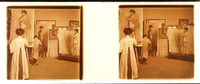
Each section of the display presented a social phenomenon of the period 1885 to 1910, rather than emphasizing an artistic movement or a developing chronology as the primary dynamic driving the visual arts. The first part was dedicated to work, subdivided into the countryside, the sea, industry, and a welcome section on women’s work, the latter being a significant aspect of working-class life, and one often described and discussed in novels of the time. In line with the ethos of the Prado in the Feminine initiative, Art and Social Transformations dedicated significant attention to the topic of women and the visual arts, broadly echoing the extensive scholarship that has been undertaken on gender and the Restoration by researchers such as Lisa Condé, Jo Labanyi, and Lou Charnon-Deutsch.[4] The viewer encountered women posed as objects of desire in numerous putatively erotic images, including stereotypes; presented as victims of sexual abuse in Antonio Fillol’s El sátiro (The Satyr; see fig. 1); in the role of maternal tenderness in, for instance, Enrique Paternina’s La visita de la madre al hospital (The Mother’s Visit to the Hospital, 1892; Prado Museum, Madrid); and as agents of the gaze in anonymous stereoscopes showing a female artist painting a female nude model in Cecilio Pla’s studio (fig. 6).[5] It still seems difficult to obtain display works by turn-of-the-century women artists, despite the number who were active at the time. The Prado did succeed in displaying here Elvira Santiso’s En la clase de dibujo (In the Drawing Class, 1906; Real Sociedad Económica de Amigos del Pais, Santiago de Compostela), showing girls learning to paint in a professional setting, as well as María Luisa Puiggener’s Madre e hija (Mother and Daughter, 1901; private collection).
The works in the first section ranged from Santiago Rusiñol’s Fábrica textil (Textile Factory, 1889; Foment del Treball Nacional, Barcelona), with its women workers lined up geometrically on a diagonal of equipment, integrated into and dwarfed by the object world around them; through Miquel Utrillo’s poster for the ironmakers Juli and Llorens Vallmitjana (1897; Marc Martí Collection, Barcelona), with its stark, black-grey profile of a muscular male worker firmly gripping his groin-level tool and glowing iron, the latter emitting two-dimensional cones of orange and yellow that form the background; to an anonymous photograph titled Pescadores (Fishermen, ca. 1890; Museo Sorolla, Madrid) where a wooden boat looms up at a diagonal onto dry land, pushing toward the viewer’s space as two men with their backs to us work on the nets and another sits in profile staring out to our left.
The second part turned to education, dealing with this aspect of life as regards men and women, the metropolis, and Spain’s overseas possessions. Frederic Balell’s 1914 photographs of outdoor classes for boys and girls gazing attentively at their teacher from their incongruous furniture (Muncipal Photographic Archive of Barcelona, Barcelona) were found in proximity to Julio Romero Torres’s enigmatic A la amiga (To the Friend School, 1906; Museo de Bellas Artes de Asturias, Oviedo) in which a woman—on a split backdrop, three quarters the same white as her clothes, and one quarter a sketchy but detailed park scene—stares at us with an uncertain expression as two children look elsewhere. The latter is in marked contrast to the simplified masses of white, grey, and darkness that make up the humans, as if a painting had been inserted behind them. Education was followed by religion, including Darío de Regoyos’s famous image of contrast and comparison, Viernes Santo en Castilla (Good Friday in Castile, 1904; Museo de Bellas Artes, Bilbao), where a tiny black procession of clergy with a Virgin process under a stone railway bridge crossed by a similarly black steam train against a blotchy setting of blue sky and orange-green land. Nearby, Ricardo Santaló’s newspaper photograph Inauguración del tren de Solares a Liérnages, Cantabria (Inauguration of the Train from Solares to Liérganes, Cantabria, 1909; ABC Archive, Madrid) treated viewers to a rather different vision of a similar subject, as a train engine, pressed up to the front of the image in a way reminiscent of Lumière movies, is bedecked with garlands and blessed by a group of clergymen.
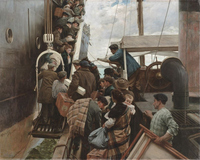
A section on illness and medicine saw Picasso’s first appearance, picking up the tensions around Catholicism with his early work Ciencia y Caridad (Science and Charity; see fig. 2): a woman lying in bed tended at once by a doctor and a nun. Vicente Borrása’s oil La vacuna (The Vaccination, ca. 1911; Prado Museum, Madrid), a colorful tumble of clothes, babes, and a strapped-down horse shared this section with Alfonso Sánchez García’s staged photograph (ca. 1915; General Archive of Administration, Alcalá de Henares) of a dissection class led by the brilliant neuroscientist Santiago Ramón y Cajal, the great man staring out at us poised with his blade on the corpse while a group of well-coiffed men attend in a solemn, posed group around him. The exhibition turned from here to illness’s successor: death. Clumsy, distant, anonymous snaps of a garroting in Belén in Jerez de la Frontera, Cadiz (1900; Mario Fernández Albarés Collection, Madrid) are accompanied by Joaquín Pinto Armado’s carefully composed image of a wake in Pontevedra, Galicia (1905; Museo de Pontevedra, Pontevedra), notable—by the standards of earlier mortuary photography—for how markedly dead—even skeletal—the corpse appears to be: there are no subtle interplays of life and death here. In the next section, the viewer encountered further danger and death in accidents at work through a succession of photographs documenting collapsed and burning infrastructure, as well as Aurelio Arteta’s oil Accidente de trabajo en una fábrica de Vizcaya (Work Accident in a Factory in Biscay, 1902; Bizcaiko Foru Aldunia/Diputación Foral de Bizcaia, Biscay), a blurry scene of dark colors lightened only by a fierce, occluded forge and the sweaty, dirty flesh of the workers as they rush to take away their stricken colleague. Displays then shifted to prostitution, including Picasso’s The Waiting (Margot). Many putatively erotic photographs of naked women, often in contorted poses—one by Luis Federico Guirao has her head inside the speaker of a gramophone (ca. 1890; María Manzanera Collection, Murcia)—were placed alongside supposedly elevated nudes that in fact frequently echoed them. Zuloaga’s shadow-covered Celestina (1906; Museo Nacional Centro de Arte Reina Sofía, Madrid)—whose title alludes to Fernando de Rojas’s eponymous early Spanish novel (1499) about a madam—shows a woman to the fore, twisting left to view herself in a mirror, while her deep red gown falls open, revealing and concealing her open legs and partly exposed breasts, while, behind the almost blank righthand side of the foreground, we see two other women conversing, much better lit but partially concealed by a windowed door. From here, the displays moved on to emigration, where photographs of crowds on board or shipside found company with not dissimilar compositions in oils, like Álvarez Sala’s Emigrantes (Emigrants; fig. 7) depicting a packed procession of people, evoked in rough-hewn paintwork, their backs to us as they twist up the stairs of a vast metal ship. Only a child appears to notice us. The internal problems of Spain combined with growing Latin American prosperity in these years to lure many people abroad.
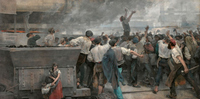
The penultimate, noncinematic section—Poverty and Ethnic and Social Marginalization. Colonialism—was unfortunately the least cogent. Despite the importance of the topics covered, the works in this part were exhibited closely together through some loose principle of association. Somehow, we ended up with Fillol’s The Satyr—a Naturalist-style denunciation of pedophilia in oils—accompanied by Nonell’s Estudio de gitana (Study of a Gypsy, 1906; Masaveu Collection, Madrid)—a near-faceless figure, almost totally merged with a dark backdrop, cast in multidirectional strokes of dark blue, black, and a dirty red. The viewer encountered a posed photographic group of hungry mothers and children gathered to eat in Our Lady of Miraflores de los Ángeles in southern Spain by the studio Fotografía Moderna (1904; Royal Collections, Madrid) in the same section as five indigenous men from the Philippines, geometrically lined up to display their weapons, by the transnational photographic company J. Laurent & Co. (1887; National Museum of Anthropology, Madrid). From here, the viewer was taken to a more focused section on strikes and social demands. Vicente Cutanda’s Una huelga de obreros den Vizcaya (A Workers’ Strike in Biscay; fig. 8) proffered an exultant mass of Basque industrial workers with their backs to us, looking upward to a single, red-bonneted individual, held high in the center above them, waving a proclamation in his raised arm. The Prado chose this gigantic image—over fifteen square meters—for the poster and catalogue cover of the exhibition. Its heroically muscular, toned male bodies and their bold gestures to the future prefigure Socialist Realism, literally drawing the promised trajectory of labor from the contemporary moment. To their left, overseen by a huge metal coal scuttle, a diminutive female and a young boy gaze furtively to the fore, separated from History’s macho proceedings. The images in the exhibition catalogue culminate with Luis Ramón Martín’s gruesome post-mortem photograph of Manuel Pardina, who shot the Prime Minister Canillejas before putting a bullet through his own forehead (1912; Fundación Pablo Iglesias, Madrid). The image is at once documentary and dreamy, the corpse resting against a rather purposeless black cloth that covers part of the wall, assuming a rigid verticality like some propped-up object, instead of occupying the supine position more traditional to corpses. The composition’s arrangement of the human body distantly recalls Goya’s print series Desastres de la guerra (Disasters of War).
The organization of the exhibition by theme echoes the approach to art taken in the catalogue essays and entries. Specific social phenomena are linked to sets of images, and vice-versa. The catalogue is an extraordinarily rich source of contextual information for these artworks, referencing not only large-scale events but also illuminating, if minor, historical episodes. In many cases, direct lines are drawn between individual works and very specific incidents. The vastness of the exhibition and catalogue and the multiplicity of such references resist summary. Undoubtedly, this aspect of the catalogue will make it an enduring, significant resource for historians of art and culture who will turn to it for essential detail. For instance, Barón shows how Cutanda’s image of Basque strikers responds to waves of industrial action that began in May 1890, while José Uría’s Después de una huelga (After a Strike, 1895; Prado Museum, Madrid)—showing a distraught woman and child next to a dead worker while the police linger in the background—reacts to stoppages between May 27 and June 8, 1892, in Valladolid at the northern railroad company (Compañía de los Caminos de Hierro del Norte de España). These came against a background of violent responses by the authorities, with legal reforms enabling a right to industrial action only occurring later between 1902 and 1909. In the sphere of education, Barón notes how illiteracy remained at over 70 percent in 1885, and the state struggled to make inroads until the 1901 mandate for obligatory schooling until the age of twelve. The catalogue remarks on a specifically Andalusian phenomenon—known as escuelas de amiga (female-friend schools)—on these schools’ relationship to demands for female education and how this information helps us understand Domingo Muñoz y Cuesta’s painting La amiga (En Córdoba) (The Friend School [In Cordoba], 1901; Prado Museum, Madrid). The latter image shows a brightly-lit, cheerful group of girls undertaking one of the few tasks felt appropriate in such a setting: sewing (26–27, 44, 175). The catalogue likewise collates an array of valuable information on the circumstances of production and display, and contemporaneous critical reaction to and controversies around the works in the exhibition. For example, we learn about the preparations—including a hospital visit on April 30, 1890—undertaken in Rome by Enrique Simonet for the well-known painting Una autopsia (An Autopsy, 1890; Prado Museum, Madrid)—an image of a doctor staring at a detached heart while its female former owner lies dead and virtually naked at his side. We read of the intriguing debate that the painting provoked over the extent (or otherwise) of the virility revealed in the artistry, inviting a gendered interpretation of the composition and facture (220–21).
The exhibition and catalogue seem rather less concerned with framing an overall interpretation of the social tensions they record or with providing an overarching account of how the various visual arts interacted with these other social realities and with each other. If the exhibition’s main question was how visual arts could give adequate expression to social transformations, its reply—for better or for worse—seemed mainly piecemeal. Such an approach is not entirely unreasonable given the immensity of the task involved in relating such diverse art and artistic movements to such complex social phenomena and the vast amount of data. Moreover, the curators were keen, instead, to emphasize social painting in its own right; to that end, they avoided foregrounding such decisively important topics as centralization and resistance to it, the imperial crisis of 1898, and the national regeneration movement (16).
The manifest downside was a lack of clarity concerning the organizing principle behind the sections of the exhibition. For instance, death is a general phenomenon common to living creatures for which there are varying responses over time and place; whereas strikes and organized labor are behaviors specific to particular contexts; and cinema—the final room—is a visual medium as much as it is a social phenomenon (and there was little on it as a social phenomenon). It was not apparent why prostitution demanded an entire section, but, the broader topic of sexuality, for example, did not—especially given that some of the images presented in that section may well not depict prostitutes anyway, but rather such diverse categories as kept women, the sexually promiscuous, or indeed—as in Fillol’s mysterious La bestia humana (The Human Beast; see fig. 10)—victims of abuse. The question of queerness was not much remarked on despite its vivid presence in some contemporaneous fiction and such invitations as the muscled laborers of Blay’s statue Borer and Smelter: a shirtless, bearded older man arm draping an arm over a handsome, fully dressed younger counterpart, the latter holding a very long, erect pole very firmly in his hands.
If one were to step back and consider the most marked tendencies and drivers of the Restoration period—as many historians of different stripes have sought to do—it is unlikely that one would come up with the list of topics around which Art and Social Transformations was organized. There have been serious attempts to understand Restoration visual culture in relation to social dynamics, including Óscar Vázquez’s insightful and elegantly conceived The End Again: Degeneration and Visual Culture in Modern Spain. Vázquez argues that “conquest and loss, celebration and mourning: these were the polarities of the modern Spanish nation.”[6] Even as artists addressed wider Western debates about degeneration and regeneration, those responses took specific turns, first because of the Black Legend—the contentious claim that obscurantism led to earlier imperial abuses and later to national decline—and second because of Spain’s geopolitical setbacks, including its perceived fall from the status of a great power and the 1898 “disaster.” As the wry title of Vázquez’s book implies, the fin-de-siècle was one more iteration of a long-running pattern of debate—and, with the events of 1898, a further iteration occurred. Rather than following one trajectory, the visual arts responded in multifaceted, multidirectional ways, imagining diverse and conflicting versions of regeneration and degeneration, where the latter—in decadentism—could also appear as an aesthetic positive. Vázquez’s account has considerable explanatory power, shedding light both on the continuities between visual art we might think of as Naturalist or Modernist or anti-Modernist, while accounting for the very different attitudes and aesthetics, and while avoiding a dogmatic commitment to Spanish art’s distinctiveness. The dynamic Vázquez sets out encompasses a wide range of works seen in Art and Social Transformations, including Sorolla’s Sad Inheritance!—which appeared in the section on poverty and marginalization and reflects the artist’s preoccupation with Mediterranean coastal healthiness—Regoyos’s semi-fantastical grotesque Victims of the Fiesta, which appeared in the section devoted to work; and Fillol’s apparently naturalistic but enigmatic The Human Beast. By comparison, the catalogue for Art and Social Transformations seemed caught among a series of countervailing tendencies: the reclamation of naturalistic art, the grouping of diverse aesthetics around common social themes, and a lingering modernist trajectory in which a vanguard exposes the inadequacy of all other kinds of art. The exhibition and catalogue raised the question of how to navigate claims of diverse historiographies, each of which explores the adequacy of art to other realities, but it did not offer a way through.
Richard Thomson has argued that the Naturalist art of neighboring Third Republic France “created a collective notion of national identity, substantially shaped to the priorities of the Republic.” Naturalism thus became the “dominant aesthetic.”[7] Given its circumstances and constitutional arrangements, Spain could scarcely replicate such an outcome. The absence of a “dominant aesthetic” is consistent with the widely expressed historical view that, by the end of the nineteenth century, the Spanish state had still not consolidated a hegemonic national ideology. A lingering “myth of backwardness” contends that the country’s leaders thus fell short on a key measure of modernization: the construction of a unified nation state. In fact, as the eminent historian José Portillo Valdés has recently pointed out, state-building in nineteenth-century Spain was quite successful by European standards, and there was no shortage of discourse on nationhood(s). The question was how the state-building, wider society, and discourses of nationhood and legitimate sovereignty were to relate to one another in the Restoration years (and beyond).[8]
In any case, the extent of a homogenous, state-backed national culture is a strange metric by which to measure cultural (or even political) success. Looked at differently, the tense dynamic of nineteenth-century Spain—for all its obvious flaws—resisted homogenization and held open gateways to multiple futures, including its own potential fragmentation. Despite the efforts of nearly forty years of Franco’s dictatorship—secured only after three years of fighting even with Nazi and Italian Fascist military support and fortuitously gifted life support by the Cold War—that legacy of contested, troubled pluralism has persisted. Thomson observes that Naturalism was “flexible, adaptable to different subjects and purposes, accommodating to individual manners within its broad compass of the descriptive;” it was a creature of the pluralism that existed within and even against the Republic.[9] Undoubtedly, when the vogue caught on in Spain—having received the French stamp of approval with Jiménez Aranda’s triumph in 1889—this inherent flexibility enabled its adaptation to the tense, plural dynamic of the Restoration. It could encompass visions as diverse as Álvarez Salas’s display of coastal Asturian religiosity, Muñoz y Cuesta’s obediently feminine, Andalusian schoolgirls, and Cutanda’s exaltation of strikers in Basque industry.
All that said, if scholars of the late nineteenth-century realist novel agree on one thing, it is that authors from Spanish-held territories continually called the notions of realism and representation into question, rather than committing to an ideology of descriptive naturalism as a “dominant aesthetic.” The protagonist of Benito Pérez Galdós’s El amigo Manso (Friend Manso, 1882) famously begins by stating that he does not exist. More subtly, in works like Emilia Pardo Bazán’s La tribuna (The Tribune, 1883) or Alas’s The Regent’s Wife, characters and descriptions overtly take up and work through a wide range of borrowed discourses and forms of expression. The same is true even of those authors who expressed open admiration of Émile Zola—author of provocatively sordid tales of social denunciation—and who found themselves, in consequence, long exiled from the literary canon. For example, Eduardo López Bago’s Carne importada (Imported Flesh, 1899), which described the rape and prostitution of an emigrant Spaniard, is a delirium of literary and visual allusions. Parallels with the quizzical, unsettled realism of contemporaneous literature were very apparent in Art and Social Transformations. A suggestive, if slight, example was to be found in José Jiménez Aranda’s ambiguously titled Los pequeños naturalistas (The Little Naturalists; fig. 9) in the section on education. In a roughly painted setting, with muddy tones and awkwardly angled pots and stones, a group of small children stare attentively at an insect. The scene may be an evocation of precocious scientific observation, but it could equally be taken as a wry, self-reflexive exploration of what the naturalist aesthetic amounted to, for good or ill. The approach to naturalism in Fillol’s early works is more profoundly disconcerting. The title of his The Human Beast (fig. 10) obviously alludes to Zola’s La bête humaine (1890), in defiance of claims—by Pardo Bazán among others[10]—that the French author’s sordid subject matter was not reflected in Spanish daily life. We see three figures in an oblique line to the viewer, from rear to front: a man, respectably dressed but unnervingly insouciant, stands lighting a cigarette next to a wine bottle and bread; a large female figure almost leans out to the viewer and turns to rest her hand on an apparently younger woman; the latter, to the fore but smaller, is a black mass of dress and hair, her face invisible, covered by her hands. As the catalogue entry succinctly comments, “Fillol enjoyed plot-lines that are open to interpretation.” Vázquez has underscored the consequent narrative uncertainty, recording a range of interpretations offered by contemporaneous viewers (282).[11] On the one hand, the image implies the offer of legible naturalist narrative. On the other, it withholds what that narrative actually is. The painting unsettles the very aesthetic that it seems to practice.
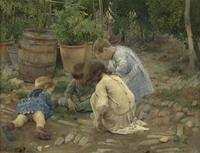
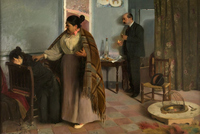
Both these paintings draw attention to the crucial question of observation in naturalistic realism and, more broadly, in art. From his earliest writings on realism, Galdós had brought observation to the fore of aesthetic concerns in late nineteenth-century Spain, advocating for “the national novel of pure observation,” and asking rhetorically “what was [the painter] Velázquez but the greatest of observers?”[12] On the one hand, both these paintings center on how people look at things or refuse to do so. On the other hand, they ensure that the viewer’s position as an observer—and thus the very experience of observational realism, of looking—is far from comfortable or settled. We cannot see the face of the victim in The Human Beast, just as Christ’s visage in The Friends of Jesus is a blank space. This stylistic trope was repeated across several works seen in Art and Social Transformations. In a playful instance, José Jiménez Aranda’s Una desgracia (A Misfortune; 1890; private collection) goes one further than Jean-Léon Gérôme’s (now lost) painting L’Accident (The Accident; 1901): to the concealment of the incident behind the backs of the peering crowd, Jiménez Aranda adds a figure to the fore who rushes away repelled, a hand covering her eyes and face. The Little Naturalists deploys a related trope: the viewer looks headlong at a child’s backside, in this case accompanied by dangling genitalia. Rears loomed up or pointed out at the viewer in many works seen in Art and Social Transformations, from Barrau’s Women Weeding, to Anselmo Guinea’s La sirga (The Towline, 1892; Urbano Ispizcua Family), and to Álvarez Salas’s Emigrants. This compositional gesture draws very pointed—even rude—attention to the awkward position of the observer in what Michael Fried calls absorptive realism, whose key elements were apparent in an even wider proportion of the works displayed. The characters are supposed to be occupied with their own real world, and so they pay no heed to the outside viewer’s presence. Yet, such images risk appearing to be quite separate from our real world, and thus manifestly a work of art. Conversely, it might be felt more realistic for characters to exchange glances with the viewer, creating a continuum between the latter’s reality and the painterly world. But such a gesture carries the same risk, calling attention to the painting’s status as a staged work of art, to its “theatricality.”[13] Across the exhibits of Art and Social Transformations, the counterpart to buttocks and blanked-out faces was found in characters who aggressively eyeball the viewer while pressing into our space. In Joan Llimona’s Los emigrantes (The Emigrants, 1887; private collection), a rowing boat is pushed right up to the boundary of the image, as if about to overrun us, and a grim-faced figure looms up glaring forward. In the genre painter Gonzalo Bilbao’s crowded brothel scene, La Esclava (The [Female] Slave, 1904; Civico Museo Revoltella/Galleria d’Arte Moderna, Trieste), an eclectically half-dressed prostitute in the very foreground stares right at us, accompanied by others around her who peer and sneer, in a setting that looks suspiciously like a stage. Strikingly, Sorolla’s Sad Inheritance! offers a playful treatment of both absorption and theatricality. We are mainly faced with the buttocks and backs of several naked children and a priest. In contrast, one boy does turn to inspect us. But his eyes and face are covered by his hand, protecting them from the sunlight; only his genitalia point openly toward the viewer. Such disconcerting tropes are significant, less for their absolute novelty, than because they so pointedly amplify and literally foreground the problems inherent in observational realism.
The acts of observing, of paying attention—or failing or refusing to do so—were constitutive of the activities depicted in social painting and related visual arts. The relationship between visual art and other realities in Spain was thus constituted by the interplay between, on the one hand, socially situated patterns of observation and attention, and, on the other, the overtly challenging and often unsettled experience of observing and paying attention. This is apparent even from that very first triumph of Spanish social art—A Hospital Ward—where we observe from a distance, and through a photographically cropped composition, how a doctor inspects a female patient while other medics observe both him and her. Acts of observation and attention—and the resistance to them—pervaded the work on display in Art and Social Transformations. The exhibition’s division into themes—work, dying, medicine, and so forth—had this in its favor: it drew attention to how observation was situated in daily activities. Doctors look at patients and patients pose for them; students pay (or do not pay) attention to their teachers and their studies; working people focus on the task at hand and the instruments of their labor, or look away in moments of distraction; crowds look to their leaders, or to sensational accidents, or to morbid events like executions; commercial posters, newspaper snaps, and political banners seek to grab the crowd’s attention; erotic models pose for the camera’s eye and the vicarious voyeur, and so on. In the exhibition, the viewer likewise encountered observation as disciplinary surveillance and as a controlling tool for classifying humans in early police mugshots, in photographs of indigenous people lined up for ethnographic inspection, and in Argentine immigration papers.
Sorolla—who came to be considered one of the world’s greatest living artists—went beyond specific tropes and infused the entire compositional structure with an acute awareness of the situation of the artist as social observer. Sorolla was concerned with his—and the viewer’s—position, both in the literal and conceptual senses of the word position. In his provocative, inquisitive exploration of viewpoint, Sorolla paralleled the finest Spanish literature of the time. His period of social painting, well represented in Art and Social Transformations, often took shape in cramped angles that press viewer and viewed close together. Through such compositions, the artist’s and others’ practices of observation and attention are at once intensely proximate and riven with contrasts and tensions. This is true both literally—in physical closeness and awkwardness—and figuratively—by interweaving a shared concern with observation with deep differences in how that concern is exercised. In Una investigación (An Investigation, 1897; Museo Sorolla, Madrid), viewers find themselves pressed right up over a workbench and against the arms and backs of two members of a tightly packed group of men in a shallow room, lit only by a gas lamp. Unmindful of our intense physical proximity, they are transfixed by the blurred figure of Dr. Luis Simarro, an eminent scientist, around whose body they press tightly. Simarro, in turn, focuses his attention closely on the biological samples before him and not on his visitors. The catalogue entry records how Sorolla worked on the canvas precisely in such circumstances and cites his intriguing account of the situation: “All of us were working in the laboratory: they, engrossed in their researches, with no great or small concern for my person; I, alien for my part to their scientific undertakings, and solely concerned with the lines, lights, and colors of their faces, and in general of their figures” (229).[14] Sorolla’s Trata de blancas (White Slave Trade, 1895; Museo Sorolla, Madrid) likewise places the viewer in tight confines with other people: a railway compartment, modern infrastructure transporting young women to be prostituted. We are so close, and they are piled so tight together, that their bodies all but tip into our space. Though bedecked in bright, even luxuriant clothing to catch the eyes of predatory voyeurs, they do not engage the viewer—as prostitutes in Spanish painting and photography habitually did—but, in awkward postures, seek some kind of respite in sleep, their eyes closed to us. Still, they are not free from surveillance: a madam (or, in Spanish, Celestina) keeps her watchful eyes upon her prisoners, as the catalogue tells us contemporaneous viewers described the young women (282). And there, unnervingly, the viewer finds themselves, also watching them—almost touching them—just as, we imagine, the artist stood there painting them as they lay there.
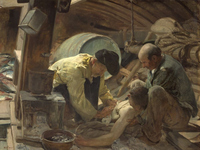
The tipping effect is repeated in Sorolla’s compositions, implying an intimate physical connection between our reality and that of the scene we observe, while also unsettling the experience of viewing. In And They Still Say Fish Is Expensive! (fig. 11), the confined space is the hull of a wooden fishing boat where we find ourselves cramped up against two men gazing intently at a stricken companion—his face hidden—whom they seek to save. Objects push up and out at a myriad of angles: a thick joist shoots slightly to the right and slightly forward, a blue barrel thrusts toward us, overlapping with one fisherman’s body. The large, dead, bleeding fish at the back left are tipped so far forward as to seem almost to float in the air. In the apparently more open setting of La vuelta de la pesca (The Return from Fishing, 1894; Musée d’Orsay, Paris), the artist and viewer are standing in the sea. It is a pointedly perilous viewing position, too close for comfort to the oxen and strong workers dragging the sailboat to land. The horizon is foreshortened and the boat looms so large as to exceed the frame of the painting. No reproduction can quite convey the effect of sheer physical force about to barrel down on the viewer in this huge image, over ten and a half meters square. With its shallow depth and immense close-up, the vision oscillates between a cogent, figurative—if sketchy—image and a bold, sensuous agglomeration of juxtaposed shapes and colors: the blue-white boat itself angled in from our left, the huge bellow of the shade and light that is the sail, the brown-black and white flesh of the oxen, the rectangle of green-blue and foam that is the sea.
Undoubtedly—in Spain as elsewhere—the widening use and new variants of photographic media—the Kodak push-button camera and the movie camera—played a significant part in this troubled concern with observation and attention. The catalogue entries and essays tick the boxes in identifying how other art forms frequently drew on the cropped composition and the viewing angles typical of photography. Their authors might also have remarked on how the camera eye becomes deeply incorporated into and inflects the other social realities that it seeks to depict, becoming a human-mechanical observer among observers. The most remarkable feature of the Jimeno brothers’ Departure from the 12 O’clock Mass is not just how the movement of the crowd is shaped by the presence of the apparatus but how people playfully gesture to it and look up to it. The movie camera observes itself being observed, and that interplay of observations becomes the subject and the form of the movie.
Such late nineteenth-century concern with observation and attention cannot just be attributed to the latest trends in technology, markets, and psychology.[15] Layers of legacies from distinct periods and from long time spans combined to form the web of observational activity. This temporal mishmash is a general feature of culture and a reminder against narrow contextualization by historical period. Artists in turn-of-the-century Spanish-held lands were acutely aware of the phenomenon, which they experienced through the controversy over their inclusion in or exclusion from the modern world, framed by the rise and decline of Spain’s Catholic-imperial hegemony. Throughout Art and Social Transformations we certainly see workers’ gazes fixed on industrial equipment, but we also see them attending carefully to hoes, to oxen, to wooden boats. Long-practiced Christian techniques of observation loomed large in the exhibition, as they do, for example, in the novel The Regent’s Wife: people look imploringly at sacred images, congregations attend to their priests’ declarations, and priests gaze upon their charges. Like the Jimeno brothers’ movie, the photograph Inauguration of the Train from Solares, displays this temporal layering: the ancient practice of priests looking on in blessing combines with the nineteenth-century predilection for official groups gazing upon inaugurated infrastructure, all framed by the eye of the camera.
Through such interplays of socially situated viewpoints, the visual arts conjured the tensions and alliances of the Restoration period. But the concern with observation was not just a matter of expressing the various perspectives in play. It was about attaining a disposition—that of the “greatest of observers,” as Galdós called Velázquez—through which the turbulence could be appropriately navigated. The vortex of nineteenth-century Spanish territories had long been associated with disruptive forces of the imagination, passion, and fantasia, which could be as dangerous as they could be liberating. In late nineteenth-century Spain, realist observation was habitually conceived as a way to reframe the supposedly wayward imagination of earlier art and literature—from melodrama to the fantastic—their “extravagance,” as Pardo Bazán puts it: their wandering out of bounds. Indeed, some people associated realism more closely with an attitude (a “realistic outlook,” we might say), than with a narrow commitment to mimetic naturalism. In consequence, aspects of the fantastic, mythic, and the symbolic could be subsumed within “realism” as they are in Fillol’s Friends of Jesus or in several of Galdós’s novels (which, in turn, served as the inspiration for several Buñuel movies).[16]
The formal techniques of observational realism played a decisive role in reframing turbulence, especially where artists still wanted to stir their audiences with something of the clarity and force of melodramatic narrative. Sorolla’s unsubtly titled And They Still Say Fish Is Expensive! presents a dramatically desperate scene, eliciting pity, empathy, and anger. But the avoidance of eye contact with the viewer and the awkward viewing angle militate against simple identification of the painter’s, audience’s, and characters’ feelings. Sorolla thereby draws a putative distinction—typical also of Spain’s radical “medical-social” novelists like López Bago—between the emotive exposure of society’s dynamics on the one hand and, on the other, the (supposed) sentimental gushing of earlier nineteenth-century socialists. Likewise, other techniques of socially situated observation—viewing from behind, cropped shots, and photographic angles—could infuse a sobering sense of distance into nonetheless shocking events. In Casas’s fusion of modernisme and social painting Garrotte Vil (Garrotte, 1894; Museo Nacional Centro de Arte Reina Sofía, Madrid), showing a public execution in Barcelona, we are raised up over the top of a packed crowd, their backs and hats to us, our view partially blocked by a tree, with the prisoner so far away as to be something of a blur. In Fillol’s The Son of the Revolution, showing the aftermath of violent police repression of protesters, the cropped view gives us largely empty, damp streets, offsetting the most emotive part of the image: the dead body lying far to the lower left.
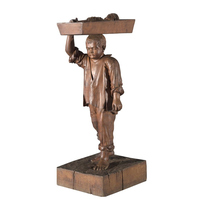
Contained gestures, implied narrative, unsettled viewing, and the avoidance of identification could be potently combined. In the shadowy painting Mother and Daughter by María Luisa Puiggener—one of the few women artists featured—we find ourselves physically close and at a tilting angle to a begging mother and child made of large swathes of black with contrasting white and flesh pink. Despite our proximity, the mother twists away from us, lips parting as if to say something, looking through black bars presumably at some unseen figure. Faced with the resonant force of her poverty and desperation, impressed in stark forms and colors, the observer cannot reductively identify with the woman, definitively tell her story, or comfortably frame her. Something similar may be said of the Filipino sculptor Gaudínez y Javier’s remarkable El arraigo de las costumbres (The Rootedness of Customs; fig. 12). The bold, almost outline forms of a young male, carrying on his head a box with a little girl’s corpse, are conjured out of a solid piece of wood and through the modulated monochrome of its textures. The dead body cannot be easily seen, and the coffin bearer lowers his eyelids, his head tilted downward, as he trudges forward making no great gestures of grief.
Did the vanguard arise because all these techniques and devices proved inadequate to the Restoration’s strained realities, as the catalogue suggests? The images displayed in Art and Social Transformations might seem to tell a different story, one made visible by the gathering of such varied art together by theme. What is thought of as the vanguard exhibited many continuities with the self-aware complexity of observational realism. The provocative techniques of the observer-artists were widely replicated among vanguard artists: as we have seen, realism, representation, and the role of the observer, had been continually in question over these decades. The blanked-out faces and contained gestures are found in Nonell’s Study of a Gypsy, the tilting viewpoints and awkward juxtapositions in Regoyos’s view of Sardineras en Fuenterrabia (Sardine Sellers in Fuenterrabia, 1897; Juan San Nicolás Collection, Madrid), the mass of black backs pointedly turned to us in the latter’s The Servants of Mary (1891), the potent gazes pressed up against us in works by Romero Torres or in Juan Gris’s Educación de príncipe (Prince’s Education, 1909; private collection). As with literature, so with the visual arts, an unsettled self-awareness of the viewer’s and artist’s observation, and of the manners of observing, pervade widely different forms of art from the 1880s to 1910 in Spanish-held territories.
But the opportunity to see the vanguard among so many of its contemporaries and immediate predecessors brought one stark difference into relief. The distinguishing feature boils down to something apparently simpler than all those sophistications of vision. The works by Nonell, Regoyos, Gris, even Romero Torres offer far less descriptive detail than, say, Fillol’s social paintings—as is generally true also of early Spanish modernist novels relative to Galdós and Pardo Bazán. The divergence from the late nineteenth-century realists and naturalists is signaled by the relatively greater tendency to simplify outline forms, to distort objects and bodies, and to aggressively flatten spatial depth. That divide indicates the revisiting of a deep nineteenth-century preoccupation: how to locate sense—however complex, equivocal, or even gnomic—in the turbulence of unfurling history. Broadly put, during the Restoration, artists like Fillol reframed the turbulence of the century and its supposedly extravagant earlier art forms through relatively detailed, textured, descriptive observation. The latter, they assumed, would now disclose the sense of history, even if that sense was unsettled or uncertain. Manifestly, vanguard artists did not agree and found the relative emphasis on descriptive detail to be at odds with insightful vision, even as they shared in the provocatively self-aware treatment of observation. Either they concluded that relatively detailed description was not adequately disclosing the unfurling sense of history, or they doubted whether history had any such sense to be disclosed. While this amounts to an important debating point between two views of art, it does not necessarily constitute a final refutation of socially situated, highly descriptive observation. Nor was the latter simply superseded, as the exhibition amply testified: such art persisted alongside the vanguard.
Indeed, given its complex, unsettled manifestation in Spain, socially situated, descriptive realism could be reinvented from within to take on characteristics that are habitually associated with the vanguard. Arguably this is what happens with the two painters who in the early 1900s formed a dominant binary star in the Spanish art scene, admired by as experimental a writer as Unamuno: the Levantine master of light, Sorolla, and the somber-toned, Basque Zuloaga.[17] Turn-of-the-century visual (and literary) culture in Spanish-held territory cannot be reduced to an opposition between two wings, the vanguard and realism. Sorolla’s brightly painted Preparación de la sultana (Preparing Sultanas; see fig. 3)—displayed in the work section of Art and Social Transformations—is recognizable as a descriptive image of Valencian workers delivering grapes to baskets and transporting them onward on a palette. But the brushwork is now so broad and loose that even the looming figure in the foreground has a completely blurred face. The foreshortening and tilting are now so exaggerated, and the scene so multifaceted, that the painting becomes a patchwork of complex, contiguous zones of broadly painted light, that seem at once to connect with and detach from each other, from the multitude of green grape spheres to the blank expanse of brown, to the arch-framed background building that resembles a modernista painting, to the blur of grey-white out of which two figures emerge to the rear. In Sad Inheritance!, we find ourselves so close on the seafront, right behind the boys and priest, that the sea seems not so much to recede to the horizon as to rise up in a fearsome wall of dark, dismal blue and off-white paint, its lower third splattered with the pink blotches of the boys’ bodies. In such paintings by Sorolla, intensely sensual observation transfigures into sensuous hallucination.
Thanks to the multimedia approach of Art and Social Transformations, the visitor could see how social photography underwent parallel mutations. The great twentieth-century photographer, José Ortiz Echagüe’s Planchadoras (Women Ironing, 1905–09; University of Navarre Museum, Pamplona) are absorbed and attentive to their labor except for one who tilts her head and grins. Characteristically printing on carbon paper, Ortiz Echagüe blurs and softens the detail, leaving the women in a halfway house between generic female form and particular existence, almost blanking out their faces. The descriptive elements risk being overwhelmed by the formal pattern: a bright, shallow diagonal of white flanked by textured blacks and greys. In Ortiz Echagüe’s Sermón en la aldea (Sermon in the Village, 1903; University of Navarre Museum, Pamplona)—using long exposure again on carbon paper (217)—the resolution is so low that the features of the posed peasant congregation verge on somber caricature, as if foreshadowing Gutiérrez Solana’s paintings of the poor.
In Spanish-held territories, a long-standing and radically historicized view of subjecthood and creativity pervaded the turn-of-the-century concern with descriptive observation and with its capacity, or otherwise, to convey the sense of unfurling history. For decades, many educated people had envisaged both subjecthood and creativity as constituted, and continually reconstituted, out of reconfigured historical material. These debates saw a succession of rival reimaginings of the nexus between plural pasts and presents. The Restoration’s system of representation itself—its mode of expression, so to speak—was one such reconfiguration of dynamic historical forces: the monarchy, the Church, liberalism. The catalogue entries and essays draw attention to artists’ continuing obsession with revisiting art history as they responded to the Restoration’s reconfigurations. Barón provides important statistical information on trends among copyists working in the Prado. On this measure in 1901, Velázquez was utterly dominant with 450 copies to Murillo’s 178, Goya’s 60, and El Greco’s mere 14 (18). Across many late nineteenth-century paintings exhibited in Art and Social Transformations, we see Velázquez echoed in the predilection for relatively free brushstrokes and a subdued palette. But there is a marked difference from the reinventions of Velázquez earlier in the nineteenth century. Reaching an apex in Sorolla, the tendency is for thick, wide brushwork, conveying broad, rugged shapes. Socially situated, descriptive observation is embodied in bold, imposing—and sometimes literally muscular—physical form. If history carries a meaning that can be captured through observation, that sense now emanates through forceful sensual realities.
The departure from relatively detailed descriptive realism was brought about in a new nexus of connections between pasts and presents. Like other scholars, Barón notes the significance of El Greco’s rising star, a real novelty in art-historical taste (18). El Greco is channeled as much in the lightened palette of the later, more hallucinatory Sorolla, as in the elongation of bodies out of their anatomical shape in works such as Gutiérrez Solana’s The Outcasts. Meanwhile, the spatial disorientations and dream-like perspectives of Goya’s nightmare etchings are reclaimed, for example, in Regoyos’s Sardine Sellers in Fuenterrabia: the angle of the road is so steep, and its surface so nebulous, that the scattered, simplified female figures seem to lose their rootedness to the ground in an image of ontological uncertainty. Gutiérrez Solana’s Goyaesque grotesque, seen here in The Outcasts and Procesión en Toledo (Procession in Toledo, 1905; Casacuberta Marsans Collection, Barcelona) breaks vision into discernible strokes of paint. As is implied by the genealogy set out in the Reina Sofía’s 2024 exhibition on Esperpento, such distancing, fragmenting effects appear more reminiscent of Goya’s successor in grotesquerie, Lucas Velázquez, than of the former’s own works.[18] Reconnections to the mid-nineteenth century are apparent too in the similarity between Sorolla’s agglomerations of sections of light and Fortuny’s decentered patterns of color, or in the resemblance between Eduardo Rosales’s exploration of nuanced monochrome—notably in his portrait of Concepción Serrano (1871; Prado Museum, Madrid)—and Nonell’s images of gypsies and “cretins.”
The tensions over how to reconfigure historical material are vividly manifest in efforts to reimagine Velázquez and Murillo’s interplay between viewer and artwork. The tropes of aggressive gazing at the viewer and of pushing figures up through the fore of the image—so frequently seen in Art and Social Transformations—owe much to the example of Velázquez’s bufones (jesters), Meninas (1656; Prado Museum, Madrid), and El triunfo de Baco (The Feast of Bacchus, 1628–29; Prado Museum, Madrid), as well as Murillo’s trompe-l’oeil self-portrait (1670–73; National Gallery, London) and Mujeres en la ventana (Two Women at a Window, 1665–75; National Gallery of Art, Washington, DC). Historic Spanish realism and self-aware techniques of observation were entwined in painting, as they were in the novel from Miguel de Cervantes’s Don Quijote (1605–15) to Galdós. But, while this unsettling experience of vision offered a continuity between relatively detailed descriptive realism and the vanguard—as it did between the former and Lucas Velázquez’s earlier ludic painting—it equally served to express profound divergences. Romero Torres’s brothel scene, Vividoras del amor (Living from Love, ca. 1906; Fondos Artísticos de la Fundación la Caja de Canarias, Las Palmas), is a powerful case in point. With its female models staring at us as if we have arrived in the room, it directly recalls Velázquez’s Meninas; the compositional parallels go so far as to include a figure coming through a doorway to look out at the viewer. Evidently, the fusion of Velázquez’s iconic scene of Spanish imperial royalty with a depiction of prostitutes is at once provocative and disconcerting. But, by setting it next to Gonzalo Bilbao’s The Slave, from two years earlier, Art and Transformations shows that the mixture of brothel-life and the Meninas was not of itself a novelty. While Bilbao’s image is far more luridly decadent, and his models’ gazes far more obviously lascivious, it was Living from Love that was banned from the National Exhibition for immorality—with Bilbao’s vote assisting its expulsion, the catalogue tells us (290–91). Romero Torres’s dark-skinned, clearly lower-class women stare hard at us almost without expression, their bodies, clothes, and surroundings reduced to correspondingly austere blocks constituted by subdued strokes of color. The painter emulates the disturbing facial indications of detachment from personal emotion that we encounter—presumably unintentionally captured—in the “erotic” photography displayed in Art and Social Transformations, while removing the clearer emotional prompts like smiles and putatively seductive poses. Citing the contemporaneous critic Francisco Alcántara, the catalogue underlines the denunciatory force of the image (291). More significantly, the starkness of the painting effects an overwhelming atmosphere of alienation: the lack of detailed descriptive elements and indicators of emotion leaves the viewer with few bearings.
As in previous decades, so at the turn of the century, the continual reconstruction of the historical subject involved the piecing together of diverse sources and art forms. Sorolla’s newspaper banner for El Pueblo fuses the French Republican icon Marianne with a folk image of a Valencian peasant. To the left, it offers an updated version of seventeenth-century Spanish trompe l’oeil as the woman seems to stretch out of the banner itself into three dimensions, bearing newspapers, whereas to the right, we see flattened, schematic, art-nouveau-like Valencian oranges. As is apparent in Sorolla’s design, historical reconstruction did not rest on an isolationist vision of local tradition, but on dynamic interconnections between materials from Spanish-governed territories and the wider world. Joaquim Mir’s La catedral de los pobres (The Cathedral of the Poor, 1897; Carmen Thyssen-Bornemisza Collection, Madrid) manages to combine an assertive beggar—who recalls Velázquez’s bufón paintings—to the fore at the right, with Naturalist-like huddled companions, a blur of Post-Impressionist light, and the rising forms of the Catalan monument that is Gaudí’s Sagrada Familia. More generally, as we have seen, mainstream social painting merged the French vogue for naturalism with reinventions of velazqueño facture and composition. The catalogue notes how some critics accused Luis Jiménez Aranda’s seminal A Hospital Ward of being too French—and indeed its sharp, cool lines are at odds with velazqueño social painting. But even this work seems to include a sly allusion to Velázquez’s Meninas: a figure has come through a door at the back of the room, a reminder of the Velázquez masterpiece and thence of the latter’s complex exploration of the gaze.
Yet, for all this interaction with Spain’s art historical past, the word Spain was the elephant in the many rooms of the exhibition. The overtly transnational flavor of much of the art displayed in Art and Social Transformations is far more than an ongoing effort to navigate the place of Spanish-governed territories in the wider world, following the successive shocks to the old empire. The issue goes beyond even the question of the plurality of peninsular territories, and the inclusion of the overseas empire—to all of which the catalogue and exhibition labels nodded. Several of the major works displayed were not only made outside Spanish-governed territories but address the social realities of France and specifically Paris. Joaquim Sunyer’s Rue des Abbesses (ca. 1901; Juan San Nicolás Collection, Madrid) is self-evidently located outside Spain; Anglada-Camarasa’s La dama del penacho (Lady with Plume, ca. 1902; Masaveu Collection, Madrid) depicts Parisian nightlife; Juan Gris’s Prince’s Education is a satirical portrayal of wealthy Parisians destined for publication in Le Témoin. As is widely known—and as the catalogue frankly acknowledges—by 1900 some Spanish-born artists not only spent a great deal of time abroad but were to a greater or lesser extent integrated in the Parisian art scene. Some lived for years in France. Parisian dealers had provided a lucrative outlet for commercial artists since at least Fortuny’s lifetime in the 1860s and 1870s. By 1900, Spain offered a limited number of exhibition venues—dominated by official exhibitions—whereas Paris’s combination of art dealers and opportunities for independent exhibition lured numerous artists who mingled with their naturalist and vanguard counterparts. As Barcelona developed a robust visual art culture in its own right, the direct connections of its artists to Paris strengthened, at times bypassing Madrid. If we are to speak of the adequacy of artistic form to other social realities at the turn of the century, we are sometimes speaking not just of the social realities of the Restoration but those of the French capital (among other places). The Spanish-born artists who came and went to Paris often navigated not only the Restoration’s systems and crises of representation but those of the French Republic.
To no insignificant extent, this development accounts for the later renown and influence of Miró, Dalí, and Buñuel across Europe and America. The greatest beneficiary in this period was, of course, Picasso himself. In Art and Social Transformations, the viewer was able to meet the young Picasso among his compatriots and contemporaries in all their variety. We could see how Picasso shared with many others that acute awareness and unsettled experience of situated observation which we have encountered so often in this review essay. As early as Science and Charity, we find split and absorbed viewpoints, embodied here in the doctor gazing at his watch as he measures the pulse, the nun and child looking on in tenderness, and then the patient herself looking up: no-one’s eyes are clearly visible. In Entierro en el campo (Burial in the Countryside, 1900; Museu Picasso, Barcelona)—as Picasso departs from relatively detailed descriptive observation—we find ourselves faced with the backsides of an utterly blurred procession, while the landscape seems to tip up and press toward us. The aggressive gaze from a figure pressed to the fore of the image is to be found in The Waiting (Margot) and in La Nana (Dwarf Dancer, 1901; Museu Picasso, Barcelona) and combines, in more abstracted form, with a contrasting viewpoint in Fauna de taberna (Inn Fauna, 1900–01; Museu del Cal-Ferrat, Sitges). While Picasso had all this in common with other Spaniards, in the brash, violent colors and paintwork of The Waiting (Margot) and Dwarf Dancer, we find him immersed in the distinctive vanguard attitudes of Third Republic Paris in the early 1900s, the “sheer creative aggression” that Thomson argues was needed to take on the “dominant aesthetic” of naturalism.[19] Through all these works Picasso engages in the continual reconstitution and reconstruction of art historical pasts and presents, national and foreign, that had characterized decades of culture in Spain. Margot, for example, combines a parodic imitation of pointillism with reminiscences of Spanish images of majas, and loosely of the hair and headwear of Goya’s La duquesa blanca (The White Duchess; 1795; Palacio de Liria, Madrid); as the catalogue notes, its recollections of the Spanish grotesque appealed to French visions of the Hispanic, and Picasso was even dubbed “Le Petit Goya” (284). In Burial in the Countryside, the catalogue entry finds a combination of Munch’s expressionistic style with techniques from Rusiñol (256–57). Of course, the fact that Picasso creatively and playfully combines visual allusions does not necessarily guarantee liberation from oppressive implications of any preexisting imagery—such as misogynistic depictions of women—that he might incorporate.
What really stood out against the backdrop of Art and Social Transformations was Picasso’s fabled, mercurial capacity for daring metamorphosis and stylistic inventiveness, for better or for worse. Not since Lucas Velázquez decades earlier had a Spanish-born artist so continually mutated his style through the citation, emulation, and provocative combination of other artists, past and present. Perhaps, amid the plural, competing visions encountered in the Spanish Restoration, exacerbated by those he discovered in the French Republic, Picasso concluded that the one truth of observation was its continual harlequin-like metamorphosis. On that account, Picasso came to resist the very assumption that an artist should have a “style,” as Elizabeth Cowling has persuasively argued.[20] Some of his compatriots were simply appalled. Following Picasso’s turn to Cubism, Rusiñol wrote Unamuno expressing his loathing—which the great Spanish thinker and novelist shared—with regards to “a Catalan [he was not Catalan] called Picasso, who has done japonisme, pointillisme, painting à la Cézanne, à la Van Gogh, à la Gauguin, etc., and I will not go on, because I would need much more paper to recount his infinite changes. The truth is that this Picasso person wants people to talk about him, and in somewhere like Paris it’s necessary to go into the Salon with a blunderbuss firing left and right. In sum: there is no sincerity.”[21] If we compare early Picasso to, say, contemporary works by Sorolla—as the exhibition and catalogue enable us to do—the grounds for Rusiñol’s concern are clear. While Picasso’s compatriots might unsettle descriptive observation and mix styles, while some of them might also push back against relatively detailed description, they work through their artistic challenges from painting to painting in a determined, almost methodical way: it is possible to discern an obvious critical thread through their trajectory. In contrast, Picasso leaps abruptly between utterly disparate artistic visions.
But, if we take seriously the many commonalities between Picasso’s art and that of his compatriots at the turn of the century—and indeed throughout the nineteenth century—if we think of him in terms of the transnational visual culture of the Restoration, we might come to a different conclusion. For many artists, the overriding concern was to inculcate an unsettling awareness of socially situated observation, to strive for insight into history’s competing viewpoints, to reconstruct the subject, like Frankenstein’s monster, out of the plural materials bequeathed by diverse pasts and presents, national and foreign. If Picasso—born in Málaga in 1881—was indeed a child of Restoration Spain, what he brought to these preoccupations was a fevered, even manic relentlessness, casting up and discarding one configuration after another, obsessively aware of the multiple possible outcomes and combinations of this undertaking.
Art and Social Transformations was a vast, extraordinary exhibition, and its catalogue will have a long afterlife as a resource for those interested in the visual culture of the Restoration. Its many rooms boldly reintroduced the public to Spanish social painting and to related arts across multiple media, interweaving these with the turn-of-the-century vanguard. If the exhibition and catalogue perhaps did not offer a compelling interpretation of Restoration visual culture, they were a generous invitation to think with similar boldness about the implications of seeing all this diverse, contemporaneous work together. Out of the tense compromise of the Restoration—its “system of representation”—and the forces resistant to it emerged visual cultures imbued with an acute, inquisitive awareness of the situation of the embodied observer in a social world constituted by observers. These artists were worthy heirs to Spain’s self-reflexive Baroque. They struggled continually to reconstitute national cultures out of the plural legacies of past and present and were sometimes immersed as much in Paris as their native lands. Some artists sought to bring the sense of history—however equivocal or complex—out of relatively detailed descriptive observation, embodied in forceful sensual realities, conjured in broad, sober brushwork and composition. They hoped to find a temperament and disposition—that of the “greatest of observers”—that would serve to navigate the social turbulence. Others, either doubting that such descriptive observation could yield the answers or plunging deeper into its visual complexities, revisited those historic legacies, hoping to become “the greatest of observers” through spatial disorientation, simplified forms, physical distortions, and hallucinatory colors. But—at least at the turn of the century—visual culture in Spanish-held territory cannot solely be described in terms of an opposition between vanguard and realist artists, given the shared commitment to questioning realism and representation. Into this charged atmosphere came the young Pablo Picasso, at once the child and renegade of the Restoration, frantically reinventing the legacies of past and present, relentlessly reconfiguring the situation of the self-aware observer.
Notes
[1] “Terrible, pero valentísimo dogma: un desafío formidable de la fe, rodeada por la incredulidad de un siglo que se ríe.” Leopoldo Alas, La Regenta (Madrid: Penguin, 2015), 298.
[2] “liquidación de todo el arte anterior.”
[3] Jo Labanyi, Gender and Modernization in the Spanish Realist Novel (Oxford: Oxford University Press, 2000).
[4] Specifically, on the visual arts, see Lou Charnon-Deutsch, Hold That Pose: Visual Culture in the Nineteenth-Century Spanish Press (University Park: Penn State University Press, 2008).
[5] A nuanced account of the female gaze is to be found in Vanesa Rodríguez Galindo, Madrid on the Move: Feeling Modern and Visually Aware in Nineteenth-Century Madrid (Manchester: Manchester University Press, 2021).
[6] Óscar Vázquez, The End Again: Degeneration and Visual Culture in Modern Spain (University Park, PA: Penn State University Press, 2017), 103.
[7] Richard Thomson, Art of the Actual: Naturalism and Style in Early Third Republic France, 1880–1900 (New Haven: Yale University Press, 2013), 72.
[8] José María Portillo Valdés, Una historia atlántica de los orígenes de la nación y el estado: España y las Españas en el siglo xix (Madrid: Alianza, 2022), 300–01.
[9] Thomson, Art of the Actual, 63.
[10] Emilia Pardo Bazán, La Tribuna, ed. Benito Varela Jácome (Madrid: Cátedra, 2020), 58.
[11] “gustaba de los argumentos abiertos a la interpretación.” See also Vázquez, The End Again, 72–73.
[12] “la novela nacional de pura observación,” “¿qué fue Velázquez sino el más grande de los observadores?” Benito Pérez Galdos, “Observaciones sobre la novela contemporánea en España,” Revista de España 57 (1870), 161–72.
[13] For Fried’s account on nineteenth-century Realism in terms of absorption and theatricality see Michael Fried, Courbet’s Realism (Chicago: Chicago University Press, 1990); Michael Fried, Manet’s Modernism (Chicago: Chicago University Press, 1996).
[14] “Todos trabajábamos en el laboratorio: ellos, abstraídos en sus investigaciones, sin preocuparse poco ni mucho por mi persona; yo, ajeno por mi parte a sus trabajos científicos, y solo preocupado de las líneas, luces y colores de sus rostros, y en general de sus figuras.”
[15] For these aspects in hegemonic countries of the West in this time, see Jonathan Crary, Suspensions of Perception: Attention, Spectacle, and Modern Culture (Cambridge, MA: MIT Press, 2001).
[16] On realism, the imagination, and sobriety, see Andrew Ginger, “Realism and the Fantastic: Revising the History of Nineteenth-Century Spanish Literature,” Siglo Diecinueve 30 (2024): 305–28.
[17] Miguel de Unamuno, Zuloaga y la pintura (Madrid: Casimiro Libros, 2017), 22.
[18] The rediscovery of Lucas Velázquez had begun in 1905 when the collector Lázaro Galdiano began to seek out his paintings. That said, it is not inconceivable that some early twentieth-century artists conflated works by Goya with those by Lucas Velázquez, as had sometimes happened in previous decades.
[19] Thomson, Art of the Actual, 107.
[20] Elizabeth Cowling provides an extraordinary account of Picasso’s capacity for and obsession with stylistic metamorphosis in Elizabeth Cowling, Picasso: Style and Meaning (New York: Phaidon Press, 2002).
[21] “un catalán llamado Picasso, que ha hecho japonismo, puntillismo, pintura de Cézanne, de Van Gogh, de Gaugin, etc., y paro, porque necesitaría mucho más papel para contar sus infinitos cambios. La verdad es que el tal Picasso quiere que se hable de él, y en un París hace falta entrar en el Salón con un trabuco a diestro y siniestro. Total: que no hay sinceridad.” Cited in Miguel de Unamuno, Zuloaga y la pintura, 58.