Konstantin Korovin’s Borderline Modernism: Vanguard Art and Imperial Expansion
by Christianna BoninChristianna Bonin is assistant professor of art history and theory at American University of Sharjah. Her scholarship and curatorial work focus on visual-art practices from the late nineteenth century to the present, in particular the cultural politics between Europe, Russia, and Central Asia. Her recent publications include “The Art of the Sixtiers in Soviet Kazakhstan, or How to Make a Portrait from a Skull” (Central Asian Survey, 2021); the coedited volume Soviet Materialities (Manchester University Press, forthcoming); and the exhibition This Other World: New Contexts for Modern Art After 1960 (Art Dubai, 2024), which focused on the cultural and political exchanges initiated by the Soviet Union in what was then called the Third World. She is completing the manuscript for her first book, “Soviet Orient: Art and Empire in Central Asia, 1900–75.”
Email the author: cbonin[at]aus.edu
Citation: Christianna Bonin, “Konstantin Korovin’s Borderline Modernism: Vanguard Art and Imperial Expansion,” Nineteenth-Century Art Worldwide 24, no. 1 (Spring 2025), https://doi.org/10.29411/ncaw.2025.24.1.2.
This work is licensed under a Creative Commons Attribution-NonCommercial 4.0 International License  unless otherwise noted.
Your browser will either open the file, download it to a folder, or display a dialog with options.
A redemptive modernism persistently “discovers” the primitive that can justify its own sense of emergence.
- James Clifford
In the early morning, wet rocks gleam merrily in the sun. They are covered with colored mosses, bright greens, and scarlet dots. . . . Past the low cliffs of the coast, sandy hollows open up and in them there are miserable low huts, with one or two windows. I open my case, grab my palette, and hurriedly add the paints. It is so beautiful, amazing . . . my hands are shaking, so much do I wish to paint this.
- Konstantin Korovin
He is a sort of Russian Henri Rivière, and is doing for his own country what our great lithographer and wood-engraver has done for Brittany and Paris.
- George Moore
If Europe really does need Russian art, what it needs is its youth and immediacy. . . . As soon as all these snow, lakes, fogs, and fir trees appeared and there was a smell of the north in the air, all doors opened for these artists. . . . They expected neo-Byzantine “mystical” painting, a Byzantine Puvis de Chavannes, so to speak.
- Sergei Diaghilev
Against a tempestuous, light gray sea, the artist Konstantin Korovin (1861–1939) painted the frigid Arctic sky as pink and lime rivulets and the rocky shore as violet dashes—forms that would be largely indecipherable if plucked from the context he made for them (figs. 1, 2). In another scene, he cast shadows in searing yellow and made the deep waters of the Siberian Lake Baikal glisten with mossy green marks (fig. 3). These and thirty-four other monumental panels by Korovin, each approximately 80 x 120 in. (2 x 3 m) and depicting landscapes within the Russian Empire’s vast territory, were hung across the walls of the empire’s Borderlands Pavilion at the Universal Exposition of 1900 in Paris.[1] For the undertaking, the French jury conferred on him gold and silver medals.[2]
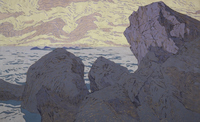
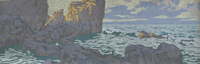

In their reviews of the exposition’s art displays, both Russian and European critics discussed the panels and the curious young artist, who up to that point had exhibited almost entirely in small-scale group shows in St. Petersburg and Moscow.[3] But in Paris, Korovin’s contributions proved unmissable. Writing in the British journal The Studio, the critic George Moore remarked that at a fair which otherwise revealed the “pretentious nullity” of Impressionism, approximating a “sepulcher, filled with the odors of decay,” Korovin stood out as an “earnest and original artist.”[4] In the artist’s depictions of the empire’s border regions, the journal found “gifts of the highest order” and included full-page reproductions of his panels of Turkestan and the Arctic north. Eminent Russian critic Alexandre Benois (1870–1960) concurred, writing that “such strength, such style, such beauty of tone and poetry . . . neither Korovin himself nor any Scandinavian or Finnish artists, who took on such charming northern motifs, has ever before achieved.”[5]
My interest here is not only in the panels’ role in Korovin’s rise to international fame but also in art history’s subsequent capacity to overlook them. For despite the awards they won and the critical praise they received in 1900, it would take over a century for the panels to again be exhibited as a group.[6] Even before the works returned to Russia in 1901, a place for them had been secured as “decoration” (ukrasheniye) in the ethnographic department of the imperial art collection, which was scheduled to open the following year in St. Petersburg.[7] Both their function as decoration and their location in the ethnographic rather than the art section of the museum have resulted in their marginalization in the canon of modern Russian art.[8]
This article advances a new interpretation of Korovin’s Paris panels by analyzing his work against the backdrop of territorial expansion during the age of empire.[9] Within this context, it will also examine an earlier set of panels depicting the Arctic north that he created for a pavilion funded by Savva Mamontov (1841–1918), a philanthropist, railroad tycoon, and Korovin’s biggest patron, for the All-Russian Arts and Industrial Fair of 1896 in Nizhny Novgorod. I demonstrate that the modernist aesthetic of both sets of panels arose in relation to uncompromising attempts to expand the empire’s railroad network. Further, Korovin’s particular ability to represent the empire’s border regions grew from his own conflicted position, challenging him to refract the interworking of an international art world as well as heated intellectual debates within Russia about the nature of the country’s cultural landscape and its relative “Westernness” or “Easternness.”[10] Drawing on W. J. T. Mitchell’s theorization of landscape as an “imperial vision” that projects outward into space and forward in time while also provoking inward reflection on the homeland, I approach Korovin’s panels first as a cognitive encounter with people, places, and the self.[11]
Korovin began to make art as the Russian Empire underwent rapid economic expansion under Finance Minister Sergei Witte.[12] Whereas in 1869 just over one thousand kilometers of railways existed in the empire, by 1914 every major city would be connected by rail.[13] Expedited overland access to the empire’s borderlands in the Arctic, Siberia, and Central Asia served important symbolic and practical functions in the drive to “discover” territories and link them. It encouraged more ambitious ethnographic, geographic, geological, and archeological undertakings as well as new forms of landscape painting—views accumulated in part from the panorama seen at high speed from train windows. Thus, as disciplines such as Oriental studies, ethnography, and geology grew in Russian academies to produce knowledge and accelerate access to human and natural resources, so too did Korovin have more opportunities to explore those frameworks and represent their subjects.[14] As the scale of his work grew from notebook-size sketches to the mural decoration of an entire building, Native communities were transformed into imperial subjects and land into landscape. Mobility, perception, and form came to intersect.
This dynamic has remained overlooked by scholars and critics who have long characterized Korovin as an interloper who sought to disrupt the ethos of St. Petersburg’s Imperial Academy of Arts, Russia’s foremost art school. Art historian Ilia Dorontchenkov has argued that for many members of the Academy at the end of the century, France-centered aesthetic approaches embodied “an ‘artistic’ principle that seemed inappropriate or at least untimely in Russia, masterly but hedonistic and often superficial.”[15] The Wanderers group (Peredvizhniki), which included the painters Ivan Kramskoy (1837–87), Vasilij Polenov (1844–1927), and Il’ya Repin (1844–1930), had formed in 1870 in the wake of the emancipation of the serf estate. While individual approaches varied, the group generally sought to give art in Russia a moral and social mission. Initially considered progressive in their frequent depictions of the countryside and hardships of rural peasant life, by the 1890s several of the Wanderers had joined the Academy, thus serving to indoctrinate their artistic approach as a Russian national tradition.[16]
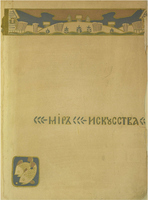
However, some members of the next generation of artists, which included Korovin, worked to shed the need to faithfully represent nature and art’s moral obligations. In 1899, Benois joined artist-critic Sergei Diaghilev (1872–1929) to establish the journal Mir iskusstva (World of art), aspiring to displace what they and their supporters perceived as the Imperial Academy’s deadening absolutes. They advocated against Russia’s provincialism, calling for renewal and criticizing the Academy and its supporters for trafficking in archaism and backwardness.[17] Korovin, who himself had lasted less than a year at the Academy, designed the cover of the inaugural issue (fig. 4). He depicted a forest village of wooden cottages—a symbol in Russian nationalist culture of the premodern, Slavic authenticity of the peasantry—but drew the cottages using the heavily contoured forms and flat zones of color favored by Symbolist and Postimpressionist artists in Europe who, in turn, were strongly influenced by Japanese art.
The premise that art in Russia might benefit from further heterogeneity appeared especially foolish to the critic Vladimir Stasov (1824–1906). Infamous among his contemporaries for his sweeping claims made vitriolic by profuse exclamation points, Stasov devoted his career to advocating for a national art grounded in the realist expression of folk motifs and social themes, which he believed ought to surpass art practices in Western Europe.[18] “What an idea! They want to rebaptize us in a new faith art!” he exclaimed of the publication’s interest in French art.[19] Stasov belittled Korovin’s cover image for Mir iskusstva in particular, reading its forms and colors as an alarming aesthetic choice:
So, for example, Mr. Korovin’s image of a “village” (probably Russian) at the top of the magazine’s cover consists of cottages, bushes, from such a perspective, and such a sky, which can be drawn only by a three-year-old who for the first time took a pencil in his hands and absurdly stained the paper. At the bottom of the cover, Mr. Korovin has put some kind of stamp of two intertwining fish, which may be very good for the Japanese and for bottles of ointment from some manufacturer, but in an art magazine (even a bad one) should not dare to appear.[20]
For Stasov, Korovin’s interest in the problem of representation precluded representation of the particular. Reifying Russian art as pure and realist, Stasov framed Western modernity as a source of cultural pollution and debased consumer goods. In this view, Korovin’s village could hardly be read as authentically Russian.
It is ironic that at the same time that Korovin’s panels with their rough facture, thick contouring, flat surfaces of color, and illusionistic perspective were being framed by Russian critics as crude and “Western,” a younger generation of artists in Russia was beginning to embrace such techniques in order to herald their radical “Easternness” and reverse the critical prejudice that cast Russian art as derivative of Western (French) modernism. Natalia Goncharova (1881–1962), Mikhail Larionov (1881–1964), and many other self-declared Neoprimitivist artists in fact studied in Korovin’s studio at the Moscow School of Painting in the late 1900s and 1910s.[21] Within a decade, the correspondence that Korovin’s panels suggested between borderland territories and new art would reemerge, reattached to the goals of his students and their contemporaries as avant-garde. Primitivism, read into the productive assimilation of conquered or “othered” cultures, has often been an artistic vanguard’s first remedy to the problem of cultural tradition.[22] In Korovin’s studio, his pupils witnessed the artist using an approach that he had been honing for theatrical set designs since the late 1890s.[23] The Neoprimitivists began collecting ancient artifacts from around the empire, drawing formal similarities with them and building what became by 1910 an aesthetic credo of “barbaric” energy embraced by artists such as Aleksandr Shevchenko (1883–1948), Vladimir Tatlin (1885–1956), and Kazimir Malevich (1878–1935).
That Korovin’s boldest modernist expressions ended up historicized as decorative and ethnographic objects—constructed categories to signal nonmodernity—reveals that the parameters distinguishing “fine art” from the “decorative” and the “ethnographic,” and the “native” from the “foreign,” blurred as critics, artists, and political officials debated art’s purpose. The label “decorative” highlighted the flatness and abstraction of his panels, causing his work (and that of many modern artists to come) to be rejected as art.[24] However, those “decorative” qualities also constituted his panels’ modernity and, as this article demonstrates, ultimately supported new contexts and techniques for art production and display in Russia and a subsequent generation. It is in Korovin’s depictions of the peoples and terrains of the Russian Empire’s borderlands as “others” of incommensurate progress—and in his own eventual historicization within Russia as an “other”—that we can begin to trace the ways in which historical agency transforms.
Seeing the Borderlands
Korovin’s contact with the sheer expanse of the Russian Empire began as part of an official study expedition in the summer of 1894, organized for and attended by Witte himself. The journey contributed to broader, concerted efforts to further integrate and consolidate the territory. Containing hundreds of ethnicities, the Russian Empire stretched for much of the nineteenth century from Poland in the west to Alaska in the east, and from the Arctic Ocean in the north to the Black Sea in the south, raising persistent questions among representatives of the tsarist state regarding how to defend and control its vast lands. An expert in railway management, Witte envisioned the railroad and the economy as a conjoined whole which would strengthen itself by increasing the connection between the upper estates and peasant and borderland populations.[25] The railway system was thus conceived as an actual and metaphorical driver of not only state-sponsored economic expansion but also of political control and cultural integration. At the time, Mamontov’s company was constructing the Moscow-Archangelsk rail line, which provided expedited and expanded access to the White Sea. It was this very railroad that carried the expedition north.[26]
Upon Mamontov’s invitation, Korovin traveled north with a group of journalists and government officials by rail and ferry from Moscow to Lapland, northern Sweden, and Norway, and the Russian Empire’s territory around the White Sea. Scouting the Kolsky Peninsula for resources as well as for sites for possible settlement and a port above the Arctic Circle was a central concern of the trip.[27] Korovin’s diary from the journey reflects a sense of awe over human penetration into unexplored land: “the forests are cut straight and in a wide strip,” he wrote, “and the rails are already laid unevenly. . . . All around are endless, mighty forests. For centuries they grew, died, fell, grew again.”[28] But as the writer Evgeny L’vov-Kochetov described in what became a best-selling travelogue, the trip was also intended to impact Russia’s broader expansionist consciousness,
the feeling of a sensible and conscious patriotism—the manifestation of all of this closely linked with growth of our interest in our far east and our far north—an interest that little by little is captivating all Russian society.[29]
Here, L’vov-Kochetov conveys that an idea of a cohesive empire depended on generating images of an accessible and controllable landscape.[30]
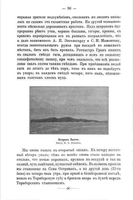
Interspersed throughout the travelogue are some of the hundreds of black-and-white photographs and reproductions of watercolors and small-format oil studies that Korovin made outdoors in frigid conditions during the trip (fig. 5).[31] While the text does not directly discuss the images, they nevertheless provide an evocative visual addition to the places and populations that L’vov-Kochetov describes. Landscapes of whales splashing in icy waters, captured in wispy brushstrokes; character studies of Native populations posed stiffly in frontal views and in profile; fishing boats and a bustling seaside market: these images portray the north as a place that is not hostile but safe and fertile, a terrain open to human intervention and nature’s putative indifference to it.[32] The images provide no indication of the discomfort that Korovin describes in his diary: “it is impossible to paint from life during the day: myriads of insects, mosquitos, horseflies bother.”[33] Instead, distributed in book form, Korovin’s landscapes and photographs work to inscribe the empire’s claims on the north while eliminating those of Native populations. Such travelogues—often misread historically as neutral and authoritative—contributed to the ongoing positivist project of gathering and analyzing the peoples and places within the empire.[34]
Undergirding Witte’s instrumentalization of the railway in service of the empire’s unity was a larger concern that the empire’s diversity might hinder its longevity. Since the reign of Tsar Aleksandr II (1855–81), Russian political and intellectual elites had engaged the European Romantic tradition, considering efforts made by the French and British Empires to build national communities and debating whether the Russian Empire’s eastern and southern borderlands could or should be further integrated into a pan-Russian political and cultural sphere.[35] Simultaneously, the Russian Geographic Society and the Imperial Academy of Sciences began to dedicate themselves to the study of non-Russian populations as the government continued to annex land.[36] Unlike the British and French Empires, the Russian Empire was geographically contiguous rather than divided by sea, which raised further concerns as to whether Russia might be conceived as a singular nation, with a particular basis for social, political, or even cultural unity, grounded in the common historical experience of a population that lived together on one land mass.[37] By the end of the nineteenth century, however, historians and ethnographers had also established a strong sense of which groups constituted Russian and non-Russian populations. The western provinces, Siberia, and the Volga region, which had historically been populated by East Slavs, were integrated into Russian national space. Other borderlands such as the Far North, the Caucasus, and Central Asia, were considered colonial domains.[38] Such views were supported by ethnography’s conventional proclivity for what Johannes Fabian has called the “denial of coevalness”—that is, the relegation of an object of study to a past time, one unsynchronized with the present.[39]
As Russian intellectuals debated their relative cultural, social, and ethnic proximity to non-Slavic populations around the empire, so too did they debate the validity of the categories of “East” and “West” as European constructions. Among imperial Orientologists, there was disagreement about whether Russia itself represented a cultural convergence (sblizhenie) of East and West, and whether there was any essential difference between the categories.[40] Such debates indicate that by the time Korovin embarked on a train to the Arctic, Russian political and intellectual elites not only were sensing but also critiquing their relative difference from Europe. Simultaneously, they established a wide-ranging imperial apparatus for the study and domination of their own “East.” This process was fraught by the problem of determining whether or not the Russian Empire itself was “East”; or, in other words, if “East” was in fact external or internal to the empire itself. The philosopher Alexander Etkind has described this process of representing and exploiting the empire’s interior provinces as an “internal colonization.”[41] Thus, despite (or perhaps due to) the claims of unity and cultural pluralism among the empire’s populations, the efforts of Russian elites to find their “Orient” reveals an unresolved cultural anxiety when confronted with the very multiculturalism that their efforts produced.
Korovin’s diaries from the period reveal his sensitivity to these broader cultural dynamics, recounting professional setbacks and grueling self-criticism. His struggles largely revolved around his status as a maverick within Russian art circles and an outsider in Parisian ones. In 1888 and 1889, he traveled across Italy, Spain, and France, returning to Paris for a longer stay between 1892 and 1893. French muralist Pierre Puvis de Chavannes (1824–98), whose broad planes of muted color and mystical subjects were celebrated by Gauguin and Vincent van Gogh (1853–90), received specific praise in Korovin’s diary. He ruminated in 1893:
Here they are, the French! Light colors, that’s it . . . there are many things that we have, but there is also something completely different. Puvis de Chavannes—how beautiful! And the Impressionists. . . . Everything that I’m scolded for at home in Moscow, I found in them.[42]
In another note, he reflected on his ostracization in Europe:
There was one curious review, I forgot in which Parisian newspaper, where the authors said that in a Russian artist, they would like to see the features of an Asian, but this is not Korovin, since he looks like a European. I thought, “here is yet another sin.”[43]
Here Korovin’s race and his aesthetic approach function as signposts of alterity, as visible markers of his otherness: in France, because of a lack of the exotic frisson of cultural difference, and in Russia, because of a dangerous drift of identity toward its western neighbors.
Both Korovin and Mamontov understood that these desires and anxieties were permeating Russian and European societies at the time and fueling the momentum that stood to be gained from invoking such tensions within “high” art.[44] The railroad—a mobilizer of capital, of Russia’s industrialization through trade across the empire and internationally, and of private entrepreneurship—also carried Korovin to the empire’s borderlands, with both artist and railway generating scenographies of these territories for Russia and the wider world. To promote the undertaking, Mamontov funded a Far North Pavilion for the All-Russian Аrts and Industrial Fair in Nizhny Novgorod in 1896 and, to create a platform for an emerging artistic vanguard, hired Korovin to design it.
Novaia Zemlia:[45] Korovin, the Far North Pavilion in Nizhny Novgorod, and the Shock of Encounter
By 1896, Korovin’s art had attracted the support of the affluent Mamontov, yet the critical reception of his work in Russia remained tepid. Changes in the Russian art establishment in the 1890s, particularly the tightening of admission requirements and the jury system at the Imperial Academy of Arts, created conflict with reform-inclined artists and patrons. Leading artists like Repin and Polenov, who had also become discouraged by these developments, tried to embolden younger artists outside the Academy by supporting artist-led, jury-free exhibitions and displays of a wider variety of work, including sketches.[46] As an active member of the Moscow Society of Art Lovers, Mamontov, together with Polenov, established the Moscow Association of Artists in 1895 as an alternative to the Imperial Academy of Arts as a sponsor of art exhibitions. It supported artists, including Korovin, who worked in less established art media or in formats like decorative crafts or in styles other than traditional realism.[47]
The collaboration between Korovin and Mamontov on the Far North Pavilion gives credence to the idea that the modern might often initially appear as a peripheral phenomenon. Staged outside of—but in strategic view of—the better-known art and commercial centers of St. Petersburg and Moscow, the fair in Nizhny Novgorod furnished an opportunity for Korovin to distinguish his work in technique, scale, and subject matter. The Far North Pavilion also allowed Mamontov to support experimental artists more publicly, in turn associating his railways with an aesthetic rejected by the Academy. Both Korovin’s art and Mamontov’s industry could thus take on a critical edge and resonate as modern, in that both challenged habits and public taste and framed the Academy as a bastion of tradition. The move recalls one made a half century earlier by Emperor Napoleon III, who endorsed a Salon des Refusés at the 1863 Paris Salon as an imperially sanctioned, populist challenge to the art establishment. It featured over two thousand works rejected by the jury of the official Salon that year.[48] Though critics lambasted the works that were exhibited (by Gustave Courbet [1819–77], Édouard Manet [1832–83], and Camille Pissarro [1830–1903], among others), the exhibition’s distinctive space and the negative criticism fueled public attention, subsequently validating the rejected artists as a vanguard. Similarly, as Mamontov made space to display his ability to reshape the land and ways of life through infrastructural expansion, so too did he usher in cultural change.
Located at the crossroads of the Oka and Volga Rivers, over one thousand kilometers southwest of the imperial capital St. Petersburg, Nizhny Novgorod and its rivers constituted a key commercial site for goods moving between northern Russia and Asia. As early as 1366, a robust market existed at this watery intersection. However, by 1896, it was paradoxically the expansion of the Trans-Siberian Railroad, which diminished the city’s economic and political relevance, that Witte, the fair’s organizer, intended to highlight.[49] Published commentary on the exhibition reveals that its organizers intended the display as a riposte to the Paris Exhibition of 1889. The fair would counter the Eurocentric vision of Russia’s peripherality not only by displaying its artistic and industrial achievements but also by foregrounding the extent of its colonialist ambitions. The popular writer Maxim Gorky (1868–1936) observed that the organizers sought to “increase interest in the exhibition and attract foreign guests to it by arranging a number of ethnographic settlements, following the example of the Paris Exhibition in 1889.”[50] Such displays were grounded in the institutionalized taxonomies of Orientalist studies and the structures of colonialism.[51] A. S. Shustov sets forth the expansionist mindset in the introduction to the fair’s catalogue, noting that “the very motives for choosing Nizhny Novgorod for the new All-Russian fair were connected with the need to better clarify the conditions for the development of such rich and vast areas as Siberia and Central Asia possessions.”[52] In particular, the fair placed “cultured states (kulturnye gosdarstva) in close connection with the people (narodnosti).”[53] Here, “cultured states” implies an abstract, civilized body, with the “crudities” (crafts, foods, and animals) of the empire’s “peoples” posed dialectically against it. In Nizhny Novgorod as in Paris, the exhibition constructed a “primitive” pendant to demonstrations of the empire’s industrial modernity: the construction of pavement, and electric streetcars and street lighting (both new phenomena in Russia). At the center of the exhibition was the world’s first diagrid hyperboloid steel water tower, constructed by the engineer Vladimir Shukhov, which prompted Gorky to call the fair a “hill of light.”[54]
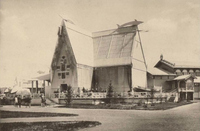
Korovin’s design for the Far North Pavilion represents a vision of imperial borderlands as sites with ample and accessible raw materials, while the lives of Native populations exist, paradoxically, in undisturbed harmony (figs. 6, 7). The wooden clapboard building featured a stark pitched roof, dramatizing the fishing warehouses used by northern traders. There was a cavernous entry with faux icicles and a sculpture of a growling polar bear, which further served to exoticize the human display of Native persons, forced to stand guard at the pavilion’s entrance. These individuals, described in the catalogue only with the generic and now-obsolete label “Samoyed,” are from a tribe indigenous to the Arctic north and were presumably kidnapped for the pavilion’s ethnographic display.[55] The interior juxtaposed raw materials and objects of research and trade—flora and fauna samples, fur pelts, whale bones—with a series of Korovin’s landscape paintings in oil, which lined the walls.
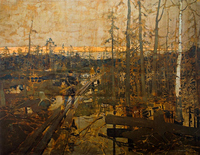
In his painting First Steps of Prospectors in the Tundra, viewers encounter Russian gold prospectors striding into the distance on a wooden path (fig. 8). Where the thick contours of tree trunks or branches intervene, the rectangles of light momentarily register as bark and a mossy green pond, set off as a steady flow of oranges, grays, and blues. Despite its poor state of preservation, the painting reveals an “untouched” land becoming a welcoming landscape, on the brink of transforming from a state of unproductivity into industrialized potential through mining. Narrow-Gauge Railroad Construction in the Tundra (1894–96; State Russian Museum, St. Petersburg), continues this theme with a depiction of deforestation. Narrow-gauge rails were favored by Russian prospectors because they could be laid quickly to support industrial transport—a necessary component of the empire’s agents moving into northern lands. The painting uses linear perspective to compel the viewer’s gaze into the distance, following the expansion of the railroad, of the human exploitation of land as a resource, and thus of imperial power itself. Such images expand Mitchell’s theorization of European landscape painting as “dreamworks of imperialism” to include the Russian context.[56]
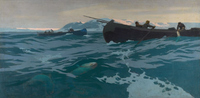
Other paintings, such as Catching Fish on the Sea of Murmansk (fig. 9) and Hunting for Walruses (fig. 10), depict scenes of predation and productivity among Native populations. Both canvases are large, nearly 80 x 120 in. (2 x 3 m). When installed in the pavilion, they would have thrust urban viewers into the action of these geographically distant places. In Catching Pike, Korovin fills much of the scene with frothy waves and icy blue waters teeming with fish. He tilts the image’s perspective upward such that viewers might imagine themselves also sitting on a wooden boat, about to be splashed, on the verge of making a catch. Hunting for Walruses uses a similar technique of oblique cropping to insert viewers into the scene’s drama. One hunter emerges from the lower edge of the canvas, approaching the resting animals, one of which is already contorted in death. Viewers see only the hunter’s back; thus, their position mimics his own. The hunter’s spear tip juts into the center of the canvas. There, at the tip of the spear, the viewer’s gaze encounters that of the prey. The hunter meets the hunted.
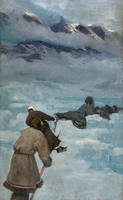
In representing these subjects, Korovin was depicting terrains, peoples, and activities that educated, urban audiences would have understood as the sites of speculation and ongoing imperial expansion. The four paintings imagine both machine- and human-powered “industry,” in which Native populations ostensibly willingly participated. Human subsistence in the Arctic tundra and subarctic taiga had generally revolved around reindeer—considered both prey and property by local communities—and the sea, where Native northerners hunted whale, seal, and walrus. With the mass invasion of Russian prospectors in the early nineteenth century, it was Russians rather than Native populations who increasingly controlled the fishing of the seas and hunting on land.[57] Overhunting, epidemics, and wars led to changes in reindeer-migration patterns, unleashing multiple and severe famines among many Native communities.[58] Crucially, unskilled Russian traders needed the abilities of Arctic Native groups to continue to hunt animals and dress furs. Because trading partners often did not share a language and feared one another, the trade was silent. As described by the British travel writer George Kennan in 1870, encounters took place in which deals were made at the tip of a spear:
[The Chukchi] would hang a bundle of furs . . . upon a sharp polished blade on a Chukchi lance, and if a Russian trader chose to take it off and suspend in its place a fair equivalent in the shape of tobacco, well and good, if not, there is no trade.[59]
Korovin placed a similar encounter at spear-point at the center of Hunting for Walruses. Faceless and unspeaking natives appear as violent hunters—a violence that nevertheless was encouraged by colonial trade. The artist evoked sympathy for the animals by infusing pathos into the wide eyes of the walruses. In his recollections about the pavilion, his account of “Vasily the Samoyed” mixes racist exoticism with a hint of humanity. He described Vasily and the live seal Vasek on equal terms: he brought both back with him to Nizhny Novgorod from his trip to the Arctic, and both communicate in grunts and eat live fish before a stunned audience, which, Korovin noted, included Witte and Mamontov.[60] Korovin then recounted an exchange between Vasily and Mamontov, when Vasily emphasized that the seals are in fact “sea men” who “love us, they live with us, and we do not beat them.”[61] This counternarrative moment, when Vasily speaks, is unique in Korovin’s recollections. The lines point to the misconceptions that arose from Vasily’s spatial—and temporal—dislocation to Nizhny Novgorod and Korovin’s depiction of Natives as “backward.”
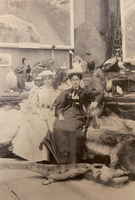
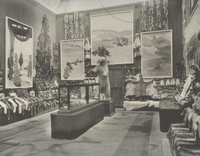
In turn, a photograph of Vera Mamontova and Olga Alyabeva, daughter and sister, respectively, of Savva Mamontov, dressed in silk summer dresses and reclining in the pavilion, can also be read for its violence (fig. 11). There are fossils and spearheads; fishing ropes and stuffed birds; even a taxidermized seal, upon which the tip of one woman’s parasol rests. Posed safely on a fur-covered bench, the women create a direct connection between animal and elite, female body. Unworked “crudities” on display in the pavilion thus transformed into tradable commodities and displays of knowledge, and inflicted damage on persons, animals, or nature remains invisible. In keeping with the goal of the pavilion, Korovin’s contributions showed only a productive future unity between the state and its diverse peoples and lands.
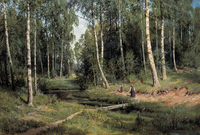
First Steps of Prospectors in the Tundra also reveals that Korovin created these panels to challenge the conventions of Russian landscape paintings. The landscape of the tundra is characterized by sparse ground cover in shrubs, lichens, and mosses. Permafrost is continuous. Yet the “tundra” Korovin painted, scattered with tall trees, actually resembles the types of thick forests popularized by his contemporaries to signal a national landscape. Particularly critical is the large white birch tree that Korovin included—the only bright and realistically painted tree in the scene. In the early nineteenth century, the Imperial Academy of Arts had heralded European picturesque landscapes and perspectives as models for Russian landscape painting. By the end of the century, however, naturalistic images of thick forests and vibrant plant and animal life had grown in popularity because they “facilitated the transition in the mind of the viewer between painted images and actual spaces—to native land.”[62] Artists such as Ivan Shishkin (1832–98) began depicting the pine and birch forests as deep, impenetrable, and untouched—radical counterpoints to the European ideal which privileged a view opening into space (fig. 12). The critic and archeologist Adrian Prakhov said of Shishkin’s contributions to the Paris World’s Fair of 1878 that they were “deeply national” (narodnyi), “not picturesque” or “wrapped up in the incidental effects of light.”[63] Neither were they scenes of desolation or a harsh climate, its lack of sustenance inimical to human life—reasons that the mid-century Academy had rejected Russian landscapes in an effort to emulate European practices.[64] Stasov went furthest to call Shishkin “the people’s artist” (khudozhnik narodnyi). Writing in 1892 with his typical nationalist vitriol, Stasov exclaimed that “all his [Shishkin’s] life he has studied the Russian northern forest, the Russian tree, the Russian thicket, the Russian wilderness. This is his kingdom. He has no rivals. He is the only one.”[65]
Korovin’s tundra is neither as deep as Shishkin’s birch forest nor as constructed as a picturesque view. By depicting the tundra with reminders of a birch forest, Korovin renders the “other” as a beautiful, familiar, and thus knowable landscape. In this sense, First Steps of Prospectors in the Tundra verges on the prototypical in that he, like Shishkin, transports the urban viewer closer to the rural world. In keeping with the subject of a prospector, however, Korovin nevertheless opens his forest scene to what Mitchell has called the “utopian fantasies of the perfected imperial prospect.”[66] This sense of a safely staged encounter with the raw wilderness was further enhanced by the elements Korovin transported from the north. As he noted in his diary,
I tried to give the pavilion the same impression that I experienced there, in the north. I hang unfinished polar-bear furs, put rough barrels with fish, seal skins, wool shirts, sea ropes, anchors, longlines, tackle, hooks, whale jaws, long skins of monstrous belugas. I was thinking about how to convey the special smell of the ocean and rocks. They take out the moss that I brought with me from the barrels and put it under the floor of the pavilion.[67]
Tundra melds with birch forest, unknown borderland with a familiar center, and the sweeping view with the wild forest.
Like Martin Heidegger’s definition of the “world picture,” which “does not mean a picture of the world but the world conceived and grasped as a picture,” these scenes intended to portray the Far North in a manner that was knowable to people in central Russia, using visual elements that dominated Russian academic landscape painting.[68] Yet in his aesthetic approach, Korovin nevertheless collided with assumptions about what the proper depiction of landscape should be. At times, he eschews shading and the perspectival thinning or lightening of lines, thus blurring distinctions between two and three dimensions. In Hunting for Walruses, irregular cropping and the incomprehensibly tilted figure of one of the hunters disturbs an otherwise stable series of relationships based on placement and color choice. Shallow space is thus confused with deep space. If the landscape promises to transport viewers to the north, the tilted hunter and twisting of scale trumpets the scene’s removal from the mundane, intelligible, sensitive world.
In both composition, coloration, and facture, Hunting for Walruses shares much with the visual strategies of contemporaneous Impressionist and Postimpressionist artists, whose work Korovin would have encountered during his travels to Paris. Like French Impressionists—and unlike Russian academic landscape painters—Korovin also titled his works using specific place names, like The Northern Lights at Hammerfest, rather than titles that reflect general conditions, such as “Birch Grove” or “Morning in a Pine Forest.”[69]
Korovin’s landscapes thus gestured toward, but contrasted with, those displayed in the nearby Fine Arts Pavilion. Organized by members of the Academy and the Wanderers group, the fine arts section featured the works of some three hundred artists and was among the fair’s largest pavilions. The jury rejected Korovin’s works in addition to those of several students of the esteemed painter Repin. Particularly scandalous was the rejection of young artist Mikhail Vrubel (1856–1910), as he initially had been commissioned to design two painted panels for the pavilion’s interiors. One panel, titled Princess Greza (1896; State Tretyakov Museum, Moscow), was intended to reference a popular international play which recounts a mythical pilgrimage for lost love. The other panel, titled Mikula Selyaninovich (1896; State Tretyakov Gallery, Moscow), envisioned a folk tale popularized in Russian literature.[70]
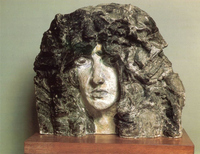
The stated reasons for rejection of these artists revolved around their “unfinished” (nezavershenyi) quality.[71] At the time, Russian academics often lobbed the pejorative term “unfinished” at works with brushy qualities associated with Impressionism or “sketches” (ekskizy) in pencil or watercolor. In retort, Mamontov, who supported Vrubel, funded another separate pavilion for Vrubel’s panels and included one of the artist’s ceramic sculptures in the Far North Pavilion. A photograph of the pavilion’s interior shows a telling juxtaposition of Vrubel’s sculpture Head of Demon with a young woman, identified in the caption only as a “Samoyed” (figs. 13, 14). Vrubel was patronized by Mamontov and friendly with Korovin, who, together with Polenov, finished Vrubel’s murals in Nizhny Novgorod on his behalf. Nevertheless, Vrubel was ostracized within the Russian cultural milieu. His fractured, mosaic-like surfaces and androgenous figures like Head of Demon proved incompatible with dominant aesthetic sensibilities still attuned to realist representation. Unlike Mamontova and Alyabeva, elite women who pose quietly in white gloves in the photograph illustrated in figure 11, this anonymous woman’s hands are actively sewing a doll in ethnic dress—a miniaturized copy of herself. Rather than sitting on animal fur, as Mamontova and Alyabeva do, she is wearing the pelt of a bear. The productivity of her labor and its commercialization are made visible by the multiple dolls on the shelves to her left. Juxtaposed with Vrubel’s sculpture, one constructed rawness reinforces the other.
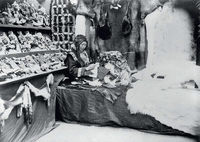
The toxic correspondence that the pavilion established between ethnographic exhibition, the empire’s industrial ambitions, and artistic vanguards is typical for the system of international fairs, where modernity would be performed through the display of technical and state progress in dialectical tension with “primitivizing foils.”[72] The Far North Pavilion boasted of the empire’s modernity via a contrast with materials and persons that signaled its underdevelopment. The presence of a human reproducing “authentic” and “native” objects for an international urban market of visitors, and the fact that both Vrubel and Korovin could produce and display art because of their patron’s contributions to the empire’s expansion through railways and his support of their travels to border regions, underscores how industrialization encouraged the aestheticization of the ethnographic and, in turn, made physical and ideational space for an emerging avant-garde.
That art deemed unfinished and thus unacceptable within the dominant academic approach was exhibited alongside raw materials and native labor indicates that the Far North Pavilion was not only a swipe at the conservative Imperial Academy of Arts. Drawing these diverse objects together in one spatial and temporal orbit was also a political attempt to bolster an artistic vanguard: Korovin and Vrubel made their works in full awareness of their surroundings as well as the contrasts and comparisons that would be made in the context of the Nizhny Novgorod fair. With the support of Mamontov, Korovin visited and represented the territorial margins of the empire in order to also put pressure on the disciplinary margins of fine art. Korovin and Vrubel thus had good reason for choosing the Far North as the developing terrain of their alternative art: the radicality and rawness of their practices would be enhanced through the shock of the encounter.[73] Positioned in a marginal space full of promise—and juxtaposed with examples of alleged backwardness—both Korovin’s art and Mamontov’s railway expansion could become spatiotemporal metaphors for the new and the advanced. Their strategy worked: Korovin garnered the commission to design the Russian Pavilion for the Universal Exposition in Paris in 1900. In this manner, Mamontov and Korovin were redrawing not only a geography for the Russian Empire but also for art in Russia itself.
Looking North to Look West; Looking West to Look North
One way of describing the difference between Korovin’s panels for Nizhny Novgorod and those for Paris is as a succession of reductions. For Nizhny Novgorod, he had begun to dismantle traditional aspects of painting by eliminating perspectival focus. In the French metropole he did away with more elements—frames, surfaces fully covered with paint, the slickness of oil on canvas—and gave himself over to dots, rough streaks, uneven lines, and fast-drying, matte tempera paints. While minimizing painterly gestures, he scaled up the supports of his works to a panoramic three meters. The range of ideas that had been hovering at the periphery of his activity could now be injected into the center of his artistic practice, so that he in turn could insert himself into the international art world.
Korovin’s panels for the Universal Exposition in Paris were intensely but only fleetingly successful, their importance combatively misread in the following years. Understanding this outcome first requires a consideration of the placement of the Russian section itself at the exposition. Rather than giving Russia two separate sections, one in the Foreign Countries section and another in the Colonies section, as it had to Britain, the fair organizers allotted Russia a single location near the Colonies section, adjacent to the locations for the French colonies Egypt and Algeria. The design of the Russian section and its accompanying catalogue essay reveal that the Russian commissioners were sensitive to this position and chose to address it through both the design and rhetorical framing of the section. Though given a large plot on the grounds of the exposition, the Russian section was nevertheless set apart from other foreign nations, essentially compelling its organizers to confront the history of a broader European perception of Russia as an Eastern “other” and potentially requiring it to represent itself as its own colony.
These challenges were addressed through the design of two separate pavilions on the site. The Handicrafts (kustarnyi) Pavilion, or Russian Village, would stand in as a living history of the Russian peasantry, its native dwellings acting as structures in which ancient cultural traditions were still extant and had to be stored and cultivated. Also designed by Korovin, the pavilion in fact consisted of several full-scale wooden cottages positioned along the slope of the Trocadero. It featured shop stalls, a cottage, and a church as well as covered passageways, all assembled by carpenters who had been sent, along with the logs and fretwork, to Paris from Sergiev Posad, a village near Moscow. The pavilion contained objects made at village-based manufacturers, in total over four hundred examples of folk costumes, embroideries, wooden dishes, and furniture.[74] These interior displays were coordinated and partially produced by the artist Elena Polenova (1850–98). Until her untimely death in 1898, Polenova had helped to ignite a handicraft revival movement, in particular through her leadership of a carpentry workshop at the Abramtsevo estate. Established by Mamontov about seventy kilometers from Moscow, Abramtsevo encouraged interaction between reformist artists like Polenova and local peasant communities. Together, Korovin’s village and Polenova’s displays contained nearly one fifth of all objects exhibited by Russia at the exposition.[75] Juxtaposed, the two pavilions represent the split condition of imperial expansion, as growth outward toward the “foreign” simultaneously provokes an inward concern for the “native.”
Thus, because the section organizers were not able to designate Russia simply as a “colony,” they chose instead to identify its “others.” The Borderlands Pavilion was designed by Roman Mel’tser (1860–1929), an architect otherwise engaged in renovating palace interiors for the imperial court. The resulting neo-Byzantine pavilion recalled Moscow’s Kremlin, with polychromatic, tent-roofed towers composed of plaster, brick, and majolica tiles. Inside the pavilion, visitors would have encountered displays of flora, fauna, minerals, maps, and graphs as well as displays representing feats of engineering.
A primary example of the latter was the Trans-Siberian Railroad—the literal and metaphorical engine of imperial connectivity. In Paris, the fleeting impressions of rail travel—what Wolfgang Schivelbusch has theorized as a “mobility of vision”—could have been experienced either via a thirty-minute, strolling panorama of the Trans-Siberian Railroad, streamed through the windows of four luxurious rail cars, or via a one-thousand-meters-per-second, painted, moving-picture panorama that depicted the Trans-Siberian’s engineering and views along its route from the Volga to Vladivostok.[76] Thus, an all-encompassing, ancient Russian structure “contained” its vast, diverse peripheries. Via the film’s moving impressions, viewers encountered the acceleration of time and the imprecision of location that Korovin himself had experienced on trains, where the landscape flows by as a total panoramic scene.
In the edited volume and text he published the same year as the exhibition, the pavilion’s commissioner, Veniamin Semenov-Tian-Shansky, took pains to emphasize the ways in which Russia resembles Europe as well as its distinctiveness as a space contiguous with Asia. An academic geographer who had studied with Alexander Humboldt, Semenov-Tian-Shansky was celebrated for his expeditions through Central Asia—taking the region’s Tien Shan mountain range as an addendum to his own surname. He filled his text with descriptions of the climate and peoples of the Russian borderlands and details about their existing trade, ways of life, and emerging industries.
For Russia, these borderlands [okrainy] represent an enormous, colonized area [kolonizatsionnuyu ploshchad’], yet due to their geographic locations, the character of their nature, and the content of their populations, they represent an entirely “other” relationship to the roots of Russia than the colonies under the influence of European states maintain to their metropoles. Unlike the colonies of Western European states, our borderlands differ in that they are not separated from their European metropoles by sea or by ocean but provide an undivided continuity of the European-Russia territory, through which one passes physically as well as ethnographically entirely unnoticed into the Asian part of the world.[77]
Despite these differences, the text also asserts the empire’s industrial modernity, claiming that
in European Russia, working industries have already experienced such growth that their production could have been, without any discomfort or awkwardness, included in their own section in the Paris World Exposition. Even agricultural industry represents great development on par with such industries of Western European states.[78]
This denial of spatial, temporal, and political parity with Europe was not new for the Russian political officials, artists, industrialists, and intellectuals involved in the exposition. The question of the empire’s relative “Europeanness” and “Asianness” still had no clear-cut answer by the turn of the century. Yet, geographic contiguity in no way prevented the Russian Empire from exercising power over its territories and populations. But just how different those territories were was indeed a question that Russians suspended, understanding the contiguous landmass paradoxically as both syncretic and divided. In essence, the Russian section became the physical manifestation of Russia’s particular colonial conundrum: a “country that has colonized itself,” in resistance to but also implicitly accepting of Western categorizations of an exotic, backward East.[79]
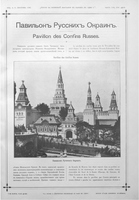
A protocol from the pavilion’s planning commission notes that Semenov-Tian-Shansky’s maps and descriptions published in Okrany Rossii provided the organizational basis of the Borderlands Pavilion and the subject matter for Korovin’s panels (fig. 15).[80] The protocol also notes that the panels were to be hung high along the borders of the pavilion’s space. The resulting works on average were 80 x 120 in. (2 x 3 m) each; the largest were around 32 ft., 10 in. (10 m) in length. Like the cinematic experience of railway travel, these sweeping panels also provided panoramas, thus enforcing the idea of discovering a landscape. As a group, the panels form Korovin’s strongest expressions of the postimpressionistic obsession with agitated lines and a wide color spectrum with deep undertones. In Rocky Tundra (Midnight Sun), for example, Korovin used a limited palette of cool grays and olives, occasionally punctuated by bright orange and soft lilac, to show light and contrast (fig. 16). Though parts of the panels seem to lack perspective, with some backgrounds flattening into foregrounds, other parts contain shading to restore a sense of receding space. Huge, solid swaths of color evoke snowy landscapes. Strong contours and unusual cropping gesture toward a wider interest in Japanese woodblock prints and an aesthetic already dominant in Impressionist circles.
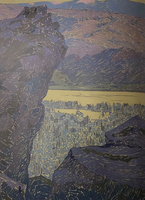
His depictions of the Comandorsky Islands and the Siberian Enisei Cliffs (fig. 17) pushed his aesthetic strategy and palette furthest as he replaced smooth surfaces with short brushstrokes, each of which provides traces of color and a sense of energy. He left the canvas below the rocky cliffs exposed, exploring contrasts between filled and unfilled space and depth and surface. The rocks are chastened by subtle, underlying contours, which define them against the thick, abstract, continuous lines in aquamarine, the froth of the waves, and the swirling purple sky. Golden yellows convey the strong contrast of the sun and the mineral veins in the rocks.
The extensive and varied critical reception of Korovin’s contributions, debated by both foreign as well as Russian critics, demonstrates the intense fascination that these objects held across cultural lines. The commentary also demonstrates the varied ways in which these works of painting and architecture communicated in their moment. With regard to the Russian Village, we can detect a local enthusiasm for consuming “authentic” Eastern culture as a frisson of difference. Unqualified praise came from members of the foreign press. For the well-known French critic Maurice Normand, the Russian Village provided the alterity he expected to find. Russia’s “cities more and more resemble our own,” he wrote, and its “manufactured products are as ingeniously conceived and artistically executed as those of Western Europe.”[81] Yet, “in opposition to the city, neither vulgar nor fantastic but authentic in every detail,” was the craft pavilion.[82] Netta Peacock, a British journalist writing for the German journal Dekorative Kunst, interpreted Korovin’s pavilion as “not a copy of a particular village, but rather a village of diverse buildings for which Korovin was inspired by old, half-ruined villages in the Archangelsk region.”[83] For Peacock, who had traveled to Russia and befriended Polenova, the village’s authenticity resided in the hands of its makers—Korovin’s creative recombination of romantically ruined forms and the connections the crafted objects maintained with the village.
Russian commentators, however, were less sanguine about the village’s authenticity. For different reasons, and with different qualifications, Stasov and Benois agreed that Korovin’s pavilion and its handicraft display succeeded. Stasov largely approved of the way Korovin replicated formal elements of traditional Russian villages, noting the “wonderful (in many ways) buildings and equipment, ornamented handrails and stairs, in the Russian style.”[84] However, he also identified “arbitrariness, often crude and tasteless decadence”—“decadence” being Stasov’s general term to polemicize against artistic devices that he perceived as Western and challenging Russian tradition.[85] Benois, on the other hand, seems to have addressed Stasov, pointing out that
the indignation of the Russians is based rather on a misunderstanding that this row of buildings named the “Russian Village” then has, in fact, easily nothing in common with Russian wooden constructions. . . . This is no Russian village, but all the same it is a purely Russian construction, a poetic recreation of those wooden, whimsical, and quaint villages with tall terems [secluded upper stories], passageways, canopies, chambers, and entranceways that were scattered about pre-Petrine Russia.[86]
Here, Benois dissolves the expectation of authenticity and celebrates Korovin’s village for what it is: a fabrication.
With regard to the Borderlands panels, the issue of visibility figured prominently in critical commentary. Varying opinions existed as to whether Korovin’s panels blended in too much or too little with the pavilion’s space and artwork in general at the fair. One critic from St. Petersburg, who understood Korovin’s panels as the pavilion’s background rather than its feature, described the panels using gendered language that framed them as feminine decoration. The “interior space of the departments are entirely harmonized with its contents. . . . Korovin created landscapes and decoration for the exhibited objects, drawn all in one tone, subdued, yet distantly soft and affectionate, neither harsh on the eyes nor corresponding to the harsh nature of the uninviting North.”[87]
Other critics, notably Benois and Stasov, found precisely the subdued tones to be problematic. Stasov judged Korovin on his representational faithfulness to the “real” landscape:
These landscapes (especially the Siberian ones) seem to be just photographs, hugely enlarged and colored, but painted very poorly. They are all dark, gloomy, dull, gray, killed; all the trees are flat, as if cut out of canvas or paper, the sea is also paper and gray, without perspective and distance. Is this really Siberia, the one we know from countless photographs, where the sun is often so bright and splendid, where are the landscapes that rival the most famous landscapes in the world? No, our Siberia is not like that, often so brilliant and wonderful, neither is our Central Asia, from which we know so many photographs and paintings. And the mosques and gardens, and the people there—all this is completely different in reality than the current huge decorations of Korovin.[88]
Rather than seeing photography as a medium that initially allowed Korovin to portray the northern landscape, Stasov meets the ethnographic photograph’s claims to truth with skepticism by framing it, and thus Korovin’s panels, as unworthy of the label “art.”
Whereas Stasov responded to Korovin’s aesthetic approach, Benois was concerned about the placement of the panels in the Borderlands Pavilion. He bemoaned the trip in general, beginning his review in Mir iskusstva by writing, “I went to Paris with displeasure . . . it was necessary to pause my études in nature in the bright warm days and go to the world exposition; that is, to endure all the hardships and agony of the cosmopolitan pilgrimage.”[89] He continued:
How to begin my review, that is, a review of the artist and art, and not only how to begin but how to continue, about what precisely to speak? The thing is, that here, art is neither concentrated in one space nor in a particular section, but has been spilled throughout the entire exhibition, fed into all of its sections. It is not only in the palaces, where there are collections of paintings and objects of artistic industry, but also in the change houses, theaters, all possible spectacles, and even in the decoration of departments where there are groupings of nonartistic things, like instruments of bread production or nutritional materials.[90]
Benois worried that Korovin’s panels had been “unsuccessfully placed” (neudachno rasporiadilsia) and that they “died from the brightness of the Caucasian silver and carpets and the robes from Bukhara.”[91] Revealing a key target audience for the panels, Benois bemoaned that this “humbleness” (skromnost’) may have damaged “not only the artist’s personal reputation but also the entire section, for surely among the French artists, it seems, no one noticed these wonderful paintings.”[92] His comments point to what scholars have since highlighted as a broader impact of international fairs and their mixed displays on modern art making and exhibiting: a sharpened sense of medium specificity.[93]
Benois’s concerns proved astute and prescient. Foreign critics did notice the panels flattened against the walls—though as expressions of Russia’s provincialism rather than as expressions of artistic modernity. As the critic for the German journal Die Kunst wrote, Korovin “extracted the soul of his native homeland, he conveys simply, with naïve artlessness and with fine instinct for all that is important and extant.”[94] Such a desire for difference prevailed among European critics of the exposition of 1900, who expressed their dissatisfaction with the standardized style of French Impressionism. As the Belgian critic Émile Verhaeren (1855–1916) wrote, “France has monopolized the mass production of art. . . . the world geography of art fundamentally changed. Its regions are no longer specifically characterized, nor distinctively special.”[95] Seeking parity as a modernist, Korovin nevertheless found fame in Paris for his cultural difference.
Borderline Modernism
The Far North and Paris pavilions demonstrate the pivotal role that Korovin and Mamontov played in art’s history of primitivism through the twinned processes of aestheticization and commercialization. Both artist and industrialist recategorized people and objects from the empire’s borderlands by importing them to a metropolitan center. Before the violent reclassification of ethnographic specimen to aestheticized object deconstructed dominant norms of aesthetic quality through modernism’s full embrace of the “primitive,” the parameters that delimited shocking new art from the ethnographic specimen were far from clear-cut in Korovin’s pavilions.
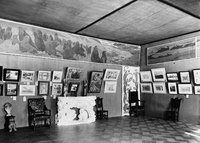
Contemporaries made a final attempt to promote Korovin’s Paris panels as modern art upon their return to St. Petersburg. In 1901, despite opposition from several older faculty members, Diaghilev organized an exhibition of affiliates of the Mir iskusstva group at the Imperial Academy of Arts. His decision to hang the panels lower seems to have been intended to respond to concerns in Paris about their visibility (fig. 18). The move proved provocative. Critic Sergei Glagol noted the lower display, which allowed for closer examination of the artist’s technique:
Contours are outlined in black and entire planes are colored in one tone. And from these conditions results several strange impressions: they have the smell of something unusual, but with this they are also beautiful and quite brightly convey the impressions produced upon the artist in our North, Central Asia, and Siberia.[96]
Other critics circled around the issue of displaying decorative works in a space for fine art. One commentator described being “among Korovin’s decoration, which could have made sense if it were in a place that demands decoration, but which looks strange at an art exhibition—there were diverse decadent landscapes looking at us.”[97] Another exclaimed, “Vrubel and Korovin—in the halls of Raphael and Titian! How could this have happened?”[98] So great was the uproar that the Academy closed the exhibition after just five days.
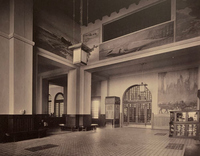
The Paris panels were then slotted to enter the ethnographic collection of the State Russian Museum, just as his Nizhny Novgorod paintings were being hung in the central hall of Iaroslavskii Rail Station in Moscow (fig. 19). The station, Mamontov’s swan-song construction before losing his fortune due to charges of fraud, opened in 1904 as the embarking point for all rail travelers moving to and from the Far North.[99] The paintings remained on the station’s walls for over half a century. Not until 1961, when Korovin’s work received its first monographic exhibition at the State Tretyakov Gallery in Moscow, were the paintings moved into the collection of an art museum.[100]
The fate of both projects reveals the dialectical relations that Korovin’s work was meant to engage. Both the ethnographic collection and the train station are spaces and temporalities of modernity: they drive a society’s sense of distance between its past and present and its sense of difference between progressiveness and backwardness. Yet at the turn of the century, neither space was associated with the display of art. In the reception of Korovin’s work, the “primitive” of the ethnographic space and the commercialized industry of the railroad join at opposite ends of the spectrum when contrasted with “free” fine art.
The alleged otherness of Korovin’s art has long hampered its institutional validation. He spent the bulk of his career developing techniques for working across, and at times from within, marginalized cultural and aesthetic categories and geographic locations. In turn, his art wove connections to internationalized movements like Impressionism and Symbolism as well as bourgeoning interests in ethnography and folk crafts in Russia. But because his work spoke to multiple disciplines and cultural contexts, it was also perpetually torn between them. He thus was and has remained a liminal figure, forever caught between East and West, installed within a liminal space, on the threshold of arrival and departure, between imperial metropole and borderland—an ambivalence that might best be expressed as borderline modernism.
Acknowledgments
I am deeply appreciative of the many individuals whose scholarship and feedback have helped to shape this article. I have presented this research at the conference “Fragile Things: Material Culture at the Russian Empire” (Yale University, 2024) and thank the audience and organizers for their productive questions and engagement. Excellent comments from Emmelyn Butterfield-Rosen, Marc Gotlieb, Katie Hanson, Maria Mileeva, Ekaterina Muromtseva, and Emily Ziffer all guided earlier versions of this article. Thank you also to the anonymous peer reviewers and the editorial team at Nineteenth-Century Art Worldwide for their ideas and assistance in bringing this publication to fruition.
Notes
Epigraph 1: James Clifford, The Predicament of Culture: Twentieth-Century Ethnography, Literature, and Art (Cambridge, MA: Harvard University Press, 1988), 198.
Epigraph 2: “Rano utrom mokrye skaly veselo zablesteli na solntse. Oni pokryty tsetnymi mkhami, iarkoi zelen’iu, alymi piatnami. Za nizkimi kamnyami berega otkryvaiutsia peschaniie lozhbinki i v nikh nizenkie izby, ubogiie, v odno-dva okoshka. Ia otkryvaiu shkatulku, beru palitru, kladu vtoropiakh kraski. Eto tak krasivo, udivitel’no: ruki drozhat, tak khochetsia napisat’ eto.” Konstantin Korovin, Konstantin Korovin vspominaet [Konstantin Korovin remembers] (Moscow: Izobrazitelnoe Iskusstvo, 1971), 396–97.
Epigraph 3: George Moore, “Studio Talk: Paris,” The Studio 20, no. 90 (1900): 274.
Epigraph 4: Sergei Diaghilev, “European Exhibitions and Russian Painters,” 1896, in Russian and Soviet Views of Modern Western Art: 1890s to Mid-1930s, ed. Ilia Dorontchenkov, trans. Charles Rougle (Berkeley: University of California Press, 2009), 41.
Unless otherwise stated, all translations are my own.
[1] The exact number of panels is a subject of debate. An exchange in 1900 between the vice president of the Imperial Academy of Arts, I. I. Tolstoy, and the Section Commissioner, V. N. Tenishev, notes that there were “bolee tridtsati panelei” (more than thirty panels). V. N. Tenishev, “On the Participation of the Academy of Arts in the Paris World Exhibition in 1900,” August 1900, l. 437, d. 5, ch. III, f. 780, Russian State Historical Archive, St. Petersburg. Currently, the State Russian Museum, St. Petersburg, has thirty-one panels in its collection, though the most recent catalogue of Korovin’s works notes that four panels were lost due to a flood in 1924 and to poor conservation. Vladimir Kruglov, “O serii ‘parizhskikh’ panno Konstantina Korovina” [On Konstantin Korovin’s ‘Paris’ panel series], in Russkii Musei predstavlyaet: Konstantin Korovin Al’manakh [The Russian Museum presents: Konstantin Korovin Almanacs], exh. cat. (St. Petersburg: Palace Editions, 2011), 147.
[2] Kruglov, “O serii ‘parizhskikh’ panno Konstantina Korovina,” 145.
[3] For a list of Korovin’s exhibition history, see Kruglov, “O serii ‘parizhskikh’ panno Konstantina Korovina,” 225–31. One exception to the small-scale group shows was the 1893 Chicago World’s Fair, where Korovin’s painting Spanish Women (1888–89) went virtually unnoticed in the Russian Section. In his extensive analysis of the fair, for example, William Walton mentions the painting only as a “cheerful theme.” William Walton, World’s Columbian Exposition: Art and Architecture (Philadelphia: George Barrie & Son, 1893), 72.
[4] Moore, “Studio Talk: Paris,” 273–74.
[5] “Takoi sily, takogo stilia, krasoty tona i poezii . . . ne sam Korovin’, ni kto-libo iz skandinavskikh ili finliandskikh khudozhnikov, bravshikhsia za podobnye svernye i ocharovatel’no-unylye motivy, ne dostigal’!” Alexandre Benois, “Pis’ma so vsemirnoi vystavki” [Letter from the World Exhibition], Mir iskusstva [World of art] 4, nos. 17, 18 (1900): 108.
[6] This exhibition took place in 2011 at the State Russian Museum, St. Petersburg, and the State Tretyakov Gallery, Moscow.
[7] I. I. Tolstoy wrote as follows to Grand Duke Georgy Mikhailovich about the prospect of the State Russian Museum acquiring Korovin’s Paris panels: “Eti panno otlichayutsia vydaushchimisya khudozhestvennymi dostoinstvami i posluzhili by istinnym i nezamenimym ukrasheniem yethnograficheskogo otdela russkogo muzeya imperatora Aleksandra III.” (These panels differ as a remarkable artistic achievement and would serve as true and indispensable decoration of the ethnographic department of the Russian Museum of Emperor Alexander III.) I. I. Tolstoy to Georgy Mikhailovich, August 26, 1900, l. 4, d. 160, op. 1, Manuscript Division, State Russian Museum Archive, St. Petersburg.
[8] Like his panels for Paris, Korovin has also faded from critical view. After his initial success in the arts and in stage design in Moscow before the Bolshevik Revolution, he emigrated permanently to France between 1922 and 1923. While living in France, he painted primarily Parisian street scenes and landscapes, and his work remains virtually unknown to scholars outside of Russia. Not until 1961, during the relative opening up of culture and politics during the “Thaw” period under First Party Secretary Nikita Khrushchev, did Soviet art historians give Korovin his first monographic exhibition, Konstantin Alekseevich Korovin, 1861–1939: K Stoletiiu so Dnia Rozhdeniia [Konstantin Alekseevich Korovin, 1861–1939: On the centennial of his birth], exh. cat. (Moscow: Izdatel’stvo Akademii Khudozhestv SSSR, 1961). Since then, he has been slowly integrated into the Russian art historical canon, albeit under the compound label “Russian Impressionist.” In 2016, the Museum of Russian Impressionism opened in Moscow, revealing Russian Impressionism as a separate collecting and discursive arena. One recent reexamination of Korovin’s work is Louise Hardiman, “Sergei Diaghilev, Konstantin Korovin, and the North in Russian Art, 1890–1905,” in Music’s Nordic Breakthrough: Aesthetics, Modernity, and Cultural Exchange, 1890–1930, ed. Philip Ross Bullock and Daniel M Grimley (Woodbridge, UK: Boydell Press, 2021), 39–61. She does not discuss the politics of Korovin’s pavilion commissions or his peripherality in art history and its relation to his aesthetic strategy.
[9] To date, art historians have mainly been concerned with situating Korovin’s work in relationship to Western Impressionism. An important recent examination of the digestion of French Impressionism in Russia is Ortrud Westheider, Michael Philipp, and Henning Schaper, eds., Impressionism in Russia: Dawn of the Avant-Garde, exh. cat. (London: Prestel, 2020).
[10] The extensive philosophical debates between “Slavophiles” and “Westernizers” in nineteenth-century Russian literature are usefully detailed in Andrzej Walicki, The Slavophile Controversy: History of a Conservative Utopia in Nineteenth-Century Russian Thought (Oxford: Clarendon Press, 1975).
[11] W. J. T. Mitchell, “Imperial Landscape,” in Landscape and Power, ed. W. J. T. Mitchell (Chicago: University of Chicago Press, 1994), 16–18.
[12] Herbert J. Ellison, “Economic Modernization in Imperial Russia: Purposes and Achievements,” Journal of Economic History 25, no. 4 (1965): 524.
[13] Ellison, “Economic Modernism and Imperial Russia,” 535–36.
[14] The connection between landscape painting, knowledge production, and imperial expansion has been studied more extensively in the French, British, and Ottoman Empires. See, for example, Peter H. Christensen, Germany and the Ottoman Railways: Art, Empire, and Infrastructure (New Haven, CT: Yale University Press, 2017).
[15] Dorontchenkov, introduction to Russian and Soviet Views of Modern Western Art, 2.
[16] Dorontchenkov, introduction to Russian and Soviet Views of Modern Western Art, 2–4. There is a vast literature on the Wanderers and nuanced practices of realism at the Imperial Academy, which I can only reference here. For recent examinations of the Academy and realism in Russian art of the late nineteenth century, see Molly Brunson, Russian Realisms: Literature and Painting, 1840–1890 (DeKalb: Northern Illinois University Press, 2016).
[17] Rosalind P. Blakesley and Margaret Samu, introduction to From Realism to the Silver Age: New Studies in Russian Artistic Culture; Essays in Honor of Elizabeth Kridl Valkenier, ed. Rosalind P. Blakesley and Margaret Samu (DeKalb: Northern Illinois University Press, 2014).
[18] See, for example, Vladimir Stasov, “Russian Folk Ornamentation: Embroidery, Weaving and Lace,” trans. Elena Clark, Experiment 22, no. 1 (2016): 178–98; and Vladimir Stasov, Russkij narodnyj ornament [Russian national ornament] (St.-Petersburg: Éd. de la Société d’Encouragement des Artistes, 1872).
[19] “Kakova zateia! Nas khotyt perekrestit’ v novuiu veru po chasti iskusstva!” Vladimir Stasov, “Nishchie dukhom” (Poor in spirit), in Izbrannye sochineniia v trekh tomax: Zhivopis’, skul’ptura, muzyka [Collected writings in three volumes: Painting, sculpture, music], vol. 3 (Moscow: Iskusstvo, 1952), 130.
[20] “Tak, naprimer, izobrazhenie ‘derevni’ (veroiatno, russkoi). Naverkhu oblozhki zhurnala sostoit u g. Korovina iz takikh izb, iz takikh kustov, iz takoi perspektivy i takogo neba, kakie mozhet narisovat’ razve chto trekhletnii rebenok, v pervyi raz vzyavshii karandash v ruki i tol’ko nesurazno maraiushchii bumagu. Vnizu toi zhe oblozhki postavlen g. Korovinym kakoi-to shtempel’ iz dvukh perepletaushchikhsia ryb, kotoryi mozhet byt’ ochen’ khorosh dlia yapontsev i dlia sklyanok s mazyu u kakogo-nibud’ fabrikanata, no v khudozhestvennom zhurnale (dazhe plokhom) ne dolzhen by smet’ pokazivat’sia.” Stasov, “Nishchie dukhom,” 130.
[21] This point is occasionally mentioned but not analyzed in scholarship. Jane Ashton Sharp, Russian Modernism between East and West: Natal’ia Goncharova and the Moscow Avant-Garde (Cambridge: Cambridge University Press, 2006), 55. John Bowlt’s early and influential essay on Neoprimitivism also mentions that Larionov had seen the French primitivist Paul Gauguin’s exhibition in Paris in 1906 but links his and Goncharova’s use of “vivid color” and a “monoplanar or surface depiction of action” to their own “creative energy” and discovery of “the virtues of traditional Russian art forms” like lubki. Korovin remains unmentioned. Increasingly desired by lower classes in the late nineteenth century, lukbi (singular: lubok) were usually made by anonymous craftspersons and depicted folk stories, social criticism, and humorous cartoons. The formal qualities of lubki and their association with the rural peasantry appealed to a broader, industrializing Russian society seeking to counterbalance its experience of change by imagining and connecting with a vernacular culture. John E. Bowlt, “Neo-Primitivism and Russian Painting,” The Burlington Magazine 116, no. 852 (1974): 137.
[22] A “disquieting quality of modernism,” as James Clifford has written, is “its taste for appropriating or redeeming otherness, for constituting non-Western arts in its own image, for discovering ahistorical ‘human’ capacities.” Clifford, The Predicament of Culture, 193.
[23] Savva Mamontov funded a private operahouse in Moscow and employed artists such as Korovin and Mikhail Vrubel to paint set designs. Haldey describes Korovin’s stage sets for Russian fairy tale operas like Sadko as lubok-inspired décor. Olga Haldey, Mamontov’s Private Opera: The Search for Modernism in Russian Theater (Bloomington: Indiana University Press, 2010), 113–22.
[24] On “decorative” as an epithet for Western modernists, see Jenny Anger, Paul Klee and the Decorative in Modern Art (Cambridge: Cambridge University Press, 2004), 2–13.
[25] Yanni Kotsonis, Making Peasants Backward: Agricultural Cooperatives and the Agrarian Question in Russia, 1861–1914 (New York: St. Martin’s Press, 1999), 37–38.
[26] Upon completion in 1898, it became the longest rail line in the empire. Konstantin Mikhailov, Arkhitekturnoe Puteshestvie Po Zheleznoi Doroge [Architectural travels on the railroad] (Moscow: Shchusev State Museum of Architecture, 2010), 38.
[27] Evgeny L’vov-Kochetov, Po studenomy moriu: Poezdka na sever; Iaroslavl, Vologda, Arkhangelsk, Murman, Nord-Kap, Trondheim, Stockholm [On the frozen sea: A trip to the North; Iaroslavl, Vologda, Arkhangelsk, Murmansk, Nord-Kap, Trondheim, Stockholm] (Moscow: Tovarishchestvo Tipografii A. I. Mamontova, 1895), 1–8. Photographs of the trip to the Arctic region are located in the archives of the Murmansk Local History Museum, Photography Collection.
[28] “Priamo, shirokoi polosoi prorubleny lesa. Uzhe prolozheny nerovno rel’sy . . . a krugom beskonechnye moguchie lesa. Vekami rosli, umirali, padali, rosli snova.” Korovin, Konstantin Korovin vspominaet, 281.
[29] “chustvo razumnago I sozhatel’nago patriotizma. I vot’ proiavlenie vsego etogo tesno sviazano s vozrastaniem sredi nas interesa k nashemu dal’nemu Vostoku i dal’nemu Severu, interesa, malo-po-malu zakhvatyvaiushchago vse russkoe obshchestvo.” L’vov-Kochetov, Po studenomy moriu, 2.
[30] The importance of painting and photography to imagining and controlling populations and land was a technique familiar to many nineteenth- and twentieth-century empires. For the British case, see James R. Ryan, Picturing Empire: Photography and the Visualization of the British Empire (Chicago: University of Chicago Press, 1997).
[31] According to L’vov-Kochetov, the journey was organized by the state, which agreed to have him come along as a turist’ (tourist) but with the understanding that he would publish something. L’vov-Kochetov, Po studenomy moriu, 4. With the exception of an exhibition of thirty photographs by Korovin at the Museum of the Arctic and Antarctic, St. Petersburg (April–August 2021), the entire collection of photographs has not been published or discussed in secondary literature. Savva Mamontov’s close relationship with Witte was cited in an exhibition label as the reason for Korovin’s invitation to join the trip.
[32] Etkind differentiates between the Russian Empire’s colonialization patterns and the American expansion into the western “frontier.” Rather than extending a cultivated space westward, Russian colonizers pressed in different directions, creating hybrid centers dispersed across swaths of time and space. Alexander Etkind, Internal Colonization: Russia’s Imperial Experience (Hoboken, NJ: Wiley, 2011), 64. See also the groundbreaking article on this subject by Mark Bassin, “Turner, Solov’ev, and the ‘Frontier Hypothesis’: The Nationalist Signification of Open Spaces,” Journal of Modern History, no. 65 (1993): 473–511.
[33] “Dnem pisat’ s natury nel’zia: meshaiut miriady vsevozmozhnoi moshkary, komarov, slepnei.” Korovin, Konstantin Korovin vspominaet, 282.
[34] Yuri Slezkine, Arctic Mirrors: Russia and the Small Peoples of the North (Ithaca, NY: Cornell University Press, 1996), 124. Slezkine emphasizes that the text/image combination of travelogues works to construct views and imagine encounters between colonizer and colonized. On writing as an ethnographic device, see James Clifford, “Introduction: Partial Truths,” in Writing Culture: The Poetics and Politics of Ethnography, ed. James Clifford, George E. Marcus, and Kim Fortun (Berkeley: University of California Press, 2010), 1–26.
[35] Vera Tolz, Russia’s Own Orient: The Politics of Identity and Oriental Studies in the Late Imperial and Early Soviet Periods (Oxford: Oxford University Press, 2011), 31.
[36] The first all-Russian census was also ongoing. Completed in 1897, it classified the empire for the first time, naming 130 nationalities and 260 languages. Roland Cvetkovski, “Introduction: On the Making of Ethnographic Knowledge in Russia,” in An Empire of Others: Creating Ethnographic Knowledge in Imperial Russia and the USSR, ed. Roland Cvetkovski and Alexis Hofmeister (Budapest: Central European University Press, 2014), 3.
[37] Tolz, Russia’s Own Orient; Vera Tolz, “Orientalism, Nationalism, and Ethnic Diversity in Late Imperial Russia,” The Historical Journal 48, no. 1 (2005): 127–50; and Andreas Kappeler, “The Ambiguities of Russification,” in Orientalism and Empire in Russia, ed. Michael David-Fox, Peter Holquist, and Alexander Martin (Bloomington, IN: Slavica, 2006), 227–33.
[38] Alexei Miller, “The Empire and the Nation in the Imagination of Russian Nationalism,” in Imperial Rule, ed. Alfred Rieber and Alexei Miller (Budapest: Central European University Press, 2004), 9–26.
[39] Johannes Fabian, Time and the Other: How Anthropology Makes Its Object (New York: Columbia University Press, 2002), 30–31.
[40] Orientologist Nikolai Marr criticized what he perceived as the Western European tendency to read “Eastern cultures” as stagnant and “clean ponds” upon which they could imagine scenarios. Nikolai Marr, “K Voprosu o Zadachakh Armenovedeniia” [On the issue of the tasks of military studies], ZhMNP 5 (1916): 242, 246.
[41] Etkind, Internal Colonization, 251.
[42] “Tak vot oni, frantsuzy. Svetlye kraski, vote to tak . . . mnogo i takogo, shto i u nas, no chto-to est’ eshe i sovsem drugoe. Piuvis-de-Shavann—kak eto krasivo! I impressionisty . . . -u nikh nashel ia vse to samoe, za to tak rugali menia doma, v Moskve.” Korovin, Konstantin Korovin vspominaet, 36.
[43] “Byl odin kur’eznyi otzyv, zabyl v kakoi gazete v Parize, gde avtory govoili, chto v russkom khudozhnike oni khoteli by videt’ osobennosti aziata, no v Korovine ego net, tak kak on pokhozh na evropeitsa. Ia podumal: ‘vot eshche gore.’” Korovin, Konstantin Korovin vspominaet, 77.
[44] That the case studies central to this article were made for or in awareness of international fairs provides a further example of what Caroline A. Jones has theorized as “predicated internationalism”: artists participate in an international art world by using a dominant aesthetic approach to speak of their cultural difference. Caroline A. Jones, The Global Work of Art (Chicago: University of Chicago Press, 2016), 96.
[45] Russian for “terra nova.”
[46] Also in 1896, Repin organized an exhibition of sketches by young artists, marking an initial attempt to reveal the creative process rather than prioritize, as the Academy did, the finished work. Alison Hilton, “The Exhibition of Experiments in St. Petersburg and the Independent Sketch,” The Art Bulletin 70, no. 4 (December 1988): 681–82.
[47] Haldey, Mamontov’s Private Opera, 82–83.
[48] For a more detailed description of the genesis of the Salon des Refusés, see Juliet Wilson-Bareau, “The Salon des Refusés of 1863: A New View,” The Burlington Magazine 149, no. 1250 (2007): 309–19.
[49] Anne Lincoln Fitzpatrick, The Great Russian Fair: Nizhnii Novgorod, 1840–90 (New York: St. Martin’s Press, 1990), 14–28, 74.
[50] “V chastnom sobranii predstavitelei vystabochnoi administratsii – v kotorom, mezhdu prochim, prinimali uchastie V.I. Kovalevskii, V.I. Timiriazev, N.M. Baranov i drugie litsa, priznano zhelatel’nym, v vidakh uvelicheniia interesa k vystavke i privlecheniia na nee inogorodnikh i inostrannykh gostei, ustroit’ riad poselkov etnograficheskogo kharaktera, no primeru parizhskoi vystavki v 1889 godu.” Maxim Gorky, “S vserossiiskoi vystavki (vpechatleniia, nabludeniia, nabroski, stseny, i t.d.)” (1896) [From the All-Russian Exhibition (impressions, observations, sketches, scenes, etc.)] (1896), in Sobraniia sochinenii [Collected writings], vol. 23 (Moscow: Gosudarstvennoe Izdatel’stvo Khudozhesvennoi Literatury, 1953), 230.
[51] For a discussion of these taxonomies as a structuring device of late nineteenth-century European fairs, see Jones, The Global Work of Art, 49–50. For a general critique of the Nizhny fair from a postcolonial perspective, see Evgenii Savitskii, “Kolonialyi Nizhnii Novgorod i fotografii Maksima Dmitrieva” [Colonial Nizhny Novgorod and the photographs of Maksim Dmitriev], Sygma (blog), November 14, 2015, https://syg.ma/@panddr/.
[52] “Pritom zhe i samye motivy vybora Nizhniago-Novgoroda dlia novoi Vserossiiskoi Vystavki byli sviazany s voprosom o neobkhodimosti luchshago vyiasneniia uslovii razvitiia stol’ bogatykh i obshirnykh oblastei kakimi iavliautsia Sibir’ i Sredneaziatskiia vladeniia.” A. S. Shustov, Vserossiiskaia promyshlennaia i khudozhestvennaia vystavka (1896: Nizhni Novgorod). Al’bom uchastnikov [All-Russian Arts and Industrial Fair (1896: Nizhny Novgorod). Album of participants] (St. Petersburg: A. S. Shustov, 1896), 9.
[53] “Zatem vystavki vsegda staviat’ kul’turnyia gosudarstva v resnuiu sviaza’ s narodnostiami.” Shustov, Vserossiiskaia promyshlennaia i khudozhestvennaia vystavka, 6.
[54] Quoted in Daniel R. Brower, The Russian City between Tradition and Modernity, 1850–1900 (Berkeley: University of California Press, 1990), 134.
[55] The term “Samoyed,” now usually considered pejorative, encompasses at least twenty-six ethnic groups (classified in the 1920s) whose traditional occupations have included hunting, fishing, trapping, and reindeer herding. Linguistically and culturally, they have ties to Uralic and Altaic families. Slezkine, Arctic Mirrors, 1–3; and Marjorie Mandelstam Balzer, The Tenacity of Ethnicity: A Siberian Saga in Global Perspective (Princeton, NJ: Princeton University Press, 1999), 29–53. Korovin also uses this term in his journal entry about the Far North Pavilion: “Samoyed Vasilii, kotorogo ia tozhe privez s soboi” (Samoyed Vasily, whom I also brought with me). Konstantin Korovin, “Pavilion Krainego Severa” [The Far North Pavilion] (1896), in To bylo davno, tam, v Rossii [What was long again, over there in Russia], vol. 1 (Moscow: Russkii Put, 2010), 250. Kidnapping Native women and children and holding them in captivity until the exchange of furs had occurred was a strategy authorized and practiced by Russian colonizers since the late eighteenth century. Etkind, Internal Colonization, 76.
[56] Mitchell, “Imperial Landscape,” 10.
[57] Slezkine, Arctic Mirrors, 4–6.
[58] Etkind, Internal Colonization, 74–75; and Slezkine, Arctic Mirrors, 80.
[59] George Kennan, Tent-Life in Siberia and Adventures among the Koraks and Other Tribes in Kamtchatka and Northern Asia (New York: Putnam, 1870), 286.
[60] “Samoyed Vasilii, kotorogo ia tozhe privez s soboi.” Korovin, “Pavilion Krainego Severa,” 177. On the power of disgust in formulating a culture’s ordering system of what is emotional, civilized, and uncivilized, see Vittoria Di Palma, Wasteland: A History (New Haven, CT: Yale University Press, 2014), 5.
[61] “Morskoi chelovek, - govoril samoed Savve Ivanovichu pro tiulenia. – Oni liubiat nas, s nami zhivut, my ikh ne b’em.” Korovin, “Pavilion Krainego Severa,” 251.
[62] Christopher David Ely, This Meager Nature: Landscape and National Identity in Imperial Russia (Dekalb: Northern Illinois University Press, 2009), 188, 202, 212. Ely does not discuss Korovin’s landscape paintings in any substantial manner and mentions neither the Far North nor the Paris panels.
[63] Adrian Prakhov, “Vystavka v Akademii khudozhestv proizvedenii russkogo iskusstva, prednaznachennykh na vsemirnoiu vystavku v Parizhe” [Exhibition at the Academy of Arts, works of Russian art planned for the World Exhibition in Paris, 1878], translated in Ely, This Meager Nature, 204.
[64] Ely, This Meager Nature, 204.
[65] “Shishkin – khudozhnik narodnyi. Vsiu zhizn’ on izuchal russkii preimushchestvenno severnyi les, prusskoe derevo, russkuiu chashchu, russkuoi glush’. Eto ego tsarstvo, I tut on ne imeet sopernikov, on edinstvennyi.” Vladimir Stasov, “Vot nashi strogie tseniteli i sud’i” [Here, our strict judges and judgments], Severyni vestnik [Northern bulletin] 1, no. 2 (1892): 102.
[66] Mitchell, “Imperial Landscape,” 10.
[67] “Staraius’ sdelat’ v pavil’one to vpechatlenie, kotoroe ia ispytal tam, na severe. Veshaiu neobdelannye mekha belykh medvedei, stavliu rubye bochki s ryboi, kozhi tiulenei, sherstianye rubashki pomor, morskie kanaty, iakoria, iarusy, snasti, kriuchki, cheliusti kita, dlinnye shkury chudovishchnykh belukh. Dumaiu, kak by peredat’ etot osobennyi zapakh okeana i skal. Iz bochek bynimaiut mokh, kotoryi ia prives s soboi, i kladut ego pod pol pavil’ona.” Korovin, “Pavilion Krainego Severa,” 251.
[68] Martin Heidegger, “The Age of the World Picture,” in The Question Concerning Technology, and Other Essays, trans. William Lovitt (New York: Harper & Row, 1977), 129.
[69] Ely emphasizes this characteristic of Russian academic realists. Ely, This Meager Nature, 198.
[70] This scandal is recounted in personal exchanges in 1896 between Savva Mamontov, Korovin, Vrubel, and Vasily Polenov, collected in Eleanora Paston, ed., Abramtsevo: Iskusstvo i zhizn’ [Abramtsevo: Art and life] (Moscow: Iskusstvo, 2003), 215–21.
[71] For details on the episode, see Eleanora Gomberg-Verzhbinskaia, Iuliia Podkopaeva, and Iurii Novikov, eds., Vrubel’: Perepiska; Vospominaniia o khudozhnike [Vrubel: Letters; Recollections about the artist] (Leningrad: Iskusstvo, 1976), 61–62, 79, 209–12, 319–20; and Hilton, “The Exhibition of Experiments in St. Petersburg and the Independent Sketch,” 683.
[72] For more theorization of this dynamic in the European context, see Jones, The Global Work of Art, 62.
[73] Hal Foster theorizes this strategy as key to the modern artist’s embrace of the primitive. Hal Foster, “The ‘Primitive’ Unconscious of Modern Art,” October, no. 34 (1985): 46.
[74] David Fisher, “Kremlin on the Trocadero: The Unexpected Claim to Modernity in Russian Architecture at the World’s Fairs,” in A History of Russian Exposition and Festival Architecture: 1700–2014, ed. Alla Aronova and Alexander Ortenberg (London: Routledge, 2018), 106–7; and Anthony Swift, “Russian National Identity at World Fairs, 1851–1900,” in World Fairs and the Global Moulding of National Identities, ed. Joseph Leerssen and Eric Storm (Leiden: Brill, 2021), 107–43.
[75] Fisher, “Kremlin on the Trocadero,” 106–7.
[76] Vsemirnaia Vystavka: Russkii Otdel (1900; Parizh); Katalog russkogo otdela na vsemirnoi Parizhskoi Vystavke 1900 [World’s fair: Russian department (1900; Paris); Catalogue of the Russian department at the Paris World Exhibition of 1900] (St. Petersburg, 1900); and Wolfgang Schivelbusch, The Railway Journey: The Industrialization of Time and Space in the Nineteenth Century (Berkeley: University of California Press, 2014), 64.
[77] “Okrainy eti, khotia i predstavliaiut’ dlia Rossii gromadnuiu kolonizatsionnuiu ploshchad’, no postavleny svoim geografichestim polozheniem, kharakterom svoei prirody i sostavom svoego neseleniia v sovershenno inyia otnosheniia k korennoi Rossii, chem kolonial’niia vladnia evropeiskikh rosudartv k ikh metropoliiam i vmest s tem v ves’ma razlichniia ekonomicheskiia usloviia s usloviiami Evorpeiskoi Rossii. Ot kolonii zapadno-evorpeiskikh gosudarstv okrainy nashi otlichaiutsia tem, shto ne otdeleny ot svoei evropeiskoi metropolii moriami i okeanami, a sostavliaiut’ neposredstvennoe prodo;zhenie evropeisko-russkoi territorii, kotoraia kak fizicheski, tak i ethograficheski, sovershenno nezametno perekhodit’ v predely aziatskoi chasti sveta.” Veniamin Semenov-Tian-Shanskii, ed., Okrainy Rossii: Sibir’, Turkestan, Kavkaz i polyarnaia chast’ evropeiskoi Rossii; S prilozheniem karty okrain Rossiiskoi imperii [Outskirts of Russia: Siberia, Turkestan, the Caucasus and the polar part of European Russia; With a map of the outskirts of the Russian Empire] (St. Petersburg: Ministerstvo Finansov, 1900), 1.
[78] “V evropeiskoi Rossii obrabotyvaiushchaia promyshlennost’ uzhe poluchila takoe obshirnoe razvitie, shto eia prozvedeniia mogut byt’ bez vsiakago neudobstva, vkoiucheny v sootvestvuiushchie otedely i gruppy Parizhskoi vsemirnoi vystavki, da i samaia zemledel’cheskaia promyshlennost’ predstavliaet’ velichiny, soizmerimiia s takouiu zhe promyshlennost’iu zapadno-evropeiskikh gosudarst.” Semenov-Tian-Shanskii, Okrainy Rossii, 2.
[79] Etkind, Internal Colonization. Etkind does not discuss this pavilion.
[80] Kruglov, “O serii ‘parizhskikh’ panno Konstantina Korovina,” 142–43.
[81] “Les villes ressemblent de plus en plus aux nôtres . . . les produits manufacturés sont aussi ingénieusement conçus et artistiquement exécutés que ceux de l’Europe occidentale.” Maurice Normand, “La Russie à l’Exposition,” L’Illustration, May 5, 1900, 280.
[82] “En opposition à la ville, ni vulgaire ni fantastique mais authentique dans les moindres détails.” Normand, “La Russie à l’Exposition,” 280.
[83] “Wir haben aber nicht etwa die Kope eines bestimmten Dorfes vor uns, sondern die verschiedenen Gebaeude sind nach den Plaenen eines russischen Kuenstlers Korovine, der sich aus alten, halbzerfallenen Dorfruinen im Regierungsbezirk Archangel seine Anregungen geholt, entstanden.” Netta Peacock, “Das Russische Dorf auf der Pariser Weltaustellung,” Dekorative Kunst, no. 6 (September 1900): 480.
[84] “Zamechatel’nye (vo mnogikh otnosheniiakh) zdaniia i oborudovaniie, ornamentirovannyie perila i lestnitsy, v russkom stile.” Vladimir Stasov, “Dekadenty v Akademii” [Decadents at the Academy], Novosti i birzhevaia gazeta [News and stock exchange newspaper], February 2, 1901.
[85] “Proizvol, chasto grubyy i bezvkusnyy dekadans.” Stasov, “Dekadenty v Akademii.”
[86] “Vprochem, negodovanie russkikh osnovano skoree na nedorazumenii, na tom, shto etot riad zanii nazan ‘russkoi derevnei,’ togda kak deistvitel’no, oh rovno nichego obshchago s russkimi derevenskimi postroikami ne imet.’. . . Eto ne russkaia derevnia, no eto, vse-taki, chisto russkaia postroike, poetichnoe vozsozdanie tekh dereviannykh zateilivykh i prichudlivykh gorodov, s vysokimi teremami, perekhodami seniami palatami i svetlitsami, kotorye byli razseiany po dopetrovskoi Rossii.” Benois, “Pis’ma so vsemirnoi vystavki,” 109.
[87] “Vnutrennee ubranstvo etikh otdelov vpolne garmoniruet s soderzhaniem. . . . Kartiny g. Korovina, sostavliaiushchie peizazh I dekoratsiiu vystavlennykh predmetov, napisany vse v odnom tone, neiarkom, no praine miagkom i laskaiushchem, ne rezhushchem raz i sootvetstviushchem mrachnoi prirode neprivetlivogo Severa.” Sphinx [pseud.], “S vsemirnoi vystavki” [From the World Exhibition], Peterburgskaya gazeta [Petersburg newspaper], April 1, 1900.
[88] “Eti peyzazhi (osobenno sibirskie) kazhutsia prosto fotografiiami, sil’no uvelichennymi i raskrashennymi, no napisannymi ochen’ plokho. Vse oni temnye, mrachnye, unylye, serye, ubitye; vse derev’ia ploskie, kak budto vyrezannye iz kholsta ili bumagi, more tozhe bumazhnoe i seroe, bez perspektivy i rasstoyaniia. Razve eto Sibir’, ta, kotoruiu my znaem po beschislennym fotografiiam, gde solntse chasto takoe iarkoe i velikolepnoe, gde peizazhi, kotorye sopernichaiut s samymi izvestnymi peizazhami mira? Net, nasha Sibir’ ne takaia, chasto takaia blestiashchaia i prekrasnaia, netakaia i nasha Sredniaia Aziia, pokotoroi my zhaem stol’ko fotografii i kartin. I mecheti, i sady, i liudi tam—vse eto v deistvitel’nosti sovsem ne to, chto nyneshnie ogromnye dekoratsii Korovina.” Stasov, “Dekadenty v Akademii.”
[89] “Ekhal ia v Parizh s neudovel’stviem. Vystavka mne izdali predstavlialas’ tomitel’nym stolpotvoreniem; nado bylo prervat’ v svetlye, teplye dni moi letnie etiudy s natury, prikhodilos; ekhat’ na vsemirnuiu vystavku, t.e. perenosit’ vse lisheniia i mucheniia kosmopolitichestkago palomnichestva.” Benois, “Pis’ma so vsemirnoi vystavki,” 105.
[90] “Kak nachat’ moi obzor vystavki, t.e.obzor khudozhnika i khudozhestvennogo kritika, ne tol’ko kak nachat’, no i kak prodolzhat’, ochem imenno govorit’? Delo vtom, chto iskusstvo zdec’ ne sosredotocheno v kakom-libo odnom pomeshchenii, v obosoblennoi sektsii, no razlilios’ po vsei vystavki, propritalo vse otdely eia. Ono ne tol’ko vo dvortsakh, v kotorykh sobrany kartiny i predmety khudozhestvennoi promyshlennosti, no i v kabachkakh, teatrakh, vsevozmozhnykh zrelishchakh i dazhe v dekoratsiikh tekh otdelenii, gde sgruppirovany takiia nekhudozhestvennyia veshchi, kak orudiia khlebopashcestva ili pitatel’nyia veshchestva.” Benois, “Pis’ma so vsemirnoi vystavki,” 105.
[91] “Pogibli ot sosedstva s iarko-krasnymi i iarko-sinimi sartskimi kovrami, kavkazskim serebrom i pestrymi bukharskimi khalatami.” Benois, “Pis’ma so vsemirnoi vystavki,” 107.
[92] “Ne tol’ko vredit’ lichno K. Korovinu, no i vsemu nashemu otdelu. Iz frantsuzskikh khdozhnikov, mne kazhetsia, nikto ne zametil etoi prekrasnoi zhivopisi.” Benois, “Pis’ma so vsemirnoi vystavki,” 106.
[93] Jones, The Global Work of Art, 315–16.
[94] “Die Seele seiner Heimat herausgeholt, erzaehlt er schlicht, mit naiver Unbefangenheit und mit feinem Instinkt fuer alles Wichtige und Bestehende.” “Dekorative Malereien,” Die Kunst, no. 10 (1900): 402.
[95] Émile Verhaeren, “Chronique de l’Exposition,” Mercure de France, June 1900, translated in Robert Rosenblum and Maryanne Stevens, 1900: Art at the Crossroads (New York: Harry N. Abrams, 2000), 69–70.
[96] “Kontura obvodiatsia chernoi liniei i tselye plany zakrashivaiutsia odnim tonom. I ot etogo panno uslovny i proizvodiat neskol’ko strannoe vpechatlenie: ot nikh veet chem-to neprivaychnym, no vmeste s tem oni krasivy i dovol’no iarko peredaiut vpechatleniia, kotorye proizveli na khudozhnika i nash Sever, i Sredkniaia Aziia, i Sibir’.” Sergei Glagol’, “Vystavka Mira iskusstva v Peterburge” [The exhibition of Mir iskusstva in St. Petersburg], Kurer, February 16, 1901.
[97] “Sredi dekoratsii g. Korovina, kotorye mozhet byt’ imeli smysl tam, gde trebovalis’ dekoratsii, no kotorye stranno videt’ na khudozhestvennoi Vystavke, - smotreli na nas raznoobraznye dekadentskie peizazhi.” Vasilii Avseenko, “U dekandentov” [With decadents], Peterburgskaya gazeta [Petersburg newspaper], January 28, 1901.
[98] “Vrubel’ i Korovin—v zalakh Rafaelia i Titsiana! Kak eto moglo sluchit’sia?” L. A., “Khudozhestvennye Novosti,” Novosti i birzhevaia gazeta [News and stock exchange newspaper], January 11, 1901.
[99] The episode is described in Haldey, Mamontov’s Private Opera, 298.
[100] Mikhailov, Arkhitekturnoe Puteshestvie Po Zheleznoi Doroge, 30.