New DiscoveriesEdmonia Lewis, Bust of Helen Ruthven Waterston, 1866
by Brian Jeffrey MaxsonBrian Jeffrey Maxson
Professor of History
East Tennessee State University
Email the author: maxson[at]mail.etsu.edu
Citation: Brian Jeffrey Maxson, “Edmonia Lewis, Bust of Helen Ruthven Waterston, 1866,” Nineteenth-Century Art Worldwide 24, no. 1 (Spring 2025), https://doi.org/10.29411/ncaw.2025.24.1.6.
This work is licensed under a Creative Commons Attribution-NonCommercial 4.0 International License  unless otherwise noted.
Your browser will either open the file, download it to a folder, or display a dialog with options.
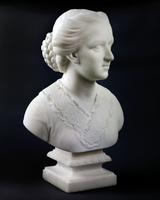
In 1866, shortly after opening a studio in Rome, the Black Indigenous US sculptor Edmonia Lewis (1844–1907) carved a bust of a young woman (fig. 1).[1] The sculpture first reappeared on the art market as early as the 1970s and has been in the collection of the Smithsonian American Art Museum (SAAM) in Washington, DC, since 1983. Thus, this article offers not a “new discovery” but instead proposes a reidentification of the sitter for the portrait bust. Since the 1980s, the bust has been identified as Lewis’s supporter Anna Quincy Waterston (1812–99), a Bostonian poet. But in fact, I contend that it is a posthumous portrait of Anna’s daughter, Helen Ruthven Waterston (1841–58), who died in Italy in 1858 at the age of seventeen. Harry Henderson, a researcher and writer about African American artists, and his son Albert Henderson, editor of Publishing Research Quarterly from 1994 to 2000, first proposed this identification in their biography of Lewis published in 2012.[2] However, their argument did not change the opinions of scholars or SAAM, who continued to describe the sculpture as a portrait of Anna Quincy Waterston until 2023, when I presented new findings outlined in this article to support the Hendersons’ arguments and to persuade SAAM to change the identification of the sitter.
My argument is divided into three parts. First, I present archival and visual evidence to reinforce the claim that this bust depicts Helen Ruthven Waterston rather than her mother Anna Quincy. That evidence includes notable differences between the bust and Anna’s facial features; visual similarities between the last portrait made of Helen and Lewis’s bust; and an archival document from 1867 that identifies a bust by Lewis as a depiction of Helen. Second, I explain why Lewis created a bust of the teenage Helen who, in 1866, had been dead for almost a decade. I document the mourning and memorialization of Helen by her parents through the mid 1860s and the direct and indirect associations between Helen’s parents, Anna and Robert, and Lewis in Boston at that time. Third, I explore the provenance of the bust, starting with its description in Lewis’s workshop in Rome in 1867. I argue that the misidentification of the bust as Anna Quincy Waterston did not occur until the summer of 1984, when SAAM sought to identify the sitter for an upcoming exhibition. By then, the memory of Helen Ruthven Waterston had long since faded into obscurity, and the only possible identification seemed to be Anna Quincy Waterston, due to her support of Lewis and her work. At the time of this writing, in November 2024, the record has been corrected; this article provides both the evidence and explanation for the reidentification.
The Identification of the Sitter
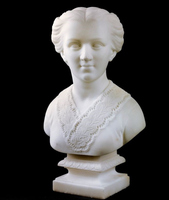
Anna Quincy Waterston was a late nineteenth-century historical figure of some significance. During her lifetime, she published individual poems, historical essays, a book of verses, and even a biography of the opera singer Adelaide Phillips. She also was an accomplished social reformer from an illustrious lineage that included her father Josiah Quincy III, who served as president of Harvard University and was a US representative as well as a mayor of Boston, and John Quincy Adams, president of the United States from 1825 to 1829. She even wrote a poem praising Lewis and her work in 1864.[3] However, the young woman with a wide face in the Waterston bust (fig. 2), which was created in mid-to-late 1866 when Anna, born in 1812, was already fifty-four years old, does not appear to be a depiction of Anna.
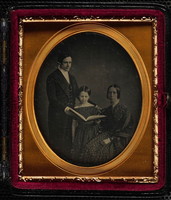
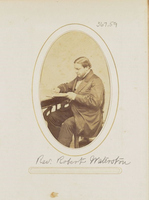
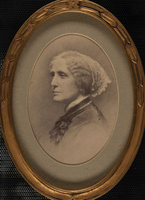
Indeed, a daguerreotype portrait of the Waterston family reveals the stark contrast between Lewis’s bust and Anna’s appearance (fig. 3). Now housed in the Historic Newton Early Photograph Collection in Newton, Massachusetts, the daguerreotype purports to depict Anna and her husband Robert flanking their young daughter Helen Ruthven. That identification of the family agrees with other known images of both Robert and Anna. For example, an undated print of a later image of Robert pictures him with the same facial features and even the same hair style as the patriarch in the earlier family portrait (fig. 4). Similarly, a vignette copy of a portrait of Anna from much later (1886) shows her with the same narrow face and features as seen in the earlier portrait (fig. 5). This evidence suggests that the family portrait does in fact depict the Waterstons. In it, Helen appears to be about eight years old—certainly no younger than six or older than ten. Because Helen was born in 1841, the family daguerreotype must date to between about 1847 and 1851. Lewis made her bust at least fifteen years later. However, already by circa 1847–51, no resemblance exists between the middle-aged matriarch Anna and the youthful woman depicted in Lewis’s bust.
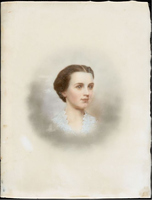
This disparity in age and appearance has been noted in the scholarship, but it has usually been explained by the claim that Lewis created an idealized image of Anna.[4] While idealism played a role in Lewis’s sculptures, in this case, the identification of the bust as Helen makes the case for such idealization unnecessary. Rather, direct similarities exist between a surviving portrait of Helen created by the Boston engraver and portraitist Alonzo Hartwell (1805–73) in 1856 and the Lewis bust (fig. 6). In Hartwell’s portrait, a wide-eyed young woman looks out of the picture with her face turned away from the viewer. Her hair is parted tightly down the middle and pulled back behind her head, possibly in the same kind of braided bun that appears in Lewis’s sculpture. The style masks the length of her hair. Her smiling face has few wrinkles and retains the slight roundness of youth. A lace collar frames her neck and forms a V below her neckline. Unlike the features of Anna, those of her daughter Helen match the bust by Lewis. In the sculpture, a similarly round, unwrinkled, youthful face looks out with open eyes and a smile. Her hair, parted down the middle, is braided in the back, and she wears a V-neck lace collar.
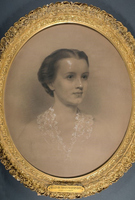
Not only does Lewis’s bust match Hartwell’s portrait, but the bust even emphasizes specific attributes that Anna recalled about it. Sometime between 1858 and 1859, Anna created a memorial book containing a few memories, poems, and letters about her daughter Helen that opens with a detailed account of the commissioning and creation of Helen’s portrait by Hartwell in 1856. The Waterstons—Anna, Robert, and Helen—were soon to embark on an extended trip to Europe. Anna thus claimed that they wanted to “leave some portrait of Helen with her families here [in and around Boston].” Anna then described the creation of the portrait, focusing on details that later were also captured in Lewis’s sculpted bust:
He [Hartwell] drew her first in her school dress & collar. I remember going home & getting the bit of old lace & o [sic] freeing her jacket at the throat & rearranging it to give it a more becoming aspect. I had said nothing to Mr. Waterston about the picture – but he was delighted with it, when he first saw it at that time. It might have looked a little older than she did. It seems now as if the artist had been inspired to present a picture both of her mortal & spiritual countenance – When Mr. Hartwell heard she was gone out of this life he said “I am not surprised for she was looking into Heaven all the time I was taking her portrait.”[5]
In this passage, Anna emphasizes her memories of her own role in commissioning the portrait of Helen as well as her contribution to Helen’s attire, especially the addition of the lace collar. She also recalls an anecdote from Hartwell about Helen’s raised, open eyes. Lewis, in turn, seems to have been careful to accentuate the open eyes and the attire that Anna so fondly remembered.[6]
In addition to these visual similarities, a description of the Waterston bust in a letter dated January 5, 1867, first brought to light by the Hendersons, is further evidence for identifying its sitter as Helen rather than her mother.[7] The letter was written by by C. C. Coffin, a journalist for the Boston Journal writing under the pen name Carleton, who was sending reports on the arts in Italy back to his newspaper in Boston. Those reports, in the form of letters, were subsequently picked up and reprinted in other publications. For example, in 1867 the monthly Ladies’ Repository reprinted Carleton’s letters about Florence in its February issue and his letters focusing on Rome in the issue for March.[8] In his letter in the March issue, dated January 5, 1867, Carleton described Lewis’s studio in Rome. He began with biographical observations about the artist and mentioned as well her fame in Boston: “Some of your readers will remember her, and will be glad to hear of her success since leaving Boston.”[9]
In Rome, Carleton observed Lewis’s sculptures of “the marriage of Hiawatha, and one figure of Nakomis [sic],” both inspired, he claimed, by the US poet Henry Wadsworth Longfellow’s epic poem The Song of Hiawatha from 1855.[10] Carleton reported on the praise by “several gentlemen” for these two works and noted the existence of a copy of Hiawatha already en route to New York. Immediately after his own praise of the two sculptures, Carleton wrote: “A beautiful bust of a beautiful young lady now deceased, daughter of Rev. Mr. Waterston of Boston, is indicative that [Lewis’s] genius is of no ordinary kind. There are but few girls, or men either, who can fight so brave a battle at such an age, against such odds.”[11]
Carleton shaped his description of Lewis’s studio for his audience in Boston. He highlighted the influence of Boston’s own Longfellow on Lewis’s works and even mentioned that Lewis was the first to have “taken subjects from this poem of Mr. Longfellow.” The description of the Waterston bust was also tailored for readers in Boston. Carleton mentioned that Lewis was in Rome “with funds obtained from the sale of the busts ordered by the friends of Colonel Shaw, and who were ready also to lend her a helping hand.”[12] Individuals like Anna and Robert, as discussed below, were a part of that group. They were also likely readers of Carleton’s correspondence.
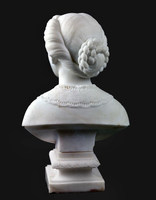
There is no doubt that Carleton was describing the sculpted bust now found at SAAM. The back of the bust contains the ambiguous dedication “M. F. Me Waterston” (fig. 7). Although the specific meaning of the abbreviation “M. F. Me” may be unclear, the Hendersons’ suggestion that it would be spelled out in French as “Mon Frére, Maître Waterston” (My brother, master Waterston) seems plausible, and the inscription unequivocally links the bust to the Waterston family.[13] No other known work by Lewis has such identifiable ties to the Waterston family. Therefore, the combination of the differences between the SAAM bust and known images of Anna; the strong similarities between the Hartwell portrait of Helen and the woman represented in the bust; and the identification of the bust in early 1867 as depicting Helen make the case that the Waterston bust depicts Helen rather than her mother Anna. Yet, admittedly, Lewis never met Helen. Why, then, would Lewis have sculpted a bust of a girl nearly ten years dead rather than a bust of the very much alive Anna Waterston? An answer to that question can be found in the sad but exceptionally well-documented tale of the death of Helen, and her parents’ inconsolable grief and their memorialization of her in the years that followed.
The Context and Creation of the Waterston Bust
Helen was born in 1841 to Anna and Robert Waterston, two wealthy, well-connected Bostonians.[14] Helen has never been the subject of a full scholarly treatment, despite there being abundant material by and about her both before and after her premature death at age seventeen in Naples in 1858. For example, Anna left a detailed diary of Helen’s development from birth through age two, including details about her first words, her first teeth, her first time standing and running, her playmates, and so on. At times Anna dreamed of her daughter’s future. On the day of the funeral procession for President William Henry Harrison, for example, Anna commented that she wished Helen, when old enough, would know that a good man had died.[15] Although Anna’s diary concluded when Helen was approximately three years of age, Helen herself took up a pen in 1855 and filled hundreds of pages of tightly packed daily diary entries to document her travels in Europe with her parents.[16]
This close bond between mother and daughter also extended to father and daughter. In her diary for Helen as an infant, Anna recorded that Robert enjoyed interacting with baby Helen. For example, she noted that Robert would ask the baby, “Who is papa’s pet?,” to which Helen would respond by putting her hand over her bosom.[17] Moreover, books once owned by Helen contain evidence of her father’s affection. Robert purchased in England a copy of Lord Byron’s Childe Harold’s Pilgrimage for Helen in 1856. In it, he recorded their shared adventures traipsing through the grounds of the home of that illustrious poet.[18] In another example, Robert purchased for Helen a picture book. In the inscription, dated January 6, 1857, he looked to the future and encouraged his daughter to search for goodness and justice.[19] This evidence makes it hardly surprising that Robert’s nephew, Josiah Quincy V, claimed after Robert’s death in 1893 that “Mr. Waterston’s second visit to Europe was marked by an affliction [Helen’s death] whose shadow never left his subsequent life.” Indeed, Quincy claimed that “such events can be no passing episodes in the history of life; they must leaven and transform whatever remains of it.”[20]
Decades before that comment, in 1856, the tight-knit Waterston family embarked on a grand tour of Europe, without a clear end point. In England, France, Germany, and Italy they stayed in different places for indefinite and unplanned periods of time. Like many upper-class young women from the United States, Helen also was educated abroad in Paris. For almost six months, beginning in December 1856, she attended school alongside two other girls from wealthy US families, Julia Gardner and Isabella Stewart (later Gardner); the three of them were the only students from the United States and formed a close-knit group.[21] After her time in Paris, Helen and her family traveled to Germany and then to Italy, where she reunited with Isabella in Rome before heading to Naples. Helen’s diaries, which still contain occasional mementos like pressed flowers and newspaper clippings, were stamped on the cover with her name and/or the name of the city in which she was living. In 1858 she finished her diary chronicling her time in Rome. That summer, she moved to Naples to begin a new diary stamped “Napoli,” but she never wrote an entry in it.[22] Instead, she died after an illness that began shortly after her arrival in Naples and also afflicted others in her traveling party. Consequently, the diary opens in her mother Anna’s hand, with a transcription of lines from a hymn “How blest are they whose transient years / Pass like an evening meteor’s flight,” followed by a quotation from Helen’s memorial.[23]
Anna and Robert buried their daughter in the Protestant cemetery in Naples after her death on July 25, 1858, and immediately began their commemoration of her. Although I have not been able to confirm whether the grave still exists, Anna drew a copy of the headstone on a sheet later inserted into Helen’s baby diary, now located at the Massachusetts Historical Society (MHS).[24] Robert requested that their friend the US poet William Cullen Bryant write a memorial to send back to their friends across the Atlantic. After all, Bryant had been in Naples during Helen’s illness, and Robert, a Unitarian minister, had baptized him there.[25] After receiving Robert’s request to write a memorial, Bryant complied, but cruelly implied that the Waterstons were largely at fault for their daughter’s death because they had not moved her out of the area with the supposedly most unhealthy air in Naples. Bryant clearly regretted his implication and wrote to Robert on August 11 to try to ensure that his words were not taken the wrong way.[26] Although specific evidence is lacking, it is not difficult to imagine that the Waterstons, with or without Bryant’s comment, believed that they had played a role in their daughter’s death.
The Waterstons left the body of their daughter in Italy but carried their grief and likely their guilt with them back to Boston. Both Robert and Anna left direct evidence that they simply did not move on from the death of their then-only child. They both wrote poems of grief into a single notebook originally given by Robert to Anna on her birthday, shortly before Helen’s passing in 1858.[27] In her Verses, published in 1863, Anna wrote one poem with the lines “But, ere another meeting / After that day in Rome, / A change and a heavy sorrow / Came to my heart and home.”[28] Then she ended the book with a poem about Helen dated to Helen’s birthday. In it, Anna commented on the positive presence of Helen everywhere she traveled. She “gladdened English air.” She “glowed” “o’er Alpine mountain-tops.” Helen’s youth was contrasted with the aged, wounded, and scarred “Etruscan towns.” Romans called Helen “a light from Heaven.” Anna concluded: “But where the tideless sea of blue / Reflects a burning height, / God took that star of heavenly hue, / And shut it from earth’s sight. / Since then, the sun and moon have shone, / Orbs fair by day and night: / Dimly they shine to me, alone, / Without that holier light. / But life’s horizon widens round, / Beyond their path afar; / And, when I pass their circle’s bound, / I shall behold my star.”[29] In another unpublished and undated work, Anna collected letters from the family’s European travels between 1856 and 1858. She began the first volume by stating that the texts would end with “our Roman winter – The great trial that awaited us in Naples, and the loss of our beloved daughter need not be written.” Near the end of the second volume she inserted a deeply melancholic quotation from a letter written by US author and longest-serving attorney general, William Wirt.[30]
The Waterstons also shared their dismay with their considerable social and cultural network. Neither Anna nor Robert systematically collected their correspondence. However, the expressions of sympathy that they received are known because they collaborated on the construction and distribution of a privately printed memorial book devoted to Helen. They published it in 1860, shortly after they returned from Europe. That book contains memorials written for Helen, poems, and excerpts from letters from friends, some of whom were among the period’s literary luminaries. The memorial for Helen by Bryant, for example, appeared near the beginning of the book. US author Harriet Beecher Stowe’s text was included within the “Extracts from Private Letters” and described her acquaintance with Helen in Paris.[31] Sophia Hawthorne, a friend of Anna’s and wife of the novelist Nathaniel Hawthorne, was probably the author of the excerpt signed simply “S. H.”[32] Family members like Anna’s father, Josiah P. Quincy, wrote poems included in the text.[33] Numerous poems signed “R. C. W.” were almost certainly written by Helen’s father Robert.
The distribution to friends of miniature copies of the Hartwell portrait of Helen was also a part of this shared performative and sincere mourning. By May 24, 1859, at the latest, copies of the portrait were in circulation. On that date, Bryant wrote to the Waterstons: “We all – my wife Julia and I thank you a thousand times for the portrait you have sent us of your daughter loved so tenderly and lost so early. It seems to us an admirable likeness in serving the dignity, the sweetness, and the spirituality of her expression, if not in the fullest degree, yet in as great a measure as we could hope in any shadow of the beautiful original.”[34] A letter from Sophia Hawthorne, undated but from the same period, offered similar sentiments: “It was very affecting to me to receive the memorial of Helen and even the shadow of her beautiful face.”[35] The Unitarian minister E. H. Sears, in a third letter from this period, described the portrait without, apparently, having ever met Helen:
It is of one whose living features we never looked upon, but who touched this earth just long enough to give those that knew her a higher ideal of angelic womanhood. There is the placid expanse of forehead, the eye dark, mild, and thoughtful, as if looking into the serene deeps and seeing things unveiled to faith alone; a blending about the lips of sweet affection and holy purpose, an expression over the whole countenance of almost unearthly purity, and withal of calm and modest surprise, such as we might suppose her to have had when she rose up among the shining ones, and saw for the first time the heavenly purities unveiled.[36]
Sears was not alone. In fact, Hartwell’s portrait of Helen became so well known among Boston’s cultural elite that the poet Jones Very—a friend of Robert’s from their days together at Harvard Divinity School—wrote verses about it entitled “On Seeing the Portrait of Helen Ruthven Waterston.”[37] Although undated, the poem probably dates to 1858 and certainly no later than the early 1860s.[38] Like Sears, Very was not writing about Helen herself but rather about Hartwell’s portrait—or more than likely a copy of it. Thus, by no later than 1859 (the date of Bryant’s letter) and probably by 1858 (the likely date of Very’s poem), some friends and acquaintances in the Waterston circle possessed copies of Helen’s portrait. While some of them compared the image to their memories of the teen, others used it to imagine a person whom they had never met.
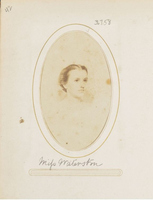
At least six miniature copies of the Hartwell portrait are known to survive. One likeness is enclosed within a velvet locket in the MHS. This copy has aged poorly, but Helen’s face remains clear. An inscription inside the locket in an unknown hand identifies Helen as the “Grand-daughter of President Quincy” and correctly records her age at death as seventeen, but incorrectly records 1859 as the year of her death (fig. 8). A second copy in a velvet locket also survives. This example, found at the Jackson Homestead and Museum in Newton, Massachusetts, is in a slightly better state of preservation. Its maker is unknown; the sitter is identified as “Helen Waterston / daughter Rev. R. W. Waterston.”[39] A third copy, at MHS, appears in a photo album compiled by an otherwise unidentified Caroline May Davis (1840–1920) (fig. 9). This time the image has the caption “Miss Waterston” and appears next to an image of her father labeled “Rev. Robert Waterston.” A fourth example of the image, in this case much better preserved, also exists at the Jackson Homestead and Museum (fig. 10). This copy, misidentified as depicting Anna Cabot Lowell Quincy Waterston, is another exact reproduction of the Hartwell portrait of Helen.
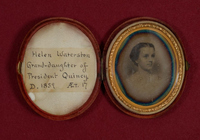
Two additional surviving copies of the portrait are identified as Helen Waterston by her mother Anna. For example, Anna sent a copy of Helen’s memorial book in March 1863 to a “Mr. and Mrs. Archibald Campbell” following the passing of their own child, Fanny.[40] That copy, now housed in the Library of Congress, contains a letter that Anna sent to Mrs. Campbell to accompany the book in which Anna expressed consolation for the couple’s loss and mentioned that she had received a picture of Campbell’s recently deceased daughter. The picture prompted Anna’s reflection:
I should have looked at it with great interest had she yet been with you. I look at it now with a tenderer affection, for I cannot doubt that she is near my beloved Helen. When I read of the expression of her face, as she passed away and of your saying – “She sees angels” – I felt as if Helen must have been one of the angels that came to her – to lead her into the holy and happy sphere where love and purity find their true home. I take the liberty of sending to you and Mr. Campbell a little volume, of memorial – and – also we hope of consolation. . . . I send you also the face of my angel – let her thus have a place in your hearts, as your Fanny has in mine.[41]
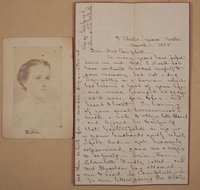
The image of Helen enclosed by Anna and captioned “Helen,” in Anna’s hand, still accompanies her letter (fig. 11). Then, a sixth example of the image was pasted by Anna, sometime after April 1866, into the first volume of her personal copy of Elizabeth Stuart, Queen of Bohemia. In that book, beneath the image, Anna wrote: “The young girl of sixteen, as beautiful as any of those fair formed who had passed over the terrace of old Heidelberg in the two hundred years which had elapsed since Elisabeth first entered this magnificent castle passed away from it forever. But to those who met her there she will ever be remembered as she walked in beauty on the terrace that Summer evening in 1857.”[42] Thus, there is no doubt that these miniature portraits depict Helen, not her mother Anna, and that, at least until 1866, the Waterstons were still grieving their daughter and circulating her image among family, friends, and acquaintances.[43]
In 1863, while the Waterstons were still grieving and memorializing their daughter, Lewis arrived in Boston and became associated with the same abolitionist circles to which the Waterstons already belonged.[44] No direct evidence explicitly reveals a meeting between Lewis and the Waterstons, but the number of their shared connections makes such a meeting likely. For example, one of Lewis’s first contacts in Boston was the abolitionist, journalist, and social reformer William Garrison, with whom the Waterstons also had a close affiliation.[45] In another example of mutual acquaintances, the poet and prominent abolitionist John Greenleaf Whittier praised Lewis in a letter and was also the author of a poem provided to Robert in memory of his daughter Helen.[46] In addition, in a newly discovered archival record, the historian and biographer Charles Hudson wrote a letter of introduction for Lewis to Robert Waterston’s brother-in-law, Charles Deane. From Cambridge, Massachusetts, on August 17, 1865, Hudson wrote, “Dear Sir – You have probably heard well of the bearer, miss Edmonia Lewis, and I venture to name you to her as at least wishing her well. She has executed for me a very good likeness, in oil, her third essay in that line. I think she shows a decided talent.”[47] Finally, it is possible that Lewis and the Waterstons knew each other through their shared interests in offering educational opportunities to newly freed people.[48]
But it was Lewis’s memorial bust of Colonel Robert Shaw, who led the Fifty-Fourth Regiment of African Americans in the Civil War, that drew her directly together with the Waterstons and reveals their support of her work. After Shaw and many of his regiment were killed in battle, Lewis sculpted Shaw’s likeness. The success of this work allowed her to sell plaster casts of it to help finance her trip to Italy in 1865.[49] Most pertinently for this article, Anna celebrated Lewis’s sculpture explicitly in a poem to honor her published in the National Anti-Slavery Standard and, one week later, in the newspaper The Anglo-African: “She hath wrought well with her unpractised hand / The mirror of her thought reflected clear. . . . / ’Tis fitting that a daughter of the race / Whose chains are breaking should receive a gift / So rare as genius.”[50] Anna’s affinity for the work perhaps should be no surprise, given her recent publication of a separate poem in honor of Shaw and his regiment.[51] Based upon the probability of their meeting and their admiration for Lewis’s work, it is also no surprise that the Waterstons continued to support Lewis after she left Boston. Specifically, after Lewis departed for Italy, she began work on her sculpture The Freed Woman. Robert was listed in the Freedman’s Record in April 1866 as the point person to collect funds to send to Lewis to assist in its creation.[52]
Thus, in summary, the memorialization of Helen Waterston and the connections between Lewis and the Waterstons support the identification of the SAAM bust as Helen rather than Anna. It is clear that there were copies of the Hartwell portrait of Helen circulating in Anna and Robert’s cultural and social circles and, in the same period, Helen continued to be missed and grieved by her parents. Helen also was a well-known figure among the cultural, social, and political elite of Boston and beyond. Her reputation endured years after her passing. Therefore, it seems probable that a copy of the Hartwell portrait likely entered Lewis’s hands at some point between 1863 and 1865—either before or after Lewis left Boston for Rome, where she hoped she would find a more welcoming, less racist environment and where a thriving community of US artists, including many women, already existed.[53] Perhaps the Waterstons gave Lewis an image, as they gave one to so many others. By this time, Lewis had already demonstrated her ability to create busts from small reproductions of likenesses, a method she had used for her earlier bust of Shaw, which Anna had much admired.[54] Lewis, in turn, used the image to sculpt the bust of Helen in Rome in mid-to-late 1866, around the time that Robert was collecting funds to support her. It is possible that the Waterstons led the efforts to collect money to help cover the cost of the marble for Lewis’s first work in Rome, and that Lewis subsequently made the bust of Helen from a leftover piece.[55] In sculpting Helen, Lewis could have been acting out of gratitude; or she could have been commissioned by the Waterstons to make the bust—although no documentation survives to indicate a commission; or perhaps she was following the advice of her early mentor, US sculptor Edward Brackett (1818–1908), who urged artists to seek fame by depicting well-known figures.[56]
Commissioned or not, Lewis’s bust of Helen fit into Anna and Robert’s widespread and long-lasting memorialization of their daughter. The story of that memorialization in Boston has been noted above, but the fact that Lewis created this bust in Rome may offer yet another layer of significance. It is clear that the Waterstons associated Italy with memories of their daughter. For example, in autumn 1860, the Waterstons hosted Bryant’s family at the Waterston home on Chester Square in Boston. The occasion was the nomination of Abraham Lincoln for president and the recent entrance into Naples of the Italian general Giuseppe Garibaldi and King Victor Emmanuel. Anna wrote that at the event
I had placed the Italian colors round Garibaldi’s picture, and written under it Mrs. Browning’s lines “Red for the patriot blood, / Green for the martyr’s crown, / And white for the dew and the rime, / When the morning of God comes down.” Mr. Bryant smiled his rare smile as he read the lines, and said: “It is a great day for Italy.” To us, who had such tender and sacred associations with Naples, it seemed a great blessing to be together at such a time.[57]
These “tender and sacred associations” were almost certainly a reference to Helen’s illness and Bryant’s baptism by Robert in Naples. In addition, Anna was not alone in drawing connections between her daughter and Italy, especially Naples. For example, in 1860, the poet Whittier dedicated a poem to Robert on the topic of Naples. The poem described Helen’s grave as “the dearest spot on earth.” Yet, the situation in Italy meant that “slaves must tread around that holy spot.” Now, with Italian unification, Whittier claimed that “the land sits free / And happy by the summer sea, / And Bourbon Naples now is Italy!”[58]
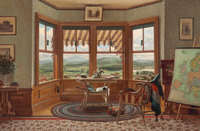
It seems likely that the images of Italy hung on the walls of the Waterstons’ summer home in Whitefield, New Hampshire, in part carried the same kinds of associations with their daughter. In the 1870s, the artist Otto Grundmann, who was a frequent guest at the Waterstons’ summer home, painted a view of the countryside almost certainly inspired by the Waterstons’ drawing room (fig. 12).[59] In this image, painted in 1878, sold at Christies in 2013, and now presumably in private hands, Grundmann depicted a room packed with mementos of Italy, especially Rome.[60] A European map is visible on the viewer’s right to set the scene, alongside an image of the Arch of Titus in Rome. On the viewer’s left is an image of the Temple of Hercules, also in Rome. Below it, partially blocked by a vase of peacock feathers, is an image of a similar, unidentifiable site. Above the picture window is what seems to be an image of an Italian palace with perhaps an Italian cityscape in the background. A small putto sculpture sits centered on the table in front of the window, beyond which opens the New Hampshire countryside. Such mementos not only marked the couple’s upper-class status and taste but also brought to mind their time in Italy with Helen.
It is possible to interpret Lewis’s creation of the bust of Helen through this lens. After all, Anna regretted the fact that no likeness had been created of Helen after the Hartwell drawing. The Hartwell “portrait,” Anna wrote, “was to be the only one to exist of Helen. Singularly we never had even a photograph taken of her in Paris or in Rome.” Anna’s regret, in fact, was greatest for such missed opportunities in Rome. “In the latter city [Rome] one or two artists wished to paint her—but something always prevented. It was not to be.” Then, Anna returned to the subject of the years seemingly added to Helen’s face in Hartwell’s portrait: “Indeed no picture could recal [sic] her face more perfectly—for tho’ in two years she developed in every way into a beautiful woman. Her countenance never left the sweet childlike expression of innocence and unconsciousness which made all who looked upon her say ‘she is an angel.’”[61] It may be only an eerie coincidence that the Waterstons supported Lewis—who was only a few years younger than Helen would have been—in her travel to Rome, where she created Helen’s likeness, albeit in marble rather than in paint or a photograph.[62]
The Provenance and Misidentification of the Sitter
After 1867, the Lewis bust of Helen Ruthven Waterston disappears from the historical record for over a century, until 1978.[63] In that year, the art dealer Edward Shein of Rhode Island was in possession of it, perhaps having acquired it from the collector James Ricau, who owned it in the mid-1970s. In 1978, Richard and Mary Frates purchased the bust from Shein and donated it to the Frederick Douglass Institute/Museum of African Art in 1981.[64] That museum had only recently joined the Smithsonian Institution, and the donation occurred in the same year as its renaming as the National Museum of African Art. Subsequently, the Waterston bust was moved to the National Museum of American Art (NMAA), where it arrived in April 1983. It was described in its accession record as “a bust length sculpture of a young woman, focus is on the face with a half-smile + wide opened eyes. The head is placed at a slight angle, turned toward her left shoulder. The sloping shoulders serve as a background for the delicate lace collar.”[65] Of particular note: none of the records through 1983 mentions the identity of the figure depicted.
The first description of the Waterston bust as depicting Anna Quincy Waterston occurred only in August 1984. In that month, a record was approved to document the transfer of the bust to the NMAA. The record describes the work as a “Woman’s Head” with “Anna Quincy Waterston” then written underneath. That attribution was likely made during the preparation of the NMAA’s exhibition and its accompanying catalogue, Sharing Traditions: Five Black Artists in Nineteenth-Century America, which was published in 1985. For the first time in a publication, the bust was described as depicting Anna Quincy Waterston.[66] After 1985, that attribution has appeared in publications seemingly without question—except for the notable exception of the Hendersons’ biography of Lewis in 2012—until the present.[67]
This article has sought to prove that the SAAM Waterston bust in fact depicts Helen Ruthven Waterston and to establish an explanation for that depiction. There is no identifiable evidence to support the bust as depicting her mother Anna, and there are no visual similarities between the bust and known images of Anna. In addition, the identification of the sitter as Anna did not occur until 1984, by which time Anna remained tied to Lewis through her poetry while Helen had long since been forgotten.[68] By contrast, the visual evidence and a description from 1867 make the reidentification of the bust as Helen Ruthven Waterston likely. Moreover, her parents’ active commemoration of her through the 1860s—a time when the Waterstons and Lewis were associating with the same people in Boston—supplies additional evidence. The circulation of copies of the Hartwell portrait to numerous people provides the almost certain version of the image that Lewis used to create in Rome a bust of a girl whom she had never met and who had been dead for almost a decade. Based upon this strong evidence, SAAM finally reidentified the Waterston bust as a depiction of Helen Ruthven Waterston and updated its website to reflect this change in late autumn 2024.
Acknowledgments
I would like to thank the Massachusetts Historical Society for a short-term fellowship and the American Philosophical Society for a Franklin Grant in support of the research for this article. I would also like to thank Jennifer Adler, Piers Baker-Bates, Petra ten-Doesschate Chu, Michael Fowler, Karen Lemmey, John Rankin, Isabel Taube, Constanze Weise, and Kanisorn Wongsrichanalai for their help with this publication.
Notes
[1] Edmonia Lewis was the first US artist of African American or Amerindian descent to achieve international fame during her own lifetime. Many of her best-known works were created from her studio in Rome, Italy, where she worked from 1866.
[2] Harry Henderson and Albert Henderson, The Indomitable Spirit of Edmonia Lewis (Milford, CT: Esquiline Hill Press, 2012). This is the most in-depth biography of the artist.
[3] The most complete biography of Anna Waterston remains Beverly Wilson Palmer, introduction to A Woman’s Wit and Whimsy: The 1833 Diary of Anna Cabot Lowell Quincy, ed. Beverly Wilson Palmer (Boston: Northeastern University Press, 2003), 3–15.
[4] See Kirsten Pai Buick, Child of the Fire: Mary Edmonia Lewis and the Problem of Art History’s Black and Indian Subject (Durham, NC: Duke University Press, 2010), 48–50, 72–76.
[5] Anna Quincy Waterston, “Memorial Poetry, 1858–1859,” folder 2, box 4, Helen Ruthven Waterston Diaries, Ms. N-60, Massachusetts Historical Society, Boston, MA (location cited hereafter as MHS).
[6] The Waterstons also seem to have referred to their belief that Helen had seen angels at the time of her passing in the bible verse they had inscribed on her tombstone: “Blessed are the pure in heart / for they shall see God.” Anna Quincy Waterston, baby diary for Helen Ruthven Waterston, loose page near the front, folder 1, box 4, Helen Ruthven Waterston Diaries, Ms. N-60, MHS.
[7] Henderson and Henderson, The Indomitable Spirit, n.p., n217.
[8] “Literary and Artistic,” Ladies Repository 36, February 1867, 155–57; and “Literary and Artistic,” Ladies Repository 36, March 1867, 235–38. The “Literary and Artistic” articles are a compilation of material written not only by Carleton but also by other named and unnamed authors.
[9] “Literary and Artistic,” March 1867, 237.
[10] “Literary and Artistic,” March 1867, 237. The reference to Hiawatha almost certainly corresponds to Lewis’s sculpted bust of this figure now at Howard University. I do not know of a sculpture by Lewis of Nokomis. It is possible that Carleton was mistaken and was describing Lewis’s sculpted bust of Minnehaha from the same time, also located today at Howard University.
[11] “Literary and Artistic,” March 1867, 237–38. See also the comments in Buick, Child of the Fire, 75, 77–132. The Waterston bust has traditionally been dated to circa 1866, but it is possible to date it with more accuracy. The Art-Journal published a letter by an individual identified only as “H. W.,” dated March 1866, with a detailed description of Lewis’s studio in Rome. H. W. wrote of Lewis’s busts of Colonel Robert Shaw, Dionysius, and the Freedwoman, and of the work she was doing on two groups from “Longfellow’s Minchaha” (a misspelling of “Minnehaha” and likely a reference to Song of Hiawatha, in which Minnehaha appears as Hiawatha’s lover). However, H. W. does not mention the Waterston bust, suggesting that work on it had not yet begun. See H. W., “Lady-Artists in Rome,” The Art-Journal, March 1866, 177. Because Carleton referred to the sculpted bust in January 1867, it seems probable that the work was executed between April and December 1866. In addition, it seems possible that the bust remained in Rome for at least some time after its completion: the magazine Public Opinion, citing the New York Tribune, recorded on November 9, 1867, that Lewis had sent her bust of Dionysius to Boston, where it was on display, and noted that “this is the first work of the kind sent from Europe to America from the hands of a coloured artist.” Untitled excerpt from the New York Tribune in 1867, Public Opinion: A Comprehensive Summary of the Press throughout the World on All Important Current Topics, July–December 1867, 528.
[12] “Literary and Artistic,” March 1867, 237–38.
[13] Henderson and Henderson, The Indomitable Spirit, n.p., after footnote 218 in the main text.
[14] Anna and Robert were married in Boston on April 21, 1840. Robert, a Unitarian minister, was the son of a successful dry-goods merchant from Scotland.
[15] Anna Quincy Waterston, baby diary for Helen Ruthven Waterston, folder 1, box 4, Helen Ruthven Waterston Diaries, Ms. N-60, MHS. The last entry in the baby diary describes a lung sickness from which Helen recovered in 1855 and ends with a poem celebrating her recovery. Anna wrote only a handful of pages in the diary about the 1850s.
[16] See Helen Ruthven Waterston Diaries, Ms. N-60, four boxes, MHS. The Waterstons also had a son, Robert, who died in infancy. Anna recorded in Helen’s baby diary the birth of Robert on May 6, 1845. Then, on June 17, 1847, she wrote: “Helen was left an only child—but she will never forget that she has yet a brother and when her experience of life is over—the brother and sister may be once more reunited.” Waterston, baby diary for Helen Ruthven Waterston.
[17] Waterston, baby diary for Helen Ruthven Waterston.
[18] On Byron’s text, see note 68.
[19] This book, Oliver Goldsmith’s The Traveller: A Poem (London: David Bogue, 1855), is now in the collection of the Museum of Fine Arts, Boston. The description of the book can be found at “Collections,” MFA Boston, https://collections.mfa.org/. My thanks to Patrick Murphy of the MFA, Boston, for graciously sending images of this inscription from Robert to his daughter.
[20] J. P. Quincy, “Memoir of Rev. R. C. Waterston,” Proceedings of the Massachusetts Historical Society, 2nd ser., 8 (1892–94): 296–97.
[21] Natalie Dykstra, Chasing Beauty: The Life of Isabella Stewart Gardner (New York: Mariner Books, 2024), 23–30. Dykstra reproduces the Hartwell portrait of Helen Waterston on p. 23.
[22] See folders 2–7, box 1, and folders 1–2, box 2, Helen Ruthven Waterston Diaries, Ms. N-60, MHS. See also the diary stamped “Napoli,” folder 3, box 3, Helen Ruthven Waterston Diaries, Ms. N-60, MHS.
[23] Diary stamped “Napoli.” This Naples diary contains many poems, most of which are without attribution but are quotations from other authors. Compare, for example, the words from the hymn quoted in the diary “How blest are they [. . .],” with hymn 211 in The Christian Hymnal: Revised (Cincinnati: Central Book Concern, 1882), 82. Helen’s diary that covers the winter in Rome contains her death date and a statement that the journal was finished “in heaven,” both written in Anna’s hand. Helen Ruthven Waterston, “Diary, November 20–January 18, 1858,” folder 2, box 2, Helen Ruthven Waterston Diaries, Ms. N-60, MHS.
[24] The tombstone was drawn on a page inserted into Helen’s baby diary. See Anna Quincy Waterston, baby diary for Helen Ruthven Waterston, folder 1, box 4, Helen Ruthven Waterston Diaries, Ms. N-60, MHS.
[25] Robert C. Waterston, Tribute to William Cullen Bryant (Boston: John Wilson and Son, 1878), 8–10, 26. See also William Cullen Bryant, Letters, ed. Thomas G. Voss, vol. 4 (New York: Fordham University Press, 1984), 25, and more generally 24–73.
[26] Bryant, Letters, 76–77. The Waterstons clearly felt no ill will. For example, Bryant included his letter at the end of his collection of letters written from Europe for the Evening Post. See William Cullen Bryant, Letters of a Traveler, Second Series (New York: D. Appleton, 1860), 237–77. Bryant sent a copy of the book to the Waterstons. See Bryant, Letters, 107. The Waterstons, in turn, copied part of the letter into their memorial book for Helen. They omitted all of Bryant’s references to the Neapolitan air. See Helen Ruthven Waterston (Boston, 1860), 12–13. Some years later, Robert Waterston wrote and published a memorial for Bryant. See Waterston, Tribute.
[27] See Anna and Robert Waterston, “Poetry, 1858,” folder 3, box 4, Helen Ruthven Waterston Diaries, Ms. N-60, MHS. The first several pages and most of the notebook, in fact, are in Robert’s hand, while later pages show Anna’s distinct hand.
[28] Anna Waterston, Verses (Boston: John Wilson and Son, 1863), 62.
[29] Waterston, Verses, 72–74.
[30] Anna Quincy Waterston, “Letters from Europe,” folders 1–2, box 3, Helen Ruthven Waterston Diaries, Ms. N-60, MHS. Adding to the sad nature of these volumes, Anna’s quotation from Wirt omitted lines from his letter that ultimately gave the letter a hopeful tone. Anna quoted Wirt as follows: “The blow struck on my heart two winters ago. I shall never get over, nor can I say I wish to get over it. It has thrown a cloud on my life that I should deem it sacrilege to dispel, if I could, for I look upon it much like that cloud which rested of old on the tabernacle of Israel to attest the presence of God. It brings me into the immediate society of Heaven whenever I cast my eyes upon it.” She omitted Wirt’s next lines: “It is, therefore, salutary to my soul, and it does not afflict me as it did. I am, indeed, often surprised at my own cheerfulness, and sometimes a little ashamed of my levity.” See John P. Kennedy, Memoirs of the Life of William Wirt, vol. 2 (New York: G. P. Putnam and Sons, 1872), 340–41. The quotation comes from a letter from Wirt to a Judge Randall dated March 8, 1833.
[31] Helen Ruthven Waterston, 43–44. The connection to Harriet Beecher Stowe seems to have made the book temporarily a collectible. In 1897, Patrick Foley listed the memorial book in Patrick Foley, A Bibliography of First and Notable Editions Chronologically Arranged with Notes (Boston, 1897). That book lists American authors and their works along with publication information. In the list for Stowe, p. 279, Foley included “Helen Ruthven Waterston. [A privately printed collection of memorial tributes by Mrs. Stowe, W. C. Bryant and others.] 8vo. Boston, 1860.” That is why it seems probable that Foley, in 1905, ran an advertisement in Publishers’ Weekly listing books he wanted, one of which was the memorial book. See Publishers’ Weekly, March 4, 1905, 763.
[32] Helen Ruthven Waterston, 39, 58–61.
[33] Helen Ruthven Waterston, 12, 19–21.
[34] William Cullen Bryant to Robert and/or Anna Waterston, May 24, 1859, folder 2, box 4, Helen Ruthven Waterston Diaries, Ms. N-60, MHS.
[35] Sophia Hawthorne to Robert and/or Anna Waterston, n.d., folder 2, box 4, Helen Ruthven Waterston Diaries, Ms. N-60, MHS.
[36] Sears published these verses in “Another Picture,” The Monthly Religious Magazine and Independent Journal 25 (January 1861): 131–32. His words indicate that he expected readers to be familiar with the death of Helen Waterston. He wrote, “The following lines are already familiar to some of our readers. They will be glad to preserve them in permanent form.” He then inserted lines by the poet John Whittier, cited below.
[37] Jones Very, Poems and Essays (Boston: Houghton, Mifflin, 1886), 473.
[38] The poem is dated 1858 in the most recent edition of Jones Very’s poems. See Jones Very, The Complete Poems, ed. Helen R. Deese (Athens: University of Georgia Press, 1993), xiii–xiv, 313–14. See also Helen R. Deese, “A Calendar of the Poems of Jones Very,” Studies in the American Renaissance (1986): 315, 362.
[39] A copy of the image can be found at Digital Commonwealth, accessed October 21, 2024, https://www.digitalcommonwealth.org/.
[40] The dedication in this copy of the book, written in Anna’s hand, explicitly states “with sincere regard and many sympathies.” See Helen Ruthven Waterston, dedication page, https://archive.org/.
[41] Helen Ruthven Waterston, materials inserted on the title page, https://archive.org/.
[42] Elizabeth Benger, Elizabeth Stuart, Queen of Bohemia, vol. 1 (London: Longman, 1825), material inserted between pages 216 and 217 in the copy located at MHS. The book also contains, on the front flyleaf, a dedication in Anna’s hand saying it was a gift from Robert Waterston in April 1866.
[43] On the culture of circulating images like this, see Robin Jaffee Frank, Love and Loss: American Portrait and Mourning Miniatures (New Haven, CT: Yale University Press, 2000); and Ann Schofield, “The Fashion of Mourning,” in Representations of Death in Nineteenth-Century US Writing and Culture, ed. Lucy Frank (Aldershot, UK: Ashgate, 2018), esp. 162–63. In addition, a seventh miniature copy of the Hartwell image almost certainly exists at the Swarthmore College library, whose catalogue lists three copies of the memorial book for Helen Ruthven Waterston. The note describing the third copy states: “Pasted on fly-leaf: portrait of Helen R. Waterston.” I have not personally seen this particular volume.
[44] For example, Anna Quincy Waterston’s brother, Edmund Quincy, was president of the Massachusetts Anti-Slavery Society, for which, one year later, Robert Waterston served as vice president; and Robert and Anna Waterston were subscribers at the five-dollar level to Garrison’s The Liberator. See “Subscription List,” The Liberator, February 19, 1864, 3 (where Anna is referred to as Mrs. Waterston), http://fair-use.org/. Edmund Quincy was described in The Liberator as the president of the Massachusetts Anti-Slavery Society throughout the early months of 1864. See also Palmer, A Woman’s Wit, 10. On Robert Waterston’s position, see Henderson and Henderson, The Indomitable Spirit, n.p., between footnotes 214 and 215 in the main text. The Freedmen’s Journal in 1865 lists R. C. Waterston among several other vice presidents of the society throughout the year (January 1865, 16; March 1865, 48; April 1865, 68; May 1865, 88; June 1865, 104; July 1865, 120; August 1865, 136; September 1865, 152; November 1865, 188; and December 1865, 204).
[45] Henderson and Henderson, The Indomitable Spirit, n.p., with multiple references to Lewis’s contact with Garrison and other abolitionists in Boston between footnotes 42 and 139 in the main text. See also Buick, Child of the Fire, 11–18; Naurice Frank Woods Jr., Race and Racism in Nineteenth-Century Art: The Ascendency of Robert Duncanson, Edward Bannister, and Edmonia Lewis (Oxford: University Press of Mississippi, 2021), 134–35; and Heidi Morse, “Roman Studios: The Black Woman Artist in the Eternal City, from Edmonia Lewis to Carrie Mae Weems,” in Classicisms in the Black Atlantic, ed. Ian Moyer, Adam Lecznar, and Heidi Morse (Oxford: Oxford University Press, 2020), 143. On Lewis’s time in Boston in general, see Caitlin Meehye Beach, Sculpture at the Ends of Slavery (Oakland: University of California Press, 2022), 121–40.
[46] Woods, Race, 141. For the Whittier poem for Helen, see John Greenleaf Whittier, Personal Poems: Occasional Poems; The Tent on the Beach (Boston: Houghton, Mifflin, 1894), 108–9.
[47] Charles Hudson to Charles Deane, August 17, 1865, Charles Deane Papers, box 5, MHS.
[48] Caitlin Beach relates that Edmonia Lewis traveled to Virginia to be a teacher for formerly enslaved children in the summer of 1865. Beach, Sculpture, 122. In regard to the same cause, Anna Cabot Lowell recorded in her journal on November 30, 1863, that she visited with Robert Waterston and saw him as both interested in and a potential advocate for her efforts with the Education Commission, which sought to send supplies to and fund a teacher for freed people. See Journal of Anna Cabot Lowell, November 30, 1863, no. 188 (November 1863–January 1864), Anna Cabot Lowell II Papers, MHS. My thanks to Kanisorn Wongsrichanalai for this reference.
[49] Lynda Roscoe Hartigan, Sharing Traditions: Five Black Artists in Nineteenth-Century America, exh. cat. (Washington, DC: Smithsonian Institution Press, 1985), 89. See also Woods, Race, 140–43; and Marilyn Richardson, “Taken from Life: Edward M. Bannister, Edmonia Lewis, and the Memorialization of the Fifty-Fourth Massachusetts Regiment,” in Hope and Glory: Essays on the Legacy of the Fifty-Fourth Massachusetts Regiment, ed. Martin H. Blatt, Thomas J. Brown, and Donal Yacovone (Amherst: University of Massachusetts Press, 2001), 102–8. See also Beach, Sculpture, 121–32.
[50] Woods, Race, 143. See Anna Quincy Waterston, “Edmonia Lewis,” The Anglo-African, December 31, 1864, 4. The newspaper is reproduced in Scholarly Editing: The Annual of the Association for Documentary Editing 34 (2013), https://scholarlyediting.org/. For further analysis, see Hartigan, Sharing Traditions, 89. For a contrasting interpretation, see Richardson, “Taken from Life,” 107. See also Beach, Sculpture, 126.
[51] I have accessed this poem at Alfred P. Putnam, ed., Singers and Songs of the Liberal Faith (Boston: Roberts Brothers, 1875), 409. Putnam devotes most of his introduction of Anna C. L. Waterston to Helen’s death (406–7). See also Steven Axelrod, “Colonel Shaw in American Poetry: ‘For the Union Dead’ and Its Precursors,” American Quarterly 24, no. 4 (1972): 526.
[52] Henderson and Henderson, The Indomitable Spirit, n.p., between footnotes 215 and 216 in the main text. See also Hartigan, Sharing Traditions, 95, 98; and Benjamin Quarles, “A Sidelight on Edmonia Lewis,” The Journal of Negro History 30, no. 1 (1945): 82–84. On The Freed Woman, see, among others, Woods, Race, 153–54.
[53] On American artists in Rome in the mid-1800s, see, among others, Melissa Dabakis, A Sisterhood of Sculptors: American Artists in Nineteenth-Century Rome (College Park, PA: Penn State University Press, 2014). For a biography of Lewis during these years, see Hartigan, Sharing Traditions, 85–87; Henderson and Henderson, The Indomitable Spirit; and Buick, Child of the Fire, 1–18.
[54] Hartigan, Sharing Traditions, 90–91.
[55] Woods, Race, 143; and Henderson and Henderson, The Indomitable Spirit, n.p., n218.
[56] Buick, Child of the Fire, 13. See also Hartigan, Sharing Traditions, 90–99, esp. 95. Hartigan is uncertain about whether the Waterston bust was commissioned or was an expression of Lewis’s appreciation for the Waterstons’ help.
[57] See Parke Godwin, A Biography of William Cullen Bryant, vol. 2 (New York: D. Appleton, 1883), 140.
[58] See Whittier, Personal Poems, 108–9.
[59] See The White Mountains: A Handbook for Travelers (Boston: James R. Osgood, 1881), 169, which records that the “Rev. Dr. Waterston, of Boston” owned an estate that “he has highly improved by skilful [sic] landscape-gardening.” See also Roger B. Stein, “Searching for Jacob’s Ladder,” Colby Quarterly 39, no. 1 (2003): 18–19. The MHS contains a collection of letters to Fred A. Shute from 1876 to 1887 that provide exceptional detail about the Waterstons’ life in Whitefield and their relationships with people there. See Letters to Fred A. Shute, Ms. N-2430, MHS.
[60] On this image, see William H. Truettner and Roger B. Stein, eds., Picturing Old New England: Image and Memory (New Haven, CT: Yale University Press, 1999), 26–27. It is also possible that Grundmann painted the outside of the Waterston’s house. A painting dated to 1881, also in private hands, is signed by Grundmann, and is described as a “summer house in Whitefield.” See Winter Auction of Fine and Decorative Arts, online auction cat. (Lone Jack, MO: Soulis Auctions, 2016), lot 161, image and catalogue available at Bidsquare, accessed May 3, 2023, https://www.bidsquare.com/. Grundmann painted Robert Waterston late in life. That portrait was then copied, seemingly hung in the Waterston library (where it probably acquired its current smoke damage), and now is still in the collection of the MHS. See Andrew Oliver, Ann Millspaugh Huff, and Edward W. Hanson, Portraits in the Massachusetts Historical Society (Boston: Northeastern University Press, 1988), 112.
[61] Anna Quincy Waterston, “Memorial Poetry, 1858–1859,” folder 2, box 4, Helen Ruthven Waterston Diaries, Ms. N-60, MHS.
[62] The Hendersons made a similar comment about Anna’s attention to women of Helen’s generation, including Edmonia Lewis. See Henderson and Henderson, The Indomitable Spirit, n.p., between footnotes 215 and 216 in the main text.
[63] For example, such was the fate of other works by Lewis. Her sculpture of Death of Cleopatra, now in SAAM’s collection, was located in a mall storage room in 1988. See Ron Grossman, “2 Saviors Vie for ‘Cleopatra,’” Chicago Tribune, June 20, 1988, updated August 8, 2021, https://www.chicagotribune.com/ [login required]. Death of Cleopatra’s discovery by Marilyn Richardson is chronicled in Lizzie Peabody, “Finding Cleopatra,” December 11, 2019, in Sidedoor, season 4, podcast, 28:41, https://www.si.edu/.
[64] This information about the object’s acquisition and possible earlier owners was kindly supplied to me by Karen Lemmey, Lucy S. Rhame Curator of Sculpture, Smithsonian American Art Museum, in private correspondence in April 2023. Additional information can be found at Nichols B. Clark, A Marble Quarry: The James H. Ricau Collection of Sculture at the Chrysler Museum of Art (New York: Hudson Hills Press, 1997), 29. Clark writes that Ricau was approached to sell his four busts by Lewis to private individuals who, in turn, would donate them to the Frederick Douglass Institute/Museum of African Art. Three of Ricau’s four busts made their way to the museum, which soon after became the Smithsonian’s Museum of African Art. In 1983 the Smithsonian’s African American holdings were moved to the National Museum of American Art (renamed the Smithsonian American Art Museum in October 2000). On the Smithsonian’s collection of Lewis sculptures in general, see Regenia A. Perry, Free within Ourselves: African-American Artists in the Collection of the National Museum of American Art (Washington, DC: National Museum of American Art, 1992), 135–39.
[65] Curatorial and registrar files for 1983.95.181, Smithsonian American Art Museum, Washington, DC. Document supplied in private correspondence with Karen Lemmey, Lucy S. Rhame Curator of Sculpture, SAAM, April 2023.
[66] Hartigan, Sharing Traditions, 95. See also Clark, A Marble Quarry, 29.
[67] There is one example in 1988 where a reproduction request for the sculpture still refers to it as “Portrait Bust of Woman,” possibly suggesting that the identification was still in flux at that time. See curatorial and registrar files for 1983.95.181, SAAM.
[68] For an example of Helen’s absence from historical memory: on March 19, 2019, the Houghton Library at Harvard posted on Twitter (now X) a photo of the dedication in a copy of Byron’s Childe Harold’s Pilgrimage to Helen Ruthven Waterston from her “affectionate father” (that is, Robert Cassie Waterston), dated November 1, 1856, at Cambridge, England. Robert wrote that, at Cambridge, he and Helen had seen at “the Library Hall of Trinity College the magnificent statue of Byron by Thorvaldsen – the more interesting from our having recently visited Annesley Hall and Newstead Abbey.” The tweet, posted to commemorate Women’s History Month, stated that Helen had lived between 1841 and 1858 and “was 17 when she died in Naples.” It also noted that the inscription was “one of the few small traces of a life cut tragically short.” Houghton Library, Harvard, @HoughtonLib, Twitter (now X), March 19, 2019, https://twitter.com/ [login required]. Helen in fact wrote extensively in her diary about November 1, 1856. Among other topics, she commented on a visit to the Fitzwilliam Museum and its “large cat,” a trip to Pembroke College, and a picture of Edmund Spencer. She did not, however, mention the gift from her father. For these diary pages, see Helen Ruthven Waterston, diary entry for November 1, 1856, folder 3, box 1, Helen Ruthven Waterston Diaries, Ms. N-60, MHS.