Gustave Caillebotte: Peindre les hommes (Gustave Caillebotte: Painting Men)
Reviewed by Amit KestenbaumAmit Kestenbaum
The Hebrew University of Jerusalem
Email the author: amit.kestenbaum[at]mail.huji.ac.il
Citation: Amit Kestenbaum, exhibition review of Gustave Caillebotte: Peindre les hommes (Gustave Caillebotte: Painting Men), Nineteenth-Century Art Worldwide 24, no. 1 (Spring 2025), https://doi.org/10.29411/ncaw.2025.24.1.21.
This work is licensed under a Creative Commons Attribution-NonCommercial 4.0 International License  unless otherwise noted.
Your browser will either open the file, download it to a folder, or display a dialog with options.
Gustave Caillebotte: Peindre les hommes (Gustave Caillebotte: Painting Men)
Musée d’Orsay, Paris
October 8, 2024–January 19, 2025
J. Paul Getty Museum, Los Angeles
February 25–May 25, 2025
Gustave Caillebotte: Painting His World
Art Institute of Chicago, Chicago
June 29–October 5, 2025
Catalogue:
Scott Allan, Gloria Groom, and Paul Perrin, eds.,
Caillebotte: Peindre les hommes.
Paris: Musée d’Orsay, 2024.
256 pp.; 177 color illus.; appendix; biographical notes; maps; bibliography; list of exhibited works; index.
€45.00 (hardcover)
ISBN: 9782754117074
Given the historical dominance of men in Western art, curating an exhibition exclusively focused on male figures by a male artist might seem outdated. Moreover, considering the frequent exploration of masculinity and its depiction in visual art through numerous museum exhibitions, one might question whether there is truly a need for another exhibition dedicated solely to the representation of men.[1] Can such an exhibition even offer new insights? Gustave Caillebotte: Peindre les hommes, currently on display at the Musée d’Orsay, proves that there is indeed much more to be learned from the portrayal of men, demonstrating that peindre les hommes is more than just painting men.
Organized collaboratively by the Musée d’Orsay, the J. Paul Getty Museum, and the Art Institute of Chicago, Gustave Caillebotte: Peindre les hommes is a comprehensive exhibition of works by the French Impressionist, exploring his preference for depicting male figures.[2] It aims to offer a fresh perspective on representations of men in nineteenth-century French art, examining how Caillebotte’s paintings reflect and challenge contemporary views on masculinity.[3]
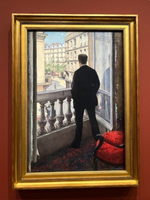
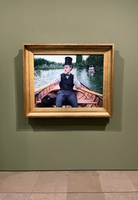
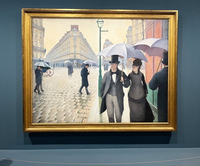
The exhibition was inspired by the recent acquisition of two artworks by Caillebotte: Young Man at His Window (fig. 1), purchased by the J. Paul Getty Museum in 2021, and Boating Party, also known as Oarsman in a Top Hat (fig. 2), acquired in 2022 by the Musée d’Orsay. The latter was designated a “national treasure” in France in 2020.[4] These paintings, along with Paris Street, Rainy Day (fig. 3), a masterpiece on loan from the Art Institute of Chicago, serve as the centerpieces of the exhibition. Enriched by approximately 140 additional artworks and documents, such as paintings, sketches, photographs, costumes, and accessories, this retrospective exhibition is a rare, perhaps once-in-a-generation opportunity to witness a significant yet often overlooked aspect of Caillebotte’s oeuvre.[5]
Caillebotte was an odd figure within the Impressionist group.[6] First, he was born into a well-off bourgeois family. His financial resources enabled him to finance and organize several of the group’s exhibitions and acquire numerous works by his fellow artists. Second, his artistic style and choice of subject matter distinguished him from other members of the Impressionist group.[7] Unlike his contemporaries, who often depicted “modern life” through female figures or scenes of social interaction and flirtation between men and women, Caillebotte focused almost exclusively on male figures.[8] Caillebotte’s subjects encompassed a wide range of male figures, from working-class men engaged in physical labor, like scrubbing floors or painting houses, to upper-class men involved in leisure activities such as reading, observing the streets, rowing, and playing cards.
Nevertheless, Caillebotte was an integral member of the Impressionist group, sharing their passion for capturing the essence and spirit of modern life. His depictions of male figures, often in private or everyday moments, reveal how men navigated both the private and public spheres of nineteenth-century Paris, prompting reflections on the intersections of masculinity and modernity. In this vein, it must be stated from the outset that this exhibition presents Caillebotte not only as a “painter of men” but as a painter of modern life itself. Through his portrayal of men and his exploration of masculinity, Caillebotte’s paintings captured the spirit of modernity and reflected nineteenth-century Paris’s social, cultural, and urban transformations.
Gustave Caillebotte: Peindre les hommes is organized into ten, roughly chronological sections spread across several galleries, each accompanied by straightforward and concise wall texts in French and English that provide information about Caillebotte’s life and interests. The exhibition covers the following themes: “Caillebotte et l’armée” (“Caillebotte and the Army”), “Gustave et ses frères” (“Gustave and His Brothers”), “Au travail et à l’oeuvre” (“At Work and at l’Oeuvre”), “La ville est à nous” (“The City is Ours”), “Gustave et le costume masculin” (“Gustave and Men’s Clothing”), “Hommes au balcon” (“Men on the Balcony”), “Portraits de célibataires” (“Portraits of Bachelors”), “Peindre le corps nu” (“Painting the Nude Body”), “Caillebotte et les sportsmen” (“Caillebotte and Sportsmen”), and “Les plaisirs d’un ‘amateur’” (“The Pleasures of an ‘Amateur’”).
In addition to paintings and preparatory drawings (the latter of which are typically missing from Impressionist exhibitions), the curators have thoughtfully selected various materials to enrich our understanding of Caillebotte’s work within its biographical, social, cultural, and historical context. These materials include clothing, accessories, photographs, documents, and maps illustrating the locations where Caillebotte lived and worked, offering valuable insights into the environments that shaped his artistic perspective. However, the true strength of the exhibition lies in the formal and thematic connections among the works displayed across various galleries.
Upon entering the exhibition, visitors are presented with two different themes. The first section on the right serves as an anteroom with a descriptive wall text that provides background on the artist and contextualizes his work within the historical and social context of late nineteenth-century France. It features a detailed self-portrait of Caillebotte completed just months before his death at forty-five (fig. 4). The second section, “Caillebotte et l’armée,” on the left side of the gallery, includes three paintings centered on the military theme: a large canvas depicting a soldier holding a cigarette in his hand and two pochades showing soldiers in a forest. The room also includes archival materials, such as the artist’s military enlistment papers detailing his physical characteristics and family information (fig. 5).
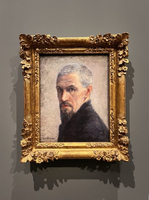
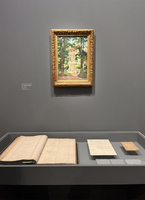
The choice to open the exhibition with a combination of self-portraiture and military scenes is compelling yet a bit unexpected. On one hand, the depiction of soldiers aligns naturally with an exploration of masculinity.[9] On the other, both the self-portrait and the military scenes diverge from traditional representations. In his self-portrait, Caillebotte is depicted with cropped hair and dressed in a sailor’s suit—an unusual choice given his social class. Positioned at the center against a neutral, bright background, he gazes directly at the viewer with a serious expression. The military-themed paintings are equally intriguing, not only because depictions of soldiers are rare in Caillebotte’s oeuvre but because of their unique focus. Rather than portraying soldiers in combat or wielding weapons, Caillebotte’s military works emphasize the quotidian lives of soldiers.
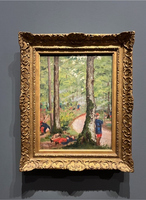
For instance, Yerres, Soldiers in the Woods (fig. 6) shows soldiers engaged in routine activities in a forest, with one soldier depicted defecating—a provocative image rare in Western art. This unconventional opening sets the tone for the exhibition, suggesting that masculinity can be expressed in various ways: through self-portraiture, facial expressions, and even the intimate, mundane act of defecation. It also introduces the issue of social class and identity, framing masculinity not as a singular, monolithic concept but as something multifaceted.
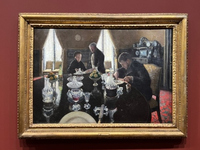
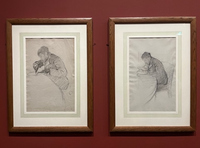
The following section, “Gustave et ses frères,” focuses on Caillebotte’s depictions of his family. In the first years of the Third Republic, Caillebotte lived in the family home in the 8th arrondissement of Paris and often used his family members as models for his paintings.[10] The canvases in this gallery reflect his interest in capturing moments from his family’s daily life as they engage in activities such as reading, knitting, observing from the window, playing billiards, and dining with fine silverware. In addition to Man at His Window (fig. 1), this room also includes Caillebotte’s famous Luncheon (fig. 7). In this painting, with its unusual perspective, Caillebotte portrays his mother, Céleste, and his brother, René, sharing a meal in their dining room, served by the family steward, Jean Daurel. The two preparatory sketches on the side, each titled Study for Luncheon: René Caillebotte at the Table (fig. 8), suggest the artist’s interest in observing his brother’s habits, including the way in which he uses utensils or reads a book at the table. By placing these preparatory works alongside the finished painting, the curators allow viewers to see that Caillebotte’s focus extends beyond mere family portraiture. His primary interest, as it seems, lies in studying everyday mannerisms, particularly the subtle gestures of the body and hands.
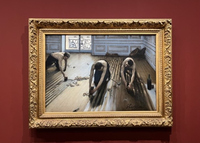
The following room, “Au travail et à l’oeuvre,” delves further into Caillebotte’s exploration of everyday life, focusing on his depictions of urban laborers. The Floor Scrapers (fig. 9) is the centerpiece of this room. Rejected by the Salon in 1875, the painting was exhibited at an Impressionist exhibition in 1876 and has since become one of Caillebotte’s most celebrated works.[11]
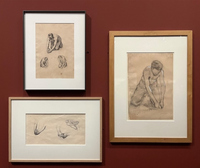
Despite his upper-class background, Caillebotte depicts these urban workers with a remarkable sense of intimacy, almost as if he identifies with them. Acting as the embodiment of vigor and masculinity, the semi-nude figures and the pronounced musculature of their arms suggest the artist’s admiration for the physicality and strength of laboring bodies. His preparatory drawings further reveal his deep fascination with manual labor and his interest in the male body and hands (fig. 10). This space offers an interesting parallel to the previous room, where the artist’s family is shown using their hands for gentle activities that reflect their social class. In contrast, the laborers’ hands firmly grasp their tools, underscoring their connection to the manual labor that characterizes their lives. Caillebotte’s focus on minute, everyday gestures invites the question of whether the contrast between his brother’s delicate actions and the laborers’ raw physicality suggests different yet intertwined forms of masculinity. Masculinity is expressed through both physical potency and more nuanced gestures of everyday life.
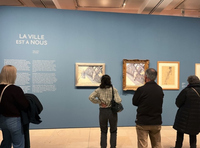
The room titled “La ville est à nous” features a large wall map of nineteenth-century Paris marked with Caillebotte’s residences and some of the locations depicted in his streetscapes exhibited in this room. Paris Street, Rainy Day (fig. 3)—which captures a quintessential Impressionist subject, modern life in an urban setting—serves as the central painting.[12] This room exemplifies Caillebotte’s dual interest in the lives of men and the portrayal of Parisian urbanity. The paintings here depict men casually strolling through the streets and observing passersby with the urban landscape as a backdrop to their daily experience (fig. 11)
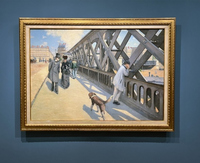
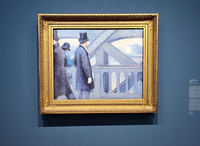
What is particularly striking in this room is that Caillebotte’s streetscapes integrate two key subjects explored in the previous sections: the upper and working classes. While the upper-class men, marked by their black suits and top hats, dominate many of his street scenes, Caillebotte also includes working-class men, as seen in Le Pont de l’Europe (fig. 12). By depicting individuals from different social classes in the same public spaces, Caillebotte’s streetscapes suggest a heterogeneous urban environment, highlighting the rich social fabric of late nineteenth-century Paris.
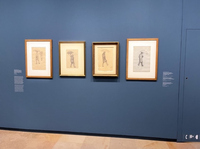
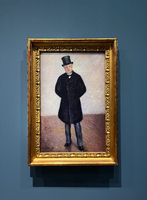
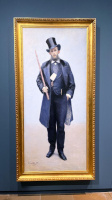
The galleries titled “Gustave et le costume masculin” and “Hommes au balcon” center on two recurring themes in Caillebotte’s oeuvre: the exploration of men’s attire as an expression of masculinity and the view from the balcony, which metaphorically aligns with the concept of the male gaze.[13] “Gustave et le costume masculin” is particularly appealing. It features paintings of men wearing black suits and several preparatory sketches of men under umbrellas (fig. 13). The curators have integrated late nineteenth-century accessories and clothing worn by upper-class men, displayed in glass vitrines alongside the artist’s paintings to highlight the period’s material culture. The paintings in this gallery suggest that, in Caillebotte’s world, clothing was at least as important as a marker of masculine identity as it was of social class.[14] For instance, the same attire is worn in Portrait of Jean Daurelle (fig. 14), a picture of a house servant, and in Portrait of Paul Hugot, which depicts an upper-class man who was a close friend and neighbor of the Caillebotte brothers (fig. 15).
“Hommes au balcon” includes several paintings of Paris as seen from the balcony of Caillebotte’s apartment (fig. 16), along with the relatively large On the Pont de l’Europe (fig. 17). In these works, upper-class men gaze down at the city, an act that can be interpreted as a form of pleasure or perhaps as symbolizing male dominance over the city from above, reflecting their social status. However, this interpretation is complicated by On the Pont de l’Europe, in which Caillebotte depicts a bourgeois man and an urban worker sharing the same act of observation from the bridge. Despite the clear distinction in social class marked by their clothing, their shared observation creates a moment of symbolic equality, challenging notions of class hierarchy and suggesting a common experience among all men.[15]
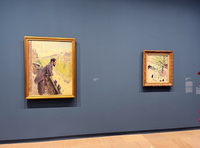
As the title indicates, the “Portraits de célibataires” room features portraits of mostly unmarried men, including the artist’s friends and acquaintances. Wall labels accompanying each painting provide detailed information about the figures depicted. In this section, the men are portrayed indoors, either seated and gazing out the window, absorbed in reading or engaged in activities such as playing cards. The intimate settings contrast with those in the earlier gallery, “Hommes au balcon,” where men observe the city from the vantage point of the balcony or the bridge, positioning themselves as part of the public sphere. Here, however, Caillebotte brings the men inside, framing them in the privacy of their domestic spaces.[16] These men assert their presence within the home, transforming the domestic setting into one that reflects their autonomy and dominance. In doing so, Caillebotte challenges the traditional notion of separate spheres, which typically associates the interior with femininity, and redefines the domestic space as a masculine domain.
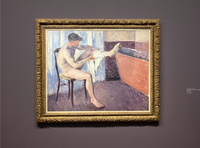
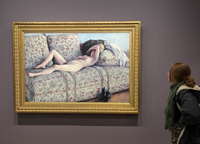
The gallery entitled “Peindre le corps nu” is undoubtedly the most compelling part of the exhibition. Here, visitors can closely observe Caillebotte’s only paintings of the nude: Man at his Bath (fig. 18), Man Drying His Leg (fig. 19), and Nude on the Couch (fig. 20), all painted during the 1880s. These three large-scale paintings, displayed in a relatively small space, confront visitors with a raw and unembellished nudity. The two male bathers face each other across the room while the female nude is positioned on the side wall, allowing visitors to simultaneously notice Caillebotte’s contrasting approaches to the male and female nude forms. The female nude is depicted in a slightly distorted form, disproportionate to the sofa, while the male nude is rendered with a focus on muscularity and idealized proportions.
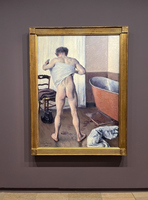
Among these three paintings, only Man at the Bath was exhibited during Caillebotte’s lifetime, at the fifth annual exhibition of Les XX in Brussels. Yet this painting apparently caused such discomfort that the organizers removed it from the main gallery, relegating it to a side room where it hung in isolation.[17] The wall label states that Caillebotte’s painting revolutionized the genre of the male nude, moving away from idealized, academic representations to a raw, naturalistic depiction of masculinity. Furthermore, the label highlights the painting’s “voyeuristic” quality, emphasizing the unrestrained display of the male anatomy and the artist’s evident pleasure in capturing it, which invites a potentially erotic interpretation of the work by viewers.
While one cannot ignore the erotic aspects, particularly in the focus on the exposed buttocks and the intimate nature of the space, Caillebotte’s male bathing paintings also evoke the ordinariness of a simple, everyday ritual. Man at His Bath and Man Drying His Leg form a sequence, with the latter continuing the depiction of the same act of self-care from a slightly different perspective, further reinforcing the banality, intimacy, and routine nature of the subject.
Interestingly, the bare buttocks in Man at the Bath, with its naturalism and directness, echoes earlier themes in the exhibition in which exposed male body parts are presented in various contexts. For example, in the first gallery, the exposed buttocks of a soldier were displayed in the “unclean” act of defecation. In contrast, this painting presents the male posterior in the act of cleaning, shifting the association from uncleanliness to hygiene and intimate self-care.
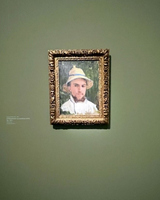
Inspired by the development of leisure culture and body care during the second half of the century, Caillebotte created a significant series of works focused on sports activities such as sailing and swimming; most of them are displayed in the gallery “Caillebotte et les sportsmen” (fig. 21). As noted in the wall text, Caillebotte portrays sailing as an exclusively masculine sport, unlike many of his contemporaries who used these themes to depict flirtations between men and women in boats. While most of the paintings in this gallery relate formally and thematically to Boating Party (fig. 2), it is the artist’s Self-Portrait in a Straw Hat (fig. 22) that adds particular depth and appeal to this space. In contrast to the more serious self-portrait displayed in the anteroom, in this self-portrait, Caillebotte presents himself in a more playful manner—with a faint, elusive smile—and wearing a straw hat. Does this suggest a shift in his persona? It is hard to tell. However, the self-portrait’s sense of spontaneity clearly aligns with the leisure themes in his sports-related works, offering a glimpse into a more personal side of Caillebotte’s life.
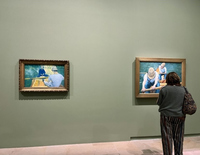
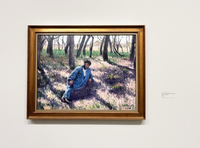
Since the exhibition is organized chronologically, the final room, “Les plaisirs d’un ‘amateur,’” includes several of Caillebotte’s late works that he painted around Normandy and in Petit-Gennevilliers, where he moved in 1887. Caillebotte’s three paintings of men in blue smocks, displayed right at the entrance to the gallery, are truly captivating (figs. 23 and 24). Although neither the figure nor the location is definitively identified, the man in these works is believed to be Magloire Raulin, a well-known gardener from the area near the old Hôtel de la Plage in Étretat. Caillebotte portrays this man strolling casually through a pastoral landscape or resting under a tree, and the blue smock—typically associated with urban laborers as seen in On the Pont de l’Europe—contrasts with the bright, serene background.
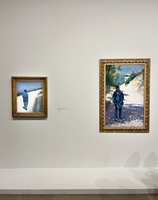
In the center of the room, a glass table displays documents and photos of Gustave and Martial Caillebotte, highlighting their passion for sailing. The items offer insights into their involvement in the yacht club Cercle de la Voile de Paris and Gustave’s achievements as a competitive sailor and boat designer. Caillebotte’s interest in sailing and outdoor leisure activities is further emphasized on the right wall of the final gallery, where viewers encounter several works depicting sailboats from a distance, making the vessels, rather than the sailors, the subject (fig. 25). While one might question the curators’ decision to end the exhibition with these images in which men appear in a secondary role, their inclusion may have been intended to highlight Caillebotte’s broader artistic engagement with modern life.
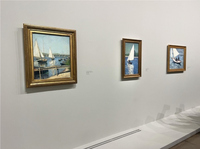
Indeed, while the title Peindre les hommes suggests the exhibition centers on male figures, the exhibition goes far beyond simply showing men. It delves into the concept of modernity through everyday moments. By focusing on men’s daily activities such as reading, playing cards, drying off after a shower, lounging on a sofa, or walking the streets, Caillebotte’s paintings show how the mundane became a defining aspect of modern life. Through his depictions of men in leisure, work, and intimate moments, Caillebotte offers a nuanced perspective on nineteenth-century masculinity. By focusing on private and everyday aspects of life, his work reveals how representations of masculinity were intertwined with urban life while challenging traditional norms of gender and social class.
The exhibition is accompanied by an illustrated catalogue edited by Scott Allen, Gloria Groom, and Paul Perrin, featuring ten insightful essays that explore various aspects of Caillebotte’s work in alignment with the exhibition’s theme. These essays deepen our understanding of Caillebotte’s art by examining his family dynamics, personal experiences, and significant life events while also placing his works within the broader artistic context of the period. Of particular note is the comprehensive introduction, which clarifies the exhibition’s artistic choices and provides an expanded historical, social, and cultural context. Additionally, the catalogue includes works by Caillebotte that are not featured in the exhibition, further enhancing its value as a resource for those seeking a deeper insight into the artist’s life and legacy.
It is worth noting that this exhibition also marks the 130th anniversary of Gustave Caillebotte’s death in 1894, which itself coincided with the extraordinary bequest of his collection of Impressionist paintings to the state. In conjunction with the exhibition, Perrin edited and published Caillebotte et les impressionnistes: Histoire d’une collection (Caillebotte and the Impressionists: History of a Collection). The essays in this volume explore Caillebotte’s pivotal role as both artist and collector, illustrating how his substantial donations, including his bequest to the Louvre, were instrumental in securing the lasting recognition of Impressionism and shaping the Musée d’Orsay’s collection.[18]
One last point to consider: in recent decades, the question of Caillebotte’s sexuality has been raised by several scholars. As a childless bachelor distanced from traditional masculine roles and with a recurring interest in depicting men, Caillebotte’s works have frequently been analyzed through the lens of a potentially homosexual desire or gender theories. The curators of this exhibition acknowledge the uncertainty surrounding the artist’s sexuality, noting that nothing is definitively known about it. And yet, the exhibition makes plain Caillebotte’s unconventional lifestyle and explores his focus on men, thus perhaps reinforcing sexualized interpretations of his work. The mere mention of uncertainty about Caillebotte’s sexuality in both the catalogue and the wall text of “Peindre le corps nu” inevitably draws visitors’ attention to it, shaping their interpretation of his works.
Accordingly, several French critics have expressed concerns about the exhibition’s approach. “A bias that introduces gender theory into the discussion,” “a biased view of Gustave Caillebotte,” and “a lingering sense of unease” are just some of the comments critics have made about the exhibition.[19] Some have argued that the exhibition places too much emphasis on a gendered interpretation and that queer or gender theories may not align with the artist’s original intentions. But even if some of Caillebotte’s paintings raise questions about his interest in men or his sexual orientation, one might wonder whether an artist’s sexual preferences should influence the interpretation of their art. Does it define the value of their work, or should we simply appreciate their art for what it is? As Caillebotte once wrote in his letter to his friend Camille Pissarro, “The true argument of a painter is his painting.”[20]
Notes
[1] Just to name a few: Visualising Masculinities (Tate Gallery, London, December 19, 1992–June 6, 1993); Masculine / Masculine: The Nude Man in Art from 1800 to the Present Day (Musée d’Orsay, Paris, September 24, 2013–January 12, 2014); Masculinities: Liberation through Photography (Barbican Art Gallery, London, July 13–August 23, 2020); Fashioning Masculinities: The Art of Menswear (V&A South Kensington, London, March 19–November 6, 2022); and Men Untitled (Fondation Henri Cartier-Bresson, Paris, September 19, 2023–January 14, 2024).
[2] Within Caillebotte’s figurative works, there are 100 paintings featuring only men, 17 with both male and female figures, and 32 with women alone. Of the 76 works he exhibited during his lifetime, 33 depicted men and 16 depicted women. See Marie Berhaut, Gustave Caillebotte: Catalogue raisonné des peintures et pastels (Paris: Wildenstein Institute, 1994). Despite Caillebotte’s ongoing interest in depicting men his portrayal of male figures has never, until now, been the subject of a dedicated exhibition. Recent thematic exhibitions on Caillebotte include Gustave Caillebotte: Impressionist Paintings from Paris to the Sea (Brooklyn Museum, New York, March 27–July 5, 2009); The Caillebotte Brothers’ Private World (Musée Jacquemart-André, Paris, March 25–July, 2011); Gustave Caillebotte: An Impressionist and Photography (Schirn Kunsthalle, Frankfurt, 2012); and Caillebotte, Painter and Gardener (Museo Nacional Thyssen-Bornemisza, Madrid, and Museum of Impressionism, Giverny, July 19–October, 2016).
[3] Paul Perrin, Scott Allan, and Gloria Groom, “Caillebotte, Peindre les hommes,” in Caillebotte, Peindre les hommes, eds. Paul Perrin, Scott Allan, and Gloria Groom, exh. cat. (Paris: Musée d’Orsay, 2024), 10.
[4] On this matter, see Paul Perrin, “Gustave Caillebotte, Partie de bateau: un trésor national pour le musée d’Orsay,” La revue des musées de France (2023–24): 19–22.
[5] This exhibition follows the previous retrospective exhibitions of the artist: Gustave Caillebotte: A Retrospective Exhibition (The Museum of Fine Arts, Houston, October 22, 1967–January 2, 1977; The Brooklyn Museum, New York, February 22–April 24, 1977); Gustave Caillebotte. Urban Impressionist (Galeries Nationales du Grand Palais, Paris, September 16, 1994–January 9, 1995; Art Institute of Chicago, Chicago, February 15–May 28, 1995; Los Angeles County Museum of Art, Los Angeles, June 22–September 10, 1995); and Gustave Caillebotte: The Painter’s Eye (National Gallery of Art, Washington, DC, June 28–October 4, 2015; Kimbell Art Museum, Fort Worth, November 8, 2015–February 14, 2016).
[6] In the first years of the Third Republic, Caillebotte abandoned his law studies and turned to painting. He was accepted to the École des Beaux-Arts after studying in the atelier of Léon Bonnat. Following his rejection from the Salon in 1875, he joined the Impressionist group. On Caillebotte’s life and artistic career, see, e.g., Stéphanie Chardeau-Botteri, Gustave Caillebotte, l’impressionniste inconnu (Paris: Fayard, 2024); and Kirk Varnedoe, Gustave Caillebotte (New Haven: Yale university Press, 2000).
[7] Fionna Barber, “Caillebotte, Masculinity, and the Bourgeois Gaze,” in The Challenge of the Avant-Garde, ed. Paul Wood (New Haven: Yale University Press, 1999), 137; and Michael Fried, “Caillebotte’s Impressionism,” in Gustave Caillebotte and the Fashioning of Identity in Impressionist Paris, ed. Norma Braude (New Brunswick, NJ: Rutgers University Press, 2002), 66–67.
[8] Perrin, Allan, and Groom, “Caillebotte, Peindre les hommes,” 12.
[9] On the connection between the army and masculinity during the Third Republic, see Robert A. Nye, Masculinity and Male Codes of Honor in Modern France (New York: Oxford University Press, 1993); and Christopher E. Forth, “La Civilisation and its Discontents: Modernity, Manhood and the Body in the Early Third Republic,” in French Masculinities: History, Culture and Politics, eds. Christopher E. Forth and Bertrand Taithe (London: Palgrave Macmillan, 2007), 85–102. On visual representations of soldiers, see Sean Kramer, “Military Manhood: Visualizing the Common Soldier in French and British Art and Culture, 1871–1914,” (PhD diss., University of Michigan, 2022).
[10] Varnedoe, Gustave Caillebotte, 2.
[11] On this painting, see Michael Marrinan, Gustave Caillebotte: Painting the Paris of Naturalism, 1872–1887 (Los Angeles: The Getty Research Institute, 2016), chap. 3.; and Barber, “Caillebotte, Masculinity,” 142–47.
[12] Over the past decades, this monumental painting has undergone conservation treatment and numerous infrared and X-ray examinations. See, e.g., Gloria Groom and Genevieve Westerby, eds., Caillebotte Paintings and Drawings at the Art Institute of Chicago (Chicago: Art Institute of Chicago, 2015), https://publications.artic.edu/.
[13] On Caillebotte’s images from the balcony, see Rodolphe Rapetti, “Paris Seen from a Window,” in Gustave Caillebotte. Urban Impressionist, eds. Anne Distel, Douglas W. Druick, Gloria Groom, and Rodolphe Rapetti, exh. cat. (Paris: Musée d’Orsay, 1995), 141–76.
[14] See Tamar Garb, Bodies of Modernity: Figure and Flesh in Fin-de-Siècle France (New York: Thames and Hudson, 1998), 35–36; On upper-class men’s clothing in general, see Phillipe Perrot, Fashioning the Bourgeoise: A History of Clothing in the Nineteenth Century, trans. Richard Bienvenu (Princeton: Princeton University Press, 1994).
[15] According to Alain Faure, the blue smock, commonly known as La blouse ouvrière (the worker’s shirt) was associated with the working class, especially with those who worked on the street. Alain Faure, “La blouse ouvrière au XIXe siècle: Les normes de la dignité,” Modes Pratiques: Revue d’histoire du vêtement et de la mode 1 (2015): 149.
[16] On the connection between masculinity and the domestic space, see Temma Balducci, Heather Belnap Jensen, and Pamela J. Warner, eds., Interior Portraiture and Masculine Identity in France, 1789–1914 (New York: Routledge, 2016); Temma Balducci, Gender, Space, and the Gaze in Post-Haussmann Visual Culture: Beyond the Flâneur (New York: Routledge, 2017), chap. 4.
[17] “Chez les XX,” La Chronique, February 10, 1888. On this painting, see Garb, Bodies of Modernity, esp. chap. 1; Richard Leppert, The Nude: The Cultural Rhetoric of the Body in the Art of Western Modernity (New York: Routledge, 2007), 194–96; and Norma Braude, “Outing Impressionism: Homosexuality and Homosocial Bonding in the Works of Caillebotte and Bazille,” in Gustave Caillebotte and the Fashioning of Identity in Impressionist Paris, ed. Norma Braude (New Brunswick, NJ: Rutgers University Press, 2002), 152–54.
[18] Paul Perrin, Caillebotte et les impressionnistes: Histoire d’une collection (Paris: Musée d’Orsay, 2024).
[19] “un biais qui fait entrer les thèses du genre dans le propos” Eric Biétry-Rivierre, “Exposition: à Orsay, Caillebotte en chantre de la figure masculine,” Le Figaro, October 6, 2024; “Un regard biaisé sur Gustave Caillebotte;” “un malaise persistant,” Harry Bellet, “Un regard biaisé sur Gustave Caillebotte, au Musée d’Orsay,” Le Monde, October 15, 2024. See also Philippe Lançon, “Au musée d’Orsay, le peintre Gustave Caillebotte effleure le mâle,” Libération, October 18, 2024.
[20] “les véritables arguments d’un peintre sont sa peinture,” Gustave Caillebotte to Camille Pissarro, January 24, 1881, in Berhaut, Gustave Caillebotte: Catalogue raisonné, 275.