“A Thing of Beauty is a Joy Forever”: Ernest Gambart (1814–1902), een leven in de kunsthandel (a life in the art trade) by Ingrid Goddeeris, Filippe De Potter, and Paul De Paepe
Reviewed by Evelien de VisserEvelien de Visser
RKD-Nederlands Instituut voor Kunstgeschiedenis
Email the author: devisser[at]rkd.nl
Citation: Evelien de Visser, book review of ‘A Thing of Beauty is a Joy Forever’: Ernest Gambart (1814–1902), een leven in de kunsthandel (a life in the art trade) by Ingrid Goddeeris, Filippe De Potter, and Paul De Paepe, Nineteenth-Century Art Worldwide 24, no. 1 (Spring 2025), https://doi.org/10.29411/ncaw.2025.24.1.14.
This work is licensed under a Creative Commons Attribution-NonCommercial 4.0 International License  unless otherwise noted.
Your browser will either open the file, download it to a folder, or display a dialog with options.
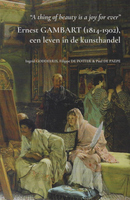
Ingrid Goddeeris, Filippe De Potter, and Paul De Paepe,
“A Thing of Beauty is a Joy Forever”: Ernest Gambart (1814–1902), een leven in de kunsthandel
Kortrijk: Koninklijke Geschied-en Oudheidkundige Kring van Kortrijk, 2023.
394 pp.; 171 color illus.; notes; three appendices; bibliography.
€35.00 (hardcover)
ISBN: 9789464775143
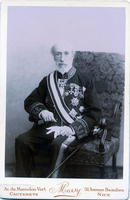
The Belgian art dealer Ernest Gambart (fig. 1) is one of the most well-known names in the nineteenth-century art trade. Since the 1970s, various publications have been dedicated to the innovative way Gambart marketed paintings and prints by contemporary artists, including Jeremy Maas’s authoritative biography Gambart: Prince of the Victorian Art World and Pamela Fletcher’s article “Creating the French Gallery: Ernest Gambart and the Rise of the Commercial Art Gallery in Mid-Victorian London.”[1] “A Thing of Beauty is a Joy Forever”: Ernest Gambart (1814–1902), Een leven in de kunsthandel (a life in the art trade) reviews his accomplishments as an art dealer and paints a picture of his life as a retiree in Spa, Belgium, and Nice, France. Contrary to what the title suggests, however, the book does not exclusively cover Gambart’s life; it also delves into the history of Gambart’s forefathers who settled in Kortrijk, Belgium, in the late eighteenth century, his activities as an art dealer, his art collection, and his estate in Nice, France.
The text introduces new sources from the recently discovered Ernest Gambart archive (which had previously been in the possession of a descendant) that cover Gambart’s life as well as the lives of those close to him. The authors were also given access to Jeremy Maas’s research archive. In recent years, both archives were donated to the Archive for Contemporary Art in Belgium (part of the Royal Museums of Fine Arts of Belgium). Additionally, the three authors—Ingrid Goddeeris, Filippe De Potter, and Paul De Paepe—conducted painstaking archival research that unearthed numerous documents, including birth certificates and even court and police records (48). Furthermore, previously known source material was reexamined. This work has resulted in a dizzying number of new details and interesting facts about Gambart, making the text, first and foremost, a resource for the well-informed reader with a pronounced interest in the subject matter.
The publication, part of the Handelingen van de Koninklijke Geschied- en Oudheidkundige Kring van Kortrijk (Proceedings of the Kortrijk Royal Historical and Archaeological Society) series, consists of three independent parts, each with its own author, structure, style, and bibliography. Paul De Paepe, who was Professor of Earth Sciences at the University of Ghent until his retirement in 2004, wrote the first part about the Gambart family in Kortrijk. Ingrid Goddeeris, curator of the library collection and researcher at the Royal Museums of Fine Arts of Belgium and a specialist in the nineteenth-century Belgian and international art market, wrote the second part about Ernest Gambart. The third part, which focuses on Gambart’s estate and villa in Nice, was written by Filippe De Potter, vice-chairman of the Koninklijke Geschied- en Oudheidkundige Kring van Kortrijk.
Part 1 provides the original impetus for the publication, but the scope of the research was expanded after the discovery of Gambart’s archive. The history of the Gambart family is discussed through Ernest Gambart’s great-grandfather, Robert (1732–1803); grandfather, Charles (1755–1834?); and father, Joseph (1788–1855). Robert Gambart moved from his hometown of Cambrai, France, and settled in Kortrijk with his family in 1758; he worked as a dealer and/or book binder. His eldest son, Charles, eventually worked as a cartographer and book binder, opening a bookshop in 1799 under the name R. Gambart, fils.[2] The bookshop sold a variety of products, such as stationery, dictionaries, and encyclopedias, but also geographical maps of the Netherlands and Paris, all kinds of liquors (e.g., absinthe, anisette, and other medicinal elixirs), healing balms, and oils. The premises also included a workshop for book binding. From 1787, the bookshop housed a reading room whose members had access to an extensive library. A print shop was added in 1794 for printing books, posters, and newspapers. In 1814, Charles and his wife, Jacqueline Dugardin, moved to Ieper, Belgium, possibly due to accusations of fraud and/or their looming bankruptcy. In Ieper, the couple once again established a print shop, while their son Joseph (1788–1855) took over the business in Kortrijk. That same year, Joseph married Catherine Cartellier Couval in Paris. They had seven children, including Ernest.
During the second—and most extensive—part of the book, Goddeeris discusses Ernest Gambart’s life chronologically in Kortrijk (1814–33), Paris (1833–40), London (1840–71), and Spa and Nice (1870–1902). To describe Gambart’s life in Kortrijk and Paris, she uses a surprising source: a document his father drafted for defending himself in court when he was accused of fraud. It reveals all sorts of interesting facts about Gambart’s life, from his childhood until he left for London. Furthermore, genealogical research into Ernest’s background establishes that he not only had two sisters and a brother, as is well known, but three additional sisters. He also appears to have not been the oldest in the family, as had been previously assumed, but the second oldest.
During his youth in Kortrijk, Gambart took painting lessons from Jean Baptiste Daveloose, an artist from the same city. After leaving school, Gambart worked in his father’s family business, where he drew and engraved vignettes. At the age of 29, Gambart traveled, at his father’s behest, to Paris, where he became an active paper and cardboard manufacturer. There, he married Anne Codant and fathered a daughter, Augustine Eugénie. Sadly, mother and daughter died shortly after each other. Gambart’s company, co-owned with Auguste Lazare Junin, had little success and, after only a few months in operation, went bankrupt in 1839. In 1840, Gambart left for London on the advice of Théodore Vibert, who worked for print publisher Goupil in Paris. Between 1840 and 1850, Gambart spent most of his time in London, involved in the print trade. In 1842, the firm of Gambart & Junin relaunched as an importer and exporter of art prints. The company also published prints in collaboration with other international publishers, including Goupil & Vibert. Furthermore, the company held the sole right to the exclusive production and sale of specific prints. After Junin’s death in 1847, Gambart continued the business under his own name but increasingly shifted his attention to dealing in paintings. In 1854, at 40, he established the well-known French Gallery, located on Pall Mall, which he headed until 1871.
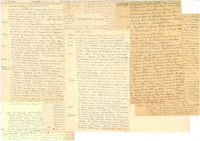
From Gambart’s retirement in 1870 until his death in 1902, he divided his time between Spa and Nice. He owned a villa in both cities: Château d’Alsa and Les Palmiers. Goddeeris mainly discusses his time in Nice between 1882 and 1897, according to Gambart’s resurfaced diary entries (fig. 2), which provide new information about this period. The entries reveal that he was a great lover of music, the theater, and the casino. He also loved nature and horticulture. While in his sixties, he still traveled extensively throughout Europe and visited Egypt, Athens, and Algeria. Goddeeris notes, however, that Italy, Switzerland, and Belgium were his favorite destinations, and he preferred to spend his summers in the Swiss mountains.
Contemporary art also continued to hold his interest. Following his retirement, Gambart likely collected around 350 paintings, watercolors, and drawings. The collection predominantly featured work by artists of the juste milieu, such as Jean-Léon Gérôme, Florent Willems, and Hans Makart, whose work Gambart previously sold. Several beautiful, though not new, photographs of the interiors of Les Palmiers reveal how the collection was displayed. Based on these photographs, a few works can be identified, but a complete reconstruction is hardly possible. One of the reasons is that many artists who are represented in Gambart’s collection created multiple versions of their paintings. This makes identification of specific works difficult. After Gambart’s death, the collection was dispersed. He bequeathed some works to family members, while others ended up in Belgian, French, and Spanish museums. Most were auctioned off in London in 1903.
Gambart mingled with international high society and enjoyed being the center of attention. He organized countless, lavish events—receptions, soirées, and parties—at his villas in Spa and Nice. These were attended by the European cultural and political elite. His position was underscored when he became the honorary consul of Spain to Nice in 1878. In this capacity, he accompanied Spanish visitors to the city and met Spanish artists, including José Villegas Cordero and Vicento March Marco, in their workshops during various visits to Rome. Both Cordero and Marco worked on paintings that Gambart had commissioned. A few of these ended up in Gambart’s collection. The retired Gambart managed to maintain his position of influence in the world of contemporary art with his private collection, which he made available for large international exhibitions. Moreover, he managed to impress his guests with his collection, which emphasized his track record as a dealer and his connections to world famous artists.
This voluminous portion of the publication concludes with a chapter that describes Gambart’s methods as an art dealer. His success depended on five strategies. First, he used the mass production of prints to promote his favorite artists to a large audience. In addition to owning paintings, Gambart held exclusive rights for their reproduction. He managed to attract the public’s attention by first publishing prints of details from the painting. This would be followed by a print of the complete image, after which the painting itself would be sent out on tour. Second, the author refers to the winter and spring exhibitions that Gambart organized at the French Gallery; these gave his gallery name recognition. His relationships with art critics also played a role in his success. His exhibitions were brought to the attention of the public because they were discussed in periodicals like The Athenaeum. It was mainly at the British magazine The Art Journal that Gambart had contacts, including Henri Mogford (who had also worked for him for some time). The fourth strategy was bringing trade inventory to auction. Between 1846 and 1871, Gambart consigned work from his inventory to at least forty auctions. Although it is not quite clear why he did this, a possible explanation is that Gambart used the auction market to speculate and/or liquidate part of his inventory and generate cash flow.
Finally, Goddeeris discusses Gambart’s artistic and business contacts, including Jean Portaels, Rosa Bonheur, and William Powell Frith. Gambart’s relationship with Bonheur has been written about often, but unpublished sources, including a manuscript containing Gambart’s recollections of Bonheur and his diary entries, offer new facts. One of these is that Gambart considered himself to have played an important role in Bonheur’s admission to the Légion d’honneur. In 1894, Bonheur became the first woman to receive this distinction. However, based on Bonheur’s own recollection, Goddeeris counters that this was an exaggeration on Gambart’s part, and that Bonheur received the distinction partly due to the intervention of two other individuals. Other new anecdotes concern the genesis of a few of Bonheur’s works and how several came to be in Gambart’s possession (fig. 3). The business network surrounding the French Gallery is discussed through the critic Henry Mogford; Surville (Victor Lauren Esliard), Gambart’s business partner, agent, broker, and family friend rolled into one; and Franz Joseph Pilgeram, who worked for Gambart between 1856 and 1870, but whose precise role is not quite clear. In any case, Pilgeram stayed on after Gambart’s retirement, when the company changed its name to Lefèvre & Pilgeram, until his own departure in 1880.
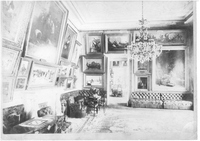
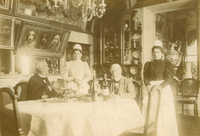
The book’s third (and final) part is dedicated to Gambart’s estate in Nice. De Potter, the author of this section, delves into the history and development of the twenty-four-acre property. Gambart enjoyed spending time in Nice due to its pleasant climate, which he found beneficial to his health. In 1870, he privately purchased the estate after the previous owner, banker Honoré Gastaud, declared bankruptcy. Gambart hired a local architect, Sébastien-Marcel Biasini, to remodel the villa, especially for hosting guests. Important reception rooms, such as the central parlor (fig. 4) and the dining room, were situated on the south side of the villa. The second floor, on the same side, housed at least three guestrooms and Gambart’s own quarters. The southern façade was fully clad in marble and offered a stunning view of the luscious gardens and the Mediterranean. The central parlor, where most of Gambart’s parties took place, featured a built-in sofa of almost fifty feet in length and a piano; French doors provided a view of the garden. Artworks by Sir Lawrence Alma-Tadema, Jean-Léon Gérôme, and Jean-Louis-Ernest Meissonier, among others, graced the walls of the parlor. The dining room was devoted to the work of Bonheur and paintings by Makart. A nice detail is that Gérôme’s bronze statuettes of the Venus de Milo and Phyrne were displayed on Gambart’s desk in his office and library. Gambart commissioned the Belgian artist Nicaise De Keyser to paint four monumental paintings for the foyer. More than eighty artists from antiquity through the nineteenth century—from Italy, Spain, Flanders, the Netherlands, France, and England—are immortalized on these canvases, which measure as large as 113 × 179½ inches. Gambart had himself depicted as well, although not together with the nineteenth-century artists; instead, he was included among the artists of classical antiquity. Around his villa, Gambart had luscious gardens planted with extraordinary collections of rhododendrons and rose bushes. The estate also included a winter garden and conservatories, one of which featured a species of water lily that was new to Europe at the time.
After Gambart’s death, the property was sold to Baron Alexander von Falz-Fein, and it was subsequently purchased by the entrepreneur Edouard Soulas in 1924. Both owners made changes to the villa and the garden. Following Soulas’s death, his heirs sold the villa and surrounding gardens to a real estate developer who wanted to reconstruct the entire premises. In 1961, apartment buildings arose on the property around the villa; only a fraction of the original garden remained. The villa itself was spared and became the property of the city of Nice, which now uses it to house its city archives. Other residential houses situated on the original Gambart property have not withstood the test of time. Villa l’Africaine, where Bonheur stayed for some time, was torn down. The small Villa Tunisienne, which the artist Félix Ziem bought from Gambart in 1876, also, unfortunately, no longer exists.
In “A thing of beauty is a joy forever”: Ernest Gambart (1814–1902), een leven in de kunsthandel, Gambart shares the spotlight with archival documents by and about him. The authors take the opportunity to provide detailed interpretations and context for these archival records. Goddeeris is convincing in her handling of Gambart’s father’s written observations and Gambart’s own diary entries, the contents of which she describes and clarifies. She also explains how these documents should be interpreted and viewed in relation to similar sources. The appendices include helpful overviews with information about the archives and their contents. An index, and perhaps a timeline, would have made the contents even more accessible. The publication contains many pictures (all in color) and is yet very reasonably priced. The originality of the chosen images is surprising: portraits (painted or otherwise) of the most important individuals are included, and it even contains a picture, in the form of an old postcard, of the villa that Ziem bought from Gambart in Nice. The complete source citation accompanying the images makes it easy for researchers whose curiosity has been piqued to find more information themselves. Moreover, the archival records are displayed in such a way that it is even possible to read along. Studying a new, disordered archive is a time-consuming process. This publication guides the reader through the comprehensive research into all aspects of Gambart’s life. With all its new information, this book will be a rich source for further research into Gambart. An English translation is not only advisable, but even obvious, considering art historians’ substantial and international interest in this prominent dealer.
Notes
Translated by Wendela van den Broek
[1] Jeremy Maas, Gambart: Prince of the Victorian Art World (London: Barrie & Jenkins Ltd., 1975); Pamela M. Fletcher, “Creating the French Gallery: Ernest Gambart and the Rise of the Commercial Art Gallery in Mid-Victorian London,” Nineteenth Century Art Worldwide 6, no. 1 (Spring 2007), https://www.19thc-artworldwide.org/.
[2] While historical sources show the name of the bookshop as “R. Gambart, fils,” the book alternates between the Dutch, zoon, and French, fils.