Gothic Modern: From Darkness to Light
Reviewed by Charlotte AshbyCharlotte Ashby
University of London
Email the author: c.ashby[at]bbk.ac.uk
Citation: Charlotte Ashby, exhibition review of Gothic Modern: From Darkness to Light, Nineteenth-Century Art Worldwide 24, no. 1 (Spring 2025), https://doi.org/10.29411/ncaw.2025.24.1.18.
This work is licensed under a Creative Commons Attribution-NonCommercial 4.0 International License  unless otherwise noted.
Your browser will either open the file, download it to a folder, or display a dialog with options.
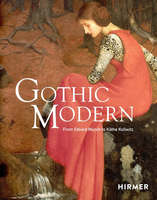
Gothic Modern: From Darkness to Light
Ateneum Art Museum, Helsinki, October 4, 2024–January 26, 2025
The National Museum, Oslo, February 28–June 25, 2025
Albertina Museum, Vienna, September 19, 2025–January 11, 2026
English Catalogue:
Anna-Maria von Bonsdorff and Juliet Simpson eds.,
Gothic Modern: From Edvard Munch to Käthe Kollwitz
Contributions by Juliet Simpson, Cynthia Osiecki, Jeanne Nuechterlein, Ralph Gleis, Stephan Kuhn, Timo Huusko, Johan De Smet, Riitta Ojanperä, Kjartan Hauglid, Anna-Maria von Bonsdorff, Marja Lahelma, and Vibeke Waallann Hansen.
Chicago: Chicago University Press, 2024.
224 pp.; 125 color illus.; notes & references; index.
$52.00 (hardcover)
ISBN: 9789527371725
Finnish Catalogue:
Anna-Maria von Bonsdorff and Juliet Simpson eds.,
Gothic Modern—Pimeydestä Valoon
Contributions by Juliet Simpson, Anna-Maria von Bonsdorff, Ralph Gleis, Vibeke Waallann Hansen, Riitta Ojanperä, Marja Lahelma, and Timo Huusko.
Helsinki: Ateneum Kansallisgalleria, 2024.
262 pp.; 122 color illus.; notes & references; index.
€38.00 (hardcover)
ISBN: 9789527371718
The mood of this exhibition experience is set on the landing of the third floor of the Ateneum Art Museum—the Finnish National Gallery in Helsinki—by a light projection of Gothic architectural tracery across the wall and ceiling and over the exhibition entrance.[1] This projection serves to invoke the memory of Gothic architectural space—churches, cathedrals, and quads—and is laid over the neo-Renaissance classicism of the Ateneum building. This is not simply theatrical flair, but a foreshadowing of the key role of such Gothic encounters as a transformative experience for artists seeking to shrug off the authority of the classical tradition, and particularly academic conventions, for the presentation of the human figure and experience.
Gothic Modern: From Darkness to Light is a research exhibition based on a project begun in 2017 by Juliet Simpson (Coventry University) and Anna-Maria von Bonsdorff (Ateneum). The project developed as a collaboration between a team of curators and academics across a range of institutions led by Simpson. The seven-year lead-in time reflects the disruption of the global pandemic, but also the challenges of undertaking a transnational, research-based, thematic exhibition and the number of loans involved. The depth of work that has gone into this exhibition feeds into the substantial exhibition catalogue that sets out, in a series of articles, the research underpinning the curation.
The exhibition itself achieves the comparatively rare feat of communicating its thesis primarily through the hang rather than the accompanying wall texts. Artworks are brought into new conjunctions, creating a compelling visual argument through a range of visual resonances. In this way, it replicates the mode of encounter that drove the artists’ own engagement with the art of the medieval past—one that was primarily visual and emotive rather than scholarly. This brings to life the thesis of visual and material objects acting across time and space.
A similar visual argument was used in another exhibition with a transnational and transmedia thesis, Japanomania in the Nordic Countries, 1875–1918 (Ateneum, February–May 2016), also led by von Bonsdorff with a range of collaborators.[2] The core visual material within the Gothic Modern exhibition covers nearly the same date range (1875–1925). Geographically, it extends its purview beyond the Nordic countries to cover Northern Europe, loosely defined, but substantially based on collections in Finland, Norway, Germany, Belgium, and the Netherlands. The works on display range from familiar favorites to lesser-known works from otherwise well-known artists, and to work by some comparatively little-known figures, previously marginalized within studies of the long fin-de-siècle.
Simpson defines Gothic modernity as “an idea of modern art—and cultural modernisms—re-conceived through porous boundaries of time, place, memory, and end-times as futures that open different visions of modern art and creative experiment” (11). The exhibition draws our attention to the transnational phenomenon of artists turning towards the Northern medieval past as a means of articulating their experience of the present. One aspect of this theme is artists’ journeys and subsequent encounters with other artworks and spaces. This adds a new string to the bow of already established narratives of artistic exchange at the fin de siècle: journeys to Paris and Munich or to artist colonies and, of course, the transformative encounter with art from East Asia.[3]
Just as with the Japanomania exhibition, the strength of the visual resonances established between different artworks is such that one is immediately surprised that this theme has not been previously tackled transnationally. Familiar artworks are transformed through new juxtapositions, drawing out this hitherto under-examined point of common connection. The first gallery of the exhibition establishes several of the key themes that are further articulated in subsequent galleries, running across the whole of the third-floor exhibition spaces.
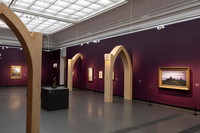
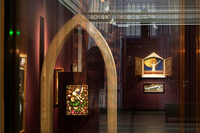
The architectural motif of the entrance is continued in the exhibition space through the installation of cloister-like pointed archways, on which are mounted plaster casts of architectural ornament from Nideros Cathedral, Trondheim (fig. 1). For the general visitor, these simply extend the evocation of encounters with Gothic or Gothic-revival architectural spaces, but they also refer to the many important architectural restoration projects of Gothic buildings of the nineteenth century. These projects, such as the restorations of the Nideros, Lund, and Turku cathedrals, were nexuses of national pride and debates regarding heritage and identity. The nation-building aspect of the nineteenth-century Gothic revival is signaled in the prominent display of Karl Friedrich Schinkel’s Mediaeval City on a River (1815; Alte Nationalgalerie, Berlin), an idealized vision of an imaginary German city.
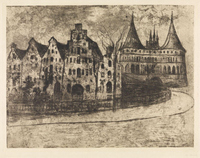
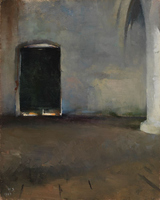
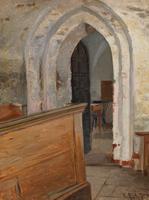
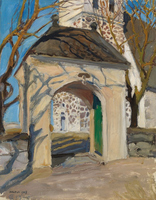
The emphasis in this exhibition, though, is on the transnational story, and we are presented parallel encounters with Gothic heritage that inflect this national story. One leitmotif is travel, both across Europe and through time. The exhibition emphasizes encounters with new sites that both release and trouble the imagination. Edvard Munch’s etching, Lübeck (fig. 2), captures the fascination with the eerie persistence of the Gothic past in the present. Karl Nordström’s Cairns of St Olav (1898; The National Museum of Art, Architecture and Design, Oslo) presents a fusion of the assimilation of French Impressionism, the northern landscape, and a Gothic mood of haunting. Helene Scherfbeck’s The Door (fig. 3) depicts a shadowy stone hall with only a plain pointed arch visible on one side and a massive, closed door under which a compelling light gleams. In the absence of identifying features, this could be a medieval Finnish church or castle, but it was in fact painted in fin-de-siècle Pont-Aven, Brittany. The transnational dialogue created by images speaking to one another across the gallery also shifts the way we look at more seemingly straightforward presentations of engagements with national heritage, such as Karl Emanuel Jansson’s Finström Church Interior (fig. 4) or Akseli Gallen-Kallela’s Rauma Church (fig. 5), to connect them to this transnational moment of engagement with the Northern gothic past.
“The Gothic” is undeniably a slippery term that gathers within its folds several connotations. These weave across time, from associations with pagan Visigoths, the Gothic of the medieval world, Gothic Romanticism, the Gothic novel of the late-eighteenth and early nineteenth centuries, the Gothic revival of the nineteenth century, and finally the Goth subculture of the 1980s. It would, perhaps, be easy for the theme to slip apart and become simply the theme of “darkness” or a game of spot-the-skeleton. But, what all these iterations of the Gothic draw upon is an opposition or antithesis to the still-dominant paradigm of the classical, rational, civilized, and academic. The modern Gothics of the eighteenth and nineteenth centuries were all shaped by this search for an alternative cultural authority and a new idiom within which to express ideas and experiences that push the boundaries of what was permissible to express. The exhibition explores this alterity.
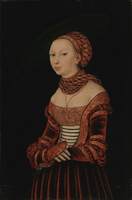
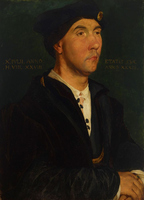
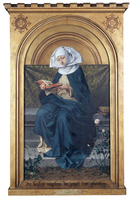
The portrayal of the human face, an intimate encounter that has the potential to collapse time with its immediacy, is another persistent device throughout the exhibition. This is also set up in the opening gallery, with three panel paintings: Lucas Cranach the Elder’s Portrait of a Young Woman (fig. 6), Scherfbeck’s Sir Richard Southwell, Copy after Hans Holbein the Younger (fig. 7), and Théophile Marie François Lybaert’s The Virgin at Prayer (fig. 8). All three have, in their different ways, an uncanny quality of being simultaneously ancient and modern, inscrutable, intimate, and transportive.
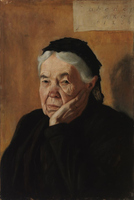
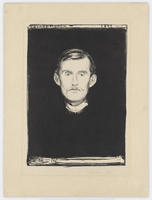
This idea of the transportive gaze is continued in the gallery entitled “Pilgrims,” which contains a series of portraits. Again, there is a slipperiness between images across time, an immediacy of address shared among a series of quarter-length portraits. Hugo Simberg’s Auntie (fig. 9) and the Cranach portrait share the same uncannily piercing dark eyes. A series of self-portraits reflects the prevalence of a new self-image of the artist as a seeker or visionary. In the case of Munch’s lithograph, Self-Portrait (fig. 10), and Schjerfbeck’s Self-Portrait (1913–26; Collection of Maire Gullichsen Art Foundation, Pori) in charcoal, watercolor, and oil on canvas, the artist appears as a ghostly figure, emerging or receding through the veil between life and death, a specter with an inscrutable message to relay. A gallery of prints serves to remind visitors that it was not only access to Japanese graphic art that stimulated the revival of artists’ engagement with this medium in the late nineteenth century. Artists in the period were also captivated by the work of Albrecht Dürer and other medieval and early Renaissance artists working in print. The work of Gallen-Kallela especially represents the parallel assimilation of both traditions.
In a side gallery, there is a slideshow with accompanying liturgical music, showing a series of key paintings, such as the Isenheim Altarpiece by Matthias Grünewald (1512–1516; Musée Unterlinden, Colmar). The catalogue explores in more depth, across several chapters, the importance of encounters with these site-specific works for artists, art historians, and other key writers. In the absence of the possibility of including such major works in the exhibition, the slideshow, with its slowly revolving series of close-ups, simulates something like the experience of such encounters. The grotesque devils, mottled skin, weeping wounds, and weeping faces, still have the capacity to disturb sensibilities and disrupt preconceptions of the relationship between art and beauty.
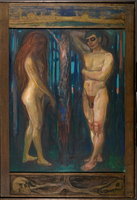
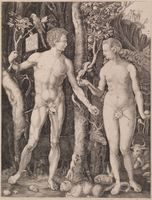
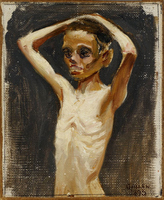
The next gallery is entitled “Erotic Devotions.” The theme of sex and death is a well-established trope in fin-de-siècle art. This exhibition develops the theme from a new angle, throwing into renewed prominence its long lineage in ambiguous images of Adam and Eve that simultaneously titillate and present dire warnings that the wage of sin is death (figs. 11, 12). Death continues to be the key theme in subsequent galleries. The “Forces of Nature” gallery includes some familiar, national romantic landscapes, but again cast in a different light in relation to the overall emphasis on nature’s pitilessness and the struggle for survival (fig. 13). Rather than the romantic solace of nature, we are presented with the enduring human battle against cold and hunger, with winter as the harbinger of death. Just as “Erotic Devotions” reflects the still very real threat of death by incurable venereal disease, “Forces of Nature” is directly connected to infant mortality and malnutrition. These were all ugly realities that all the “progress” of the nineteenth century had failed to alleviate or address. Gallen-Kallela’s Girl from the Jaskala Croft (fig. 14), with her sunken eyes and prominent ribs, is a stark correction to the parallel national romantic image of the robust peasantry.
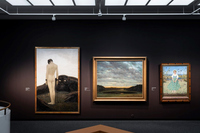
The “Communities” and “Gothic Alterities” galleries connect back to the soulful gazes of the earlier “Pilgrims” portraits, as well as the challenge/impossibility of real human connection displayed in the fraught gender relations of the “Erotic Devotions” gallery. In the absence of faith, either in God or in the myth of human progress, individual human connection offers the only possible route to redemption. As a corollary, the failure of this connection is frightening isolation (fig. 15). Existential angst is not, of course, a new theme in relation to the fin de siècle. Gothic Modern again foregrounds the ways in which encounters with Christian imagery of suffering and solace from previous centuries provided artists with a new idiom through which to express their intense desire for community in the face of modern loneliness. The Christian model of hope—or redemption through Christ’s love—is translated into the possibility of salvation through human bonds.
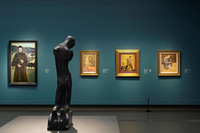
The exhibition’s thesis is expressed especially in visual conjunctions, most notably in a series of parallels between medieval and modern images of the mother and child and individuals in the act of prayer or inward reflection. In this way, it depends not on textual arguments, but on the act of recognition. This captures the essence of the connection presumably experienced by the artists themselves in their encounters with older religious art: the recognition of a way of articulating the intensity of spiritual want. Through these resonances it is possible to trace the ways in which artists were stimulated by the emotional intensity of religious imagery to find new ways to express their own secular hope for redemption through human love and inner peace.
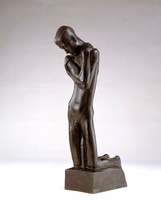
The catalogue explores some of the art historians—such as Julius Meier-Graefe, Jens Thiis, Johann Jacob Tikkanen, and Curt Glaser—who were pivotal in reappraising the medieval and early modern art of northern Europe and identifying resonances with the present (36–44, 143–63). These art historians played a role in introducing contemporary artists and the public to this heritage, but, at the same time, their scholarly interventions did not develop the same themes so much as offer a parallel story. Museum visitors need minimal guidance to recognize the echo between George Minne’s Kneeling Youth from the Fountain (fig. 16) and the Olstad Crucifix (1325–50; Museum of Cultural History, Oslo), presented nearby. The “man of sorrow” idea, whether in a secular or religious context, uses a painfully fragile body and bowed head to make visible internal pain and an isolated state.
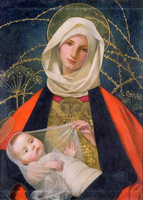
There is no suggestion that Minne saw this particular Norwegian medieval sculpture. Indeed, a whole host of alternative parallels could be summoned to mind: the supplicating, etiolated limbs of Jan Toorop or Stanisław Wyspiański and any number of emaciated wooden Christs. The thesis of the project, instead, allows medieval art to take its place alongside folk and East Asian arts as objects of the search for a new and more authentic way to express identity in the modern world. Something of this fusion of ideas can be seen in Marianne Stokes’s Madonna and Child (fig. 17). Stokes (née Preindlsberger) was an Austrian artist who studied in Munich and Paris and visited Pont-Aven with Schjerfbeck. She and her husband, artist Alfred Stokes, were also visitors to the Danish artist colony at Skagen, neatly unraveling any attempt to slot her work into any one national history of art. This and her gender have, until recently, largely eclipsed her reputation.
Stokes’s mother and child share parallel, limpid gazes out at the viewer, too intensely knowing for the youth of their naturalistically rendered faces. The depth of understanding suggests divine revelation, echoed by the Virgin’s gesture of drawing aside the veil to reveal Christ. This resonates with Hans Baldung Grien’s The Nativity (ca. 1525–30; Städel Museum, Frankfurt am Main), hung in the same gallery, in which only the youthful face of the Virgin can endure the blinding light of Christ’s presence. The closely observed naturalism of faces and hands is set against a flat solidity of form, which Simpson, commenting on the Gothic alterity of the image, describes as a “strange mixture of intense naturalism and artifice” (26–29). The Virgin is from no distinct time or place. White linen is loosely wrapped around her head like a wimple or traditional Breton headdress. Her body is framed by a heavy, scarlet, black-lined cape, creating a pyramidal composition. Most striking of all, in contrast to all the bare-breasted Eves and Marys in the exhibition, beneath the cape is what looks like a flat, gold breastplate embossed with swirling lines and flower forms, suggestive of Celtic or Viking knotwork and creating a hieratic, and surprisingly martial, pagan body for this gentle Virgin. The child’s stiff swaddling bands create a similar contrast between solidity and softness—a dissonance underscored by the gold tracery in the background of thorn branches and stylized angelica.
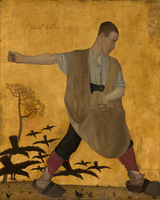
Stokes is one of the overlooked artists that the exhibition seeks to reposition in relation to a pan-European story of the fin de siècle. Stokes’s shift to tempera on panel was informed by her study of early Renaissance art, a choice that was also linked to her desire for sincerity of feeling.[4] Another such reinsertion is the inclusion of a number of works by Gustave van de Woestijne, whose reputation, Johan De Smet argues in the catalogue, has been undeservedly eclipsed due to the artist exhibiting almost exclusively in Belgium, because the outbreak of World War I disrupted the possibility of establishing himself within the wider European art world (119). Van de Woestijne’s works, such as The Bad Sower (fig. 18), make clear the artist’s sense of kinship with Pieter Bruegel the Elder. The combination of intensely observed naturalistic details—in the wrinkled skin, furrowed brows, and rumpled socks—with stylized aspects such as the gold background and simplified tree and bird silhouettes creates an uncanny effect of the pursuit of a truth that transcends the material.
The final galleries, “Dance of Death” and “Illuminations,” continue the interplay of spiritual hope and existential despair. The large decal of Bernt Notke’s Danse Macabre (late 15th century; St. Nicholas Church, Art Museum of Estonia, Tallinn), which runs the length of the corridor connecting the two wings of exhibition galleries, reminds visitors of another aspect of the visual tradition upon which artists in the early twentieth century drew as they attempted to articulate their own experiences of mortality, living with grief, sickness, and ultimately death.
Ad Astra (1907; Villa Gyllenberg Foundation, Helsinki) is reassembled in the final gallery, in an arrangement that draws attention to its function as an altarpiece by means of the inclusion of the intended predella, The Slain Lemminkäinen (fig. 19). The 1907 image is a near-copy of an earlier work from 1894–96, which Gallen-Kallela conceived as a memorial to his daughter Impi-Marjatta, who died in infancy, and which served as a proxy altarpiece for the baptism of his younger children.[5] Simpson points out the 1907 additions to the composition, notably the stigmata on the risen female figure’s upraised hands and the parallel between the Lemminkäinen image and Hans Holbein the Younger’s The Dead Christ in the Tomb (1521–22; Kunstmuseum, Basel), which Gallen-Kallela admired (180–81). This resonance with that striking Holbein work occurs elsewhere in the exhibition within Käthe Kollwitz’s The Downtrodden (1900; The Albertina Museum, Vienna). In the catalogue, Jeanne Nuechterlein discusses late medieval images of Christ that focused on his embodied humanity and suffering. She suggests that these images were important for later artists seeking a similar mechanism of visceral reaction triggering emotional release (48–49).
The Ad Astra altarpiece installation is illuminating for the multiple connections it reveals. The gold wings of the frame transform the oil on canvas painting into a religious object. The addition of the stigmata underscores the Christian dimensions of the work that otherwise sits more firmly within the parallel traditions of pantheistic and esoteric imagery of the fin de siècle. Lemminkäinen is undeniably Christ-like, but he is also explicitly not Christ as he lays beside the river of Tuonela. The result is a palimpsest of ideas and imageries, pursued in hopes of emotional release and catharsis as the artist grappled with his experience of loss, his own mortality, and the hope of some sort of resolution or promise of life transcending pain and death.
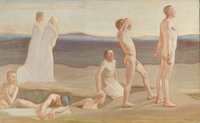
Alongside Ad Astra in the final gallery are several studies for altar pieces. Both Magnus Enckell’s Resurrection (fig. 20) and Emmanuel Vigeland’s Day of Judgement (ca. 1900; Emmanuel Vigeland Museum, Oslo) serve to create another link to the important parallel story of architecture, as does the reintroduction of pointed arches within this last gallery’s exhibition architecture. It may well be that for Finnish and, later in the exhibition’s travel schedule, Norwegian, audiences, the affective interiors of the Tampere Cathedral (1902–07; Tampere) and Vigeland’s Mausoleum (1926; Oslo) are so familiar that they do not need to be illustrated in the show, but they are an important dimension of the story. These buildings, and many like them across Europe, such as Watts Chapel (1896–98; Surrey), drew explicitly on the tradition of medieval Gothic architecture while blending it with a range of other imageries. These designs have typically been grouped under the umbrella of international Arts and Crafts (for their craft revival aspects) or Art Nouveau (for their emphasis on nature or esotericism), but this exhibition reintroduces another dimension that emphasized the cultural engagement with the religious imagery of the Northern medieval and Renaissance periods.
In a similar way, the multimedia turn of artists in this period, away from the dominant medium of canvas painting toward various forms of printmaking, panel painting, fresco, and applied arts is given a new inflection. Yes, there was pan-European interest in the writings of John Ruskin, William Morris, and Walter Crane in this same period, but the exhibition serves to set this well-established English influence to one side in favor of other sources for reengaging with the Gothic past, both in terms of local traditions and an alternative transnational fascination with Northern European Gothic heritage and pan-European travel. It would have been nice to see further examples of these parallels in the applied arts, beyond the one carved cabinet by Gallen-Kallela and Mary Gallen included in the exhibition. Bookbinding was an especially flourishing art form in this period and would have resonated well. It speaks to the potency of the exhibition theme that there are so many possibilities to extend the displays beyond the already substantial material collected, both in the sense of additional examples and potentially fascinating parallels to, for example, the Byzantine revival or Catalan Gothic.
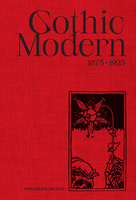
A research exhibition of this scale and duration demands a substantial financial investment from the host institutions, and this expense is not always easily justified. It is especially gratifying to see, therefore, that, as well as making a significant contribution to art history, the exhibition is a popular success, with, according to the press office, almost one hundred thousand visitors between opening on October 4, 2024, and the time of writing, November 15, 2024. The exhibition was certainly crowded when I visited mid-day on a weekday, and I observed a larger than usual number of visitors in their teens and early twenties, drawn perhaps by the theme of existential anxiety and the resonances with Gothic horror in other forms. The translation of an academic research project into an exhibition experience of popular appeal is exemplified in the Finnish-language edition of the catalogue. This is a departure from the English and Norwegian editions and presents a reduced version of the catalogue text in a smaller, 15 × 21 cm format that, as well as being cheaper, fits well in the hand and on the regular bookshelf (fig. 21). It appeals to both hand and eye by means of a blood-red, cloth-bound cover stamped with the title and a reproduction of Gallen-Kallela’s Death and the Flower woodcut (1896; Finnish National Gallery, Helsinki). The page edges are also colored red, and the book has an exposed spine, making visible the binding’s black stitching, like an old book that has lost its spinestrip. The attention to aesthetic and tactile pleasure continues throughout the book with ivory-colored paper and the occasional use of red ink and foldouts for larger, horizontal images. This representation has appeal beyond the usual reasons for purchasing a catalogue, as being both an encapsulation of the exhibition experience and a beautiful object itself.
Notes
[1] Exhibition architect: Osmo Leppälä; exhibition curator: Anna-Maria von Bonsdorff.
[2] Etienne Tornier, “Review of Japanomania in the Nordic Countries, 1875–1918,” Nineteenth-Century Art Worldwide 15, no. 3 (2016), https://doi.org/10.29411/ncaw.2016.15.3.22.
[3] Frances Fowle, ed., “Nordic Artists’ Colonies 1870–1914 (Part 1),” special issue, Art in Translation 9, no. 2 (2017); Frances Fowle, ed., “Nordic Artists’ Colonies 1870–1914 (Part 2),” special issue, Art in Translation 9, no. 4 (2017); Gabriel P. Weisberg, Anna-Maria von Bonsdorff, and Hanne Selkokari, eds., Japanomania in the Nordic Countries, 1875–1918 (Brussels: Mercatorfonds, 2016); Frances Fowle, Richard Thomson, Rodolphe Rapetti, and Anna-Maria von Bonsdorff, eds., Van Gogh to Kandinsky: Symbolist Landscape in Europe 1880–1910 (London: Thames & Hudson, 2012); Guy Cogeval, ed., Au delà des étoiles: Le paysage mystique de Monet à Kandinsky (Paris: Réunion des musées nationaux, 2017).
[4] Meaghan Clarke, “On Tempera and Temperament: Women, Art, and Feeling at the Fin de Siècle,” 19: Interdisciplinary Studies in the Long Nineteenth Century 23 (2016), https://doi.org/10.16995/ntn.767.
[5] Ingeborg Becker and Sigrid Melchior, eds., Now the Light Comes from the North: Art Nouveau in Finland (Berlin: Bröhan-Museum, 2002), 126.