Hagia Sophia in the Long Nineteenth Century edited by Emily Neumeier and Benjamin Anderson
Reviewed by Berin GolonuBerin Golonu
University of Buffalo
Email the author: beringol[at]buffalo.edu
Citation: Berin Golonu, book review of Hagia Sophia in the Long Nineteenth Century edited by Emily Neumeier and Benjamin Anderson, Nineteenth-Century Art Worldwide 24, no. 1 (Spring 2025), https://doi.org/10.29411/ncaw.2025.24.1.9.
This work is licensed under a Creative Commons Attribution-NonCommercial 4.0 International License  unless otherwise noted.
Your browser will either open the file, download it to a folder, or display a dialog with options.
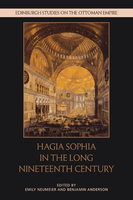
Emily Neumeier and Benjamin Anderson, eds.,
Hagia Sophia in the Long Nineteenth Century.
Edinburgh: Edinburgh University Press, 2024.
312 pp.; 41 color and 54 b&w illus.; bibliography; notes; index.
$125 (hardcover)
ISBN: 9781474461009
The editors of this volume, Emily Neumeier, a scholar of Ottoman art, and Benjamin Anderson, a scholar of Byzantine art, state that their book project was already under way when the Hagia Sophia was reconverted into a mosque in July 2020. Yet this change of affairs certainly influenced the narratives that emerge from its contents. Having been secularized as a museum in 1934, the Hagia Sophia’s resumption of its Ottoman identity as a mosque eclipsed both its Christian Byzantine and secular Turkish Republican pasts. The original marble floors of this sixth-century Byzantine church were once again covered with carpets; its eleventh-century apse mosaic of the Virgin and Child was shrouded with a curtain to shield it from the eyes of Muslim worshippers; and tourists were guided to a separate entrance that only allowed access to the restored Byzantine mosaics in the second-floor galleries. Non-Muslims were barred from entering the central worship hall. Objectors to the recent conversion argue that it has drastically limited public and research access and undermined the monument’s status as a world heritage site with a multidenominational history. Moderate supporters of the redesign say that the conversion is a more faithful way to honor the building’s Ottoman past, whereas Islamist conservatives and nationalists applaud the reconversion as a victory symbol celebrating Sultan Mehmet II’s conquest of Constantinople in 1453. Neumeier and Anderson’s volume offers a nuanced contribution to these debates by showing how the Hagia Sophia emerged as a cultural symbol that attracted a host of discursive meanings, often existing in tandem, during the long nineteenth century.
Nine chapters approach the task of unpacking the Hagia Sophia’s myriad meanings through vastly different methodologies. Some chapters undertake a careful architectural read of the building, its additions, and its structural components, as well as some of the other buildings it inspired. Other chapters analyze the ways in which the dissemination of the Hagia Sophia’s image in print media familiarized the structure for global audiences, even for those who had never set foot in Istanbul. Yet others examine the circulation of literary and textual narratives about the Hagia Sophia that appear on the building’s inscriptions and calligraphic panels or in folk tales and songs that illustrate shifting understandings of its meanings and histories over time. As diverse as these approaches are, they do not undermine the cohesiveness of the volume; instead, they substantiate the book’s main argument: that over the course of the long nineteenth century, the building transgressed its function as an imperial mosque, emerging as a symbolic monument that attracted “a plurality of claims” (2).
The editors posit a very long nineteenth century that stretches from 1739 to 1934, a period of tremendous territorial, political, social, and economic change that concluded with the fall of the Ottoman sultanate, the disbanding of the caliphate, and the secularizing changes of the founding decade of the Turkish Republic. They argue that this “century” bears relevance to current debates about cultural heritage because it witnessed the rise of an increasing historical consciousness. As much as those in support of Mustafa Kemal Atatürk’s decision to turn the mosque into a secular museum in 1934 believe that this was the most diplomatic way to honor the building’s multidenominational past, it did not silence or resolve competing claims for the monument. Questions arose then, as they have in 2020, about how Hagia Sophia’s multilayered pasts should be honored and represented. The book’s various essays point to these questions but refrain from offering easy resolutions. Four of the essays that most satisfyingly illustrate this competing plurality of claims are discussed here.
The first chapter, authored by Ottoman art historian Ünver Rüstem, focuses on the period following the signing of the peace treaty with the Hapsburg Monarchy in 1739, which marked the conclusion of a successful military campaign under Sultan Mahmud I. Rüstem’s 2019 monograph on the “Ottoman Baroque” detailed the emergence of this eclectic style in the mid-eighteenth century.[1] Here he anchors the emergence of the Ottoman Baroque to the need for cultural redefinition in the giddy wake of Mahmud I’s political victory, when the sultan transformed the Hagia Sophia from an imperial mosque into a charitable külliye (mosque complex), complete with a new soup kitchen, library, school, and ablution fountain.[2] By making additions to one of the city’s most illustrious mosques, Mahmud I aimed to equate his accomplishments with the empire’s most powerful sultans, first and foremost those of the city’s conqueror Sultan Mehmet II, who originally converted the Byzantine church into a mosque. Rüstem argues that the patronage and augmentation of a religious structure with public services—such as a sıbyan mektebi (primary school) and imaret (soup kitchen)—was Mahmud’s attempt to separate his reign from that of his predecessor Ahmet III, who was perceived as a decadent elite out of touch with the masses and brought down by a public rebellion.
Rüstem’s argument culminates in his formal analysis of the magnificent entry gate of the Hagia Sophia’s imaret, a key example of the Ottoman Baroque. As the public face of a soup kitchen situated on a square containing the splendid fountain of Sultan Ahmet III and the main outer gate of the Topkapı Palace (Bab-ı Hümayun), the imaret’s entry gate needed to be dazzling if it was to hold its own against these iconic structures. Using a rich and highly descriptive vocabulary, Rüstem shows how this entry gate helped define the Ottoman Baroque by orchestrating a break from earlier Ottoman architectural lexicons. Like the Italian Baroque, the Ottoman Baroque is characterized by ornamental excess and eclecticism. Yet it also features distinctive Ottoman identifiers, such as calligraphic inscriptions that include the emblem bearing the Sultan’s tuğra (signature), which, as Neumeier’s chapter explains, emerged into an element of architectural decoration in the eighteenth century. Nationalist discourses claim that the Ottoman Baroque signaled excessive Westernization, which allegedly led to a loss of identity and resulted in Ottoman political decline. Rüstem argues that the Ottoman Baroque’s references to Italian architecture may have signaled closer diplomatic ties with Europe in the eighteenth century, but that its aesthetic novelty expressed a celebratory mood after the 1736–39 war with the Hapsburgs. Contrary to the narrative of decline, he holds that the Ottoman Baroque should be read as a self-assured statement that the Ottomans could compete with their Christian rivals on the world stage.
Images of the Hagia Sophia reproduced and disseminated in the emergent print media of the nineteenth century certainly helped familiarize this monument among global populations. As Asli Menevse’s and Robert Ousterhout’s chapters show, print media also played a role in the monument’s emergence as a symbol for competing religious and territorial ambitions. Menevse’s essay focuses on Gaspare Fossati’s restoration of the structure under the patronage of Sultan Abdülmecid in 1847–49 and the lithographic album of the restored interiors designed by Fossati and funded by the Ottoman leadership. She explains that the restoration and the album worked in tandem as a public relations campaign during the Tanzimat, an era of Ottoman reform (1839–76). The Fossati restoration was undertaken to reinforce the building’s massive dome and repair the columns leaning under its weight, but it also unveiled the splendid Byzantine mosaics that were resting under layers of plaster. The mosaics were carefully documented in drawings by the Prussian engineer Wilhelm Salzenberg that were published in 1854. They were then covered anew, with reports that Abdülmecid encouraged architects to cover them in such a way as to preserve them for posterity. Similar reports appearing in French-language newspaper and journal articles detailed the Sultan’s appreciation for the arts of the pre-Ottoman, Christian past. Such articles aimed to spread news of the Ottoman Empire’s entry into the age of the Enlightenment. Menevse’s read of the individual plates in the Fossati album reveals how the Enlightenment motif extended to representations of state leaders, literally representing them in beams of light as they stood in the renovated interior of the Hagia Sophia. She also challenges accounts that upheld Salzenberg’s renderings as more historically valuable records than those of Fossati due to their scientific accuracy. Menevse argues that the Fossati album was, in fact, a more realistic record of the building’s evolution and status in the mid-nineteenth century. Whereas the Salzenberg renderings depict the Hagia Sophia restored to its origins as a Byzantine monument and stripped of its Ottoman-era additions, the Fossati album more accurately represents a “historicist awareness” of the building’s multiple histories and identities over time (225).
Robert S. Nelson’s 2004 monograph on the Hagia Sophia focused on the ways in which this building became an icon, model, and inspiration for art and architecture between 1850 and 1950, mainly through the circulation of its imagery.[3] (The book cover reproduces an elevation of the Hagia Sofia by Salzberg.) It makes sense that the Hagia Sophia sparked a Byzantine revival in church architecture, particularly in the churches of the Greek Orthodox faith, but Nelson’s chapter for this volume reveals a more surprising reference. He discusses how the “Byzantine synagogue” emerged as a style in the 1920s, focusing his essay on the Congregation Tifereth Israel in Cleveland, which looked to the Hagia Sophia as its architectural prototype. There was an effort to assimilate modern Jewish identity to its Palestinian roots by referencing early Byzantine architecture. The Cleveland synagogue also took inspiration from the domes of two nineteenth-century synagogues built during Ottoman rule in Jerusalem, structures linked to an aesthetic lineage rooted in the Hagia Sophia. US rabbis, according to Nelson, felt the need to define a Jewish architectural style that distinguished itself from other religions. As the vogue for the Byzantine synagogue spread, Tifereth Israel’s architect Charles R. Greco (who was Catholic) received commissions up and down the eastern United States. It may seem paradoxical that efforts to cultivate an “authentic” self-definition came to rely on global signifiers of identity. These signifiers are rooted in the Hagia Sophia, which has served as an inspiration for a host of civilizations, from the Ottomans who claimed the building as their own after the conquest of Constantinople, to the synagogues of Jerusalem that feature an Ottoman typology inspired by Byzantine architecture, to the historicist US synagogues that reference the Byzantine synagogues of Jerusalem. The distinction between Byzantine and Ottoman became somewhat diluted in this chain of references, as have many other distinctions in the intermingling of the many sources of Jewish, Christian, and Muslim cultures.
The volume concludes with a chapter by the late Robert Ousterhout, an esteemed scholar of Byzantine art and architecture who passed away in 2023. Ousterhout’s essay focuses on the period marking the decline and fall of the Ottoman Empire in the early twentieth century, when demands to convert the Hagia Sophia back into a Christian church became more vehement. As the imperial powers were scrambling for territorial holdings in the wake of World War I, the Hagia Sophia emerged as a symbol of victory for those who aimed to play a greater role in regional politics. Ousterhout’s selective reading of perceptions of the Hagia Sophia in the US press from the 1910s through 1930s reveals that many Christian-majority nations supported the conversion of the mosque back into a church, including Russia, Britain, the United States, the Vatican, and, of course, Greece. They did so by stoking predictable Orientalist tropes about the Turks’ inability to care for such a precious historical monument. Yet there does not seem to have been any consensus about which denomination should take control of the church. The Hagia Sophia was, in fact, used as a Greek Orthodox Church during the Allied occupation between 1921 and 1923. In an overt gesture of Greek irredentism, the Archbishop of Athens was appointed the Ecumenical Patriarch of Constantinople during these years. These facts certainly place current debates on the Hagia Sophia within a historical context—it continues to serve as a trophy symbol in power struggles between Christianity and Islam. Many have linked the Turkish leadership’s unapologetic decision to reinstate this monument as an Islamic house of prayer to the more aggressive role it has taken in regional and global politics (with or without the permission of its NATO allies). From this perspective, Atatürk’s decision to turn the mosque into a museum is viewed less as a diplomatic move to uphold the monument as a symbol of peace, and more as a capitulation to foreign demands, a perceived gesture of weakness that the current Turkish ruling party vows not to repeat.
Given that the editors chose 1934 as the end point of their chronology rather than the year that the Turkish Republic was founded, the volume could have benefited from the addition of another chapter focusing on the early Republican years, especially on the changes initiated to the Hagia Sophia complex in the early 1930s. As an example, the nineteenth-century madrasa (an Islamic educational institution) situated near the northeast corner of the monument was torn down in this period. A chapter discussing these alterations and perhaps tying them to other secularizing changes made to the urban fabric of the former Ottoman capital would have been an appropriate endpoint for the volume. It would have offered a counterpoint to chapter 1, showing how the need to represent shifting political ideologies resulted in another set of significant structural changes to this monument at the end of the long nineteenth century. Such a chapter may have also offered an answer to the question posed in Ousterhout’s essay: “how much did popular Western sentiment contribute to the decision to convert the building into a museum?” (276). Here, Atatürk’s decision is left disconnected from the much larger redefinition program of the Kemalist Cultural Revolution and his formidable efforts to forge a new Turkish identity, one separate from its Ottoman past.
Hagia Sophia in the Long Nineteenth Century makes a timely addition to the immense volume of scholarship on the Hagia Sophia. While the brief history of the building outlined in the introduction provides adequate context for nonspecialists, the volume’s wealth of references also directs scholars and students to more specialized studies. The individual chapters, with their varied scope, come together to make a compelling case for a more expansive mode of heritage production. Its authors demonstrate how historicist approaches can account for the multicultural and multiethnic pasts of a globally significant monument as well as the pluralism of late Ottoman society. Given its focus on the Hagia Sophia under Ottoman rule, the volume may be better suited to specialists of Islamic—as opposed to Byzantine—art and culture, but the diversity of its many chapters renders it well-suited to a variety of curricular needs.
Notes
[1] Ünver Rüstem, Ottoman Baroque: The Architectural Refashioning of Eighteenth Century Istanbul (Princeton: Princeton University Press, 2019).
[2] Whereas Neumeier and Anderson use the term imaret to refer to a charitable mosque complex as a whole, Rüstem uses the term külliye to differentiate the complex from its soup kitchen, which is also termed imaret. Both terms have been used to refer to mosque complexes at different points in Ottoman history.
[3] Robert S. Nelson, Hagia Sophia, 1850–1950: Holy Wisdom and the Modern Monument (Chicago: University of Chicago Press, 2004).