Van Gogh: Poets & Lovers
Reviewed by Hannah WierHannah Wier
Washington University in St. Louis
Email the author: hannah.wier[at]wustl.edu
Citation: Hannah Wier, exhibition review of Van Gogh: Poets & Lovers, Nineteenth-Century Art Worldwide 24, no. 1 (Spring 2025), https://doi.org/10.29411/ncaw.2025.24.1.23.
This work is licensed under a Creative Commons Attribution-NonCommercial 4.0 International License  unless otherwise noted.
Your browser will either open the file, download it to a folder, or display a dialog with options.
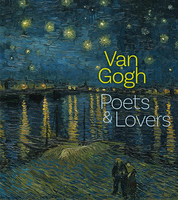
Van Gogh: Poets & Lovers
The National Gallery, London
September 14, 2024–January 19, 2025
Catalogue:
Cornelia Homburg with Christopher Riopelle and contributions by Renske Cohen Tervaert, Julien Domercq, Michael Glover, Cindy Kang, Sterre Overmars, Judy Sund, and Marnin Young,
Van Gogh: Poets & Lovers.
London: National Gallery Global, 2024.
256 pp.; 180 color illus.; bibliography; notes; list of illustrations; index.
£35.00 (hardcover)
ISBN: 9781857097016
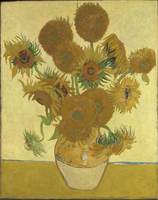
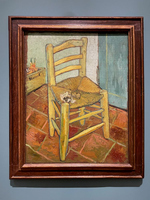
The National Gallery, London, marked its bicentenary last year with a blockbuster exhibition dedicated to Vincent van Gogh and inspired in part by the presence of Sunflowers (fig. 1) and Van Gogh’s Chair (fig. 2) in the gallery’s own collection. This exhibition is a refreshing addition to the plethora of Van Gogh blockbusters that have filled museum galleries over the last several decades. Van Gogh: Poets & Lovers does not focus on the details of the artist’s career, nor does it traffic in questions about his mental state or belabor the circumstances of his death. Rather, this exhibition paints a joyful picture of the artistic drive, creative vision, and idiosyncratic techniques that characterize the artist’s two years in Arles and Saint-Rémy-de-Provence (1888–90).
Through forty-seven paintings and fourteen works on paper, the exhibition’s curators, Cornelia Homburg and Christopher Riopelle, present Van Gogh as an intentional and ambitious artist who was keenly attuned to the Paris art market of the 1880s and to his fellow artists’ endeavors. The strategic, highly intentional Van Gogh visitors encounter in this exhibition transformed the natural world before him into imaginative “poetic subjects,” cast acquaintances in Arles as “symbolic types” in universalizing portraits, and planned precise modes of display for his decorative canvases.[1] This novel approach to Van Gogh’s work unfolds thematically across six galleries, each one containing significant international loans that guarantee the exhibition’s status as a “once-in-a-century exhibition,” as it has been billed on the National Gallery’s website.[2] Through the thematic frameworks structuring each room, the curators introduce a wide range of important topics in Van Gogh’s works and writings: a desire for artistic collaboration; an interest in producing serial imagery in drawings and paintings; the artist’s innovative concept of décoration (decorative program); and repetitions painted in the studio after earlier works drawn from nature.
This exhibition is accompanied by a superbly illustrated catalogue by Homburg with Riopelle and contributions by several important Van Gogh scholars. The thirteen essays in the volume elaborate on and expand the ideas presented in the exhibition, providing a comprehensive overview of the artist’s ambitions, innovations, and pictorial strategies during the Provence period. Homburg’s essay, “Art of the Future,” introduces the themes of the exhibition through discussions of the structuring principles of its galleries and of Van Gogh’s pictorial strategies that focus on color as a mode of expression, symbolic forms in imagery of “observed nature,” and studio work as a method for combining “observation and imagination” (19, 28, 36).
While the Arles and Saint-Rémy periods have previously been treated as separate areas of Van Gogh’s life and career—most notably in Ronald Pickvance’s two blockbuster exhibitions at the Metropolitan Museum of Art—the National Gallery show considers these periods in tandem.[3] Indeed, Van Gogh’s near-constant flow of poetic ideas and artistic innovations is woven through galleries that present canvases and drawings from Arles and Saint-Rémy alongside one another, effectively reuniting these periods of his career to allow for fruitful engagement with this highly productive period.
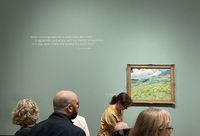
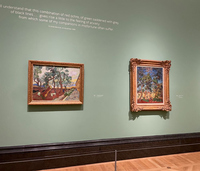
Throughout the exhibition, the curators foreground Van Gogh’s literary influences and pictorial strategies using quotations from his letters that adorn the walls of each room (fig. 3). These quotations are generally located intentionally over single artworks or pairs to indicate relevance, though some are placed over a larger group of canvases or on empty wall space to convey their significance for a gallery or the exhibition as a whole. References in scholarship and the media to Van Gogh’s abundant writings sometimes seem anachronistic or are used sensationally, but the quotations in the exhibition are indeed from the Provence period and directly related to the works on view or the artistic ideas embedded within them. As such, they add significant value to the viewing experience and tastefully foreground the artist’s voice. One on the rightmost wall of the introductory gallery, for instance, presents visitors with an idea that underpins the exhibition’s approach to Van Gogh’s concept of the poet’s garden: “The garden has a funny style that means that you can very well imagine the Renaissance poets, Dante, Petrarch, Boccaccio, strolling among these bushes on the flowery grass.”[4] Van Gogh’s knowledge of these Renaissance poets and of contemporary novelists, including Alphonse Daudet, Charles Dickens, Pierre Loti, Edouard Rod, and Emile Zola, informs his worldview and idiosyncratic modes of painterly expression. He was a voracious reader who believed in the poeticism of painted lines and color combinations: “I don’t know if you’ll understand that one can speak poetry just by arranging colors well, just as one can say comforting things in music.”[5] Bold wall colors throughout the exhibition suggest that the curators share this sentiment; as such, the different wall colors in each room may enhance each visitor’s experience of the works on view.
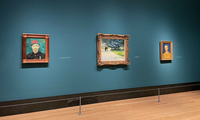
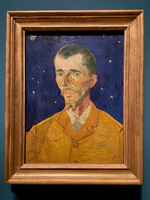
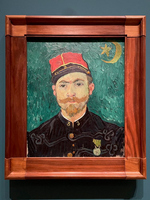
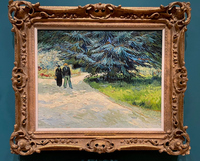
Representations of the figures that form the exhibition’s bipartite title—Poets & Lovers—greet visitors as they enter the first room of the special exhibition galleries (fig. 4). These concepts are represented through two “symbolic portraits” (to use Renske Cohen Tervaert’s term from the exhibition catalogue) of the artist’s friends envisioned as universalized types—The Poet (Portrait of Eugène Boch) and The Lover (Portrait of Lieutenant Milliet) (figs. 5 and 6)—and a painting of the public garden across from Van Gogh’s famous Yellow House in Arles, The Poet’s Garden (Public Garden in Arles) (fig. 7) (173–83). The latter is transformed through the artist’s literary imagination into a Renaissance “poet’s garden,” peopled by a promenading pair of lovers. These symbolic figures and the garden space as poetic landscape function as the underlying motifs of the exhibition; visitors encounter representations of public parks, private gardens, and expansive countryside landscapes alongside symbolic and allegorical portraits throughout the show’s six galleries.
Along the eucalyptus-green walls of the second gallery, titled “The Garden: Poetic Interpretations,” canvases and drawings of lush green spaces and wide park pathways illustrate Van Gogh’s engagement with poetic ideas and the expressive possibilities of color in his garden imagery. In one of her three essays in the exhibition catalogue, “The Public Park, A Garden of One’s Own,” Judy Sund describes the unusual arrangement of Arles’s public park, the Jardin de la Cavalerie, which contains French- and English-style gardens that each enchanted Van Gogh for different reasons (45). For example, Entrance to the Public Garden in Arles and Path in the Park, Arles (fig. 8)—both depicting the French-style garden—feature inviting views of the bustling park pathways that reminded Van Gogh of Honoré Daumier’s humorous lithographs depicting people in public spaces (49).
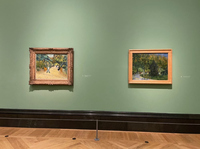
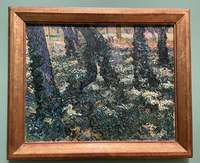
Seven paintings and four drawings in this section depict the “neglected garden” in the courtyard of the Saint-Paul de Mausole psychiatric hospital in Saint-Rémy, but Van Gogh strategically minimized the presence of the hospital in many of these images (161).[6] In Undergrowth (fig. 9), for instance, Van Gogh depicts a sous-bois (undergrowth) of twisting, climbing ivy using short, dense brushstrokes. In the upper register of the canvas, above the sea of violet and green foliage, the yellow and grey expanses of the hospital’s garden wall betray the reality of the contained and controlled space in which Van Gogh is working. In wider views of the hospital courtyard, however, such as The Park of the Hospital at Saint-Rémy and Hospital at Saint-Rémy (fig. 10), Van Gogh suggests the “feeling of anxiety from which some of [his] companions in misfortune often suffer” through the emotionally evocative motif of a sawn-off tree trunk and the stifling scale of the trees that tower over the hospital and disrupt one’s view of the sky.[7] In her third catalogue essay, Sund notes that Van Gogh’s close-up views of flowers in this section, such as Iris (1890; National Gallery of Canada, Ottawa), “bespeak oneness with nature and carry an aura of intimacy” (161). The poeticism of maintaining intimacy in near isolation by connecting with nature, especially in an area of the hospital that was not accessible to female patients at a time when Van Gogh longed for human connection, imbues this gallery with an air of hope and positivity that also characterizes Van Gogh’s enthusiasm for the “Studio of the South” he longed to create in Arles (163).
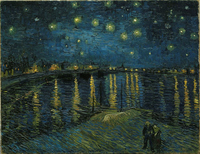
The third room of the exhibition is dedicated to “The Yellow House: The Artist’s Home.” This powerhouse of a gallery is filled with major canvases, including Van Gogh’s Chair, Starry Night Over the Rhône (fig. 11), The Sower (fig. 12), and The Yellow House (The Street) (fig. 13). The idea of artistic collaboration propelled Van Gogh’s creative approach to decorating the Yellow House, his home and studio in Arles that he wished to transform into a communal artist’s studio with his friends from Paris. He used or conceived of many of the canvases in this gallery as objects that would complement one another to form a unified décoration for the enjoyment of his peers. Though Paul Gauguin joined Van Gogh in Arles in October 1888, the Studio of the South was a short-lived dream that ended with Gauguin’s abrupt departure two months after his long-awaited arrival.[8]
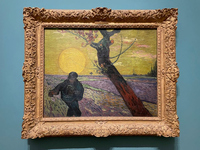
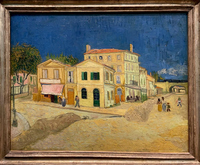
Homburg and Riopelle highlight Van Gogh’s intentionality and ambition as an artist in this excessively mythologized and dramatized period of his life, setting aside the personal relationships and mental health concerns that typically overshadow or inform interpretations of the Studio of the South works. Van Gogh’s artistic production from the Arles period, then, is able to stand on its own as a forceful demonstration of his avant-garde display strategies and clarity of artistic vision. In the wall text that introduces this room, the curators frame Van Gogh’s creative approach to displaying his works as décorations in the Yellow House as the primary theme of this section. The concept of décoration and Van Gogh’s greater plans for devising and displaying décorations to the public are the subject of the second-to-last room in the exhibition; but first, there is an interlude in the form of a small gallery attached to the “Yellow House” room.
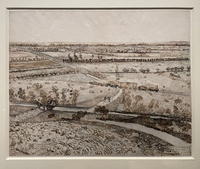
Van Gogh’s interest in constructing groupings of separate works is evidenced further in a small, adjacent room featuring a series of drawings depicting the ruins of the medieval Montmajour Abbey and its grounds outside of Arles. Here, the curators provide visitors with a welcome respite from the larger, more crowded galleries and an opportunity—in more intimate surroundings—to see drawings that are rarely shown to the public. Most notable was View of La Crau from Montmajour (fig. 14), on loan from the British Museum but only on display for the first month of the exhibition due to conservation concerns (as is noted in the exhibition booklet). Those who visited the exhibition in its early weeks were especially fortunate to view this large-scale pen and reed pen drawing that Van Gogh considered one of “the best I’ve done with my pen.”[9]
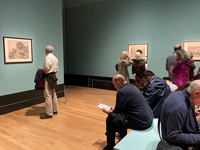
The Montmajour series of drawings builds on the literary theme established through the poet’s garden imagery displayed at the start of the exhibition.[10] As Julien Domercq notes in his essay on the Montmajour series, for Van Gogh this tranquil landscape of overgrown foliage, rocky outcroppings, and picturesque medieval ruins recalled Emile Zola’s Le Paradou—an abandoned, secluded, paradisiacal Provençal garden—from his novel The Sin of Abbé Mouret (1875). Much like Le Paradou—which, as Domercq notes in the catalogue, “seems to become a character of its own”—the landscape surrounding Montmajour Abbey takes on a life of its own through the vitality and dynamism of Van Gogh’s gestural ink-drawn lines and dashes in the six drawings on display (fig. 15) (58). Placed in proximity to one another in this serene space, this series of drawings demonstrates the artist’s sustained and thoughtful approach to the natural and constructed forms of the Provençal landscape outside of Arles.
Van Gogh’s deliberate engagement with seriality as an artistic method continued throughout his time in Arles and Saint-Rémy, culminating in his serial paintings of olive trees that visitors encounter in the final room of the exhibition. This strategic dedication to seriality enabled the artist to experiment with different but intimately related compositions. His serial method goes hand-in-hand with his practice of producing studio repetitions after his own works painted from nature, which helped the artist to refine his compositions across several versions of a single motif or theme.[11]
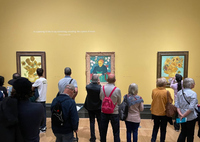
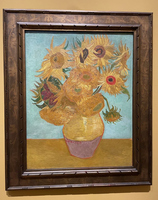
Of the sixty-one artworks in the exhibition, three seemed to attract the most attention from visitors: Sunflowers, La Berceuse (1889; Museum of Fine Arts, Boston), and Sunflowers (figs. 1, 16, and 17). The loan of the Philadelphia canvas is a noteworthy triumph, as this exhibition marks the first time the painting has left the United States since its acquisition by Carroll Tyson in 1935.[12] These three works, hung alongside one another on an appropriately bright, sunflower-yellow wall in the “Decoration” room, are an homage to Van Gogh’s own intentions for the display of these paintings as a triptych. In a letter to his younger brother Theo, written in Saint-Rémy in May 1889, Van Gogh explained that he wanted to create a triptych comprised of a Sunflowers canvas with a yellow background on the left, one of the five repetitions of La Berceuse in the center, and a Sunflowers canvas with a blue background on the right. Though two of the three canvases in this gallery are not the exact ones Van Gogh envisioned for this décoration, the arrangement illustrates well the artist’s desired mode of display and captures the essence of the triptych that he proposed in 1889.[13]
Two essays in the catalogue provide comprehensive analyses of the factors that may have contributed to Van Gogh’s formation of the décoration concept. In “‘Unity is Strength’: Van Gogh and the Exhibitions of the Avant-Garde,” Marnin Young places Van Gogh in the context of the Parisian avant-garde of the late 1880s as a member of a “self-conceived artistic community” and considers his experimental exhibition strategies in this period (115). Young frames “unity” and the “ensemble” as the primary motifs of this essay, juxtaposed against Albert Aurier’s characterization of Van Gogh as an “isolated artist” in his 1890 Mercure de France article, “Les isolés: Vincent van Gogh” (113, 120). Furthermore, he claims that Van Gogh devised his décoration plan to “challenge the existing critical standard of an isolated, autonomous picture” (120). Cindy Kang similarly traces the origins of Van Gogh’s décoration concept to his two-year stay in Paris (1886–88), but with a focus on the works and ideas of his contemporaries that may have influenced this new framework for displaying his paintings in Arles (133–45).
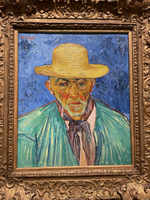
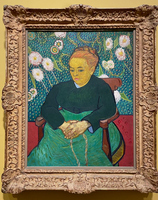
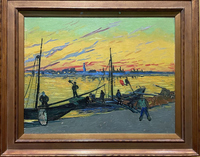
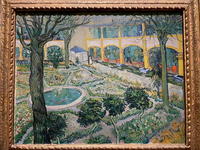
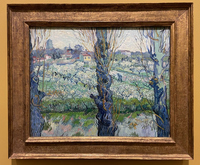
A second coup of the curators was the loan of Portrait of a Peasant (Patience Escalier) (fig. 18), the result of an exchange partnership between the National Gallery and the Norton Simon Museum. Patience Escalier belongs to the group of symbolic portraits hung throughout the exhibition. Patience Escalier was a local gardener who Van Gogh immortalized as the archetypal peasant; likewise, Madame Auguste Roulin (the wife of Postmaster Joseph Roulin) is cast as the comforting, matronly berceuse (cradle-rocker) in her universalizing portrait on the adjacent wall (fig. 19). On the other side of this gallery, landscapes and cityscapes from Arles and Saint-Rémy craft a cohesive image of Van Gogh’s decorative project in this period. In these paintings, such as The Stevedores (fig. 20), The Courtyard of the Hospital at Arles (fig. 21), and View of Arles (fig. 22), Van Gogh endeavored to create affective imagery through vivid, expressive colors and textured impasto.
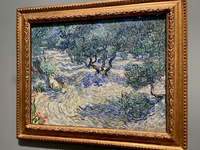
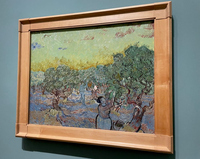
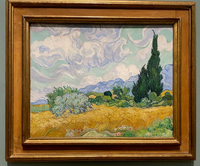
The sixth and final gallery, “Variations on a Theme,” returns to the idea of seriality that first appears in the Montmajour drawings room. Much like his sustained engagement with the motif of the Montmajour Abbey near Arles, Van Gogh selected a range of subjects in Saint-Rémy derived from his observations of nature that could be further developed or reworked inside his hospital studio. Six paintings of olive trees (figs. 23–25) and the National Gallery’s own A Wheatfield with Cypresses (fig. 26) form part of an “ensemble”—to be called “Impressions of Provence”—that Van Gogh envisioned (127).[14] The paintings in this series were begun outside the grounds of the hospital and later completed or reworked in the artist’s studio, enabling him to work more slowly and deliberately than when painting en plein air. In this period, abstractions from nature in the form of sculptural clouds, radiating sunbeams, and carefully considered repetitions of earlier motifs characterize Van Gogh’s modified approach to painting directly from nature rather than memory. A robust studio practice rooted in observations from nature thus “became a hallmark of Van Gogh’s artistic production of 1889,” according to Homburg (33).
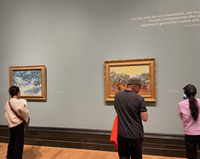
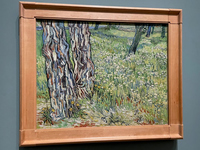
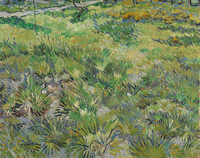
The last wall of the exhibition features two paintings: Tree Trunks in the Grass from the Kröller-Müller Museum (fig. 27) and Long Grass with Butterflies from the National Gallery’s own collection (fig. 28). These tranquil sous-bois paintings depict the undergrowth in the garden at Saint-Paul de Mausole and are imbued with a hopeful—perhaps even joyful—undertone. Van Gogh used a palette of vivid greens, whites, yellows, reds, and blues to capture a landscape bathed in sunlight and bursting with spring flowers. In the final work of the exhibition, five small butterflies flit about in the grassy, sun-soaked garden. What was previously represented as a neglected space that symbolized the suffering of the hospital’s residents now shows “signs of burgeoning life,” just as Van Gogh was making arrangements to leave the hospital at Saint-Rémy for a fresh start in the Parisian suburb of Auvers-sur-Oise.[15] To the right of these final paintings, a concluding wall text summarizes Van Gogh’s artistic progress during the Arles and Saint-Rémy periods: “In just over two years, he developed ways of using intense color and technique to create poetic subjects filled with emotion.” He would then go on to produce over one hundred completed paintings and drawings in Auvers in the span of nine weeks, rapidly building upon the innovative painterly strategies he developed in the South of France.[16]
Information about individual paintings, explanatory texts, and comparative images is provided to visitors in a free exhibition booklet. This innovative approach improves visitors’ experiences in the ever-crowded galleries (typical of a blockbuster Van Gogh exhibition) by allowing them to look closely at artworks first and then privately consult labels with ease. The booklet also provides a chronology of Van Gogh’s heavily mythologized life, which was not presented elsewhere in the exhibition. Thus, in the galleries that display Van Gogh: Poets & Lovers, visitors are encouraged to focus primarily on the artist’s expressive paintings and words, which convey the senses of joy and hope that persisted despite the hardships he faced during this tumultuous period of his life.
Notes
[1] Vincent van Gogh to Theo van Gogh, Arles, October 4 or 5, 1888, Vincent van Gogh: The Letters, Van Gogh Museum, accessed November 24, 2024, https://vangoghletters.org/; and “Introduction,” in Van Gogh: Poets & Lovers, exh. booklet, 2024, n.p. Van Gogh uses the phrase “poetic subjects” to describe the following paintings: Starry Night over the Rhône (1888; Musée d’Orsay, Paris; exhibited), The Green Vineyard (1888; Kröller-Müller Museum, Otterlo; exhibited), Ploughed Fields (1888; Van Gogh Museum, Amsterdam), and The Poet’s Garden (1888; The Art Institute of Chicago). Homburg and Riopelle align this concept with the thematic framework of the exhibition, in which it is linked most closely to the “poet’s garden” theme, the idea of décoration, and the ambitious decorative program Van Gogh planned for the Yellow House in Arles. The “poetic subject” is referenced in two labels in the exhibition booklet—objects 22 (Starry Night over the Rhône) and 28 (The Green Vineyard)—and in Cornelia Homburg’s catalogue essay (24, 33).
[2] “Van Gogh: Poets and Lovers,” National Gallery, London, accessed November 24, 2024, https://www.nationalgallery.org.uk/.
[3] Ronald Pickvance, Van Gogh in Arles, exh. cat. (New York: Abrams, 1984); and Ronald Pickvance, Van Gogh in Saint-Rémy and Auvers, exh. cat. (New York: Abrams, 1986).
[4] Vincent van Gogh to Theo van Gogh, Arles, September 26, 1888, Vincent van Gogh: The Letters, Van Gogh Museum, accessed November 24, 2024, https://vangoghletters.org/.
[5] Vincent van Gogh to Willemien van Gogh, Arles, on or about November 12, 1888, Vincent van Gogh: The Letters, Van Gogh Museum, accessed November 24, 2024, https://vangoghletters.org/.
[6] Sund quotes a letter in which Van Gogh writes, “the neglected garden planted with tall pines under which grows tall and badly tended grass intermingled with various weeds, has provided me with enough work, and I haven’t yet gone outside.” Vincent van Gogh to Theo van Gogh, Saint-Rémy-de-Provence, on or about May 23, 1889, Vincent van Gogh: The Letters, Van Gogh Museum, accessed November 24, 2024, https://vangoghletters.org/.
[7] Vincent van Gogh to Emile Bernard, Saint-Rémy-de-Provence, on or about November 26, 1889, Vincent van Gogh: The Letters, Van Gogh Museum, accessed November 24, 2024, https://vangoghletters.org/. This quote appears on the wall above The Park of the Hospital at Saint-Rémy (see fig. 9).
[8] For further discussion of the “Studio of the South,” see Douglas W. Druick, Van Gogh and Gauguin: The Studio of the South, exh. cat. (Chicago: Thames & Hudson, 2001).
[9] Vincent van Gogh to Theo van Gogh, Arles, on or about July 13, 1888, Vincent van Gogh: The Letters, Van Gogh Museum, accessed November 24, 2024, https://vangoghletters.org/. Quoted in Van Gogh: Poets & Lovers exh. booklet, n.p. [label for object 33]. In this letter, Van Gogh is referring to the British Museum’s drawing and to La Crau Seen from Montmajour (1888; Van Gogh Museum, Amsterdam). See Letter 639, n4.
[10] For more on Van Gogh’s literary interests and inspirations, see Mariella Guzzoni, Vincent’s Books: Van Gogh and the Writers Who Inspired Him (Chicago: The University of Chicago Press, 2020); and Michael Glover, “The Painter and His Poetry,” in Van Gogh: Poets & Lovers, exh. cat. (London: National Gallery Global, 2024), 185–97.
[11] For an in-depth study of Van Gogh’s repetitions, see Eliza E. Rathbone, William H. Robinson, Elizabeth Steele, and Marcia Steele, Van Gogh Repetitions, exh. cat. (New Haven: Yale University Press, 2013).
[12] “Philadelphia’s ‘Sunflowers’ to travel from the United States for the first time for the National Gallery to recreate Van Gogh’s idea of a triptych,” The National Gallery, London, June 2024, https://www.nationalgallery.org.uk/.
[13] Vincent van Gogh to Theo van Gogh, Saint-Rémy-de-Provence, on or about May 23, 1889, Vincent van Gogh: The Letters, Van Gogh Museum, accessed November 24, 2024, https://vangoghletters.org/, n6.
[14] Vincent van Gogh to Theo van Gogh, Saint-Rémy-de-Provence, October 5, 1889, Vincent van Gogh: The Letters, Van Gogh Museum, accessed January 14, 2025, https://vangoghletters.org/. For more information on Van Gogh’s Olive Trees paintings, see Nienke Bakker and Nicole Myers, eds., Van Gogh and the Olive Groves, exh. cat. (Dallas: Dallas Museum of Art, 2021).
[15] Vincent van Gogh to Theo van Gogh, Saint-Rémy-de-Provence, May 4, 1890, Vincent van Gogh: The Letters, Van Gogh Museum, accessed November 24, 2024, https://vangoghletters.org/; and Van Gogh: Poets & Lovers exh. booklet, n.p. [label for object 61].
[16] Judy Sund, Van Gogh (2002; repr., London: Phaidon Press Limited, 2010), 288.