Painting US Empire: Nineteenth-Century Art and Its Legacies by Maggie M. Cao
Reviewed by Kim OrcuttKim Orcutt
Independent scholar
Email the author: kimorcutt301[at]gmail.com
Citation: Kim Orcutt, book review of Painting US Empire: Nineteenth-Century Art and Its Legacies by Maggie M. Cao, Nineteenth-Century Art Worldwide 24, no. 3 (Autumn 2025), https://doi.org/10.29411/ncaw.2025.24.3.15.
This work is licensed under a Creative Commons Attribution-NonCommercial 4.0 International License  unless otherwise noted.
Your browser will either open the file, download it to a folder, or display a dialog with options.
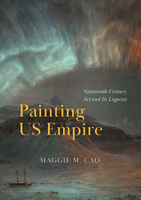
Maggie M. Cao,
Painting US Empire: Nineteenth-Century Art and Its Legacies.
The University of Chicago Press, 2025.
290 pp.; 98 color and 34 b&w illus.; notes; index.
$40.00 (hardcover)
ISBN: 9780226832418
Maggie M. Cao’s Painting US Empire: Nineteenth-Century Art and Its Legacies is a synthetic account of art and US imperialism that seeks to trace US painters’ complicity with and resistance to US imperialism. Each of the five core chapters is paired with an “intervention” comprised of works by present-day anticolonial artists who reckon with US imperialism and its legacy. Cao’s aim is to use the artworks under discussion “to connect the past injustices of imperialism with its contemporary consequences” (3). She employs a capacious definition of imperialism as “an expansionist ideology that strives to establish inequalities between the people, places, and things of one national, racial, or ethnic group and those of another” (6). This is presented as a largely economic project, including commercial ventures and the exploitation of natural resources. Her approach is indirect by design, one that “goes below the surface,” looking for “themes, styles and material conditions that connect the United States to other parts of the globe in unequal ways” (7–8). The author firmly identifies this as a history in the service of present-day activism, stating that to see the period in its own terms would be unethical; she further explains that “we live in an era of intensifying nationalism that has serious humanitarian, ecological, and economic costs around the globe. Such present conditions and their nineteenth-century roots urgently demand our attention” (16).
The volume often relies on chains of associations to connect nineteenth-century artworks to US colonialism. Rather than looking for strict causality, the volume seeks to uncover unseen connections between artworks and imperialism, creating linkages that start with the artwork itself and then move outward from one contextual topic to the next, associating it with technologies and events that are in turn connected to racial oppression and exploitation. This approach privileges artworks that reference such material: works that, in recent years, have become a canon of its own, and some of them recur in this volume. Thomas Cole’s Course of Empire series (ca. 1834–36; The New York Historical, New York) is offered as an introductory case study that depicts the rise and fall of an “imperial metropolis.” The artist is blamed for not only failing to transform his fellow painters into anti-imperialists, but also for encouraging them to “embrace the national ethos of economic growth and geographic expansion” (11).
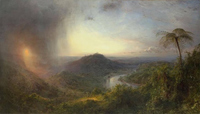
Chapter 1, “Growth and Decay in the Southern Tropics,” focuses on landscape painter Frederic Church’s time in Jamaica in 1865, concentrating on the depiction of plants in his works from that period as a springboard to discuss how the tropics informed US imperialism in that country. The artist’s only major work to result from the trip was The Vale of St. Thomas, Jamaica (fig. 1), completed two years later. As the author notes, attempts have been made to connect the painting iconographically to the Morant Bay Rebellion, which occurred a month after the Churches left Jamaica. While Cao touches on the painting briefly, her focus is on collecting and depicting tropical plants, a novel aspect of the artist’s trip that, to my knowledge, is little known. It is fascinating to learn about “fern fever,” the period’s popular interest in collecting and cultivating ferns in relation to Church’s depictions of them, and the author sheds new light on both little-known and better-known works from this period. That Church, his wife, and patrons such as Elizabeth Colt collected these plants is cast as an attempt to contain and assimilate the tropics as a place of “both alluring beauty and dangerous decay” (20). Cao asserts that paintings of tropical landscapes were not mere images of terrain, but rather ecological images that show that the circulation and cultivation of plants was a key aspect of US involvement in the Caribbean and Latin America.
A key example is the “Wardian case,” a kind of transportable terrarium that allowed plants to be moved over long distances. Its initial use for ferns expanded into the transportation of other plants, such as tea and rubber, that became the basis for colonial plantation economies. Its development for private use further allowed amateur gardeners to cultivate exotic plants in their homes, an attempt at horticultural assimilation that is seen as an analogue for “ideal coloniality”—that is, “the flexibility of geographic adaptation that empires required when forcibly moving human populations around the world, particularly in systems of enslavement and indentured servitude” (28). Cao notes that Church’s travel companion on a trip to the tropics in 1853 brought back a young boy and attempted unsuccessfully to assimilate him to Western ways. A discussion follows on human adaptability to new environments in relation to nineteenth-century conceptions of the tropics and the intersection of race science and botanical science. Returning to The Vale of St. Thomas, Cao connects comments from Church’s letters to the period trope of the tropics as a site of botanical fecundity and with decay and ruin, as human works are overcome by persistent vegetal growth. Contrary to the conventions of the picturesque, the compositional scheme of this painting allows the viewer no point of entry. This is linked to physical decay via plants as a signal of colonial failure, though these meanings are not attributed to any intention on Church’s part.
Cao then turns to Southerner Remy Mignot, an artist and friend of Church’s who traveled with him to South America in 1857 and painted lush riverscapes with ruined buildings, particularly churches. In contrast to the author’s treatment of Church, a purpose is assigned to Mignot and his work: “While intention is impossible to discern with certainty without Mignot’s own voice (which does not survive in archival documents), his very taste for a ‘slow paced and devout’ life, I argue, was political” (40, author’s emphasis). To demonstrate this, Cao notes a general Southern interest in ruins and Mignot’s upbringing in an enslaver family in Charleston; though the artist left there in 1848 (at 17 years old) never to return, it is possible that he held Confederate sympathies.
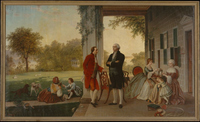
The artist’s Southern identity is related to his large-scale history painting Washington and Lafayette at Mount Vernon, 1784 (fig. 2), a collaboration with Thomas Prichard Rossiter that includes a depiction of an enslaved woman. The author suggests that Eastman Johnson originally planned to collaborate with Mignot but did not embrace Mignot’s vision in a decision that was “undeniably political” (43) in light of Johnson’s images of Mount Vernon and its enslaved inhabitants in 1857. Cao points out that Mount Vernon was itself a ruin at that time, and in 1859 the Mount Vernon Ladies Association purchased the property and conducted a national campaign to restore it. The author casts the campaign as a Southern cause, linking it to ruins of plantations that dotted the region after the Civil War, though these would not have been seen until many years later. Washington and Lafayette at Mount Vernon is considered as an attempted restoration that, “in the guise of historical preservation, . . . idealized plantation slavery while obscuring Washington’s complicity” (45). Indeed, the painting does not depict the terrible realities of slavery but, nonetheless, if the artist wanted to conceal the founding father’s holding enslaved people, he could have simply omitted the enslaved woman. The conversation on ruins in the US South is linked to the tropics in a discussion of tropical medicine and “shared pathologies, the study of which sanctioned both imperialism abroad and racial segregation in the Southern States” (46).
Mignot’s Ecuadorian scenes of ruins in the tropics are introduced in relation to present-day scholarship that connects the fecundity of plants with the “lazy native” trope of the period, suggesting that Indigenous peoples lacked the industry to control their environment. The artist’s views of buildings covered in vegetation are contrasted with Mount Vernon, which shows no hint of decay, and the author suggests that the latter’s pristine state is an endorsement of its slave-based economy. However, the artist’s project from the start was to depict Mount Vernon as it would have been in 1784, rather than in its ruined state in 1857. How much Mignot’s attitudes toward slavery had to do with this decision is unclear, and one would certainly not expect to see Mount Vernon in ruins.
Cao continues by positing that, though the artist’s views on US expansionism are unknown, he seemed to connect tropical ruin with the decline of European colonialism, and that, considering US ventures in South America during that time, the landscape of ruin suggested a need for a US rescue. A discussion of faux ruins in the United States returns to the topic of fern culture and the use of ruins in the “fernery.” She links the depiction of ruins to Southern anxieties about slave rebellions and incidents of enslaved people destroying or appropriating their former enslavers’ belongings. The chapter concludes with a criticism of Mignot and Church, who “shied away from facing the contemporary social problems of postemancipation Jamaica and postindependence Ecuador” (52) in any documentable fashion.
Chapter 1 is followed by a discussion of the work of contemporary multidisciplinary artist Maria Thereza Alves, who investigates the displacement of seeds that were inadvertent passengers of historic shipping, including the transport of enslaved persons. Alves’s work examines the racial and ethnic implications of opposing foreign and native plants through artworks and plant-based installations in port cities. The artist proposes an environmental activism rooted in social justice that contrasts with the aims of Church and Mignot, whatever these may have been.
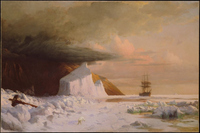
Chapter 2, “The Politics of Ice,” transitions from the tropics to the Arctic via the paintings of Church and William Bradford. Cao argues that “paintings of the Arctic . . . emerged from a culture in which ice was laden with racial and colonial meanings” (67). She begins by associating Bradford’s work (see, e.g., fig. 3) with exploration and the search for a Northwest Passage. Period theories about the geographic and climactic character of the North (including that a hollow shaft in the earth connected the North and South Poles) are framed in terms of interests in expanding US trade, which is cast as inherently imperialist. The author explains that ice and the development of refrigeration technologies played an important role in global shipping, bringing perishable goods farther and farther afield. It is interesting to learn about ice’s growing ubiquity and importance, and Cao illuminates how viewers would have understood these works in their time. Toward the end of the nineteenth century, ice was gradually replaced by chemical-based refrigeration.
Cao’s reading of Church’s and Bradford’s Arctic works begins by looking at landscape conventions, citing the scholarly trope of the landscape allowing the viewer to imagine possessing the land via a privileged, elevated viewpoint and set firmly on the ground. The author cites the American Art-Union Bulletin’s recommendation that the artist should create a place in the middle ground of landscapes where the viewer may imagine themselves standing, but it does not suggest a gaze of any specific kind, of ownership or otherwise. This is juxtaposed with Church’s and Bradford’s attempts to create a sense of groundedness in icescapes, rendering them “a conquerable surface within a navigable landscape” (79), though icebergs were notoriously unstable. Cao contrasts on the one hand, Church’s work integrating his painted studies into a large composition and the inherent problems with a lack of human presence; and on the other, Bradford’s method of compositing from photographs and adding narrative with people traversing the terrain and struggling against its challenges.
The author discusses the artists’ failure to transform Arctic ice, with its volatility and unstable materiality, into a traditional landscape and turns to nineteenth-century connections between ice and sculpture that cast it in terms of “seeing in” to the medium as a mode of perception and an associational practice. The author asserts that, “To see ice as sculpted stone rather than frozen water entangled the Arctic in marble’s racial analogies” (84), opening onto recent scholarship about the racism inherent in the whiteness of marble.
The author explains that Church renamed his The Icebergs (1861; Dallas Museum of Art, Dallas) as The North as an allusion to the Union side of the Civil War and writes that “in the Civil War era, ice may have been righteously tethered to Union politics by Church and others, but it can hardly be pardoned from problematic racial constructs” (88). Frozen water is shown to be racist via the work of scientist Louis Agassiz, who was also an advocate of white supremacy. The author makes an indirect connection between Agassiz’s demonstrably racist views and ice, linking Agassiz’s theory of the earth once being covered with ice to views about Inuits as primitive, despite their skills and knowledge of the difficult region as well as their artistic abilities, thereby privileging white people. Ice functions as a “colonizing material” (91) since it was a luxury good in tropical locations, and enslaved people were used to import it. Cao concludes that “the icescapes of Bradford and Church brought together practices of perception and of globalization that gave ice an imperial cast and racial dimensions at every distance,” describing “a mobile imperialism” that “aims to control both global pathways and the things that move through them” (92–93).
The second intervention follows up on this point through the work of New York-based, Bahamian artist-explorer Tavares Strachan and other artists working in the medium of ice. The author interprets these compelling works with melting ice as entropic in nature, describing installations of large blocks of ice whose thaw performs a “drama of melting” to evoke associations with economic colonialization, fears of climate change, and environmental destruction. Similarly, Strachan’s works make ice a central component of photographs and video installations that trace the movement of ice and the neglected people of color who helped facilitate Arctic expeditions. Cao cites the possibility of an ice-free Northwest Passage and calls for action to address climate change fears.
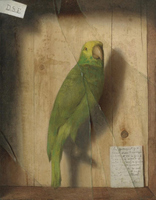
The third chapter, “Trompe l’oeil’s Global Goods,” focuses on a little-known work by a little-known artist, De Scott Evans’s Homage to a Parrot (fig. 4). Parrots were imported from Africa and South America as pets in the nineteenth century; this parrot, stuffed and presented as a taxidermic specimen, is said to have originated in South America and to have been taken to Paris, where it learned French. The chapter focuses on how the work “engages with US expansionism abroad and references contemporary European empires and their ideologies” (106). More broadly, the author asserts that trompe l’oeil artists, including Evans, “exploited the conditions associated with trompe l’oeil—deceptiveness, linguistic play, and ironic humor—to examine the circulation and consumption of global goods and their political implications” (106).
Cao points out that trompe l’oeil in the late nineteenth-century US was associated with circulation in forms such as letters, calling cards, and cash; and indeed, they were best suited to the medium as flat objects that make deception the most plausible. However, Evans’s still life paintings and others in this chapter depict three-dimensional objects. The author aims to contextualize Homage to a Parrot in global networks of trade and colonialism, focusing on the growing trade in imported birds and plants, particularly in Jamaica, where Evans visited. From there, the discussion turns to US trade with Jamaica and its effect on the country’s ecology and economy via trade and tourism.
Parrots are understood as a commodity that speaks and remembers. The apparent fact that this parrot spoke French opens a conversation about the role of linguistics in the cultural indoctrination that went along with colonialism. Questions of intent come particularly to the fore here, as Cao asserts that “in fashioning his parrot’s fluency in its captor’s language, Evans was no doubt recalling the linguistic forms of indoctrination then taking place all over the world” (110–11). Parrots’ distinctive capabilities to speak in different languages are considered as an index for cultural understandings about a hierarchy of language and culture, which the author then links to race and ethnic discrimination in the United States. The artist’s choice of subject is posited as showing his interest in the French Empire, which “allowed Evans to ground his picture in a recognizable empire as well as to link his own geographic dislocation to the bird’s,” as “for Evans, trompe l’oeil was particularly suited for envisaging the fate of animals in empire” (112). Since the artist is being credited with a purpose here that is key to the author’s thesis, some documentary support would be helpful.
Evans’s engagement with trompe l’oeil, a maligned genre during the period, highlights his use of humor and irony. Cao links the parrot as an example of taxidermy to its use to transport specimens of animals across vast distances. By this period, taxidermy served public institutions, curio shops, and even private individuals, but here the author focuses on its use across oceans, which connects it to imperialism and its relationship to trompe l’oeil in terms of flatness and embodiment. Trompe l’oeil sometimes uses a stuffed specimen not prone to decay, as opposed to still life painting, which is often a race against time to portray perishable subjects such as fruit or fish. In this context, Homage to a Parrot is framed as an engagement with both life and death. The author discusses the use of taxidermy in the natural sciences of the period, which “links [the painting] to a colonial death narrative” (123). An example is provided in another trompe l’oeil painting by Astley D. M. Cooper of a mounted buffalo head, which recalls the wholesale slaughter of buffalo and injustices against Native Americans.
Cao suggests that Evans might have offered a critique of imperialism in his still life The Irish Question (1880s; Art Institute of Chicago, Chicago). The title references a note pinned to the wall, behind two potatoes hung up with twine. At that time, Ireland was amid a campaign for self-rule from Britain that was of much interest in the United States. Cao points out that the hanging potatoes may refer to the hangings of Irish reformers but concedes that Evans did not overtly choose a side in his depiction.
The author explains that trompe l’oeil paintings communicate implicitly through visual clues, so their degree of political subversiveness cannot be definitively determined. She suggests, however, that the genre’s level of detail and high finish relates it to Orientalism, noting that its very realism allowed paintings of exotic subjects to facilitate a “European colonial gaze” (128). In fact, highly finished realism was employed not only in Orientalist works, but across a range of figural subjects including genre, allegorical works, and portraits.
In the United States, trompe l’oeil paintings were generally collected by merchants and could be seen in shops, hotels, and saloons. According to Cao, these capitalist underpinnings link trompe l’oeil not just to domestic trade, but also to global materials, labor, and trade routes. John Haberle’s Chinese Firecrackers (ca. 1890; Wadsworth Atheneum Museum of Art, Hartford) is offered as an example of how trompe l’oeil painters, looked down upon by other artists and compared to mere sign painters, depicted allusions to groups they thought lower than themselves to ironically comment on their status. Current theorists’ ideas about mimicry are introduced that give these imitative pictures “an undercurrent of political subversiveness” (135). In this way, their seemingly light-hearted treatment of such subjects takes on a darker meaning.
The third intervention discusses a filmed performance in which Native Alaskan artist Nicholas Galanin skins a taxidermic wolf. This is compared to Evans’s parrot to show how aspects of trompe l’oeil painting are evoked in contemporary art as a challenge to US imperialism. Galanin’s work references the history of US involvement with Alaska and its Indigenous people, as their land was taken from them by the government and individual settlers. Cao traces Galanin’s efforts to address imperialism in Alaska and concerns about climate change in several of his works. She discusses his early training in wood carving and critiques the market for such works as an arena for objects that merely mimic Native culture. She suggests a link to Evans and Haberle, who “sought to reclaim mimetic labor with their portrayal of global goods” (145) in the works cited in this chapter. The author suggests that they chose these global goods and adopted subaltern identities with that specific purpose in mind, although they seem singular in each artist’s oeuvre. Cao also describes Galanin’s critique of cultural appropriation in contrast with Evans and Haberle, who fall short, concluding that they “may well have respected subjugated individuals, but in their respect they also unwittingly perpetuated cultural hierarchies through markers of difference” (147).
The next chapter, “Keeping and Losing Time in the Pacific,” focuses on John La Farge’s travels in the South Seas in 1890–91. It opens with an anecdote from his travel companion, historian Henry Adams, about how Tahitians gathered around to marvel at La Farge painting the fruit of a tree. This is framed as condescension, since Adams assumes that they have never seen a painting before. The chapter examines “ways in which paintings produced by foreign travelers such as La Farge imposed a colonizers’ system of knowledge on their subjects of representation” (150) and focuses on time in relation to La Farge’s images of dance on his Pacific travels.
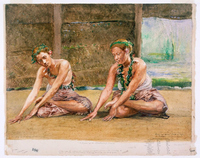
La Farge executed many figure studies in Samoa and landscapes in Tahiti. Unlike other artists discussed in this volume, La Farge clearly articulated his views in favor of the US annexation of Pacific lands. Cao aims to unpack La Farge’s depictions of native cultures, which he, of course, could not have fully understood. The author discusses time and the Other and how anthropologists distance themselves from other cultures by portraying them as being of an earlier era. The increasing standardization of its measurement in the form of time zones, with Greenwich designated as the location of the prime meridian, created disputes over dating in Oceania. Cao posits that Indigenous people’s adherence to traditional methods of measuring time was a subversion of foreign temporality. Thus, La Farge’s inscription of dates and times on his travel sketches (see fig. 5) is political because it is out of sync with Indigenous practices of measuring time. The artist’s images of dance in Samoa and his frustration with the difficulty of depicting motion and rhythm are interpreted in relation to period interests in chronophotography, series of photographs that broke down time into specific intervals and tracked motion with unprecedented precision. Noting La Farge’s interest in photography, the author discusses instances of anthropologists photographing different “types” of individuals for the purposes of measurement and comparison, linking them to racism. This is connected to instances of La Farge taking measurements of his models, therefore similarly implicating him. A sketch of undifferentiated nude figures seen from behind, offered as evidence that La Farge considered Samoan women to be interchangeable, supplements this interpretation. However, the author notes that it was unlikely that Tahitian women would have posed nude for the artist, raising the possibility that their lack of individuality is rather because they came from La Farge’s imagination. Cao asserts that “by using and referencing technologies that mechanized and industrialized the movements of the body, La Farge negated the Indigenous temporality that siva [the dance] embodied” (166). She points out that the artist seemed to not understand the meaning of the dances, considering them mere entertainment. She further notes that La Farge’s pictures render the dancers mute, still, and silent (although this is the nature of his medium) and proposes that these qualities might also be read as a form of resistance on the dancers’ part.
Both La Farge and Adams worked on projects related to the Indigenous knowledge of the Teva clan: La Farge through watercolors of sacred lands and sites and Adams through a history written from the clan’s point of view. The Teva matriarch had married an English man and had her children educated abroad; La Farge and Adams became close to the family and were ceremonially adopted into the clan. The author credits them with a genuine attempt to understand the clan’s traditions and family history, but they nonetheless also fall short: Adams struggles to form their account, which is defined by genealogy rather than chronological time, and La Farge references European histories of Tahiti and wonders whether he was treading in the footsteps of the first “discoverers” of the island or its early European colonizers, which included his own grandfather. La Farge’s landscapes are interpreted as exercises in capturing temporal effects including clouds and a pronounced sense of atmosphere, in keeping with the Impressionist interest in the momentary that militates against Indigenous understandings of time. It is not surprising that the artist would produce landscapes in keeping with his established style and the interests of his milieu, rather than with the Teva concept of “deep time,” though it is intriguing to try to imagine how he might have done so.
Cao concludes that despite their efforts, both Adams and La Farge “failed to accommodate those culturally foreign knowledge systems into their own familiar modes of representation” (175). She does note, however, that the Teva leaders benefited from their connections with the two men in their endeavors to make international contacts. Here, the author mentions a portrait of a Tahitian chief painted during a visit by Captain Cook in 1777. Their culture did not have a tradition of naturalistic painting, and the portrait was likely not displayed, which perhaps explains their initial wonderment at La Farge’s work mentioned at the opening of the chapter.
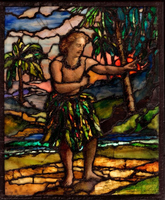
Chapter 4 ends with a study of Oceanic motifs in La Farge’s later work, positioned as an experiment in analyzing an additional medium: stained glass. La Farge’s Samoan Dancing a Standing Siva (fig. 6) shows how the artist’s mastery of changing light effects throughout the day makes the figure dance again, as Cao picturesquely puts it. The gender of the figure has been variously attributed and is difficult to pin down, which the author considers a challenge to colonial ideas about gender; she offers a 1791 anecdote about a cross-dressing Tahitian to show that gender ambiguity was part of Polynesian culture alongside La Farge’s and Adams’s observations that Samoan women were maternal but also large and strong.
The fourth intervention introduces Siva in Motion (2012; Milford Galleries, Queenstown), a video by Samoan artist Yuki Kihara, in which the artist performs a dance akin to those that La Farge depicted. The artist is a transgender woman who identifies as a fa’afafine, a third gender in Samoan culture, and takes on an identity that she has named Salome, dressed in restrictive late nineteenth-century Western costume. In manipulating time in the video through reversing, fusing, and scrambling moments in the performance, the work “challenges time as a source of colonial power on both human and planetary scales” (185). The artist specifically addresses Western visitors’ “consumption” of these dances as a marker for pre-colonial culture to show how their continuing performance for tourists has commodified them, emptying them of meaning.
Another work by Kihara, titled Kicking (2015; Milford Galleries, Queenstown)—a series of photographs of Samoan New Zealander artist and former rugby player Ioane Ioane kicking a ball—recalls Eadweard Muybridge’s chronophotographs. While Cao acknowledges that most chronophotographs were of white people, she emphasizes that they also relate to Taylorism (the early twentieth-century movement touting factory efficiency) and to timekeeping as a means of colonial control. The artist uses brief moments in which the subject turns to the camera, seen only when the motion is stopped, to subvert Western time management. In addition, the artist’s black-and-white photographs depict the character Salome visiting historically significant sites and those that recall environmental destruction at the hands of colonists in Oceania.
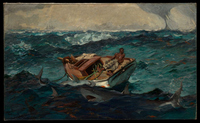
Chapter 5, “Perils on the Caribbean Sea,” focuses on islands and their relation to the oceanic aspects of imperialism. The chapter begins with Winslow Homer’s The Gulf Stream (fig. 7), which has received renewed attention in recent years as a locus for conversation about race issues.[1] Cao looks at the sea as a practical reality, rather than as a metaphor or abstraction, and aims to “engage the sea through Homer’s subjects, specifically his Black mariners—silenced figures of colonial history” (200). Homer traveled to the Caribbean in 1884 and to the Bahamas in 1898–99 and painted a number of watercolors there. The author points out that US control of Cuba serves as a backdrop for the latter trip; his later painting Searchlight on Harbor Entrance, Santiago de Cuba (1901; The Metropolitan Museum of Art, New York), with its modern searchlight, is associated with the US defeat of the Spanish Fleet in 1898. In her reading, “the whiteness of electric light was linked to Euro-American superiority over the world’s darker races” (203).[2] However, Cao notes that few viewers of the period saw it as a political work, so they might not have shared her interpretation. The author pairs it with The Gulf Stream (as Homer once suggested) as “a dialogue around human control over the ocean’s material conditions in the context of empire” (205).
Cao credits Homer with turning from caricature to sympathetic portrayals of Black subjects, beginning with his works during and after the Civil War. She posits that The Gulf Stream is informed by Homer’s Caribbean watercolors in which Black men are often depicted submerged in water. The author suggests that submergence usually denotes failure and gives several applicable examples in Homer’s New England subjects. In contrast, most of the examples of his Caribbean subjects show Black men navigating the water with ease and mastery, diving and fishing, and this is linked to sightseeing by white tourists during the period. Homer’s use of transparent watercolor as a means of portraying the water-based environment is placed in the context of period debates about the virtues of transparent versus opaque watercolor. Cao suggests that Homer chose the transparent medium to emphasize the clarity and liquidity of his watery environments, with divers as a link between air and water. Paradoxically, she posits that these portrayals show Homer’s admiration of their skill, overmastering such strong and agile creatures as sea turtles and even sharks; yet, since their abilities “border on the inhuman” (220–21), they can be connected to negative associations of Black people with reptiles and sea creatures that were common in period literature about the Bahamas. Tourists’ use of nautical glasses and glass-bottomed tubes or buckets had their origin in the sponging industry, with fishermen using them to identify sponges on the sea floor. The author muses on period descriptions of the sponge and the diver that mediate between air and water and how they “bridged the world of elite, white tourists consuming ocean resources and that of Black locals who depended on them for their survival” (224).
The conversation returns to The Gulf Stream by presenting the Black figure as both heroic and in deathly peril. Cao notes that Homer later changed the composition, adding a ship in the distance to reassure viewers concerned about the figure’s fate. She hypothesizes that the figure is a Bahamian diver and, on that basis, links it to other works by the artist of beings both human and animal in vulnerable positions; however, in this case, the premise that the figure is a Bahamian diver links his peril to colonialism and its attendant exploitation.
In the final intervention, Cao compares Homer’s watercolor After the Hurricane (1899; Art Institute of Chicago, Chicago) with Afro-Cuban artist Carlos Martiel’s performance Sujeto (Subject) of 2012. The former depicts a Black man washed up on the shore; the latter featured Martiel naked in a tidepool, a fishline attached to fishhooks embedded in his body tethering him in place as the tide pulled at his skin. It was intended as an act of suffering to bring attention to social justice issues. Cao describes how Martiel’s works critique Cuba’s oppression of its people and the United States’ colonial relations with it. Other works have the artist performing acts of endurance, such as submerging himself in a water tank with a steadily decreasing air supply. His performances are intended to reference refugees fleeing the Middle East and Africa, as well as the history of slavery. Cao links Martiel’s work, carefully orchestrated to reflect both heroism and powerlessness, to Homer’s depictions of Black Bahamians to “draw attention to the ongoing effects of imperialism on Black individuals” (237). As with the other artists discussed in this volume, Homer is condemned for his complicity with colonialism, since, as a tourist, he gave Bahamian divers “visibility but not voice” (238).
The author is admirably clear about her aims and means; she explains what she will do and does it. However, the volume raises epistemological questions about format and methodology, as well as more philosophical questions about the aims of art history as a practice. The methodological concerns begin with the case study format. It has become a very popular approach, in which four or five chapters each examine an object or a handful of objects in depth, and they are tied together by a theme. The danger with this format is that one begins with the end in mind and then searches for evidence of one’s chosen conclusion, leading to the risk of confirmation bias. This can also lead to dependence on works that can be “read” by the present-day author in a way that propels their narrative. Often the author is drawn to either thoroughly discussed works that have been seized upon repeatedly for their utility or little-known works that happen to suit their purpose, creating an odd combination of the overly familiar and the unusual. The case study format pairs well with a “chain of associations” methodology. It involves placing historical events, innovations, and ideas adjacent to one another, rather than connecting them firmly by causality or direct evidence. This technique is remarkably flexible; it can be used to connect a broad range of ideas, events, and people. The connections drift further and further from the artwork until they reach the issues under discussion.
The book is presented as a synthetic account of art and US imperialism in the nineteenth century, and how US painters were either complicit with or resistant to it. Accordingly, one of the key problems raised in the volume is whether the artist’s intent is relevant to the author’s argument. Since connections are made on the basis of association, rather than by direct purpose, the intent of nineteenth-century artists is either not discussed or assigned based on inferences (except for La Farge). Though their political views and purposes are usually not known, artists are held responsible for their “failures,” either for being connected to events or innovations that were used (or more often misused) in the service of racist acts or for not taking actions that would now be considered appropriate. It is easy to condemn early efforts at exploration, new technologies, and theories for not being as advanced or as environmentally and culturally sensitive as they have become or are coming to be. By declining to see these artists through the lens of their period, with its particular circumstances, challenges, and concerns, it becomes possible to judge them by the standards of the author’s own period, and they are found wanting in not embracing and promoting twenty-first century concerns.
Additionally, in the volume’s turn toward intense contextualizing, the artwork is introduced and then fades from view in discussions about known aspects of colonialism. While context is critical to fully understanding a work of art, in this case it becomes the topic. Since this material makes up a large part of the book, the historic artwork begins to seem like a minor player in the conversation, one that functions largely as a site of blame, though it is earned indirectly and unconsciously. It may bring an aspect of history to an art-oriented audience, but given the limited use of the artworks and the indirect methodology, it is not clear how much new light this approach can shed.
Contemporary art plays a key role, and the author’s “interventions” take the form of performances with a clear political message. The idea of “transhistorical” art has been of keen interest recently, particularly in museums, where contemporary artworks are placed in galleries of historic art in order to demonstrate the relevance of the older work to present-day visitors and to “use the present as a gateway to the past.”[3] Here, the contemporary works do the opposite. They reference past acts of colonialism, racism, and environmental destruction, bringing contemporary works into the past, rather than bringing historic works into the present day. Cao concludes the volume by suggesting that, rather than illuminating the circumstances of the period and its people to the best of one’s ability, “If we are to continue to study and to admire Homer’s paintings and the work of other canonical, white US artists of the past, then we must do so with a radical empathy for their subjects, who can only recover their voice and agency through contemporary proxies” (239). Since the historical record is far from complete, and there are many unrecorded voices, some speculation is called for, but substituting contemporary voices in this way literally puts words in their mouths. As a form of creative expression, performances and other art forms can do the important work of pointing to the neglected voices of the past, but they were not made to serve as scholarly evidence. These works contribute substantially to the author’s project of seeing history through a twenty-first century lens, while the historic works function as objects of critique for their failure to see their own time through that lens.
The book raises ontological questions as well. Cao forthrightly states in the introduction that “artworks can register the epistemological effects of imperialism in ways that political, legal, and economic histories cannot” (152). But here, historic artworks are seen to fail in conveying those effects; instead, they serve as little more than a starting point that eventually leads to the more concrete effects of historical imperialism and calls for present-day action. Looking at past events that seem related to present-day concerns can help us better understand our world, and there are certainly past examples of art historians applying their political beliefs to shape the approach they take to topics within their field. However, there are harmful extremes: Cao’s approach is part of a trend that risks relegating artists and artworks to the role of a prop or an illustration—a means for promoting political activism, rather than an end to be studied for its own sake.[4] This is not unique to Cao, but is part of what seems to be a larger need to legitimize the study of historic US artworks by either heroizing their makers as proto-crusaders for current concerns or criticizing them for failing to be.
Ultimately the question is, what is our job as art historians? In the past, one might have answered that, in the simplest terms, art historians are charged with better understanding art through and throughout history. However, in recent years it seems increasingly common to expect historic art to understand us and to provide some utility in advancing present-day political goals, and, therefore, to be disappointed when it doesn’t. This approach is defined by the assumption that one’s own concerns, and the concerns of one’s time, are morally superior to those of artists’ own time and place, which can lead to a less than even-handed view of history. For instance, it would be appropriate to offer some credit for nineteenth-century efforts that led to our current era of incredible conveniences and almost effortless global connection and to acknowledge the challenges they faced that we do not. Painting US Empire is a creditable and well-crafted example of current approaches to US art, albeit ones that might benefit from a better balance between criticality and humility, and between the worlds of the past and the present.
Notes
[1] For example, Lydia Figes, “The legacy of Winslow Homer’s ‘The Gulf Stream’,” Art UK, October 17, 2022, https://artuk.org/; and Mark Derry, “The Unseen Depths of Winslow Homer’s ‘The Gulf Stream’,” Hyperallergic, May 31, 2022, https://hyperallergic.com/.
[2] For a different reading based on period commentary, see Stephanie Herdrich, “Crosscurrents: Conflict, Nature, and Mortality in Winslow Homer’s Art,” in Winslow Homer: Crosscurrents, eds. Stephanie Herdrich and Sylvia Yount, exh. cat. (The Metropolitan Museum of Art, 2022), 146.
[3] Rachel Poser, “The Transhistorical Moment,” Harper’s Magazine, September 23, 2016, https://harpers.org/. See also Nicola Setari, “Notes on Transhistoricity: Between Art Theory and Critical Practice,” in The Transhistorical Museum: Mapping the Field, eds. Eva Wittocx, Ann Demeester, and Melanie Bühler (Valiz: 2018): 22–37.
[4] Tom Ginsburg, “Scholarship and Activism Are Two Different Things,” The Chronicle of Higher Education, March 4, 2025, https://www.chronicle.com/ [login required]. Ginsberg notes that “While of course there is always a deep politics of scholarship, for example in the selection of topics for inquiry or methods for approaching, these biases ought to be examined and minimized in genuine inquiry, not celebrated. This requires a humility about the limits of one’s own perspective.”