Mary Cassatt between Paris and New York: The Making of a Transatlantic Legacy by Ruth E. Iskin
Reviewed by Samantha BurtonSamantha Burton
University of Southern California
Email the author: burtons[at]usc.edu
Citation: Samantha Burton, book review of Mary Cassatt between Paris and New York: The Making of a Transatlantic Legacy by Ruth E. Iskin, Nineteenth-Century Art Worldwide 24, no. 3 (Autumn 2025), https://doi.org/10.29411/ncaw.2025.24.3.9.
This work is licensed under a Creative Commons Attribution-NonCommercial 4.0 International License  unless otherwise noted.
Your browser will either open the file, download it to a folder, or display a dialog with options.
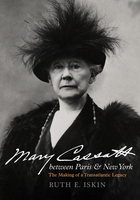
Ruth E. Iskin,
Mary Cassatt between Paris and New York: The Making of a Transatlantic Legacy.
University of California Press, 2025.
344 pp.; 99 color illus.; notes; bibliography; index.
$49.95 (hardcover)
ISBN: 9780520355453
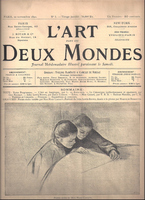
On November 22, 1890, art dealer Paul Durand-Ruel launched a new weekly magazine aimed at promoting modern art and, by extension, his own galleries in Paris and New York. Entitled L’Art dans les deux mondes (Art in the Two Worlds), the cover of the magazine’s first issue aptly featured Mary Cassatt’s drypoint The Map (1889–90) (fig. 1). The sparse image shows two girls looking intently at the titular document; the location it denotes is left to the viewer’s imagination. Although the map itself is small and two-dimensional, the curve of the surface it rests upon suggests the curvature of the globe and the distance between the “two worlds” connected by Durand-Ruel’s growing art empire. Beyond the appropriate subject matter, Cassatt herself was a savvy choice to feature on the cover of this new venture: the United States-born, France-based artist embodied the precise transatlantic networks Durand-Ruel aimed to exploit in his expanding business.
Just a few months later, however, Cassatt’s transatlantic identity presented a roadblock to her professional ambitions. In April 1891 Cassatt and fellow North American-born artist Camille Pissarro were excluded from the exhibition of the Société des Peintres-Graveurs. Though both had been founding members two years earlier, the newly nationalist direction of the society prohibited artists who were not French citizens from exhibiting. At the time, Cassatt had lived primarily in France for twenty-five years; Pissarro, originally from the island of St. Thomas in the Danish West Indies, for nearly forty. The solution determined was for the two foreigners to display their work in separate rooms adjacent to the main show. It was Cassatt’s first solo exhibition: a perhaps bittersweet career landmark.
Ruth E. Iskin’s Mary Cassatt between Paris and New York: The Making of a Transatlantic Legacy offers a fresh look at a well-known artist by asking how such transatlantic connections and frictions shaped Mary Cassatt’s identity, work, and legacy. Born to a wealthy family in Pennsylvania in 1844, Cassatt attended the Pennsylvania Academy of the Fine Arts in Philadelphia before becoming one of the many North American artists who crossed the Atlantic in the decades between the American Civil War and World War I in pursuit of the kind of artistic training and professional careers not yet available in their homelands. While Cassatt initially sought traditional academic instruction and the glory of the Salon, what she found was the most avant-garde French movement of the day: Impressionism. After participating in the fourth Impressionist exhibition in 1879, the artist became a central part of the group now often thought of (rightly or wrongly) as quintessentially French. She returned to the United States only three times after settling permanently in France after 1875. And yet, she did not take any steps to adopt French citizenship and identified as “American” until the end of her long life. Even as late as 1918, Cassatt claimed on her passport application to only be “temporarily residing abroad for professional work.”[1]
In accessible and engaging prose, Iskin makes a strong case for the significant role Cassatt played in bringing together the art worlds of France and the United States in the late nineteenth and early twentieth centuries. Further, she compellingly explores what the artist’s legacy might reveal about the nationalist underpinnings of art history as a field today. In some respects, the book is a continuation of the kinds of questions Iskin has investigated in her previous work on late nineteenth-century French art and visual culture, in particular expanding the examination of women’s active participation in public life that she initiated in Modern Women and Parisian Consumer Culture (2007). In its narrow focus on the life of a single artist, however, the book is a departure for the author. Taking a primarily biographical approach, Iskin mobilizes archival materials (including previously unpublished letters) to reconstruct transatlantic networks that interweave the personal, professional, and political. The book focuses chiefly on Cassatt’s immediate social and professional circles in the decades after the Impressionist exhibitions of the 1870s and 1880s and is consistently attentive to the gendered and classed nature of these relationships. Two key topics surface as Iskin’s main avenues of exploring Cassatt’s transatlantic identity. First, the reader learns about Cassatt’s important work as an art adviser to friends and family from the United States and, by extension, her influence in shaping the collections of major museums in that country. Second, Iskin illuminates Cassatt’s engagement with the suffrage movement and her interest in women’s issues more broadly. Threaded through each of the seven chapters, these themes provide a solid framework for a wide-ranging examination of Cassatt’s life and career.
Iskin’s book usefully builds on existing Cassatt scholarship, bringing together some of the current trends in research about the artist. The first book dedicated to Cassatt and her work was published during the artist’s own lifetime. Achille Segard’s Mary Cassatt: Un peintre des enfants et des mères (Mary Cassatt: A Painter of Children and Mothers) (1913) established—for better or worse—Cassatt’s longstanding reputation as a “feminine” artist of mothers and children in private, domestic settings. Spurred by the emergence of feminist art history, the 1980s and 1990s saw scholars such as Nancy Mowll Mathews and Griselda Pollock take a considerably more complex look at the gendered contexts for Cassatt’s production. In the years since, the artist has been the subject of major exhibitions at venues such as the Art Institute of Chicago (1998), the National Gallery of Art (2014), and the Philadelphia Museum of Art (2024). These exhibitions and the essays in their accompanying catalogues have examined the artist from a variety of new angles, many of which Iskin picks up on here. Recently, the Musée Jacquemart-André in Paris (2018) and the Art Gallery of Ontario in Toronto (2023) have each hosted exhibitions that situate Cassatt’s work in an explicitly transatlantic context.[2]
While the prevailing twenty-first-century art historical trend has been, Iskin points out, to see the world and its artists as essentially global, she argues that “in the case of Cassatt, not only were nation-based identifications a determining factor in her own worldview, but they continue to shape the way in which her art is displayed in museums to this day” (6). In Iskin’s account, Cassatt emerges as a figure who strongly identified as both an American advocating for (and indeed, actively shaping) the developing art world of the United States and as a proud member of the French Impressionist group who understood her work and career to be embedded in a decidedly French context: an “American,” but not an “American artist.” This dual identification, however, has not persisted through to today, Iskin shows. Instead, scholars and museums have typically chosen one framework or the other, reducing the artist’s identity and her work to something less nuanced than Cassatt understood these to be. Instead, Iskin proposes an interpretation of Cassatt and her legacy that “cannot be fully charted within the boundaries of either her homeland or France, but can be understood anew within the framework of the transatlantic world of her time” (14).
Following an introduction that outlines the major themes and stakes of the book, the first three chapters form a natural subsection that examines several of Cassatt’s most important personal, professional, and political relationships. Iskin interestingly focuses much attention on Cassatt’s friendships, rather than the family relationships that have often occupied previous scholarly attention. Drawing on the theoretical framework of friendship studies, these chapters push back on preconceived notions of friendship as feminine coded and essentially private, instead insisting on the professional and political dimensions of these relationships. Chapter 1 introduces the reader to some of the key US figures in Cassatt’s transatlantic network: banker James J. Stillman, modernist photographer Sarah Choate Sears, architect Theodate Pope, curator Sara T. Hallowell, and critic Forbes Watson. Iskin persuasively shows how affective and emotional bonds with these men and women supported Cassatt’s professional ambitions and political interests, while helping her to maintain strong ties to the United States. Tirelessly advocating for her friends to acquire modern French art, Cassatt made introductions to artists and dealers and advised on worthy purchases, often pushing Americans outside of their comfort zones. In this way Cassatt was able to exert a significant influence over the kind of art being transmitted to the United States and its museums.
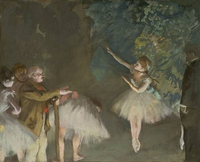
The next two chapters look in more depth at two of Cassatt’s most significant long-term friendships, with Louisine Havemeyer and Edgar Degas. Cassatt and Havemeyer met in Paris in 1874 and maintained a close friendship through their lives, even when they were on opposite sides of the Atlantic. Cassatt initially acted as a mentor for the younger woman, helping her navigate an independent life abroad. This included guiding Havemeyer on how to develop her taste in art and, beginning not long after their meeting, encouraging her to acquire pieces by Cassatt’s contemporaries. In Cassatt’s first act of art advising, Havemeyer purchased Degas’s Rehearsal of the Ballet (ca. 1876) (fig. 2), making the New Yorker the first American to collect Degas’s work. Havemeyer would go on to amass a collection of thousands of works, many obtained on her friend’s advice. As such, Iskin makes a convincing argument that this close friendship was how Cassatt would eventually leave the most enduring legacy on the emergent art world in the United States, given that Havemeyer and her husband eventually donated much of their vast collection to growing institutions such as the Metropolitan Museum of Art. In the second main topic of the chapter, Iskin explores the Cassatt-Havemeyer relationship in the context of their mutual, though sometimes conflicting, interest in women’s suffrage and each woman’s active advocacy for women’s rights in the political and professional spheres. In its intersection of personal, professional, and political threads, Iskin contends that Havemeyer’s friendship was the primary “conduit through which Cassatt could maintain her lifelong sense of belonging to the American nation” (55).
The following chapter revisits Cassatt’s decades-long friendship with fellow artist Degas. The two met in the 1870s and found common ground in their realist approaches to style and subject matter. Iskin aims to correct earlier scholarship that either largely omitted Cassatt from accounts of Degas’s life and career or alternatively positioned Cassatt as a student or romantic interest of the older French artist. Instead, she argues for Cassatt’s agency within this relationship, positioning the two as equals united by similar artistic goals (though not by their differing attitudes towards subjects such as women’s rights). In this respect, the chapter builds on the important work done by the National Gallery of Art’s Degas-Cassatt exhibition (2014) and its supporting catalogue. However, while one section tackles Cassatt’s role in disseminating Degas’s work in the United States, this chapter unfortunately loses sight of the book’s larger argument about transatlantic networks and therefore seems somewhat out of place. If a chapter on the pair’s friendship was necessary, it seems like a missed opportunity in this context to not address Degas’s own North American ancestry and brief time in New Orleans.[3]
The next three chapters form another natural subsection within the book, focusing on Cassatt’s interest in women’s rights and her engagement with the US suffrage movement. In the first of these chapters, Iskin extends previous feminist scholarship about the artist by looking at Cassatt’s investment in a variety of specific political and social issues, including her nuanced thoughts on suffrage, marriage, professionalism and financial independence, citizenship, participation in women-only exhibitions, and the doctrine of separate spheres. Iskin demonstrates that Cassatt largely framed her understanding of these issues through a transatlantic lens and in dialogue with others from the United States.
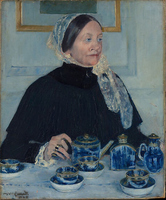
Iskin expands on this in the following chapter by examining how Cassatt’s feminism is visible in her art. This chapter stands out among the others as engaging in the most depth with the artist’s work. We read, for example, about works that explicitly address women’s achievements, such as her mural Modern Woman (1893; currently unlocated) for the Woman’s Building of the Chicago World’s Fair. But Iskin also looks at how a feminist ethos is present in less obvious areas of Cassatt’s oeuvre. She provides a thought-provoking reading of Cassatt’s representations of older women, for example, showing how works such as Reading Le Figaro (1878; private collection) and Lady at the Tea Table (1883–85) (fig. 3) connect age with intelligence, self-possession, and cosmopolitanism. Iskin also reinterprets Cassatt’s much-discussed maternal subjects by looking at how this same imagery was being leveraged contemporaneously in the context of the suffrage movement, both by those in favor of and those against the cause. While these two chapters survey an impressive number of topics to show the depth and diversity of Cassatt’s commitment to feminist thought and action, each of those subjects unfortunately receives only a relatively brief discussion—any one of the topics discussed here merits its own chapter.
Happily, Iskin does just this in chapter 6, where she closely analyzes an exhibition of Cassatt’s and Degas’s works in New York City in 1915. Organized by Havemeyer, the proceeds from the show benefitted the New York suffrage campaign in advance of a referendum for women’s suffrage on the ballot in the state that year. Using newly discovered photographs, Iskin reveals the equal treatment of the two artists on the walls of the gallery: a spatial and visual manifestation of the equal rights for which the exhibition advocated. Moving beyond the question of suffrage, Iskin also claims that the show was a key moment in the history of modern art in the United States, placing the show in dialogue with the Armory Show of 1913. What differentiated the later exhibition, she observes, was that the works on display came from collections within the United States: it was “the first time that New York could claim to have outdistanced Paris in terms of the sheer volume of works by these artists available for viewing in the city” (206). The exhibition was thus a victory not just for Cassatt, but for New York and the United States as well.
The seventh and final chapter serves as an extended conclusion and most directly addresses the book’s subtitle: the making of a transatlantic legacy. In addition to surveying Cassatt’s attempts to control her own professional legacy, the chapter acts as an excellent case study of how art history constructs national categories and identities through museum collection and display practices. Observing that “posterity is undoubtedly a dynamic process” (223), Iskin shows that Cassatt’s legacy should really be understood as legacies: flexible and changing, dependent on context. In France, she demonstrates, Cassatt has been considerably less celebrated since her death than in the United States: the artist received her first major solo retrospective show in France only in 2018. Looking at the Musée d’Orsay and other Parisian institutions, Iskin shows that in French museums, Cassatt’s work is typically displayed alongside the other French Impressionists with whom she professionally identified during her lifetime. In the United States, on the other hand, museums like the Metropolitan Museum of Art, the Museum of Fine Arts, Boston, and the Art Institute of Chicago include her work in the American art galleries, acknowledging her nationality, but divorcing her from the French avant-garde colleagues with whom she professionally identified. Neither strategy manages to capture the full complexity of a transatlantic life and career. The chapter raises important questions about the artifice of the national borders that have acted as a framework for the field of art history and the limitations of this approach when it comes to artists like Cassatt.
Coming nearly a century after Mary Cassatt’s death in 1926, Mary Cassatt between Paris and New York is an important new addition to scholarship about the artist’s life and career. Reconstructing relationships that marry the personal, professional, and political, the text expands our understanding of Cassatt’s art advising and political activism, situating these activities in a transatlantic context. The strength of the book is its tight focus on Cassatt herself and the parts of her life and career that have been less frequently examined in the existing literature; the depth of archival research on display is impressive. The book’s narrow focus, however, also has a downside. The primarily biographical approach leaves the reader with the important question of how the transatlantic networks Iskin skillfully maps in the artist’s relationships might be visible in her artwork. Although the book is rich in illustrations, relatively few of the included images are discussed in depth. Similarly, discussions of both the wider social and historical contexts of Cassatt’s transatlantic experience and of the theoretical frameworks of transatlantic studies were sometimes underdeveloped.
Joining a recent flourishing of publications decentering France in studies of Impressionism and nineteenth-century art more generally, Iskin’s book opens the doors for further investigations connecting Cassatt and her work to global networks in the later nineteenth and early twentieth centuries.[4] There is particular opportunity to expand the scope of thinking about Cassatt’s transatlantic networks beyond her relationships with US friends to her connections to other artists caught in similar transnational webs. Degas and Pissarro stand out here, the latter perhaps especially so. Cassatt has often been lauded as the “only American” to join the French Impressionist group, but it would be more precise to say that she was the only artist from the United States to do so. Pissarro and Cassatt were close colleagues from early in Cassatt’s career. Both were born outside of France but were strongly affiliated with the French art world. Neither pursued French citizenship, even though it cost them professional opportunities. Did they bond over this shared transatlantic identity? Or, indeed, understand it to be shared at all, given their very different backgrounds? Further research in directions like these would not only bring new light to Cassatt’s life and work, but also help open up our understanding of transatlantic networks beyond the links between “America” and France—conceived of as two monolithic entities—to other kinds of connections and an understanding of both “American” and “French” as multifaceted and transnational within their own boundaries.[5] Iskin’s book provides an excellent jumping off point for potential future research in this area.
Notes
[1] Jennifer A. Thompson, “‘Practicing Art, My Profession:’ Cassatt’s Working Life,” in Mary Cassatt at Work, ed. Jennifer A. Thompson and Laurel Garber, exh. cat. (Yale University Press, 2024), 21.
[2] The book’s key themes have also been examined in recent academic scholarship on Cassatt. On Cassatt’s transatlantic identity and how it shaped her art, see Hollis Clayson, “Cassatt’s Alterity,” in Companion to Impressionism, ed. André Dombrowski (Wiley, 2021), 253–70. On Cassatt’s work as art adviser and her participation in transatlantic collecting networks, see Laura D. Corey’s research, including “The Many Hats of Mary Cassatt: Artist, Adviser, Broker, Tastemaker,” in Dealing Art on Both Sides of the Atlantic: 1860–1940, ed. Lynn Catterson (Brill, 2017), 39–58. On Cassatt and suffrage, see Nicole Georgopulos, “‘The Sunflower’s Bloom of Women’s Equality:’ New Contexts for Mary Cassatt’s La Femme au tournesol,” Panorama: Journal of the Association of Historians of American Art 8, no. 1 (Spring 2022), https://doi.org/10.24926/24716839.13070.
[3] On Degas and connections to North America, see most recently Michelle Foa, “In Transit: Edgar Degas and the Matter of Cotton, between New World and Old,” Art Bulletin 102, no. 3 (August 2020): 54–76, https://doi.org/10.1080/00043079.2020.1711487.
[4] See, for example, Emily C. Burns and Alice M. Rudy Price, Mapping Impressionist Painting in Transnational Contexts (Routledge, 2021); Alexis Clark and Frances Fowle, Globalizing Impressionism: Reception, Translation, and Transnationalism (Yale University Press, 2020), https://doi.org/10.37862/aaeportal.00198; and Hollis Clayson and André Dombrowski, eds., Is Paris Still the Capital of the Nineteenth Century? Essays on Art and Modernity, 1850–1900 (Routledge, 2016).
[5] On Paris as fundamentally “cosmopolitan and emphatically transatlantic,” see Hollis Clayson, Illuminated Paris: Essays on Art and Lighting in the Belle Époque (University of Chicago Press, 2019), 130.