The Art and Life of Francesca Alexander: 1837-1917 by Jacqueline Marie Musacchio
Reviewed by Melissa DabakisMelissa Dabakis
Kenyon College
Email the author: dabakis[at]kenyon.edu
Citation: Melissa Dabakis, book review of The Art and Life of Francesca Alexander: 1837-1917 by Jacqueline Marie Musacchio, Nineteenth-Century Art Worldwide 24, no. 3 (Autumn 2025), https://doi.org/10.29411/ncaw.2025.24.3.11.
This work is licensed under a Creative Commons Attribution-NonCommercial 4.0 International License  unless otherwise noted.
Your browser will either open the file, download it to a folder, or display a dialog with options.
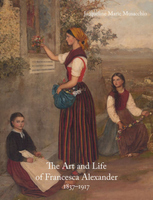
Jacqueline Marie Musacchio,
The Art and Life of Francesca Alexander: 1837–1917.
Lund Humphries, 2025.
208 pp.; 29 color and 89 b&w illus.; notes; archival source abbreviations; books by Francesca Alexander; select bibliography; index.
$47.00 (hardcover)
ISBN: 9781848226364
Though trained in Italian Renaissance studies, Jaqueline Marie Musacchio (Professor of Art History at Wellesley College) has recently committed herself to Anglo-American and Italian cross-cultural studies in the long nineteenth century. She has authored important articles on the US sculptors Anne Whitney and Florence Freeman, as well as continuing her work on a larger book project that addresses the general topic of late nineteenth-century women artists in Italy.[1] In the meantime, she has produced an exhaustively researched and bountifully illustrated monograph on the (now) little known, but certainly once very relevant, US artist and writer, Francesca (Frances) Alexander, who lived and worked in Florence for almost sixty-four years, from 1853 to 1917. I am aware of the difficulties of researching US women artists who traveled to Italy in the nineteenth century and recognize that Musacchio has left no stone unturned in her study of Alexander’s life and art. Just a cursory look at the archival sources in the book is testament to her scholarly proficiency (193). She has also tracked down several “lost works” among a large cache of unlocated paintings and drawings, a problem endemic to the study of nineteenth-century women artists in Italy, who, at the time, had garnered much recognition but were subsequently omitted from art historical scholarship until recently. In a prologue, five chapters, and an epilogue, Musacchio traces Alexander’s artistic life and charitable mission from her formative years in Boston society to her death in Florence in 1917 at the age of 79, creating a coherent biographical narrative of a fascinating and complex US cosmopolitan artist.
Born into a well-connected Boston family in 1837, Alexander was trained by her father, who was a successful artist—predominantly a portraitist—in his own right. Before Francesca’s birth, Francis Alexander traveled to Italy in 1832 and 1833; he hobnobbed with the expatriate sculptor Horatio Greenough in Florence and traveled with Thomas Cole to Rome, where he lived atop the famous Spanish Steps. He then continued to southern Italy with Cole and later visited Venice with the US painter John Cranch. He ended this inspiring trip in London, accompanied by the writer and philosopher Ralph Waldo Emerson. After returning to Boston, he married Lucia Gray Swett, heiress to a maritime family fortune, and resumed his successful portrait business: in 1837, he painted Hiram Powers, another expatriate sculptor living in Florence who would later become a close family friend; he would later also paint Henry Wadsworth Longfellow and Charles Dickens, the latter commission becoming one of the professional highlights of Francis’s career.
In Boston, the Alexanders were part of an elite circle of philanthropic and socially progressive families. Among Francis’s patrons were the abolitionists Lydia Maria Child and William Lloyd Garrison. The Alexander family was also well ensconced within Boston’s cultural elite, being acquainted, for example, with Isabella Stewart Gardner and her husband, Jack.[2] Within this prestigious milieu, Francesca’s father taught her to paint and draw. She reproduced the natural world around her with extreme acuity and created several striking portraits of those close to her. In 1852, she rendered sympathetic portraits of two African American women, Julia Benson and Deborah Dorsay, presenting both with a humanity and dignity often denied in representations of Black women. Growing up in Boston’s progressive abolitionist circles served as a formative experience for Francesca, preparing her, I would argue, for her philanthropic mission in Italy.
In 1853, when Francesca was 16 years old, the family departed for Florence. She would remain in Italy for the rest of her life, save a few brief visits back to the United States. She drew regularly with her father in Florentine churches, copying famous Renaissance frescoes by Ghirlandaio, Fra Angelico, and Perugino. Showing great talent, she produced her first finished paintings in 1861 and continued to draw, paint, and illustrate books until the end of her life. In Italy, she rarely competed for entry into art exhibits and did not open her studio to visitors and patrons, remaining outside the traditional art market until the 1880s.[3] Throughout her life, she accepted commissions and sold artwork often within a charitable framework.
At the time of the family’s arrival in Italy, Florence was replete with Bostonians, who became part of their social circle abroad. The city was also home to many artists, among them, the sculptors Thomas Ball, Florence Freeman, Joel Tanner Hart, and Larkin Goldsmith Meade, as well as the painters Lizzie Boott (with whom Francesca became quite close), Frank Duveneck, and Thomas Buchanan Read. The Alexanders attended the salons of Robert and Elizabeth Barrett Browning at Casa Guida, were particularly close to Powers and his family, and socialized with Nathaniel Hawthorne and his family, who briefly lived in Florence during the summer of 1858. By the end of Francesca’s career, the city boasted thirty thousand Anglo-American residents in addition to its onslaught of seasonal tourists.
By all accounts, Francesca lived a rather cloistered life. She never married, which was not unusual for women artists in Italy at the time, and lived within a quietly domesticated world, devoting herself to her parents, particularly her mother with whom she lived for her entire life. (Her father died in 1880.) She arrived in Italy only one year after the intrepid sculptor Harriet Hosmer had relocated to Rome to live among a daring community of women artists, writers, and intellectuals in the circle of the thespian Charlotte Cushman.[4] Hosmer was one of a group of US women sculptors that included Anne Whitney, Emma Stebbins, Edmonia Lewis, Margaret Foley, Louisa Lander, Sarah Fisher Ames, and Vinnie Ream (Hoxie). Developing successful professional careers, these artists competed for and won public commissions, created ideal statuary (with mythological, historical, or biblical subjects), modeled portrait busts, and sold “fancy pieces” (i.e., garden sculpture and the like). At mid-century, they numbered among the first women artists to attain professional stature in the US art world while achieving international fame in Rome, London, and other cosmopolitan European cities. Indeed, their independent lives charted new territory for feminine professionalism in the arts.
The lives of these US sculptors could not have been more different than that of Francesca’s. In fact, there seemed to be very little contact between Francesca and her more daring counterparts in the Eternal City who lived independent lives, unaccompanied by parents, guardians, or husbands. Opening their studios to the public, they were considered curiosities for the public lives they led and attracted much attention from tourists and the expatriate community in general. They pushed the boundaries of “true womanhood” by challenging the traditional notions of domestic femininity.[5] Francesca, on the other hand, lived a life more consistent with that of the “true woman,” defined by home and family and idealized as selfless, sentimental, nurturing, and pious. Friends and visitors alike characterized her as saint-like, “with the naïve outlook of a cloistered nun,” demonstrating an “almost angelic simplicity” (122, 148, and 153). She certainly seemed out of step with the modern world that her Roman sisters were struggling to negotiate.
At the same time, the Alexander family was aware of the political situation in Italy and whole-heartedly supported the Risorgimento—the movement to liberate the Italian peninsula from foreign control and to unify the land as a sovereign nation-state. When the Alexanders arrived in Florence, European imperial powers ruled the peninsula: Austria governed Florence, Venice and the Veneto, and Milan; the Spanish Hapsburgs controlled Naples and the southern Italian provinces; and the Vatican ruled the Papal States, including Rome. The Alexanders aligned Italian values and political goals with those of their native land, including the abolition of slavery and support for a republican form of government. In 1860, an independent Kingdom of Italy was declared. When Florence became the temporary capital of this new sovereign nation in 1865, the family rejoiced. Then, in 1871, they supported the Italian troops in Rome, when the Papacy lost its political power, and Rome became the permanent capital of Italy.
As exciting and turbulent as these events were, they never entered Francesca’s artwork directly. Her politics were more local and more personal. She was deeply engaged in the Florentine environment in which she lived. She spoke (and wrote) the Italian language perfectly and developed close friendships with Italian people, particularly the contadini (the peasants and farm workers) who lived and worked nearby. These relationships were considered unusual for members of the expatriate community, who tended to keep their distance from the local inhabitants and socialize primarily within Anglo-American society. Not surprisingly, Italy generated complicated responses from Anglo-American expatriates and visitors in the mid-nineteenth century. To be sure, the Italian peninsula was a cultural mecca, constructed for the public by contemporary guidebooks and cheaply sold prints and photographs. Touristic Italy was perceived as an imagined arcadian world: exotic in its old-world traditions, intriguing yet dangerous in its Catholic pomp and ritual, and timeless in its landscape of ruins. Many travelers approached this imagined land as an ideal past independent of recent history. In other words, this arcadian vision stood in conflict with Italy’s current historical circumstances.
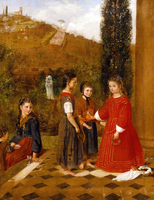
Francesca, to her credit, did not live in this imagined world. Her closeness with the Italian people made her a citizen of the new Italy; she cared deeply for her neighbors, aware of the poverty and adversity that dominated their existence. Throughout her life, she supported her friends and neighbors with money, food, clothing, and medicine. For example, one of her earliest works produced in Italy, Charity, shows a young girl—probably a stand-in for Francesca, Musacchio argues—distributing oranges, bread, and wine to four hungry children on a loggia (fig. 1).
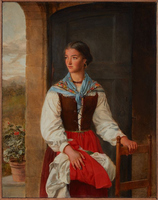
Profits from the sale of her various artworks and literary projects were often dedicated to these families. And many of the women and children became the subjects of her drawings and paintings. On regular occasions, her patrons would pay her a higher price for a painting or drawing so that she could donate the money to her local charities. I suppose it is not surprising that even her friend, Lilly Callahan Cleveland, believed Francesca to be a “very queer person . . . She is very good natured + knows all the peasants about their villa. . . . She is altogether a curiosity, + I like her, being addicted to peculiar people . . . [We] are going to their villa now to spend the day, + she is to take me to see a peasant beauty” (57). This “peasant beauty,” most likely, was one of the local Italian women whom Francesca painted. In the 1860s and 1870s, she produced several portraits of Italian women, often dressed in peasant frocks and at times holding babies. She knew these women by name, capturing their beauty and dignity with a detailed elegance, as in her portrait of Clorinda Amadei (fig. 2).
Through her friendships with these women, Francesca became interested in local folklore and peasant narratives that she chronicled in many publications beginning in the 1880s. Like an anthropologist, she retrieved these stories first-hand to share with a broader public; as an artist, she illustrated the manuscripts with her own skilled drawings of local flora and fauna, often accompanied by portraits of Italian women. These literary/visual projects soon became her central artistic focus, one for which she gained notable fame.
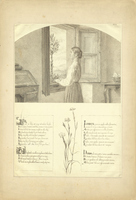
Among her first such projects was Tuscan Songs, completed sometime before 1883 and comprising 122 pages of songs, musically annotated in English and Italian, and illustrated with native plants and local inhabitants. She collected the songs, often sung by Italian women while at work, over a twenty-year period and spent another four years putting the manuscript together (fig. 3). After its completion, she met the influential English author John Ruskin in Florence on his final trip to the city; Ruskin became fascinated with Francesca and her artistic and charitable work. From this moment on, her life changed dramatically. According to Musacchio she “became a celebrity on both sides of the Atlantic” following this meeting (9). In 1885, Ruskin purchased and published her early manuscript, retitling it Roadside Songs of Tuscany. Taking complete control of the project—with Francesca’s blessing—he edited the manuscript, published only a portion of the 122 folios, rearranged their order, and wrote an introduction and explanatory text. He lavishly illustrated the publication with platinum photographs.[6]
Ruskin was 63 when they met, and throughout his life he had been a champion of women writers and illustrators, including, for example, Kate Greenaway. Nonetheless, he held rather traditional views about women’s place in society, and Francesca fit into his more domesticated view of womanhood. Although eager to publish more of Francesca’s works, he could be quite sloppy with his editing, at times not doing justice to her original manuscript. Her other literary works, some of which Ruskin continued to publish, consisted of La Sorellaccia (1883), a moralizing tale she learned from a contadina in a nearby village; The Story of Ida (1884), a biography of her friend, Ida, which had a wide following in the United States, Britain, and Italy; Christ’s Folk in Apennine (1887), a compilation of “word-portraits” or stories of local peasant life; and The Hidden Servants and Other Very Old Stories (1900), a versification of twelve Italian folk tales.
At this point in her career, patrons sought her out through her calling card or by word of mouth—she became one of the sights to see while touring Florence. Not unlike her colleagues in Rome, she began to make public the address of her studio in 1894. Visitors would enter her workspace and watch her draw; at times, they would also purchase works of art. “After the good fortune which had befallen me became known,” Francesca wrote to her friend Lilly Cleveland in 1884: “my works and myself became objects of general curiosity, and my peaceable little room was filled, from one week’s end to another, with the strangest variety of people that you can imagine of every possible nationality” (124).
With her publications in the 1880s, Francesca had entered the professional art world, despite her reputation of quiet domesticity. Her studio, with its now public character, served as a site of both production and display where she, wittingly or unwittingly, showcased herself and her artwork. With its commercial and financial negotiations, the artist’s studio held the potential of tarnishing a woman artist’s reputation, as it had in Rome, with the scandal surrounding the US sculptor Louisa Lander.[7] Protected by the mantle of domesticity and enshrined by the aura of her charitable mission, Francesca was able to enjoy her public success without fear of moral taint.[8] By the following decade, Francesca’s sight had failed to the point where she could no longer draw, though she continued her charity work until the end of her life. Wheelchair bound, she never stopped distributing money and other types of aid to the poor. In 1916, Francesca’s mother died at the age of 102; shortly thereafter, in 1917, the artist died of pneumonia.
In detailing Francesca’s life with such lucidity, Musacchio has brought to our attention a fascinating artist who, until now, had been lost to history. In her unconventional life, Alexander uniquely preserved the traditions of domesticity while also participating fully in a public life that brought her much notoriety. As current research has taught us, there is no one type of feminine artistic professionalism assigned to all women, but a series of different strategies that these artists adopted to help negotiate a sometimes unwelcoming art world. Thus, this book helps demonstrate the wide variety of feminine experiences that were possible in the nineteenth-century art world. “Very few Anglo-Americans took part in Italian life as enthusiastically and sympathetically, or for as long a period of time [as did Francesca Alexander],” Musacchio succinctly summarizes. “She engaged with an international community of artists, politicians and intellectuals, and she was determined to use her talents to provide friendship and charity to Italy’s neediest, while sharing their stories with a wide audience who would have no knowledge of them otherwise. She may have outlived her world, but she worked her entire life to make it a better place” (170).
Notes
[1] Jacqueline Marie Musacchio, “Finding Florence Freeman,” Nineteenth-Century Art Worldwide 21, no. 1 (Spring 2022), https://doi.org/10.29411/ncaw.2022.21.1.4; and Jacqueline Marie Musacchio, “Mapping the ‘White Marmorean Flock’: Anne Whitney Abroad, 1867–1868,” Nineteenth-Century Art Worldwide 13, no. 2 (Autumn 2014), http://www.19thc-artworldwide.org/.
[2] Musacchio lists a veritable who’s who of Boston families with connections to the Alexanders (106).
[3] Only once did she submit a pen and ink drawing to the Esposizione Nazionale Italiana of 1861 in Florence, but her work was rejected.
[4] See Melissa Dabakis, A Sisterhood of Sculptors: American Artists in Nineteenth-Century Rome (Penn State University Press, 2014).
[5] For a discussion of this concept, see Barbara Welter, “The Cult of True Womanhood: 1820–1860,” American Quarterly 18, no. 2 (Summer 1966): 151–74. For more on the historiography of separate spheres ideology, see Linda K. Kerber, “Separate Spheres, Female Worlds: The Rhetoric of Women’s History” (1988), reprinted in Linda K. Kerber, Toward an Intellectual History of Women (University of North Carolina Press, 1997).
[6] In 1896, Houghton Mifflin published the original manuscript, Tuscan Songs, in a limited edition, with 108 folios.
[7] See Dabakis, Sisterhood of Sculptors, 63–93.
[8] This is not unlike the experience of the sculptor Sarah Fisher Ames, a married woman of high society who donated the profits of her plaster bust of Abraham Lincoln to charity. See Dabakis, Sisterhood of Sculptors, 181–207.