The Medicine of Art: Disease and the Aesthetic Object in Gilded Age America by Elizabeth L. Lee
Reviewed by Barbara Dayer GallatiBarbara Dayer Gallati
Curator Emerita, Brooklyn Museum
Email the author: barbaragallati[at]googlemail.com
Citation: Barbara Dayer Gallati, book review of The Medicine of Art: Disease and the Aesthetic Object in Gilded Age America by Elizabeth L. Lee, Nineteenth-Century Art Worldwide 24, no. 3 (Autumn 2025), https://doi.org/10.29411/ncaw.2025.24.3.13.
This work is licensed under a Creative Commons Attribution-NonCommercial 4.0 International License  unless otherwise noted.
Your browser will either open the file, download it to a folder, or display a dialog with options.
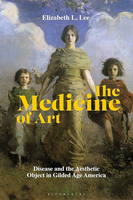
Elizabeth L. Lee,
The Medicine of Art: Disease and the Aesthetic Object in Gilded Age America.
Bloomsbury Visual Arts, 2022.
234 pp.; 80 b&w illus.; bibliography; notes; index.
£85.00 (hardcover)
£76.50 (e-book)
ISBN: 9781501346880
The Medicine of Art: Disease and the Aesthetic Object in Gilded Age America undertakes “to show how major Gilded Age works of art can be understood in novel ways through the perspective of medicine” (5). Consisting of five chapters and an epilogue, the book opens with what is essentially an extended introduction entitled “Naming and Framing Disease.”[1]
After citing examples of artists’ comments about dealing with fatigue (the artists include James McNeill Whistler, Abbott Handerson Thayer, and John White Alexander), the author traces late nineteenth-century ideas about physical and mental fatigue. This brings into play the dominance of neurasthenia and the emergence of scientific theories (especially Hermann von Helmholtz’s law of thermodynamics, which spawned the idea that an individual’s energy was finite and, through exertion, the body would eventually enter a state of deterioration, or fatigue). Unfortunately, the misspelling of McNeill in the first line of the chapter immediately introduces doubt about the care with which the book was edited.[2]
Throughout the chapter Lee cites a wealth of sources, among them the influential rest-cure specialist, Dr. S. Weir Mitchell, the psychologist William James, and the popular body builder Bernarr Macfadden. Added to these are references to works by contemporary historians of art, medicine, and sociology. Here it must be noted that the multitude of endnotes reflects the staggering amount of research conducted for this project; the notes and bibliography alone establish a firm foundation for further research along these lines. With a “select bibliography” that stretches to eighteen pages, one hastens to wonder about the length of the full list. That said, the sheer number of references and quotes within the text becomes somewhat overwhelming and, with judicious editing, the author’s theories could be argued more succinctly and with greater clarity. A similar editorial matter arises with Lee’s relatively lengthy detour into a discussion of Thomas Eakins’s Arcadian paintings; although it is of interest, it rehearses information easily found elsewhere and does not necessarily add to the author’s overall aim of establishing an innovative means of interpreting imagery.
In setting the stage for the four case studies that follow, Lee asserts that, because of the amorphous nature of neurasthenia, its galaxy of symptoms and possible causes, she has chosen instead to investigate the relationship of specific works of art to clearly defined illnesses, namely cancer, tuberculosis, and syphilis. The parameters of this aim are further qualified by the contention that the specific health issues under consideration were primarily the domain of a privileged class of white, Protestant males. In this respect, she credits the work of T. Jackson Lears for shaping her thoughts about an emerging “therapeutic world view” in which religion was displaced by secular remedies that promoted psychological well-being (22).[3] The real crux of the chapter lies in Lee’s explanation of her methodology, about which she states, “I utilize select information from the lives of the artists to connect with larger cultural narratives on illness and health” (27).
Chapter 2, “The ‘Picturesque Unfitness’ of Robert Louis Stevenson,” is the first case study and takes its title from a passage (quoted in an epigraph) from an essay about Stevenson written by Mariana Griswold van Rensselaer in 1895. The endnote for the quote refers the reader to a recent publication, but it does not provide the larger context for van Rensselaer’s comment or where her essay appeared.[4] Lee states that the purpose of the chapter is to show that John Singer Sargent, Augustus Saint-Gaudens, and Abbott Handerson Thayer “helped promote [Stevenson’s] image as a consumptive writer,” and Lee bases her argument on biographical elements selected from each of their lives that may have shaped their attitudes toward illness and, by extension, their portrayals of the writer (42). The chapter opens with a brief outline of contemporaneous cultural mindsets surrounding tuberculosis and theorizes that Stevenson cultivated the image of himself as a consumptive, bohemian writer despite evidence that his physical ailments stemmed from other, possibly genetic, respiratory problems and not tuberculosis per se.
This is followed by an analysis of Sargent’s Robert Louis Stevenson and His Wife (1885; Crystal Bridges Museum of American Art, Bentonville), which portrays the writer and his wife Fanny in their Bournemouth home, Skerryvore. Lee synopsizes the medical histories of Sargent’s, Henry James’s and his sister Alice’s families (all of whom were friends of the Stevensons) to construct a narrative “treating illness as a theme that is woven through the image” (52). Granted, Robert and Fanny Stevenson, the Sargent and James families, as well as Saint-Gaudens and Thayer (the medical experiences of the latter two are treated subsequently) had suffered a long list of ailments and causes of death, but does that guarantee that their conversance with ill health would be interpolated in their art? Lee interprets the painting in terms of mortality, describing the prominent open doorway as a metaphor marking the transition from life to death: “The tall, narrow proportions of the doorframe mirror the writer’s own, much like a tomb, as though Sargent has literally imagined this passageway in Stevenson’s home as the site of his internment [sic]” (43). Much is made of the room itself, with Lee identifying it as the writer’s drawing room. From that, she constructs a rather dubious thread of meaning, contending that the etymological source for drawing room—“withdrawing room”—confirms its role as the liminal space between the living and the dead. Stevenson himself discounted this supposition, writing: “Sargent was down again and painted a portrait of me walking about in my own dining room [emphasis added], in my own velveteen jacket and twisting, as I do, my own mustache.”[5] Another source states that the Skerryvore dining room was red and that the drawing room was blue.[6] Admittedly, Stevenson had life-long bouts with debilitating illness, but the painting does not suggest this as he is caught mid-stride. What is more, Lee does not raise the possibility that the composition—with the cropped figure of Fanny Stevenson on the right, the odd, empty spatial arrangement, and the informality of the portrait itself—signals Sargent’s assimilation of the modern compositional strategies of such men as Edgar Degas and Edouard Manet, whose work he admired.
The little that is actually known about what Sargent and the Stevensons thought of the painting (they were pleased with it) is summarized in the Sargent catalogue raisonné, and none of their comments evince the sensibility of illness and death.[7] Where Lee takes Stevenson’s description of Fanny as ghostlike and invoking thoughts of death, she omits the fact that he also thought “the glimpse of my wife in an Indian dress . . . adds a touch of poesy and comicality.”[8]
Leaving Sargent, the chapter continues with a section devoted to nineteenth-century perceptions of tuberculosis, focusing chiefly on the notion of “specialness” attached to the disease. As Lee writes (paraphrasing and crediting Susan Sontag), “[tuberculosis] functioned as a shorthand for a type of inspired, passionate person and was purportedly accompanied by heightened consciousness, intellectual acuity, and spiritual insight” (55). This section flows nicely and presents a sound, albeit brief, summary of the concept as it developed into the idea of the romantic consumptive. This leads to a section covering Saint-Gaudens’s series of low relief portraits of Stevenson propped up on a bed (or, in one instance, a couch), smoking as he writes. The sculptor had met Stevenson in New York in 1887, when the writer was staying in a hotel. As Lee points out, the man Saint-Gaudens met was not the sickly invalid that governed his public persona, but a man who, in the sculptor’s words, looked “astonishingly young, not a bit like an invalid, and a bully fellow” (65). Here, Lee is on firmer ground in that she acknowledges the divide between public perception and personal bearing and allows for the artist’s and writer’s collusion in perpetuating the trope of Stevenson’s invalidism—or what van Rensselaer called his “picturesque unfitness” (41).
The final section of the chapter covers Thayer’s Stevenson Memorial (1903, Smithsonian American Art Museum, Washington). Here Lee links the artist’s deceased wife Kate and Stevenson through tuberculosis. Much of the material in this short section relies on and credits Richard Murray’s definitive article on the painting published in 1999.[9] Unlike Lee, Murray emphasized Thayer’s high regard for Stevenson’s writing, thus providing a separate motive for the artist’s desire to create a tribute to the writer whom he may not have known personally. The issues surrounding Thayer’s tribute to Stevenson are complicated and originate in the painter’s early version of a memorial to the Scot that evolved into My Children (1893–97, Smithsonian American Art Museum, Washington). In attempting to summarize this complex creative process that eventually resulted in separate memorials to Stevenson, as noted above, and to Kate Thayer (Winged Figure Seated on a Rock, 1916; Freer Gallery of Art, Washington), Lee finds tuberculosis to be a key element.[10] It is impossible to say with confidence that tuberculosis was on Thayer’s mind in each case and the inception of both memorials is more likely to be simply grounded in feelings of loss, grief, and hope for spiritual renewal as expressed through the winged figures that emerged in his art in 1887.
Chapter 3, “Therapeutic Living in Dublin,” examines the reasons behind Thayer’s move to Dublin, New Hampshire, and the growth of the small colony of artists who gathered there. Again, Lee attributes Thayer’s permanent move to Dublin (with his three children) to his wife’s death from tuberculosis in 1891 and his desire to live in a natural environment that allowed for a healthy, simple lifestyle. The cultural background for what was essentially his “back to nature” existence is outlined, starting with Thayer’s own faith in science and awareness that some diseases were transmitted by germs; his veneration for the writings of Ralph Waldo Emerson and Henry David Thoreau; and his firmly antimodern attitudes held in reaction to the stresses and illnesses generated by urban growth and industrial progress. For him, as Lee writes, nature was medicinal in its ability to achieve and maintain health. Moreover, it took the observer of its beauties closer to spiritual transcendence.
Thayer’s sometimes extreme measures to bolster his family’s health (such as sleeping in unheated huts in the dead of winter) are described, and, what is more important, Lee provides an interpretation of the artist’s landscapes featuring the nearby Mt. Monadnock through the lens of the factors noted above. For Thayer, Monadnock not only dominated the surrounding landscape, but also attained a totemic identity “as a beacon of resistance against a backdrop of rapid modernization” (99).
All told, chapter 3 presents a well-argued assessment of Thayer’s beliefs and how they inflected his Monadnock imagery. The organization of the text, however, has a cut-and-paste quality. For example, the focus on Thayer is interrupted by several pages devoted to George de Forest Brush’s paintings of American Indians, citing them as examples of a pre-colonial ideal of living in harmony with nature. The chapter ends with a short nod to dress reform. The patchy narration noted here probably has to do with the fact that chapter 3 contains portions of two articles the author previously published, and, although the information is of interest, it diminishes the impact of the chapter as a whole.
The next chapter, “Chasing a Cure in Cornish,” recounts the course of Saint-Gaudens’s cancer-ridden final years.[11] Lee points out that the sculptor had experienced periods of nervous exhaustion from overwork and urban stress throughout his professional life. With his diagnosis of rectal cancer in 1900, the artist determined to undertake a new “manner of existence” that would incorporate healthful, leisure activity into his routine. Although Saint-Gaudens had previously spent summers at the Cornish, New Hampshire, artists’ colony, he moved there permanently in 1900 to facilitate his new resolve to attain health.
Lee prefaces the discussion of Saint-Gaudens’s turn to healthy living with a protracted, graphic account of the course of the disease and the various treatments engaged at least to relieve its symptoms, if not to produce a cure. Over the succeeding seven years, such treatments followed Edward Hooker Dewey’s recommendation that the body could repair itself through fasting—because doing so would save energy and improve brain function—and Horace Fletcher’s advice about mastication to improve digestion.[12] Overall, the array of curative options was enormous, ranging from Eugen Sandow’s physical culture movement to recent discoveries in medical science, among them Dr. John Beard’s Tripsyn Cure and courses of X-ray treatment conducted by Dr. Margaret Cleaves.
To advance her theories, Lee concentrates on Saint-Gaudens’s memorial to the famed Boston preacher and Episcopal bishop Phillips Brooks. Commissioned in 1893, the Phillips Brooks Memorial was nearly finished at the time of the artist’s death in 1907 and was finally installed at Copley Square outside Trinity Church in 1910. The project certainly posed significant problems for Saint-Gaudens, who was already slow to focus on the commission throughout the 1890s, well before his cancer diagnosis. Pointing to a letter written in 1903 from the sculptor to Reverend Winchester Donald, a member of the commissioning committee, Lee describes what was a watershed moment in Saint-Gaudens’s mental attitude toward life. After stating that “the horrible vision of death” had been hanging over him for six years, the sculptor continued: “About three months ago, as the result of diet or something a total change in mentality came; the vision of death vanished and an entire new grip on life and health took possession of me” (139). By then, Saint-Gaudens had revised his original plan and replaced the angel that was to accompany the full-length figure of Brooks with a representation of Christ, a decision that introduced a new constellation of problems. The artist’s struggle to achieve a satisfying image of Christ coincided with his last years, and, as Lee proposes, the prolonged work on the project is partially explained by the possibility that “Saint-Gaudens seems to have found with the Brooks a kind of reassuring constant companion” (145). The key element in this exposition is touch. Lee cites Homer Saint-Gaudens’s statement that the Brooks sculpture was one of the last works his father touched, a gesture found also in the touch of Christ’s hand on Brooks’s shoulder. Lee concludes, “In all, the work can be said to function as a talismanic presence for the ailing sculptor, connecting him to a Christian promise of salvation and renewed vigor through the deeply empathetic and healing figure of Brooks” (146). To this, she should have perhaps added Christ’s healing touch.
The final chapter, “Collecting as Cure,” examines the possible relationship between Charles Lang Freer’s passion for collecting art and his suffering from syphilis, the “taboo” disease that he cloaked under the guise of neurasthenia. Lee follows her established pattern of providing a short history of the disease in question along with treatments for and social attitudes surrounding it, eventually blending that with the specifics of Freer’s malady. This is followed by a summary of Freer’s collecting practices, drawing primarily on published sources written by, among others, Lears, Kathleen Pyne, Thomas Lawton, Linda Merrill, and Agnes Meyer as well as archival materials, including Freer’s diaries. The thrust of the discussion rests mainly on the notion that “works of art now functioned as a salve, providing respite from an overstimulating modern world” (163). In sum, apart from underscoring the effects of syphilis, little of this chapter registers as being terribly new, except for Lee’s conclusion that “perhaps it was his own diseased body that indirectly gained coherency—if not unity—through his collecting” (185).
This last quotation encapsulates the core problem that persists throughout the book. Too many of Lee’s arguments are based on “perhaps.” Yes, what she proposes is plausible, but it is also patently impossible to prove. This is not to say that the idea Lee proposes is invalid. To be sure, her investigation into the various diseases and treatments is admirable. However, the process of interpretation needs greater rigor in the approach to the Gilded Age aesthetic objects that she targets.
Notes
[1] There is a discrepancy between the chapter title given here and the table of contents provided on the publisher’s website, where the chapter title is listed as “The Culture of Health and Illness.”
[2] The misspelling of McNeill occurs intermittently throughout the book; it is sometimes correctly spelled.
[3] See T. J. Jackson Lears, No Place of Grace: Antimodernism and the Transformation of American Culture, 1880–1920 (University of Chicago Press, 1981).
[4] This complaint may seem minor, but in view of the hundreds of endnotes in the book, one might expect to be referred to an original rather than a secondary source. The article was published more than a year after his death. See Mariana Griswold van Rensselaer, “Robert Louis Stevenson, and His Writing,” Century Magazine, November 1895, 123–29.
[5] These lines are from Stevenson’s letter to his friend, the artist Will Low, quoted in Claire Harman, Robert Louis Stevenson: Biography (Harper Perennial, 2005), 277. Her source for the letter is Bradford A. Booth and Ernest Mehew, eds., The Letters of Robert Louis Stevenson, vol. 5 (Yale University Press, 1994–95), 137. Because Lee cites Harman’s book elsewhere, it is difficult to understand why Stevenson’s own description of the room pictured in Sargent’s portrait of him was ignored.
[6] See Richard Dury’s extensive comments based on the floor plans of Skerryvore (bombed and destroyed during WWII) in which he demonstrates that the narrow entrance hall opened into the red dining room. He also notes that William Archer was mistaken in describing the drawing room as red. See William Archer, “Robert Louis Stevenson at ‘Skerryvore’,” The Critic, November 5, 1887, 225–27, https://edrls.wordpress.com/.
[7] Richard Ormond and Elaine Kilmurray, John Singer Sargent: The Early Portraits. Complete Paintings, vol. 1 (Yale University Press for The Paul Mellon Centre for Studies in British Art, 1998), 167–69.
[8] Harman, Robert Louis Stevenson, 278.
[9] Richard Murray, “Abbott Thayer’s ‘Stevenson Memorial’,” American Art 13, no. 2 (Summer 1999): 2–25.
[10] Another instance of poor copyediting is found on page 71, where Winged Figure Seated on a Rock is also titled Winged Figure Seated Upon a Rock on the same page and given a date of 1916 in the text and 1914 in the picture caption.
[11] Again, poor copyediting is evidenced in the epigraph for this chapter, where Augustus is spelled incorrectly.
[12] In her discussion of Dewey’s theories, Lee inadvertently refers to him as Dewing (145). Another problem arises with Figure 5.4 (162), a reproduction of a photograph from the Freer Gallery Archives taken when Freer was on a hiking trip in the Catskills with Frederick S. Church. Captioned “Freer with Frederick S. Church,” the photograph shows only Freer. The record in the archives indicates that the photograph is attributed to Church. Moreover, the date of the photograph is correctly given as 1889, while Lee’s text on the previous page dates their hiking trip to 1892.