Republics and Empires: Italian and American Art in Transnational Perspective edited by Melissa Dabakis and Paul H. D. Kaplan
Reviewed by Paolo CoenPaolo Coen
Università di Teramo
Email the author: pcoen[at]unite.it
Citation: Paolo Coen, book review of Republics and Empires: Italian and American Art in Transnational Perspective edited by Melissa Dabakis and Paul H. D. Kaplan, Nineteenth-Century Art Worldwide 24, no. 3 (Autumn 2025), https://doi.org/10.29411/ncaw.2025.24.3.10.
This work is licensed under a Creative Commons Attribution-NonCommercial 4.0 International License  unless otherwise noted.
Your browser will either open the file, download it to a folder, or display a dialog with options.
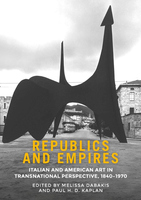
Melissa Dabakis and Paul H. D. Kaplan, eds.,
Republics and Empires: Italian and American Art in Transnational Perspective.
Manchester University Press, 2021.
296 pp.; 32 color and 50 b&w illus.; plates; index.
$120.00 (hardcover)
ISBN: 9781526154620
This volume originates from two academic conferences, the first held in Rome in October 2016, and the second in Washington, DC, in October 2017. Both events focused on investigating the cultural relationships between Italy and the United States over the longue durée, beginning with Benjamin West’s stay in Rome during the 1760s. This publication brings together a selection of fifteen papers presented on those two occasions.
In line with the conferences’ themes, the editors aim to offer a deeper understanding of the artistic, literary, and broader cultural ties between the two countries. As underlined in their introduction, their approach is “fundamentally transnational and collaborative,” fostering an expanded perspective that challenges the traditional Franco-British-German axis dominating transatlantic art history, by drawing renewed attention to Italy’s role in these exchanges (3).
An increasingly rich bibliography is emerging on this topic. A fundamental and still-relevant point of reference remains William L. Vance’s volume, published in 1990, which explores how classical topoi and Roman landscapes shaped US cultural aesthetics.[1] Also noteworthy is the scholarship of Regina Soria, whose work originated with studies on Elihu Vedder. The figure of Vedder—a US painter who settled in Rome—subsequently inspired her to conceive of a continuous bridge across the Atlantic. From this starting point emerged a significant series of contributions on Italian artists and decorative painters active in the United States. Written in a clear and accessible style, Soria’s contributions remain highly valuable today and are frequently consulted—if only for their foundational framework.[2] In 2016, John Pinto broadened his longstanding engagement with architectural history; in City of the Soul the scholar examines how nineteenth-century Romantic artists, writers, and travelers—many of them American—represented and experienced Rome through ruins, landscapes, and classical imagination.[3] More recently, the United States has featured prominently in the monograph Il recupero del Rinascimento, which examines the formative decades of Rome as the national capital (1870–1911), explores several key episodes ranging from the foundation of Saint Paul’s Within the Walls to the transatlantic export of artworks, and culminates in the establishment of the American Academy in Rome.[4] These phenomena are framed as part of a broader cultural and political process, a deliberate “recovery” of values tied to stability and tradition, partly in reaction to the avant-garde spirit and perceived dangers of Paris.
Despite contributing to an already established field, Republics and Empires brings significant innovations. One of the most evident is its balanced inclusion of both US and Italian scholars, ensuring a genuinely dialogic exchange. This editorial choice is reflected in the disciplinary breadth of the essays, which encompasses visual arts, literature, photography, film, and print media. The scope is consistently “fundamentally transnational and collaborative,” as highlighted in the introduction (3). Another innovative feature lies in the deliberate expansion of the media considered. Alongside the canonical triad of painting, sculpture, and architecture, the volume devotes serious attention to photography, cinema, and illustrated journalism, thus broadening the analytical toolkit available to scholars of transatlantic exchange.
The collection proves timely and useful in several respects. It sheds light on relatively unknown artists such as Francesco Pezzicar, previously studied almost exclusively within the regional context of Friuli Venezia Giulia. In her essay, Caitlin Meehye Beach offers the first thorough and scholarly reading of Pezzicar’s L’abolizione della schiavitù negli Stati Uniti d’America (1875), a bronze work held at the Museo Revoltella in Trieste. The volume also recontextualizes better-known figures, such as Andrea Cefaly, Afro Basaldella, and Giorgio Morandi by examining their relevance within the Italian-US artistic nexus. Contributions by Maria Severa Ruga (on Cefaly and Basaldella) and Catherine Viviano (on Morandi) invite us to reassess the artists’ reception in a transnational framework.
As the title suggests, the volume is divided into two sections that intertwine chronological progression with thematic contrast. The first, “Hybrid Republicanisms,” addresses the several overlapping forms of republican ideology that emerged in the visual and literary cultures of the United States and Italy throughout the long nineteenth century. This section comprises seven essays covering literature, art history—particularly sculpture—and photographic archives. The second section, “The Courses of Empire,” examines the fascination with the concept of empire in both Italian and US art from the late nineteenth to the twentieth century. This part also consists of seven essays and further expands the disciplinary scope to include history. As is typical in edited volumes with diverse contributions, each essay is accompanied by its own set of illustrations and bibliographic references. This format facilitates individual consultation, though it can at times produce a fragmented reading experience. At the end of the volume is a hybrid index that includes both personal names and geographical references. It is a genuinely useful tool, one that may even be read independently as a thematic thread that aids cross-referencing while also implicitly outlining the boundaries of the volume’s scope. In an age of increasing cultural standardization—one that is also the age of Google and AI—such a curated index remains a valuable scholarly aid.
Each of the fifteen essays would merit a separate discussion. In this context, however, it is preferable to highlight some of the volume’s key thematic lines. A recurring strategy is the use of primary sources or secondary literature previously limited to the domains of history, diplomacy, or international politics now fruitfully applied to the fields of art, architecture, urban planning, and culture more broadly. This methodological openness recalls the legacy of social art history.
Among the contributions that best exemplify this approach is Daniele Fiorentino’s essay. Fiorentino focuses on three key figures—Harry Nelson Gay, William Roscoe Thayer, and Joseph Pennell—to reassess the cultural and artistic relations between Italy and the United States and to present a more nuanced image of Italy beyond traditional Grand Tour clichés. Gay, who lived in Italy from 1898 until his death in 1932, began collecting books and manuscripts on the Italian Risorgimento, often in collaboration with Thayer. Thayer, a Harvard historian, pursued similar interests, as evidenced in his writings on Camillo Benso di Cavour. A parallel spirit of modernization informed the work of Pennell, one of the most original figures in US illustration, who produced two views of the Victor Emmanuel Monument, understood as a symbol of Rome’s transformation into a dynamic modern capital.
The transatlantic movement of US sculptors in the nineteenth century also features prominently. Their choice to settle in Italy, particularly in Rome, was not only linguistic or cultural, but also economic. As Nathaniel Hawthorne noted in The Marble Faun (1860), US artists could rely on a skilled local workforce capable of translating plaster models into marble at lower costs. Elisa Camboni’s essay addresses this phenomenon, describing the “prosperous traffic” (207) between the two sides of the Atlantic—not only of marble, but also of critical ideas. Her study focuses on three figures: William Wetmore Story, Walt Whitman, and the Italian poet and critic Enrico Nencioni, who helped introduce the first two to Italian audiences. The friendship and professional exchange between Story and Nencioni is central to the essay. After the capture of Rome in 1870, Nencioni reviewed Story’s most successful literary work, Roba di Roma, in the newspaper L’Italia nuova, emphasizing its links to the Italian national cause. In a second article published in 1881 in the Fanfulla della Domenica, Nencioni offered a full biography of Story, once again highlighting his sympathies for the Risorgimento. The central part of Camboni’s essay turns to the issues of slavery and the American Civil War. As a Risorgimento patriot, Nencioni shared the abolitionist and nationalist values of both Story and Whitman. To all three, slavery represented not only a stain on the democratic republic but also a relic of an outdated feudal order. With this mindset, Nencioni approached Drum-Taps (1865), Whitman’s collection of poems written during the American Civil War and published in the wake of Lincoln’s assassination. The volume meditates on war, death, sacrifice, pain, and national identity.
A recent exhibition at the Vittoriano in Rome highlighted the figure of Giuseppe Mazzini, placing him in dialogue with the Macchiaiolo painter Silvestro Lega.[5] A focal point of the exhibition was The Dying Mazzini (1873; Rhode Island School of Design Museum, Providence). While Mazzini himself actively shaped his image through painting and, above all, photography, the sculptural representations enjoyed greater freedom. Giovanni Spertini, born in Pavia but active mainly in Milan, produced a semi-serial series of busts and full-length statues of Mazzini—mostly in plaster and more rarely in marble—that circulated widely both within Italy and abroad. These works stemmed from political as well as economic motivations. Spertini, a committed patriot, benefited financially from this output.
Similar dynamics—concerning how the Italian Risorgimento—its ideologies, campaigns, and heroes—were visualized and exported, even to the United States, are central to Melissa Dabakis’s essay on Giuseppe Garibaldi and the Southern Campaign. She discusses, among others, representations of the campaign in Thomas Nast’s work. As Dabakis notes, “Nast’s images of Garibaldi’s Southern campaign kept alive for many Americans the ideals for which their own revolution had been fought.” She continues, “Italy came to represent the promise of a new liberal nation, an active agent in its own self-governance, inspired, at least in part, by America’s own colonial past and revolutionary heritage” (91). Garibaldi understood the strategic value of the publicity surrounding his military exploits. Through the press, he became an international celebrity. Unlike Mazzini, however, Garibaldi developed no strategy for controlling or promoting his public image.
The volume results from a well-conceived thematic choice and careful editorial selection—first during the planning of the two conferences, then during the composition of the book itself. These efforts have yielded a high degree of originality and scholarly relevance. The diversity of approaches, writing styles, and disciplinary perspectives—while potentially disorienting—should be seen as an added value. Explicitly acknowledged and embraced, this heterogeneity reflects the complexity of the subject and enables a more multifaceted, dialogical reading of the contributions.
Another strength lies in the sheer volume of primary sources made available to the reader, many of which were previously unpublished and are rich in documentary potential. Sergio Cortesini’s essay exemplifies this. Revisiting a theme originally proposed by the painter Stephen Olin Dows in the form of memoir,[6] Cortesini examines the role of fresco painting during the Roosevelt years, tracing its many links to the Italian Renaissance tradition during the New Deal and beyond. This analysis is rooted in a meticulous study of bureaucratic documents related to different artistic “projects,” as well as the figures involved. Particularly revealing are the papers of Edward Bruce, a lawyer, economist, and painter but, above all, a major institutional advocate for the visual arts in his role as director of the Section of Painting and Sculpture (later Section of Fine Arts) at the United States Treasury Department.
The book’s cover image deserves an extended reflection. It reproduces a photograph taken in Spoleto in the early 1960s by the renowned Italian artist Ugo Mulas. In the foreground stands Alexander Calder’s Teodelapio (1962; Spoleto), manufactured in the Italsider factories of Savona. This work remains the only permanent public sculpture by Calder in Italy. Installed in 1962 thanks to the efforts of the Italian critic Giovanni Carandente, Teodelapio still greets travelers as they exit the Spoleto railway station. In the background—visible through a telescopic urban corridor—Mulas captures two visual icons of Spoleto: the Duomo and, even further in the distance, the Rocca of Cardinal Albornoz. Between the foreground and the background, one can spot an electric railcar, likely a Stanga-TIBB model. These railcars, produced in the late 1940s and resembling urban trams, served several electrified regional lines, including the Rome–Spoleto–Ancona route. By the time Mulas and Calder encountered them, they were already aging, if not obsolete. Mulas’s photograph connects thematically to Marin R. Sullivan’s essay, which is largely devoted to Carandente, Spoleto, and the role of prominent US sculptors in the various editions of the Festival dei Due Mondi. As noted earlier, several contributions in the volume aim to recover the voices and visibility of US artists and writers who projected a vision of Italy rooted in contemporaneity and forward-looking aspirations—markedly different, even antithetical, to the sweetened imagery of the old and new Grand Tour. While highly evocative and visually compelling, Mulas’s photograph only partially conveys this spirit. A reader who has based their expectations solely on the cover might come away with a misleading impression of the volume’s content. Otherwise, the volume fully achieves the objectives set out by its editors. It is a valuable contribution both in terms of the theme it addresses and the methodological approaches it employs. The book succeeds in offering a fresh, nuanced, and richly documented perspective on the cultural and artistic exchanges between Italy and the United States over a long historical span.
Its relevance is twofold: it provides scholars with new tools and case studies for understanding transnational artistic networks, and it offers students an accessible yet rigorous introduction to this emerging field. For these reasons, the volume will undoubtedly become a key point of reference—not only among specialists in US or Italian art history, but also in university contexts, where it will be adopted in courses aimed at encouraging a critical and historically grounded understanding of cross-cultural artistic dialogue.
Notes
[1] William L. Vance, America’s Rome: Artists in the Eternal City, 1800–1900 (Yale University Press, 1990).
[2] Regina Soria, Elihu Vedder: American Visionary Artist in Rome (Fairleigh Dickinson University Press, 1970); Regina Soria, Fratelli lontani: Artisti italiani in America 1870–1914 (Centro Di, 1983); Regina Soria, Dictionary of Nineteenth-Century Italian Painters (Associated University Presses, 1996).
[3] John Pinto, City of the Soul: Rome and the Romantics (Royal Academy of Arts, 2016).
[4] Paolo Coen, Il recupero del Rinascimento: Arte, politica e mercato nei primi decenni di Roma capitale 1870–1911 (Silvana, 2020).
[5] Edith Gabrielli (with the historical advice of Giuseppe Monsagrati), L’ultimo ritratto: Mazzini e Lega. Storie parallele del Risorgimento, 2 vols. (Electa, 2024).
[6] Stephen Olin Dows, Franklin Roosevelt at Hyde Park: Documented Drawings and Text (American Artists Group, 1949).