Seeing is Believing: The Art and Influence of Jean-Léon Gérôme
Reviewed by Alia NourAlia Nour
Independent Art Historian
Email the author: nounali449[at]gmail.com
Citation: Alia Nour, exhibition review of Seeing is Believing: The Art and Influence of Jean-Léon Gérôme, Nineteenth-Century Art Worldwide 24, no. 3 (Autumn 2025), https://doi.org/10.29411/ncaw.2025.24.3.27.
This work is licensed under a Creative Commons Attribution-NonCommercial 4.0 International License  unless otherwise noted.
Your browser will either open the file, download it to a folder, or display a dialog with options.
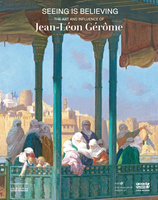
Seeing is Believing: The Art and Influence of Jean-Léon Gérôme
Mathaf: Arab Museum of Art, Doha
November 3, 2024–February 22, 2025
Catalogue:
Alexandra Bounia ed.,
Seeing is Believing: The Art and Influence of Jean-Léon Gérôme.
Qatar Museums; Silvana Editoriale, 2024.
176 pp.; 94 color illus. and 54 b&w illus.; bibliographical references; timeline.
$45.00 (soft cover)
ISBN (Silvana Editoriale): 9788836659326
ISBN (Qatar Museums): 9789927108969
In Doha from early November 2024 to February 2025, the future Lusail Museum, in collaboration with the Mathaf: Arab Museum of Modern Art, organized an exhibition devoted to Jean-Léon Gérôme’s Orientalist paintings, their photographic context, and their contemporary legacy to celebrate the bicentennial of the artist’s birth.[1] The exhibition comprised nearly four hundred works, including paintings, photographs, prints, videos, and installations drawn from the collections of Qatar Museums and loans from the Metropolitan Museum of Art in New York, the Islamic Arts Museum in Kuala Lumpur, galleries, and private collections. Two contemporary works were also commissioned for the exhibition, one from Azerbaijani artist Babi Badalov and another from Tunisian artist Nadia Kaabi-Linke.
One of the most famous and commercially successful artists of his day, Gérôme initially painted portraits as well as history and historic genre scenes from classical antiquity. After 1855, however, he shifted his focus to Orientalist subjects.[2] As modernist aesthetics began to prevail in the late nineteenth century, Gérôme’s art fell out of favor, but a renewed interest in his work began in 1972 with an exhibition organized by Gerald M. Ackerman; this groundbreaking show was followed by several other exhibitions and publications.[3] By the 1980s, Gérôme’s detailed and realistic depictions of the Orient were considered emblematic of Western imperialism. The art historian Linda Nochlin promoted this idea in her essay “The Imaginary Orient” (1983), in which she applied the ideas of Edward Said’s Orientalism (1978) to Gérôme’s paintings of North Africa and the Middle East. Said’s ideas have been criticized and reformulated in the nearly fifty years since the publication of his germinal book, but their impact continues to this day and plays an enduring role in the way Gérôme’s work is read and evaluated.
The Doha exhibition and catalogue reopened the conversation on Gérôme’s Orientalist subjects in the very region where Gérôme and other Orientalist artists encountered and recorded the cultures and people of the traditional “Orient” over two hundred years ago.[4] They did so, in part, by combining Gérôme’s Orientalist paintings with contemporaneous Orientalist photography, as well as contemporary art by MENASA (Middle East, North Africa, and South Asia) artists. The Lusail Museum’s extensive collection of Orientalist art, as well as Qatar Museums’ historic and contemporary photographic archive, which has been acquired over the last decades, positioned the exhibition to do just that. The return of Orientalist art “to the lands that inspired it” has been a phenomenon for some time, as the architect and art historian Mercedes Volait has aptly discussed.[5] Yusuf Ahmad Al-Homaid, an adviser to the Amir of Qatar, has shed some light on the reason for the collecting of Orientalist art: “the presentation of these works comes off as a reclamation of history, a way of ‘decentralizing’ Orientalizing exotic scenes.”[6] Similarly, Sheikha Al Mayassa bint Hamad bin Khalifa Al Thani (Chairperson, Qatar Museums Board of Trustees) envisions the Lusail as a “think tank” where people can discuss important cultural issues of their time, especially in the realm of cultural encounters and exchange (5).
The medium-sized catalogue for Seeing is Believing was published only in paperback edition. It contains forewords by Sheikha Al Mayassa bint Hamad bin Khalifa Al Thani, Sheikha Amna bint Abdulaziz Al Thani (Chief of Museums and Heritage Development), Julia Gonnella (director of the Lusail Museum), and Zeina Arida (director of Mathaf: Arab Museum of Art). The text comprises four concise thematic essays written by international specialists including Christine Peltre, a French art historian, and the three exhibition co-curators: Emily M. Weeks, an independent art historian who is currently compiling a revised catalogue raisonné of Gérôme’s works; Giles Hudson, Senior Curator of Photography at the Lusail Museum; and Sara Raza, a curator and writer specializing in postcolonial and post-Soviet perspectives. The catalogue also features brief object entries (unfortunately lacking provenance information), a timeline of Gérôme’s life, and biographies of the featured contemporary artists and essay contributors.
Peltre, who has published widely on Orientalism, sets the stage for the subsequent essays in “The Light and Shade of Orientalism.” She provides a nuanced perspective that acknowledges yet challenges Said’s and Nochlin’s ideas by exploring the aesthetic and historical development of Orientalism, particularly within the French context. Retracing many of the ideas introduced in her earlier works, including Orientalism in Art (1998), she sketches the evolution of Orientalist art from the Romantic fascination with the exotic, inspired by the poems of Lord Byron and Victor Hugo, to the “ethnographic gaze” of the mid-nineteenth century, and finally to the exploration of light by avant-garde artists at the turn of the twentieth century. Though hardly new, the essay may serve as an introduction to the subject for a younger audience, which the exhibition appeared to have been targeting.
Gérôme’s biography, artistic practice, and legacy are the focus of Weeks’s essay, “A Wider Lens, a New Gérôme.” Weeks argues that Gérôme was “a product of his time, a stylistic pioneer, and something of a riddle waiting to be solved,” whose carefully observed and realistic depictions of everyday life in parts of North Africa, the Middle East, and Turkey came to define the Orientalist themes of the day (22). Central to this thesis is the artist’s academic art education, his travels, and his artistic practice. Gérôme’s attention to detail and the smooth, polished finish—or fini—of his paintings were shaped by his rigorous training, rooted in classical and Renaissance art. He combined traditional academic craftsmanship with his “power at inventive recreation” to create images that blend reality with fiction (25). By the end of the 1860s, Gérôme’s style and subjects became “Orientalism’s gold standard” (26). But Weeks contends that this was neither his enduring reputation nor his legacy. Rather, it was Said’s book and Nochlin’s essay that labeled his work as a “visual document of 19th-century colonialist ideology” (27). While acknowledging the importance of Nochlin’s argument about the ideological context of Gérôme’s Orientalist images, Weeks contends that such a “monocular approach” focusing only on that aspect of his art has overlooked the artist’s “technique and practice” (27). Five themes in the exhibition, she argues, aim to “decentralize still dominant readings of his art in order to introduce new informational possibilities”: “The Instability of Power,” “Portrait Versus Type,” “Beyond the Odalisque,” “The Theatre of Prayer,” and “Imag[in]ing Daily Life” (27). Each section contains drawings and paintings that upend the traditional view of Orientalist paintings as timeless, exotic, and sensual. These include Gérôme’s sketch of Amer Abdallah (ca. 1855–56, Galerie Ary Jan, Paris), an Egyptian fellah (male peasant) annotated with the sitter’s name, location, and date of portrait in French and Arabic (the Arabic script was added later, but still within the contemporary period of its creation), and a painting of a Turkish harem with fully clothed women in a brightly lit exterior setting (Study for Harem in the Kiosk, ca. 1870–75; Lusail Museum, Doha). The painting The Black Bard (1888, Lusail Museum, Doha), as the Lusail Museum’s Deputy Director of Curatorial Affairs, Kholood Al-Fahd states, exemplifies a stereotypical Orientalist theme, but it has elements that reflect the core mission of the Qatar Museums, which is to collect works that speak to cultural exchange.[7] Al-Fahd explains, this is conveyed in the painting through the depiction of objects from different cultures: Iznik tiles from Turkey, a musical instrument from Ethiopia, a sword from Sudan, and slippers from Morocco.[8] Despite—or perhaps because of—its focus on downplaying “dominant readings of Gérôme’s art,” many of Gérôme’s prominent themes are underrepresented or excluded from the exhibition, such as the Bashi-Bazouks or Arnauts and the hammam or bath series (most likely not featured because of cultural sensitivities).
In “Between Gérôme and Photography: Truth is Stranger than Fiction,” Hudson explores Gérôme’s relationship with photography and the wider context of nineteenth-century photography in the Middle East and North Africa. The subtitle of his essay (borrowed from Mark Twain) underscores the essay’s argument that art and photography construct narratives.[9] A good example would be The Black Bard and the albumen print that inspired its setting, which Hudson notes “depart from reality” (73). The print of the Topkapi Palace interior that provided Gérôme with the setting was probably from the Abdullah Frères studio in Constantinople (present day Istanbul). In his composition, Gérôme used light blue instead of the original yellow tiles and dark blue where they were green and red, whereas the monochrome tones of the Abdullah Frères print were altered because of the wet collodion process (82).
The essay discusses a stunning selection of “stereotypes and counter-stereotypes” from the regional image archive in the Qatar Museums’ collection (75). Sudanese Dance (ca. 1890) by the Greek Zangaki Frères studio—based in Port Said, Egypt—is an example of the stereotyping genre. In his catalogue entry, Hudson, however, emphasizes the agency of the two Nubian dancers in this image, which suggests a collaboration between the dancers and the photographers (114). According to the scholar Ali Behdad, commercial studios in the region produced photographs that “fall within the purview of ethnographic typecasting” to cater to the European market in addition to photographs of Ottoman dignitaries and official ceremonies.[10] Examples of this alternative perspective in the exhibition include an image of the oil derricks in Azerbaijan (ca. 1898, Lusail Museum, Doha) by Russian photographer Dmitri Ermakov. Similarly, there are portraits by “inside observers,” such as the fascinating photographic collage, mostly made by Naser al-Din Shah Qajar, shah of Iran (ca. 1858–64, Qatar Museums, Doha) of 144 portraits of members of his harem, including his numerous wives, concubines, female servants, boy servants, and eunuchs (108). Hudson broaches the subject of the long-lasting impact of the Orientalist color palette on photography, which he contends is an “overlooked aspect of Orientalism” (77). Moroccan born artist and photographer Hassan Hajjaj’s Arfoud Brother (2017/1438, Lusail Museum, Doha) is an example of a contemporary regional photographer “working within the counter discourse of contemporary art” (78).
Raza’s essay, “I Swear I Saw That,” moves into the contemporary realm. The title is a pun on anthropologist Michael Taussig’s book I Swear I Saw This (2011), which highlights the relationship among observation, memory, and creative expression, and questions the difference between seeing and believing. For some time, Raza’s curatorial approach has focused on global punk visual cultural aesthetics to “construct a new curatorial aggregate for rethinking Orientalism” (128).[11] Taking Edward Said’s thesis as her starting point, Raza questions the “harmful myopic Orientalist perspectives” through the lens of twenty-four contemporary artists from different geographical backgrounds.[12] Their works “provide an alternative avenue for deconstructing Orientalism through resistance and rebellion” (129). While the artworks in the exhibition do not reference specific paintings by Gérôme, they engage with his various themes and representations. For example, the reevaluation of the role of the artist as an ethnographer is explored by Bulgarian-born artist and filmmaker Ergin Çavuşoğlu, who lives and works in London in collaboration with Bulgarian filmmaker Konstantin Bojanov, who lives in New York City. Their multiscreen video installation Quintet Without Borders (2007) synchronizes the different rich musical and cultural traditions—Turkish, Greek, Roma, Jewish, Bulgarian, Armenian, and Arab—of five Roma musicians from a border town in Turkey, highlighting the fluidity of borders. The theme of Gérôme’s depictions of Oriental women, either “nude, nearly nude, veiled, enslaved or as concubines,” is challenged by Palestinian artist Raeda Saadeh, who lives and works in Jerusalem. In her performance-based portrait Who will make me real (2003), Saadeh stages herself in the style of the ubiquitous odalisque. With her body entirely covered by Arabic newspapers, the artist’s direct gaze subverts the Western traditional male gaze, “questioning the viral capacity of the news and media to generate information of a people and a culture” (133). One of the commissioned works for the exhibition was Text Still (2024), a textile installation by Babi Badalov, an artist who lives and works in Paris. Text Still covered the exterior of the Mathaf building with collaged and stitched fabric panels inscribed with texts in various alphabets including Arabic, Cyrillic, and Latin. Badalov combines decorative transcultural scripts, collaged grammar, and disrupted syntax to highlight the implications of “linguistic imperialism” and the assumed dominance of certain languages and cultures (132). Many works in the exhibition extend Orientalism beyond the traditional Eurocentric focus to include perspectives on the expansion of the Ottoman Empire and the Russian (and later Soviet) conquest of Central Asia. Examples include the Girls of Kyrgyzstan series (2011) by Aziza Shadenova, a Kasakh artist who lives and works in the United Kingdom. The series critiques and subverts Soviet Orientalist portrayals of young Central Asian women; the group of young women depicted use social media platforms like Facebook to reclaim their autonomy and challenge traditional representations.
Seeing is Believing: The Art and Influence of Jean-Léon Gérôme is a welcomed addition to Orientalist and Postcolonial studies, as well as to Gérôme scholarship. The exhibition and the catalogue essays presented different perspectives on Gérôme and his Orientalist legacy in both painting and photography, while engaging with the shifting interpretations of Orientalism, from an artistic phenomenon in the nineteenth century to a tool of political discourse and cultural imperialism in the twentieth and twenty-first. Peltre and Weeks both acknowledge Said’s and Nochlin’s framework while offering a broader and more nuanced understanding of Orientalism as a complex artistic and cultural phenomenon. I second Weeks’s admonition to widen the lens (beyond the political) through which we view Gérôme’s paintings and other Orientalist artworks. I would add that European encounters with the East were also embedded in a complex web of self-serving interests on both sides, representing national as well as individual interests. The Egyptian and French relationship in the nineteenth century is a case in point. After occupying Egypt (1798–1801), the French played a prominent role in Egypt’s modernization and Western-inspired reforms, while the Egyptian ruling dynasty turned to French artists for their artistic projects.[13] Art historian Mary Roberts notes that Gérôme executed some paintings for the Ottoman Sultan Abdulaziz (r. 1861–76) and also negotiated the sale of paintings to the Sultan through his father-in-law’s firm Goupil & Cie.[14] Crucially, we must also remember that painters did not primarily depict Orientalist subjects as a means of political expression, but in order to sell their works and make a living. As Gérôme said, “Primo vivere: that’s my motto. Painters must eat, drink, sleep, and buy clothes like everyone else. One cannot work for glory alone.”[15]
Likewise, Hudson engages with the “Orientalist ideas embedded in . . . the regional photographic archive” but critiques the postcolonial model for its binary framework. While not providing an alternative thesis, Hudson urges that we “must be mindful of our own subjectivity” when judging photographs of the period (80). In contrast, Raza emphasizes the responsibility of visual practitioners to address the challenges of Orientalism in the twenty-first century. She and the contemporary artists participating in the exhibition critique Orientalist tropes, particularly those in the works of Gérôme, by providing alternative representations to reclaim and redefine cultural narratives.
Nevertheless, some questions remain. Did the museum intend to present new readings of Gérôme from a non-Western view? If so, why does the catalogue text remain largely dominated by Western scholars and scholarship? The exception is Raza, who is British by birth, of Persian and Central Asian descent, and based presently in New York City. Likewise, most of the contemporary artists engaged in challenging and reinterpreting Orientalism are also based in the West. Could this be due to their access to art institutions and platforms that showcase their work? Are they also appealing to a broader audience to gain more visibility and financial success, as many Orientalist artists in the nineteenth century did? Moreover, can the contemporary artist’s approach of opposing and fighting Eurocentric visions contribute to bridging the gap between the Western and Eastern worlds? One of the biggest collectors of Orientalist art, the Egyptian Shafik Gabr, sees Orientalists as “global artists” to whom “we owe . . . a great debt, because although much of what they saw lives on today in our streets and villages, we constantly need to be reminded of the richness and value of our culture.”[16] It is important to listen to those who resist and defend Orientalism. The future Lusail Museum will be a key platform for critical engagement with both the past and the present, as it was in Seeing is Believing.
Notes
[1] The Lusail Museum (under construction) and Mathaf: Arab Museum of Modern Art are part of the art institution Qatar Museums, which also includes the National Museum of Qatar, and the Museum of Islamic Art.
[2] According to Olivier Deshayes, Orientalist works constitute no less than 40 percent of Gérôme’s artistic output. Olivier Deshayes, Jean-Léon Gérôme: désir d’Orient (L’Harmattan, 2018), 126.
[3] See Gerald M. Ackerman, Jean-Léon Gérôme, exh. cat. (Dayton, 1972); Gerald M. Ackerman, The Life and Work of Jean-Léon Gérôme (Sotheby’s Publications, 1986); Albert Boime, “Gérôme and the Bourgeois Artist’s Burden,” Arts Magazine 57, no. 5 (January 1983): 64–73; Gérôme & Goupil: Art and Enterprise, exh. cat. (Éditions de la Réunion des musées nationaux; Musée Goupil; Frick Art and Historical Center; and Dahesh Museum of Art, 2000); Laurence des Cars, Dominique de Font-Réaulx, and Edouard Papet, eds., The Spectacular Art of Jean-Léon Gérôme (1824–1904), exh. cat. (SKIRA, 2010); Scott Allan and Mary Morton, eds., Reconsidering Gérôme (Getty Publications, 2010); and Deshayes, Jean-Léon Gérôme.
[4] The Spectacular Art of Jean-Léon Gérôme exhibition (2010–11), its catalogue, and related publication, Reconsidering Gérôme, reassessed the artist’s work, including his Orientalist subjects and engagement with photography.
[5] See Mercedes Volait, “Middle Eastern Collections of Orientalist Painting at the Turn of the 21st Century: Paradoxical Reversal or Persistent Misunderstanding?,” in François Pouillon and Jean-Claude Vatin, eds., After Orientalism: Critical Perspectives on Western Agency and Eastern Re-appropriations (Brill, 2014), 251–71.
[6] Volait, “Middle Eastern Collections,” 260.
[7] Kholood Al-Fahd, “The Resurgence of a New Orientalism from the Middle East,” World Art 13, no. 1 (2023): 81, https://doi.org/10.1080/21500894.2022.2142275.
[8] Al-Fahd, “Resurgence,” 81.
[9] Mark Twain, Following the Equator; a Journey Around the World (American Pub. Co., 1897), 156.
[10] Ali Behdad, “Orientalism Matters,” MFS Modern Fiction Studies 56, no. 4 (Winter 2010): 717.
[11] See Sara Raza, Punk Orientalism: The Art of Rebellion (Black Dog Press, 2022).
[12] Artists are from: Afghanistan, Iran, Azerbaijan, Turkey (3), Lebanon, Greece, Morocco, Iraq, India, Tunis, Algeria, Kazakhstan, Palestine, Egypt (2), and Uzbekistan.
[13] Alia Nour-Elsayed, “Egyptian-French Encounters: Art and National Identity 1867–1928” (PhD diss., Rutgers University, 2020).
[14] Mary Roberts, “Gérôme in Istanbul,” in Allan and Morton, Reconsidering Gérôme, 119–34.
[15] Ackerman, Life and Work, 142.
[16] Dina Nasser-Khadivi, ed., The Shafik Gabr Collection (ACR, 2008), 6–7, quoted in Volait, “Middle Eastern Collections,” 265.