Heiress: Sargent’s American Portraits
Reviewed by Barbara Dayer GallatiBarbara Dayer Gallati
Curator Emerita, Brooklyn Museum
Email the author: barbaragallati[at]googlemail.com
Citation: Barbara Dayer Gallati, exhibition review of Heiress: Sargent’s American Portraits, Nineteenth-Century Art Worldwide 24, no. 3 (Autumn 2025), https://doi.org/10.29411/ncaw.2025.24.3.20.
This work is licensed under a Creative Commons Attribution-NonCommercial 4.0 International License  unless otherwise noted.
Your browser will either open the file, download it to a folder, or display a dialog with options.
Heiress: Sargent’s American Portraits
Kenwood, London
May 16–October 5, 2025
This year marks the centenary of John Singer Sargent’s death.[1] London celebrated the occasion with its own nod to the expatriate American and long-time London resident with Heiress: Sargent’s American Portraits, a small, tightly curated exhibition focusing on the artist’s portraits of American women who married into the English peerage and upper classes. Often referred to as “dollar princesses,” the women who were players in this late nineteenth-century social phenomenon were frequently dismissed as simply ambitious “buccaneers” (as the novelist Edith Wharton called them), who were eager for a title in exchange for the fortunes they could offer their financially strapped, but socially desirable English husbands.[2] Heiress aims to pierce the stereotype that circumscribes the lives of these women; as announced in the introductory didactic panel, “Not all were rich, and few were ‘sad poachers’ (of men) as they were described. Many were friends with each other, and each made an indelible contribution to the families, estates, and society they entered.” A second panel in the next room briefly highlights the political and social origins of the dollar princess stereotype.
Comprised of only eighteen works (eight oils and ten drawings), the show punches far above its weight. This is largely because of the quality of the art itself, the setting in which it is installed, and the thoughtful connections among the sitters in various works that emerge through careful reading of the informative labels written by curator Wendy Monkhouse, who assembled the group with advisory assistance from the distinguished Sargent scholar Richard Ormond.

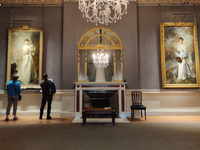
The exhibition venue, Kenwood (fig. 1), is situated at the edge of Hampstead Heath in northern London. The building (originally a brick construction) probably dates to the early seventeenth century and, from 1764 to 1779, underwent significant renovations and additions designed by the renowned neoclassical architect Robert Adam. Over the centuries the house changed hands several times, its final owner being Edward Cecil Guinness, 1st Earl of Iveagh, who purchased the mansion and extensive grounds in 1922. Maintained today by English Heritage as an eighteenth-century home suited for an “artistic gentleman,” Kenwood has on display numerous Old Master and British paintings from Lord Iveagh’s bequest.[3] As such, the grand domestic interior of the house is an ideal setting for Sargent’s portraits, which would have originally hung in rooms of similar scale and grandeur.
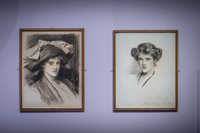
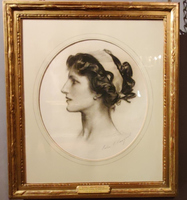
The introductory portion of the exhibition, however, is modest. It contains a single didactic panel explaining the show’s raison d’etre and two marvelous charcoal drawings of the New York-born Lady Anne Innes-Ker née Breese (fig. 2), who was raised in England following her widowed mother’s marriage to Harry Higgins, president of the Covent Garden Opera Company and head of the syndicate owning the Carlton Hotel in London and the Ritz in Paris. Like her older sister, Eloise—whose portrait hangs in the next room (fig. 3)—Anne was part of London’s “smart set.” While Eloise wed Lord Willoughby de Eresby (later 2nd Earl of Ancaster), Anne married Lord Alastair Robert Innes-Ker, the younger brother of the 8th Duke of Roxburghe in 1907. The union made her a sister-in-law of the then Duchess of Roxburghe, the former May Goelet of New York, who was said to have been instrumental in arranging the match. Such connections, familial and national, flow through the lives of the sitters whose portraits are on view.[4] Sargent’s drawings of the two sisters register their very different personalities; Anne’s suggests her somewhat serious, wary nature, whereas Sargent seems to have emphasized Eloise’s eccentric, theatrical character, depicting her à la grecque in an unusual oval format.[5] Their fortunes varied significantly as well; Anne’s husband never attained the dukedom, whereas Eloise’s inherited vast real estate holdings when he became 2nd Earl of Ancaster in 1910. Contrary to the notion of dollar princess wealth, neither woman brought a significant fortune to her marriage.
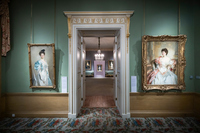
The small entry space opens into a moderately large room where the portraits of Mary Crowninshield Endicott Chamberlain and Cora, Countess of Strafford, flank the door leading to an even larger room (fig. 4). The two portraits, like the lives of their sitters, could not be more unlike. Mary Chamberlain glows with energy as she seems to stop momentarily to acknowledge us. In contrast, the Countess of Strafford averts her gaze and exudes a sense of world-weary fatigue, communicated in the slight disarray of her gown and the position of her hands resting limply in her lap as she absent-mindedly fingers a string of pearls.
It is at this point that the only weakness of the exhibition surfaces. The pocket-size pamphlet that accompanies the exhibition does well to summarize the basic information pertaining to each sitter (it is an unillustrated take-away reproducing the label copy), but it leaves much to be said not only about each sitter, but about Sargent and his relationships with his subjects. Unfortunately, time constraints and a lack of funding precluded the production of even a small catalogue for the project. Thus, we must make do with knowing that Mary Chamberlain was the daughter of William Crowninshield Endicott, a US politician, and met her future husband, a wealthy businessman and member of the British Parliament, Joseph Chamberlain, when he was on government business in Washington, DC. What needs saying is that Chamberlain was twice a widower with eleven children (one of whom was future Prime Minister Neville Chamberlain), and that he was twenty-eight years her senior. Despite these seeming impediments, the two were married in 1888, the year after they met. Throughout their marriage (he died in 1914), Mary supported her husband’s political career, a role for which she was doubtless prepared, having grown up in a political household. What would have been of additional interest is that Sargent had painted Joseph Chamberlain’s portrait in 1896 and that of Mary’s mother, Ellen Peabody Endicott, in 1901. In 1903 (the year after Mary sat to him), the artist was provided a studio in the Endicotts’ home on Marlborough Street, Boston, where Mary Chamberlain’s portrait was hanging and where he painted Mary’s sister-in-law, Mrs. William Crowninshield Endicott, Jr.
Such friendly connections between Sargent and his sitters doubtless had an impact on how he portrayed them and may account for the disparities separating the portraits of Mary Chamberlain and that of the Countess of Strafford. Indeed, by the time Sargent executed the portrait of the forty-eight-year-old socialite (by then twice-widowed and married a third time to an explorer and big game hunter), he had declared he would stop painting oil portraits. Just why Sargent accepted the commission for this portrait from the wealthy countess (her first husband was Samuel Colgate of the soap and toothpaste fortune; her second husband, the Earl of Strafford, died five months after their 1899 marriage) is unknown.[6] One wonders if the artist discovered in the New Orleans-born beauty Cora Smith echoes of a sitter from his past, another New Orleans native and famous socialite, Virginie Amélie Avegno Gautreau, otherwise known as Madame X. The possibility of such mental association may explain the countess’s near-profile pose and a gown that slips indecorously to reveal too much of a shoulder.[7]
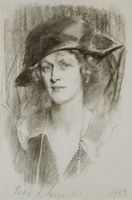
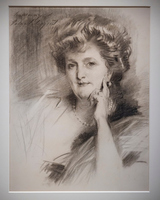
The two oils discussed above initially command the viewer’s attention. However, the charcoal portraits that are installed in the same room reward close examination and introduce additional connections to be found in the final gallery. Chief among them in this context is the superb portrait of Nancy Astor, shown here as a guarded, mature woman accustomed to meeting the challenges of Parliamentary life (fig. 5). Notable, too, is a stunning portrait of the dowager Duchess of Manchester, the former Consuelo Yznaga de Valle (fig. 6), which bears witness to Sargent’s consummate skill as a draftsman. A Louisiana-born daughter of a Cuban sugar plantation owner whose 1876 marriage to the future 8th Duke of Manchester cemented her place in British society, she weathered her husband’s infidelities, became a popular member of the Marlborough set surrounding the Prince of Wales, and supported educational and anti-poverty charities. She also moved within the Vanderbilt family orbit, and the most famous of the dollar princesses, Consuelo Vanderbilt, the future Duchess of Marlborough, was her goddaughter and namesake. The absence of Sargent’s massive Marlborough family portrait that hangs at Blenheim Palace is understandable, and the presence of Consuelo Vanderbilt in the exhibition is manifested in a slight, but charming pencil drawing of the duchess that hangs in the next room.
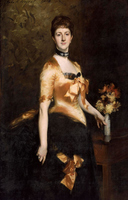
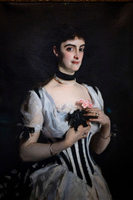
Upon crossing the threshold into the largest and final portion of the installation (Kenwood’s music room in which part of its permanent collection is usually displayed), three major paintings hit the eye: Lady Playfair (1884), Mrs. Wilton Phipps (ca. 1884), and Mrs. Waldorf Astor (1908–09) (figs. 7–9), an assemblage that spans approximately three decades of Sargent’s career and discounts any accusations of his failure to suggest the personalities of his sitters. The Playfair and Phipps portraits reveal Sargent’s stylistic debts to his years in France (here the influence of Carolus-Duran and Édouard Manet, respectively), yet the artist created images suggesting two distinct temperaments. On the one hand, Lady Playfair’s haughty bearing defies closer interaction, a stance in keeping with her reserved New England roots and corresponding to descriptions of her as being bookish and socially detached. Mrs. Phipps (Sargent’s distant cousin on his mother’s side) directs an alert, thoughtful gaze toward her observer as if she were deciding whether or not to withhold herself from personal engagement, an impression signaled by the self-protective gesture as she holds a spray of flowers to her breast. Yet Jessie Phipps was made of sterner stuff; a dedicated proponent of education, she was awarded a damehood in 1926 for her years of work on the London County Council.
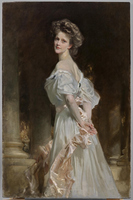
Of all the women featured in the exhibition, Nancy Astor (fig. 9) appears to have had the closest bond with the artist. This sensibility shines through in his depiction of her that also documents his embrace of an artistic vocabulary referencing the look and style of eighteenth-century British portraiture. A southern belle born to a family of reduced circumstances following the American Civil War, Nancy Langhorne escaped an unhappy first marriage and wed Waldorf Astor in 1906. The couple lived at Cliveden, the palatial home given to them by Astor’s fabulously wealthy father, William Waldorf Astor, who was created Viscount Astor in 1917. Nancy Astor, an advocate of women’s rights and temperance, was the first woman to take a seat in the House of Commons, when her husband entered the House of Lords, having acceded to the title of Viscount in 1919. She served as MP for Plymouth until 1954. While the charcoal drawing of her mentioned above presents her as a woman of steely mettle, the oil portrait hinges on a palpable sense of youthful energy and charm that perhaps stems from the playful, mock-flirtatious tone carried out in Sargent’s correspondence with her.[8]
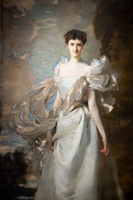
Family connections continue to emerge, particularly with the full-length portrait of Pauline Astor (Nancy Astor’s sister-in-law) on the adjacent wall, which it shares with another majestic full-length canvas depicting Marguerite “Daisy” Leiter (fig. 10). Painted in 1898, the two portraits were among the first to announce Sargent’s intention to continue in the great eighteenth-century portrait tradition established by Sir Joshua Reynolds and Thomas Gainsborough. Yet, as Henry James opined about Daisy’s portrait, “the intensely modern Fifth Avenue face of the young woman rather militates.”[9] Daisy was a daughter of Chicagoan Levi Leiter, who made his fortune in real estate. Her marriage in 1904 to Henry Howard, 19th Earl of Suffolk, was reported to be a love match, although the wealth with which she infused the Suffolk estates was exceedingly welcome. Sargent’s portrait of Daisy (fig. 11), now part of the English Heritage collection at Kenwood, serves as an impressive reminder of the person behind the addition of the famed Suffolk collection of royal and family portraits to Kenwood’s holdings.[10]
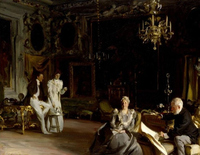
As a final note, mention must be made of Sargent’s An Interior in Venice (fig. 12), a magical conversation piece depicting two generations of the Curtis family, US expatriates then living in an apartment in the magnificent Palazzo Barbaro on Venice’s Grand Canal.[11] A distant cousin of the owner, Daniel Sargent Curtis, Sargent was a frequent guest at the palazzo, along with a host of other cultural luminaries. Whereas the label copy points to the younger woman, Lisa Colt Curtis, as the rationale for the painting’s presence in the exhibition, the focus on the American wife of an American husband living in Italy does not align with the premise of the exhibition. Nevertheless, it is always a joy to see, and it broadens the scope of the show’s thematic inquiry, prompting further examination of the issue of the US expatriate experience. To be sure, it reminds us that Sargent was himself a nomadic expatriate, Italian-born, French-trained, London-based, and emphatically American.
The question arises as to whether the exhibition achieves its goals. The answer is a resounding “yes.” The women in Sargent’s portraits come to life as individuals and resist the imposed categorization of dollar princesses. Yet, since many of the sitters were his friends who shared his expatriate experience and nationality, we can assume that his sympathies were with them. However, one is left to wonder about the hundreds of other women who crossed the Atlantic to marry, and if the facts of their lives compound or refute the stereotype that still defines them.
Notes
[1] A large exhibition devoted to the artist’s years in Paris (Sargent and Paris, co-organized by the Metropolitan Museum of Art, New York, and the Musée d’Orsay, Paris) was on view at the Metropolitan Museum of Art from April 27 to August 3, 2025, and travels to the Musée d’Orsay, Paris, where it will be on view from September 22, 2025 to January 11, 2026. British audiences had had the opportunity to view Sargent and Fashion (co-organized by MFA Boston and Tate Britain) at Tate Britain, London, from February 21 to July 7, 2024. Another large, UK Sargent exhibition for 2025 would have been impossible to achieve.
[2] For a lively and informative account of the dollar princess phenomenon, see Gail MacColl and Carol McD. Wallace, To Marry an English Lord (Workman Publishing, 1989). For a more recent, scholarly treatment of the topic, see Maureen E. Montgomery, ‘Gilded Prostitution’: Status, Money, and Transatlantic Marriages, 1870–1914 (Routledge Library Editions, 2013). Wharton’s novel, The Buccaneers, was unfinished at her death in 1937 and published in 1938. It was made into a television miniseries and screened in 1995, and appeared once again as a television series in 2023.
[3] The 1st Earl of Iveagh bequeathed Kenwood House, the land, and his collection of paintings to the nation in 1927. In 1929, the Iveagh Bequest (Kenwood) Act was passed by Parliament, confirming the terms of the bequest.
[4] For example, Eloise’s elder son married the Hon. Nancy Phyllis Louise Astor, the daughter of Viscount Astor and his wife, Nancy.
[5] Sargent’s charcoal portraits (many of which remain in private hands) have rarely been the focus of exhibitions, the one recent exception being John Singer Sargent: Portraits in Charcoal, shown at the Morgan Library & Museum, New York, in 2019 and at the Smithsonian National Portrait Gallery, Washington, DC, in 2020. With the timely publication of Richard Ormond’s John Singer Sargent: The Charcoal Portraits (Yale University Press for The Paul Mellon Centre for Studies in British Art, 2025), Sargent’s significant body of nearly seven hundred portraits in this medium is bound to attract greater scholarly attention.
[6] The entry for the portrait in the Sargent catalogue raisonné is brief and describes her only as a “famous society hostess.” It supplies no information about the artist’s possible connection to the sitter. See Richard Ormond and Elaine Kilmurray, John Singer Sargent: The Later Portraits. Complete Paintings, vol. 3 (Yale University Press for The Paul Mellon Centre for Studies in British Art, 2003), 200.
[7] Madame X was the title of the famed Sargent portrait of Gautreau, which was exhibited at the Paris Salon of 1884. For the most recent discussion of the painting, see Stephanie L. Herdrich, “Sargent and Gautreau: Fashioning Celebrity in Paris,” in Sargent and Paris, ed. Stephanie L. Herdrich (Metropolitan Museum of Art, 2025), 162–85.
[8] Sargent’s letters to Nancy Astor are held in the University of Reading Library. See Ormond and Kilmurray, John Singer Sargent, 3:210.
[9] Henry James to Isabella Stewart Gardner, April 3, 1898, Isabella Stewart Gardner Museum Archive, quoted in Richard Ormond and Elaine Kilmurray, John Singer Sargent: Portraits of the 1890s. Complete Paintings, vol 2 (Yale University Press, for The Paul Mellon Centre for Studies in British Art, 2002), 142.
[10] The ancestral Suffolk collection of royal and family portraits was bequeathed to the nation in 1974 via the will of Daisy, the 19th Countess of Suffolk, under the direction of her daughter-in-law, Mary Greville Howard.
[11] The label and pamphlet note for An Interior in Venice give the date of 1899 for the painting. Although the painting is inscribed with that date, the catalogue raisonné states that it was completed in 1898. Ormond and Kilmurray, John Singer Sargent, 2:154.