Masquerade, Make-up & Ensor
Reviewed by Apolline MalevezApolline Malevez
Ghent University
Email the author: Apolline.Malevez[at]UGent.be
Citation: Apolline Malevez, exhibition review of Masquerade, Make-up & Ensor, Nineteenth-Century Art Worldwide 24, no. 3 (Autumn 2025), https://doi.org/10.29411/ncaw.2025.24.3.26.
This work is licensed under a Creative Commons Attribution-NonCommercial 4.0 International License  unless otherwise noted.
Your browser will either open the file, download it to a folder, or display a dialog with options.
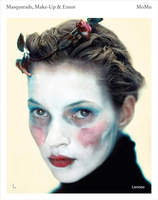
Masquerade, Make-up & Ensor
MoMu–Fashion Museum Antwerp
September 28, 2024–February 2, 2025
Catalogue:
Kaat Debo, ed.,
Masquerade, Make-up & Ensor.
Lannoo Publishers, 2024.
256 pp.; 240 color and 40 b&w illus.; notes.
€55.00 (hardcover)
ISBN: 9789401427067
2024 marked the 75th anniversary of the death of Belgian painter James Ensor (1860–1949). Among the numerous exhibitions celebrating this special occasion, Masquerade, Make-up & Ensor was arguably one of the most daring, juxtaposing a selection of Ensor’s paintings with the work of contemporary make-up artists and creators. For MoMu curators Romy Cockx, Kaat Debo, and Elisa De Wyngaert, it offered an opportunity to showcase the work of make-up artists and hairstylists, moving away from their usual focus on clothing, for the first time. It also renewed discourse on Ensor by exploring themes such as beauty ideals, artificiality, and aging. In this review, I focus primarily on Ensor’s works that were on display and how they interacted with the broader themes the exhibition raised.
The exhibition was divided into four loosely thematic sections entitled “Masquerade,” “Great Expectations,” “Grotesque,” and “Eternal Beauty.” Three more tightly focused displays by guest curator Janice Li sought to make the exhibition more inclusive. Signaled by yellow boards with text discussing their themes, the vitrines for “Masking,” “Colors,” and “Rejuvenating” introduced an additional critical voice into the exhibition space. Alongside paintings, the exhibition featured photographs, installations, videos, scrapbooks, magazines, make-up and beauty products, and hairstyles, displayed within a theatrical scenography designed by Janina Pedan.
Upon entering the exhibition, visitors were presented with two works by Ensor that outline important themes in his art: Theatre of Masks (1889; Museum of Fine Arts, Antwerp), depicting a stage with costumed performers and showcasing Ensor’s enduring fascination with theatre and travesty, and Skeletons Fighting over the Body of a Hanged Man (1891; Museum of Fine Arts, Antwerp), emphasizing Ensor’s use of masks and puppets to convey the idea of social critique. This first room offered visitors unfamiliar with Ensor’s work an opportunity to catch up.
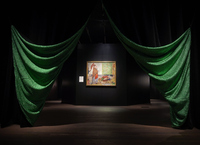
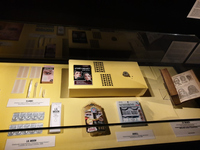
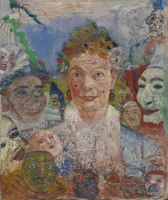
From this introductory space, visitors could admire The Astonishment of the Mask Wouse (fig. 1) through the dramatic opening of a glittering green curtain. Next to the painting was Li’s display about masking (fig. 2), which addressed the racialized standards that beauty ideals uphold. These standards ranged from eyelid crease stickers marketed to Asian women to mouches (artificial beauty marks) worn by late seventeenth- and eighteenth-century elites to enhance the radiance and whiteness of their skin. The mouche motif appears in Ensor’s Old Lady with Masks (fig. 3), which was featured in the final section of the show. Otherwise, the link to Ensor’s work was rather tenuous, and the interesting questions the display raised were not extrapolated to his oeuvre. For example, there was no investigation into racial stereotyping and the use of blackface in The Astonishment of the Mask Wouse and other similar works.
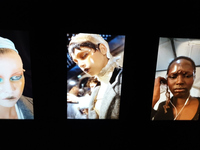
The first section, “Masquerade,” explored tensions between hiding and revealing. A particularly compelling example of this ambivalence was the transparent make-up created by Pat McGrath for Maison Margiela’s Spring/Summer 2024 collection (fig. 4). Consisting of four peel-off sheet masks superposed on top of each other, it created a shiny glaze for the skin. The intended effect was to recreate the quality of glass, a variation on the current trend of “porcelain” or “glazed doughnut” skin, a dewy look that requires stripping away the skin’s natural barrier. Although the skin was still visible through the make-up, it was evened out and perfected. Ensor, too, suggested that some of his works might be best viewed through glass, which would enhance and soften them.[1] Make-up can therefore not only create deceptive appearances, like paint, but can offer a layer of protection and beautification, like glass or varnish. Alfred Stevens—though admittedly not a painter that Ensor held in high esteem—wrote in 1869: “To really understand my painting, it needs to be varnished and framed. Because a painting is like a beautiful woman, she still needs to be groomed.”[2] Stevens believed that however beautiful his paintings were, they needed an additional layer to mediate between their raw surface and the world to be fully appreciated. However, it is left to visitors to draw such associations, as they are presented with works as diverse as photographs of bold and graphic make-up looks by Inge Grognard for Maison Margiela, colorful make-up designs by Walter Van Beirendonck, striking hairstyles by Julien d’Ys, and a conceptual film by make-up artist Lucy Bridge and hairstylist Eugene Souleiman.
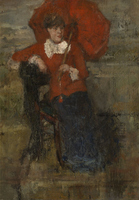
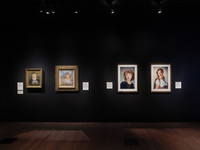
In “Great Expectations,” Ensor’s mondaine (society) portraits took center stage, including Lady with a Red Parasol (1880; Museum of Fine Arts, Antwerp), Lady with a Fan (1880 or 1881; Museum of Fine Arts, Antwerp), Our Two Portraits (ca. 1905; The Phoebus Foundation, Antwerp), and Portrait of Augusta Bogaerts or The Siren (ca. 1930; private collection). These works shed light on the social norms surrounding women’s use of cosmetics at the time, which, much like today, favored a slightly enhanced natural look. The heavy use of make-up was associated with questionable morals and lifestyle choices. Ensor’s use of a bold red lipstick in Lady with a Red Parasol (fig. 5) would therefore be an artistic choice (that matched his model’s accessory), while the coral lips of Lady with a Fan (fig. 6) was more appropriate for a woman of her standing. This points toward the long history of make-up as a form of class performance. Contemporary artist Tschabalala Self, who is represented in the exhibition by three drawings exploring the representation of Black femininity, takes this further by acknowledging in the catalogue that “a lot of the time, beauty ideals reflect the politics you want to align yourself with” (148). This is particularly true in the United States at present, where prominent liberal women tend to wear a more “natural” look, contrasting with the more conspicuous make-up worn by high-profile Republican women.[3] Beyond Self’s statement, the politics of make-up were only indirectly addressed in the exhibition, and the curators frequently relied on the exhibited artists to voice critical points.
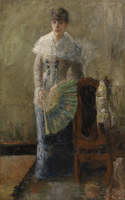
Fashionable Women (1928; private collection), shown in the same room, is an intriguing and little-known work. It depicts three women dressed in fashion from different eras (an imagined blend of the eighteenth- and nineteenth-century, the 1900s, and the 1920s) and surrounded by masks. The work was made for the Antwerp hatmaker Irma Caers and expresses, according to the label text, Ensor’s “compassion for the woman who follows fashion and moves with the time.” It portrays the gaze with which women are confronted whenever they make a fashion choice. According to curator De Wyngaert, “It’s this kind of impossibility—how do you ever win? That is something we wanted to leave space for. Women constantly feel they are not in charge of their own bodies.”[4] Ensor, though probably not a staunch feminist, was more sympathetic to the women’s cause than many of his contemporaries, a sensitivity to which this work attests.[5]
Li’s second display addressed colors, from the colonial history of the preference for light skin to blushed cheeks as a sign of youthfulness. Colonial photographs depicting topless, nameless, Black women were contrasted with the fifty-nine foundation shades offered by Rihanna’s brand, Fenty Beauty, one of the first to cater to such a diverse range of darker skin tones. Although Ensor’s voice and writings were absent from the exhibition itself, he also believed that the ideal woman should be young, with pale skin and flushed cheeks. If not, he once asserted, painting could potentially help to fix that: “Thanks to painters, ladies, pencils redden your divine skins, brushes whiten you and embellish your light foreheads, silks caress you and rejuvenate you.”[6]
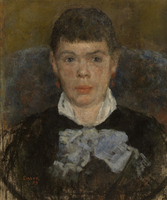
Woman with Upturned Nose (fig. 7) and Old Lady with Masks (Théâtre des masques ou Bouquet d’artifice) (see fig. 3) hung side by side in the final section of the exhibition, which was dedicated to “Eternal Beauty.” The tone of the two works is very different. The former realistically depicts a young woman with blushed cheeks and an averted gaze, while the latter represents an elderly lady wearing a full face of make-up, surrounded by masks and addressing the viewer directly. In contemporary terms, these paintings appear to contrast different uses of make-up: on the one hand, the “high maintenance to be low maintenance” skincare-focused regimen, and, on the other, the mocking of a bold refusal to “age gracefully” and the conspicuous use of artifices.
As in Fashionable Women, the Old Lady with Masks has an audience who attend to her every move. Here, however, Ensor seems to express mockery rather than compassion. In the Antwerp exhibition, the painting was shown alongside photographs by Cindy Sherman of heavily made-up young and middle-aged women (fig. 8). This juxtaposition worked cleverly to tone down Ensor’s ironic gaze, instead focusing on the potentially taxing effects of relentlessly pursuing youth, beautification, and self-improvement through make-up and cosmetic surgery. Sherman’s use of exaggerated contouring, highlighting, and prosthetics evokes the bouquet d’artifice (bouquet of artifice) the elderly lady in Ensor’s painting uses (make-up, jewelry, mouches, hairstyles and dyes).
However, rather than continuing this critical discourse on aging and beauty, the final vitrine focused somewhat ambivalently on “rejuvenating,” showcasing recent and historical “anti-aging” aids such as face bandages and LED masks. It showed how skincare and skin technologies have gradually replaced make-up in the quest to erase visible signs of aging. Nevertheless, the wall text uncritically presented rejuvenation as a desirable goal. While the techniques may have changed, the idea that women should be beautiful and appear youthful remains. It is perhaps all the better if the work to achieve this remains largely hidden, as these technologies enable.
More broadly, the selected works betray a cisgender, heteronormative view of make-up, which seemingly appears as something that only women do. This ties in with more regressive discourses that view make-up and beauty procedures as the exclusive domain of cisgender women. Achieving a normative feminine appearance is desirable and broadly marketed to them through various means. Meanwhile, the access to gender-affirming products and procedures remains difficult or prohibited for trans individuals.
The exhibition could also have told a more inclusive story by seeking the participation of drag artists. Although Ensor did not live to see the mainstream success of RuPaul’s Drag Race television franchise, he might have approved of artists whose aesthetic involves exaggeration, irony, and play with societal, aesthetic, and gender conventions. One could argue that Ensor himself dabbled in drag: his Self-portrait with Flowered Hat (1883–88; Mu.ZEE, Ostend) attests to his interest in cross-dressing, an important theme in his work, which is addressed by Ensor specialist Susan M. Canning in the catalogue, albeit not explicitly from a queer perspective. Carnivals and performances, which Ensor represented on many occasions, have long offered queer and gender nonconforming individuals the chance to experience temporarily loosened gender norms.[7]
Given that Antwerp is where the first Pride march took place in Belgium, overlooking the intertwined histories of make-up and queerness feels like a missed opportunity.[8] It could also have been a powerful statement at a time when gender essentialism is again on the rise. Furthermore, drag is one of the few spaces in which the empowering potential of make-up is most unambiguous: make-up that enables individuals to embrace their authentic selves while challenging rigid gender identities and stereotypes.
Overall, engaging more deeply with Ensor’s work could have enriched the discourse of the exhibition and opened new avenues for dialogue and confrontation between his work and that of contemporary make-up artists. For instance, Ensor’s opposition to vivisection is in stark contrast to the extensive use of animal bodies in the cosmetics industry from collagen to carmine. Furthermore, the thriving beauty industry is also heavily dependent on fossil fuel-derived ingredients. Therefore, it is structurally embedded in the present-day climate crisis. How would Ensor have reacted to, for example, the accelerated flooding of the Belgian coastal dunes, a landscape he lobbied to preserve?[9]
The essays contained in the catalogue articulate a critical perspective that was sometimes lacking in the exhibition itself. Canning delves deeper into the role of make-up and masks, drawing attention to the important role of carnivals and travesty in the painter’s work. Alistair O’Neill uses a description of masks by Ensor as “freshness of color, sumptuous decoration, wild unexpected gestures, very shrill expressions, exquisite turbulence” (41) to consider the work of five contemporary make-up artists. Cockx investigates how perceptions of make-up changed in Ensor’s time, tracing its journey from taboo to increased commodification. Francesca Granata explores the work of creators such as Grognard, Sherman, and Van Beirendonck who challenged beauty norms by using grotesque imagery. Lavishly illustrated, the catalogue also contains interviews with contemporary creators, short texts by Li, and two focus pieces on works by Ensor, Old Lady with Masks and The Astonishment of the Mask Wouse.
Masquerade, Make-up & Ensor was a thought-provoking exhibition that celebrated the creativity of make-up artists and offered a fresh perspective on Ensor’s art. However, despite its highly innovative approach and compelling discourse on whiteness in relation to beauty, the exhibition lacked a thorough, critical examination of make-up’s roles in contemporary society. This, in turn, impeded real engagement with Ensor’s work. While the exhibition did address cosmetics’ nature as both an exploitative industry and a means of self-expression and artistic experimentation, this duality was not fully articulated.[10] Despite these shortcomings, the exhibition was highly necessary for its critical discussion of beauty and the visibility it brought to aging bodies—sometimes quite literally. The audible gasp of two young people upon seeing Bruce Gilden’s close-up photographs of elderly people convinced me of this.
Notes
[1] James Ensor, Lettres, ed. Xavier Tricot (Labor, 1999), 406–07.
[2] Alfred Stevens to Ernest Van Neck, December 17, 1869, 38.984, Fonds Alfred Stevens, Archives de l’Art contemporain en Belgique, Brussels.
[3] Adrian Daub and Moira Donogan, hosts, In Bed with the Right, podcast, episode 68, “Republican Makeup with Jessica Defino,” https://gender.stanford.edu/.
[4] Zoe Whitfield, “‘Masquerade, Make-up & Ensor’ at MoMu Celebrates the Artistry of Pat McGrath, Cindy Sherman and More,” Wallpaper, October 11, 2024, https://www.wallpaper.com/.
[5] For more information on this topic, see Ina Dinter, Claire, Rose, Blanche: James Ensor’s Bildstrategien in Liebesgarten, Nymphenbildern und dem Spätwerk (epubli, 2015), 227–45.
[6] “Grâce aux peintres, Mesdames, des crayons rougissent vos peaux divines, des pinceaux vous blanchissent, embellissent vos fronts légers, des soies vous caressent et vous rajeunissent” [translation by author]. James Ensor, “Pour remercier Monsieur A. de Monzie,” in Mes Écrits ou Les Suffisances matamoresques, ed. Hugo Martin (Éditions Labor, 1999), 167.
[7] Manique Hendricks and Maaike Rikhof, The Art of Drag, exh. cat. (Frans Hals Museum, 2024), 29.
[8] For more information on the history of the first Pride marches in Belgium, see Gonzague Pluvinage, Pride in the city: Une histoire des luttes LGBTQI+ (CFC-Editions, 2024), 94–117.
[9] James Ensor, “La beauté menacée: Les dunes,” in Ensor, Mes Écrits, 240; James Ensor, “Les dunes,” in Ensor, Mes Écrits, 241–42.
[10] In the words of the beauty reporter and critic Jessica DeFino, who has inspired much of the thinking behind this review, “Beauty can be an act of care and expression and it can be an act of harm and oppression. It’s also possible to be passionate about and entertained by things that don’t support your flourishing.” Jessica DeFino, “Care/Expression vs. Harm/Oppression: An interview with L’ADN Magazine on the beauty spectrum,” Flesh World, February 11, 2025, https://jessicadefino.substack.com/.