New DiscoveriesSally Philipsen, Portrait of the Chinese Craftsman and Dwarf Tjong Fu’hk Wong Waih, 1904
by William MaWilliam H. Ma
Louisiana State University, Baton Rouge, LA
Email the author: williamma1[at]lsu.edu
Citation: William Ma, “Sally Philipsen, Portrait of the Chinese Craftsman and Dwarf Tjong Fu’hk Wong Waih, 1904,” Nineteenth-Century Art Worldwide 24, no. 3 (Autumn 2025), https://doi.org/10.29411/ncaw.2025.24.3.7.
This work is licensed under a Creative Commons Attribution-NonCommercial 4.0 International License  unless otherwise noted.
Your browser will either open the file, download it to a folder, or display a dialog with options.
Introduction
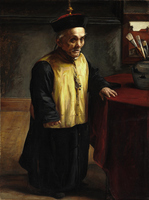
A portrait of a Chinese man with the condition of dwarfism was sold quietly in 2017 by the Danish auction house Bruun Rasmussen (fig. 1).[1] Painted by the Danish artist Sally Nicolaj Philipsen (1879–1936) and entitled An Elderly Chinese Dwarf in Traditional Dress Standing by a Table, its provenance was unlisted and presumably unknown. By the time it was included in an online exhibition at Colnaghi Elliott Master Drawings in London in 2024, the painting’s title had been amended to Portrait of the Chinese Craftsman and Dwarf Tjong Fu’hk Wong Waih.[2]
In the following article, I will briefly introduce Philipsen, provide an overview of his career, and situate this painting within his artistic trajectory. I will then turn my attention to the subject of the painting, Wong Waih (ca. 1841–?), who arrived in Denmark in 1902 as part of that year’s China in Tivoli exhibition in Copenhagen’s Tivoli Gardens. In as far as this is possible, I will recover Wong’s identity, the circumstances that brought him to Denmark, and his life after the exhibition, when he married a Danish girl and presumably stayed in Denmark at least until 1908 but perhaps for the rest of his life. I will then turn to the painting. Through careful analysis, I hope to shed some light on the numerous issues and questions it raises, including, perhaps most importantly, the relationship between its artist and his model.
Sally Nicolaj Philipsen
Born in Copenhagen, Sally Nicolaj Philipsen was one of six children of Ferdinand and Sophie Philipsen. His father was a printer and later a wholesaler. In 1896, Sally Philipsen was admitted to the Royal Academy of Arts, where he studied with Frants Henningsen (1850–1908), Frederik Vermehren (1823–1910), and Otto Bache (1839–1927) and graduated in 1901.[3] In 1904, Philipsen made his public debut at the Kunsthal Charlottenborg, which served as an exhibition venue throughout his career. For the next two decades, he traveled around Europe with the support of various scholarships. During one of his sojourns in Paris in 1909, he became enamored with Impressionist landscape painting. When he returned to Denmark, he sought to incorporate the impressionist style into his depictions of urban centers like Copenhagen as well as country and marine scenery. Philipsen had numerous connections with contemporary Danish artists. He was at the center of a group of painters who traveled to different destinations to paint together including Einar Olsen (1876–1950), Sven Schou (1877–1961), Henrik Schouboe (1876–1949), Aage Lønborg-Jensen (1877–1938), Lauritz Mikkelsen (1879–1966), and Marius Hammann (1879–1936). Philipsen was not only an artist but also an important collector who acquired works by contemporary Danish and French painters as well as African sculptures and Chinese antiques.[4]
Philipsen appears to have sold enough works during his lifetime to make a comfortable living. In addition to private commissions and sales several auctions of his works were held during his lifetime. After his death, some of his paintings were sold at auction in Copenhagen.[5] He was childless and survived by his wife, Louise Juliane Fanny Larsen, who died in 1951 and whose estate may have held additional paintings by her husband.[6] At least one of Philipsen’s relatives is known,[7] and there may be others who possess examples of his paintings. Today, the majority of his paintings are in Danish collections.[8]
Wong Waih
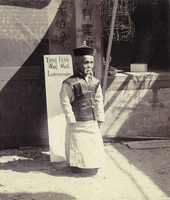
Who was the subject of Philipsen’s portrait of an “elderly Chinese dwarf?” His identity has been established through comparisons with numerous contemporary photographs from the China in Tivoli exhibition of a man who is clearly the same one as in the portrait. In one photograph (fig. 2), this man is identified on a placard behind him as Tjong Fu’hk/Wong Waih/Lanternemager (lantern maker). Despite my best effort, I was unable to discover his Chinese name based on the transliteration. Wong is a common surname, a typical transliteration used at the time that corresponds to either Wang (王) or Huang (黃) in the modern pinyin system for Mandarin Chinese. In Chinese convention, the surname appears first, so Waih would be his given name. A broadside for the China in Tivoli exhibition suggests that Tjong Fu’hk was another person.[9] I suspect, however, that Tjong Fu’hk refers to Wong’s ancestral place of origin, though it is impossible to reconstruct what place that might be. Below the Danish identification on the placard are several overexposed Chinese characters providing further identification, though they are only partially legible: 大清國 人, or “a person of [undecipherable] trade from the Nation of the Great Qing”; and 福 (fu) for “fortune,” the latter corresponding to the word “Fu’hk” in the title of the painting.
According to Vejleder gennem “Kina i Tivoli” (A guide through “China in Tivoli”), Wong was sixty-two years of age when, along with thirty-four Chinese men, women, and children, he traveled to Denmark to participate in the Tivoli Gardens exhibition in the summer of 1902.[10] Exactly how these Chinese got to Denmark is unknown. Though marketing materials from the China in Tivoli exhibition claim that they came directly from Shanghai, there is evidence that at least two of the members of the group had already been traveling and perhaps working as performers in Europe.[11] It is possible that Wong, too, had been on the exhibition circuit in Europe, though he may have been “on show” in his own country as well. A new culture of exhibiting human curiosities was in full swing by the turn of the nineteenth century in China.[12] It is possible that Wong had been performing in China and in Europe and was recruited to take part in the China in Tivoli exhibition.[13]
Whatever the circumstance, Wong was one of countless men who left southern China in search of opportunities overseas in the late nineteenth and early twentieth centuries. Most of them came from rural areas collectively called Siyi, southwest of the city of Guangzhou. Seeking to improve the economic future of their families back home, these Chinese men traveled to many parts of the world. When gold was discovered in California in 1848, the number of men leaving China exponentially increased as they went in search of the “Gold Mountain” in North America.[14] Some were tricked into becoming indentured servants in the Caribbean and South America, laboring on plantations and in guano mines. With the exception of Great Britain and France, few Chinese migrants ventured to Western Europe, due to their lack of familiarity with Western European countries and a lack of contact between those countries and China. In Denmark, the first documented Chinese people arrived as early as 1858, performing at fairs and in tea houses.[15] Among the first permanent Chinese settlers in Denmark were nearly half of the performers at the Tivoli exhibition, including Wong,[16] who by the end of the exhibition became engaged to a Danish woman, as announced in the newspaper Politiken:
“The old [Chinese] dwarf is betrothed to one of Tivoli’s sandwich maids, who in addition to her young love has bequeathed upon him a locket with her own and his photo, a cigarette case and assorted tokens of her love. The dwarf is apparently delighted and the lady, whose name is Petersen, is said to be equally delighted—and, more importantly—to have true intentions.”[17]
Interracial engagements and marriages were rare but not unusual. Danish scholar Rikke Andreassen has observed that the exhibited Chinese men were the focus of romantic and even erotic fascination on the part of Danish female visitors, despite objections from the conservative public.[18] We do not know if Wong and Petersen had children or when Wong died. In contrast, other Chinese performers like San Wung-sung (1883–1926) married local women, had children, and established “the first Chinese colony” in Copenhagen.[19] Wong was part of this small community.
Displaying Chinese in Copenhagen
From May to September of 1902, the exhibition China in Tivoli showed men, women, and children from China, who “performed” their life style in an artificially constructed “Chinese Village” at the Tivoli amusement park.[20] Within weeks of its opening on June 5, it had attracted more than seventy thousand visitors, and in two months the attendance nearly doubled to 135,320.[21] The exhibition was part of a trend in Western Europe and the United States to display unfamiliar people and cultures and to highlight their racial and cultural differences for the entertainment of predominantly white, urban visitors.[22] Such ethnic shows or Völkerschauen were pioneered by the German zoo owner Carl Hagenbeck (1844–1913), who toured his first exhibition—of Nubians—in 1876 to Paris, Berlin, and London. Human exhibitions soon became popular throughout Europe, reaching Denmark in 1878. Numerous ethnographic exhibitions took place around Copenhagen decades before and after the Chinese exhibition in Tivoli, which have recently been extensively inventoried and studied by Andreassen.[23]
The China in Tivoli exhibition included a pagoda, a theater, a bazaar/museum, and a display of gruesome methods of corporal punishment for criminals.[24] Living human displays were grouped according to their trades: a lantern maker, a tailor, a rickshaw puller, a traditional doctor, a female singer, and so on. These displays matched occupational categories familiar to European audiences through eighteenth- and nineteenth-century images of China, repeating and reaffirming popular stereotypical views of the country and its people (figs. 3, 4). The overall perception, as presented by the guide and other marketing materials, was that China was ancient and unchanging. The organizer of the exhibition, Johannes Madsen, wrote, “As people live in China today, at the time of Christ they had lived for two thousand years. . . . [China is] a piece of antiquity in the middle of the present.”[25] The goal of the exhibition, touts the official guide, was to provide the Danish visitors an authentic picture of a Chinese folk life that was correct, stylish, and interesting.[26]
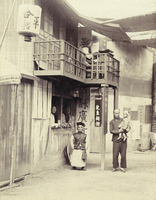
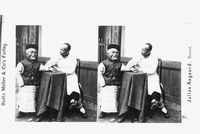
Wong was one of the highlights of the exhibition, prominently featured in several of its marketing images. Vejleder gennem “Kina i Tivoli” elaborates:
If you go from Ajoh further on you will meet a little further on in the “Cage” the most curious 62-year-old dwarf, who is a first-rate attraction. He sells old coins for new ones and does a great deal of business, as everyone wants to make “small talk” with him and shake his hand. He is an extremely jovial old fellow, who gets on brilliantly with the public. Just in case, he has taken his coffin with him on the journey, but he is otherwise healthy and fit.[27]
Though written in a lighthearted tone, this description nonetheless provides fragmentary information about Wong as a person. His vaunted interpersonal skills, probably acquired early on to counteract ableist prejudices, would have served him well in a foreign environment. As for the coffin, being away from his family and his ancestral home, and being of an advanced age, the terrible fate of dying alone in a strange land without proper rites would have greatly troubled Wong. Apparently, according to the guide to the exhibition, it was stipulated in a contract that “if any of the Chinese should die on the journey, the body should be embalmed and taken to the heavenly kingdom in a consecrated coffin.”[28] Whereas in places like San Francisco, a city dense with Chinese migrants, there were charitable associations to provide coffins, funeral services, and repatriation assistance to Chinese who died away from China, no such support was available in Copenhagen.[29]
In addition to Wong’s lively personality, his double otherness was another point of attraction. His body bore many typical “Chinese” signifiers, from his colorful costume to his hairstyle and skin color. Then there was his distinctiveness as a person with dwarfism. His small stature was constantly referenced and reinforced in the exhibition’s marketing materials. In one example, he is depicted carrying an oversized parasol to underscore his smallness, with the simple label “Dwarf (Dværg)” appearing below him (fig. 5).[30] On the same page, several additional photographic illustrations include a closely cropped bound foot, a group of Chinese men outside a pawn shop with long queues trailing down their backs, and a male actor in the costume of a female character. Collectively, these images repeat some of the most popular racial stereotypes associated with Chinese people at the time: effeminacy, and deformed bodies caused by “backward” traditions or supposed biological inferiority.
Fig. 5, Author currently unidentified, Kina i Tivoli (China in Tivoli), 1902. Exhibition broadside. Det Kongelige Bibliotek, Copenhagen. Image in the public domain; available from Det Kongelige Bibliotek.
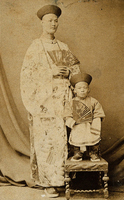
Indeed, deformity, disease, and physical abnormalities were seen as biological manifestations of the ills of the Chinese—what the scholar Ari Henrich has called a “pathologization of Chinese identity.”[31] In the medical anthology The Diseases of China (1910), the authors begin their chapter titled “Diseases Peculiar to China” with the statement “China has long been known as the world’s largest storehouse of physical freaks . . . Chinese giant, Chinese dwarf, and so on.”[32] Before Wong’s appearance in China in Tivoli, there were other physically different Chinese bodies on display in the West. The most famous was Chang Yu-sing (Zhan Shicai, 1841–93), also known at the time as Chang the Chinese Giant. Measuring “at least seven feet six inches,”[33] he toured Europe, England, the United States, and Australia from the 1860s to the 1880s. His act had a partner who served as a physical foil: Chung Mow, also known as the Tartar Rebel Dwarf (fig. 6). Like Wong, Chang wore the attire of a Qing official, including a mandarin’s hat and boots.[34] For Western audiences, and for a Chinese audience yearning for a modern nation at the end of the nineteenth century, Chinese bodies like Chang’s and Wong’s were emblems of a “backward” people and their regressive nation.[35]
Philipsen’s Portrait of Wong Waih
Signed by Sally Philipsen and dated 1904 in the lower right corner, the portrait of Wong Waih (see fig. 1) is a careful study of a Chinese man with the condition of dwarfism. Though its current and former title draw attention to the subject’s medical condition, it is unknown how Philipsen originally referred to the painting. The most common form of dwarfism, achondroplasia, is a form of skeletal dysplasia. It is a rare genetic condition that affects bone growth and is characterized by proportionally short upper arms and thighs, a large forehead, a flat nose bridge, and small hands.[36] Unlike contemporaneous images of people with dwarfism that underscore or even exaggerate their short stature through comparisons of scale, such as the photograph of Chang Yu-sing and Chung Mow (see fig. 6), Philipsen’s portrait does not unduly emphasize his small stature, though it does depict a body proportionally incongruous with the subject’s age, especially given the length of his limbs and the size of his hands.
The artist does, however, focus on the “Chineseness” of his sitter, who is dressed in a huang magua (黃馬褂), the yellow jacket that during the Qing dynasty was reserved for meritorious officials. He also wears a black felt hat with red tassels typical of a high-ranking official from the Qing court, but its lack of peacock feathers and pearls suggests that the hat has been decommissioned. It is highly unlikely that Wong was a former court official. Like so many Chinese traveling overseas at the time, these articles of clothing were ethnographic costumes and aspirational signifiers of social status. They were particularly useful for performers, who relied on costumes to heighten their racial otherness. Wong’s “Chineseness” is also made visible through the queue, a thin, gray braid that runs down his back. A hairstyle mandated by the ruling Manchus in the Qing dynasty for all Chinese male subjects, it irrefutably identifies the figure in the painting as racially Chinese.
Philipsen has carefully rendered the Chinese man’s gray hair, eyebrows, and mustache, and the numerous wrinkles in his face. The figure is standing in a room next to a round table covered in a red cloth, on which he is resting his left hand with short fingers and long, pointed nails. The table is a common compositional device in both painted and photographed Western portraits from the nineteenth century. Often, the sitter is presented next to a table at an appropriate height, upon which his or her hand is placed in proximity to objects that have a connection with the person portrayed. To better accommodate the height of his subject, Philipsen has represented him standing, rather than sitting, next to a low side table. At its center is a common, blue-and-white, Chinese ginger jar, inside of which is a cluster of clean brushes.
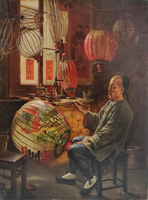
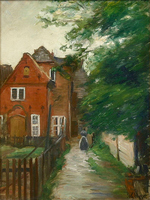
Because of the presence of the Chinese jar, one may be tempted to assume that the portrait was painted in Wong’s studio, but that idea does not bear out under scrutiny. The undated Chinese Lantern Painter by the American painter Theodore Wores (1859–1939) provides a helpful comparison (fig. 7). Wores was known to be a frequent visitor to and close observer of people in San Francisco’s Chinatown. Unlike the studio depicted in Philipsen’s portrait, the room where the San Francisco lantern maker is practicing his trade is cluttered. Behind him hang lanterns in different stages of completion. On the worktable next to him are tools to carve, cut, glue, and shape the bamboo armatures and the paper covers of his lanterns. Most notable is a large, flat brush made from several smaller, tapered-tip brushes strung together. None of these tools are visible in Philipsen’s painting. The brushes in his portrait are European and likely his own. The ginger jar, used as a container for pickled vegetables by Chinese communities and frequently collected by Europeans, likely came from Philipsen’s collection of Chinese antiques. Everything in the portrait suggests that it was painted in Philipsen’s own studio. This is corroborated by the partial view of a painting in the background, in which we can just make out a brownish roof and an arched doorway, akin to the rural architecture in many of Philipsen’s landscapes (fig. 8).
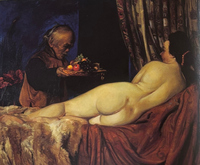
A performer at Tivoli, Wong’s likeness was widely reproduced in photographs and publications, but he was never presented outside of the Chinese Village—the artificial evocation of China that the Danes at Tivoli built for him and his fellow countrymen. By asking Wong to pose for him at his own studio, Philipsen took him out of this Orientalist fantasy and found alternative ways to connect with his subject by portraying him as a fellow human being or perhaps even a fellow artist. This is not to say that Philipsen was not interested in the subject’s exoticism and racist stereotypes. Four years after completing this portrait, Philipsen pictured Wong again in a painting entitled Frugten serveres (Fruit is Served) from 1908 (fig. 9).[37] The old man now appears as a humble servant, bowing his head while offering a tray of fruit to his mistress, whose voluptuous backside is on full display for viewers. The work is a clear homage to Diego Velázquez’s (1599–1660) The Toilet of Venus (“The Rokeby Venus”) (1647–51; National Gallery, London), with the Chinese man reimagined as a grotesque version of Cupid in that painting; instead of holding a mirror to reflect the divine beauty of his mother, his aged body serves as a contrast to that of the supple, young, white woman. Perhaps the inclusion of Wong also alludes to another racial foil in a more famous painting of a nude: the black maid in Édouard Manet’s (1832–83) Olympia (1863; Musée d’Orsay, Paris). Wong’s gesture is evocative of contemporary images of Chinese men who worked as waiters in Chinese tea salons and restaurants in Copenhagen—the same Chinese performers from the Tivoli exhibition who decided to settle in Denmark at the conclusion of the exhibition (fig. 10).[38]
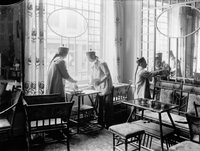
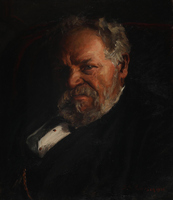
According to the various biographical sketches of Philipsen, he was known as a portraitist early in his career before turning towards landscape painting, though auction records suggest that he never truly abandoned portrait painting. His early portraits have a sense of psychological and even dramatic intensity that his later portraits seem to lack. For example, in the Portrait of Mr. Sørensen of 1906, the face of his subject is closely cropped, forcing the viewer to intimately engage with the raw emotional expression engendered by the contorted facial muscles (fig. 11). Sørensen’s personality is exposed by the strong contrast of light and dark—the right side of his face almost completely submerged in shadow. The thickly applied strokes materialize features that animate the sitter: his nose, beard, and pink lines at the corner of his left eye. Writings on Philipsen reference the influence of Rembrandt van Rijn (1606–69) in his portraits. The fact sheet for the portrait provided by Colnaghi, for example, points to the “Rembrandt patch” on the left side of Sørensen’s face—a triangular area that denotes the bagginess of the eye, suggesting the subject’s old age and his weariness with the world—a technique borrowed from late self-portraits by Rembrandt.[39] A clear directional light source that suffuses and reiterates the color and contour of the subject is also something that Rembrandt utilized.
It is likely, however, that portraits by Velázquez played an even greater role in Philipsen’s portraits of Wong, the two surviving examples of which are the best evidence of the artist’s admiration for Velázquez.[40] While Frugten serveres is an obvious reference to Velázquez’s only female nude, Philipsen’s portrait of Wong evokes Velázquez’s numerous portraits of Spanish court dwarfs. As has often been remarked, these portraits stand out for their uncompromising realism as well as their psychological insight. In her essay on the Portrait of Sebastián de Morra (1644; Museo del Prado, Madrid), the art historian Letha Ch’ien comments that the “portrait’s insistence on the subject’s humanity diverges from prevalent dehumanizing attitudes toward disabled people.”[41] This is achieved through a straightforward depiction of Morra’s body without exaggeration, a lack of objects or other people for a comparison of scale, and a plain background. The same traits are present in Philipsen’s portrait.
Beyond references to Velázquez, the dwarf was a prominent cultural trope in fin-de-siècle European literature. From Oscar Wilde’s (1854–1900) short story “The Birthday of the Infanta” of 1891 to the opera Der Zwerg by Alexander Zemlinsky (1871–1942) in 1922, the figure of the dwarf was a substitute for the artist, expressing his insecurity and anxiety about being on the margins of a society that hinges “on the play between the external appearances and internal dimensions of the self.”[42] Further, the figure of the dwarf, in both Wilde’s and Zemlinsky’s works, was interpreted by their contemporaries as both an “Oriental” and a Jew.[43] This point is relevant to Philipsen’s own Jewish background and may provide a possible motivation for the painting.[44] Though the number of Jews in Denmark during the first decade of the twentieth century was considerably higher than the number of Chinese, they were still a small minority.[45] Perhaps as a Jew, the painter identified with Wong—a racialized other and a wanderer searching for a home.
Conclusion
While Philipsen in his portrait of Wong from 1904 largely refrained from racial stereotyping, he returned to it in another painting of the same model four years later. What caused the change in perspective? Were the two paintings the result of two different commissions? What was the nature of the relationship between the artist and model? Did Philipsen ask Wong to pose for him? And most important, what kind of agency did Wong have as a model working for Philipsen? In the absence of any substantial information on both paintings’ history and provenance, or, for that matter, on the personal relationship between Philipsen and Wong, these questions are difficult to answer.
What we do know is that Wong lived in Denmark until at least 1908, when he was around sixty-eight years of age and may have died there. Soon after China in Tivoli ended, he found employment with its organizer, Madsen.[46] He also served as a paid or unpaid model to Philipsen. Given his depiction as a server in the painting of 1908, it is possible he later worked at a teahouse in the same capacity, like his fellow Chinese performers.
The portrait of 1904 suggests a link between artist and model through the obvious presence of the Chinese jar in the center of the painting. Though an object that probably came from Philipsen’s own collection of Chinese antiques, it makes a clear reference to his subject. Despite the nearly four decades of difference in age between Wong and Philipsen, perhaps the artist felt some “collegial” kinship with his subject, who was an artist/artisan like himself. Despite the power imbalance between the two men, Philipsen played a crucial role in making Wong publicly visible, allowing us a glimpse into the life of an individual who traveled to the other side of the world in search of opportunities and dignity—an individual who, often relegated to the margins by both Chinese and European society due to ableism and racism during his lifetime, would otherwise be forgotten.
Acknowledgments
My sincere gratitude to Alexis Ashot for introducing me to this painting, helping me with research by finding many obscure sources and contacting experts, and offering insights into the painter and the painting. I would also like to thank Petra Chu for her patient suggestions and careful edits.
Notes
Unless otherwise noted, the original Danish in this article was translated by the Google Translate tool (https://translate.google.com/) in the Chrome browser, with modification by the author.
[1] The painting, An Elderly Chinese Dwarf in Traditional Dress Standing by a Table, was lot no. 17 in the auction Paintings, Works of Art and Design, held February 6–9, 2017. See “The Auction by Bruun Rasmussen, Lyngby: Paintings, Works of Art and Design,” askART, https://www.askart.com/. See also Kristine Vindahl and Bruun Rasmussen, email message to author, February 6, 2025.
[2] The online exhibition Picturing the Artist took place from March 21 to April 26, 2024. See Picturing the Artist, Colnaghi Elliott Master Drawings, accessed July 22, 2025, https://www.colnaghielliott.com/. In January 2018, the painting was exhibited in a dealer’s exhibition by James Bauerle of Kunsthandel in Copenhagen. At the time, it had the title Le vendeur de lanternes Tjong-Fuhk (Tjong-Fuhk the Lantern Seller). The only records of this exhibition are photographs shared by Alexis Ashot. Alexis Ashot, email message (with attachment) to author, July 31, 2025.
[3] K. G. Saur, “Philipsen, Sally,” in Allgemeine Künstlerlexikon – Internationale Künstlerdatenbank – Online (DBIS, 2021), https://www.degruyter.com/ [login required].
[4] Merete Bodelsen, “Sally Philipsen,” in The Danish Biographical Lexicon, July 18, 2011, https://biografiskleksikon.lex.dk/. Philipsen’s collections were auctioned by Winkel & Magnussen after his death in 1936. See Fortegnelse over maleren Sally Philipsen’s efterladte samling: Malerier, neger-skulpturer, kinesiske antikviteter, møbler m.m. samt kunstnerens egne malerier [. . .], auction cat. (Copenhagen: Winkel & Magnussen, 1936).
[5] Fortegnelse over maleren Sally Philipsen’s efterladte samling.
[6] For Larsen’s death record, see Døde kvinder 1949–1952, Frederiksberg Sogn, Kontraministerialbog, Rigsarkivet (National Archives), Copenhagen, https://arkivalieronline.rigsarkivet.dk/. I thank Allan Falk for finding the death record.
[7] The known relative is his niece Esther, who died in the United States. See “Esther Charlotte Sophie Philipsen Harlan,” Memorials, Find a Grave, added June 12, 2011, https://www.findagrave.com/. I thank Allan Falk for finding the name of the niece and the location of her gravesite.
[8] For examples of paintings in Danish collections, see Malerier af Sally Philipsen udstillede hos Chr. M. Bach (Københavns Klichéfabrik, 1918); Fortegnelse over maleren Sally Philipsen’s malerie rog studier som bortsælges ved auktion (Anton Hansen’s Kunstauktioner, 1932); and Fortegnelse over maleren Sally Philipsen’s efterladte samling.
[9] Kina i Tivoli, 1902, Digital Collection, Det Kongelige Bibliotek, Copenhagen, http://www5.kb.dk/.
[10] Vejleder gennem “Kina i Tivoli,” 1902, Danmarkshistorien, March 25, 2025, n4, https://danmarkshistorien.lex.dk/.
[11] Those members were San Wung-sung and his brother. Rikke Andreassen, Human Exhibitions: Race, Gender and Sexuality in Ethnic Displays (Ashgate, 2015), 184–85.
[12] Bozhou Men, “From a Tall Man to ‘Zhan the Chinese Giant’: Global and National Imaginaires Surrounding an Extraordinary Body in Fin de Siècle China,” Journal of Asian Studies 83, no. 4 (November 2024): 833.
[13] There were examples of Chinese with dwarfism traveling and performing in China. The authors of the medical anthology The Diseases of China report on a “well-known” Chinese dwarf named McGinty who had traveled around the world and was now permanently living in Shanghai. William Hamilton Jefferys and James L. Maxwell, The Diseases of China, Including Formosa and Korea (P. Blakiston’s Son, 1910), 303.
[14] Erika Lee, The Making of Asian America: A History (Simon & Schuster, 2015), 59.
[15] Mette Thunø, “Chinese in Denmark,” chap. 7 in The Chinese in Europe, ed. Gregor Benton and Frank N. Pieke (Macmillan; St. Martin’s Press, 1998), 171.
[16] Andreassen, Human Exhibitions, 159.
[17] Quoted in Andreassen, Human Exhibitions, 157. The original announcement appeared in “Teater og Tribune,” Politiken, September 9, 1902.
[18] Andreassen, Human Exhibitions, 145
[19] Andreassen, Human Exhibitions, 182–86; and Thunø, “Chinese in Denmark,” 172–73.
[20] Thunø, “Chinese in Denmark,” 172.
[21] See Kina i Tivoli for the attendance number of 70,000. For the attendance number of 135,320, see Tivoli, Beretning til Aktionœrerne i Kjøbenhavns Tivoli for Aar 1902 (Sophus Kruckows Bogtrykkeri, 1902), cited in Thunø, “Chinese in Denmark,” 172.
[22] Andreassen, Human Exhibitions, 33.
[23] Andreassen, Human Exhibitions, 8–15.
[24] See Vejleder gennem “Kina i Tivoli.”
[25] Quoted in Rikke Andreassen and Lene Myong, “Professorer advarer om coronaracisme: Medierne har et ansvar,” Politiken, April 2, 2020, https://politiken.dk/ [login required].
[26] “Det er en Kendsgerning, at der aldrig nogensinde før i Europa er vist et virkelig kinesisk Folkelivsbillede i Smag med det, som ‘Kina i Tivoli’ frembyder, saa korrekt, saa stilfuldt og saa overordentligt interessant.” (It is a fact that never before in Europe has a truer picture of the Chinese folk life been shown in the way of what ‘China in Tivoli’ presents, so correct, so stylish and so extraordinarily interesting.) Vejleder gennem “Kina i Tivoli.”
[27] “Gaar man fra Ajoh videre træffer man lidt længere fremme i ‘Buret’ den højst mærkelige 62 Aar gamle Dværg, der er en Seværdighed af første Rang. Han sælger gamle Mønter for nye og gør store Forretninger, da alle gerne vil ‘passiare’ med ham og trykke hans Haand. Han er en overordentlig jovial gammel Fyr, som kommer brillant ud af det med Publikum. For alle Tilfældes Skyld har han taget sin Ligkiste med paa Rejsen, men han er for øvrigt sund og rask.” Vejleder gennem “Kina i Tivoli.”
[28] “Det er kontraktmæssigt bestemt, at hvis nogen af kineserne skulde dø paa Turen, saa skal Liget balsameres og føres til det himmelske Rige i en indviet Kiste.” Vejleder gennem “Kina i Tivoli.”
[29] Hon-Ming Yip, “Huiguan (會館) as an Overseas Charitable Institution: Homebound Burials and the Global Chinese Diaspora, 1850–1949,” in Chinese Diaspora Charity and the Cantonese Pacific, 1850–1949, ed. John Fitzgerald and Hon-ming Yip (Hong Kong University Press, 2020), 77.
[30] See “Kina i Tivoli.”
[31] Larissa (Ari) Heinrich, The Afterlife of Images: Translating the Pathological Body Between China and the West (Duke University Press, 2008), 39.
[32] Jefferys and Maxwell, The Diseases of China, 303 (emphasis in original).
[33] Men, “From a Tall Man to ‘Zhan the Chinese Giant,’” 840.
[34] Philip B. Kunhardt Jr., P. T. Barnum: America’s Greatest Showman (Knopf, 1995), 274.
[35] Men, “From a Tall Man to ‘Zhan the Chinese Giant,’” 842.
[36] “Dwarfism (Skeletal Dysplasia) and Other Causes of Short Stature,” Diseases and Conditions, Health Library, Cleveland Clinic, last reviewed July 13, 2023, https://my.clevelandclinic.org/.
[37] The painting was sold by Bruun Rasmussen Vejle auction house in 1995 and again in 1997; its current whereabouts are unknown. For information on one of its sales, see “Sally Nikolai Philipsen, Danish, 1879–1936, Frugten serveres, 1908,” Artnet, https://www.artnet.com/ [login required].
[38] Thunø, “Chinese in Denmark,” 175.
[39] Fact sheet provided by Colnaghi.
[40] I thank Petra Chu for pointing out the connection to Diego Velázquez.
[41] Letha Ch’ien, “Diego Velázquez, Portrait of Sebastián de Morra,” Smarthistory: The Center for Public Art History, https://smarthistory.org/.
[42] Sherry D. Lee, “The Other in the Mirror, or Recognizing the Self: Wilde’s and Zemlinsky’s Dwarf,” Music & Letters 91, no. 2 (May 2010): 202.
[43] Lee, “The Other in the Mirror,” 205–6.
[44] Thanks to Dr. Silvia Goldbaum Tarabini for searching the Danish Jewish Genealogical Database for Sally Philipsen’s background.
[45] Conrad Kisch, “The Jewish Community in Denmark: History and Present Status,” Judaism 47, no. 2 (Spring 1998): 215.
[46] See Andreassen, Human Exhibitions, 114; and H. J., “Kineserne,” Politiken, October 24, 1902.