“A Strange Woman Slumbers”: The Reframing of the Medieval Queen Margrete’s Sarcophagus by the Danish Women’s Movement and the Artist Agnes Slott-Møller
by Katrine Bruun JørgensenKatrine Bruun Jørgensen is a PhD fellow in the department of art history at Aarhus University, Denmark, and a curator at Ribe Kunstmuseum since 2021. She was previously a curator at SMK – Statens Museum for Kunst in Denmark. She is currently working on a PhD dissertation examining how medievalist artworks negotiate the status of gender in the period 1885 to 1937. With this project, she aims to establish a framework for understanding the practices of both female and male artists whose work has not conformed to the aesthetic ideals of modernism. Her article “Women’s Art and Peasant Painters: On Gender Discourse in the Peasant Painter Feud and Agnes Slott-Møller’s Resistance” was published in 2023 in the online journal Perspective. Her dissertation research will serve as the foundation for an upcoming exhibition on medievalism in Danish art.
Email the author: kbj[at]ribekunstmuseum.dk
Citation: Katrine Bruun Jørgensen, “‘A Strange Woman Slumbers’: The Reframing of the Medieval Queen Margrete’s Sarcophagus by the Danish Women’s Movement and the Artist Agnes Slott-Møller,” Nineteenth-Century Art Worldwide 24, no. 3 (Autumn 2025), https://doi.org/10.29411/ncaw.2025.24.3.2.
This work is licensed under a Creative Commons Attribution-NonCommercial 4.0 International License  unless otherwise noted.
Your browser will either open the file, download it to a folder, or display a dialog with options.
Introduction
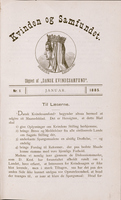
In 1885 the Danish Women’s Society published the first issue of its magazine Kvinden og Samfundet (Woman and society) and chose to picture the medieval Danish queen Margrete I (1353–1412) on the cover (fig. 1). In the following decades, similar portrayals of the queen circulated within the Danish women’s movement. Such representations of the queen, as I demonstrate, have strong ties to her portrayal in the effigy on her sarcophagus, installed in 1429 in Roskilde Cathedral, and reveal how the women’s movement reframed the queen’s image to promote its members’ progressive aims while adapting to a broader national agenda. Current research has recognized Margrete’s importance to the Danish women’s movement, while focusing on how she was framed as an Amazon, regarding her as a militant figure. Rather than seeing her as an Amazon, I argue that her portrayal, based on her effigy, helped to promote the more diplomatic and conservative approach to the women’s cause that was advocated in the statement of purpose in the statutes of the Danish Women’s Society.
In exploring how this image of the queen was used to further the women’s agenda, I focus on several works by the artist Agnes Slott-Møller (1862–1937) which played key roles at two prominent sites for the Danish women’s movement—Kvindelig Læseforening (the Women’s Reading Club), established in 1872, and the exhibition Kvindernes Udstilling fra Fortid og Nutid (The Women’s Exhibition from Past and Present), held in Copenhagen in 1895.[1] By showing the relevance of Slott-Møller’s works to the women’s cause, this article challenges the perception that she was an outsider and puts her back into a dialogue with her contemporaries.
After situating the article in the context of Danish feminist art historical scholarship, I examine the ties between the Danish women’s movement and the national agenda of the nineteenth and early twentieth centuries and consider the reframing of the portrayal of queen Margrete on her sarcophagus as an example of national activist medievalism. Then, I offer a semiotic analysis of the motif of Queen Margrete, focusing on the reception of her portrayals in speeches and articles from Kvinden og Samfundet and other relevant literature written by women involved in the women’s movement together with a photograph of one of Slott-Møller’s works in the Women’s Reading Club.
Discourses of Marginalization
With its focus on female artists associated with the Danish women’s movement, this article continues a feminist approach to the art of the late nineteenth and early twentieth centuries that has recently proliferated in Danish art history. However, I do not focus on analyzing the marginalization of women artists, their biographies, or the reasons for their exclusion from the art historical canon, as the art historians Emilie Boe Bierlich and Sine Krogh have done in their recent dissertations.[2] Building on the work of the art historian Marsha Meskimmon, I aim to highlight the cultural agency of women artists rather than their marginalization within the masculine framework of the art world.[3] In doing so, I consider a particular motif—the effigy of Queen Margrete—and its circulation and reception within the Danish women’s movement. My approach, therefore, is similar to that of the art historian Lene Bøgh Rønberg in the recent exhibition and catalogue Women Artists in Denmark 1880–1910.[4] Bøgh Rønberg explored the representation of gloves in portraits painted by female artists, arguing that they were included as comments on a public morality debate about sexual mores.[5] Whereas the representation of gloves was part of a subtle symbolism, I argue that the visual signs associated with Queen Margrete were used more overtly and strategically to promote the agenda of the women’s movement.
A Semiotic Approach and the Need for Framing
In my analysis of the motif of Queen Margrete, I adopt a semiotic approach to art history as defined by the art historians Mieke Bal and Norman Bryson. In their article “Semiotics and Art History,” they challenge the classical iconographical method as defined by Erwin Panofsky (1892–1968). As opposed to Panofsky’s preference for a three-step iconological analysis, Bal and Bryson point to the dynamism of the sign and reject the possibility of finding a unified meaning in it.[6] They argue against the idea of creating a totalizing context within which to understand an artwork, and the concomitant tendency to allow an “incomplete formulation of context to stand for the totality of contexts, by synecdoche.”[7] They propose that rather than focusing on a given context for a work of art, art historians should use instead the concept of “framing” proposed by the scholar of comparative literature Jonathan Culler. As the art historian Hans Dam Christensen has noted, when researchers choose to anchor a visual representation by framing it rather than contextualizing it, they expose how signs are constituted through discursive and institutional practices, rather than implying that the visual representations (signs) fit into a given, static context.[8] This means not only that the framing of the object becomes crucial to how we understand the artwork but also that the framing is constructed. Below I will consider the women’s movement’s use of the representations of Queen Margrete from the perspective of framing. I will examine how these women wished to constitute new meanings for the signs of the queen—meanings related to their own agenda—through their discursive and institutional practices. I aim to challenge the dominant narratives about the outsider status of female artists and emphasize instead the interest in national medievalism and the figure of Queen Margrete shared by these artists and the women’s movement during the period 1885–1915.
Not all of the women active in the women’s movement were in agreement about the status of the queen or the national agenda of the Danish Women’s Society. However, the women I present here did agree about the significance of Queen Margrete.[9] They all actively used the queen in their discourses regarding women’s rights, thereby framing her within their own agenda. Moreover, Slott-Møller circled around the figure of the queen in her early works from the 1880s and 1890s, as did the sculptor Anne Marie Carl-Nielsen (1863–1945).
National History as a Space of Possibilities
For art historians who have dealt with Danish art of the nineteenth century, the idea of a national spirit has been a recurring theme. During the nineteenth century, Denmark lost a large part of its territory, including the cession of Norway to Sweden following the country’s defeat at the end of the Napoleonic War in 1814 and later the loss of the duchies Schleswig, Holstein, and Lauenburg to Germany in the Second Schleswig War in 1864. Scholars have used these two Danish defeats to mark the beginning and end of the period referred to as the Danish Golden Age.[10] Art historians have tried to find a certain Danish style in the artworks of this period, defined by motifs, colors, and expression.[11]
Krogh argues that art critics lauded art that appeared to be Danish in the Danish Golden Age and were opposed to art that appeared to be European, particularly German. While I agree with Krogh that national values played an important role in establishing a nineteenth-century canon of Danish artists and may have led to the exclusion of some artists, like Elisabeth Jerichau-Baumann (1819–81), I contend that Danish nationalism offered possibilities for the later generation of female artists, such as Slott-Møller and Carl-Nielsen. As I demonstrate below, Slott-Møller’s and Carl-Nielsen’s embrace of the motif of the medieval Queen Margrete was met with support from agents of the women’s movement. In addition, since Slott-Møller’s works circulated within the central networks of the women’s movement, I consider her as a key agent in the development of the signs associated with Queen Margrete and their meanings.[12]
Reframing Agnes Slott-Møller
The Danish and Nordic art historical literature has tended to characterize Slott-Møller as an outsider. For example, the literary historian Lis Møller, who has worked extensively on medievalism in Danish literature, considers Slott-Møller a medievalist, regarding her as isolated from the contemporary art scene. Møller draws a connection between Slott-Møller and the Danish Romantic literary tradition, mentioning the Danish authors B. S. Ingemann (1789–1862) and J. L. Heiberg (1791–1860) as important figures of contextualization.[13] However, when situating Slott-Møller within the field of the visual arts, Møller focuses on the German Nazarene movement and the English Pre-Raphaelite Brotherhood, as have other authors writing about Slott-Møller.[14] These international points of reference have contributed to Slott-Møller’s status as an outsider in the context of Danish art. Yet she was born fifty-three years after the birth of the German Nazarene movement, and she was a Dane and not part of the Pre-Raphaelite Brotherhood.[15] Emphasizing these movements as her main artistic inspirations leaves an image of her as an artist who was isolated in Denmark and out of touch with contemporary ideas.
Little attention has been paid to the significance of Slott-Møller’s art in her own time and the networks with which she was involved. As a result, her work has not been regarded as relevant to the contemporary Danish art scene.[16] I attempt to question this omission through my examination of how the portrayal of Queen Margrete on her sarcophagus was reframed and adapted in the late nineteenth and early twentieth centuries in order to advance the agenda of the Danish women’s movement. As I focus on Agnes Slott-Møller, who was an important contributor to these new depictions of the queen, I include a discussion of the reception of her works, which allows me to assess the artist’s impact during her lifetime.[17] This approach sheds light on Slott-Møller’s relevance while acknowledging that she also faced opposition within the established art world.[18]
A Consensual Approach
Early in the history of the Danish women’s movement, the country’s women wished to establish a national rather than an international organization. The first women’s organization in Denmark was the Danish branch of the Association Internationale des Femmes (International Association of Women), established in 1871; by the end of that year the branch had closed, and in its place the Danish Women’s Society was established as a strictly national organization.[19] Upon its founding, the society passed a new statement of purpose:
§1. The purpose of Danish Women’s Society is to elevate woman spiritually, morally, and economically, thereby enabling her to become a more independent and active member of both family and state, particularly by granting her access to self-employment.[20]
The statement’s emphasis on how a woman should be “a more independent and active member of both family and state” was maintained in future statements until 1906, when women’s suffrage was first mentioned. Women gained the right to vote in municipal elections in 1908, but thousands of women had been engaged in the fight for suffrage as early as the 1880s. Thus, the addition of women’s suffrage to the society’s mission statement was rather late, given that this goal already had guided women’s political work for decades.[21]
The statement of purpose was defined by a conservative and precautionary strategy, which maintained that a woman’s role was closely tied to the family. This approach to the women’s cause can also be connected to the choice of Queen Margrete as a central symbolic figure for the movement. By associating itself with a royal personality, the Danish Women’s Society embedded its agenda within a broader framework of national history. The invocation of a powerful queen, whose importance was firmly established, enabled the society to engage in an existing and pertinent discourse of national medievalism.
National Medievalism and the Women’s Movement
Medievalism examines how the Middle Ages are interpreted in a later age, treating this interpretation as a cultural phenomenon that reveals more about the time period referencing the Middle Ages than the Middle Ages themselves. Medievalism, while not confined to the visual arts, offers the possibility of examining visualities across different cultural areas. The use of a medieval figure as an icon for a women’s movement is not unique to Denmark. From the early twentieth century to the 1920s, the suffrage movements in both the United Kingdom and the United States used the French medieval warrior Joan of Arc (ca. 1412–31) as a powerful symbol of female agency and feminine strength in their marches and on posters and banners.[22] In the anthology International Medievalisms: From Nationalism to Activism, the medievalist scholar Mary Boyle identifies the uses of Joan of Arc within the US women’s movement as an example of activist medievalism, which she distinguishes from nationalist medievalism:[23]
Activist medievalism as it is discussed here, is . . . a progressive endeavor—understood broadly and not restricted to the present—that attempts to subvert traditional postmedieval uses of the Middle Ages. Chief among these uses is nationalist medievalism.[24]
Boyle associates activist medievalism with medievalisms that foreground politics and connects it with international medievalism. According to Boyle, proponents of activist medievalism “tend to position themselves in open and politicized opposition to previous uses of the Middle Ages.”[25] I consider the use of Queen Margrete within the Danish women’s movement as an example of activist medievalism, since Danish women used the queen to foreground their political cause. However, as Danish women used a national figure for their cause—as opposed to the English and US suffrage movements, which used the French Joan of Arc—I do not agree that activist medievalism has to be international in order to stand in opposition to previous uses of medievalism. National figures can also be framed and used in new and progressive ways. Here I agree with the historian Lone Kølle Martinsen, who has argued that “the ideology of nationalism in the nineteenth century could be a progressive force for change for women, too.”[26] The uses to which the signs associated with Queen Margrete were put troubles Boyle’s binary of a regressive nationalist medievalism and a progressive, international, activist medievalism. Following Martinsen, I also emphasize the importance of the Danish author and priest N. F. S. Grundtvig (1856–1945) for the Danish women’s movement, but I argue that the women’s movement framed Margrete’s importance differently than Grundtvig did, as revealed by the visual representations of the queen.
Grundtvig and Queen Margrete
Grundtvig was a central figure in the formation of a Danish nationalism based on the idea of a certain Danish folk spirit, rooted in national literature and spoken language. He specifically opposed the use of Joan of Arc as a leading figure for Danish female emancipation in a review of the book Clara Raphael: Twelve Letters (1850),[27] which is a landmark in the development of the Danish women’s movement. The book, published anonymously but known to have been written by Mathilde Fibiger (1830–72), describes a young woman’s break with the bourgeoisie and her concerns regarding female emancipation. The book gave Fibiger a unique position in the history of the women’s cause in Denmark.[28] In his review of the book Grundtvig applauded both the book and the protagonist Clara Raphael for her Danishness, but he also critiqued the protagonist’s identification with Joan of Arc through Friedrich Schiller’s (1759–1805) retelling of the story in Die Jungfrau von Orleans (The Maid of Orleans).[29] According to Grundtvig, for Raphael to be truly Danish, she needed to take a stand in opposition to German and French works. This critique may, in turn, have led the Danish women’s movement to choose Queen Margrete as a leading figure rather than Joan of Arc.
Kølle Martinsen has pointed to the ties between the women’s movement and Grundtvig, emphasizing that Norse mythology, which was central in Grundtvig’s work, was where he encountered the word kvinde (woman). The word was associated with meanings originating in myths about valkyries and shieldmaidens—meanings, Kølle Martinsen argues, that were adopted by the women’s movement.[30] Furthermore, she links the appeal of Queen Margrete for the women’s movement with the notion of the queen as an Amazon, a theme introduced by Grundtvig in the poem, Roskilde Rhyme (1814).[31]
However, an examination of the visual culture of the women’s movement reveals that its members did not choose to have Margrete represented as an Amazon. Using a semiotic approach, I will analyze the discourse used by these women when they invoked Queen Margrete in speeches and articles published in the Danish Women’s Society magazine Kvinden og Samfundet. I will argue that the women’s movement distanced itself from the idea of women as Amazons or as other militant figures.
Queen Margrete’s Sarcophagus
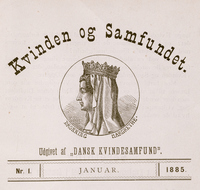
When the Danish Women’s Society commenced publication of Kvinden og Samfundet in 1885, they chose the queen as the icon of the movement (fig. 2). Until the 1970s, she remained an important reference for the movement and the magazine.[32] In her book about the first forty years of the Danish Women’s Society, first published in 1912, Gyrithe Lemche (1866–1945), one of the society’s most prominent voices, mentioned the choice of Queen Margrete for the ornamented nameplate on the magazine’s front cover, referring to it as the publication’s vignette:
The journal should be named “Woman and Society,” and under this title, on the cover, there should be a vignette featuring Queen Margrethe’s head from the sarcophagus in Roskilde Cathedral.[33]
Queen Margrete was the daughter of the Danish king Valdemar Atterdag. At the age of ten, she was married to the Norwegian king Haakon in 1363 and became the queen of Norway. After Haakon died in 1380, and after she lost her only son, Oluf, in 1387, Margrete adopted her sister’s grandson, Erik, who became the king of Norway at the age of seven. Queen Margrete successfully established alliances between Denmark, Norway, and Sweden. The Kalmar Union was officially formed in 1397 when the Nordic councils of Denmark, Norway, and Sweden met at Kalmar Castle. Erik was officially pronounced king of the three countries, but in practice it was Margrete who ruled.[34] The Kalmar Union also included present-day Finland, which was a part of Sweden, as well as Iceland, Greenland, the Faroe Islands, the Orkney Islands, and the Shetland Islands, which were under Norwegian rule. The Kalmar Union had its center of power in Denmark, but in practice the three countries were controlled by their own rules and traditions.[35]
Though the Kalmar Union lasted only until 1523, when Sweden broke away from the union, the alliance between Denmark and Norway was sustained for centuries, until 1814. The sarcophagus in Roskilde Cathedral is the most prominent representation of the queen; more than a memorial of the queen and her legacy, it can be seen as a monument to a powerful period in Danish history. In 1912, a memorial ceremony was held in Roskilde celebrating the five hundred years following her death. There, the newly restored sarcophagus could be examined, and the queen was commemorated with speeches, songs, and music.[36] The event underpinned both the importance of the queen and the sarcophagus.
The sarcophagus was already well known in the nineteenth century (fig. 3). In Grundtvig’s poem, he describes a walk inside Roskilde Cathedral, where almost all the Danish kings and queens are buried. In the poem, the narrator stops at each grave to contemplate these royals, including Queen Margrete.[37] He situates the queen’s sarcophagus within a succession of burial sites of important kings, thus anchoring the queen in Danish national history. The poem contributed to making the sarcophagus better known and inserting it in the public imaginary, which may explain why the effigy’s depiction of the queen became so important for the visual culture of the women’s movement.

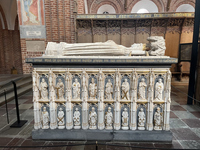
The artist who made the sarcophagus is currently unidentified but was most likely Netherlandish or French.[38] It is known, however, that the sarcophagus was installed in 1423, eleven years after the queen’s death (fig. 4).[39] The tomb effigy is made of alabaster, except for its golden crown, which is from the sixteenth century; it replaced the original crown, which today is lost.[40] Beneath her crown, the queen wears a head linen, under which her hair—styled in two buns tied at the front of the head—is visible. The queen’s off-the-shoulder dress and double cape with patterned braiding recalls French fashion of the fifteenth century.[41] She wears a belt made from rectangular, ornamented metal plates. From the belt hang five long chains with bells. The historian Tage E. Christensen has noted that the queen is depicted as both lying down and standing upright, as was typical in medieval tradition.[42] The draping of the head linen and the dress are depicted as if the queen were standing, but the sarcophagus is horizontal and her head rests on a pillow; moreover, she is depicted with her eyes closed and her hands crossed below her abdomen. As the figure on the sarcophagus is elevated, Christiansen rightly argues that the statue of the queen was intended to be seen not from the front but from the sides, in profile.[43]
The illustration of the queen on the cover of Kvinden og Samfundet (see fig. 2) recalls the queen’s representation in Roskilde. On the cover, the queen is also seen from the side, and what is visible of her dress and head linen resemble the portrayal of the queen on the sarcophagus. A significant change, however, is that she is represented upright and with her eyes open, and the parts of the sarcophagus that point to the queen being asleep—or dead—are changed. With the passage of time, the representation of the queen as she appears on the cover of the magazine differed, but it continued to follow the stringent style of the sarcophagus, with the proviso that she was depicted upright and awake.[44]
Queen Margrete and the Question of Gender
The queen’s stiff profile and her attire were characteristics of the effigy that were used not only on the cover of Kvinden og Samfundet but also in other visual representations in the 1890s. Slott-Møller was deeply devoted to medieval subjects and to the aesthetic of medieval art. Like Grundtvig, she was dedicated to the question of national identity and pursued an art that served a great idea and a national feeling.[45] Slott-Møller studied the sarcophagus and made drawings of the effigy (fig. 5), which she may have used as sources for her painting Queen Margrete, Erik of Pomerania and the Jutlandic Aristocracy, from 1889–90 (fig. 6).[46] In the painting, Queen Margrete is sitting on a throne facing a group of men representing what Slott-Møller has called the Jutlandic aristocracy. In a letter to her friend, the artist Marie Krøyer, Slott-Møller described how Queen Margrete in the painting “presented the old deeds and documents and summoned the men who wrongfully held the crown estate before her, so they had to accept that she asserted her right and power.”[47]

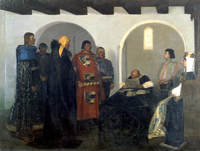
These men were aristocrats from the part of Denmark called Jutland, which is defined by large rural areas.[48] Here again, the queen is represented in the painting wearing the same head linen, cape, and dress as on the sarcophagus. However, Slott-Møller has added the lions of the Danish coat of arms on her dress, likely to emphasize Margrete’s status as a Danish queen. As on the cover of the magazine, the queen is represented upright, her eyes are open, and she faces left. In the painting, however, Slott-Møller has depicted her entire body and placed her on a gothic-style throne in a white room with two arches and a dark ceiling supported by wooden beams. Behind the queen, a small, arched window lets in light.
Slott-Møller’s painting drew a great deal of attention when it was first exhibited. The question of gender was a recurrent theme in its reception, especially among male critics. In a review of the painting in 1890 in the newspaper Politiken, the writer Sophus Michaëlis (1865–1932) emphasized how Margrete was represented as “upright and male”;[49] in 1891, Karl Madsen noted in wonder that the painting showed no trace of being the work of a “woman’s hand and spirit.”[50] In another review of the artwork in 1901, the critic Nicolaus Lützhøft seemed offended by the representation of the men and was mystified as to why anyone would choose to paint this scene:
Perhaps one might think that it could be in a female artist’s interest to demonstrate a clever woman’s advantage over a group of contemptible men; but if one approaches the painting with that expectation, disappointment can hardly fail to ensue. For even though sympathy and intelligence are on the woman’s, Queen Margrethe’s, side, they are not particularly crushing, and are in stark contrast to the incredibly stupid Jutlanders.[51]
The contrast between the queen and the men is, as Lützhøft points out, considerable. The queen is represented as a stoic, calm, and proud ruler, while the men who stand before her and represent the Jutlandic aristocracy are represented as brutes and look like stereotypes.[52] The man in the back is tall and lanky, while the two in the front are short and stocky. In the middle of the painting a short, blond man has a black eye. The oldest of the men wears a yellow hood and has a posture that looks like a vulture’s as he bows his head toward the queen. In the back, a man appears as a silhouette against the room’s white walls and looks up in shame. Next to this group of men sits an anonymous scribe at the end of the table separating the queen from the noblemen. He hides behind the document that he holds in his hands. Beside him, we see Queen Margrete’s adoptive son, the king, Erik of Pomerania. But while Lützhøft assessed the painting from a gendered perspective and considered the possibility that it represented an attack on men, that is not what the author Clara Bergsøe noticed.[53] In the article “Agnes Slott-Møller” in Julealbum from 1902, she describes the painting as follows:
The tone of the painting is stiff and harsh, like the very time it depicts. The costumes are disturbingly faithful down to the smallest detail, but the artist has captured that wild period in the heart, has—so to speak—seized it by the throat of its defiant recklessness. And yet—here sits the queen, who knows how to handle even the wildest men’s rudeness; before her authority, it pauses for a moment before accelerating away from it twice as fast.[54]
Bergsøe appreciates how the work represents a contrast between the rawness of the men and the authority of the queen, who appears to be a calm presence in an otherwise turbulent period. That emphasis, however, is not necessarily to be understood as a gendered interpretation of the work, celebrating women over men. In a letter to Slott-Møller dated December 29, 1903, Bergsøe describes her concerns about the women’s movement’s attacks on men in a comment about her own work on a book about the Norwegian author Camilla Collet (1813–95): “Mrs. Collet’s production is not very large. I would not engage in her violent attacks on men. The women’s cause would [?] suffer from it.”[55] Seen in this light, Bergsøe’s emphasis on the contrast between “the wildest men’s rudeness” and the authority of the queen should be understood not as intended to humiliate men but rather as praise for the queen in her reprimanding of a group of wrongheaded citizens who had stolen land belonging to the Danish state. For Bergsøe, this contrast might well represent a moral conflict between classes rather than a confrontation between men and women.

When the painting was donated to the Women’s Reading Club in Copenhagen in 1904, it entered one of the important institutions of the Danish women’s movement, a context that has affected its interpretation in recent literature.[56] The club was a private library for women, offering a new public space for women in which they could borrow and read books, journals, and magazines and acquire new knowledge. The club also arranged talks by prominent women who were authors or activists for the women’s cause.[57] In a photograph from 1906, the painting is seen hanging in the club’s tearoom, with women taking their tea in front of it (fig. 7). In her book about the Women’s Reading Club from 2008, the librarian Helle Hvenegård-Lassen has pointed to the symbolic meaning of the motif of Queen Margrete, Erik of Pomerania and the Jutlandic Aristocracy in the context of the club. She sees the queen as repossessing something that had been taken from her, drawing an analogy between the queen and the women’s cause.[58] Thus, Hvenegaard-Lassen interprets the painting from the gendered perspective introduced by Lutzhöft, but with emphasis on the women’s movement’s struggle to gain rights for women. This interpretation of the painting does not align with Bergsøe’s account of the work. The question of gender and/or the struggle for equal rights is not reflected in Bergsøe’s interpretation of the painting and does not seem to have been articulated by women of the time. Rather, the queen was seen as a role model.
The Lineage from Queen Margrete to Crown Princess Louisa

The representation of Margrete, which can be traced back to the effigy of the sarcophagus, was also used, and further developed, in connection with Kvindernes Udstilling fra Fortid og Nutid of 1895. The idea behind this exhibition was to show how women from all levels of society had come together for the advancement of women’s work, historical records and contemporary examples of which were presented. The exhibition committee thereby wished to show how women’s work had moved beyond the confines of the home in the past to a broader social realm in the 1890s, when women also worked outside the home.[59] Inspired by the World’s Columbian Exposition held in Chicago in 1893, which had celebrated the four-hundred-year centenary of Christopher Colombus’s arrival in the Americas, the Danish exhibition of 1895 also sought to showcase a historical moment to look back upon and be encouraged by, framed around Queen Margrete.[60] In so doing, they nationalized the historical narrative presented in the exhibition. As part of this narrative, the women on the exhibition committee decided to present a tapestry to the Danish Crown Princess Louisa and her husband, Crown Prince Frederik VIII, in 1894 on the twenty-fifth anniversary of their wedding. After some delay, the tapestry was ready for the exhibition in 1895 (fig. 8) and was eventually presented to the couple a few days before Kvindernes Udstilling fra Fortid og Nutid closed.[61] It was designed by Slott-Møller and woven by Emma Fischer. At the center of the tapestry, Slott-Møller positioned Queen Margrete, once again representing her as she was depicted in the effigy. This time, however, the queen is standing and seen from the front so that her garments are more visible, leaving no doubt that the sarcophagus was the model for her figure in the tapestry: She is depicted in the same dress with the hanging bells and the same double cape, and she holds her hands in the same position.[62] Again, as in the nameplate for Kvinden og Samfundet, her eyes are open. She is depicted against a background of three-leafed clover, and on each side of her are texts from Rimkrøniken, the Danish rhymed chronicle, a document that was likely written by several authors and finished around 1477, some sixty-five years after the queen’s death.[63] It was published in 1495 by Gotfred of Ghemen—the first book ever published in the Danish language.[64] The verses of the chronicle are dedicated to kings and queens and written in their own voices. Many of the verses begin with a sentence which points to a moral imperative. Queen Margrete’s verse is oriented toward men:
I ask of all good men / To honour all good Women! / And I give you that advice / To remember it carefully / That although they are fragile by nature / They often do manly things.[65]
At the top of the tapestry is Crown Princess Louisa’s motto, “Omnia cum Deo / Nihil sine deo” (Everything with God / Nothing without God); below, in roman numerals, are the years of Louisa and Frederik’s wedding (1869) and their twenty-fifth anniversary (1894). Represented around the figure of Queen Margrete are four different coats of arms from the North: the Danish coat of arms, the present-day Swedish coat of arms, the former Swedish coat of arms, and the Norwegian coat of arms.[66] Having been born a Swedish-Norwegian princess, Louisa in 1895 became a Danish crown princess. Sophie Oxholm (1848–1935), first president of the committee for the exhibition Kvindernes Udstilling fra Fortid og Nutid, perceived the crown princess as a leading figure who could unite Nordic women. In the tapestry, this role was symbolized by the coats of arms of the countries that Queen Margrete had united in the Kalmar Union.[67]

The distinct representations in the tapestry point to different temporalities. For the women of 1895, the tapestry merged past and present by combining the semiotics of the sarcophagus, the verse from the Danish rhymed chronicle, and the motto of the crown princess. The representation echoing that on the sarcophagus pointed to the late Middle Ages; the text from the rhymed chronicle was directed (with a moral imperative) toward a future viewer reading about the Middle Ages; and, in a late nineteenth-century context, the motto of the crown princess represented a contemporary voice. As a further temporal layer, the representation from the effigy was made in an archaic, medieval style that mimicked the style of wall paintings from Danish medieval churches such as Saint Bendt’s Church in Ringsted (fig. 9).[68] The tapestry is woven in earth tones that mimic the mineral colors of this type of wall painting, and the imagery is stylized. The flat, two-dimensional figure of Queen Margrete contrasts with the actual effigy, which is more naturalistic. Furthermore, the tapestry shows simplified architectural elements, such as the gothic arches, to create a pictorial space, which is also seen in the wall painting in Saint Bendt’s Church.
The art historians Alexander Nagel and Christopher Woods have argued that the idea of the anachronic is important in the understanding of Renaissance art, as the temporal instability of the artwork is used as an “occasion for reflection on that instability.”[69] Rather than trying to understand the artwork solely in terms of the time of its origin, they argue that we should investigate how the artwork deals with time and what it does.[70] Nagel and Woods write that “the work of art when it is late, when it repeats, when it hesitates, when it remembers, but also when it projects a future or an Ideal, is ‘anachronic.’”[71] The tapestry’s fusion of the representation of the queen that references the sarcophagus, the texts, and the archaic style seems to destabilize the distance in time between the women’s movement of the nineteenth century and the queen herself, pointing both backward to the past and forward to the present. This destabilization in time is used strategically to highlight the relevance of the queen to women in the late nineteenth century, legitimating the women’s movement in the past but also marking its direction for the future.

This strategy can also be seen in the nameplate of 1902 on the cover of Kvinden og Samfundet, in which the connection between Queen Margrete and contemporary women was further emphasized by the addition of the motto “As the woman of today, so the lineage of the future” (fig. 10).[72] Rather than defining the tapestry as symbolist or as an example of another stylistic program, I argue that it is important that we recognize these chronologically targeted elements in the image, as this approach to the sign of Queen Margrethe offers an explanation of how a medieval queen could serve as a leading figure for the Danish women’s movement in the nineteenth century.
The Sarcophagus as a Site of Reflection
In 1912, to mark the five hundred years since Queen Margrete’s death, the restored and reconstructed sarcophagus was presented to the public. The Danish Women’s Society was represented on the occasion by six members, including Lemche, who gave a speech in which she reflected on the importance of the sarcophagus.[73] She called the tomb effigy a sphinx, and considered the queen to be an enigma:
Like a Sphinx on a Sarcophagus, Queen Margrethe’s figure rests over the cause of the North. Generation after generation, man after man, has stood victoriously before the Sphinx and spoken the words intended to solve the riddle; but the Sphinx’s stone eye has stared past them indifferently, and its heavy body has each time rested even heavier on the lid.[74]
Lemche’s answer to the riddle of how Queen Margrete had managed to create the Kalmar Union was that the queen combined both male and female qualities.[75] Among her female qualities were her patience, selflessness, and justice as well as her love and piety; among her male qualities were her drive and strength. Lemche emphasized that collaboration between men and women in the democracies of the North would lead to a new time of flourishing.[76] The Danish Women’s Society also wrote a song for the occasion, which repeats some of the points Lemche made in her speech and adds to a more detailed understanding of how the women’s movement understood the sarcophagus.[77] One of the verses is:
Neither brush nor chisel thy image gave us,
A strange woman slumbers in the stone of thy tomb.
But, chiseled in a deed that shall never pass away,
The enigma of Thy image stands for the generations.[78]
The verse reveals that these women did not believe that the queen looked like the figure on the sarcophagus,[79] only that, through her actions, she had changed history. This indeterminacy of the queen was not necessarily negative, since her representation could be associated with an openness that allowed her to be framed within the agenda of the women’s movement. In the speech, in the song, and in the text of the nameplate, the women’s movement used the medieval sarcophagus as a sign of women’s potential in the present.
A Danish Joan of Arc?
The temporal distance between the nineteenth century and the Middle Ages created an imaginative space in which women’s opportunities could be negotiated and redefined. The status of Queen Margrete within the Danish women’s movement can be compared with the role of Joan of Arc in the British and US women’s movements in the early twentieth century. Both were historical figures from the Middle Ages and served as important exemplars for contemporary women. The medievalist Suzanne LaVere argues that Joan of Arc as a figure of the distant medieval past was a symbol that could be used to promote a plurality of different causes in the present.[80] Queen Margrete, considered as a symbol, shared the same malleability. However, the representations and attributes of these two medieval women are markedly different and are the result of contrasting approaches to the cause of women. In her work on the visual culture of the English women’s movement, the art historian Lisa Tickner points to the “militant woman” as an archetype used by the British women’s movement. According to Tickner, the militant woman “claimed her ‘womanliness’ from another source, that of female heroism in history, allegory, and myth.”[81] Tickner considers Joan of Arc to be an example of this type of woman. While she was widely used by early twentieth-century women’s movements in the UK and the US, Joan of Arc was absent from the suffrage imagery of the French women’s movement of the same period. In France, by contrast, she was employed in the promotion of nationalism, and her imagery was used to promote the restoration of monarchical authority.[82] French women of the late nineteenth century distanced themselves from Joan of Arc, wishing to obtain the vote by “ladylike” means and disavowing the militancy with which Joan of Arc was associated.[83]

Danish women also shared these concerns in relation to representations of Queen Margrete. In articles in Kvinden og Samfundet, both Lemche and the writer Emma Gad (1852–1921)[84] suggested that an equestrian statue of the queen sculpted by the artist Carl-Nielsen, who had already made a model for such a monument in 1897, should be placed in Copenhagen (fig. 11).[85] Gad’s suggestion was published in the magazine in 1910 and Lemche’s in 1915, on the occasion of Danish women gaining the right to vote on March 5, 1915. As a contribution to the debate, Signe Bjerregaard, a member of the Danish Women’s Society, wrote that she would prefer a monument that represented the queen sitting on her throne or giving her advisors commands rather than as “an Amazon on horseback.”[86] This was clearly an exaggeration, as Carl-Nielsen’s model for the equestrian statue was far from the idea of the Amazons of Greek myth, who were often represented bare-breasted on horseback and participating in war.[87] Carl-Nielsen’s queen was represented fully clothed, calmly sitting upright, and riding sidesaddle, a style of riding that contrasts with the idea of the Amazon, as it is associated with genteel women wearing long skirts. The prospect of any association of a woman with an Amazon in the public debate about women’s rights was considered undesirable at this time. In 1905, Lemche noted that upper-class Copenhagen society saw the members of the women’s movement as “manly Amazons” and used this as their pretext for not engaging in the women’s cause.[88]

The association of Joan of Arc with a strong female personality was also used critically during this time. In his memoir, Harald Slott-Møller (1864–1937), Agnes Slott-Møller’s husband, who was also an artist, describes an episode when the Danish critic Georg Brandes (1842–1927) came to visit his studio in 1887. On seeing the monumental portrait of Agnes on which Harald was working at the time, Brandes noted, “Yes, that is indeed Joan of Arc just before she is to mount the pyre.”[89] The portrait represents Agnes in full figure, seen from slightly below, smiling and looking beyond the picture frame (fig. 12). Harald notes in his memoir that while the critic’s comment was off the mark, there was a grain of truth in it, as Harald thought there was a hint of heroism in Agnes’s personality. He does not explain why he considered the comment off the mark, but there do seem to have been negative opinions associated with Joan of Arc as well as with the idea of the heroic woman.

In Grundtvig’s poem Roskilde Rhyme, he calls Queen Margrete “the Amazon of the North”; nothing, however, in the effigy’s representation of the queen points to this conception of her as a warrior. However, the image of the warrior woman was present in Denmark, for example in Stephan Sinding’s (1846–1922) statue Valkyrie from 1908 (fig. 13), in which a woman is represented as a bare-breasted warrior riding a horse and raising her spear, ready to attack. The wind is blowing her hair and cape, and she is pulling the harness of the horse with her mouth open, a sign of physical exertion. The sculpture is defined by a dramatic, diagonal forward thrust. The women’s movement did not, however, appropriate this more aggressive representation of a woman. Instead, the magazine Kvinden og Samfundet continued to use on its cover the representation of Queen Margrete as she was represented on her sarcophagus.
In her speech of 1912, Lemche emphasized how patience and piety were female qualities while drive and strength were male. By choosing this stoic representation of the queen, members of the Danish Women’s Society focused on her qualities that supported an image of women as calm, decent, and able to fulfill their roles both in the home and in society at large, in contrast to the idea of women as Amazons or valkyries.
Nationalist Medievalism and the Agency of Women
When the pioneers of the Danish women’s movement chose to create a national independent organization rather than continue to be a division under the French Association Internationales des Femmes, they chose to focus on the rights of women as a national rather than an international matter. The choice of Queen Margrete as a leading figure for the Danish Women’s Society supported this national emphasis. The historian Anne-Marie Thiesse has argued that strong national identities were created in Europe in the nineteenth century, and that common among these European identities was that they chose their founding figures.[90] Queen Margrete served as such a figure for the Danish women’s movement. The movement used the semiotics of the sarcophagus and the figure of the queen in a new way to foreground the needs and rights of women.
On the cover of Kvinden og Samfundet and on the tapestry made for the exhibition Kvindernes Udstilling fra Fortid og Nutid, the queen was presented as a role model for Danish women. By choosing a national figure, the Danish Women’s Society and the committee behind the exhibition conformed to an existing nationalist agenda in Danish culture, which was cultivated in the wake of the territorial losses of the nineteenth century. However, they also framed the queen in such a way that she could be used to legitimize why women should have better rights in the family and in society. In this way, they articulated a progressive aim within the framework of the national historical narrative.
The Danish women’s movement used the semiotics of the sarcophagus and the figure of the queen in a new way to foreground the needs and rights of women. While Queen Margrete was a known figure and mentioned as a strong woman (for example, in the long poem Dronning Margrete [Queen Margrete] from 1836 by Ingemann),[91] the use of the queen in a political context was new and can be seen as an example of what Boyle defines as activist medievalism, where medieval figures are framed in new, progressive ways. But where Boyle links activist medievalism with international medievalism, I have argued that nationalist medievalism can also be activist. One of Boyle’s examples of activist medievalism is the way Joan of Arc was used in processions in the United States, as described by Suzanne LaVere.[92] In contrast, the use of the representations of the queen was much more diplomatic in Denmark, exemplifying a more quiet “activist medievalism”: Her image was not used on protest banners, and there were no marches centered around the queen. The women’s movement was careful to activate its agenda using signs that were already circulating in Danish culture. Choosing the representation of the queen from the effigy of the sarcophagus underlines the value of the queen as a national symbol. Placed in Roskilde Cathedral under the same roof as other Danish kings and queens, it situates her in a lineage of national power. The Danish Women’s Society framed this portrayal to promote and legitimize the role of women within Danish society at the turn of the century. In the new public spaces of the women’s movement, such as the Women’s Reading Club and the exhibition Kvindernes Udstilling fra Fortid og Nutid, the representation of the queen from the effigy gained new meanings. In 1912, the Danish Women’s Society used the five-hundredth anniversary of the queen’s death as an occasion on which to underline their claim that the queen’s female qualities—her patience and piety—played an important role in her success. These are the qualities, along with stoicism, that the queen’s effigy reflects. Their admiration for these qualities can serve as an explanation for why the editors of Kvinden og Samfundet maintained this portrayal of her on the cover of the magazine for almost a century.
Agnes Slott-Møller’s works contributed new narratives about the queen that appealed to the women’s movement. Her works depicted the queen as a strong regent and created a lineage between the queen and nineteenth-century women, thereby supporting the argument about why the queen was a role model for women in the past, present, and future. This idea of the queen was in line with the agenda of the women’s movement and was likely articulated by Oxholm, the first president of the exhibition committee for Kvindernes Udstilling fra Fortid og Nutid, when she understood Crown Princess Louisa as a modern-day Queen Margrete.
Postscript

On the occasion of International Women’s Day on March 8, 2024, the Danish minister of culture, Jakob Engel-Schmidt, stated that “our history is full of women who should have been cast in bronze and hold a prominent position in our history and in our cities. But they are not there.”[93] Lemche, Gad, and Carl-Nielsen campaigned for Queen Margrete to be represented in a monument installed in a central location in Copenhagen, but at the time they did not succeed. Perhaps the women’s movement was a little too hesitant about representing the queen with the equestrian statue, because she appeared too militant. In any case, the sarcophagus remained the only monument dedicated to the queen until 2006. A century after discussions about raising Carl-Nielsen’s equestrian statue had first begun, the statue was finally installed in Roskilde (fig. 14).[94] Perhaps the time has now come for a new representation of the queen in central Copenhagen, to honor not only the important role she played in the establishment of the Kalmar Union but also the female agency she inspired in the first wave of the Danish women’s movement and among Danish women artists.
Notes
All translations are my own, except where otherwise noted. Gyrithe Lemche and the Danish Women’s Society spell the name Margrete with an h (Margrethe). In the article I have chosen to follow Vivian Etting’s spelling of the queen’s name in her book Margrete 1: En regent & hendes samtid, 4th ed. (Gyldendal, 2021).
[1] These sites are but two that represent the women’s movement. A number of specialized organizations advocated for the interests of working women. Though neither the Women’s Reading Club nor Kvindernes Udstilling fra Fortid og Nutid was directly associated with the Danish Women’s Society, I consider these institutions to be associated with the women’s movement, as they were all forums in which the rights and possibilities for women were directly or indirectly pushed forward.
[2] Several recent dissertations explore the marginalization of Danish female artists such as Bertha Wegmann (1846–1926), Anne Marie Carl-Nielsen (1863–1945), and Elisabeth Jerichau-Baumann (1819–81). The art historian Emilie Boe Bierlich examines the structural sexism that defines the discipline of Danish art history and has led to the exclusion of female artists from canonical art history. She articulates the strategies that Wegmann and Carl-Nielsen used to make room for an artistic practice in a society defined by patriarchal and phallogocentric structures. In this connection, Boe Bierlich suggests that Carl-Nielsen chose a mimetic strategy, working with a narrative that framed her as a child of the countryside and a woman bound to nature—an idea that followed a widespread conception that women were in a symbiotic relationship with nature. The art historian Sine Krogh focuses on the importance of the conception of a national art for nineteenth-century Danish artists and the concomitant exclusion of artists, including Jerichau-Baumann, who were not identified as Danish in the canon of art history. Emilie Boe Bierlich, “Excentriske slægtskaber: En mobilitetsbevidst gentænkning af danske kvindelige kunstnere ca. 1880–1910” (PhD diss., University of Copenhagen, 2020); and Sine Krogh, “Grænsegængere: Konflikter om nationalæstetik, kunstneridentiteter og danskhed i 1800-tallets kunst” (PhD diss., Aarhus University, 2021).
[3] Marsha Meskimmon, We Weren’t Modern Enough: Women Artists and the Limits of German Modernism (I. B. Tauris, 1999), 5. Meskimmon examines artworks made by female artists representing different female archetypes such as the prostitute, the mother, and the “New Woman” in the Weimar republic in the 1920s and 1930s. These artworks were executed in a realist style, which Expressionists considered to be reactionary but offered a mode of expression for female artists. Meskimmon examines a wide range of visual material across different media.
[4] The exhibition was on view at the Hirschsprung Collection in Copenhagen and Randers Art Museum in Randers in 2024–25. For the English-language version of the catalogue, see Inge Lise Mogensen Bech and Lene Bøgh Røngberg, Women Artists in Denmark 1880–1910, exh. cat. (Aarhus University Press; Yale University Press, 2025); the Danish-language version is cited in note 5.
[5] Lene Bøgh Rønberg, “Handsken i hånden,” in Kvindernes moderne gennembrud 1880–1910, ed. Inge Lise Mogensen Bech and Lene Bøgh Rønberg, exh. cat. (Den Hirschsprungske Samling, 2024), 210–27.
[6] Mieke Bal and Norman Bryson, “Semiotics and Art History,” The Art Bulletin 73, no. 2 (June 1991): 174–208, https://doi.org/10.2307/3045790 [login required].
[7] Bal and Bryson, “Semiotics and Art History,” 178.
[8] Hans Dam Christensen, Forskydningens kunst: Kritiske bidrag til kunsthistoriens historie (Multivers, 2001), 97.
[9] On the occasion of Danish women gaining the right to vote in 1915, the Danish Women’s Society marched in the streets of Copenhagen with a banner representing the young woman Kirsten Svendsdatter, who found one of two golden horns in 1639—a richly decorated national treasure made in ca. 400 CE. When the golden horns were stolen, the national poet Adam Oehlenschlager wrote a poem about them in 1803. Oehlenschlager made them a symbol of lost national grandeur. The use of Svendsdatter on the banner challenged the status of Queen Margrete as the leading figure of the movement; however, the Danish Women’s Society kept representing Margrete on the cover of their magazine. The process of developing the banner exemplifies the disagreements around the symbolism of the movement and the opposition to the use of Queen Margrete, which is seen in the minutes of the meetings of the Danish Women’s Society and in articles in Kvinden og Samfundet. For the protocols of the Danish Women’s Society, see “Styrelsesmøde med kredsformændene 27. Januar 1911,” KVINFO, accessed September 8, 2025, https://www.kvinfo.dk/. See also Dorothea Sandal Jeppesen, “Et Ord om Bannersagen fra en af de 14,” Kvinden og Samfundet, September 30, 1911, n.p.
[10] Peter Nørgaard Larsen and Magnus Olausson, introduction to Dansk guldalder: Verdenskunst mellem to katastrofer, ed. Cecilie Høgsbro Østergaard, exh. cat. (SMK – Statens Museum for Kunst, 2019), 14–25.
[11] Sine Krogh and Rasmus Glenthøj, “Introduktion: De forskellige nederlag,” in I nederlagets skygge: Andre kunsthistorier om 1800-tallet, ed. Sine Krogh, exh. cat. (Museum Sønderjylland, 2023), 8.
[12] In this article I focus on the reception of two works by Agnes Slott-Møller representing Queen Margrete, which circulated within the Danish women’s movement. Slott-Møller made a third work representing the queen: Queen Margrete and Erik of Pomerania is dated 1884 or 1887 and is in the collection of the Kunstmuseum Brandts, Odense, but it does not seem to have been well known in the 1880s and 1890s. The work does not figure on the list of works from the spring exhibition at the academic Charlottenborg exhibition in 1884 or 1887. There is a large amount of archival material on Agnes Slott-Møller at Det Kongelige Bibliotek (The Royal Danish Library) in Copenhagen, but the collections of reviews of the exhibitions she participated in begin with reviews of Queen Margrete and the Jutlandic Aristocracy, 1889–90, exhibited in 1890 at the Charlottenborg exhibition. This is the case in both the collection of press clippings related to various artists, titled “Hjalmar Bruhns udklipssamling” in Det Kongelige Bibliotek, and in the collected reviews of Agnes Slott-Møller’s and her husband Harald Slott-Møller’s exhibitions, in Harald og Agnes Slott-Møller’s Efterladte Papirer, NKS 4839, box 98, IV, 5, Det Kongelige Bibliotek.
[13] Lis Møller, “For konge og fædreland: Valdemar Sejr hos B. S. Ingemann og Agnes Slott-Møller,” Passage 34, no. 81 (2019), https://doi.org/10.7146/pas.v34i81.114432; and Lis Møller, “Agnes Slott-Møller og middelalderismen,” in Agnes Slott-Møller: Helte og heltinder, ed. Erlend G. Høyersten (Aros, 2018).
[14] Slott-Møller has also been categorized as a follower of Edward Burne-Jones in the exhibition Edward Burne-Jones: The Pre-Raphaelites and the North (2020) and as a Pre-Raphaelite in the Danish exhibition Symbolism in Danish and European Painting 1870–1910 (2000). See also Alison Smith et al., Edward Burne-Jones: The Pre-Raphaelites and the North, exh. cat. (KODE, 2020); and Peter Nørgaard Larsen and Charlotte Christensen, Symbolism in Danish and European Painting 1870–1910, exh. cat. (SMK – Statens Museum for Kunst, 2000). This interpretation of her practice is in line with her own self-understanding as expressed in her memoirs Folkevisebilleder [Folk ballad images], in which she categorizes herself as a Danish Pre-Raphaelite. Agnes Slott-Møller, Folkevisebilleder (H. Aschehoug, 1923), 13.
[15] Edward Burne-Jones (1833–98) and Dante Gabriel Rosetti (1828–82), who were a generation older than Slott-Møller, were highly inspiring to her. There were several female Pre-Raphaelites, including Marie Spartali Stillman (1844–1927). While Slott-Møller could have been familiar with Stillman’s work, Slott-Møller herself mentioned in Folkevisebilleder only the inspiration she found in the older male generation of Pre-Raphaelites. A note in a newspaper from 1895 reported that Slott-Møller objected to being called “Malerinde fru Slott-Møller” (paintress Mrs. Slott-Møller), preferring instead the designation “Maler Slott-Møller” (painter Slott-Møller). “Hvorfor Kammerherrerinden gik,” Frederiksborg Amts-Tidende og Udrejseavis, June 22, 1895. It may have been intentional that, when referring to the great painters of her time, she avoided mentioning other female artists, thereby distancing herself from a female art history.
[16] Thor J. Mednick and Karina Lykke Grand, “The Shifting Contours of Danishness: Agnes Slott-Møller, Kunstnergaven, and the Duties of Nationalism,” in Culture and Conflict: Nation-Building in Denmark and Scandinavia, 1800–1930, ed. Sine Krogh, Thor J. Mednick, and Karina Lykke Grand (Aarhus University Press, 2022), 127–44.
[17] In her book Folkevisebilleder, Slott-Møller does not mention any explicit engagement with the Danish women’s movement, but the circulation of her works shows a different picture.
[18] I have discussed these issues in my article “Women’s Art and Peasant Painters: On Gender Discourse in the Peasant Painter Feud and Agnes Slott-Møller’s Resistance,” in which I argue that it is necessary to challenge this positioning of Slott-Møller, as she was marginalized on the basis of gendered parameters of qualification. Katrine Bruun Jørgensen, “Women’s Art and Peasant Painters: On Gender Discourse in the Peasant Painter Feud and Agnes Slott-Møller’s Resistance,” Perspective (August, 2023), https://www.perspectivejournal.dk/.
[19] Gyrithe Lemche, Dansk Kvindesamfunds Historie Gennem 40 Aar: Med Tillæg 1912–1918, rev. ed. (Gyldendalske Boghandel, 1939), 22–23. Originally published in 1912.
[20] The statement of purpose is paragraph 1 in the statutes of the Danish Women’s Society, as they were stated on February 24, 1871, when the organization was first founded: “§1. Dansk Kvindesamfunds Formaal er at hæve Kvinden i aandelig, sædelig og økonomisk Henseende og saaledes tillige at gøre hende til et selvstændigere og virksommere Medlem af Familie og Stat navnlig ved at aabne hende Adgang til Selverhverv.” Lemche, Dansk Kvindesamfunds Historie Gennem 40 Aar, 24.
[21] Lemche, Dansk Kvindesamfunds Historie gennem 40 Aar, 324. For an overview of women’s political efforts to gain the right to vote, see Bodil Olesen, “Kvindelig valgret 1849–1915,” Danmarkshistorien, lex.dk (Danmarks Nationalleksikon), last modified August 2025, https://danmarkshistorien.lex.dk/.
[22] The suffrage groups in the UK held demonstrations and processions beginning in 1908. The Coronation procession in 1911 was led by Marjorie Annan Bryce dressed as Joan of Arc, who was staged as a leader. Bryce was on horseback wearing a knight’s helmet and a kirtel. Colleen Denney, The Visual Culture of Women’s Activism in London, Paris and Beyond: An Analytical Art History, 1860 to the Present (McFarland, 2018), 4. In the US, suffrage parades arranged by different leaders and groups started to spread across the country in the 1910s, many of which featured a woman playing Joan of Arc. Suzanne LaVere, “‘The Great Original Suffragist’: Joan of Arc as a Symbol in the US Women’s Suffrage Movement,” in International Medievalisms: From Nationalism to Activism, ed. Mary Boyle (D. S. Brewer, 2023), 192.
[23] Boyle problematizes some of the paradoxes of working with a divide between the national and the international, and she operates with Benedict Anderson’s understanding of nations as “imagined political communities,” meaning that nations are constructed by the people who consider themselves a part of them. Boyle emphasizes that the volume’s subtitle, “from nationalism to activism,” is not to be understood as a statement about chronology or progress, but the binary between national and activist medievalism is present in Boyle’s framing of activist medievalism. Mary Boyle, introduction to International Medievalisms, 9.
[24] Boyle, introduction to International Medievalisms, 10.
[25] Boyle, introduction to International Medievalisms, 9.
[26] Lone Kølle Martinsen, “‘A Shieldmaiden Born to Fight and Love’: A Conceptual History of Kvinder and Old Norse Mythology in Grundtvig, Ingemann and Oehlenschläger’s Romantic Poetry,” in Mythology and Nation Building: N. F. S. Grundtvig and His Contemporaries, ed. Sophie Bønding, Lone Kølle Martinsen, and Pierre-Brice Stahl (Aarhus University Press, 2021) 195–232.
[27] N. F. S. Grundtvig, “Clara Raphael,” Danskeren, January 4, 1851, 321–30. The year of publication noted on the book’s title page is 1851, but the book was published in December 1850.
[28] Gyrithe Lemche calls Fibiger the guardian of the Danish Women’s Society. Lemche, Dansk Kvindesamfunds Historie gennem 40 Aar, 11. Eva Hemmer Hansen calls her the saint of the Danish Women’s Cause. Eva Hemmer Hansen, Blåstrømper, rødstrømper, uldstrømper: Dansk kvindesamfunds historie i 100 år (Grevas, 1970).
[29] Sune Auken, “Skandalesuccesen Clara Raphael,” Dansk litteraturs historie, lex.dk (Danmarks Nationalleksikon) last modified January 2020, https://dansklitteraturshistorie.lex.dk/Skandalesuccesen_Clara_Raphael.
[30] “‘A Shieldmaiden Born to Fight and Love,’” 201–2.
[31] Lone Kølle Martinsen, “Nordens Amazone: N. F. S. Grundvig om Dronning Margrete 1,” in Konge og kirke: Festskrift i anledning af Michael Bregnsbos 60-års dag, ed. Rasmus Glenthøj et al. (Syddansk Universitetsforlag, 2022), 177–92.
[32] In one article, a woman describes how she dreams of Margrete; in another, the queen is used as a point of reference when women defend their right to work outside the home. In the digitized version of the magazine, the articles about the queen are tagged with “Dronning Margrethe I,” showing thirty-five references from 1911 to 1953. A search using the term “Dronning Margrethe” (Queen Margrethe) results in additional hits. See KVINFO, https://www.kvinfo.dk/.
[33] “Bladet skulle hedde ‘Kvinden og Samfundet,’ og under denne Titel skulde der paa Forsiden anbringes en Vignet med Dronning Margrethes Hoved fra Sarkofagen I Roskilde Domkirke.” Lemche, Dansk Kvindesamfunds Historie gennem 40 Aar, 41.
[34] Etting, Margrete 1, 149.
[35] Anders Bøgh and Doron Haahr, Kalmarunionen, 1397–1523, Danmarkshistorien, lex.dk (Danmarks Nationalleksikon), last modified August 2025, https://danmarkshistorien.lex.dk/.
[36] “Mindefest for Dronning Margrete – Paa 500-Aarsdagen for Dronningens Død,” Roskilde Avis, October 5, 1912.
[37] Kølle Martinsen, “Nordens Amazone.”
[38] Etting, Margrete 1, 328.
[39] The figures on the sides of the sarcophagus are newer additions, added as part of the restoration of the sarcophagus done by Frederik Gottlieb Herzog (1821–92) and Carl Aarsleff (1852–1918) and finished in 1912. When the nameplate for the magazine was made, there were no figures on the sides of the sarcophagus, only the naked tumba made of Belgian marble and the effigy. See the photograph in Tage E. Christiansen, “Middelalderlige Kongebegravelser,” in Danmarks Kirker. 3, Københavns Amt, ed. Erik Moltke et al. (Gad, 1944), 1804. Christensen also gives an account of the badly damaged original figures.
[40] Etting, Margrete 1, 327.
[41] Etting, Margrete 1, 328.
[42] Christiansen, “Middelalderlige Kongebegravelser,” 1781–1831.
[43] Christiansen, “Middelalderlige Kongebegravelser,” 1813.
[44] On the cover of the very first issue of Kvinden og Samfundet, the nameplate was made after a woodcut by Hans Peter Hansen and printed by the workshop Aagaard and Kittendorph in Copenhagen. Hansen’s woodcut was originally made for the history book Nordens Historie, written by Niels Bache, and was included among the many portraits in the book. See Niels Bache, Danmarks, Norges og Sverigs Historie: Populært fremstillet efter de bedste trykte Kilder, vol. 3 (Copenhagen, 1871), 5.
[45] Agnes Slott-Møller, Nationale Værdier (H. Hagerups Forlag, 1917), 170. Slott-Møller and Grundtvig shared a great fascination for Danish folk ballads. Pil Dahlerup, “National bevidsthed og kunst,” in Agnes Slott-Møller: Skønhed er til evig glæde, ed. Iben Overgaard (Skovgaard Museet, 2008), 121.
[46] The drawing of the effigy is undated and part of the Agnes and Harald Slott-Møller Archive in the Royal Collection of Graphic Art, SMK – Statens Museum for Kunst. Agnes Slott-Møller hoped to be in charge of the final restoration of Queen Margrete’s sarcophagus, but she did not get the job. Slott-Møller, Folkevisebilleder, 47. The sketch may have been made as a preparation for this assignment or as a preliminary work for the tapestry she made for Kvindernes Udstilling fra Fortid og Nutid in 1895.
[47] “fremlagde de gamle Skøder og Dokumenter og lod de Mænd, der med urette havde Krongodset, indstævne for sig, saa måtte de indfinde sig i at hun gjorde sin Ret og Magt gældende.” Quoted in Hanne Lopdrup, “Dronning Margrethe og den jyske adel: Om Agnes Slott-Møllers billede og dets lange vej til Frederiksborgmuseet,” in Årsskrift / Carlsbergfondet, Frederiksborgmuseet, Ny Carlsbergfondet (Rhodos Internationalt Forlag for Videnskab og Kunst, 1993), 125.
[48] In the letter to Krøyer Agnes Slott-Møller refers to the men as “Jens Hvasser,” meaning men named Jens Hvas. However, there are no known historic records of a meeting between a Jens Hvas and Queen Margrethe, so the event could have been invented. Lopdrup, “Dronning Margrethe og den jyske adel,” 125.
[49] “Dronning Margrethe sidder rank og mandig i den højryggede Stol af udskaaret Træ.” Sophus Michaëlis, “Foraarsudstillingen II,” Politiken, April 10, 1890.
[50] Karl Madsen, “Den fri Udstilling 1891,” Tilskueren 8 (1891), 323–43; and Michaëlis, “Foraarsudstillingen II.”
[51] “man tænker saa måske, at det kunne være i en Kunstnerindens Interesse at vise en kløgtig Kvindes Overtag over en Flok nedrige Mandfolk; men kommer man til Billedet med den Forventning, fejler det næppe, at man lider en Skuffelse. Thi om end Sympatien og Intelligensen er paa Kvindens, Dronning Margrethes, Side saa er den saamænd ikke videre knusende endda og maa navnlig tage Relief fra de utrolig stupide Jyder.” Nicolaus Lützhøft, “Udstilingen ved Charlottenborg IV: Slott-Møller,” Politiken, May 5, 1901. Lützhøft recognizes the intertextuality of the painting as he writes in the same article of the “aging queen still bearing traces of the beauty of the coffin lid” (den aldrende Margrethe—endnu med mindelser om skønheden fra kistelåget), demonstrating that he, too, knew that the model for the depiction was the sarcophagus.
[52] It is not only the nobles of the Jutlandic artistocracy who look like caricatures. Agnes Slott-Møller purposefully represented Eric of Pomerania looking “not very attractive and foreign,” having read his testament in which he attempted to incorporate the empire of Denmark into Germany and in so doing became a foreigner to the artist. Slott-Møller, Folkevisebilleder, 21. For her, the contrast between the queen and the men surrounding her became a question of national values as well. The men in the image who did not support the national agenda of Queen Margrete I were represented as unattractive.
[53] Bergsøe wrote several books about prominent women of the time, including the Norwegian writer Camilla Collet and the Danish-Norwegian author Magdalene Thoresen. See Clara Bergsøe, Camilla Collet: Et livsbillede (Gyldendal, 1902); and Clara Bergsøe, Magdalene Thoresen: Portrætstudie (Gyldendal, 1904). I consider this work to have contributed to the ideals of the women’s movement, as formulated in paragraph 1 of the statutes, and Bergsøe herself to be a representative of the movement.
[54] “Tonen i Maleriet er stiv og haard, som selve den Tid, det skildrer, Dragterne afskrækkende tro til den mindste Enkelthed, men Kunstnerinden har ramt hin vilde Periode i Hjertet, har—saa at sige—grebet den i Struben af dens trodsige Tøjlesløshed. Og dog—her sidder Dronningen, der forstaar at magte selv de vildeste Mænds Raahed, foran hendes Herskeravtoritet standser den et øjeblik for borte fra den at tage dobbelt Fart. Dronning Margrethe kan betragtes som den stærke, haardføre Rod, hvorfra hendes Kunst tager sin Vækst, indtil den ender i Billeder af rent lyrisk Karakter.” Clara Bergsøe, “Agnes Slott-Møller,” Julealbum 11 (1902), n.p.
[55] “Fru Collet’s Produktion er jo ikke meget stor. Hendes voldsomme Angreb paa Mændene vilde jeg ikke tage fat paa. Kvindesagen vilde [. . . ?] tage Skade deraf.” Clara Bergsøe to Agnes Slott-Møller, December 29, 1903, Breve fra fremmede, NKS 4839 kvart, Det Kongelige Bibliotek, Copenhagen (underlining in original).
[56] The donation was funded by the Signe Lehmans Foundation, which was directed by the art and literature critic and journalist Margrethe Vullum. Helle Hvenegård-Lassen, Et andet hjem: Kvindelig Læseforeningens historie 1872–1962 (Det Kongelige Bibliotek, 2008), 217. Vullum was an acquaintance of Agnes Slott-Møller. In 1904, when Vullum was in Copenhagen, Slott-Møller helped her by contacting the director of the Danish Royal Theatre to recommend Vullum’s son Helge Rode to the director. Hanne Engberg, En frigørelseshistorie: Margrethe Vullum 1846–1918 (Gyldendal, 1994), 311.
[57] Hvenegård-Lassen, Et andet hjem, 18.
[58] Hvenegård-Lassen, Et andet hjem, 217.
[59] Sophie Oxholm, Aktmæssig Fremstilling af de Begivenheder, der foranledigede Præsidentskiftet ved Kvindernes Udstilling fra Fortid og Nutid i 1895 (Copenhagen, 1896), 34.
[60] Oxholm, Aktmæssig Fremstilling af de Begivenheder, 41. Another contributor to the representations of Queen Margrete was Harald Slott-Møller, the husband of Agnes. In the Royal Collection of Graphic Art, a drawing for a seal for Kvindernes Udstilling fra Fortid og Nutid is found in a notebook with other drawings made by Harald Slott-Møller. Agnes Slott-Møller is considered to be the artist who designed the seal, but it is likely that Harald Slott-Møller drew the seal, as he worked more often with posters and logos. In the seal, the queen is in a contrapposto pose, not following the style of the sarcophagus, which Agnes Slott-Møller used in the tapestry for the exhibition and the painting Queen Margrete, Erik of Pomerania and the Jutlandic Aristocracy.
[61] Eva Lous, “Kvindernes Udstilling fra Fortid til Nutid 1895,” Rotunden 12 (1999): 44.
[62] In her study from the Royal Graphic Collection of Art, Agnes Slott-Møller also made a separate study of the queen’s hands, which could indicate that the drawing was made as part of Slott-Møller’s work on the tapestry. In either case, she was familiar with the tomb effigy.
[63] Pernille Hermann, “Rimkrøniken: Tradition og erindring i senmiddelalder og tidlig renæssance,” in Romantikkens verden: Natur, menneske, samfund, kunst og kultur (Aarhus Universitetsforlag, 2008), 267.
[64] Hermann, “Rimkrøniken,” 268.
[65] Translation from Kølle Martinsen, “‘A Shieldmaiden Born to Fight and Love,’” 222.
[66] The Danish coat of arms, with three lions surrounded by hearts, stemming from the house of the ancient Danish king Svend Estridsen, appears at the top left of the tapestry; the present Swedish coat of arms, with three crowns on a blue shield, appears at the top right; at the lower left is the former coat of arms of Sweden, with a lion (Folksungeløven) on a blue-and-white-striped background (which, for a brief interval during the reign of Queen Margrete, contained hearts); at the lower right is the Norwegian coat of arms, with one lion on a red shield. Bodil Busk Laursen, “Mellem kunst og idealer,” in Agnes og Harald Slott-Møller: Mellem kunst og idealer, ed. Bodil Busk Laursen and Aino Kann Rasmussen (Kunstforeningen, 1988), 27. In this essay there is a contribution by Lise Warberg, explaining the iconography of the tapestry in detail.
[67] Oxholm, Aktmæssig Fremstilling af de Begivenheder, 42. The use of the queen in the framing of the exhibition led to a heated debate over the exhibition’s symbol, which was changed from the rose associated with the queen to a dandelion at the very last minute. A group of women were dissatisfied with the abandonment of the representations of the queen and still saw her as a strong example. Laura Kieler, “Udstillings-symbolik,” Politiken, June 22, 1895; and Eva, “Indtryk fra Kvindernes Udstilling,” Politiken, September 13, 1895. Why the symbolism of the exhibition was changed is not clear. The art historian Lene Bøgh Rønberg associates the dandelion with strong-willed women of the time, as opposed to the rose, which she sees as linked to beautiful, fragile, elite women. Lene Bøgh Rønberg, “Manglede der noget? Om Bertha Wegmanns bidrag på ‘Kvindernes Udstilling’ i 1895,” in Bertha Wegmann, ed. Gertrud Oelsner and Lene Bøgh Rønberg (Hirschsprung Collection, 2022), 155. This was not how Oxholm saw the rose, which she called a blooming defense, shielding the tower where Margrete lived. Oxholm was engaged in the historical thematization of the exhibition, but when the exhibition opened, she had stepped down. This change in leadership may have affected the change in the symbolism of the exhibition. Oxholm, Aktmæssig Fremstilling af de Begivenheder, 44.
[68] In the Royal Collection of Prints and Drawings there exist different tracings made by Agnes Slott-Møller. One of them is of the grave plate of Erik Menved in Saint Bendt’s Church, box 12, Archive of Agnes and Harald Slott-Møller, Royal Collection of Prints and Drawings, Copenhagen.
[69] Alexander Nagel and Christopher S. Wood, Anachronic Renaissance (Zone Books, 2010), 9.
[70] Nagel and Wood, Anachronic Renaissance, 14.
[71] Nagel and Wood, Anachronic Renaissance, 13.
[72] The motto “Som Nutids Kvinde, saa Fremtids Slægt” was added to the magazine’s nameplate in the issue published on March 8, 1902. The motto was written by the teacher and literary historian Ida Falbe Hansen (1849–1922), inspired by a suggestion sent to the editor of the magazine. “Mottoerne,” Kvinden og Samfundet, March 8, 1902. Falbe was an active member of the Women’s Reading Club and lived with the editor of Kvinden og Samfundet, Elisabeth Grundtvig. Tinne Vammen, “Ida Falbe-Hansen,” Dansk Kvindebiografisk Leksikon, lex.dk (Danmarks Nationalleksikon), last modified April 2023, https://kvindebiografiskleksikon.lex.dk/.
[73] Gyrithe Lemche, “Tale holdt ved Mindefesten for Dronning Margrethe,” Kvinden og Samfundet, October 30, 1912, 202–3.
[74] “Som en Sfinx paa en Sarkofag hviler Dronning Margrethes Skikkelse over Nordens Sag. Slægt efter Slægt, Mand efter Mand har staaet sejrsmodig frem for Sfinxen og sagt de Ord, som var tænkte at skulle løse Gaaden; men Sfinxens Stenøje har stirret dem ligegyldige forbi, og dens tunge Legeme har for hver Gang hvilet endnu tungere paa Laaget.” Gyrithe Lemche, “Tale holdt i Roskilde ved Mindefesten for Dronning Margrethe den 28. Oktober 1912,” Kvinden og Samfundet, October 30, 1912, 202–3.
[75] “Ligesom Styrken til alle Tider har været anerkendt som en mandlig Egenskab, saaledes har Taalmodigheden været anerkendt som en kvindelig; og mandlig Handlekraft og kvindelig Taalmod havde i Margrethe indgaaet en lykkelig Forbindelse, hende og Nordens Riger til Gavn og Hæder.” (Just as strength has at all times been recognized as a masculine quality, so patience has been recognized as a feminine one; and in Margrete, manly decisiveness and womanly patience were united in a happy combination, to the benefit and honor of herself and the kingdoms of the North.) Lemche, “Tale holdt i Roskilde ved Mindefesten for Dronning Margrethe den 28. Oktober 1912.”
[76] Lemche, “Tale holdt i Roskilde ved Mindefesten for Dronning Margrethe den 28. Oktober 1912.”
[77] In particular, the line “Hvo løser Din Gåde: Halv Kvinde, halv Mand?” (Who solves your riddle: half woman, half man) in verse 4 iterates the idea of the queen’s male and female qualities; the closing line, “Igen stædes Folket for Sfinksen i Nord” (Once again the people stand before the Sphinx in the North), repeats the analogy between the queen and the mythical creature of the sphinx. “Dronning Margrethe: I Anledning af 500-Aarsdagen for hendes Død. Den 28. Oktober 1912,” Kvinden og Samfundet, October 30, 1912, 1.
[78] “Ej Pensel, ej Mejsel Dit Billede os gav, / En fremmed Kvinde slumrer i Stenen paa Din Grav. / Men, mejslet i en Gerning, som aldrig forgaar, / Dit Billedes Gaade for Slægterne staar.” “Dronning Margrethe.”
[79] Historians and archaeologists agree on this point, as the figure depicts the queen as a young woman, yet she died at nearly age sixty. Christiansen, “Middelalderlige Kongebegravelser,” 1813; and Etting, Margrete 1, 328.
[80] LaVere, “‘The Great Original Suffragist,’” 191.
[81] Lisa Tickner, The Spectacle of Women: Imagery of the Suffrage Campaign, 1907–14 (Chatto & Windus, 1987), 207.
[82] Denney, The Visual Culture of Women’s Activism in London, Paris and Beyond, 97–98.
[83] Denney, The Visual Culture of Women’s Activism in London, Paris and Beyond, 99.
[84] In 1895, Emma Gad became the second president of Kvindernes Udstilling fra Fortid og Nutid. Eva Lous, “Kvindernes Udstilling fra Fortid til Nutid 1895,” Rotunden 12 (1999): 15.
[85] Emma Gad, “Et Dronning Margrethe Monument,” Kvinden og Samfundet, January 30, 1910, 17–18. See also Gyrithe Lemche, “Et Mindesmærke for Kvindevalgrettens Sejr i Danmark,” Kvinden og Samfundet, July 30, 1915, 217–18. A photograph of Anne Marie Carl-Nielsen’s model was printed on the same page as Lemche’s article. Today the statuette is in the collection of the Carl Nielsen Museum in Odense (see fig. 11).
[86] “Kunde hun ikke faa Lov til at være saa meget kvindelig, at hun f. eks. blev anbragt siddende i sin Tronstol, eller vilde det være umuligt for en Kunstner at fremstille hende staaende i al sin Dronningsværdighed, udstedende sine Befalinger til sine Rådgivere? Vilde begge Stillinger—mest maaske den første—ikke være værdigere og smukkere for en Kvinde som Dronning Margrethe, end Fremstillingen af en Amazone til Hest?” (Could she not be allowed to express her femininity by, for example, being depicted sitting on her throne, or would it be impossible for an artist to portray her standing in all her queenly dignity, issuing her commands to her advisors? Would both positions—perhaps mostly the first—not be more dignified and beautiful for a woman like Queen Margrethe, than the depiction of an Amazon on horseback?) Signe Bjerregaard, “Dronning Margrethe-Statuen,” Kvinden og Samfundet, September 30, 1915, 249–50.
[87] For Western representations of Amazons, see, for example, two artworks in the collection of the SMK – Statens Museum for Kunst: Hans Joerdans III, Fight with Amazons, 1587–1680, oil on canvas; and Willem Panneels, The Battle of the Amazons, 1628–34, black chalk, pen, and brown ink on yellowish paper.
[88] Lise Busk-Jensen, “‘Den nye kvinde’ i det tidlige 1900-tals kulturdebat og litteratur,” Fund og Forskning 55 (2016): 219.
[89] “Ja, det er altsaa Jeanne D’Arc lige før hun skal bestige Baalet.” The memoirs of Harald Slott-Møller, 41, NKS 4839 kvart, box 28, Det Kongelige Bibliotek, Copenhagen. The painting mentioned is Harald Slott-Møller’s Agnes Rambusch (see fig. 12). Agnes Slott-Møller’s maiden name was Rambusch. The painting was made before she married Harald Slott-Møller and changed her last name.
[90] Anne-Marie Thiesse, “National Identities: A Transnational Paradigm,” in Revisiting Nationalism: Theories and Processes, ed. Alain Dieckhoff and Christophe Jaffrelot (C. Hurst, 2005), 122.
[91] Ingemann’s poem describes the queen’s efforts to unite the North in the Kalmar Union in 1397. B. S. Ingemann, B. S. Ingemanns historiske digte: Valdemar den Store og hans Mænd; Dronning Margrete (Hus og Hjems Forlag, 1913).
[92] See LaVere, “‘The Great Original Suffragist.’”
[93] “Vores historie er fyldt med kvinder, der burde være støbt i bronze og have en fremtrædende plads i vores historie og også i vores byer. Men vi mangler dem.” Quoted in Ritzau, “Vores historie er fyldt med kvinder, der burde være støbt i bronze,” Politiken, March 7, 2024.
[94] The statue raised in 2006 was created from a later plaster sketch by Anne Marie Carl-Nielsen. Gitte Haastrup, “Dronning Margrete I,” in Anne Marie Carl-Nielsen født Brodersen, ed. Anne Christiansen (Odense Bys Museer, 2013), 171.