The Dance of Life: Figure and Imagination in American Art, 1876–1917
Reviewed by Amy Kurtz LansingAmy Kurtz Lansing
Florence Griswold Museum
Email the author: amy[at]flogris.org
Citation: Amy Kurtz Lansing, exhibition review of The Dance of Life: Figure and Imagination in American Art, 1876–1917, Nineteenth-Century Art Worldwide 24, no. 3 (Autumn 2025), https://doi.org/10.29411/ncaw.2025.24.3.24.
This work is licensed under a Creative Commons Attribution-NonCommercial 4.0 International License  unless otherwise noted.
Your browser will either open the file, download it to a folder, or display a dialog with options.
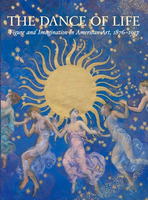
The Dance of Life: Figure and Imagination in American Art, 1876–1917
Yale University Art Gallery, New Haven
September 6, 2024–January 5, 2025
Catalogue:
Mark D. Mitchell, ed.,
The Dance of Life: Figure and Imagination in American Art, 1876–1917.
Yale University Art Gallery, 2024.
304 pp.; 160 color illus.; index.
$65.00 (hardcover)
ISBN: 9780300256451
The Dance of Life: Figure and Imagination in American Art, 1876–1917 proposed to reconsider art made in the United States in the interval between the Centennial and World War I by demonstrating how, as the wall text stated it, a “cosmopolitan generation” of artists gearing up after the devastation of the Civil War “embraced life as their subject” and “chose the human figure to embody the ideals of the age.”[1] What those ideals were—and what their intellectual, cultural, and political underpinnings and consequences were—remained somewhat elusive in the exhibition’s coverage of such a sprawling time period, but the installation traced the lofty ambitions of what is traditionally called the American Renaissance through stunning preparatory studies for large civic commissions such as the Boston Public Library (BPL) and the Pennsylvania State Capitol. In a contemporary moment when civic institutions and mentalities are besieged, it is tempting to revisit the astonishing talents applied by artists over the course of years of work to articulating and implementing the cultural import of libraries and other public buildings. These painters and sculptors took inspiration from “the power of democracy over autocracy, of innovation over stagnation, of a stable and vibrant future over a stormy and divided past.”
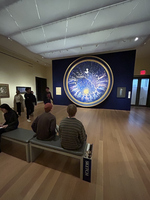
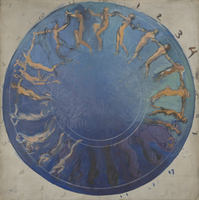
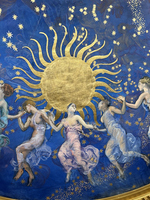
The exhibition’s organization centered the creative process with one wall text asserting that studies by John Singer Sargent, Edwin Austin Abbey, Violet Oakley, and others are the “clearest and most direct expressions of their ideas,” more so than the completed commissions implemented by teams of assistants. This decision is logical in part because of the immobility of architectural decorative schemes in situ but also because of the Yale University Art Gallery’s (YUAG’s) immense collection of three thousand works by Abbey, gifted in 1937, and only exhibited in substantial numbers a few times.[2] Although supplemented by relevant loans from other public and private collections, the breadth and depth of YUAG’s Abbey bequest, which includes works he owned by close friend and studio mate John Singer Sargent, enabled curators to illuminate—to a degree seldom possible—how prolific Abbey was and how exhaustive and dynamic a process he undertook to refine his ideas into elaborate decorative schemes at the BPL and Pennsylvania State Capitol, among others. The most breathtaking of these studies is the immense, twelve-foot-wide, half-scale model for Abbey’s Pennsylvania State Capitol ceiling dome mural, The Hours (1909–11), in the final gallery, to which visitors were led by a trail of drawn and painted studies for the work in earlier sections of the show (fig. 1). Twenty-four figures representing the hours process from day to night around the sumptuous blue canvas traced with constellations and gilded celestial bodies. Visitors coming upon the sight as they entered the gallery could be heard gasping at its scale, sheer beauty, and powerful humanity, a response harder to imagine someone having in the House of Representatives chamber where the finished design hangs high overhead in a space teeming with elaborate murals and colorfully painted architectural details.
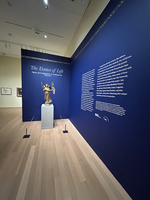
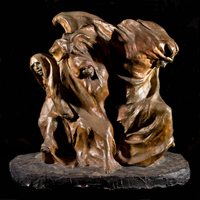
The exhibition comprised eleven thematic sections, each containing works spanning the dates in the show’s subtitle but also following the larger arc across the galleries from the promise of the Centennial year to the aftermath of World War I: “A Renaissance in America,” “Role Models,” “Setting the Stage,” “Boston’s Public Library,” “Reaching Out,” “Vital Energy,” “Pennsylvania’s Capitol,” “Dance,” “Expression,” “The Hours,” and “Modern.” It opened in a small side gallery with a cast of Augustus Saint-Gaudens’s Victory (modeled ca. 1892–93, cast by 1916), from the New York City memorial commemorating the Union General William Tecumseh Sherman’s destruction of the “viability of the Confederacy.” (fig. 2). As in several recent exhibitions that have reintroduced the identities and centered the humanity and agency of artists’ models, the mixed-race woman Hettie Andersen was named as the model for Victory. She was described as “a prophetic figure” who “moves into the future,” “emblematic of not only the hopes of an era but also the ineffable presence of its recent past.” The exhibition checked back in on women’s allegorical prevalence and significance at the end of the installation and its chronological span, when they had come to stand for the promise of technology and a more caring world as embodied by Violet Oakley’s reworking of a concept for the Pennsylvania State House from the Creation and Preservation of the Union (ca. 1912; Westmoreland Museum of American Art, Greensburg) to a female figure representing International Understanding and Unity (ca. 1916; The State Museum of Pennsylvania, Harrisburg) following World War I. The work of women artists appeared several places in the exhibition, an important reminder of the contributions of Oakley, Evelyn Beatrice Longman, and Meta Vaux Warrick Fuller (fig. 3), all of whom faced gender discrimination (and Fuller racial discrimination) in an era when professional women artists were typically limited to the “teams of assistants” who realized large-scale commissions, a group glossed over in the exhibition’s focus on master artists’ preliminary studies.
Two early sections, “A Renaissance in America” and “Role Models,” comprised studies by John La Farge for Boston’s Trinity Church (considered the American Renaissance’s debut) and traced the rigorous academic training in figure drawing that artists such as Kenyon Cox acquired (fig. 4). The selection of objects highlighted US artists’ new willingness to embrace the once-taboo naked figure as they stepped into a less parochial, more global frame that enabled them to focus less on defining an “American” art and more on inspirations from European, and even Asian, art and history. A positive consequence of foregrounding preliminary studies was the acknowledgment of artists’ labor (even if that recognition was not extended to the vast teams who also labored to realize the final commissions, a topic only dealt with in the catalogue) and the recognition that decorative ensembles like the ones at the BPL or Pennsylvania State Capitol did not emerge fully formed but rather developed through an exacting and evolving process fundamental to but perhaps not easily visible in the finished product. One might have wished that the curators had incorporated into the wall texts more discussion of collective labor and of the bitterly contested labor/management relations that defined this time period and seemed like a relevant context or frame for the individual toil of artists like Cox (a topic covered in Bryan J. Wolf’s wonderful catalogue essay). Among a different kind of role model introduced here was Abraham Lincoln, whose depiction recurred and evolved over the course of the American Renaissance.
“Setting the Stage” presented works by Richard Morris Hunt and La Farge, instrumental figures in the American Renaissance, and laid the ground for Abbey’s cycle The Quest and Achievement of the Holy Grail (installed 1895–1902) in the BPL’s Book Delivery Room (fig. 5). Their attendance to color and lighting effects drew upon innovations in theater, such as artificial stage illumination, which Abbey in particular embraced as a devotee of the theater. The use of theatrical techniques defined his BPL work, but, as the exhibition and catalogue went on to trace, are ones from which he departed in favor of the physical intricacies, emotiveness, and bodily dependencies of dance in his later Pennsylvania State Capitol project.
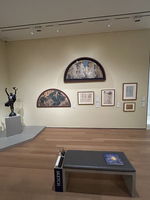
“The Boston Public Library” section explored the venues that were “hailed as democratic institutions of learning and opportunity” in the American Renaissance and thus lavished with decoration that would both celebrate and further that mission (fig. 6). Studies for Edwin Howland Blashfield’s The Evolution of Civilization (1895–96) for the Library of Congress’s reading room demonstrate the period admiration for Renaissance concepts of knowledge and artistic methods such as true fresco (fig. 7). Abbey’s The Quest and Achievement of the Holy Grail in the BPL’s Book Delivery Room received the bulk of attention, and for the first time in the show we encountered a large-scale image of the finished ensemble in situ, reproduced in a tonal photograph on the gallery wall. Hanging the art at various heights in this section as well as others in the show suggested to viewers how they might have had to look up—often way up—to take in these lessons in paint (fig. 8). The Arthurian theme of Abbey’s first mural resonated in a “benighted world seeking salvation” in the Civil War’s long aftermath.
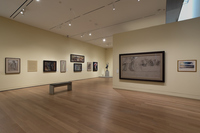
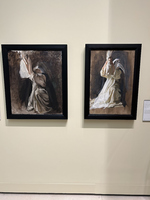
As the first opportunity in the exhibition to pull together so many studies related to a single project, the BPL section allowed important subthemes to emerge and be carried forward. These included the sensuality of both materials and bodies and the grouping of figures into clusters that evoke “musical lyricism,” points exemplified in two figure studies for Abbey’s The Castle of the Maidens (figs. 9, 10). I was struck repeatedly in this area of the exhibition by the opportunities for deeper appreciation made possible by the extensiveness of Yale’s Abbey holdings, including the pairing of studies for the Passing of King Amfortas, in which exhilarating color and light suggestive of an apotheosis signal the artist’s ambitions even if he toned them down in the final work; or, a bit further on, a duo of studies of light and dark oil sketches of a nun for The Infancy of Galahad (figs. 11, 12). Was any nuance ever too small? Abbey seemingly spared no effort in his own exhaustive quest to arrive at the most compelling realization of his ideas.
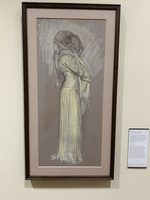
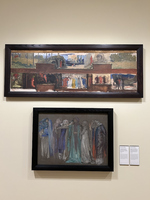
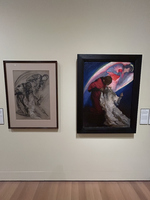
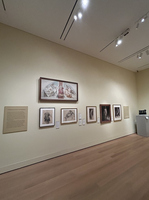
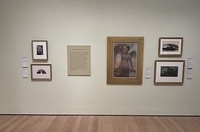
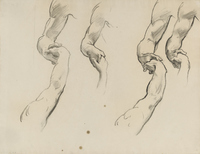
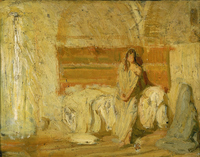
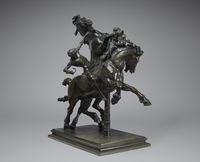
Leading toward a section on “Reaching Out,” a wall with works by Sargent, Abbey, La Farge, Oakley, and Cox teemed with limbs that touched, reached, beseeched, and thrusted, highlighting the physicality of American Renaissance bodies and their “organic humanism” (figs. 13, 14). Their positions convey visceral emotion to the beholder. At the same time, these studies of grasped hands and grappling figures charge the space around them, a breaking of the frame that continued throughout the exhibition. The curators’ choices and explanations in subsequent sections like “Vital Energy” illustrated how those artists’ compositional strategies made large mural projects at the BPL or Pennsylvania State Capitol engage both the audience’s sense of touch and their sympathetic identification and understanding. American Renaissance decorative ensembles easily perceived as aloof in their lofty architectural settings were anything but, a recognition made possible by the curators flipping the script to focus on the “brisk vitality of the preparatory works.” These less examined but intensely sensual, animated studies by Abbey and such contemporaries as Charles Courtney Curran, Gari Melchers, Oakley, Cox, La Farge, and Henry Ossawa Tanner bear out the assertion that affirmations of life were the essence of the American Renaissance. Tanner’s inclusion in this section was valuable, offering an opportunity to note that he formed his reputation in France due to racial prejudice in the United States. Study for The Annunciation set a precedent by representing the angel’s body as a ray of light, a tactic Abbey embraced for the spiritualized figures of kerosene in his Pennsylvania State House work, exhibited in a subsequent gallery (fig. 15). An artist of African descent, Tanner’s choice to abandon the angel’s physical body, abstracting it into light itself, could perhaps be considered an experiment in leaving behind a body judged on skin color. In this section of the show, the airiness of the drapery studies and works thematizing light, electricity, and progress in general proximity to the Tanner could have benefited from more anchors like Frederick MacMonnies’s sculpture The Horse Tamer, where the animals’ barely controlled rearing was analogized to the “vertiginous change happening in America throughout the period” (fig. 16).
“Pennsylvania State Capitol” set up and led into the other major Abbey project considered deeply in The Dance of Life, on which he spent the last decade of his life (figs. 17, 18). “Aspiration and memory” guided the artist’s thinking on how to represent Pennsylvania’s history and economic growth, along with fellow contributors—sculptor George Grey Barnard and painter Violet Oakley—who finished the project after Abbey’s death. Large oil studies of Abbey’s The Apotheosis of Pennsylvania (1909; Pennsylvania State Capitol, Harrisburg) and selected pastels of costumed figures such as Sir Walter Raleigh helped suggest the dual importance of “symbolic expression” and “dynamic sensuality” in the artist’s exhaustive preparations for that monumental painting, which moved away from his past reliance on theatrical storytelling. Most astonishing in its daring and directness (as attested to by the regularity of visitors sketching it from one of the benches placed throughout the gallery and stocked with supplies for that purpose) is Abbey’s figure study for The Spirit of Vulcan: Genius of the Workers in Iron and Steel (fig. 19). The curators observed that this “oil study transforms paint into flesh and back again, oozing and flowing across the surface of the canvas. . . . The paint in the background seems to run in rivulets around them, as if molten, and their tanned leather aprons blend into their bodies. The figures are lit by the glow of a furnace at left, and the oil paint seems to cast itself into skin, sinew, and muscle.” Just above, the compositional study for The Spirit of Light displayed the fluidity of Abbey’s conceptions, with white draped women drifting skyward while figures climbing out of the earth would morph into a separate lunette, Science Revealing the Treasures of the Earth. Bodies and groups of bodies were at center stage—their movement, expression, and interactions—and remained there for the rest of the walk through the galleries. The studies for The Spirit of Light that explore movements in space through reaching and arching female nude figures were showstoppers as Abbey refined how a body can portray flame or smoke through upraised arms or lower limbs that trail into abstract swathes of chalk (fig. 20).
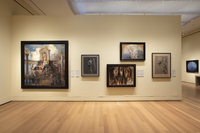
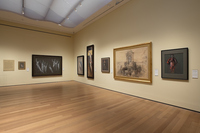
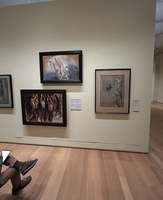
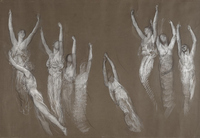
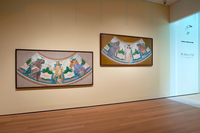
“Dance” flowed from the previous section with studies from The Hours (fig. 21). The arching backs and thrusting arms “echo the liberated natural movement” identified with pioneering modern choreographer Isadora Duncan. “Modern dance especially drew the attention of artists creating public art,” the panel text noted, “and their figures changed from actors to dancers.” This theme, like that of “Vital Energy,” threaded through the ensuing portion of the exhibition. While the lyrical collective movements of modern dance found an echo in “human work” in the words of Havelock Ellis and were persuasively prevalent when gazing around the gallery, specific archival references to individual American Renaissance artists’ thoughts on or knowledge of contemporary dance felt slightly absent. The playful exuberance of one composition study for The Hours, with the feet turned inward rather than out as in the final version, is redolent of the “joyful dancers of the French artist Henri Matisse in his own studies from this period” (fig. 22). But although “Abbey traveled to Paris each year to see the latest exhibitions and certainly admired recent art, . . . his opinion of Matisse is unrecorded,” the wall text acknowledged.
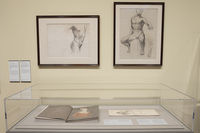
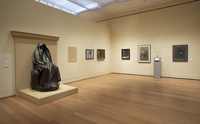
“Expression” turned attention to another key modern feature of American Renaissance art: its attunement to the emerging field of psychology and the registration of interior states upon the body (fig. 23). A gamut of emotions emanated from the studies for public artworks in this section, from joy to anguish, the latter often embodied during the American Renaissance in the figure of a ruminating Abraham Lincoln as a repository of loss. Saint-Gaudens and Abbey shared a commitment to the affective in an era in which art was increasingly shaped by the growth of psychology.
The smart inclusion of a full-scale cast of Saint-Gaudens’s Adams Memorial (modeled 1886–91, cast 1969; Smithsonian American Art Museum, Washington) and its placement directly across the gallery from The Hours brought “physical engagement to life size” and highlighted “the significance of scale in communicating feeling.” A sculpture like the Adams Memorial modeled inner life in a rich bronze. It encouraged introspection in those who encountered the funerary monument face to face in the cemetery grove, while a finished ceiling mural’s physical remoteness might mitigate the expressive potential and emotional resonance so evident in the preparatory studies.
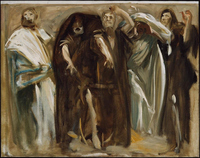
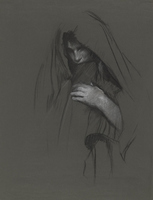
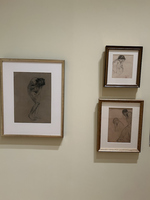
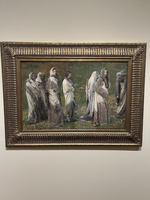
But from the many studies in the exhibition, it was clear that Abbey infused psychological resonance into The Hours to transcend the physical distance between painting and viewer. Sargent’s painterly technique in his study for the Frieze of the Prophets and Abbey’s study for Mary, the wife of Cleophas in The Three Marys showed how the artists chose and exploited materials like oil or charcoal to dramatize beseeching gestures or draw shadows that intensify the “stark emotion” (figs. 24, 25). In the “Expression” section, the works on view predominantly depicted women, both clothed and nude, perhaps registering a societal determination that women more than men were the transmitters of intense emotion. Often allegorical figures who project power, women like the stoical prostitute in Oakley’s mural study for International Understanding and Unity in the Pennsylvania State Capitol or the ashamed female nude in an undated charcoal sketch by Gari Melchers departed from conventional heroism in their quiet, intense endurance of suffering. In Melchers’s drawing, her defenseless body bends in on itself, a black hole of “emotional distress extending to her physical withdrawal,” as the wall text described (fig. 26).
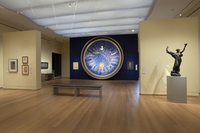
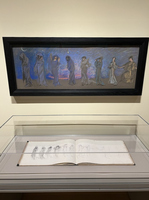
The breadcrumb trail of studies for The Hours culminated in the exhibition’s final space. There, the half-scale disk of The Hours filled the rich blue wall from floor to ceiling, a feat of yearslong study, conservation, and, ultimately, installation efforts by staff that the gallery celebrated on its social media accounts and that in many ways echoed the large-scale collaboration necessary to complete the final Harrisburg version (fig. 27). Abbey would still go on to make considerable changes in order to finish that twenty-four-foot-wide ceiling mural, but the sheer beauty of the penultimate version, with figures processing around a blue field strewn with metallic gold and silver sun, stars, and moon, was a satisfying conclusion to exhibition (fig. 28). Gallery visitors were treated to an opportunity for wonder and immersion seldom afforded by exhibitions but that in some sense linked the experience of viewing The Hours today back to the lofty aspirations of American Renaissance artists more than a century ago. Cycling from cloaked and hooded figures representing night (who resemble the psychological intensity of Saint-Gaudens’s figure in the Adams Memorial) to lightly clothed women, embodying day, who float or dance à la Isadora Duncan, the composition exemplifies Henry James’s observation that in Abbey’s art, “life itself is his subject,” as the wall text quoted. Not to be missed in this section were works by both Abbey and Sargent that demonstrated the evolution of The Hours from a linear frieze like that in Sargent’s Cashmere (dated the year that Abbey began work on The Hours [ca. 1908; Private collection]) to an eternal cycle. The men were living and working in England and knew of each other’s projects, perhaps explaining the shared “time-lapse” succession of poses in both compositions (figs. 29, 30).
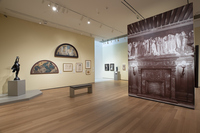
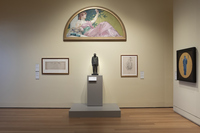
While The Hours stops the show, “Modern” provided a coda to the exhibition with a brief consideration of whether the art of the American Renaissance achieved the lofty goals with which the era began in the Civil War’s aftermath (fig. 31). The gallery themes mapped across the show demonstrated the gradual dissipation of both literary narratives and humanistic optimism and the emergence of Symbolism, psychology, and an ebbing of postbellum hope, leaving the petering out of the American Renaissance around World War I as little surprise. Much had changed in those fifty years, particularly the pervasiveness of technology. The section text pointed out that “American Renaissance artists’ work, especially studies for commissions that were never completed, reflects uncertainty about an age that coupled technological and economic progress with racial oppression, public corruption and corporate monopolies.” Through the 1890s, female figures could still signify modern communication technologies (as in H. Siddons Mowbray’s Muse of Electricity [1893; Yale University Art Gallery, New Haven] for the Collis P. Huntington Mansion, seen in fig. 31) or the “mysterious and generous” promise of science (as in Abbey’s Science study [fig. 32]). Models of “maternal care” remained staples of allegory in a world bruised by World War I, as in Oakley’s sketch of Unity for International Understanding and Unity in the Senate Chamber of the Pennsylvania State Capitol (at left in fig. 31). But, as poignantly exemplified by the antithesis of Saint-Gaudens’s prophetic and hopeful gilded Victory at the show’s outset, Onorio Ruotolo’s The Doomed (bottom center in fig. 31) protests the death penalty with a single figure, representing the “new phase of modern humanist art that never came, replaced instead by the stylized and streamlined archaism of Art Deco after World War I.”
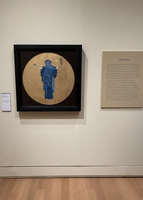
The sumptuously illustrated catalogue by exhibition curator Mark D. Mitchell, with essays by scholars Bryan J. Wolf, Josephine W. Rodgers, and conservator Kelsey Wingel, contains the same eleven sections as the exhibition and provides a broader context for the work. Additional subsections, such as “Real People,” “Passing Generations,” “Reaching Out,” “Audience,” “Matriarchs,” “Spirits,” or “Control”—a veritable word cloud for the American Renaissance—enable closer comparison and discussion of works around shared themes or formal elements. Several works appear in catalogue subsections that differ from their placement in the exhibition, and Mitchell persuasively articulates their thematic richness in both contexts.
Wolf’s essay, “‘Live One’s Life as a Work of Art’: A Fable of Class and Taste,” probes the hunger for high culture in the American Renaissance. With mechanization and commerce everywhere, the “better classes” turned to culture of the sort promulgated via the Boston Public Library’s programs and decoration as both a social template and a glue to reinforce their difference from and supremacy over the “dangerous classes” for whose uplift those institutions purportedly existed (64). “The language of uplift,” he notes “has been hijacked from a social and economic context to an aesthetic one,” with the possession of “artistic feeling” ranking certain people over others (63). Wolf cites Sven Beckert’s observation that high culture transcended the “economic fault lines that market competition generated” (64). Classicism’s conspicuous lack of modernity appealed to Abbey and others because of its “rebuff to the rising commercialism of his time” (65). Wolf takes this further in probing why the heroic body was so central to the art of the age. Beginning by analyzing illustrations by Thomas Wilmer Dewing and Winslow Homer, he reveals how the “ghost” of mechanized work pervades treatments of the body and accounts for its prevalence in American Renaissance art (67). Wolf cites Eadweard Muybridge’s motion studies and sides of meat and Frederick Winslow Taylor’s The Principles of Scientific Management (1911) as evidence of the “machinelike nature of the worker’s body” (68) that permeates even Abbey’s The Hours—where the procession of figures comes from a world defined by “serialized forms, repetitive gestures, and standardized units of time” (67). The bounty of figure studies that fills the exhibition takes on a new aspect of “resistance” via Wolf’s assertion that classical bodies “must be read not only as a confirmation of an elite class’s cultural nostalgia for a preindustrial past but also as their response to and refusal of the proletarianization of the body in a rapidly industrializing era” (69). Abbey’s idealizations of bodies, particularly in his Pennsylvania State House treatment of workers, take us into a “utopian” realm where figures could stand for something better than the “distortions of late nineteenth-century society” (70).
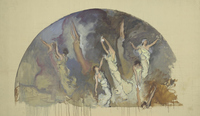
From his wise reading of Abbey’s male bodies, Wolf dissects the “women into angels” (70) who pervade his studies and paintings (fig. 33). The permeation of religion and culture gave new emphasis to individual interior life. Rather than strong, physical, worldly working bodies like Degas’s dancers, Abbey personified the “religion of feeling” in weightless women who float across his murals not as traditional angels but as “avatars” on a quest for heightened subjectivity (70–71). Allegory, as Wolf attests in his reading of the Tiffany stained-glass window on the theme of education in Yale’s Linsly-Chittenden Hall, works noiselessly against the machine, its very beauty instilling the serenity that keeps social order in the “quiet battle with proletarianization” (74).
Josephine D. Rodgers contributed “Mural Painting and the Nineteenth-Century Civic Imagination: Art, Innovation, and Science,” an essay that examines the large civic projects of libraries and state capitols. Their construction employed the formerly enslaved, veterans, and immigrants, and the decorative murals inside served “ideological functions” to affirm that “the nation’s integrity remained” through “art that could address the struggles of the day” (163). The murals, it was hoped, would re-instill unity to a fractured polity struggling with “immigration, industrialization, corporate capitalism, and economic instability” (168). Artists including Blashfield and Cox turned murals into the key means of imparting these lessons and assurances, with technology and science themes as the vehicles for instilling a “new mythology” of American progress (172). The Library of Congress (LOC) and the Pennsylvania State Capitol are deployed as the exemplars in this essay. Cox’s rigorous methods of observation and draftsmanship in preparation of the LOC’s Science lunette demonstrate his “scientific approach to art history” to achieve a “universal language that would unify different people and tastes” (167). The mural language of pieces like Blashfield’s Evolution of Civilization (fig. 34), also in the LOC, mattered deeply to the project of America’s own post-Civil War renaissance because of murals’ power to shape “public memory” and serve as points of identification with the Progressive agenda of education, cultural uplift, and improved public welfare (167). Importantly, Rodgers notes, Blashfield pictures America’s allegorical figure as an engineer, perched above the word science. Empowered by education and armed with science and technology, he is poised for progress, a construct still central to “American” identity today.
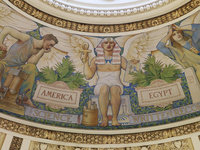
Rodgers rightly pauses to inquire who built the palace of knowledge that is the mural-filled LOC, delving into records to identify details about the corps of workers. She observes that the words used at the time to describe employees who included vets, immigrants, and freed Black men correspond to values such as industriousness and good citizenship espoused in the library’s mural program as ladders to opportunity. The information is a tantalizing, if brief, counterpoint to the depth of attention paid to the visual artists who decorated the buildings constructed by these men—including Reisin M. Shipley. His story reflects both the progressive ambitions and crushing limitations of the day. As a freed Black man and Howard University graduate, he was recommended by an Iowa senator for a Library of Congress job, not in an office, but as a laborer.
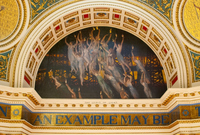
Discussion shifts in Rodgers’s essay to Abbey’s oil-themed murals for the Pennsylvania State Capitol rotunda as embodiments of the “radical shift” industrialization caused in the environment, and the resulting “crisis of culture and civic imagination” experienced by Americans (172). Their long sanctification of unspoiled nature confronted the rampant exploitation of earth’s resources for industrial growth. Murals on The Spirit of Religion, The Spirit of Vulcan, Genius of the Workers in Iron and Steel, Science Revealing the Treasures of the Earth, and The Spirit of Light proclaim Pennsylvania’s industrial might, while also registering the clear effects of environmental depredation (fig. 35). Rodgers identifies the tensions Abbey wrestled with in developing visual treatments of Pennsylvania’s history, weighing narratives and myth against a scarred “visible landscape and what lies beneath” (173). She asserts that he recognized that a new mode of vision was required that took into account a “beholder’s visual experience” of a scene, an approach earlier developed by George Inness as he reinterpreted landscape with acknowledgment of industrialization’s environmental and social toll (174). In response “to these same fundamental changes,” Abbey embraced “a new relationship between painting and beholder, establishing a provocative style of mural painting to confront the harsh realities of environmental dispossession” (175). The mural tradition could not remain the same, nor could allegories, which, as Rodgers demonstrates in her discussion of The Spirit of Light, were developed into “contemporary symbolic narrative” (176). The resulting painting is remarkable in its improbable fusion of the oil industry’s grease and grit with the apotheosis of energy into light. Abbey’s achievement was praised when he exhibited the canvas in London in 1908 by a critic who marveled that he had “converted the hardest prose . . . into poetry . . . Every canvas is spiritualized with significance and transfigured with beauty” (178). Abbey’s success lay in how he managed, with the layering and whiteness of paint in the female figures representing kerosene’s brilliance, to balance “materiality and illusion,” producing a result representative of his friend William James’s concept of “vision as a physical, bodily experience” (179). Abbey’s approach did not skirt the “harsh reality (or environmental dispossession)” associated with oil derricks and kerosene but used the mural form in new ways to draw beholders, both then and today, into “a personal, imaginative, and historical experience” of the birth of America’s carbon economy (180–81).
The exhibition’s processional rhythm culminated in The Hours, addressed likewise in the catalogue’s final section. The project required Abbey to develop new methods so he could work at different “orders of magnitude” in a shift away from the storytelling emphasis of his earlier illustration work toward a psychologically complex Symbolist treatment of the human figure as fine art (268). Appropriately, given the years of study and treatment necessary to prepare it and other long-stored Abbey bequest works for exhibition, it is conservator Kelsey Wingel who contributes the essay, “Creating The Hours: Edwin Austin Abbey’s Process and Materials.” Through adept citations of his writings about the commission as well as his art, and by exploring influences ranging across time from Edward Burne-Jones to Giovanni di Paolo, Peter Apian, and Muybridge (a true Renaissance span), she offers a full picture of how he arrived at both the half-scale The Hours in the exhibition and the full-scale final work.
Wingel captures the importance to Abbey of the “floating idea,” an initial, generative concept he pursued rigorously but nonlinearly through research and observation-based studies: “While I am waiting to discover the details of one design numerous others will have suggested themselves, or some detail or movement I may have been groping for, for a year, may appear out of the mist” (271). The opportunity to create a ceiling mural, his first and only such work, sparked Abbey’s imagination in new ways, prompting him to undertake over one hundred studies between 1909 and 1911. Those studies are artworks in their own right, “moments of thought communicated and preserved through his materials,” rightly “captivating” us as we see Abbey gain power by exploring the potential of materials and reformatting the composition from a frieze to a cycle (273).
Closely analyzing the artist’s “lively brushwork” and “lighter palette,” as well as peering below the surface with X-radiography, Wingel reveals Abbey’s simultaneous efforts to evoke relatable bodily movements and sensations that register the “figure’s potential to represent fundamental and unchanging human emotions and experience” (279). With the unparalleled evidence provided by the alternately spontaneous and “premeditated” studies preserved at Yale, Wingel can confidently assess “Abbey’s intent to represent spirit through movement” by piecing together what he added or changed and when (280).
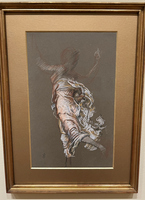
It was hard work, as attested to by scraped paint, smudged charcoal, and remnants of pinholes in studies tacked to other studies while figuring out how to articulate the character and emotion of each hour through a human body. So thorough was his commitment to somatic presence in certain studies for The Hours that Abbey fully realized each body on its own (fig. 36) before clothing it in paint to represent diaphanous drapery, resulting not in remote goddesses but rather “maidens of the modern age” (286).
Along with attention to their physicality, Abbey carefully delineated the faces to impart a psychological dimension, particularly to the figures representing night. The artist’s compositional and expressive refinements correspond with his expanding concept of The Hours as not only the symbolic representation of a day, but as the cycle of human life. And to ensure its perception as a celestial space that would stay luminous without yellowing and be visible from the floor without a varnished glare, Abbey learned from techniques developed by fellow mural painters how to employ a wax-based medium for a matte, warm surface.
As awe-inspiring as we may find the penultimate, half-scale study of The Hours in the exhibition, the final work entailed more refinements. Wingel enumerates the changes Abbey introduced: personally financing its expansion from the planned eighteen-foot diameter to twenty-four feet; flipping the star map so that the viewer’s perspective is that of humans rather than God, looking up from earth and out to the heavens; inserting Halley’s Comet, which returned in 1910 during work on the mural, in an homage to both Giotto’s gesture in the Scrovegni Chapel centuries before and the contemporary moment.
The essay, and the catalogue, conclude with a valuable meditation on what The Hours signified in the House chamber, as part of a larger ensemble with Abbey paintings on themes of Pennsylvania history. Wingel’s decision usefully zooms out the frame to the project’s larger significance, breaking us out of the immersion in studies (albeit glorious, but also admittedly “self-absorbed,” as described in the “Void” subsection) throughout the course of the show and book (229). The ceiling “alludes to the fated birth of a great nation” and, in combination with the chamber’s full decorative scheme, “reminds the representatives of their distinguished history and their current responsibility as participants in the democratic system” (291). The Hours, the author asserts, “urges both reflection and action” at the same time through Abbey’s use of materials (including gilding) and the work’s iconography (291). The “stars have aligned over Pennsylvania,” literally, in Abbey’s dome, and he “declares that our ability to complete the steps leading to the Genius of State depends on the actions of our hours” (291–92). Yet the apotheosis of the American Renaissance ideals installed in Harrisburg never attained full force. Set in motion by the Civil War, the American Renaissance concluded with World War I, undermining the civic promise embodied in the era’s projects.
While devotees of art from the post–Civil War US will be familiar with most of the artists included in this exhibition, it is safe to say that Sargent is the only one known by general museumgoers today (and largely for portraits like Sargent’s Madame X rather than public commissions). Despite his remarkable skill, Abbey has fallen out of wide recognition, in part because devotees of modern art ignored his contributions and in part because so much of his work, although preserved at Yale, has been challenging to access without considerable intervention by conservators. Now returned to their original magnificence through the momentous undertaking of the Yale University Art Gallery’s exhibition, Abbey’s works, and the ambition of art to engage with life itself, will hopefully remain in public consciousness. Honoring the decades that Abbey spent living and working in England after he left the United States for good in 1878, a version of the exhibition will travel to the National Gallery of Art in London. Edwin Austin Abbey: The Dawn’s Early Light, the first show about the artist in England in more than a century, will be on view from November 20, 2025, to February 15, 2026.
Notes
[1] Unless otherwise noted, all quotations come from wall text in the exhibition.
[2] See Alan Shestack, ed., Edwin Austin Abbey (1852–1911), exh. cat. (Yale University Art Gallery, 1973); Lucy Oakley, Unfaded Pageant: Edwin Austin Abbey’s Shakespearean Subjects, exh. cat. (The Wallach Art Gallery, Columbia University, 1994); and Edwin Austin Abbey’s Shakespeare, Farnsworth Art Museum, October 4, 2014–January 4, 2015.