L’Art est dans la rue (Art Is in the Street)
Reviewed by Peter ClericuzioPeter Clericuzio
Syracuse University
Email the author: pjcleric[at]syr.edu
Citation: Peter Clericuzio, exhibition review of L’Art est dans la rue (Art Is in the Street), Nineteenth-Century Art Worldwide 24, no. 3 (Autumn 2025), https://doi.org/10.29411/ncaw.2025.24.3.19.
This work is licensed under a Creative Commons Attribution-NonCommercial 4.0 International License  unless otherwise noted.
Your browser will either open the file, download it to a folder, or display a dialog with options.
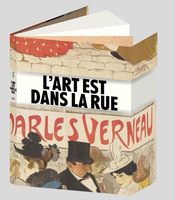
L’Art est dans la rue (Art Is in the Street)
Paris, Musée d’Orsay, March 18–July 6, 2025
Catalogue:
Élise Dubreuil and Clémence Reynaud, eds.,
L’Art est dans la rue.
Musée d’Orsay/Bibliothèque Nationale de France, 2025.
256 pp.; 180 color illus.; list of works shown; bibliography; index of proper names.
€45.00 (softcover)
ISBN: 9782717729658
Relatively few exhibitions sell out the host museum’s entire stock of catalogues a month before the close of their run.[1] Then again, there are few shows with the magnetic attraction of the Musée d’Orsay’s L’Art est dans la rue (Art Is in the Street). The distinction is well-deserved: this show is impressive for both its breadth of content and the quality of the items on view. Highly anticipated, it is arguably long overdue: as Élise Dubreuil and Clémence Reynaud—Orsay curators of architecture and decorative arts, respectively—note in the introduction to its catalogue, this is the museum’s first exhibition dedicated to posters since 1987, the year after it opened (11).[2] While one ponders how France’s national museum of the long nineteenth century could turn its primary attention away from large-scale graphic arts for nearly forty years, it is worth recalling that French posters of the era have hardly been neglected by major and specialized museums worldwide over the same time span.[3] Indeed, a number of these institutions’ exhibitions have also been accompanied by hefty, well-illustrated catalogues and reviewed in this very journal, thus filling the void.[4]
The popularity of posters at the turn of the century was remarkable, because, as Dubreuil and Reynaud note, they transformed the experience of virtually everyone in Paris (and to a lesser extent, the provinces) by flooding the streets of the city with a rainbow of color and a riot of imagery. This acutely sharpened the visual—if not also textual—literacy of the French public, who swiftly recognized posters as a distinct, new, and modern art form (11–12). It should not be surprising, then, that like the traditional fine arts, posters during the 1890s became also the purview of serious collectors—a phenomenon now called affichomania (“poster mania”)—with some individuals amassing astounding collections of posters; one collector of the era is said to have compiled an archive of upwards of sixty thousand examples. Likewise, the tapering off of affichomania in the decade just after the turn of the century underscores the renown of this particular time period as the “Golden Age of the Poster” (174, 186). While one can only surmise in many cases what became of many private collections, the dépôt legal, as the catalogue notes, required the deposit of two copies of all printed matter produced in France (a law still in force today). This has provided the Bibliothèque Nationale—whose own curatorial staff cooperated with the Orsay’s to realize this exhibition—with one of the most comprehensive collections of French turn-of-the-century posters (13). This collection, from which the vast majority of items in this show hail, also virtually designates the medium itself as a kind of French national patrimony, another reason to question how the Orsay has not staged an exhibition like this for so long.
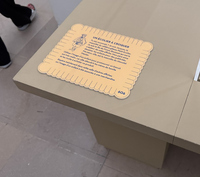
The sheer number and quality of items on display in the show (227 works, of which 149 are posters) assured the show’s broad appeal, but the curators and organizers enhanced the appeal of the work on display in various ways (10).[5] Visitors were invited not only to see, watch, and even listen to the kinds of experiences that posters promulgated and evoked, but also to participate in learning about their production. Just as impressively—and appropriately so for such a democratic medium—the exhibition has been made accessible to an exceedingly wide audience through bilingual (French and English) wall texts and placards; in French, they appeared in the shape of a Pétit Ecolier cookie placed only a few feet off the ground, targeted to the youngest attendees (fig. 1).
The inviting presentation of L’Art est dans la rue, however, belies the show’s intellectual sophistication. Those less familiar with the history of posters were offered a thorough account of their development, production, and impact, both materially and as political and social tools in France prior to World War I. Although historians familiar with this material may only have found a few new factual or intellectual discoveries, their interests and perspectives surely were piqued and fleshed out with the range of items on view. Like many large-scale art historical exhibitions, this one was geared toward a broad audience. Its importance and value lies in the way it described the invention and explosion in popularity of posters in France between 1880 and 1914. The exhibition asserted that the poster was the first truly democratic art of the modern age because of its reach across socioeconomic lines, and it used nearly every available platform of the digital age to make the experience of living in France (and especially Paris) at the turn of the century plainly understood. The accompanying catalogue, published only in French, provides well-researched essays by numerous contributors that enrich but also go beyond the issues raised in the show itself.
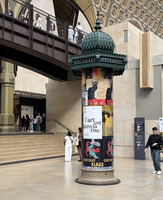
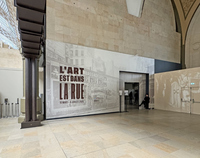
The exhibition proceeded through eight principal rooms, each focused around a separate theme.[6] Though not explicitly stated, it was divided into two “halves”: the first three galleries concentrated on issues related to the production and distribution of posters, while the remainder addressed their content. The show’s entrance was cleverly marked by a precise replica of a Morris column situated at the side of the ground floor of the museum, whose cylindrical drum is papered over with replicas of some of the posters on display in the exhibition (fig. 2). It directed visitors up a couple of steps to the entrance of the exhibition proper, through a doorway at the right of an adjacent wall covered by an enlarged period photograph of posters installed on a Paris city street and the show’s title superimposed in large, black letters (fig. 3).
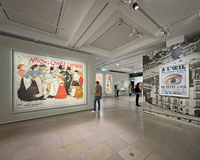
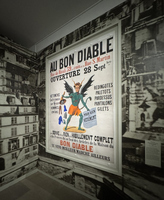
The entrance foyer confronted visitors with Théophile Steinlen’s multisheet poster, La Rue (1896), advertising the Charles Verneau publishing house, which specialized in such graphics. Its massive scale (nearly eight by ten feet) and iconography—people of various backgrounds completely filling a street—announced plainly the premise of the exhibition (fig. 4). Not only were Steinlen and his colleagues acutely aware of the unprecedented size of the audience that they were reaching (along with the striking colors, exaggerated figures, and typography required to do so), they keenly understood their transformative role in modern society, marrying, for the first time, artistic talent with the full advantages of mass production. To illustrate the dramatic nature of these developments in lithographic technology and pictorial strategies, the curators contrasted Steinlen’s work with a pair of one-sheet examples from 1859 and 1864 on the adjacent walls, each of which featured a single color image surrounded by the blocky, mostly black lettering typical of older, midcentury broadsides whose relatively limited visual attraction were plainly evident (fig. 5; see also fig. 4).
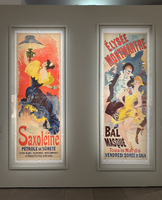
The first large gallery introduced the technical brilliance of color lithography and, in particular, the pioneering work of Jules Chéret who, as the wall text reminded us, established his own printing house for the production of posters as early as 1866. Among the first works to catch one’s attention here were two of Chéret’s dynamic Art Nouveau creations on the far wall: one for Saxoléine lamp oil (1893) and the other for a masked ball at the Elysée Montmartre theater (1890) (fig. 6). In them, we see the crystallization of Chéret’s decades of research into various design strategies, including the standard seductive female figure hawking the product and the development of the three-color theory of lithography, wherein the combination of the primary hues of red, yellow, and blue serves as a highly effective vehicle for attracting the eye of the flâneur. By 1901, according to journalist Georges d’Avenel, some 1.5 million posters were newly displayed annually on the streets in Paris, with another eight hundred thousand during election years; one Paris distributor reported that it had posted some six million posters annually in the provinces (26).
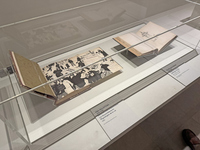
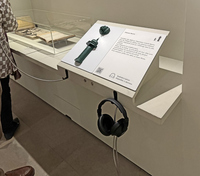
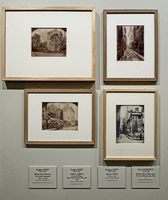
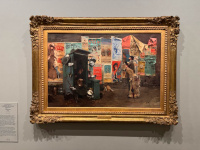
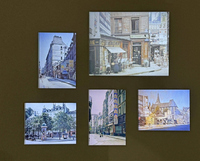
But precisely where in the field of view were all these posters located? Other displays in the gallery addressed this question. Adjacent to Chéret’s posters, a case contained Les Rassemblements, physiologies de la rue (Gatherings: Physiology of the Street, 1896), illustrated by Félix Vallotton, and a sketchbook of Ilya Repin’s from the 1870s opened to a drawing of a Morris column, whose familiar green, steel cylinders topped by onion domes has functioned as an official locus of graphic publicity in Paris since 1868 (fig. 7; see also fig. 2).[7] Next to this case was the first of several audio stations in the exhibition where headphones offered a description of the Morris column (also accessible through a QR code) (fig. 8). Nearby, visitors could see several black-and-white photographs by Eugène Atget and Henri Godefroy from about 1900 showing walls in the capital completely papered over with posters and Louis-Robert Carriere-Belleuse’s oil L’Étameur (1882), which in virtuosically precise detail depicts the bright patchwork of posters that enlivens the otherwise dull wall behind the titular tin merchant’s stand (figs. 9 and 10). As if this is not enough, a slideshow projected onto the low-lit far end of the gallery presented the brilliant autochrome photographs commissioned by French banker Albert Kahn just before World War I. They reveal quilted hues that adorned nearly every visible flat surface within the urban landscape (fig. 11).[8] In short, posters were everywhere.
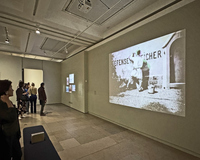
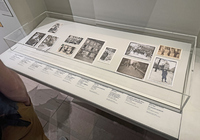
The dark end of the first gallery turns the corner to the right, morphing into the second section, devoted to colleurs (billposters, or those employed to glue posters to the substrates), an often-overlooked demographic within the historiography. Here, the gallery was filled with items documenting colleurs’ activities and identities to an extraordinary degree. This was the most unexpected and satisfying gem of the exhibition, for both experts and casual attendees alike. Further down, on the same wall as the autochrome slides, the curators screened two early films of colleurs from the 1890s, one by Georges Méliès and the other by the Lumière Brothers. These are slapstick adventures with buckets of glue and rollers. In Méliès’s film Défense d’afficher (Post No Bills, 1896) (fig. 12), a colleur attempts to affix posters to a wall clearly emblazoned with a warning forbidding them. Another space in this gallery evoked the work of the billposters. In the catalogue, Marie-Liesse Boquien’s fascinating mini-essay reminds us that, despite the entertaining aspects of these films, such workers often labored in dangerous conditions far above the ground and without safety protections and—depending on the subjects of the items they were hanging—could be easily subjected to verbal and physical abuse from objecting passersby (36). On the wall opposite the films, visitors could inspect an equally remarkable case of period ephemera showing the many kinds of advertising professions, including sandwich-board men, stanchion carriers, and women billposters—the latter of whom were even depicted on postcards, suggesting that their employment in the advertising industry was recognized as a significant social phenomenon (fig. 13).
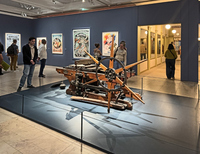
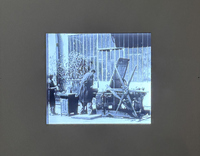
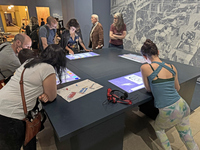
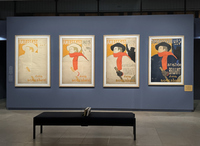
Passing through a low doorway into the third gallery, attendees entered what was arguably the most important part of the exhibition, which probed the technical and legal questions of poster production (fig. 14). Visitors first encountered the former through two major displays: a large, multiarmed, manual rotary lithographic press—developed by Jules Voirin around 1890 and nicknamed the bête à cornes (“horned beast”)—in the center of the gallery. The press was accompanied on one wall by the brief Lumière Brothers’ film Intérieur d’une imprimerie (1899), which shows the operation of a similar model in a print shop (fig. 15). As the wall text explained, this impressive, hand-operated contraption only gives a taste of the industrial scale of these printing works, since the most robust publishers would employ even larger, steam-driven and mostly automated machines that could pump out thousands of copies of an individual matrix’s design a day, thus fueling the public’s voracious appetite for their imagery. Meanwhile, the lithographic process, which is difficult to describe in precise detail textually, was clarified through an ingenious and very popular digital display in an alcove. There, a square table with four workstations invited participants to select from the designs and colors for several well-known period posters and then observe pictorially how the final product would have been physically produced (fig. 16). The interactive screen simultaneously explained the principles of lithography (based on the repellent relationship of oil and water) and the application of the design to the lithographic stone (or which areas would receive which colors of ink). At its conclusion, the demonstration gave participants the option of receiving a digital copy of the personalized design via email. This gallery also displayed the proofs of each stage (one for each color) necessary to print Henri de Toulouse-Lautrec’s famed Ambassadeurs: Aristide Bruant dans son cabaret (Ambassadeurs: Aristide Bruant in His Cabaret, 1892) (fig. 17).
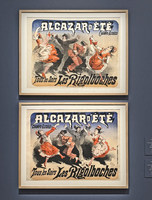
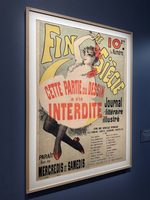
As attractive as posters were, they were not appreciated by everyone. Wall texts reminded visitors repeatedly of their detractors, including the conservative but revered architect Charles Garnier, who famously railed against posters in the 1870s as degrading to the architecture that they covered, just as he would later vigorously lead the charge against the completion of the Eiffel Tower. We must also remember, as the catalogue essays point out, that the mass proliferation of posters in late nineteenth-century France was in no small part due to the reshaping of censorship under the Third Republic, particularly the new Law of July 29, 1881, frequently called the Law on the Freedom of the Press, which consolidated the privileges of printing and publishing from the warren of forty-two statutes enacted by ten previous regimes. Now frequently remembered, ironically, for the ubiquitous “DÉFENSE D’AFFICHER—LOI DE 29 JUILLET 1881” (“NO POSTING BILLS—LAW OF 29 JULY 1881”)—the warning seen on walls across France that prohibits unsanctioned billposting on wall surfaces—the act considerably liberalized the rights to advertise or proclaim anything of public interest in graphic form. The absence of censorship was, however, not absolute. Before 1881, certain imagery now considered quite tame was forced to be edited out of some designs, as a comparison between two versions of a Chéret poster from 1876 advertising female theatrical dancers revealed (fig. 18). Even after the law’s passage, customary mores required the excision of imagery that was too sexually suggestive from purely commercial advertising, yet some publications converted such conventions to their advantage, blotting out the offending area and reminding viewers of its proscription (fig. 19).
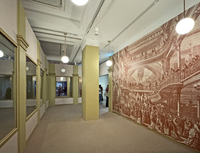
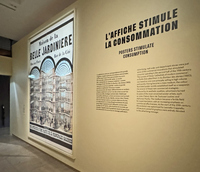
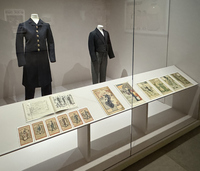
A hallway decorated with mirrors on one side and an enlarged detail from an engraving of the interior of a period department store conveyed visitors to the second half of the exhibition, which was focused on the content and purpose of the posters (fig. 20). This transition was not entirely evident, as the first object to confront viewers in the next gallery was a large, colored xylograph from 1849 showing the interior of the Belle Jardinière department store, with its three bays of arched windows and corresponding galleries, all framed in iron and stocked with piles of goods. It introduced us to the next section on how posters spurred consumption, more broadly (fig. 21). Along an adjacent wall, a tall case displayed staff uniforms, advertising trade cards, and store catalogues, reminding visitors of the regimentation of such interiors and the organization of the retail process taken to an industrialized scale, including its heavy reliance on lithography (fig. 22).
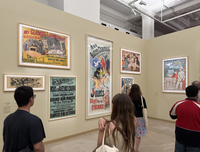
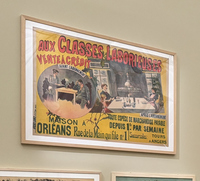
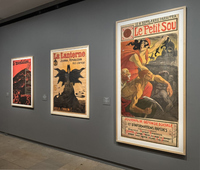
The intermezzo served as a transition to the next full gallery, dedicated more generally to the theme of posters as the vehicles for selling. It was a large, bright room with cream-colored walls, crowned by a permanent ceiling crisscrossed by beams articulated by floral moldings, much like the interiors of Belle Époque department stores (fig. 23). Here, the attraction was really the range of items that posters hawked—everything from chocolate, New Year’s toys, and linens to bicycles, cigarettes, and train travel to the Pyrenees and the Alps—along with the advertising strategies used to do so (fig. 24). After the heavily informational and interactive experience of the first set of galleries, visitors may well have appreciated the opportunity here to stroll leisurely around the gallery and bask in the flood of color and easy-to-read graphics without thinking too hard. Despite the wealth of clear imagery, it is worth noting the extensive reliance of some of these posters on text to reach their target audience, evidence in part of the government’s contemporaneous efforts to bolster and secularize the educational system, particularly through the Jules Ferry laws of 1881–82.[9] Among the more noteworthy examples here was the anonymous lithograph of 1892 targeting working-class clientèle (literally entitled Aux Classes Laborieuses [To the Working Classes]), which promoted the early practice of some large retailers of selling goods on credit with a regular payment schedule (fig. 25). This process enabled poorer consumers who could not pay cash to acquire entire suites of furnishings (thus the poster’s before-and-after vignettes of a family’s dining room) and other expensive items for their meager dwellings. Anaïs Albert’s contribution to the catalogue fleshes out the intricacies of this system, including the in-person methods of credit reporting that verified customers’ neighborhood addresses and socioeconomic rank to estimate the likelihood that they could repay the amount owed (82–94).
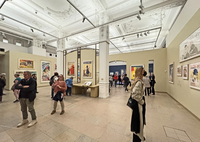
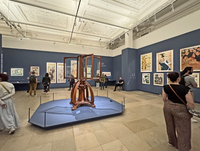
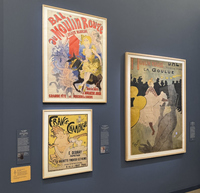
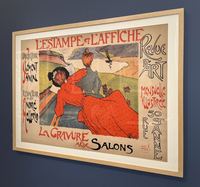
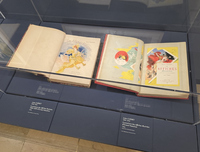
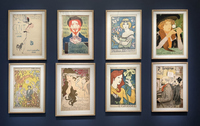
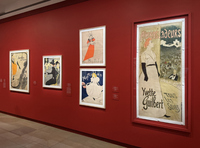
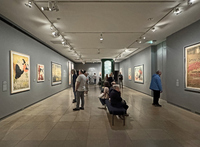
If the poster, through retail advertising, was the primary vehicle by which art came to reach the broadest socioeconomic cross-section of French society in modern history, it was also instrumental in expanding the contemporary definition of art itself. The sixth gallery, distinguished by its cool Prussian blue walls, charted the medium’s elevation to the status of high art, emblematized well by its centerpiece, a masterful rotary Art Nouveau stand of frames by famed Nancy-based ébéniste (cabinet maker) Eugène Vallin (fig. 26). Vallin’s group of Art Nouveau decorative artists, called the École de Nancy, played a seminal role in the debate over the status of the major and minor arts (e.g., prints and decorative arts), which reached a crisis point at the end of the nineteenth century.[10] On the surrounding walls was a selection of some of the most famous lithographs of the era by giants in the field: Chéret, Steinlen, Toulouse-Lautrec, Alphonse Mucha, Pierre Bonnard, Edouard Vuillard, and Eugène Grasset, among others (fig. 27). The swift ascent of posters to the uppermost ranks of artistic prestige in the span of a few decades was effected through several mechanisms on display here, chief among them the sister industry of mass publishing, which, likewise after 1881, went through a rapid expansion and relied partially on posters to increase circulation. The field spawned several artistic magazines focused specifically on posters, such as L’Estampe et l’affiche (The Print and the Poster, launched 1897) and La Plume (The Pen, launched 1889) (fig. 28). These were complemented by other specialized publications, such as the celebrated folio Les Maîtres de l’Affiche (Masters of the Poster), which reproduced many choice designs at smaller scales and whose individual leaves might have been exhibited as works of art themselves (and still are today). Ernest Maindron’s two-volume set of Les Affiches Illustrés (Posters Illustrated; 1886 and 1896), also displayed here, represented the first attempt to write a history of the medium (fig. 29). Meanwhile, the development of a serious set of poster connoisseurs along with an elaborate network of dealers to satisfy them also elevated the status of the poster, with some collectors organizing lavish exhibitions of their collections (173–80).[11] In turn, regular exhibitions such as the Salon des Cent placed the medium in line with the long-established Salons for painting, sculpture, and architecture, as well as the avant-garde Salon d’Automne that Frantz Jourdain would help organize beginning in 1903 (fig. 30). A key date for the birth of affichomania was 1890, the year Chéret was nominated to the Légion d’Honneur for his innovations in the graphic arts and fêted with a lavish banquet (for which he designed the menus). In 1899, the editors of L’Estampe et l’affiche even proposed the creation of a poster museum, an institution that, perhaps surprisingly, would not be realized in France until 1978 (184). One small regret for this section is the omission of posters advertising the grand Expositions Universelles that Paris held, like clockwork, every eleven years over the last third of the century to underline the city’s global reputation as the capital of civilization and culture.
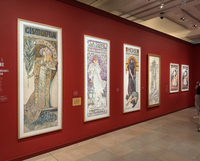
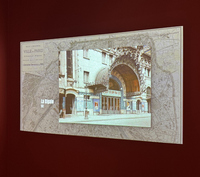
World’s fairs brought together many of the entertainments explored in the next gallery, which visitors entered via a small, red room decorated with false theater doors and filled with the sound of music from period performances (fig. 31). This section explored how the poster worked in tandem with the theater, evoking the drama or carefree atmosphere that revues attempted to engender. The connections between artists and stage performers, such as Mucha and Sarah Bernhardt or Toulouse-Lautrec and Jane Avril, was one of the primary highlights here, with several canonical posters suggesting how such personal relationships worked reciprocally, simultaneously reinforcing both the performers’ and artists’ iconic status in their respective fields. These included Mucha’s vertically-oriented banners of Bernhardt as Gismonda (1894) and Medea (1898) as well as Toulouse-Lautrec’s jazzy advertisements for Avril’s can-can at the Jardin de Paris (1893) and the Divan Japonais (1892–93) (figs. 32, 33). A slideshow near the entrance to the gallery mapped the various locations of several turn-of-the century theaters in Paris, such as La Cigale and the Folies-Bergère, which were then superimposed with period photographs of the clubs’ entrances covered in posters, their twisted curves and exaggerated imagery complementing the garish Art Nouveau marquees so well that they appeared almost like rationalist architectural ornament naturally growing out of the structure (fig. 34). Indeed, some theater owners took this principle to its logical conclusion: as one brief catalogue vignette by Dubreuil recounts, beginning in 1893 the Théâtre des Ambassadeurs rented the surface of its auditorium curtain to Le Courrier français, which covered it with a quilt of Chéret’s posters, as documented in a photograph from 1895 reproduced in the catalogue (212–13).
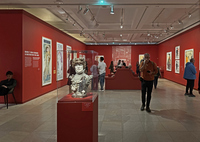
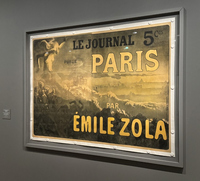
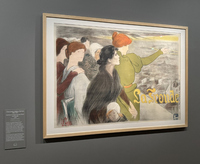
The frivolity of the Belle Époque that the exhibition (and the period’s very name) provoked, however, belies its fraught social, political, and economic realities, which were omnipresent in and thoroughly enmeshed with the art of the poster, and facilitated by the 1881 press statutes, as the eighth and final section of the show demonstrated (fig. 35).[12] Freely and plainly visible to everyone, the poster was above all a democratic art (as Steinlen’s poster at the beginning of the show attests), enlivening the streets both aesthetically and politically. No wonder that many contemporaneous French critics and government officials, including Roger Marx, Jean Lahor, and Gustave Kahn, followed on the heels of William Morris in declaring that art could and should serve as a means to brighten and improve the lives of even the desperately poor working classes.[13] For some, such as Félix Fénéon, posters went even further, constituting “painting that’s more elegant than the licorice juice [at the Salon] that delights the upper-class assholes.”[14] The poster and Art Nouveau were the ideal format and style to achieve such ends. It is not surprising, then, that one of the popular uses of posters up to 1900 was as advertisements for the socially conscious novels of Emile Zola and others that ruminated on the plight of the proletariat and were serialized in many of these newspapers (fig. 36). The liberalization of the press sparked the establishment of political and satirical magazines of every stripe, including those for anti-clerical, socialist, racist, mutual aid, anti-Semitic, and anarchist groups and purposes, all of whom used posters to attract readers (fig. 37). The political nature of posters was only magnified during election season, when hundreds of thousands of additional broadsides—usually heavily loaded with explanatory text—urged voters to choose candidates or parties. We must also recognize the poster’s role in promoting the rethinking of gender norms with the inclusion here of an 1898 lithograph by Clémentine-Hélène Dufau for the daily La Fronde, a periodical owned and run wholly by women; as a nearby audio bank informed visitors, this represented a thinly-veiled call for women’s suffrage, a right that would only be conferred in France in 1944 after the Provisional Government assumed power in the aftermath of Vichy (fig. 38).
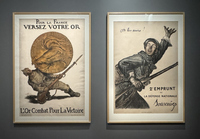
Eschewing all fanfare, the show closed with a pair of posters by Abel Faivre; their subdued gray and tan hues depicted individual French and German World War I soldiers and urged French citizens to buy war bonds for national defense (fig. 39). These posters starkly contrasted with the ebullience of the Belle Époque images and deserved more robust attention, in both the gallery and the catalogue, given the specific literature on French posters of the conflict and ample recent treatments of the war’s visual culture.[15] Likewise, it might have been worth including some examples from the 1920s to at least raise the question of the legacy of the poster’s Golden Age.
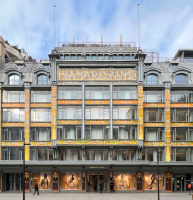
For all the concern with the poster as a distinctly urban art that often hung on walls, the exhibition by and large missed the possibility of exploring the medium’s relationship to architecture. The poster, as Bertrand Tillier rightly stresses near the end of the catalogue, had a particular purpose to serve in Paris, which had been recast from the 1850s to the 1870s into the seemingly interminable stretches of beige, Haussmannian apartment blocks; posters’ brilliant, contrasting tones provided a reassuring respite from this potentially disorienting monotony. On the other hand, Napoleon III’s widening of the boulevards and opening up of large plazas helped enhance pedestrians’ ability to see posters that were affixed to walls at varying heights (226, 237). This, as Meredith Clausen has shown, was pivotal for the development of Art Nouveau in the built environment, particularly for leftist architect Frantz Jourdain’s designs for the old (1891) and new (1905–10) Samaritaine department stores.[16] Indeed, Jourdain knew that the brilliant, floral-patterned, yellow, enamel panels and signage of his new emporium, set against its cool, painted iron frame, would function much like the lithographs dotting the streetscape below (fig. 40). Perhaps, ironically, the poster would make its greatest impact on the permanent built environment in Brussels, a city whose picturesque ensembles of townhouses and commercial buildings in various styles at the turn of the century arguably needed little enlivening from lithographs. There, however, the politics of burgomaster Charles Buls, an enthusiastic supporter of the Belgian public art movement, Art à la Rue, encouraged architectural experimentation, including through the institution of a façade competition in 1897, a version of which was famously adopted the following year by the Parisian municipal government. In Brussels, therefore, the poster’s legacy remains the widespread, flat sgraffito decorating the upper levels of numerous Art Nouveau townhouses in the districts of Ixelles and Saint-Gilles, framed by brick, stone, and iron, but largely emptied of sociopolitical commentary (fig. 41).

The catalogue is well-conceived and produced, with just under two hundred illustrations in full color, including many reproduced at a full-page scale. Its essays are accessible and not intended exclusively for a scholarly audience, though they assume a firm grasp of nineteenth-century history, befitting the target French-speaking public éclairé.[17] It is nonetheless a valuable reference for art historians, with its pithy, direct texts based on rigorous research. Some of the essays are outstanding in this respect; in addition to those already cited, I note Sandrine Maillet and Anne-Marie Sauvage’s “L’Affiche illustré en couleurs et l’imprimerie,” which explores Chéret’s pioneering research into theories of applied color schemes and cost economies while running his own print factory. It then describes the degree of precise control that he and other artists such as Toulouse-Lautrec exercised over the various steps of the printing process, including intricate knowledge of the mechanisms of manual-operated and steam-driven presses (40–52). This is complemented by Marie-Liesse Boquien and Claire Guitton’s essay “L’Affiche illustré au service de la publicité (1870–1914),” which details the development of poster design (in line with period psychology) to attract customers and provides some fascinating anecdotal evidence of the relationships between poster artists and the businessmen who employed them (100–16).
The catalogue format alternates longer essays exploring a broader theme in greater depth with shorter one- or two-page vignettes with tight focuses on specific objects or topics. While this strategy is largely effective, in some cases the shorter pieces deserve to be developed further. Olga Lemagnen’s brief study of posters and photographs of Paris from the era, for example, could have been afforded more space given the significant number of photographs of posters in the exhibition, especially the autochromes that revealed the extent to which posters colorized the cityscape prior to World War I (78–81). Occasionally, there are instances in which the essays refer to images located very far away from the discussion in the catalogue and a few places where the author of an essay discusses an unillustrated image in depth. In other essays, the reader might demand more sustained engagement with the posters shown to explicate precisely how the strategies of visual persuasion operate.
L’Art est dans la Rue underscored technological and social developments and emphasized important but often-overlooked legal factors that explain why the end of the long nineteenth century became the Golden Age of the Poster. Posters certainly would not have developed into a mass democratic art without the possibilities of color lithography and the liberalization of the French press that the Third Republic settled on after 1871. Aided also by a bolstered and largely secularized educational system, this freedom in turn fueled an unprecedented explosion of French textual print culture and the corresponding wealth of discourse on political, social, economic, and cultural matters that, by the dawn of the twentieth century, drew in all segments of French society. Posters, more than any other medium, included everyone, even children, in this discourse because everyone could freely see and understand them using the tools that republican society had delivered to them. Napoleon III and Baron Haussman’s renovations to Paris, meanwhile, provided the capital with the canvas and display space that maximized the spectacle of posters by offering a kind of permanent and free exhibition space for lithographers—along with the corresponding commentary from numerous critics. Given the huge numbers of posters distributed and installed nationwide on a regular basis and the number of artists and technicians employed to produce them—to say nothing of the vast sums that some affichomaniacs spent on collecting them—posters represented a significant sector of the French economy. As such, the exhibition emphasized the notion that posters of this period indeed constitute a form of national patrimony; and, to its credit, the Musée d’Orsay organized numerous specialized conferences, lectures, and theatrical and musical shows to accompany the exhibition, many of which reproduced or approximated the kinds of performances that the posters originally advertised.[18] With any luck, we will not have to wait another four decades for the national museum of the nineteenth century to revisit a perpetually appreciated segment of French art.
Notes
[1] Inès Masset, email to the author, June 12, 2025. Due to the shortage, the author even needed to purchase a copy from a third party to complete this review.
[2] See the entire March 2025 issue of Connaissance des arts dedicated to the show; see also the full March 2025 issue of L’Objet d’Art with essays by Brice Ameille dedicated to the exhibition.
[3] For a few recent examples, see The Paris of Toulouse-Lautrec: Prints and Posters (Museum of Modern Art, New York, 2013); Always New: The Posters of Jules Chéret (Milwaukee Art Museum, Milwaukee, 2022); Toulouse-Lautrec: Paris and the Moulin Rouge (National Gallery of Australia, Canberra, 2013); The Art of Advertisement: Art Nouveau Posters of the Late 19th Century (Virginia Museum of Fine Arts, Richmond, 2014); Posters of Paris: Toulouse-Lautrec and his Contemporaries (Milwaukee Art Museum, Milwaukee, and Dallas Museum of Art, Dallas, 2012–13); Alphonse Mucha: Art Nouveau/Nouvelle Femme (Poster House, New York, 2019); and De La Caricature à L’Affiche, 1850–1918 (Musée des Arts décoratifs, Paris, and Palais Lumière, Evian, 2016). This is surely not an exhaustive list.
[4] For two such critiques, see Karen Carter, Review of Always New: The Posters of Jules Chéret, Nineteenth-Century Art Worldwide 21, no. 3 (Autumn 2022), https://doi.org/10.29411/ncaw.2022.21.3.26; and Dennis Cate, Review of De La Caricature à L’Affiche, 1850–1918, Nineteenth-Century Art Worldwide 16, no. 1 (Spring 2017), https://www.19thc-artworldwide.org/.
[5] 159 of the works shown, 138 of which were posters, came from the Bibliothèque Nationale; only eleven posters came from external lenders.
[6] Official publicity organized the show into six sections and an introduction, but there are eight distinct gallery spaces of display. Dossier de presse, 10–21.
[7] Invented by the German Ernst Litfaß and first installed in Berlin in 1855, such columns are often known as Litfaßsäule in German-speaking countries, but elsewhere they are often called Morris columns after Gabriel Morris, who received the concession to erect them in Paris. Despite their fame, Morris columns have a thin historiography. See Steffen Damm, Ernst Litfass und sein Erbe: eine Kulturgeschichte der Litfasssäule (Bostelmann & Siebenhaar, 2005); Laila Seewang, “Ernst Litfaß and the Trickle-Down Effect,” AA Files 75 (2017): 45–57; and Anne-Marie Holze, Die Litfaßsaule in Deutschland. Bedeutung, Räumlichkeit und Konkurrenz zu anderen Medien (Grin, 2016).
[8] On these, consult Jeanne Beausoleil, Paris 1910–1931: au travers des autochromes et des films de la Photothèque-cinémathèque Albert Kahn (Musée Carnavalet, 1982); David Okefuena, The Wonderful World of Albert Kahn: Colour Photographs from a Lost Age (BBC, 2008); and John Wood, The Art of the Autochrome: The Birth of Color Photography (University of Iowa Press, 1993).
[9] On the laws and the transformation of the French educational system, see Xavier Darcos, L’Ecole de Jules Ferry: 1880–1905 (Hachette, 2005).
[10] On Vallin and the Ecole de Nancy, see Françoise-Thérèse Charpentier, et al., Art Nouveau: L’Ecole de Nancy (Serpenoise, 1987); Frédéric Descouturelle, Eugène Vallin: Menusier d’artiste industriel (AAMEN, 1998); Claire Aptel et al., Nancy 1900: Rayonnement de l’Art Nouveau (Gérard Klopp, 1986), and Christian Debize, Emile Gallé and the “Ecole de Nancy,” trans. Ruth Atkin-Etienne (Serpenoise, 1998), among many other monographs and exhibition catalogues.
[11] Raymond Kahn, Media in France (Routledge, 1994), 16–20.
[12] Hugh Gough, The Newspaper Press in the French Revolution (Routledge, 1988), 231.
[13] Gustave Kahn, L’Esthetique de la rue (Charpentier, 1901); Roger Marx, L’Art Social (Charpentier, 1913); Jean Lahor, L’Art Nouveau: son histoire, l’art nouveau étranger à l’Exposition, l’art nouveau du point de vue social (Lemerre, 1901). Jean Lahor was the pseudonym of physician Henri Cazalis.
[14] “La peinture plus hurf que les croûtes au jus de réglisse qui font la jubilation des trous au cul de haute.” Félix Fénéon, “Chez les barbouilleurs: Les affiches en couleurs,” Le Père peinard, April 30, 1893, 5.
[15] For example, see Pearl James, ed., Picture This: World War I Posters and Visual Culture (University of Nebraska Press, 2009); and Mark Levitch, “The Visual Culture of Modern War: Photography, Posters, and Soldiers’ Art in World War I France” (PhD diss., University of Pennsylvania, 2008).
[16] Meredith Clausen, “Architecture and the Poster: Towards a Redefinition of the Art Nouveau,” Gazette des Beaux-Arts, September 1985, 81–94.
[17] Distinct in France from English-speaking countries (where arguably such an educated public is now fast disappearing), the term public éclairé refers broadly to “students, professionals in management and the economy, and political leaders.” Guy di Méo, “Review of Un atlas régional, autrement . . ., by P. Buléon,” Annales de Géographie 118, no. 667 (2009): 345.
[18] Dossier de presse, 34–40.