Shifting Shorelines: Art, Industry, and Ecology along the Hudson River
Reviewed by Patricia MainardiPatricia Mainardi
Professor Emerita, CUNY Graduate Center
Email the author: pmmainardi[at]gmail.com
Citation: Patricia Mainardi, exhibition review of Shifting Shorelines: Art, Industry, and Ecology along the Hudson River, Nineteenth-Century Art Worldwide 24, no. 3 (Autumn 2025), https://doi.org/10.29411/ncaw.2025.24.3.25.
This work is licensed under a Creative Commons Attribution-NonCommercial 4.0 International License  unless otherwise noted.
Your browser will either open the file, download it to a folder, or display a dialog with options.
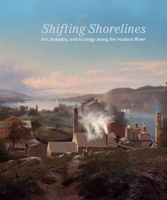
Shifting Shorelines: Art, Industry, and Ecology along the Hudson River
Miriam and Ira D. Wallach Art Gallery, Columbia University, New York City
October 5, 2024–January 12, 2025
Catalogue:
Annette Blaugrund, Betti-Sue Hertz, Elizabeth Hutchinson, and Dorothy M. Peteet, eds.,
Shifting Shorelines: Art, Industry, and Ecology along the Hudson River.
Miriam and Ira D. Wallach Art Gallery, Columbia University, 2024.
144 pp.; 76 color illus.; catalogue; resource list.
$45.00 (softcover)
ISBN: 9781884919398
While large exhibitions usually focus on an artist, a movement, or a theme, what makes Shifting Shorelines different, and a landmark exhibition, is its focus on the natural environment; it includes not just the expected artworks but also material culture and scientific documentation that interweaves with these works. A sprawling exhibition, it encompasses almost a hundred works from the seventeenth century to the present, telling a moving story of growth, near death, and (we hope) resurrection. A most ambitious undertaking, it aims to present an overview of the river across four centuries and in a variety of media. The exhibition was co-curated by the Wallach director Betti-Sue Hertz, a specialist in contemporary art, two historians of American art, Annette Blaugrund and Elizabeth Hutchinson, and one research scientist, Dorothy M. Peteet. It derives its approach from New Materialism, a loose amalgam of theories related to material culture that has been particularly important in the study of American art, where “extraction” has become a virtual mantra.
The exhibition is organized into ten sections, each with its own theme: brickmaking, landscape, marshes, oysters, piers, extraction, transportation, geology, industry, and environment. This organization structures the show’s coherence and enables the viewer to assimilate an enormous amount of disparate information. Each theme is elucidated by works in a variety of media and periods; contemporary works are installed throughout the show, providing both immediacy and counterpoint to the historical record. The exhibition’s superb and well-illustrated catalogue has twelve essays on the section themes, followed by a roundtable discussion with contemporary artists. Wall text in the galleries is derived from the essays. While the wall texts contextualize the displays into the overarching history of the river, the artworks themselves—paintings, sculpture, prints, photographs—provide a kaleidoscopic point of view.
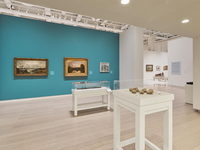
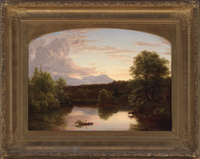
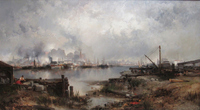
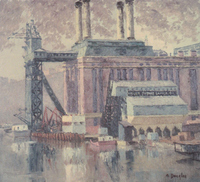
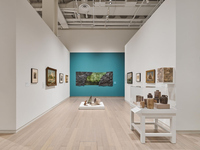
Two display cases confront visitors upon entering the exhibition, one containing Mohican net sinkers dating as far back as 5500 BCE, the other displaying two Piermont Marsh sediment cores, vertical slices from the Hudson riverbed that show its deterioration over time. Behind them stands the primary entrance wall, presenting a striking juxtaposition of three paintings that set forth the exhibition’s theme (fig. 1). Visitors with even a modicum of art historical knowledge will immediately recognize the central work, Thomas Cole’s North Mountain and Catskill Creek (fig. 2), as a “Hudson River School” painting. Here at center stage, it displays the familiar arcadian landscape of upper New York state, its verdant hills and forests dwarfing the tiny figures on horseback and in canoes. This idyllic image is flanked, however, by two paintings that expand our definition of Hudson River painting by depicting the later industrial development of the river. Thomas Moran’s Lower Manhattan from Communipaw, New Jersey (fig. 3) contrasts the Hudson’s two banks viewed from what was already a degraded tidal marsh on the New Jersey side, looking across the river to the bustling New York harbor. Its chimneys, with their belching smoke, are rendered in pale grays whose incandescent delicacy belies what we now know are poisonous fumes. Opposite the Moran is Aaron Douglas’s Inwood Power Plant (fig. 4), where lush pastels serve to counterpoint all that pollution by presenting the splendor of industrial architecture almost like a Greek temple. These are Hudson River paintings to be sure, but not what one would normally identify with that movement.
These apparent contradictions are clarified both in the wall labels and, more extensively, by Annette Blaugrund, whose catalogue essay “Omissions from the Canon: Artists’ Representations of Industry along the Hudson in the 19th and 20th Centuries,” provides a valuable overview of the exhibition and should be required reading for all art historians. Blaugrund proposes the armature of the exhibition in her first sentence: “When Thomas Cole, the father of the Hudson River School of landscape painting, visited the Hudson Valley for the first time in 1825, he envisioned a virgin wilderness. By the mid-nineteenth century the river’s shores were filled with smoke-spewing factories and railroads that he and other artists excluded, concealed, or telescoped in the distance” (41). The gradual deterioration of the river and its environs is explored in several essays, beginning with Elizabeth Hutchinson’s “From Relative to Resource: Depicting Ecology and Industry along the Hudson, 1650–1850.” By avoiding the simplistic proposition of pure nature vs. pollution, the exhibition focuses instead on each period’s use and abuse of the river and its environs and on artists’ and viewers’ awareness of that relationship. From nineteenth-century views of a natural paradise to twentieth-century visions celebrating the vitality of modern industry and to our more recent focus on the resulting environmental damage, the exhibition presents a comprehensive overview, intertwining, as its subtitle indicates, “Art, Industry, and Ecology along the Hudson River.”
Shifting Shorelines focuses on the length of the river from the point where New York Harbor opens to the Atlantic Ocean to the end of its tidal estuary north near Troy, where the ocean’s tidal saltwater is overtaken by freshwater streams. A series of large aerial photographs by the Center for Land Use Interpretation titled Up River: Man-Made Sites of Interest on the Hudson from the Battery to Troy, depicts both sides of the river. Played continuously on a screen, they take the viewer on a photojournalistic journey through forests and factories, quarries, junkyards, and hydroelectric plants as well as through areas where reclamation efforts have begun to restore the waterfront.
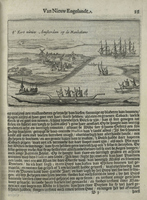
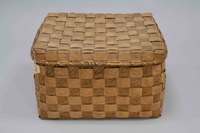
The earliest work in the show, a 1651 engraving by Kryn Frederycks, T’Fort Nieuw Amsterdam op de Manhatans (Fort Amsterdam, Manhattan) (fig. 5), juxtaposes Dutch ships arriving in New Amsterdam (now Manhattan) with the native Lenape in their flatboats. Several of the most recent works were commissioned directly for the show. The traditional Indigenous cultures that were rapidly displaced by Europeans are here represented by examples of traditional Algonquian and Mohican beadwork and basketry (fig. 6) as well as work by contemporary artists Reva Fuhrman (fig. 7) and Donna Hogerhuis, both of Mohican ancestry.

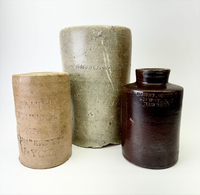
An early section in the exhibition is devoted to the oyster trade. In his catalogue essay, “Early New York Oyster Jars,” Christopher Pickerell explains the importance of the industry, which was dominated by African Americans until the mid-nineteenth century, but died out because of both overfishing and pollution. A pile of eighteenth-century oyster shells underscores its demise, alongside a selection of stoneware jars that the African American potter Thomas W. Commeraw made for the transport of pickled oysters, a much sought-after delicacy (fig. 8). Commeraw’s jars have been found throughout the western hemisphere from New York to the West Indies and South America, attesting both to his craftsmanship and to the internationalism of that trade. It is here depicted in a painting by Alex Matthew, Oystering at Prince’s Bay (fig. 9). New York harbor, the southernmost end of the Hudson, is the focus of this section, which also includes Alfred Stieglitz’s harbor view photograph The City across the River (1911) and Reginald Marsh’s Tugboat and New York City Skyline (1933).
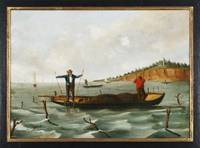
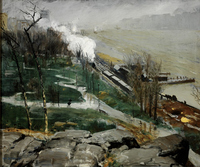
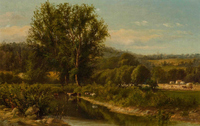
As we proceed through the exhibition, we see the role of industry gradually overpowering nature, first with picturesque fishing boats and cultivated farmland, later with factories, mines, and railroads—favored subjects of artists of the Ashcan School and The Eight in the decades around 1900. George Bellows’s painting Rain on the River (fig. 10), in the section on transportation, takes as its subject the railroad as much as the river, and American Modernists John Marin and Gifford Reynolds Beal, both well represented nearby, were clearly more exhilarated by the role of industrial development than by the natural environment. Sometimes, however, environmental degradation can be invisible, disguised by a lovely landscape: Julie Hart Beers—one of the few female painters of the Hudson River School in its traditional sense—painted Cows in a Landscape (fig. 11) in 1869; it depicts a pastoral scene of hills and a stream, forest and farms and is exhibited here in a section of nineteenth-century landscape views. While her contemporaneous audience would have appreciated its depiction of an Edenic America, our twenty-first century viewing pleasure is somewhat mitigated by Dorothy M. Peteet’s catalogue essay “Hudson Marshes: Archives of Biodiversity, Climate Change, and Human Impact,”—which foregrounds the environmental impact of agricultural development. Peteet notes that the English and Dutch logged off the forests of the region in the eighteenth century, that the verdant pastures Beers depicted were surrounded by the remnants of those forests, and that the cows and stone walls indicate “significant disturbance of the landscape, evidenced by higher mineral runoff and increased nitrogen pollution in the Hudson shoreline marshes downstream” (65). She reminds us that, while we can still admire Beers’s painting, our pleasure comes with an environmental cost. This directive, to hold two opposing realities in mind at the same time, guides us through the exhibition, enabling us to see each work through the eyes of its artist and its contemporaneous audience, but now also with the consciousness of our own epoch’s climate crisis.
The bare bones of the story that the exhibition relates are that, from the moment the first Dutch ship sailed up the Hudson to trade with the Mohicans for beaver pelts in 1610, Europeans recognized the river and its environs as a commercial boon. The area could provide fish and meat, fur, timber, clay, and minerals as well as a navigable route for commerce. Agriculture and industry thrived, particularly after the construction of the railroad that followed the river north. Early seen as a positive sign of modernity, railroads were later acknowledged as a factor in ecological devastation. Victoria Horrocke’s essay “Industrial Harmony: Connecting Industry along the Hudson River Railroad” details their early history, although the date of the completion of the Hudson River Railroad in 1851—an important factor in considering the river’s degradation—is not cited.
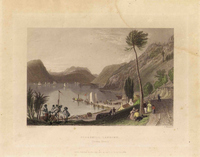
A timeline in both the exhibition and the catalogue would have been most helpful. This would enable the viewer/reader to better comprehend not just the development of industrialization along the river but its history prior to European contact, different aspects of which are discussed in Elizabeth Hutchinson’s and Dorothy M. Peteet’s essays, as well as Stephen Schimmrich’s, “The Geology of Shifting Shorelines.” Hutchinson explains that by the mid-nineteenth century, Americans had an “extractive relationship to nature” (23), focusing on farming, fishing, and natural resources such as stone, minerals, and timber. Even earlier, in the Revolutionary period, brickmaking was flourishing along the Hudson because of the river’s rich clay beds and offer of easy transport. Nonetheless, as Ross Barrett points out in his essay “Landscape Painting and the Hudson Valley Brick Industry,” the subject rarely appeared in painted depictions because Haverstraw, where the industry was dominant, was associated with immigrant workers, free people of color, strikes, and social disruption. When brickmaking did appear in paintings, as in Haverstraw on the Hudson (fig. 12) by Marie-François-Régis Gignoux (one of the early artists of New York’s Tenth Street Studio and George Inness’s teacher), the factory is partially concealed by trees. In this largely agrarian image, only the factory’s bellowing smokestack is apparent, and even that is offset by the leisured ladies with parasol watching from a distance. This conventional trope of setting leisured well-dressed members of the upper classes as spectators of a scene of labor is satirized by one of the contemporary artists in the show, Jean-Marc Superville Sovak, who reminds us of the underlying realities of such arcadias by inserting figures from anti-slavery manuals and abolitionist tracts into nineteenth-century engravings. His a-Historical Landscape: Peekskill/Runaways (fig. 13) reworks an engraving by the nineteenth-century artist William Henry Bartlett by adding a group of freedom seekers in the foreground to counterpoint the leisured ladies.
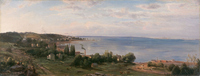
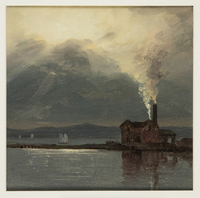
The works displayed are sometimes by less familiar artists, but often by major figures whom one doesn’t normally associate with images of the industrial exploitation of nature. In 1844–45, Frederic Edwin Church painted Hudson River with Factory by Moonlight (fig. 14), which depicts the round-the-clock machinery of industry. Edward Hopper’s watercolor Hook Mountain Nyack (1899; Whitney Museum of American Art, New York) shows a quarry hacked into the side of that mountain. Two essays present a dire portrayal of this earlier state of the river, at least until recent legislation began to reverse almost two centuries of depredation. In “Hudson River as Sink: Waste, Pollution, and the Restoration of Nature,” May Joseph points out that the first river restoration project undertaken by the Clean Water Act of 1972 was the Hudson, a development Tracy Brown also discusses in “From Degradation to Restoration: Shifting the Hudson’s Storyline.” Joseph warns that the 2023 Supreme Court decision reversing federal protections for wetlands, Sackett v. Environmental Protection Agency, has once again imperiled the nation’s waterways. An ironic note here is that the notorious Sing Sing Prison was constructed on the Hudson at Ossining, NY, in 1826 because the river’s salubrious setting was thought to encourage criminal reform. This irony is underscored by the inclusion of several works by the self-taught artist Anthony Papa, who served twelve years at Sing Sing for a narcotics-related offense and also contributed a catalogue essay, “The Hudson River and Anthony Papa.”
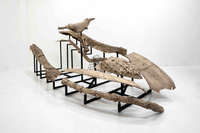
The exhibition continues to the present with a broad selection of twenty-first century works discussed in an essay by Betti-Sue Hertz, “Extraction, Products, and the Environment: Materiality in Contemporary Art of the Hudson River.” These works, often large in scale, bring an added dimension to the exhibition, engaging with the river’s present state of both degradation and reclamation. The Discovery of Slowness (fig. 15), by Athena LaTocha of the Standing Rock Sioux, offers a moving and somber vision of the river’s endurance. Marie Lorenz’s Jet Ski (fig. 16), constructed from the decayed wreckage of the titular vehicle and positioned centrally in one of the largest exhibition spaces, seems to oscillate between contemporary sculpture and antediluvian relic; it is an apt symbol of the environmental damage done by recreational watercraft and our throw-away culture. Regrettably, the best-known contemporary artist to treat the Hudson River theme, the Cherokee artist Kay WalkingStick, is not included in the exhibition.
One of the concluding sections of the show focuses on the Hudson River piers, the subject of Jonathan Weinberg’s memoir of gay culture in the 1970s and 1980s, “On the Waterfront Again.” This section includes photojournalism from that period as well as large-scale photographic documentation of the afterlife of those piers in works by David Hammons and Gordon Matta-Clark.
The various groupings throughout the exhibition are in the best tradition of the social history of art, illuminating the subjects of the works, their formal qualities, and the artists’ viewpoints. The works themselves never become mere illustrations of a theme but retain their individuality, aspects of a discussion that ranges from movement styles to ecological events. The result is a multidimensional historical tapestry, inviting the viewer on a long journey through several hundred years of American art, history, and visual culture.
We cannot see this exhibition without experiencing a radical transformation in our understanding of the Hudson River, which has become what the French philosopher Maurice Merleau-Ponty called “a durable theme of historical life.” As we struggle to assimilate past and present realities, our understanding of these works shifts into multidrive. The experience is disruptive to be sure, but, as Merleau-Ponty wrote of the French Revolution: “In a sense, everything that could have been said and that will be said about the French Revolution has always been and is henceforth within it, in that wave which arched itself out of a roil of discrete facts, with its froth of the past and its crest of the future.”[1] We are now living in that future, and Shifting Shorelines has shown us how “that roil of discrete facts”—namely representations of the Hudson River bequeathed to us by that past—is cresting in our own time.
Notes
[1] Maurice Merleau-Ponty, “Eye and Mind,” in The Primacy of Perception, ed. James M. Edie (Northwestern University Press, 1964), 179.