Napoleon Sarony’s Living Pictures: The Celebrity Photograph in Gilded Age New York by Erin Pauwels
Reviewed by Katherine FeinKatherine Fein
Amherst College
Email the author: kfein[at]amherst.edu
Citation: Katherine Fein, book review of Napoleon Sarony’s Living Pictures: The Celebrity Photograph in Gilded Age New York by Erin Pauwels, Nineteenth-Century Art Worldwide 24, no. 3 (Autumn 2025), https://doi.org/10.29411/ncaw.2025.24.3.12.
This work is licensed under a Creative Commons Attribution-NonCommercial 4.0 International License  unless otherwise noted.
Your browser will either open the file, download it to a folder, or display a dialog with options.
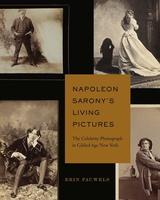
Erin Pauwels,
Napoleon Sarony’s Living Pictures: The Celebrity Photograph in Gilded Age New York.
Penn State University Press, 2024.
268 pp.; 90 b&w illus.; notes; bibliography; index.
$69.95 (hardcover)
ISBN: 9780271095066
From 1876 to 1895, one photographer’s name loomed large—literally—over New York City’s Union Square: Sarony. Although not widely acknowledged today, this name in its characteristic swirling script would have been recognizable not only to passersby beneath the Broadway marquee but also to the countless individuals who encountered his widely circulated portrait photographs. At its height in the 1880s, Napoleon Sarony’s Union Square studio filled orders for more than one thousand photographs a day; Sarony estimated that, over the course of his career, he produced approximately two hundred thousand portraits (5). He photographed many of the most famous people of the Gilded Age, including actors, authors, and politicians, and innovated new techniques of staging, retouching, and printing images. Yet his legacy was tarnished by the next generation of modernist photographers who consciously distanced themselves from predecessors such as Sarony to stake their own claims for the medium.
Erin Pauwels’s new book, Napoleon Sarony’s Living Pictures: The Celebrity Photograph in Gilded Age New York, takes up the challenge of troubling the narrative that photographers like Alfred Stieglitz and early historians like Robert Taft promulgated about nineteenth-century image making. Where they identified a modernist rupture based upon an embrace of medium specificity and a disavowal of commercialism, Pauwels traces complexities and continuities across generations. In doing so, she recovers Sarony’s contributions not only to the history of photography but also to emergent cultures of celebrity and mass media. Although she makes the case for understanding this photographer in his time, she puts this nineteenth-century history in dialogue with contemporary concerns about the making and circulating of images, including social media, copyright, and appropriation. These connections are compelling and could be further highlighted as a central theme of the book.
Pauwels conceives of her project as “an experimental variation on a traditional monograph” (16). To her, that means a “representative microhistory” that is “divorced from obligatory triumphalism and opened to the reality that most artistic careers fail to achieve canonical status” (16). This book successfully navigates the tension between avoiding triumphalism while also justifying its protagonist as a compelling subject of study. Pauwels demonstrates that, although Sarony may not have achieved canonical status, he was a leading photographer during a period of dramatic and lasting change. When he first opened a studio in 1866, photography was still “nebulous enough in its applications that early photographers remained reluctant to claim the title of artist”; by the time he died in 1896, “photographers did not hesitate to call themselves artists, and the status of their medium as a tool for making art was considerably more assured” (226). She does not attribute this shift to Sarony alone but rather excavates his prolonged commitment to establishing photography as a fine art through his images, business practices, exhibitions, legal advocacy, and more.
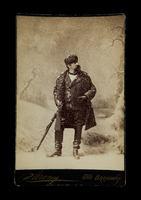
The opening chapter introduces Sarony by way of an artificially snowy self-portrait from around 1875 (fig. 1). He photographed himself frequently, and this exemplary image reveals how he crafted a unique public persona that subverted expectations of the profession. Tracing this persona through images and texts, Pauwels contends that “Sarony’s most significant contribution to photography in the United States was his decisive break from the myth of autonomous production that dominated understanding of the medium in its first decades” (26). By transforming his own identity in photographs, he simultaneously worked against the prevailing notion of the medium as transcriptive and remade the image of a photographer in the model of contemporary painters: “debonair, unconventional, and unabashedly eccentric” (35). This chapter also establishes Stieglitz as a foil to Sarony. To many readers, the contrast between Sarony’s snowy self-portrait and Stieglitz’s photographs of snowy New York might affirm the enduring narrative of a modernist break, but Pauwels suggests that they have more in common than it might at first appear, a theme to which she returns at the end of the book.
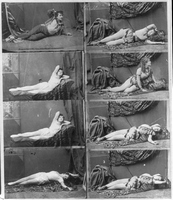
In chapter 2, Pauwels considers Sarony’s portrait photography alongside the rise of theater and celebrity culture in the wake of the Civil War. At the center of this discussion are Sarony’s portraits of Adah Isaacs Menken, an actress renowned for her gender-bending and risqué performance as Prince Mazeppa (fig. 2). Taken in 1866, these photographs helped launch Sarony’s career, and Pauwels attributes their success to his ability to depict Menken’s signature gender fluidity—where other photographers had struggled—by making room for improvisation, expressiveness, and performance within the frame. This expanded notion of photographic posing (or not posing, as Sarony would have it) became his hallmark, coupled with the use of the theatrical sets and props that became more visible as collectible photographs expanded from cartes de visite to cabinet cards. As Pauwels shows, Sarony’s images constitute a remarkable archive of the relationship between photography and theater during a formative period for both, an investigation that might be enhanced through more robust engagement with contemporary queer theory and performance studies.
The third chapter turns back the clock to Sarony’s early career as a commercial lithographer. Here, Pauwels aims to demonstrate that Sarony’s lifelong preoccupation with artistic recognition began long before he took up photography, emerging out of his frustration with the lithographic industry. Studying a few of Sarony’s most successful prints, Pauwels outlines how his experience of this replicative media, so widespread in antebellum visual culture, presaged his later multimedia experiments in photography as well as his insistence on creative authorship, an aspect of his career that Pauwels examines in the following chapter. Although this connection across chapters is compelling, and although the structure of the book is not chronological, this chapter stands out from the others, asking the reader to jump across both time and media.
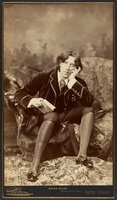
In the fourth chapter, Pauwels uses Sarony’s omnipresent signature as a starting point to consider how he navigated changing social conceptions and legal definitions of photographic artistry. After considering Sarony’s work in dialogue with different international paradigms of intellectual property law, as well as with nineteenth-century enthusiasm for collecting signatures, this chapter culminates in Burrow-Giles Lithographic Company v. Sarony, a case decided by the United States Supreme Court in 1884. This dispute concerned one of Sarony’s portraits of Oscar Wilde—a photograph that became both the defining image of the subject and the most recognized accomplishment of the maker (fig. 3). After a lithographic company used this photograph without permission to produce eighty-five thousand advertising cards, Sarony sued and eventually won, setting a precedent that photography is subject to copyright protection but only if it evinces sufficient authorial originality. Through this influential case—still studied and referenced today—Sarony’s pioneering vision for photography as art was affirmed by the legal system. Pauwels might have spent more time with this important facet of Sarony’s legacy, further connecting it to twenty-first century debates around intellectual property.
In chapter 5, Pauwels takes us into the studio behind the famous marquee on Union Square, assessing Sarony’s photographs in the context of late nineteenth-century consumer culture. In an era of burgeoning mass production and consumption, Sarony negotiated photography’s dual role as both a commodity and a mode of depicting commodities—all the while asserting its standing as an art form. Pauwels highlights 1876 as a formative year for Sarony: he participated in the Centennial International Exposition in Philadelphia and established his studio on Union Square, in both cases aspiring to enhance his reputation with broad publics. Sarony filled his new reception rooms with myriad things, from contemporary sculptures to a taxidermy crocodile. Pauwels shows how “borrowing strategies from contemporary painters and presenting his photographs as beautiful objects in pleasing aesthetic assemblages allowed Sarony to concoct a potent visual argument that his work belonged within their ranks” (171). His photographs, too, carefully layered objects to create innovative effects.
The final chapter addresses one of Sarony’s last ventures: a magazine called Sarony’s Living Pictures. It debuted in 1894 and comprised images produced with a novel photochrome process. Although critics and historians have long derided these prints as kitsch and an artistic dead-end, Pauwels makes the case that “despite appearances and regardless of its long-term success, Sarony’s Living Pictures represented the culmination of a career-long desire to develop a strategy for making fine art out of reproductive mass media” (189). Building on Michael Leja’s work, Pauwels presents them as “fortified hybrid images” (203): based on paintings, photographed with performers in the studio, and heavily retouched before printing. She discusses how the notion of “living pictures” was, in the 1890s, expanding to encompass another media innovation—the motion picture—and how images in Sarony’s Living Pictures inspired a series of short films produced by Thomas Edison’s American Mutoscope and Biograph Company, further troubling their denigration by subsequent narrators. Stieglitz returns to bookend this story, as Pauwels examines his work as founder and owner of the Photochrome Engraving Company, which printed Sarony’s Living Pictures. Although Stieglitz would come to disavow this project, Pauwels reveals that he did, at the time, participate in this vision of photography. Stieglitz’s later rewriting of this chapter of his career—including the destruction of some of his work—paved the way for the sidelining of Sarony in the history of photography. Yet, as Pauwels shows, “the interconnections between modernism and the rich visual culture that preceded it are far messier and more beautifully entangled than the stories we tell about them conventionally allow” (217). Particularly in this chapter, the book’s black-and-white illustrations fall flat, and the reader is left to seek out reproductions elsewhere to understand Sarony’s contributions to color photography.
Together, the six chapters make a compelling case for including Sarony more prominently in the history of photography. As promised in the introduction, Pauwels avoids triumphalism and does not shy away from highlighting the more complex or unfashionable aspects of Sarony’s oeuvre; rather, she asserts his significance in still unfolding debates about photography, art, and mass media. Her “experimental variation on a traditional monograph” also manifests in the sequence of chapters, pointedly avoiding the chronological narrative that often defines monographs. While this choice works to shift focus from Sarony as an individual and toward his participation in broader cultural dynamics, the resulting sequence feels somewhat arbitrary, and, as mentioned above, the jumps in time (and, in one case, media) might prove challenging to a reader not well-versed in the period.
Sarony was a small man, standing at less than five feet tall—the actress Sarah Bernhardt called him “mon petit Sarony” (41). Yet, as Pauwels shows, he worked fastidiously to broadcast an outsized persona belying his small stature, championing himself as an artist through images, spaces, advertisements, exhibitions, and even a lawsuit. He was, by many counts, successful, and his obituaries presented him as “a photographic giant” (219). Despite these efforts and his prominence during his lifetime, his stature in the history of photography remains relatively small. In her conclusion, Pauwels meditates on why. She outlines a confluence of factors, including the posthumous sale of his studio and trademark to the Burrow-Giles Lithographic Company, the very company he had once sued for copyright infringement. But she highlights above all the self-conscious narration of modernist photography as a break from what came before, what Stieglitz famously called a “secession.” Perhaps the most salient contribution of this book is a critique of canon formation and a call to reexamine long-held narratives in the history of photography.