Dealing in Splendour: A History of the European Art Market edited by Christian Huemer and Stephan Koja
Reviewed by Darius A. SpiethDarius A. Spieth
Louisiana State University
Email the author: dspieth[at]lsu.edu
Citation: Darius A. Spieth, book review of Dealing in Splendour: A History of the European Art Market edited by Christian Huemer and Stephan Koja, Nineteenth-Century Art Worldwide 25, no. 3 (Autumn 2026), https://doi.org/10.29411/ncaw.2026.25.3.17.
This work is licensed under a Creative Commons Attribution-NonCommercial 4.0 International License  unless otherwise noted.
Your browser will either open the file, download it to a folder, or display a dialog with options.
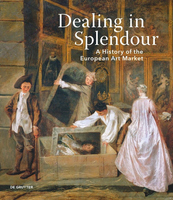
Christian Huemer and Stephan Koja, eds.,
Dealing in Splendour: A History of the European Art Market.
De Gruyter Brill, 2026.
448 pp.; 210 color illus.
$64.99 (hardcover)
ISBN: 9783689241070
Art market studies are fashionable these days. Writers, historians, economists, academics, advisers, theoreticians of all kinds, self-appointed “policy makers,” and, worst of all, press people and influencers are constantly on the prowl. Practitioners—such as buyers, sellers, collectors, and dealers—are much less so. Hardly a month goes by without a new conference, colloquium, or publication on the subject. Twenty or thirty years ago, this specialized field hardly existed, and all relevant publications fit on a one-page bibliography. Why now is there such a seemingly insatiable interest in the subject matter? One might suspect that the rise of the internet and the digital age opened the alleged “secrets” of the art market to public scrutiny. The application of econometric and financial methods, the proliferation of auction record databases, the accessibility of online bidding and global broadcasts of live sales, and other online phenomena garnered the attention of the mainstream press—a double-edged sword for sure—and triggered a never-ending, love-hate relationship between social media and record prices, real or imagined.
Art market-related exhibitions represent a different story. They tend to be rare; in recent times, only La fabrique du Luxe: Les marchands merciers parisiens au XVIIIe siècle (The Fabrication of Luxury: the Parisian Marchands-Merciers in the Eighteenth Century) at the Musée Cognac-Jay in Paris (2019) and Global Baroque: The World in Rome in the Age of Bernini in the Scuderie of the Quirinale in Rome (2025)—both of which were highly original, narrowly focused, and exquisitely curated—can compete in this category. Exhibitions about art markets pose the challenge of how to visualize economic transactions involving artworks. It is a problem for which there are generally only two solutions: to show artwork depicting the places where the transactions take place (e.g., auction houses, fairs, galleries) or to focus on artworks that, for one reason or another, have become touchstones for the economic value of art, usually manifested in the record prices they fetched. In the latter case, of course, there is nothing intrinsically visual to such artworks that link them to their extrinsic, monetary value. From a curatorial perspective, such solutions are hardly satisfactory. Nor is the prospect of displaying archival materials, such as historical account books and past auction catalogues.
By organizing Dealing in Splendour: A History of the European Art Market for the Princely Liechtenstein Collection this Winter/Spring in Vienna, Christian Huemer, Stephan Koja, and their collaborators accepted this challenge. The accompanying exhibition catalogue impresses us by its monumentality. It is a coffee table book of almost 450 pages that brings together more than thirty scholarly essays on subjects ranging from the markets for tapestries in Baroque Antwerp to the early branding efforts of James Christie (the founder of Christie’s Auction House) in eighteenth-century London. The format and context raise questions about the nature of the publication and its intentions. Is it truly an exhibition catalogue, that is, a permanent scholarly record that discusses the ideas behind the objects assembled temporarily at an institution, usually a museum? Is it a colloquium with topical contributions by the leading specialists in the field? Is it an attempt, as the title suggests, to write a general history of the art market? Dealing in Splendour attempts to be all of the above at once.
One of the most compelling aspects of the publication is its rich visual documentation. Detailed reproductions of difficult-to-find or previously overlooked iconographic materials, such as Bartholomeus van Bassen’s The Art Fair in the Vladislav Hall of Prague Castle (ca. 1607; private collection) (114–15) or the minutiae of a shop filled with paintings operated under the auspices of the painters’ guild in an anonymous Dutch painting of a quack at the Rijksmuseum (155–57), bring the workings of early modern art markets in seventeenth-century Europe to life. These two examples are anything but coincidental. In general, Dealing in Splendour strongly emphasizes the periods of the Baroque and the Enlightenment; geographically, it is anchored in and around the Habsburg lands—not surprisingly, because the Princely Liechtenstein Collection sponsored and hosted the exhibition.
The twentieth-century art market is relegated to an epilogue on Modernism by Tom Stammers at the end of the catalogue; it barely comprises ten pages of text. Introduced by a discussion of Gerald Reitlinger’s The Economics of Taste (1962–70), which is now considered something like the ancestral foundation of twenty-first-century art market studies, it covers such “evergreens” of the genre as the early twentieth-century market for Pablo Picasso, the expansion of Christie’s and Sotheby’s into the US market after World War II, and the story of how the Japanese “bubble economy” of the 1980s fueled a price explosion for Vincent van Gogh and Impressionist and Post-Impressionist art. Passing references to the rise of art fairs in the 1960s, Jeff Koons, and the criticism of the art market by contemporary artists through their creations round out the picture. For those readers interested in the art market of the twentieth century, of modern and contemporary art, or more marginal centers of exchange (which, in this instance, curiously seems to even include London and New York), Dealing in Splendour will not have much to offer.
Thus, the strong suit of Dealing in Splendour is, for lack of a better term, the “Old Masters”—and especially Dutch and Flemish works from the Renaissance to the “Golden Age,” as well as the dialogue with the classical past across the ages, plus a smattering of the nineteenth century. The geographical range is mostly delineated by Holland, Flanders, France, and then Italy and German-speaking countries, with the Habsburg lands as a common denominator. The essays that constitute the volume are gracefully short and concise. Alexandria Bounia’s contribution about collecting and copying activities in ancient Rome is erudite and original with its reliance on primary sources by Cicero, Livy, and others to paint a picture of antiquity as the cradle of the modern Western art market, including its psychological dramas, politics, marketing, social postering—all fueled by an already highly developed auction system. Susanne Kubersky-Piredda’s study of the art market in early Renaissance Florence underscores the fact that, contrary to the general history of art, the notion of the art market was not “revived” in Renaissance Italy from classical antiquity. Instead, if one wants to analyze the Italian Renaissance from an economic perspective, the center of gravity is with patronage, prices of raw materials, labor costs, workshop relations, art’s place in the luxury industries at large, or the geographically expanded range of circulation patterns of money and merchandise.
Some of the very best contributions in Dealing in Splendour engage small, specialized, and topical fields of the art market that are often overlooked, such as the Renaissance fad for small bronze copies of monumental classical sculptures from antiquity (Claudia Kryza-Gersch) or the competing markets for tapestries in Antwerp and Brussels during the Baroque period (Koenraad Brosens). Christof Metzger draws our attention to the often-overlooked importance of Albrecht Dürer as a traveling chronicler of the economic conditions both north and south of the Alps, especially as they relate to art and its market. Dürer is not only a textbook example of how multiples—prints in his case—enlarged and boosted art market activities but also stands out as a stickler for recording specific prices and the exact nature of transactions. Metzger’s account of how the artist exchanged two panels of his for two rings valued at 22 to 24 ducats (90) resonates with current-day anecdotes, such as Nicholas Cage’s pawning his luxury watch to acquire a Robert Williams painting.
Filip Vermeylen belongs to the “classic authors” of art market literature. His breakthrough study from 2003, Painting for the Market: Commercialization of Art in Antwerp’s Golden Age, not only showed how the art market in Antwerp, which he described as a system of “pands” during the long sixteenth century, existed at the intersection of ecclesiastical, guild, and early financial influences (the bourse [stock market] being door-to-door with the market for altarpieces and religious art).[1] Antwerp can indeed be regarded as something like the originator of early modern art markets. Vermeylen also convincingly argued for the Protestant Reformation as both a destroyer of the original system, where the Church and its institutions were pre-eminent forces on the demand side, and a catalyst for a modern, collector-driven market made up of private individuals searching for aesthetic gratification. Fast-paced and engagingly written, Vermeylen’s scholarship complements that of other writers, such as Victor Stoichita, by tackling the subject and the times in economic terms. Vermeylen’s essay in Dealing in Splendour, “Art Fairs in Early Modern Antwerp,” can be regarded as something like a synthesis of the highlights in the author’s prior scholarship.
Like Vermeylen, Kim Oosterlinck and Anne-Sophie Radermecker are household names in art market studies. Their contribution revisits the genealogical problems of the Bruegel (spelled Brueghel in the catalogue) family of painters, which has baffled generations of art historians and elevated it to a case study in artistic name branding. It is certainly a clever idea and a cleverly written article, but most importantly a welcome refresher course on the conundrums of the Brueghel family and its members. In this instance, shifts in style and family associations are framed by considerations of taste, marketing, and the market value of art.
Taking a sociological approach, Weixuan Li’s chapter on “Painting for the People: Mass Consumption and Display of Art in Seventeenth-Century Amsterdam” stands in the tradition of such writings as John Michael Montias’s Art at Auction in 17th-Century Amsterdam (2002) and Simon Schama’s The Embarrassment of Riches.[2] The observations about how Amsterdam’s rise as a center for the trade and production of art is owed to the decline of Antwerp are astute; as is the author’s summary of the demise of Amsterdam as an art center after 1670. Not unlike her forebears, she stresses the omnipresence of art in Dutch middle-class homes by the middle of the seventeenth century. The author is at her best when she discovers and discusses minute details in paintings that have historical information about early Dutch art markets to reveal.
Sandra van Ginhoven has acquired a reputation among art market scholars for quantitative and statistical research—and especially the use of digital mapping and information design, as it pertains to Netherlandish Baroque art. Her analysis of the Antwerp-based Forchondt family of dealers, which she already investigated previously in her book Connecting Art Markets, stands methodologically in the tradition of Hans Van Miegroet and Neil De Marchi.[3] Her mapping of the Fochondts’ business activities from ca. 1640 to 1670 confirms the geographical logic of the Antwerp location within the Habsburg context: much of the dealers’ exports went to Spain (and from Spain on to Spanish America), as well as Austria, especially Vienna. Her integration of this analysis with specific extant works from the Royal Liechtenstein Collection and its provenance is intriguing.
The Habsburg Empire and its collections are also the center of the investigation in Virginie Spenlé’s chapter on princes and their art agents in which Rudolf II holds the place of honor. The essay is a reminder of the convoluted history of the Habsburg collections between Prague and Vienna prior to their being looted by Christina of Sweden in 1647. It argues for the personal involvement of princes in collecting activities: as a matter of pride, competitiveness, ambition, and genuine love for art, for which Friedrich August of Saxony’s acquisition of the Sistine Madonna by Raphael is a case in point. Princely art agents (in today’s lingo, art advisers) were often recruited from the diplomatic and ecclesiastic milieu and adeptness at negotiating the acquisition of art could turn into a career booster for some such individuals.
Adriano Aymonino’s chapter on Grand Tour art is a competent summary of the subject, covering the bases of the historical, geographical, and socioeconomic roots of the phenomenon before describing the eighteenth-century market for copies of antiquities and the place of artists such as Giovanni Paolo Panini, Pompeo Girolamo Batoni, and Canaletto in this scheme. But ultimately his essay does not have new insights to offer. Adequately explaining Antoine Watteau’s Shop Sign of the Art Dealer Gersaint (1720–21; Charlottenburg Palace, Berlin) is something like the holy grail of historical art market studies. It has already garnered an extensive body of secondary literature by Andrew McClellan, Di Marchi, and Van Miegroet, and, most importantly, Guillaume Glorieux. Sophie Raux, in more recent years, has contributed to this body of knowledge through digital reconstructions of the actual setting of Gersaint’s shop on the Pont Notre-Dame in Paris, as well as further statistical analyses of the auctions held by Gersaint in the 1730s and 1740s. Her chapter on the subject essentially represents a synthesis of existing scholarship.
Bénédicte Miyamoto’s chapter begins as a biography of James Christie, the well-known eponymous founder of the London auction house, and ends as a comparative study of auction premises and printed auction catalogues in London and in Paris. The story of Jean-Baptiste Pierre Le Brun’s tumultuous activities in the art market before and during the French Revolution, his promotion of Netherlandish art in late eighteenth-century Paris, his auction room, his role in Revolutionary politics, his friendship with Jacques-Louis David, and his implication in the early history of the Louvre Museum have been extensively covered by authors such as Bette W. Oliver, Gilberte-Emile Mâle, Fabienne Camus, and others (not to mention the even vaster literature on his wife, the painter Elisabeth Louise Vigée-LeBrun). Iris Yvonne Wagner’s essay on the subject, based on her 2014 dissertation at the University of Marburg, does not offer much new on the topic.
The final section of Dealing in Splendour, on “strategies and publicity of the art market in the industrial age,” consists of essays by Patricia Mainardi, Christian Huemer, and Simon Kelly. Mainardi is best known for her studies of the world fairs of 1855 and 1867 published in the 1980s, as well as her magnum opus, The End of the Salon.[4] Her essay draws on this earlier scholarship when she revisits the structural and institutional changes of the official Parisian Salon, which she contextualizes with the expansion and emancipation of private galleries as well as the peer pressure from an ever-growing number of artworks submitted. The institutional changes affecting this evolution of the Salon, of course, were a driving force for the blossoming of the French and international art market during the second half of the nineteenth century. The role of critics and shifting attitudes of an increasingly well defined “art public” provide important subtexts for Mainardi’s analysis. Christian Huemer’s essay supplements Mainardi’s by investigating the late nineteenth-century market for academic art and its larges machines. He begins with a review of admission fees demanded for exhibitions of and by contemporary artists: from Benjamin West and Jacques-Louis David’s Louvre studio to the Shakespeare Gallery in London. He then shifts attention to the business model of the Goupil gallery—today probably best remembered as an early employer of Vincent van Gogh—and its international branches, especially its reliance on reproductions of all kinds. The case of Jean-Léon Gérôme, as the flagship artist of the Goupil empire, serves as a key example. Huemer concludes the essay with a comparison of Goupil with the dealer Charles Sedelmeyer and his promotion of painter Mihály Munkácsy, who, like the Polish painters Jan and Adam Styka some years later, attained success with panoramic Biblical melodramas. The commercial success of Jean François Millet’s peasant scenes at the end of the century links Huemer’s contribution to that of Simon Kelly, who reviews the market for French landscape paintings. His essay spans the arc from the Barbizon School to the Impressionists, reminding us of the fact that the Barbizon painters were the first living artists to extensively organize auctions at the Hôtel Drouot to boost the sale of their artistic output; dealer Paul Durand-Ruel’s role in the success story of the Impressionists is rightly stressed. Historiographically, Kelly’s essay stands in the tradition of John Rewald and establishes the historical closure for the materials covered by Dealing in Splendour.
The catalogue also contains eleven shorter, dictionary-style entries on such subjects as “Copies,” “Art Fairs,” “Lotteries,” and “Transport.” While useful for the novice, these entries have little new to offer readers already familiar with the subjects. It is unfortunate that Koenraad Brosens, in his entry on “The Dark Side,” is harping on sensationalist and often unsubstantiated press coverage concerning “stolen art,” “opaque secrecy infrastructures,” and “money laundering” to call for more “regulations” of whatever kind in a publication that is otherwise mercifully free of jargon, moralizing rhetoric, and buzz words. The catalogue concludes with a forty-page annex illustrating the objects included in the Vienna exhibition, mostly from the Liechtenstein collection. Given that many of the objects shown were already illustrated, often in a much higher quality, in the preceding chapters, the appendix has a certain redundancy.
In summary, Dealing in Splendour is more of a synthesis of the last forty or so years of art market scholarship but more lavishly illustrated and better presented than before. It has much to offer for readers who were previously unfamiliar with the field and who want to gain a quick overview of the highlights of continental European art markets from the seventeenth to late nineteenth centuries. However, for specialists already familiar with the subject, Dealing in Splendour will not have much new to offer outside of the masterly (re)contextualization of existing knowledge; rather, it summarizes the state of the field.
Notes
[1] Filip Vermeylen, Painting for the Market: Commercialization of Art in Antwerp’s Golden Age (Brepols, 2003).
[2] John Michael Montias, Art at Auction in 17th-Century Amsterdam (Amsterdam University Press, 2002); and Simon Schama, The Embarrassment of Riches: An Interpretation of Dutch Culture in the Golden Age (Alfred A. Knopf, 1987).
[3] Sandra van Ginhoven, Connecting Art Markets: Guilliam Forchondt’s Dealership in Antwerp (c. 1632–78) and the Overseas Paintings Trade (Brill, 2016).
[4] Patricia Mainardi, The End of the Salon: Art and the State in the Early Third Republic (Cambridge University Press, 1993).