Divergent Approaches to the Portrait of Joseph Smith by David Rogers: Historical Context and Reception
by Lauren Kellogg DiSalvo and Nancy RossLauren Kellogg DiSalvo is a collegiate associate professor of art history at Virginia Tech. Her research investigates the reception of the art and material culture of the classical world in Europe and the United States during the eighteenth and nineteenth centuries. She has worked on classical plaster collections from the long nineteenth century in connection with universities and world’s fairs, Grand Tour material culture, and portraiture of the long eighteenth century. Her recent publications include “Connecting to Antiquity Through Touch: Gem Impressions in the Long Eighteenth Century” (Arts, 2025), “Translating Antiquity onto Souvenirs: The Collectively Shaped Reception of the Doves of Pliny on Micromosaics” (Art Inquiries, 2023), and “Postures After the Antique in Eighteenth-Century Portraits of Women” (ABO: Interactive Journal for Women and the Arts, 1640–1830, 2022).
Email the author: laurendisalvo4[at]vt.edu
Nancy Ross is an associate professor of interdisciplinary arts and sciences at Utah Tech. Her PhD in art history focused on medieval English manuscripts, but her work eventually evolved toward historical and sociological research on Mormonism, Mormon feminism, and Mormon material culture. Her latest work includes the book Mormon Garments: Sacred and Secret (University of Illinois Press, 2026), coauthored with Jessica Finnigan and Larissa Kanno Kindred. Her article with David Howlett, “Creating a Feminist Religious Counterpublic: RLDS Feminists and Women’s Ordination Advocacy in America, 1970–1985” (Religion and American Culture, 2023), was the recipient of multiple awards: Best Article on Mormon Women’s History and the Greg Kofford Best Historical Article Award.
Email the author: nancy.ross[at]utahtech.edu
Citation: Lauren Kellogg DiSalvo and Nancy Ross, “Divergent Approaches to the Portrait of Joseph Smith by David Rogers: Historical Context and Reception,” Nineteenth-Century Art Worldwide 25, no. 3 (Autumn 2026), https://doi.org/10.29411/ncaw.2026.25.3.5.
This work is licensed under a Creative Commons Attribution-NonCommercial 4.0 International License  unless otherwise noted.
Your browser will either open the file, download it to a folder, or display a dialog with options.
Preamble
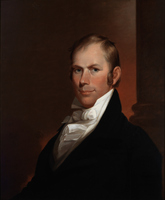
In the summer of 2022, scholars from Community of Christ’s Church History and Sacred Story team published an article on a recently rediscovered daguerreotype that they argued portrayed the founder of the Latter Day Saint movement, Joseph Smith (1805–44) (fig. 1).[1] After its initial publication, two main Utah news outlets, the Deseret News and The Salt Lake Tribune, issued responses, which, in turn, led to a debate about the daguerreotype’s authenticity on social media. Disagreement about whether it depicted Smith largely fell along denominational lines, reigniting old conflicts. Members of Community of Christ (known as the Reorganized Church of Jesus Christ of Latter Day Saints [RLDS] prior to 2001) tended to accept the identification of Smith. Members of the Church of Jesus Christ of Latter-day Saints (Latter-day Saints, LDS, or Mormons) often rejected it, citing the daguerreotype’s lack of resemblance to the iconic portrait of Smith by David Rogers (1807–84) from 1842, which had long been heralded in Latter-day Saint circles as the best representation of Smith’s likeness (fig. 2).[2]
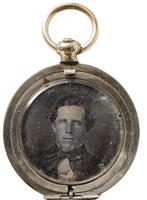
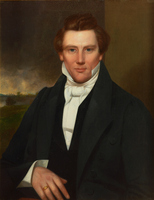
This debate caught our attention. As art historians, we were concerned that arguments about the identity of the daguerreotype’s sitter were based on a painted portrait of Smith, as though the primary purpose of that painting was to create a definitive, authoritative likeness. Our initial reaction was to use the tools of art history to demonstrate that the Latter-day Saint community had misunderstood the Rogers portrait and its purpose. However, during our research, we became preoccupied with its reception, and as a result, several questions emerged: Why is there disagreement between these two communities in their understanding of the meaning of Smith’s image? Why does a nineteenth-century image of Smith still matter to them? More generally, what can this debate about the Rogers portrait teach art historians about how an image’s meaning evolves within religious communities over time?
Introduction
This article explores three divergent understandings of Rogers’s Joseph Smith and what is at stake in the various claims made about it. We begin with an art historical analysis of the portrait as a political tool before taking into consideration the divergent understandings of members of Community of Christ and the Church of Jesus Christ of Latter-day Saints. Whereas Community of Christ regards the portrait as evidence of Smith’s monogamy and the legitimacy of church leaders born to him and his wife, Emma Hale Smith (1804–79), as well as their direct descendants, the community of Latter-day Saints interprets it as a true-to-life image of Smith as a divinely inspired prophet.[3] As we demonstrate, these readings, in turn, inform how these two branches of Mormonism engage with and disseminate the Rogers portrait in their church communities and beyond.
While many earlier art historical studies of Mormonism view its cultural products as unique, there is a growing movement to understand the art of Latter-day Saints within a broad sociohistorical context.[4] Drawing on archival evidence and comparisons with then-contemporary Grand Manner portraits, we argue that the Rogers portrait demonstrates Smith’s ambition and his use of portraiture to enhance his image and achieve his political goals, particularly in the wake of negative press. This art historical interpretation provides a valuable counterpoint to readings of the portrait that emerge from the two religious communities following Smith’s death.
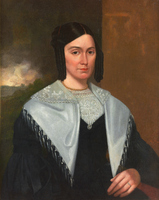
We interpret the reception of Rogers’s portrait by Community of Christ and the Church of Jesus Christ of Latter-day Saints through the lens of literary theorist Stanley Fish’s concept of “interpretive communities” and religious scholar David Morgan’s concept of “enchantment.”[5] By examining the portrait as an object of religious enchantment that exists within a matrix of forces, we learn that the Latter-day Saint and Community of Christ interpretive communities each approach the image with a different set of assumptions about Smith.[6] Community of Christ viewers regard the Rogers portrait as a companion piece to a portrait of Emma Smith (fig. 3), emphasizing the myth of the couple’s monogamous marriage, which, through its progeny, generations of church leaders descended. On the other hand, Latter-day Saint viewers engage in a literal reading of the painting, assuming that the aspirational image represents a faithful, true-to-life rendering of the man that affirms his prophetic status. In the portrait, Smith appears to the members of this group as a heroic, godlike figure whose actions play a role in human salvation. Ultimately, we contend that a multivalent approach to a historical religious image leads to a more nuanced art historical understanding of the portrait as serving more than just religious ends and reveals the importance that nineteenth-century images still hold for religious communities today.
Joseph Smith and the Rogers Portrait
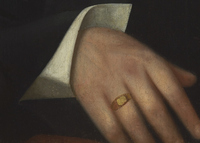
The Rogers portrait dates to September 1842, a time during which Smith was building the fullest expression of his religious vision in Nauvoo, Illinois.[7] It presents a half-length, three-quarter view of the sitter who is seated facing the viewer with a landscape behind his right shoulder and a wall or pilaster behind his left (see fig. 2). Smith’s clean-shaven face turns fully toward the viewer with a neutral expression. He wears fashionable, mid-nineteenth-century men’s clothing—a fitted, dark, double-breasted, collared waistcoat with slightly puffed sleeves at the shoulders; a white cotton shirt with a standing collar; and a cravat around his neck.[8] His outfit underscores his position in society as a refined, elite gentleman who did not engage in manual labor. This status is further reinforced by his clean white shirt cuff, a difficult thing to achieve on the US frontier. His right hand reveals a gold ring on the fourth finger, signifying his marriage to Emma. However, our close examination of the paint surface and the fact that the ring appears on his right hand rather than his left suggest that the ring may not be original to the painting but instead a later addition (fig. 4), present at least as early as 1844, as pictured in a daguerreotype, probably by Lucian Foster, of the painting.[9] The background elements also can be interpreted as signs of his identity and character. The combination of architecture and landscape serve as what art historian Barbara Groseclose identifies as one of the “obligatory accouterments of status,” signaling the sitter’s strength, rationality, and stability.[10] The uninhabited, frontier-like landscape with the sun over a river lined with trees most likely suggests the sitter’s ownership of land as it often did in historical portraits. The stormy sky juxtaposed with the calm and dignified sitter further positions Smith as a competent leader in tumultuous times.
As Smith’s journal indicates, the artist and church member Rogers visited Smith in Nauvoo on September 7, 1842.[11] During this meeting, Smith likely discussed his wish for a portrait painted by Rogers, who, according to historians Katherine Woltz and Lachlan Mackay, was a student of John Vanderlyn (1775–1852), a celebrated US artist who studied in Paris and worked as a portrait and history painter.[12] By the time of his meeting with Smith, Rogers was regularly exhibiting at the National Academy of Design in New York and was therefore well-versed in nineteenth-century portrait conventions.[13]
In his journal, Smith describes being present while Rogers painted his portrait on September 15, 16, and 17 and again on September 19 and 20.[14] An early draft of Smith’s autobiography gives further insight into this painting, noting that on September 16, 1842, “I [Joseph Smith] was at home with bro[ther] [David] Rogers who was painting my likeness.”[15] Smith sat for the portrait on these days, but it is unclear exactly when the painting was completed and delivered to him. While it is difficult to determine the extent to which Smith dictated his representation, it likely was commissioned by Smith himself and was painted in his presence, giving him an opportunity to provide input. Smith’s choice of Rogers, an artist familiar with trends in national portraiture, signals his intent to adopt well-established US portrait conventions.
Before turning to our art historical interpretation of this portrait, we offer a brief biography of its sitter. Joseph Smith Jr. was raised in Palmyra, New York, where the Smith family settled in 1816. Growing up in a region where many religious revivals took place, Smith unsurprisingly became interested in religion.[16] Smith claimed that God and angels visited him in a series of visions from 1820 onward. While establishing a church and a following and achieving a position of high status among his followers as a prophet, Smith was met with disapproval by those outside his church. Locals and newspapers in the region called him a religious imposter and boycotted his publication of the Book of Mormon in 1830.[17]
Smith and his followers ran into further conflict with local inhabitants in places they settled following their migration from New York, including Kirtland, Ohio; Jackson County, Missouri; and Nauvoo.[18] It was in Nauvoo where Smith let his wife Emma know that an angel had visited him and commanded him to practice polygamy and take additional wives. This practice, which would spread also to Smith’s inner circle, would further fuel negative perceptions of Smith and complicate his legacy.[19] Smith’s numerous wives, totaling perhaps thirty-three, included teenage girls aged fourteen and older and women who were already married to other men.[20]
In an attempt to seek justice for the hostile treatment of his people by locals in the places where they settled, Smith became involved in politics on a national level. In January 1844 he announced his candidacy for US president, the election of which would be held in November of that same year.[21] His candidacy was cut short when he and several of his followers were murdered in Carthage Jail in Illinois in June 1844 while incarcerated for treason and inciting a riot.[22]
After Smith’s death, Brigham Young (1801–77) emerged as the new leader of the religious community. Much of the fledgling church’s property was in Smith’s name, causing Emma Smith and Young to fight over ownership of Smith’s assets.[23] When Young announced his plans for the whole church to leave Nauvoo and move west in 1846, Emma and others stayed behind. Young and his group settled in the Salt Lake Valley in 1847, using the name the Church of Jesus Christ of Latter-day Saints. The Rogers portrait stayed behind in Nauvoo in the possession of Emma and her descendants. She supported her son Joseph Smith III (1832–1914) in becoming the leader of the newly formed Reorganized Church of Jesus Christ of Latter Day Saints in 1860.[24]
Art Historical Insights
By placing the Rogers portrait within its broader historical, stylistic, and relational contexts, we argue it is less the unique object that Latter-day Saint religious groups claim and more a representative example of nineteenth-century Grand Manner portraiture in the United States.[25] In the nineteenth century, when photography was rare and newspapers were often biased, portrait paintings played a crucial role in shaping reputations.[26] Our art historical analysis reveals how the portrait presented Smith as a frontier leader of status, power, and refinement, akin to other US leaders of this period, and functioned as a deliberate strategy to counter negative press.
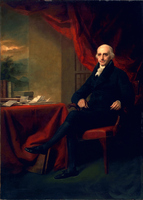
The portrait aligns with broad trends in US portraiture, drawing on the Grand Manner to place Smith within the existing visual iconography of power as seen in presidential portraits of the period. Grand Manner portraiture already had a long history in Britain and Europe among wealthy, powerful, and refined sitters before colonial American artists first adopted this style in the eighteenth century. Grand Manner portraits were commissioned by the wealthy to display in their houses and usually feature a full-length view of the sitter in an outdoor setting, sometimes along with classical architecture. In the late eighteenth century, the Grand Manner was described and recommended by British painter Joshua Reynolds (1723–92) as a strategy allowing art to transcend time by adhering to more generalized, ideal forms, as determined by historical artists who used classicizing styles.[27] The pursuit of this ideal form generally resulted in images with figures of classical proportions, restrained facial expressions, and bold colors applied in broad masses.[28] Typical of this manner as it developed in the early nineteenth century is a portrait of Sir William Miller, Lord Glenlee, by British painter Henry Raeburn (1756–1823) (fig. 5). It depicts the Scottish judge and book collector, Lord Glenlee, seated beside a table covered with his personal effects, with a swath of red drapery pulled back above his head to reveal a bookshelf and a window with a view of a landscape, including a sun emerging through a cloudy sky. Reynolds’s and other British Grand Manner portraits like that of Lord Glenlee had a significant impact on nineteenth-century portraiture in the United States.[29] Rogers would likely have seen Reynolds’s work and other Grand Manner portraits on view at the annual exhibitions of the National Academy of Design in New York, which was deeply influenced by the Royal Academy in London, which Reynolds founded and led.[30] He also may have learned about Reynolds’s work while studying with Vanderlyn, who himself was trained by Scottish-born artist Archibald Robertson (1765–1835) and worked in the Grand Manner, or through prints, as we know that later artists working for Smith’s church community in Nauvoo collected Grand Manner prints by Reynolds and others for reference and teaching.[31]
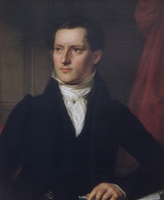
The Rogers portrait features common characteristics found in European and US Grand Manner portraits, such as those by John Hoppner (1758–1810), Samuel Lovett Waldo (1783–1861), Benjamin West (1738–1820), and Thomas Lawrence (1769–1830).[32] The pairing of a landscape and an architectural detail, usually a column or a pilaster, signaled traits of elite social rank and leadership that Smith wished to claim for himself in his public image.[33] Smith’s classical proportions and restrained facial expression also align with other sitters in Grand Manner portraits. For example, the Rogers portrait correlates with John Vanderlyn’s portrait of his agent, John A. Sidell, painted in 1830 (fig. 6). Both paintings feature similarly dressed men with one arm visible against an architectural background. They embody typical Grand Manner aesthetics, with paint broadly applied to the canvases that depict classicizing figures with restrained facial expressions.
Rogers’s portrait also adheres to the compositional and stylistic devices seen in Grand Manner portraits of politicians, suggesting Smith’s political ambitions at a time when he was attempting to gain federal intervention for persecuted church members in Missouri. Despite President Martin Van Buren’s (1782–1862) refusal to intervene, and the ultimate failure of a petition to Congress to do the same, Smith continued to pursue federal intervention, in addition to attempting to gain national recognition for his new religious community by running for president.[34] His portrait from 1842, painted before his presidential bid in 1844, foreshadowed these ambitions. Even as US politicians like Andrew Jackson (1767–1845) ignored his pleas for federal intervention, Smith adopted their visual iconography of power—rooted in the classicizing elements of the Grand Manner—and likely knew that this imagery of elite leadership would resonate with his followers and those on the national stage.
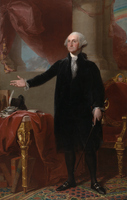
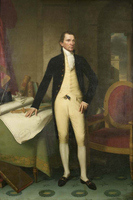
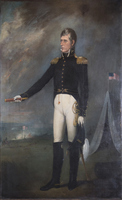
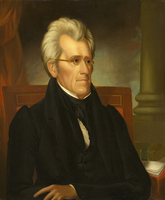
Through his portrait, Smith connected his image to that of important US political leaders past and present. He had many dealings over the years with figures in the national political spotlight, which likely exposed him to the portraiture of leaders to whose offices he aspired. While George Washington’s Lansdowne Portrait by Gilbert Stuart (1755–1828) predated Smith (fig. 7), it remained a touchstone during the nineteenth century; Vanderlyn, who trained with Stuart for a few months, painted a portrait of James Monroe that references the posture of Washington in the Lansdowne Portrait (fig. 8).[35] The latter portrays Washington standing in front of a background with Doric columns, dramatic drapery, and a cloudy sky with a rainbow. This portrait, which was distributed widely through prints, influenced later presidential iconography, such as that of Jackson, for whom image was everything.[36] Ralph Eleaser Whiteside Earl (ca. 1785–1838) depicted President Jackson in several Grand Manner portraits. Earl’s portrait of Jackson from 1817 in the Tennessee State Museum uses the model of the heroic figure in front of a battlefield in such a way that recalls Grand Manner paintings by British portraitists, such as Reynolds and Lawrence (fig. 9). In another example by Earl that more closely aligns with the Rogers portrait, Jackson is seated in a half-length portrait, with a classical column in the background and a red curtain drawn back to expose a sunset (fig. 10).[37] The setting, with its “obligatory accoutrements of status” and landscape, emphasizes Jackson’s leadership, grandeur, and authority.[38] Art historian Rachel Stephens suggests that this and several similar portraits functioned to counter prints that depicted Jackson as unfit for the presidency.[39] Rogers’s depiction of Smith is similarly a half-length portrait with classical architecture and a dramatic landscape, according him a visual authority similar to that in past presidential portraits painted in the Grand Manner.
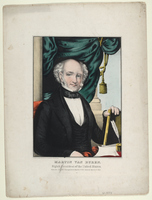
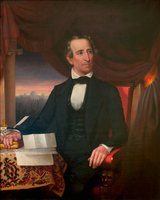
The Grand Manner continued to be popular in political portraiture in the years after Jackson’s presidency and leading up to the commission of the Rogers portrait in 1842. A lithograph by the firm E. B. and E. C. Kellogg of Van Buren, who succeeded Jackson as president, depicts him seated in front of a column (fig. 11). A portrait of President John Tyler Jr. (1790–1862), who succeeded Van Buren, by James Hart from circa 1841 portrays Tyler seated in front of a column with a view of the US Capitol building in the distance (fig. 12). Longtime Washington, DC insider Senator Henry Clay (1777–1852), who had experienced three failed bids for the presidency, is featured in a series of portraits painted by Matthew Harris Jouett (1787–1827) that closely align compositionally with the Rogers portrait (fig. 13). Both men are dressed similarly and seated in front of architectural backgrounds with dramatic skies.
While primary source materials do not tell us which Grand Manner portraits Smith might have known, they do reveal that he went to Washington, DC, where he likely saw them in person.[40] In 1839, Smith met with President Van Buren in the White House on multiple occasions and visited with Senator Clay at several events.[41] Smith also may have seen the widely circulated prints of portraits of Jackson, Tyler, and Van Buren, as he arguably became more interested in modeling his own self-image after those with positions of power in the US government.
Nathan Rees’s analysis of Mormon visual culture in territorial Utah serves as a model for understanding the earlier Nauvoo period when Smith sought to align his community’s art with national trends to support his political ambitions and lend legitimacy to his fledgling religion.[42] Rees argues that the visual arts were not “mere illustrations of Mormon settlement” in territorial Utah (1850–96); rather, Latter-day Saints used visual images to shape their early religious identity and embraced art as a symbol of their refinement, countering their portrayal as culturally backward, oversexed outlaws in the media.[43] He also challenges the idea that early art of the Latter-day Saints was created in isolation and instead demonstrates how Latter-day Saints had exposure to national academic styles.[44]
The Rogers portrait became a key precedent for the later visual images in Utah that Rees discusses. It establishes an artistic model that favors a naturalistic and idealized representation of the sitter—a style that would later dominate Latter-day Saint commissions, despite resistance from women artists and artists of color.[45] This emphasis on what Rees describes as “truth-signaling naturalism,” reflecting a belief in “the physicality of spiritual vision,” influenced how art was judged in nineteenth-century Mormonism, and, as Latter-day Saint studies scholar Terryl L. Givens notes, continues to shape artistic approaches in spaces sacred to Latter-day Saints.[46]
The Rogers portrait exemplifies an early attempt at the artistic assimilation of national trends that Rees noted in the later territorial Utah period. The adoption of Grand Manner pictorial devices in the portrait emerged as a deliberate image-making strategy to counter the intense negative press that Smith faced in the decade leading up to the painting of the portrait. Early anti-Mormonism focused on discrediting Smith personally, representing him as a fraud and a man of poor moral character.[47] Smith and his family had long been involved in local treasure seeking using divining rods and peep or seer stones, which was met with skepticism.[48] In 1826, Smith was convicted of treasure hunting using these methods.[49] From this point forward, Smith was frequently targeted by a hostile press who used text and illustrations against him.[50]
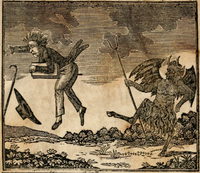
One influential publication that picked up these themes was Eber D. Howe’s Mormonism Unvailed [sic] (1834).[51] With supporting negative statements from neighbors, Howe characterized Smith as a fraud with poor character, a treasure hunter, and an unreliable narrator who told numerous contradictory lies about encountering supernatural forces and finding gold plates.[52] The book opens with a woodcut illustration that depicts a buffoonish Smith clutching the golden plates as he sails through the air, having been kicked in the backside by a horned and winged devil (fig. 14). Smith responded to Howe’s illustration by describing himself as “braving the mountain waves of opposition” before casting Howe, instead of himself, as the lying devil.[53] Still, the woodcut proved popular in anti-Mormon literature and was reprinted in 1838 in Origen Bacheler’s publication Mormonism Exposed: Internally and Externally, and in the Anti-Mormon Almanac for 1842.[54]
Leading up to the commission of the Rogers portrait in September 1842, negative press continued to plague Smith. “I am tired of the misrepresentation, calumny, and detraction heaped upon me by wicked men,” he wrote to the Sangamo Journal on June 10, 1842.[55] In this already hostile environment, just days before Rogers began painting Smith’s portrait in early September, Smith received news of a damaging betrayal by John C. Bennett, a former follower of Smith. Rogers and converted Methodist minister George J. Adams brought a letter to Smith discussing Bennett, who had begun delivering scathing lectures about Smith’s religion.[56] These lectures went beyond accusing Smith of lying, fraud, and treasure hunting, instead accusing him of treason, murder, prostitution, adultery, and conspiring to assassinate the Missouri governor in retaliation for an executive order that commanded Smith’s community to leave the state. Later that year, Bennett published a full-length exposé detailing his accusations, the first publication to address Smith’s community’s practice of polygamy.[57] Many outside the faith saw this book as confirming the worst rumors about Smith and his group.[58] These events likely pushed Smith to take action to rehabilitate his reputation and fashion his own public image in order to detract from the negative press, utilizing established conventions in academic art to project himself as a powerful leader.
The stormy sky in Smith’s portrait alludes to the turmoil he and his followers experienced leading up to the commission of the portrait. The landscape behind Smith shows the sun, whose golden light is reflected in the Mississippi River, breaking through the dark storm clouds in the sky above. Here, Smith is the divinely-appointed leader weathering turbulent times with grace and dignity. This seemingly unsettled place could represent the “promised land” that Smith was attempting to build on the US frontier in Nauvoo, where he led his people across a body of water—recalling Moses, or Lehi in the Book of Mormon—to the safety of the divinely appointed “Zion.”[59] The sun emerging from the clouds represents a new beginning in Zion after troubled times. Just as landscape was often present in Grand Manner portraits to show ownership, the landscape in the Rogers portrait likely alludes to Smith’s divinely-sanctioned Zion. In early Mormonism, landscape was believed to be an expression of the divine, and scriptural events were often tied to specific landscapes. In 1835, Smith identified a location on the Grand River in Missouri as the place where Adam and Eve sought refuge after they were expelled from Eden.[60] Smith and his followers firmly connected divinity to the US landscape itself, believing that God destined the United States to be the location of Zion.[61] Taking cues from the biblical book of Revelation, chapter 22, Smith planned the city of Zion to be in Jackson County, Missouri, giving this US place a biblical past.[62] The followers of Smith residing in Missouri believed that God had given them the land as their religious inheritance, a belief that fed later conflicts with residents who were not Latter Day Saints.[63] The river in Smith’s portrait represents the Mississippi River, where the community first practiced baptisms for the dead at Nauvoo in September 1840 and which took on sacred dimensions.[64]
Connections with land and the divine also persist in the Doctrine of Discovery, an international legal principle that was used both to colonize the Americas and to justify US expansionist policies from 1774 to 1855. One key element of the doctrine mandated that non-Christians did not have the same rights to land and sovereignty as Christians. Thomas Jefferson used the Doctrine of Discovery to realize the Lewis and Clark Expedition and later the Louisiana Purchase in 1803.[65] This convergence of land ownership with religion in early US westward expansion aligned with the Book of Mormon’s teachings, which suggest that obedience to God is necessary in order to rightfully possess land in the Americas.[66]
Reading the Rogers portrait through an art historical lens reveals its significance beyond the question of Smith’s physical likeness, the central concern of the debate about the daguerreotype in the preamble. By examining the painting’s stylistic elements, its alignment with broader trends in nineteenth-century US portraiture becomes evident. Moreover, situating the portrait within its sociopolitical context, particularly the negative press surrounding Smith and his political aspirations, underscores its role as an image intended to convey status and authority in opposition to the growing popular narratives that Smith could not be trusted. In the Rogers commission, Smith, too, was attempting to counter negative narratives through visual culture by presenting himself to his followers and outsiders as a refined gentleman and a great leader with a vision for, and possession of, the land. The Rogers portrait, far from being a simple representation, was a calculated visual statement designed to legitimize Smith’s leadership, echoing the ways in which other prominent US politicians used portraiture to assert their power. Ultimately, this art historical approach contrasts with purely denominational readings of the portrait, discussed in the next two sections, demonstrating the complexities of meaning embedded within religious imagery and highlighting the necessity of considering both artistic and sociohistorical contexts to reach a comprehensive understanding.
Interpretive Communities
Literary theorist Fish’s concept of interpretive communities plays an instrumental role in our analysis of the reception of the Rogers portrait after the death of Smith. Part of becoming a member of a social group, Fish argued, is adopting the group’s interpretive strategies of texts, based on shared assumptions, practices, and background knowledge, which generate meaning for the group rather than the texts themselves. Disagreements between communities about the meaning of a text are foundationally disagreements about interpretive strategies. Each interpretive community decides what constitutes evidence in their own meaning-making process.
As a professor of journalism and media, Thomas Lindlof argues that the framework of interpretive communities has particular relevance for religion and media. He notes the importance of “shared circumstances, interests, costumes, and purposes” as well as “shared moral obligations.”[67] Lindlof also speaks to the organizational elements of religious interpretive communities, including stability, internal communications, and social networks. Building on the work of communication studies scholars James Anderson and Timothy Meyer, Lindlof emphasizes that when different communities employ their own interpretive strategies around a shared text, that text “becomes a site of contested interpretations.”[68] At the same time, interpretive communities are not perfectly consistent, and members may use interpretive strategies for different ends.[69]
The shared frameworks of an interpretive community can coalesce into what Morgan terms “enchantment,” which is “conducted by any device that trumps or outplays an opposing reality by virtue of an agreed-upon code or set of rules.”[70] The assumptions, shared practices, and background knowledge that interpretive communities hold produces a “sedimented” practice in which actions repeated over time cement enchantments.[71] We assert that the two interpretive communities addressed here, Community of Christ and the Church of Jesus Christ of Latter-day Saints, are enchanted with the Rogers portrait and that their divergent understandings of it depend on different sets of shared assumptions, practices, background knowledge, circumstances, interests, purposes, and moral obligations.
Community of Christ Interpretive Community
Interpretations of the Rogers portrait by members of the RLDS (and later, by members of Community of Christ) reveal an enchantment with this painting, anchored to Smith’s wife, Emma, and the rightful succession of their sons as leaders of their branch of the church. The RLDS shares fourteen years of history with the Church of Jesus Christ of Latter-day Saints before Joseph Smith’s death in 1844, but the denominations ultimately grew apart, developing different sets of assumptions, practices, and background knowledge together with different interests and shared moral obligations. While at first both denominations held to the idea that they were God’s one true church, RLDS’s leadership firmly let go of that belief in 1979 after the church sent its leaders to a mainline Protestant seminary.[72] Both groups took on different projects of assimilation, with the Church of Jesus Christ of Latter-day Saints aiming to align with evangelicals, adhering to their moral and political values, and the RLDS aiming to align with the progressive politics of mainline Protestants. Members of the Church of Jesus Christ of Latter-day Saints were influenced by some evangelical ideas from their founding, but finally found greater alignment with them in the early 1980s in joining the evangelical political organization known as the Moral Majority.[73] In 2001, the RLDS rebranded itself as Community of Christ in an effort to distance itself from past beliefs and to signal itself as a mainline Protestant or adjacent denomination.[74] The different groups worked to create separate sets of interpretive strategies that reflect the political and religious alignment of these assimilation projects.
Community of Christ holds a different set of assumptions about Joseph Smith and his legacy than the Church of Jesus Christ of Latter-day Saints, which, in turn, affects its interpretation of the Rogers portrait. While Smith is understood as the founder of the movement, RLDS history emphasizes Smith’s son, Joseph Smith III, as the first prophet-president of the RLDS and his mother, Emma, as the spiritual mother of the church. All church presidents from 1860 until 2005 were male descendants of Joseph and Emma Smith, and their lineage was a core tenet of belief, legitimacy, and practice.[75]
Within ecumenical gatherings of different Latter Day Saint groups, it is common for Community of Christ members to identify themselves as “Team Emma” or as being part of “Emma’s Church.”[76] While many of Smith’s polygamous wives later became Young’s polygamous wives, Emma’s resistance to Young is at the heart of the RLDS story. After Smith’s death in 1844, Emma consistently asserted that her husband had not practiced polygamy, likely in an effort to ensure that her sons did not inherit the relational and political baggage of polygamy.[77] The RLDS maintained a firm antipolygamy stance in its understanding of Smith’s personal history, which lasted until the late twentieth century.[78] While RLDS leaders had long “struggled to articulate” the church’s core message, it held fast on two central points: resistance to polygamy and the requirement that its top leaders be descendants of Joseph and Emma.[79]
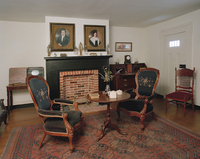
When Young took his group west, the Rogers portrait remained in the Mansion House in Nauvoo and later in the Nauvoo House, which served as Emma’s home until her death in 1879.[80] At some point, a portrait of Emma Smith in a similar style and by a currently unidentified artist joined the Rogers portrait in a matching frame (see fig. 3). The two paintings hung together in the sitting room of the Mansion House, which served as the Smiths’ home and boarding house (fig. 15).[81] Like her husband, Emma is portrayed at half-length in front of a background with a similar type of landscape and a wall or pilaster. The similarities in composition connect the two portraits, visualizing a harmonious bond between husband and wife. Emma wears a black dress with ballooning sleeves and a white muslin collar over a lace chemisette. Her left hand is prominently displayed, with its accompanying wedding ring on the fourth finger. This ring appears to be contemporary with the painting, unlike that of her husband’s ring in his portrait. Placed side-by-side on the wall, the portraits of Emma and Joseph represented the central married couple of the RLDS tradition, from whom their sons, grandsons, and great grandsons inherited the leadership of the denomination. Within this context, the added ring on Joseph’s hand can be understood as a commitment to a monogamous relationship with Emma, which resulted in a privileged lineage of RLDS leaders.
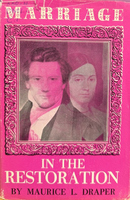
The RLDS understood the two paintings of Emma and Joseph as belonging together. In 1962, they were displayed together in the art gallery in the Auditorium in Independence, Missouri, which served as the RLDS’s headquarters and gathering space.[82] A guide to the Auditorium described the paintings as “companion portraits” painted by the same artist.[83] Overlapping details of Joseph’s and Emma’s heads from the portraits were reproduced on the book jacket of a RLDS publication on the sanctity of monogamous marriage in 1968 (fig. 16).[84] Church leaders from that time believed and taught that Joseph had not been polygamous, and the portraits offered visual evidence for the “enchanted” myths of the church community: that Joseph was married to only one wife and that the later leaders of the RLDS descended from his union with Emma.
RLDS enchantment with the portrait, namely how it symbolized rightful legitimacy and succession, played out in several twentieth-century episodes. In the late 1920s, RLDS president Frederick M. Smith, grandson of Joseph and Emma, sent a photograph of the Rogers portrait to the Latter-day Saint apostle (and later church president) George Albert Smith.[85] This reproduction of the portrait hung in the church historian’s office in downtown Salt Lake City.[86] Such gifts were tools of diplomacy and reminders to the leaders of the Church of Jesus Christ of Latter-day Saints that the RLDS had tokens of legitimacy that the other branch of the church could not claim, namely the Rogers portrait and Joseph Smith’s sons as leaders.
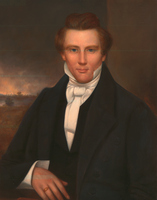
The enchantment with the portrait as portraying rightful succession is also revealed by RLDS dealings with the Smithsonian Institution. In 1968, the inaugural exhibition at the Smithsonian’s National Portrait Gallery (NPG) titled This New Man: A Discourse in Portraits, featured the original Rogers portrait, loaned by the RLDS.[87] As a reviewer from the Saints’ Herald proclaimed, the Rogers portrait depicted one of “this country’s outstanding religious leaders of the past” in an exhibition dedicated to presenting the national character of the United States.[88] Marvin Sadik, the director of the NPG, was so enamored with the portrait that he made a proposal to RLDS leaders: The NPG would acquire the original and pay for a renowned portraitist, Adrian Lamb (1901–89), to make a copy to give to the RLDS, or, if this was not amenable, the RLDS could fund a copy of the portrait to gift to the NPG.[89] The RLDS chose the latter option (fig. 17).[90] On Sunday, November 14, 1971, the NPG held a private ceremony to celebrate the RLDS’s donation of the Lamb copy of the portrait, which coincided with the seventy-first birthday of W. Wallace Smith, president of the RLDS and a grandson of Joseph and Emma Smith.[91] W. Wallace Smith’s remarks at the ceremony affirmed the RLDS as the “true and lawful continuation of, and successor to the church which Joseph Smith, Jr. was commissioned to organize in 1830,” affirming the connection between the Rogers portrait and the belief in the rightful succession of Smith’s descendants.[92]
In 1972, an appraisal valued the portraits of Emma and Joseph at $5,000, but a letter from The First Presidency (W. Wallace Smith) of the RLDS to Reed M. Holmes in 1973 emphasized that monetary value was irrelevant compared to preserving the physical paintings.[93] The true priorities were maintaining the presence of the portraits in the Auditorium and safeguarding the originals from loss.[94] In a desire to display copies in the Auditorium, RLDS leaders commissioned further work from Lamb, paying him $5,000 for additional reproductions of the portraits of Joseph and Emma.[95] For RLDS leaders during this period, preserving the original paintings and the church’s ownership of them was part of an ongoing act of enchantment. These sacred portraits embodied the idea of their denomination’s divine founding and their claim to rightful succession from Joseph and Emma Smith.
Several other episodes in the early 1970s illustrate enchantment with the Rogers portrait as a symbol of the RLDS as the rightful successor of Joseph Smith. In another exchange, apostle Alvin R. Dyer of the Church of Jesus Christ of Latter-day Saints made a request for photographic copies of the two portraits.[96] Replies by W. Wallace Smith to Dyer referred to the photographic copies made from the Rogers portrait as “the pictures of Grandfather” and to the Rogers portrait as “the original portrait of grandfather,” emphasizing close familial ties to Joseph Smith.[97] RLDS leaders agreed to the request, but with clear language dictating that ownership of the originals by RLDS should be communicated to all viewers and that the Latter-day Saints were not to further reproduce these.[98] RLDS leaders were happy to share copies, provided that RLDS ownership was emphasized in the process.
In 1973 the two interpretive communities came into direct conflict over the meaning of the Rogers portrait. Louella Johnson, a member of the RLDS congregation in Washington, DC, wrote to Sadik requesting that Lamb’s copy of the portrait be moved from its placement next to a portrait of Young.[99] Johnson argued that juxtaposing the portraits implied that Young was the rightful successor to Joseph Smith, contrary to her belief and religious identity. She further objected to a museum plaque that referenced Smith’s ideas concerning “celestial marriage” (plural marriage or polygamy), as the RLDS had long denied that Smith was involved with such practices.[100]
Community of Christ enchantment with the Rogers portrait centers on the intertwined legacy of Joseph and Emma Smith. The pairing of Joseph’s and Emma’s portraits visually reinforces the church’s narrative of monogamous devotion and familial leadership. Its enchantment with the portrait has more to do with the specific, family-centered succession narrative attached to the painting than with the representation of Smith.
The Latter-day Saint Interpretive Community
The Latter-day Saint interpretive community’s reception of the Rogers portrait is built on a core set of assumptions that position Smith as a near-divine prophet whose labor contributed to the salvation of the world. With these beliefs, the community understands the portrait not as a political image or one emphasizing monogamous marriage but as a faithful and accurate physical representation of Smith’s prophetic status. For them, this image created a visual archetype of prophethood that subsequent church leaders borrowed from after his death. We argue that the Latter-day Saints’ focus on Smith’s appearance as evidence of his special status constitutes an enchantment with material manifestations of his being, including the Rogers portrait.
Smith’s legacy took shape in the immediate aftermath of his death. On the day of his murder, John Taylor, who was present with Smith when he died and would later become the third church president, drafted a eulogy: “Joseph Smith, the Prophet and Seer of the Lord, has done more, save Jesus only, for the salvation of men in this world, more than any other man that ever lived in it.” This text was included in the Doctrine and Covenants (135:3), part of the open canon of Latter-day Saint scripture, and has been an oft-repeated summary of Smith’s spiritual achievements.[101] This hagiographic statement became the way that the church community remembered and understood Smith after his death, as a heroic figure who was more than human but not fully divine.
Early descriptions of Joseph Smith provide insight into the ways in which the community remembered and made meaning of his appearance after his death. These descriptions compare him to biblical prophets and deities as well as emphasize the way in which he was revered within the community. Church member Lyman Woods later remembered that Smith “looked like a god.”[102] Lydia Bailey, an early convert to Smith’s religion, wrote that he had “the carriage of an Apollo, brown hair, handsome blue eyes, which seemed to dive down to the innermost thoughts with their sharp penetrating gaze, a striking countenance, and with manners at once majestic yet gentle, dignified yet exceedingly pleasant.”[103] Convert James Palmer reported that Smith “looked and had, the appearance of one that was heaven born while preaching, or as tho he had been sent from the heavenly worlds on a divine mission.”[104] Church leader Parley P. Pratt wrote that “he possess[es] a noble boldness and independence of character. . . . In short, in him the character of a Daniel [a biblical prophet], and a Cyrus [the ancient Achaemenid king] were wonderfully blended. The gifts, wisdom and devotion of a Daniel were united with the boldness, courage, temperance, perseverance and generosity of a Cyrus.”[105] These comments, which were extensions of Taylor’s statement, understand Smith’s appearance as revealing his prophetic status, his power as a leader, his high moral character, and his physical attractiveness.
The core assumptions about Smith that members of the Church of Jesus Christ of Latter-day Saints have brought to their understanding of the Rogers portrait are rooted in nineteenth-century beliefs that vision provided access to truth and, by extension, images could act as agents of that truth.[106] This belief continued to be important in Latter-day Saint art and aesthetics into the twentieth century.[107] Latter-day Saint scholars in the last fifty years have pursued the likeness of Smith as a kind of spiritual quest that will reveal the divinity of the prophet. Independent scholar William McCarl wrote an entire thesis on the accuracy of the likeness of Smith in portraiture.[108] In his preface, McCarl explained why he took on the project:
[I] was converted to Mormonism in 1953. At that time the greatest puzzlement about the new religion seemed to be the personality of Joseph Smith. It was hard to believe all that was told about him. Study during ensuing years had convinced [me] of the truthfulness of most of the stories told about Joseph Smith, so a recent desire had been to unfold the true physical image of the man. This work was undertaken in hopes of realizing that ambition.[109]
It seems as though McCarl was attempting to uncover spiritual truth in seeking Smith’s “true” likeness.
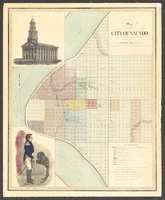
Later scholars continued this type of identity work and used the Rogers portrait to establish Smith’s appearance. Architect Ephraim Hatch studied Smith’s death mask, comparing it with a profile portrait of Smith by the Nauvoo artist Sutcliffe Maudsley (1809–81) (fig. 18), the Rogers portrait, and written descriptions of Smith, seeking to discover the true appearance of the prophet.[110] Independent historian S. Michael Tracy took on a similar project, comparing the mask and two portraits with a recently discovered daguerreotype in an effort to discover Smith’s “true appearance.”[111] Linguist Curtis G. Weber created models of each of these items and laid them on top of each other in an attempt to confirm the identity of Smith in the death mask.[112] A research team composed of a forensic anthropologist, a historian, and an anatomist worked to forensically link a photograph purported to be Smith from the 1840s to his death mask.[113] This scholarship reveals the foundational enchantment of the interpretive community with Smith’s appearance. By embarking on quests for the true appearance of Smith, these Latter-day Saint scholars believe they are participating in a spiritual quest as well; the true image of Smith validates his divinity and religious vision, which is, in turn, used by leaders in the Church of Jesus Christ of Latter-day Saints to legitimize their leadership.
Without the descendants of Smith as their leaders, the Latter-day Saints have had to rely on the image of Smith as a means of legitimizing their claim to religious authority. At the time of Smith’s death, he and his community were in the process of building the Nauvoo Temple, which was a space for communal rituals, including those related to plural marriages.[114] This building was completed and dedicated in December 1845. The Celestial Room of the Nauvoo Temple represented the final destination of the endowment ceremony, the home of God’s dwelling, also known as the Celestial Kingdom in Latter-day Saint cosmology.[115] This room, representing a space in heaven, would not have been complete without the image of Smith. Scholars have suggested that Emma Smith may have refused to lend the Rogers portrait to the Celestial Room’s display, where it would have joined other portraits of prominent leaders and married couples in the Nauvoo church community.[116] Without the Rogers portrait, decorators of the room chose to use Maudsley’s profile drawing of Smith wearing a general’s uniform (see fig. 18) in addition to portraits of Smith’s mother and brother. Notably, these portraits accompanied one of Young—the most prominent portrait in the room—painted in 1845 by Selah van Sickle (1809–ca. 1880).[117]
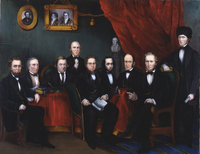
The presence of Smith’s image in the temple alongside that of Young visualized the passing of authority from one leader to the next in this sacred ritual space. In mapping out how portraiture was used in the early Church of Jesus Christ of Latter-day Saints to align Young with Smith, art historian Ashlee Whitaken Evans argues that the Smith portraits in the Celestial Room bolster the central image of Young in an act of “assert[ing] primacy of obedience to divinely appointed leadership.”[118] Evans additionally detailed how a painting by Sarah Ann Burbage Long (1817–78), Brigham Young and His Friends (ca. 1864), used images of Smith family members to grant Young the authority to lead the church (fig. 19). In this image, a portrait of Smith and his brother Hyrum hang on the wall behind Young and his inner circle. In both the Celestial Room paintings and Long’s painting, physical proximity to the Smith family granted Young divine blessing. Following Smith’s death, a number of potential leaders of the community emerged. Young’s visual claim as rightful successor to Smith communicated to his followers that they should follow Young without question.
In the wake of the succession crisis, a popular story emerged about Young taking on the appearance and voice of Smith before a crowd on August 8, 1844. This is chronicled by Smith’s secretary, Benjamin F. Johnson (1818–1905), who claimed to have witnessed the event: “And as from Heaven, I heard the voice of the Prophet Joseph . . . and quickly turning around I saw in the transfiguration of Brigham Young, the tall, straight, and portly form of the Prophet Joseph Smith, clothed in a sheen of light.”[119] This miracle helped the crowd identify Young as Smith’s divinely appointed successor.[120] The existence and popularity of this story in Latter-day Saint lore and teaching is consistent with the idea that the image of Smith was used to assert authority and compel obedience to later church leaders through association with its beloved founder.
Since the Latter-day Saint interpretive community did not have direct access to the Rogers portrait, it relied instead on photographic copies, as previously discussed, and new paintings of Smith. Artists affiliated with the church were inspired by the refined presentation of the portrait in their own renditions of Smith. These took the form of replicas, such as an engraving done by H. B. Hall & Sons of New York (fig. 20); a number of copies by Charles William Carter and others in the nineteenth and twentieth centuries (fig. 21); and modern copies, like the one by Ken Corbett in 1996 (fig. 22).[121] Glen M. Leonard, then-director of the Museum of Church History and Art (now the Church History Museum), explained that “all images with any authentic resemblance to the Prophet” can be traced back to the Rogers portrait, among others.[122] This was echoed by current Church History Museum curator Laura Paulsen Howe, who stated that the portrait set the precedent for every portrait of Smith thereafter.[123] Artists Alvin Gittens and David Lindsley were inspired by the Rogers portrait; both of their portraits of Smith (figs. 23, 24) were utilized in the pamphlet Testimony of the Prophet Joseph Smith, distributed by the Church of Jesus Christ of Latter-day Saints.[124] Religion journalist Peggy Fletcher Stack observed, “As he gets closer to his 200th birthday, Joseph Smith has grown more handsome. In modern portraits and films, the Mormon church’s founder’s large nose, Napoleonic hairstyle, and stout belly have given way to the leaner, tanner look of a California surfer.”[125] As Stack indicated, this process of refining and idealizing Smith’s image continues today, as can be seen in the evolution of his image from Maudsley’s profile to Lindsley’s portrait (see figs. 18–24).
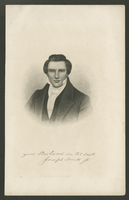
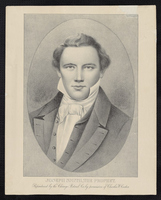
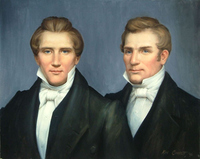
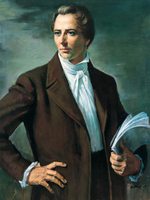
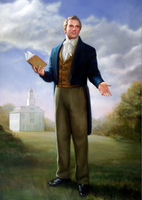
The Latter-day Saint interpretive community has long approached the Rogers portrait with a core set of assumptions about Smith, positioning him as a near-divine figure. These assumptions lead to the community’s “enchanted” view of the portrait as an accurate, physical representation of Smith, reflective of his prophetic status and moral character. Returning to the daguerreotype mentioned in the preamble to this article, its rejection by the Latter-day Saints as a portrait of Smith now begins to make sense. A widely held assessment of the daguerreotype was that the sitter had a mature, weatherworn face.[126] We suggest that members of the Church of Jesus Christ of Latter-day Saints had such an intense reaction against Smith as its sitter because the depiction was not appropriate for his divine, prophetic stature, unlike the idealized portrayal in the Rogers portrait.
The Sale of the Portraits of Joseph and Emma Smith
The sale of the Rogers portrait in 2024 demonstrates the continuance of both interpretive strategies well beyond their original, nineteenth-century context. On March 5, 2024, Community of Christ announced the sale of the portrait, together with several of its historical sites, artifacts, and documents, to the Church of Jesus Christ of Latter-day Saints for a total of $192 million.[127] Steven M. Veazey, president of Community of Christ, indicated in the announcement that the new injection of cash would support the mission of the shrinking church.[128] Today, Community of Christ is a tiny denomination of about 250,000 members that has been facing difficult decisions in the wake of falling membership and donations, whereas the much larger Church of Jesus Christ of Latter-day Saints, claiming nearly eighteen million members, has been in the news as a result of its great financial wealth.[129] In a joint news release from both organizations, Russell M. Nelson, president of the Church of Jesus Christ of Latter-day Saints, was quoted as saying, “We are deeply honored to assume the stewardship of these sacred places, documents, and artifacts.”[130] In Nelson’s view, the Rogers portrait was a sacred artifact belonging to a tradition that understands history and historical precedent as occupying the place of theology. Church Historian and Recorder Kyle S. McKay deemed the assumption of ownership of these items by the church as “nothing short of miraculous.”[131]
The Rogers portrait was a significant acquisition for the members of the Church of Jesus Christ of Latter-day Saints, who still claim to be the true and rightful heirs of Smith’s religious vision. By the time of the sale, Community of Christ had moved away from denying Smith’s polygamy and the practice of choosing the denominational leader from direct descendants of Joseph and Emma; the enchantment with the portraits as conveyers of monogamy and family-centered succession loosened as theological beliefs evolved.[132] Ownership of the portrait by the Latter-day Saints was a kind of religious victory that overcame a historical injustice and was celebrated as such by church members on social media.[133] Ownership reasserted leadership succession from Smith and emphasized the religious authority of current leaders. Online celebration was so extensive that some Latter-day Saint historians felt uncomfortable knowing that their Community of Christ historian friends and colleagues were experiencing a great loss. A popular Latter-day Saint YouTube channel, Scripture Central, discussed the sale in a video with Scott Woodward and Casey Griffiths, the latter an associate professor of church history and doctrine at Brigham Young University who advised Latter-day Saints to refrain from open celebration: “I would plead with the members of our church to be gracious during this time. No triumphalism, no spiking the football . . . no gloating. Please, please, please be gracious.”[134]
Official church personnel reinforced the value of the acquisition by the Latter-day Saints. McKay emphasized how Latter-day Saint ownership of these sacred items “help[s] us to know the hand of the Lord” and is “sacred evidence of the . . . Restoration,” referencing Smith’s salvific work.[135] Matthew J. Grow, managing director of the Church History Department, asserted, “We have the portraits that were done during their [the Smiths’] lifetime, which are among the most important pieces of Latter-day Saint art that exist in the world.”[136] Grow describes the portraits as “Latter-day Saint” without reference to their previous history within Community of Christ; this erasure presents an uninterrupted continuity of rightful possession. The Rogers portrait’s ownership by the Latter-day Saints demonstrates that the image is not just a nineteenth-century artifact but a present-day mechanism for establishing continuity with Smith’s divine authority.
The sale of the portrait, along with other historical sites and artifacts, represented more than just a financial exchange; it led to a continuation of the ongoing contest over the portrait’s meaning and ownership. For the Church of Jesus Christ of Latter-day Saints, acquiring the portrait was a significant victory, reaffirming their claim as the “true and rightful heir” of Smith’s religious vision. Conversely, for many members of Community of Christ, the sale remains a poignant loss. While acknowledging the financial necessities driving the decision, some members expressed grief and concern over the symbolic relinquishing of key pieces of their heritage. Comments on the sale often referenced the portraits of Joseph and Emma, indicating their central role in Community of Christ’s understanding of their history. Podcast discussions with Community of Christ leaders like Lachlan Mackay, a descendant of Joseph and Emma, further illustrate the complex emotions and reflections prompted by the event, including a struggle to reconcile practical needs with the emotional and spiritual significance of these historical items.[137] Mackay said in one podcast, “We’re making a decision to choose people over property and paper and paintings.” Explaining how he was working through his grief over the sale of these items, he wanted “to remember that the most important items in the transaction came to us from the Smith family. Joseph III conveyed Kirtland Temple to us. The Nauvoo properties are the Smith family properties. The paintings came from the Smith family. . . So the proceeds from the sale at some level, are an extraordinarily generous gift from them, that will sustain us into the future.”[138]
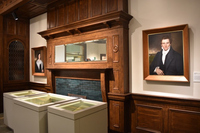
By the end of March 2024, the Rogers portrait and the portrait of Emma were on public display at the Church History Museum in downtown Salt Lake City, Utah.[139] In the exhibition, Sacred History Treasures from the Restoration of the Gospel of Jesus Christ, which closed in October 2024, the portraits, notably reframed, hung on either side of a fireplace rather than side by side (fig. 25).[140] The new arrangement acknowledges that the two paintings have a long historical association, even if their ownership and immediate surroundings have changed. In an interview for The City Journal, Church History Museum curator Howe noted that it was good to show the two paintings together: “It is indicative of their [the Smiths’] relationship together. They led the church together, raised children together, lost children together and struggled mightily over their trials, especially plural marriage.”[141]
Over time, Community of Christ’s relationship with the portrait evolved, from valuing its presence as an original artifact to commissioning copies and ultimately selling it. This trajectory reflected a struggle to balance preservation with financial needs and a shifting emphasis away from Smith’s central role toward a broader, more progressive theological stance. In its new context in the Latter-day Saints’ Church History Museum, the Rogers portrait acknowledges historical RLDS interpretations through its pairing with Emma. But ultimately, for Latter-day Saints, this acquisition seems to have materially manifested the divine authority that leaders of the Church of Jesus Christ of Latter-day Saints have long proclaimed.
Conclusion
The enduring significance of the Rogers portrait of Joseph Smith rests not on a singular likeness but on its original historical and artistic contexts and the divergent meanings assigned to it by its interpretive communities. Through an art historical reading detailing its Grand Manner influences, we established the portrait as a deliberate piece of political image making, designed to legitimize Smith’s status and counter negative press. Conversely, the reception history of the portrait reveals its postcreation power: for Community of Christ, it functions as an enchanted visual anchor for the myth of a monogamous founding couple, while for the Latter-day Saint community it is an enchanted object that reveals divinity and reinforces institutional authority. Ultimately, the conflict between these historical and reception-based readings underscores the necessity of a multivalent art historical approach to religious imagery, demonstrating the complex and active role that nineteenth-century art continues to play in shaping contemporary religious identity and discourse.
Art historians can be facilitators of complicated discourse about religious objects. Morgan suggests that it is only to outsiders that enchanted images reveal their matrix of forces; to insiders, who are themselves part of the network, it is impossible to deviate from the centrality of the image’s enchantment.[142] We suggest that the discipline of art history has a role to play in bringing into dialogue the complex intersections of enchantment, reception, and art historical readings of images. More importantly, by not engaging in more contemporary discourse with historical religious images, art historians miss an opportunity to demonstrate how their methods are relevant in our contemporary world.
This study highlights the necessity of embracing diverse, even conflicting, perspectives when studying religious art. Engaging with the enchantment of believers alongside art historical analysis opens up a richer, more nuanced understanding of how images function throughout time and are valued within communities, bridging the gap between academic and religious viewpoints. By engaging with both, scholars avoid imposing a singular interpretation, recognizing instead the multifaceted and ever-evolving meanings that historical religious images hold.
Acknowledgments
The authors would like to thank the anonymous reviewers and editors of NCAW for their guidance that greatly contributed to improving this manuscript. We also appreciate the feedback and support that Patrick Bishop, Lachlan Mackay, and Rachel Killebrew provided.
Notes
[1] The daguerreotype was housed in a locket that had been in the possession of the Smith family since the 1840s. Based on this provenance, Lachlan Mackay and Ronald Roming argue that it depicted Joseph Smith Jr. Lachlan Mackay and Ronald Romig, “Hidden Things Shall Come to Light: The Visual Image of Joseph Smith, Jr.,” John Whitmer Historical Association Journal 42, no. 1 (2022): 28–60.
[2] In the comments on a Latter-day Saint historian’s Facebook post from July 29, 2022, one Latter-day Saint commenter wrote, “I don’t think it looks like him,” and the historian responded that the understanding of what Smith looks like comes from a painting, not from a photo. Benjamin Park (benjaminparkhistorian), reply to Michelle Brady Stone (michelle.stone9674), Facebook discussion post, July 29, 2022). On another Latter-day Saint historian’s Facebook post from July 22, 2022, a Latter-day Saint commenter wrote, “I have a hard time seeing how whoever painted the portrait [by David Rogers] could mess up the eyes so much, particularly the eyebrows.” Guy Foutz (guy.foutz), reply to Ardis E. Parshall (ardis.parshall), Facebook, July 22, 2022, https://www.facebook.com/. Community of Christ members, including prominent voices, generally supported Lachlan Mackay and Ronald Romig’s research, as they are both well-known and well-respected Community of Christ historians and leaders in the community. In regard to the terminology in our article: The term “Latter Day Saint movement” refers to all the groups and churches that descend from Joseph Smith. The term “Latter-day Saints,” with a hyphen, refers to the largest of the churches, which developed this usage to differentiate it from other offshoot groups, such as the Reorganized Church of Jesus Christ of Latter Day Saints, who sometimes use the shorthand term “Latter Day Saints.”
[3] To clarify the authors’ positions: Nancy Ross used to be a practicing Latter-day Saint and later converted to Community of Christ. Lauren DiSalvo has never been a Latter-day Saint; while currently religiously unaffiliated, she was raised in the Catholic tradition. This article’s material is neither made, provided, approved, nor endorsed by Intellectual Reserve, Inc., or the Church of Jesus Christ of Latter-day Saints. Any content or opinions expressed, implied, or included in or with the material in this article are solely those of the authors and not those of Intellectual Reserve, Inc., or the Church of Jesus Christ of Latter-day Saints.
[4] See Nathan Rees, Mormon Visual Culture and the American West (Taylor and Francis, 2021), 3–5; Heather Belnap, Corry Cropper, and Daryl Lee, Marianne Meets the Mormons: Representations of Mormons in Nineteenth-Century France (University of Illinois Press, 2022), 49; Mary Campbell, Charles Ellis Johnson and the Erotic Mormon Image (University of Chicago Press, 2016), 89; and Rebecca Janzen, “Mormon Art and Architecture in Mexico: Between Mexico and the United States,” in Latter-Day Saint Art: A Critical Reader, ed. Amanda K. Beardsley and Mason Kamana Allred (Oxford University Press, 2024), 292.
[5] Stanley E. Fish, “Interpreting the Variorum,” Critical Inquiry 2, no. 3 (1976): 465–85, https://doi.org/10.1086/447881 [login required]. David Morgan’s concept of “enchantment” builds on French philosopher Bruno Latour’s Actor-Network Theory, which is a framework that understands the social and natural worlds as existing in shifting networks of relationship. David Morgan, Images at Work: The Material Culture of Enchantment (Oxford University Press, 2018), 4–10; and Bruno Latour, “What Is Iconoclash, or Is There a World Beyond the Image Wars?,” in Iconoclash: Beyond the Image Wars in Science, Religion, and Art, ed. Bruno Latour and Peter Weibel (ZKM Center for Art and Media, 2002), 32.
[6] Morgan, Images at Work, 72.
[7] Benjamin E. Park, Kingdom of Nauvoo: The Rise and Fall of a Religious Empire on the American Frontier (Liveright, 2020), 3.
[8] Shaun Cole, The Story of Men’s Underwear (Parkstone International, 2010), 45.
[9] Ephraim Hatch, Joseph Smith Portraits: A Search for the Prophet’s Likeness (Religious Studies Center, Brigham Young University, 1998), fig. 7.1; and Mackay and Romig, “Hidden Things Shall Come to Light,” 29–33.
[10] Barbara S. Groseclose, Nineteenth-Century American Art (Oxford University Press, 2000), 39.
[11] Joseph Smith, Journal, December 1841–December 1842, 190, Joseph Smith Papers, Joseph Smith Papers Project, Church Historian’s Press, https://www.josephsmithpapers.org/.
[12] Private correspondence between Lachlan Mackay and Katherine Woltz, June 11, 2020; and Mackay and Romig, “Hidden Things Shall Come to Light,” 29.
[13] The National Academy of Design in New York, founded in 1825, was led first by Samuel F. B. Morse and later by Asher B. Durand and was influenced by the Royal Academy in London. It was the most important art organization in the United States during the mid-nineteenth century and therefore deeply influenced art produced in the United States during this time. David Rogers is listed as an active exhibitor with the National Academy of Design from 1829 to 1852. He exhibited Portrait of a Gentleman and Portrait of a Lady in 1829 and Portrait of a Gentleman in 1831. See Mary Bartlett Cowdrey, National Academy of Design Exhibition Record, 1826–1860, vol. 2 (New-York Historical Society, 1943), x–xiii; 100.
[14] Smith, Journal, December 1841–December 1842, 205, https://www.josephsmithpapers.org/.
[15] Joseph Smith, History draft [July 1–December 31, 1842], 13, Joseph Smith Papers, Joseph Smith Papers Project, Church Historian’s Press, https://www.josephsmithpapers.org/.
[16] Richard S. Van Wagoner, Natural Born Seer: Joseph Smith, American Prophet, 1805–1830 (Smith-Pettit Foundation, 2016), 81–2, 149–51.
[17] Richard Lyman Bushman, Joseph Smith: Rough Stone Rolling (Alfred A. Knopf, 2005), 80–83.
[18] Bushman, Joseph Smith, 116–18, 125–26, 161, 178–80, 222–27, 327, 365–75; Fawn M. Brodie, No Man Knows My History: The Life of Joseph Smith, the Mormon Prophet (Alfred A. Knopf, 1973), 16–33; and Van Wagoner, Natural Born Seer, 130–42.
[19] Brodie, No Man Knows My History, 339–43.
[20] Todd M. Compton, In Sacred Loneliness: The Documents (Signature, 2022), xvi.
[21] Spencer W. McBride, Joseph Smith for President: The Prophet, the Assassins, and the Fight for American Religious Freedom (Oxford University Press, 2021), 3.
[22] Bushman, Joseph Smith, 541–50; and Brodie, No Man Knows My History, 129.
[23] Linda King Newell and Valeen Tippetts Avery, Mormon Enigma: Emma Hale Smith (University of Illinois Press, 1994), 199–200; and Max Perry Mueller, “Changing Portraits of the Elect Lady: Emma Smith in Non-Mormon, RLDS, and LDS Historiography, 1933–2005,” Journal of Mormon History 37, no. 2 (2011): 185, https://doi.org/10.2307/23291642 [login required].
[24] Mueller, “Changing Portraits of the Elect Lady,” 184–85.
[25] For the Grand Manner as Joshua Reynolds outlined it in his Third and Fourth Discourses see Joshua Reynolds, Sir Joshua Reynolds’s Discourses on Art, ed. Edward Gilpin Johnson (A.C. McClurg, 1891), 81–122. For the Grand Manner in America, two essays provide useful background: Marvin Sadik, “Heroes for a New Nation: 1776–1812,” in American Portraiture in the Grand Manner: 1720–1920, ed. Michael Quick, Marvin Sadik, and William H. Gerdts, exh. cat. (Los Angeles County Museum of Art, 1981), 21–26; and William H. Gerdts, “Natural Aristocrats in a Democracy: 1810–1870,” in Quick, Sadik, and Gerdts, American Portraiture in the Grand Manner, 27–60.
[26] Rachel Stephens, Selling Andrew Jackson: Ralph E. W. Earl and the Politics of Portraiture (University of South Carolina Press, 2018), 1.
[27] David H. Solkin, “Great Pictures or Great Men? Reynolds, Male Portraiture, and the Power of Art,” Oxford Art Journal 9, no. 2 (1986): 47, https://doi.org/10.1093/oxartj/9.2.42 [login required].
[28] Grove Art Online, “Grand Manner [Great Style],” by David Mannings, 2003, https://doi.org/10.1093/gao/9781884446054.article.T034044 [login required].
[29] For example, Ralph E. W. Earl, who painted portraits of Andrew Jackson and was deeply influenced by Reynolds’s portraits, was said to have recommended Reynolds’s works to any young artist he knew was interested in portraiture. Stephens, Selling Andrew Jackson, 86.
[30] Cowdrey, National Academy of Design Exhibition Record, 1826–1860, vol. 2, xiii.
[31] Sadik, “Heroes for a New Nation,” 26; and Jill C. Major, “Artworks in the Celestial Room of the First Nauvoo Temple,” Brigham Young University Studies 41, no. 2 (2002): 54, 66nn28–29.
[32] See, for example, “Samuel Lovett Waldo, Portrait of a Woman,” MFAH Collections, Museum of Fine Arts, Houston, https://emuseum.mfah.org/.
[33] Groseclose, Nineteenth-Century American Art, 39.
[34] McBride, Joseph Smith for President, 7, 24; and Bushman, Joseph Smith, 393–94, 397.
[35] Sadik, “Heroes for a New Nation,” 26.
[36] Stephens, Selling Andrew Jackson, 1, 177.
[37] Sunsets were frequently pictured in Earl’s portraits of Andrew Jackson, where they were usually a veiled reference to death, illness, or the conclusion of Jackson’s presidency. Stephens, Selling Andrew Jackson, 162, 174.
[38] “Andrew Jackson, (1767–1845)” NCMALearn, North Carolina Museum of Art, https://learn.ncartmuseum.org/; and Stephens, Selling Andrew Jackson, 164.
[39] Stephens, Selling Andrew Jackson, 164.
[40] Smith recorded viewing Benjamin West’s Death on the Pale Horse (1817) days before Smith’s death. Terryl C. Givens, People of Paradox: A History of Mormon Culture (Oxford University Press, 2007), 181; Smith, Journal, December 1842–June 1844, book 4, and March 1–June 22, 1844, 157, https://www.josephsmithpapers.org/.
[41] McBride, Joseph Smith for President, 8, 20. Smith met with Clay in Washington in 1839 following an unsuccessful attempt to persuade President Van Buren to take interest in the Latter-day Saints’ case against Missouri. McBride, Joseph Smith for President, 76–77.
[42] Rees, Mormon Visual Culture and the American West. While Smith himself did not design the first Latter-day Saint temples, as Terryl Givens explains, “the best of secular training would have to accommodate guidelines revealed by or through the Prophet.” Givens, People of Paradox, 107–9. Divine revelations for the first three temples relied on popular US styles that would emphasize their continuity with antiquity. For example, the temple in Kirtland, Ohio, was primarily Greek revival in its style.
[43] Rees, Mormon Visual Culture and the American West, 3, 30–32.
[44] Rees, Mormon Visual Culture and the American West, 3–5.
[45] Marie W. Dallam, “Art, Religious Memory, and Mormon Polygamy,” MAVCOR Journal 5, no. 1 (2021): 4, https://doi.org/10.22332/mav.ess.2021.2.
[46] Rees, Mormon Visual Culture and the American West, 3; and Terryl L. Givens, “A Theology of Mormon Art,” in Beardsley and Allred, Latter-Day Saint Art, 23.
[47] J. Spencer Fluhman, “A Peculiar People:” Anti-Mormonism and the Making of Religion in Nineteenth-Century America (University of North Carolina Press, 2012), 23–29.
[48] Brodie, No Man Knows My History, 16–33; and Van Wagoner, Natural Born Seer, 133–46.
[49] Terryl L. Givens, The Viper on the Hearth: Mormons, Myths, and the Construction of Heresy (Oxford University Press, 2013), 45; Jan Shipps, “The Prophet Puzzle: Suggestions Leading Toward a More Comprehensive Interpretation of Joseph Smith,” Journal of Mormon History 1 (1974): 12–13; and Jan Shipps, Sojourner in the Promised Land: Forty Years Among the Mormons (University of Illinois Press, 2000), 51.
[50] Givens, The Viper on the Hearth, 42.
[51] Eber D. Howe, Mormonism Unvailed [sic] (printed and published by the author, 1834).
[52] Howe, Mormonism Unvailed, 12–18. See also Gary L. Bunker and Davis Bitton, The Mormon Graphic Image, 1834–1914: Cartoons, Caricatures, and Illustrations (University of Utah Press, 1983), 11.
[53] Joseph Smith Jr., History of the Church of Jesus Christ of Latter-Day Saints (Deseret News, 1904), 2.268.
[54] Origen Bacheler, Mormonism Exposed: Internally and Externally (New York, 1838), frontispiece; and Anti-Mormon Almanac for 1842 (New York, 1841), 24.
[55] Joseph Smith, “Murder, a ‘Noble Deed,’” Sangamo Journal (Springfield, IL), June 10, 1842.
[56] Smith, Journal, December 1841–December 1842, 190, https://www.josephsmithpapers.org/.
[57] John C. Bennett, A History of the Saints: An Exposé (Boston, 1842).
[58] Givens, The Viper on the Hearth, 40–59.
[59] Roger D. Launius and John E. Hallwas, eds., Kingdom on the Mississippi Revisited: Nauvoo in Mormon History (University of Illinois Press, 1996), 231.
[60] Rees, Mormon Visual Culture and the American West, 69–70.
[61] Givens, People of Paradox, 101.
[62] Givens, People of Paradox, 103; Susan Staker, ed., Waiting for the World’s End: Diaries of Wilford Woodruff (Signature, 1993), 305; and Jake Johnson, Mormons, Musical Theater, and Belonging in America (University of Illinois Press, 2019), 4.
[63] Shipps, Sojourner in the Promised Land, 51–52.
[64] These rituals would later be performed in sacred temples. M. Guy Bishop, “What Has Become of Our Fathers? Baptism for the Dead at Nauvoo,” Dialogue: A Journal of Mormon Thought 23, no. 2 (1990): 85–97.
[65] Robert J. Miller, Native America, Discovered and Conquered: Thomas Jefferson, Lewis & Clark, and Manifest Destiny (Bloomsbury, 2006), 1–6, 68–69.
[66] Rees, Mormon Visual Culture and the American West, 67–68.
[67] Thomas R. Lindlof, “Interpretive Community: An Approach to Media and Religion,” Journal of Media and Religion 1, no. 1 (2002): 63, https://doi.org/10.1207/s15328415jmr0101_7 [login required].
[68] Lindlof, “Interpretive Community,” 64; and James A. Anderson and Timothy P. Meyer, Mediated Communication: A Social Action Perspective (Sage, 1988), 314.
[69] Lindlof, “Interpretive Community,” 65.
[70] Morgan, Images at Work, 19.
[71] Morgan, Images at Work, 30.
[72] Mark A. Scherer, Journey of A People: The Era of Worldwide Community, 1946–2015 (Community of Christ Seminary, 2016), 294–96; and Megan Ann Stanton, “Community of Christ: Developing an Independent Message,” Mormon Studies Review 12 (2025): 11, https://doi.org/10.5406/21568030.12.02.
[73] O. Kendall White Jr., “A Review and Commentary on the Prospects of a Mormon New Christian Right Coalition,” Review of Religious Research 28, no. 2 (December 1986): 180–88; and Merlin B. Brinkerhoff, Jeffrey C. Jacob, and Marlene M. Mackie, “Mormonism and the Moral Majority Make Strange Bedfellows? An Exploratory Critique,” Review of Religious Research 28, no. 3 (March 1987): 236–51.
[74] Stanton, “Community of Christ,” 14.
[75] Mark A. Scherer, Journey of A People, 487–90; and Stanton, “Community of Christ,” 5.
[76] Mueller, “Changing Portraits of the Elect Lady,” 195n18.
[77] Mueller, “Changing Portraits of the Elect Lady,” 191; and Brodie, No Man Knows My History, 327.
[78] Richard P. Howard, “Facing Ahistory in the Community of Christ,” John Whitmer Historical Association Journal 33, no. 1 (2013): 84–87; and Stanton, “Community of Christ,” 5.
[79] Stanton, “Community of Christ,” 5.
[80] Junius F. Wells, “Portraits of Joseph Smith the Prophet,” Instructor, February 1930, 79.
[81] While RLDS publications asserted that the portrait of Emma was probably also by David Rogers, there are no documents to support this. Close examination of high-resolution images of the two portraits reveals them to be by two different hands. Emma’s portrait has a less clearly articulated background setting, a flatter representation of the body, and a less developed rendering of facial features than Joseph’s portrait.
[82] Roger Yarrington, The Auditorium: The World Headquarters Building of the Reorganized Church of Jesus Christ of Latter Day Saints (Herald House, 1962), 10.
[83] Yarrington, The Auditorium, 33–34.
[84] Maurice L. Draper, Marriage in the Restoration (Herald House, 1968).
[85] Wells, “Portraits of Joseph Smith the Prophet,” 79.
[86] Wells, “Portraits of Joseph Smith the Prophet,” 80.
[87] Smithsonian Institution, Office of Public Affairs, “Portrait of Religious Leader Joseph Smith Will Be Given to National Portrait Gallery,” RG 29–4 f55, Community of Christ Archive, Independence, MO (hereafter CCA).
[88] “Joseph Smith Portrait to Be Displayed at Smithsonian,” Saints’ Herald, September 1, 1968.
[89] Louella Johnson to Wallace Smith, March 10, 1971, RG 29–4 f55, CCA.
[90] Untitled news release from the Auditorium, World Headquarters Reorganized Church of Jesus Christ of Latter Day Saints, June 23, 1971, RG 29–4 f55, CCA.
[91] “Portrait of Church Leader to Gallery,” The Examiner (Independence, MO), November 12, 1971.
[92] “Statement at Portrait Presentation,” transcript of a speech, November 14, 1971, RG 29–4 f55, CCA.
[93] The First Presidency [W. Wallace Smith] to Reed Holmes, April 11, 1973, RG 29–4 f55, CCA.
[94] The First Presidency [W. Wallace Smith] to Adrian Lamb, November 21, 1972, RG 29–4 f55, CCA.
[95] The First Presidency [W. Wallace Smith] to Adrian Lamb, April 11, 1973, RG 29–4 f55, CCA; and Adrian Lamb to Maurice L. Draper, April 7, 1973, RG 29–4 f55, CCA.
[96] These copies were not high-quality paintings but photographs reproduced on paper for a fraction of the cost. Alvin R. Dyer to W. Wallace Smith, February 17, 1972, RG 29-4 f55, CCA.
[97] The First Presidency [W. Wallace Smith] to Alvin R. Dyer, January 17, 1972, RG 29–4 f55, CCA; and The First Presidency [W. Wallace Smith] to Alvin R. Dyer, February 16, 1972, RG 29–4 f55, CCA.
[98] The First Presidency [W. Wallace Smith] to Alvin R. Dyer, February 14, 1972, RG 29-4 f55, CCA; and The First Presidency [W. Wallace Smith] to Alvin R. Dyer, February 14, 1972, RG 29–4 f55, CCA.
[99] Louella Johnson to Marvin S. Sadik, January 16, 1973, RG 29–4 f55, CCA.
[100] Louella Johnson to Marvin S. Sadik, January 16, 1973, RG 29–4 f55, CCA; and Howard, “Facing Ahistory in the Community of Christ,” 84–87.
[101] Christopher James Blythe, “Opening the Canon: A New Scriptural Tradition,” in Open Canon: Scriptures of the Latter Day Saint Tradition, ed. Christine Elyse Blythe, Christopher James Blythe, and Jay Burton (University of Utah Press, 2022), 3–16.
[102] Quoted in Nels Anderson, Desert Saints (University of Chicago Press, 1942), 5. See also Gary James Bergera, “Joseph Smith and the Hazards of Charismatic Leadership,” John Whitmer Historical Association Journal 6 (1986): 34.
[103] Journal History of the Church (1833), October 29, p. 2, Church History Library, Salt Lake City, Utah.
[104] “James Palmer reminiscences, circa 1884–1898,” p. 69, MS 1752, Church History Library, Church of Jesus Christ of Latter-Day Saints, Salt Lake City, Utah, https://catalog.churchofjesuschrist.org/ (underlining in original).
[105] Parley P. Pratt, The Autobiography of Parley Parker Pratt (Chicago, 1888), 45–46; and McCarl, “The Visual Image of Joseph Smith,” 9.
[106] Rees, Mormon Visual Culture and the American West, 13.
[107] Givens, “A Theology of Mormon Art,” 23.
[108] Obituary for William McCarl, The Arizona Republic, October 22, 2011; and McCarl, “The Visual Image of Joseph Smith,” 1–3.
[109] McCarl, “The Visual Image of Joseph Smith,” iii.
[110] Hatch, Joseph Smith Portraits, 1.
[111] S. Michael Tracy, Millions Shall Know Brother Joseph Again: The Joseph Smith Photograph (Eborn, 2008), acknowledgments.
[112] Curtis G. Weber, “Skulls and Crossed Bones? A Forensic Study of the Remains of Hyrum and Joseph Smith,” Mormon Historical Studies 10, no. 2 (2009): 1–20.
[113] Teghan Lucas, Debra Hatfield, and Maciej Henneberg, “A Morphological Comparison Between a Death Mask of the American Prophet Joseph Smith and a Photograph Likely to Depict Him,” Anthropological Review 85, no. 4 (2022): 1–11, https://doi.org/10.18778/1898-6773.85.4.01.
[114] Benjamin E. Park, American Zion: A New History of Mormonism (Liveright, 2024), 86.
[115] Major, “Artworks in the Celestial Room,” 50.
[116] Major, “Artworks in the Celestial Room,” 50–51.
[117] Major, “Artworks in the Celestial Room,” 56; and Ashlee Whitaken Evans, “Establishing Zion: Identity and Communitas in Early Latter-day Saint Art,” in Beardsley and Allred, Latter-Day Saint Art, 106–9.
[118] Evans, “Establishing Zion,” 106–9.
[119] Benjamin F. Johnson, My Life’s Review (Zion’s Printing, 1947), 135.
[120] Richard S. Van Wagoner, “The Making of a Mormon Myth: The 1844 Transfiguration of Brigham Young,” Dialogue: A Journal of Mormon Thought 28, no. 4 (1995): 1–24, https://doi.org/10.2307/45226773.
[121] For more examples, see Robert A. Rees, “Seeing Joseph Smith: The Changing Image of the Mormon Prophet,” Sunstone, December 2005, 18–27.
[122] Quoted in Sarah Jane Weaver, “What Did Joseph Smith Really Look Like?” Church News: A Living Record of the Restoration, December 6, 1997, https://www.thechurchnews.com/.
[123] See Kaitlyn Bancroft, “Artifacts Acquired with Kirtland Temple Now on Display at Church History Museum,” Church News: A Living Record of the Restoration, March 25, 2024, https://www.thechurchnews.com/.
[124] The Church of Jesus Christ of Latter-Day Saints, The Testimony of the Prophet Joseph Smith (pamphlet) (Intellectual Reserve, 1999), https://www.churchofjesuschrist.org/. Lindsley’s portrait appears on the cover of the pamphlet; Gittens’s portrait appears on p. 10.
[125] Quoted in Rees, “Seeing Joseph Smith,” 24.
[126] Peggy Fletcher Stack described the image in the daguerreotype as a “frontiersman whose humanness was as clear as his widely reported mystical gifts.” Peggy Fletcher Stack, “If This Photo Is Joseph Smith, He Looks Like a Man ‘You Could Follow into Battle Rather Than Salute in the Pews’,” Salt Lake Tribune, June 20, 2026, https://www.sltrib.com/ [login required].
[127] Tamarra Kemsley and Peggy Fletcher Stack, “The LDS Church Buys the Kirtland Temple, Historic Nauvoo Buildings, and Artifacts for $192M,” Salt Lake Tribune, March 5, 2024, https://www.sltrib.com/ [login required].
[128] Joint statement from Community of Christ and the Church of Jesus Christ of Latter-day Saints, “Responsibility and Ownership of Sacred Sites and Historic Documents Transfer to Church of Jesus Christ,” Church Newsroom, March 5, 2024, https://newsroom.churchofjesuschrist.org/.
[129] Community of Christ, “About Us,” Community of Christ, 2026, https://cofchrist.org/; The Church of Jesus Christ of Latter-Day Saints, “2025 Statistical Report of the Church of Jesus Christ of Latter-Day Saints,” Church Newsroom, April 4, 2026, https://newsroom.churchofjesuschrist.org/; and Tony Semerad, “LDS Church’s Investment Portfolio Hits a Five-Year High. See How Much It’s Worth,” Salt Lake Tribune, November 17, 2024, https://www.sltrib.com/ [login required].
[130] Quoted in Joint statement from Community of Christ and the Church of Jesus Christ of Latter-day Saints, “Responsibility and Ownership of Sacred Sites and Historic Documents Transfer to Church of Jesus Christ.”
[131] Church of Jesus Christ of Latter-day Saints, “Elder McKay Explains Why the Church Purchased the Kirtland Temple,” news release, June 14, 2024, https://newsroom.churchofjesuschrist.org/.
[132] Andrew Bolton, “History in the Community of Christ: A Personal View,” Journal of Mormon History 36, no. 4 (2010): 71–80.
[133] People in Latter-day Saint–themed Reddit groups discussed the sale with comments that included claims that the property and items had been “returned” to the church or that the church received the items “back.” See, for example, Aislynn Skye (@AislynnSkye), “We got Kirtland back!!! So excited!,” comment on “Church Purchases Kirtland Temple, Other Historic Buildings and Artifacts from Community of Christ,” Reddit, March 5, 2024, https://www.reddit.com/.
[134] Scott Woodward and Casey Griffiths, “Church History Experts React to Church Purchasing the Kirtland Temple and MORE!,” posted March 6, 2024, by Scripture Central, YouTube, 15 min., 22 sec., https://www.youtube.com/.
[135] Church of Jesus Christ of Latter-Day Saints, “Elder McKay Explains Why the Church Purchased the Kirtland Temple”; and Sarah Jane Weaver and Joel Randall, hosts, Church News podcast, episode 179, “Church Historians Reflect on the Spiritual Significance of the Historic Kirtland Temple, Other Sites, Artifacts,” March 12, 2024, https://www.thechurchnews.com/.
[136] Weaver and Randall, “Church Historians Reflect on the Spiritual Significance of the Historic Kirtland Temple.”
[137] Karin Peter, host, Project Zion podcast, episode 692, “Cuppa Joe: Historic Sites and a Vision for the Future,” March 12, 2024, https://www.projectzionpodcast.org/.
[138] Peter, “Cuppa Joe.”
[139] Peggy Fletcher Stack, “Where You Can See LDS Founder Joseph Smith’s Last Letter to Wife Emma—Written on the Day He Died,” Salt Lake Tribune, updated March 26, 2024, https://www.sltrib.com/ [login required].
[140] The museum website indicates that a different portrait of Smith hangs near Brigham Young’s portrait in the museum’s Hall of Church Presidents.
[141] Becky Ginos, “Church History Museum Exhibit Features Artifacts Transferred from Community of Christ,” City Journal (Bountiful, UT), March 28, 2024, https://www.davisjournal.com/.
[142] Morgan, Images at Work, 78.