Picturing Landscape in an Age of Extraction: Europe and Its Colonial Networks, 1780–1850 by Stephanie O’Rourke
Reviewed by Yajie HuiYajie Hui
University of Illinois
Email the author: yajie3[at]illinois.edu
Citation: Yajie Hui, book review of Picturing Landscape in an Age of Extraction: Europe and Its Colonial Networks, 1780–1850 by Stephanie O’Rourke, Nineteenth-Century Art Worldwide 25, no. 3 (Autumn 2026), https://doi.org/10.29411/ncaw.2026.25.3.12.
This work is licensed under a Creative Commons Attribution-NonCommercial 4.0 International License  unless otherwise noted.
Your browser will either open the file, download it to a folder, or display a dialog with options.
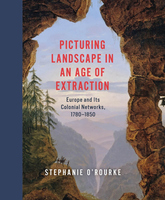
Stephanie O’Rourke,
Picturing Landscape in an Age of Extraction: Europe and Its Colonial Networks, 1780–1850.
The University of Chicago Press, 2025.
240 pp.; 46 color illus.; notes; bibliography; index.
$45.00 (hardcover)
ISBN: 9780226841557
Stephanie O’Rourke’s Picturing Landscape in an Age of Extraction makes an important contribution to recent scholarship in environmental art history, particularly work on the long nineteenth century. Twenty-five years after Greg Thomas’s pioneering Art and Ecology in Nineteenth-Century France,[1] O’Rourke’s book demonstrates how art historians have developed new approaches to examining artworks from ecocritical perspectives. What is notable is O’Rourke’s commitment to historical specificity, a dimension that much previous scholarship has addressed insufficiently. Rather than reading artworks for ecological or proto-ecological awareness—or for general interconnections between the human and natural worlds—O’Rourke examines the various modalities through which late eighteenth- and early nineteenth-century landscapes addressed new extractive ways of treating and conceptualizing the natural world. By extraction, O’Rourke refers to “large-scale coordinated efforts to quantify, optimize, separate, circulate, and monetize the physical environment across global networks” (13). As a core mechanism that emerged during modern industrialization and came to shape human societies as well as humanity’s relationship with the environment, extraction compelled a new way of looking, which O’Rourke terms the “appraising view,” a concept she defines as “a perceptual vantage point that assesses the prospective economic value of a given environment” and that also “entailed various forms of blindness” (16). Under this explanatory framework of extractive vision, O’Rourke examines images in relation to the extractive logic of timber harvesting, ore mining, coal mining, and the extraction of human resources.
The first chapter situates French landscape painting within the development of timber extraction and the science of forest management in France and colonial Algeria. O’Rourke argues that Hubert Robert’s Entrance to the Lawn (1777; Musée National des Châteaux de Versailles et de Trianon, Versailles), together with the early nineteenth-century academic tradition of historical landscape, treated trees as entities that could be isolated from their environments. This pictorial logic corresponded to an emerging scientific forestry that understood trees as economically valuable resources to be rationalized, monetized, and managed. In contrast, the trees celebrated by the mid-nineteenth-century Barbizon School are endowed with individual features and are not easily decontextualized, rationalized, or set into circulation. Yet O’Rourke points out that this seeming resistance to an extractive mode of looking, as well as the artists’ advocacy for the conservation of ancient French trees, in fact depended on the exploitation of Algerian forests as a new source of timber. She further argues that Orientalist landscapes by painters such as Eugène Fromentin, including depictions of unharvested trees and scenes of desertification in Algeria, served to justify French intervention in these forests for timber extraction and climate regulation.
The second chapter turns to early nineteenth-century German landscape painting and ore mining. O’Rourke argues that underground mining, with its excavation of subterranean ores, introduced a vertical orientation into landscape representation that constrained viewers’ perceptions of and access to the natural world. Paintings by Caspar David Friedrich and Karl Friedrich Schinkel adopt this verticality, which stands at odds with the horizontal orientation of traditional landscape composition. O’Rourke finds that, by foregrounding the stratification of rocks or arranging them as visual barriers, these artists also gestured toward the ultimate “imperception and incomprehension within the human experience of the natural world” (70), an epistemological doubt about humans’ capacity to understand in the context of the notion of “deep time” developed within geology (93–94). O’Rourke thus offers an alternative to interpretations of Friedrich’s paintings through the sublime: in Friedrich’s Wanderer above a Sea of Clouds (ca. 1817; Hamburger Kunsthalle, Hamburg), what is staged is not the triumph of human perception but its limitation.
The third chapter focuses on the British painter John Martin, who provides a unique example of how artistic practice was embedded in an intellectual milieu attentive to the scientific theories and technologies emerging from industrialization. An amateur engineer, Martin worked on designs for safety lamps used in coal mines to prevent explosions then believed to be caused by noxious gases, and he developed plans for the circulation of water and sewage in London. Both projects reflect a concern with the unregulated flows set in motion by extractive practices, an invisible force beyond human experience. O’Rourke observes that this concern also appears in Martin’s paintings, in which he experimented with representational devices for regulating flows within the pictorial system. In an etching designed to accompany his famous painting Belshazzar’s Feast (1820; Yale Center for British Art, New Haven), for example, he used arrows to channel the viewer’s gaze through distinct visual units. Among Martin’s various strategies, what O’Rourke finds most important is his attentiveness to the scalar relationship between human figures and monumental architecture. Through scale effects, O’Rourke argues that Martin managed to “mediate the intense disjunction of the human vantage point and natural phenomena” (104).
The final chapter explores how scientific frameworks underpinning the extraction of human resources shaped representations of human beings within their environments. O’Rourke maps two competing theories within comparative anatomy that informed understandings of humanity’s relationship to climate and of racial difference. Whereas Jean-Baptiste Lamarck held that humans and their environments existed in a reciprocal relationship, Georges Cuvier argued that humans were distinct from their environments. In French prints produced during late eighteenth- and early nineteenth-century Pacific expeditions, O’Rourke identifies the coexistence of two modes of depicting Indigenous peoples. Her visual analysis offers valuable insight into the formation of accounts of racial fixity. When she turns to academic painting, however, O’Rourke offers an oversimplified, though interesting, reading of the contrast between Eugène Delacroix and Jean Auguste Dominique Ingres, aligning the former with a Lamarckian model and the latter with a Cuvierian one: Delacroix’s figures, such as the interracial couple in The Natchez (completed 1835; The Metropolitan Museum of Art, New York) and the personification of Greece in Greece on the Ruins of Missolonghi (1826; Musée des Beaux-Arts, Bordeaux), share similar colors and textures with their painted environments, while Ingres’s figures have clearly delineated contours.
The book is a compelling example of interdisciplinary scholarship. O’Rourke’s skillful writing, which weaves together visual analysis of images in different media and references to scientific accounts, historically situates visual culture within its contemporary intellectual milieu. The book’s rich body of material, drawn from France, Britain, Germany, and regions subjected to European colonial violence, makes it an indispensable reference for understanding the formation of colonial extractive capitalism and its continuing global effects.
O’Rourke employs one strategy of particular note. In each chapter, she juxtaposes scientific illustrations with paintings or drawings in order to situate them within their respective scientific milieux: Henri-Louis Duhamel du Monceau’s Cartesian-grid diagram for measuring tree trunks in De l’exploitation des bois (1764; Bibliothèque nationale de France, Paris) with Robert’s Entrance to the Lawn;[2] Friedrich von Trebra’s mining illustration in Erfahrungen vom Innern der Gebirge (1805; J. Paul Getty Museum, Los Angeles) with Friedrich’s Wanderer above a Sea of Clouds;[3] and Martin’s “Plan for preventing the pollution of the water of the Thames” (1834; London Museum, London) with his paintings. However, the gap between these two categories is not always easy to bridge. Scientific images used to rationalize practices such as logging and mining have a more straightforward alignment with extractive logic, whereas paintings and drawings traditionally classified as “fine art” are embedded in more complex—even contradictory—social and cultural contexts. Consequently, some readings of extractive logic or the “appraising view” are less persuasive than others. For instance, her interpretation of Fromentin’s Olive Trees at Blidah (1846; Musée des Beaux-Arts de La Rochelle, La Rochelle) as a justification for French intervention in Algerian forests ignores the painting’s formal affinities with the Barbizon School and its poetic, even melancholic, tone. Fromentin’s own writing about the olive grove at Blidah likewise expresses regret over the French army’s destruction of the trees.[4] The drawing therefore reads less as a celebration of extractive logic than as a lament that stands in tension with it. This example complicates O’Rourke’s claim that “the logic of timber extraction was, for the most part, easily accommodated within preexisting academic formats of picturing landscape” (43).
This also raises a crucial question about the role of artworks in scholarship on environmental art history. As Olga Smith and Andrew Patrizio have recently noted, “all too often artworks in this context are reduced to an illustration of an idea, an epiphenomenon, a means of raising awareness in the service of environmental science”; they instead call for a mode of art-historical writing that “requires readiness to confront artworks as a vital force, a paradox, a challenge, and a revelation.”[5] Although O’Rourke states that artworks can not only “affirm” but also “introduce friction within the protocols of extraction” (23), the book does not examine this critical capacity fully enough. The extractive regime that O’Rourke lays out thus seems too overarching and powerful to be disrupted. O’Rourke herself is not unaware of this inadequacy, as she asks in the conclusion: “Is an artistic format premised on instrumentalizing the natural world capable of critiquing an economic system that employs an intensified version of a similar logic?” (180). She attributes the possible impotence of such critique to landscape itself, as a genre that “entails prioritizing some features of the natural world at the expense of others” (179). But what if interpreting landscapes as commensurate with extractive imperatives is itself, to some extent, extractive, insofar as the viewer must select a particular pictorial mode at the expense of many other features and possibilities? What if we instead read images such as Fromentin’s Olive Trees at Blidah as paradoxes, ambivalences, and thus challenges to extractive logic? Nevertheless, Picturing Landscape in an Age of Extraction opens important terrain for further research.
Notes
[1] Greg M. Thomas, Art and Ecology in Nineteenth-Century France: The Landscapes of Théodore Rousseau (Princeton University Press, 2000).
[2] Henri-Louis Duhamel du Monceau, De l’exploitation des bois, vol. 1 (H.-L. Guerin and L.-F. Delatour, 1764), 166, plate 1.
[3] Friedrich Wilhelm Heinrich von Trebra, Erfahrungen vom Innern der Gebirge (Verlagskasse für Gelehrte und Künstler, 1805), plate 1.
[4] Eugène Fromentin, Between Sea and Sahara: An Algerian Journal (Ohio University Press, 2000), 101–03.
[5] Olga Smith and Andrew Patrizio, Methods for Ecocritical Art History (Manchester University Press, 2026), 7–8.