God Is in the Detail: Reception and Revelation in Joseph Noel Paton’s Dawn: Luther at Erfurt
by Christine BatesChristine Bates is a doctoral researcher at the University of Jena and an associate of the University of York. Her research focuses on nineteenth-century British art, particularly the Pre-Raphaelites, and engages with transnational reception histories, gender studies, postcolonialism, and ecocriticism. She coedited Picturing the Romantic: New Perspectives on European Romanticism(s) in the Visual Arts and has published on the New Woman in the work of Eleanor Fortescue-Brickdale and on Heinrich Vogeler’s book illustrations. Together with two collaborators, she received the Australian Institute of Art History Early Career Research Award in 2025 for Remapping the Anthropocene, a project examining extraction and colonialism in nineteenth-century images of Australia, and was awarded the 2026–27 Art History Residency by the Association for Art History for research on Anna Blunden and ecofeminism. She has held visiting research appointments at the Yale Center for British Art and the Delaware Art Museum.
Email the author: cn780[at]york.ac.uk
Citation: Christine Bates, “God Is in the Detail: Reception and Revelation in Joseph Noel Paton’s Dawn: Luther at Erfurt,” Nineteenth-Century Art Worldwide 25, no. 3 (Autumn 2026), https://doi.org/10.29411/ncaw.2026.25.3.2.
This work is licensed under a Creative Commons Attribution-NonCommercial 4.0 International License  unless otherwise noted.
Your browser will either open the file, download it to a folder, or display a dialog with options.
The exhibition Joseph Noel Paton: An Artist’s Life—From Dunfermline to the Royal Court (September 14, 2024 to February 9, 2025) at the Dunfermline Carnegie Library and Galleries in Dunfermline, Scotland, presented the first major solo exhibition of Scottish artist Joseph Noel Paton (1821–1901). Among its highlights was Dawn: Luther at Erfurt (1861), an oil painting from Paton’s Pre-Raphaelite period (fig. 1), depicting Martin Luther (1483–1546) bent over an open folio in solitary study. Long overlooked in the storehouses of the National Galleries of Scotland, its recent display brought renewed attention to a canvas whose intricate symbolism, meticulous detail, and luminosity exemplify Paton’s distinctive synthesis of historical imagination and Pre-Raphaelite precision. Yet Dawn: Luther at Erfurt resists easy classification. Why did a Scottish painter lavish such care on a subject rooted in the German Reformation, and why eschew the familiar iconography of Luther posting his theses on the door of the church in Wittenberg in favor of an obscure scene of private struggle and illumination?
Fig. 1. Joseph Noel Paton, Dawn: Luther at Erfurt, 1861. Oil on canvas. National Galleries of Scotland, Edinburgh. Artwork in the public domain; photograph courtesy of the National Galleries of Scotland.
I argue that Paton’s painting is neither a conventional Reformation subject nor simply an appeal to Protestant patronage but an ambitious experiment in Victorian history painting that reconfigures the relationship between image, beholder, and historical consciousness. Building on Uwe Jens Wandel’s pioneering but little-known essay, “Morgendämmerung: Luther in Erfurt” (Dawn: Luther in Erfurt), I move beyond iconography by adopting a reception-aesthetic approach—a methodology essential for grasping the inner logic of Paton’s pictorial strategies.[1] Reception aesthetics understands meaning as emerging through the interaction between artwork and beholder.[2] Drawing on Wolfgang Iser’s theory of reading and Johannes Grave’s account of image perception as a temporally extended process, I contend that Paton structures the viewer’s experience through carefully orchestrated movements of attention, repetition, and discovery.[3] Examining the painting’s inscriptions, heraldic emblems, and effects of light alongside its historical and cultural resonances, this article demonstrates that Paton constructs a historically informed mode of viewing that links the German Reformation to Victorian Britain while exposing how Pre-Raphaelite history painting could operate as a laboratory for innovative spectatorship.
Despite occasional appearances in exhibition catalogues and local press reports, Dawn: Luther at Erfurt has received remarkably little scholarly attention. The exhibition of 2024–25 lacked a catalogue, and the only monograph on Paton, published in 1990, remains primarily biographical.[4] Wandel’s German essay therefore remains the most thorough contextualization of the painting, yet no comprehensive account of it has been published in English.[5] This study addresses that gap through a reception-aesthetic reading of Dawn: Luther at Erfurt, arguing that Paton elaborated a pictorial mode that renders beholding itself a historically reflexive and extended temporal process in which revelation is enacted rather than represented. The argument proceeds in three interlocking steps: First, a close formal and material analysis identifies how meaning emerges through the act of looking; second, these observations are theorized within a framework emphasizing the performative and temporal dimensions of spectatorship; and third, the painting is situated within transnational networks of religious, artistic, and intellectual exchange, including Prince Albert’s (1819–61) patronage. By foregrounding the oscillation between materiality and illusion, Paton’s work transforms the spectator into an active, historically literate participant in meaning-making, thereby occupying a place within nineteenth-century debates concerning the agency of images and the experience of viewing.
Constructing Luther: Identity Without Likeness
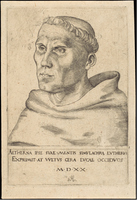
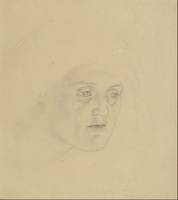
In 1861, Paton completed his oil painting Dawn: Luther at Erfurt, finalizing it just four days before dispatching it from his Edinburgh home to London.[6] A handwritten note in the upper-left corner of the canvas records that he began sketching the composition during a visit to the Isle of Arran in 1855.[7] At the center of the work stands a monk behind a wooden desk, one knee resting on a chair and a discarded sandal behind him on the floor. As the title reveals, the figure represents the German reformer Luther. Dressed in the black cowl and white tunic of an Augustinian monk, he leans over a folio, his head resting on his left hand in contemplation.[8] Contemporaneous critics immediately recognized that Paton had departed from Luther’s established iconography. Paton did not model Luther’s features on the canonical portraits by Lucas Cranach the Elder (1472–1553), widely disseminated across Europe in nineteenth-century prints (fig. 2). Following the Pre-Raphaelite practice of using live models for historical figures, he modeled Luther after his wife, Margaret Gourlay Noel Paton (née Ferrier), masculinizing her features (fig. 3). The resulting youthful and somewhat androgynous figure puzzled contemporaneous reviewers accustomed to Cranach’s authoritative reformer. The Daily News regretted that they “miss any of the traits of Luther, and this want of modified likeness is a serious lack in the picture.”[9]
Yet this apparent departure from portrait tradition is deliberate. Rather than relying on physiognomic recognition, Paton shifts meaning onto the painting’s orchestrated network of objects and symbols, requiring the viewer to construct Luther’s identity through continuous observation. A reception-aesthetic approach is particularly appropriate here, as the painting directs the spectator’s gaze through successive acts of discovery rather than immediate recognition. Contemporaneous reviewers already sensed the profusion of visual detail, redirecting attention from the ostensible subject toward the interpretive work of the beholder: “[T]he central interest of the face is somewhat sacrificed to the elaborate finish of the accessories, which draws off the attention from the incipient Reformer, to the old folios, chased crucifix, lamp, rosary, stained glass, tapestry, carvings and furniture of a mediaeval library.”[10]
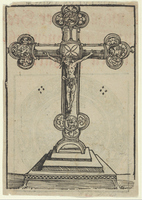
Rather than diminishing the painting’s effectiveness, this diffusion of attention forms the basis of the painting’s visual strategy. The desk is cluttered with worn, leather-bound books, their pages marked by paper slips and a rosary for later reference, while an inkwell and quills imply ongoing annotation. Symbols of mortality—a gilded crucifix, an hourglass, and a skull—adorn the windowsill. Paton drew these objects from authentic sources in his father’s collection at Wooers’ Alley in Dunfermline. The nineteenth-century phrenologist David George Goyder recalls “an ebony cross and below it a skull and cross bones, a Bible and some ancient religious books.”[11] This triad also appears in the fifteenth plate of Paton’s illustration for William Shakespeare’s The Tempest.[12] Paton borrowed the crucifix (fig. 4), however, which was made by William Calder Marshall, from Scottish painter and architect Patrick Allan Fraser, who was living at Hospitalfield House in Arbroath.[13] Paton replicated its quatrefoils, saints, strapwork motifs, and Christ figure but altered the bishop into a full-body figure seated beneath Christ, accentuating the centrality of the Catholic Church. A similar crucifix design appears in Cranach’s Wittenberger Heiligthumsbuch (Wittenberg reliquary book) of 1510 (fig. 5), confirming Paton’s grounding in sixteenth-century sources.

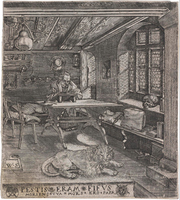
This carefully assembled interior places Dawn: Luther at Erfurt within the studiolo tradition. In Renaissance Italy, the studiolo functioned as a small, private chamber for study, contemplation, and the display of books, artworks, and natural curiosities, becoming a visual shorthand for intellectual authority.[14] Recognizing this shorthand was itself part of the beholder’s interpretive labor: A period viewer would read Luther’s cluttered desk as a coded assertion of intellectual and spiritual authority, compensating for the lack of physiognomic resemblance in the painting. Petrarch’s studiolo at Arquà near Padua became a model for such representations of intellectual labor, particularly those of Saint Jerome.[15] A fresco from 1374 in Padua’s Sala dei Giganti and a manuscript illumination of De viris illustribus (On illustrious men) from circa 1400 depict Petrarch at a desk with a lectern, surrounded by books, writing instruments, a revolving bookstand, and a mirror, establishing a visual language of scholarly authority that informed Renaissance and later depictions of eruditeness. Petrarch’s study functions not only as biographical reality but also as a paradigmatic fiction, shaping the humanist as both material figure and imaginative construct. It became a model for such enduring archetypes as Saint Jerome as the reflective humanist.[16] The most celebrated example of this iconography is Albrecht Dürer’s (1471–1528) Saint Jerome in His Study from 1514 (fig. 6). Given its prominence in nineteenth-century Britain, Paton likely knew Dürer’s engraving. Dürer’s prints, widely circulated internationally, secured his fame more than any other aspect of his oeuvre.[17] The Pre-Raphaelites reimagined the studiolo in a modern Victorian context as a space for introspection and moral reflection. Many Pre-Raphaelite paintings, such as Dante Gabriel Rossetti’s (1828–82) The Girlhood of Mary Virgin (1848–49; Tate Britain, London), John Roddam Spencer Stanhope’s (1829–1908) Thoughts of the Past (1858–59; Tate Britain, London), or John Everett Millais’s (1829–96) Mariana (1851; Tate Britain, London), thus function as modern studioli, creating a private, contemplative world for the beholder.[18]
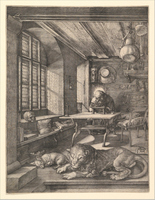
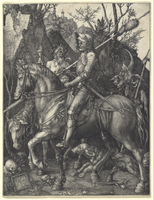
Recovering these sources reconstructs the visual vocabulary through which contemporaries could recognize Paton’s interior as a legible tradition of scholarly portraiture, not a failure of likeness. The Glenrothes Archives preserve an unfinished pencil study by Paton after Dürer’s engraving Knight, Death and the Devil (1513), demonstrating both technical precision and sustained engagement with Dürer’s visual vocabulary (figs. 7, 8). As part of Dürer’s Meisterstiche (master engravings), it is likely Paton knew the companion engravings Melencolia I (1514; The Metropolitan Museum of Art, New York) and—crucially—Saint Jerome in His Study (see fig. 6), suggesting the latter served as a compositional reference for Dawn: Luther at Erfurt.[19] A close comparison reveals numerous borrowings, including the skull, slippers, books, crucifix, and hourglass. Paton even seemed familiar with Wolfgang Stuber’s engraving Luther as Saint Jerome (fig. 9), a mirrored adaptation of Dürer’s print commemorating Luther’s death in 1546.[20] The figure’s orientation and the spatial configuration in Paton’s work correspond to Stuber’s version, and even the inkwell and quills occupy precisely the same position. While Paton’s direct consultation of the Stuber print cannot be confirmed, the artist’s granddaughter Margaret Hamilton Noel-Paton noted he had “borrowed an engraved portrait of Luther in monastic habit” from the Scottish antiquarian David Laing, demonstrating his access to widely circulated prints of the reformer.[21] Paton’s correspondence with Laing in the 1860s reveals the dual trajectory of Paton’s practice, combining artistic production with historical research.[22] Laing’s holdings—including works on Dürer and a Luther biography—suggest that Dawn: Luther at Erfurt was shaped by both archival study and engagement with early European print culture.[23] It is precisely this network of references, associations, and interpretive prompts that a reception-aesthetic approach is best equipped to trace.

Sola Fide, an Existential Crisis, and the Art of Reception
According to art historian Werner Hofmann, Luther relied extensively on Saint Jerome’s Latin translation from Hebrew and Greek Scriptures when producing his German translation of the Bible.[24] Stuber’s engraving situates Luther within the visual and intellectual lineage of Saint Jerome, presenting him as both scholar and interpreter of Scripture.[25] Noel-Paton recalls that her grandfather presented Dawn: Luther at Erfurt as a depiction of Luther’s biblical translation.[26] Yet Luther did not begin translating the Bible in Erfurt but at Wartburg Castle in Eisenach in 1521.[27] Paton’s painting does not merely depict translation but conveys Luther’s inner turmoil—his despair at failing to attain God’s favor despite rigorous monastic devotion. This struggle is expressed through his bent posture and world-weary expression, signaling physical exhaustion and psychological burden. In Pre-Raphaelite fashion, Paton combines intricate detail and layered symbolism to expose the theological and institutional tensions central to the Reformation.
When exhibited at the Royal Scottish Academy in Edinburgh in 1862, one critic complained that the painting’s meaning depended on the catalogue entry, as the figure bore no resemblance to conventional Luther portraits:
Mr. Paton’s picture of “Luther at Erfurt” (No. 490) bears the strong impress of careful study and unerring delineation, but from the want of resemblance in the figure to the known portraits of Luther, the picture fails to convey its meaning, which can only be made out by referring to the explanatory note—otherwise, it might as well represent any other monk or ascetic person.[28]
The criticism, however, overlooks the painting’s central strategy. Rather than identifying Luther through physiognomic likeness, Paton constructs his identity through a network of contextual and symbolic markers, making interpretation itself fundamental to the viewing experience. Behind Luther hangs a tondo of Pope Alexander VI in profile, his hand raised in benediction. Born Rodrigo de Borgia (1431–1503), Alexander rose from the powerful Borgia dynasty to the papacy in 1492 through simony, becoming notorious for political maneuvering and open disregard of clerical celibacy, fathering four children with his mistress, Vannozza dei Cattanei (1442–1518).[29] Such notoriety rendered him an apt emblem of ecclesiastical corruption. Significantly, Alexander’s portrait obscures the upper half of a red-chalk drawing of the Crucifixion. The contrast is striking: The gilded frame encasing Alexander’s likeness overwhelms the fragile chalk outline of Christ’s Passion, representing the Catholic Church’s subordination of Scripture to papal authority. As historian Lyndal Roper observes, Luther’s doctrine of sola scriptura—the primacy of Scripture alone—directly challenged such corruption.[30] The modest Crucifixion becomes an allegory of this principle, its muted authority awaiting restoration through the removal of the ornate papal overlay. This allegorical force implicates the beholder as well. Almost imperceptible at a normal viewing distance, the chalk drawing requires the viewer to move closer to discern its contours. In this physical repositioning, the spectator mirrors the very principle of sola scriptura: Truth must be actively sought, recovered from beneath the layers of distortion imposed by ecclesiastical authority. Paton transforms the act of looking into an experiential allegory, compelling the audience to shift both gaze and interpretive stance to apprehend the primacy of Scripture. In doing so, his composition not only historicizes Luther’s struggle but also visualizes the very act of unveiling.
Paton’s visual strategy is rooted in Victorian conceptions of seeing. As art historian Kate Flint has shown, nineteenth-century visual culture understood perception not as a passive physiological process but as an active negotiation between image, viewer, and culturally acquired habits of interpretation.[31] Pre-Raphaelite painting exemplified this conception by requiring viewers to read meticulously rendered details as symbolic signs, making looking a hermeneutic act that combined empirical observation with imaginative interpretation.[32] Art historian Julia Thomas extends this insight in her analysis of Paton’s painting In Memoriam (1858; private collection), arguing that narrative painting positions the viewer as an active reader who assembles visual clues into coherent meaning.[33] Images communicate not only through what they show but also through what they withhold, inviting multiple interpretations.[34]
Dawn: Luther at Erfurt operates in precisely this manner. Rather than presenting a straightforward historical episode, Paton requires the beholder to reconstruct Luther’s identity and theological position through an accumulation of carefully orchestrated visual signs. By placing the papal likeness above Christ’s head, Paton not only signals Luther’s rejection of papal authority but also foreshadows his eventual break with the doctrinal framework of the Roman Catholic Church, culminating in the publication of his Ninety-Five Theses in 1517. Paton’s painting anticipates the historical drama that follows. Similarly, the small biblical scene of Jesus on Mount Olivet on the front of Luther’s desk functions as a typological foreshadowing. Just as Jesus enters Gethsemane after the Last Supper to prepare in solitude for the Passion, Luther is shown as a Christ-like figure on the threshold of a spiritual transformation whose consequences extend far beyond the moment represented. The title locates the scene in the Augustinian monastery at Erfurt, where Luther entered as a novice in 1505—twelve years before the alleged posting of his theses.[35] Before entering the order, Luther had studied philosophy and law for four years at the University of Erfurt.[36] Theologian and historian Martin Brecht links Luther’s decision to join the Augustinians to an existential crisis during these studies, which he sought to resolve through Scripture.[37] Tradition holds that Luther vowed to join the monastery after surviving several perilous experiences, most famously a violent thunderstorm in which he implored Saint Anne for protection.[38] His exact motivation is unclear, yet the Augustinians’ scholarly reputation, university connections, and rich library likely influenced his decision.[39]
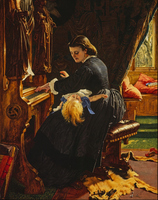
Paton encodes this intellectual and historical context in his painting. In the background, a side room contains a lectern piled with books, partly concealed by a heavy, ornamental curtain. A perspective drawing for Paton’s The Lullaby (fig. 10), produced the same year, is annotated “Van.[tage] point of splay of window in Luther,” indicating that The Lullaby and Dawn: Luther at Erfurt share the same spatial model. The recessed window and curtain correspond strikingly, and when the two works are set side by side, the mother at the piano occupies the same position as Luther on the opposite side of the room, suggesting a thematic link between domestic devotion and spiritual reflection.[40] Sunlight filters through a stained-glass lancet window, illuminating the image of a haloed bishop—Augustine of Hippo, the order’s patron saint. Above, the coat of arms of the Wettin dynasty anchors the scene historically: Erfurt had fallen under Wettin protectorate through the Treaty of Weimar in 1483.[41] Such seemingly minor details signal place and meaning, offering the beholder cues that situate the scene within the intellectual, spiritual, and political world of late fifteenth-century Erfurt.
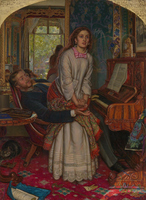
The most compelling clue to Luther’s identity lies in the books pictured in Dawn: Luther at Erfurt. At the center of the desk rests the third volume of Augustine’s De Civitate Dei (The City of God), reinforcing the painting’s Augustinian framework already established by the stained-glass image of Saint Augustine and Luther’s monastic habit. Still more revealing—though easily overlooked—is the illuminated verso of the page that Luther appears to have been reading. Close inspection reveals the inscriptions Ad Romanos and Paulus, identifying Paul’s Epistle to the Romans—the very text through which Luther reached his radical conviction of salvation by faith alone (sola fide). This theological breakthrough destabilized the Catholic system of confession, penance, and indulgences, becoming the catalyst for the Reformation.[42] Although Luther later described this transformative “tower experience” as a sudden revelation, theologian Martin Nicol and others have shown it to be a gradual process retrospectively shaped into a foundation myth.[43] Paton visualizes precisely this moment of spiritual awakening. The Augustinian monk appears to have spent the night immersed in philosophy, theology, and Scripture, as suggested by the almost-extinguished oil lamp above him. Morning light streaming through the open window falls directly upon Luther’s forehead, signaling revelation—the “dawn of the Reformation.”[44] Paton’s use of light to mark epiphany recalls William Holman Hunt’s (1827–1910) oil painting The Awakening Conscience of 1853 (fig. 11). Both pictures share the distinctive arched top and near-identical proportions, and both center on a figure poised at the threshold of transformation: in Hunt’s case, a woman rising from her lover’s embrace with newfound moral awareness; in Paton’s, Luther awakening to a new theological consciousness. More significantly, both artists stage revelation through densely articulated interiors in which meaning is dispersed across objects, texts, and material surfaces rather than concentrated in gesture alone. In each case, light becomes the vehicle through which inner transformation becomes outwardly legible. Conceived as a modern moral subject in the tradition of William Hogarth (1697–1764), Hunt’s painting presents a kept mistress in a richly furnished St. John’s Wood interior whose sudden recollection of lost innocence and spiritual awakening is prompted by Thomas Moore’s song “Oft in the Stilly Night.”[45] The comparison also clarifies the role of detail in Pre-Raphaelite painting. In Hunt’s work, objects such as the mirror, abandoned glove, sheet music, and unfinished embroidery actively construct the narrative by linking memory, present crisis, and implied future within a single visual field. Paton employs an analogous strategy. The inscriptions in Luther’s Bible, like Hunt’s sheet music, interrupt the viewer’s initial perception and reward close scrutiny, shifting attention from the image as a whole to the material act of reading. Revelation thus unfolds not only within the painting but also through the spectator’s process of deciphering it.
The painting’s reception reveals how its pictorial strategies demand active, prolonged viewing. The critic writing for The Scotsman, who deemed the figure of Luther unrecognizable without consulting the entry for the painting in the exhibition catalogue, misconstrued the work’s central logic.[46] The painting compels the beholder to shift position, moving closer to discern the inscriptions on the open pages and book spines—details that establish Luther’s Augustinian and theological identity at Erfurt. As art historian Grave has argued, inscriptions in images possess a distinctive capacity to draw the viewer into proximity. Once this threshold is crossed, further elements emerge: the faint chalk Crucifix, or the very texture of paint on canvas.[47] The reception-aesthetic effect of such details lies precisely in this invitation to oscillate repeatedly between distant and close viewing, between immersion in the depicted scene and a reflective awareness of its pictorial mediation. This dynamic recalls literary scholar John Plotz’s account of reading, in which intimacy arises not despite mediation but through it. Readers become absorbed in another consciousness while remaining aware that this encounter is enabled by the material presence of the text.[48] Paton invites an analogous mode of spectatorship. The painting offers no privileged vantage point from which its meaning is immediately disclosed; rather, it unfolds through extended engagement with its visual and material complexities. Grave’s emphasis on the temporal unfolding of perception draws on Iser’s account of reception as a process of continually revised projections.[49] Rather than confirming the beholder’s initial expectations, Paton’s painting repeatedly frustrates and corrects them, so that Luther’s identity and theological significance emerge only through sustained acts of looking. Just as Luther believed that faith is realized through the Word, Paton enacts faith through visual perception, drawing viewers into a perceptual process that culminates in the epiphanous recognition encoded in the depiction of the reformer. Luther’s theological insight remains latent within the pictorial object until activated by the beholder’s prolonged attention, so that the process of recognition in front of the painting mirrors the moment of revelation it depicts. Dawn: Luther at Erfurt thus stages a dynamic interplay between image, text, and observer, insisting that understanding and faith emerge through engagement itself.
The painting persistently draws attention to its materiality—its texture, surface, and physical presence—underscoring the dynamic interplay between depicted image and physical object. At the upper right, morning light enters through an opened, stained-glass panel, projecting colored patches onto the wooden shutter. These luminous traces are deliberately staged: resembling daubs of pigment on a painter’s palette, they transpose material paint into depicted paint. In this way, the work exposes and celebrates its own artifice, foregrounding its self-referential character and collapsing the boundary between medium and representation. As art historian Paul Barlow has argued in relation to Millais, such effects of visual “difficulty” and distraction are central to Pre-Raphaelite practice, drawing attention to the painting as both representation and material object.[50] This oscillation between transparency (depicted scene) and opacity (material surface) is intrinsic to figurative art—between what can be seen through and what resists vision. This interplay of revelation and concealment, clarity and obscurity, mirrors Luther’s progression toward epiphany.[51] The same strategy governs the books on Luther’s desk. As the beholder approaches to discern their titles and inscriptions, the painting rewards closer inspection with an increasing awareness of its own material surface: The delicate creases of paper parallel the precariousness of the painting’s material support. Paint feigns paper while paper reflects canvas, forming a layered meditation on material transience. Far from acting as an inert vehicle for iconography, the material surface becomes an active agent of meaning. Art historian Elizabeth Prettejohn has similarly argued that Pre-Raphaelite history painting redefined the genre through a self-conscious engagement with materials, labor, and technique, making visible facture an essential component of meaning rather than a transparent means of representation.[52] The hermeneutic parallel is clear: Just as Luther’s theological insight demanded sustained engagement with Scripture, so too must the beholder attend closely to the painting’s material and formal properties.
A contemporaneous reviewer sensed this shift between transparency and opacity when praising the effect the depicted books had upon them: “[O]ld and strong, lying all about, as if taken up and thrown down in restless search, how wonderfully they are painted! or rather, how wonderfully you never think of them as painted! and yet they are not merely imitated–you don’t mistake them for actual books, they are the realised ideas of books.”[53] This perceptive observation captures the paradox of painted materiality: the books appear worn and tangible yet are never mistaken for real objects. They function simultaneously as convincing representations and as conceptual embodiments—“realised ideas”—that affirm and transcend their material facture. Paton stages not merely a scene of revelation but a visual meditation on interpretation, in which materiality itself becomes a vehicle of theological understanding, drawing an analogy between painting and the reformer it depicts. Within this context, it is telling that contemporaneous critics repeatedly described John Ruskin (1819–1900) as the “Luther of painting,” casting him as a reformer who defended the Pre-Raphaelites’ rejection of academic convention just as Luther had challenged the medieval Church. Paton’s depiction of Luther therefore participated in a broader Victorian tendency to use religious reform as a metaphor for artistic renewal.[54] As one critic remarked, “we express our general high admiration and homage to ‘The Luther of Painting,’ as he has been not inappropriately called—the Luther of the fine arts.”[55] Such commentary, current in the 1850s and 1860s, would almost certainly have been known to Paton, who moved in the same artistic and literary circles as Ruskin. At the very moment Ruskin was hailed as a Luther of art, Paton’s canvas gave visual form to the archetype of the principled reformer, reflecting a broader Victorian tendency to invoke religious reform as a metaphor for artistic renewal.
It is through these reception-aesthetic strategies—activated by the intricate interplay of the painting’s material and formal properties—that Dawn: Luther at Erfurt exerts its greatest force upon the beholder. This agency was not merely latent within the work’s visual strategies but also recognized, if not systematically theorized, by contemporaneous commentators. Reviewing the Royal Academy Summer Exhibition of 1861, The Illustrated London News remarked that “[i]mmediately on entering the great room we are struck by an impressive picture by J[oseph] N[oel] Paton.”[56] Likewise, The Scotsman observed that it wished “[that] all our readers could have shared the pleasure we enjoyed from seeing it, and coming under its power.”[57] Here, “power” functions less as rhetorical flourish than as an acknowledgment of the painting’s capacity to shape perception, mobilize affect, and elicit embodied response. Another reviewer stressed reception processes, reflecting on visual details and the movements of the gaze in beholding the painting: “This only must we note in passing, that the wealth of detail and suggestiveness in the accessories is right and noble, for all is subordinate to the face of the figure. That is what chains your attention first–what your gaze lingers on last as you leave the picture.”[58] This observation describes not simply the painting’s subject but the experience of viewing it. The reviewer traces the eye’s movement across the composition—from the surrounding details to Luther’s face and back again—anticipating the oscillating mode of spectatorship explored throughout this article.
Reframing Luther in Nineteenth-Century Britain
Dawn: Luther at Erfurt invites us to consider not only how form and material shape aesthetic experience but also why Paton chose this particular historical subject. It is noteworthy that Paton does not depict Luther’s public defiance in Wittenberg or his Bible translation at Wartburg Castle but rather a moment of contemplative study during his Augustinian novitiate at Erfurt. Why would a Scottish painter aligned with the Pre-Raphaelite Brotherhood choose scholarly reflection over revolutionary action? Why evoke the German Reformation rather than Scotland’s own? Paton’s choice highlights the entanglement of Scottish artistic practice with wider European intellectual and visual cultures, revealing the transnational dimensions of nineteenth-century British art.
Although Wandel has argued against a “Luther Renaissance” in nineteenth-century Britain, English translations and studies of Luther circulated widely.[59] William B. Turnbull’s edition of Jean Marie Audin’s History of the Life, Writings, and Doctrines of Luther from 1854, for instance, devotes two chapters to Luther’s early monastic life, embellishing his epiphany with an alleged dialogue between Luther and an elderly monk.[60] The catalogue for the Royal Academy Exhibition of 1861 features quotes chosen by Paton from Barnas Sears’s biography of Luther, printed alongside Paton’s Luther painting and signaling the artist’s close engagement with contemporaneous English scholarship. One quote, which is a translation of Luther’s own account of his monastic years, reads as follows: “When I had taken the vow, they took the Bible from me again, and gave me the sophistical books. But as often as I could, I would hide myself in the library, and give my mind to the Bible.”[61] While these words allude to Luther’s studious disposition during his years as an Augustinian monk, Paton subsequently chose another quote from Sears that foregrounds Luther’s commitment, again in his own words, to the core principle of sola fide:
My confused conscience oft-times did cast me into fits of anger, and I sought, day and night, to make out the meaning of Paul; and at last I came to apprehend it thus: Through the Gospel is revealed the righteousness by which God, in his mercy and compassion justifieth us, as it is written, “The just shall live by faith.” Straightway I felt as if I were born anew; it was as if I had found the door of Paradise thrown wide open.[62]
The library of Paton’s father, Joseph Neil Paton, further illustrates the family’s prolonged engagement with Reformation history. His posthumous sales catalogue records Sears’s Luther, four volumes of Thomas Stephens’s The History of the Church of Scotland (1843–45), Gilbert Burnet’s History of the Reformation of the Church of England (1682), two volumes of John Knox’s History of the Reformation in Scotland (1791), and even an edition of Luther’s Bibel from 1847 in German.[63] Paton’s engagement with Luther, therefore, extended beyond pictorial invention to sustained historical reading.
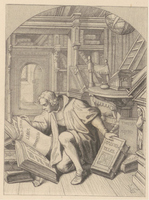
Paton’s Dawn: Luther at Erfurt also resonates with a distinctly nineteenth-century German construction of the reformer. Its focus on the formative Erfurt years draws on a visual tradition that emerged in Germany during the nineteenth century and centered on the becoming of the future hero—the period of inward struggle, intellectual maturation preceding decisive historical action.[64] This emphasis parallels depictions by Gustav König (1808–69), whose pictures explored the reformer’s early intellectual and spiritual development.[65] König’s Luther Discovers a Latin Bible in the University Library at Erfurt of circa 1851 (fig. 12), in which Luther kneels before an unusually large and newly discovered Bible, places Luther within a similarly compressed scholarly interior with an arched top. Yet their focus differs: König depicts the external discovery of the Scriptures, whereas Paton transforms the episode into an inward experience of dramatic illumination and psychological introspection. Such imagery was tied to nineteenth-century reinterpretations of the reformer as a national hero whose significance extended beyond theology.[66] As historian Patrick Hayden-Roy has demonstrated, by the mid-nineteenth century, Luther had been recast within German culture as the embodiment of Germanness itself, rather than merely the initiator of religious reform.[67]
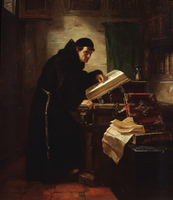
Between 1840 and 1870, fourteen Luther-themed paintings appeared at the Royal Academy Summer Exhibitions—a considerable number, given the subject’s primarily German context. Yet it was only with Paton that the theme gained renewed momentum. Dawn: Luther at Erfurt stands out, enhancing both the subject’s significance and Paton’s achievement. The painting’s display prompted other artists to revisit Luther’s monastic experience, as in Henry Nelson O’Neil’s (1817–80) An Incident in Luther’s Monastic Life at Erfurt (1867; location currently unknown) and Edward Matthew Ward’s (1816–79) Luther’s First Study of the Bible of 1869 (fig. 13).[68] Paton’s painting served as both catalyst and benchmark. Before Paton, only five Luther-themed works had been shown since 1840, two of them architectural landscapes. A rare narrative treatment appeared in Robert McInnes’s (1801–86) Luther Listening to the Sacred Ballad (1844; private collection), which shows Luther at a window listening to a singer performing verses adapted from his sermons.[69] Though marginal to the composition, Luther is immediately recognizable through reference to Cranach’s canonical portraits. In 1867, Paton’s fellow Pre-Raphaelite Henry Wallis (1830–1916) exhibited Luther and Melanchthon (1867; private collection), showing the reformer alongside his collaborator, the theologian and reformer Philipp Melanchthon (1497–1560), at a wooden lectern in a modest study lit by diffused light.[70] Wallis likewise drew on canonical portraits for his Luther depiction. Ronald Lessens and Dennis T. Lanigan suggest that Melanchthon’s likeness also derives from an engraved portrait by Dürer, indicating his active engagement with established models of historical portraiture.[71] Despite its celebrated reformers, the painting foregrounds domesticity: Katharina Melanchthon breastfeeds their child, linking religious renewal with generational continuity and reform to maternal care. Wallis’s work communicates its meaning more immediately, relying on a central motif rather than the sustained engagement demanded by Paton’s densely detailed canvas.
Wallis’s conception of Luther and Melanchthon was likely indebted to his close friend Eyre Crowe (1824–1910), whose Luther Posting His Theses on the Church-Door of Wittenberg (1864; Bob Jones University Museum and Art Gallery, Greenville) was exhibited three years earlier.[72] It depicts the canonical—though historically contested—moment of Luther affixing his Ninety-Five Theses, with figures from Luther’s family circle modeled on historical portraits. Both artists shift focus from the Reformation’s origins to moments when its trajectory is already established, presenting Luther in a form immediately recognizable to the mid-nineteenth-century viewer.
Ward’s Luther’s First Study of the Bible offers the closest compositional parallel to Paton. It depicts Luther bent over a lectern, the chained Bible underscoring Scripture’s rarity and restricted accessibility prior to the Reformation. The irony is striking: The very Word that Luther found to be a source of liberation was materially bound and institutionally confined. Ward deploys chiaroscuro to cast divine light upon both Luther’s face and the open text, contrasting with the surrounding darkness suggesting ignorance and spiritual constraint. In this way, the composition signals not only Luther’s moment of personal enlightenment but also embodies the broader epistemic rupture of the Reformation—the triumph of divine truth over institutional obscurity. Like Paton, Ward eschews conventional portraiture: Luther’s absorbed expression conveys the psychological intensity of inward transformation, reinforcing the fact that the Reformation began as a spiritual awakening. Sheets of parchment scattered across the table invite the viewer into the space of study, just as Paton’s inscriptions engage the audience in an active interpretive process. Unlike Paton, however, Ward’s painting offers no visual cues for the geographical or institutional setting. Luther’s dark habit might suggest an Augustinian monk, yet no further detail situates the figure within a particular monastery or location. Consequently, the identification of the figure as Luther relies almost entirely on the title, emphasizing the work’s dependence on textual framing rather than visual evidence.
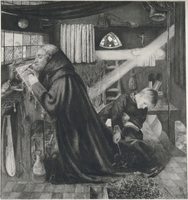
Although Dawn: Luther at Erfurt seems to have shaped later oil depictions of Luther, Paton’s own composition arguably draws on Dante Gabriel Rossetti’s Fra Pace (Brother Peace) of 1856 (fig. 14).[73] Despite their differing visual strategies, the parallels are instructive: Paton adapts Rossetti’s pictorial reference, transferring it into his own temporal and thematic context. In doing so, he forges a dialogue between past and present, invoking Dürer and other historical models within a distinctly contemporary vision. Rossetti depicts a monk kneeling before a lectern in a sparsely furnished interior with a loft bed, broom, scattered books, and a small, triangular, stained-glass window. The monk is absorbed in painting a dead mouse brought in by a cat, which a boy gently pets in the background. This unusual subject situates the monk not in devotional practice but in empirical observation, integrating natural detail into an illuminated manuscript. Like Paton’s work, Fra Pace foregrounds its own materiality: its execution as a watercolor on paper mirrors the pictorial activity it depicts. Central to both works is the motif of light as a vehicle for revelation. In Fra Pace, a ray illuminates the monk’s back, highlighting the transformative significance of artistic observation and drawing from nature. In Dawn: Luther at Erfurt, Paton employs light to dramatize Luther’s spiritual awakening, casting illumination as a metaphor for divine truth attained through critical scrutiny of Scripture. Where Rossetti presents the monastic cell as a space of creative insight, Paton renders it as the locus of theological struggle.
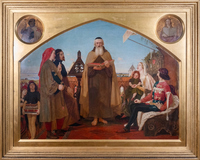
Representations of Martin Luther among Pre-Raphaelite painters are rare, perhaps reflecting the movement’s early intellectual and aesthetic affinities with the Oxford High Church (Tractarian) movement, which leaned closer to Catholic tradition than Protestant reform.[74] Ford Madox Brown (1821–93) instead turned to an earlier reformer: Wycliffe Reading His Translation of the Bible to John of Gaunt (fig. 15) foregrounds the English theologian John Wycliffe (1328–84), whose vernacular translation of Scripture arguably had greater historical resonance in Britain than Luther’s. Brown’s composition contrasts Catholic restriction with Protestant accessibility. In the decorative tondi above the main image, Catholicism is personified with a closed book, signifying Scripture’s inaccessibility under ecclesiastical control, while Protestantism holds an open book, symbolizing its dissemination. This juxtaposition reinforces the radical significance of Wycliffe’s translation in enabling an engaged, literate laity and anticipates the ideals that Paton’s Luther would later dramatize.
Why, then, did Paton turn to Luther? This question requires attention to the work’s material, formal, and reception-aesthetic strategies alongside Paton’s own religious formation. His father, Joseph Neil Paton, initially adhered to Methodism before affiliating with the Religious Society of Friends, becoming a Quaker prior to Paton’s birth in 1821. Paton and his siblings were thus raised within the Quaker tradition under the guidance of their parents and a governess.[75] Yet Neil Paton was later described in his obituary in The Scotsman as a Swedenborgian.[76] Followers of Emanuel Swedenborg (1688–1772) emphasized visionary interpretations of Scripture and personal spiritual experience, placing them at some distance from both the mainline Protestantism of Luther or John Knox (1514–72) (the reformer of the Scottish Presbyterian Church) and from Quakerism.[77] Notably, Swedenborg fundamentally rejected Luther’s doctrine of sola fide, arguing that faith without corresponding action was insufficient for salvation. His theological position insisted that genuine belief must manifest in practical works to achieve redemption.[78] Paton’s only known reflections on denominational divisions reveal a marked skepticism toward sectarianism. In a diary entry of November 18, 1863, he lamented that the Presbyterians were “cut up with an infinite number of sects, each thinking itself ‘the only true Kirk’ and instantly resenting any indication of kindliness toward any of the others.”[79] This remark arose during his residence at Windsor, where, at Queen Victoria’s invitation, he sketched the royal family for the painting In Memoriam (1863–64; Royal Collection Trust, London), commemorating the late Prince Consort. It appears to respond to a discussion about the queen’s regard for the Presbyterian community, which contrasted sharply with the indignation of the Scottish minister Robert Smith Candlish of the Free Church of Scotland, who objected to the queen’s selection of an inscription from the Apocrypha for the Prince Albert Cairn at Balmoral. Candlish deemed it a noncanonical text by Presbyterian standards.[80] Paton’s diary entry highlights the tensions between personal piety and institutional dogmatism and suggests a distaste for rigid claims to doctrinal exclusivity. Candlish’s protest was widely satirized, leading to his public derision as a “Frantic Divine.”[81] Punch, for instance, mocked the minister’s stance, noting that the Apocrypha—“[a] book which Luther placed between The Books—is not good enough for Candlish, and he finds ‘an insult to Scotland’ in the citation!”[82]
The tricentenary of the Scottish Reformation was commemorated in 1860, one year before Dawn: Luther at Erfurt was exhibited at the Royal Academy.[83] Although Paton’s pencil note records that his work on the painting began in 1855, making it unlikely that the anniversary shaped its conception, the tricentenary nevertheless forms an important context for its reception. The Edinburgh commemorations attracted ongoing press attention and a spate of publications, notably John Tulloch’s Leaders of the Reformation: Luther, Calvin, Latimer, Knox, which described Luther as “the most notable of all the Reformers.”[84] Such publications situated the Scottish Reformation within a broader European history of reform and demonstrate the continued prominence of Luther in nineteenth-century historical culture. The enduring popularity of Jean-Henri Merle d’Aubigné’s (1794–1872) History of the Great Reformation of the Sixteenth Century in Germany, Switzerland, etc., first published in English translation in 1838 and repeatedly reissued thereafter, likewise indicates the currency of Luther’s life and thought in Victorian Britain; it recounts Luther’s spiritual awakening at Erfurt and was later quoted from by O’Neil, Crowe, and Ward in their respective catalogue entries.[85] Further evidence appears in The Scotsman’s advertisement for Hately Waddell’s lecture, “Knox and Luther,” demonstrating that Luther was actively integrated into Scottish reflections on the Reformation.[86]
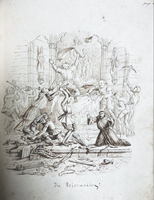
Paton’s unpublished manuscript “A Slight Sketch from the Glorious Reformation and the Only True Kirk,” written between 1836 and 1838 and accompanied by twelve satirical illustrations, provides an illuminating counterpoint to Dawn: Luther at Erfurt.[87] Here, Paton presents the Reformation not as a triumph of spiritual renewal but as a destructive movement founded on false notions of liberty and pernicious doctrines.[88] He portrays Luther in uncompromisingly hostile terms as a corrupt bigot guilty of immorality, drunkenness, adulterous teaching, scriptural distortion, and coarse vulgarity. Central to his critique is Luther’s doctrine of sola fide, which Paton contends encouraged moral license over genuine Christian piety, even suggesting that Luther’s reforms were inspired by the devil himself—a claim that underscores the ferocity of his repudiation of Protestant theology.[89] The Scottish Kirk fares little better in his account, being depicted as hypocritical, intolerant, and coercive despite its claims to religious liberty. Paton’s satire, though couched in irony, conveys a serious judgment: The Reformation fractured Christian unity, corrupted Scripture, and legitimized violence and intolerance, whereas Catholicism is treated with considerably greater sympathy.[90] Paton framed historical failings and episodes of intolerance within the Catholic Church as aberrations from an essentially sound foundation. Indeed, he argues that Catholicism has historically demonstrated greater capacity for toleration than Protestantism, and he defends Catholics against the hostility and misrepresentation they suffered at the hands of reformed polemicists.[91] One of the twelve accompanying illustrations, entitled Reformation (fig. 16), visualizes the iconoclastic fervor and violent upheavals that accompanied the dismantling of sixteenth-century Catholic institutions. Within a desecrated church interior, statues are smashed, devotional objects lie scattered across the floor, and a solitary monk kneels in despair while reformers destroy sacred images, even attacking a Raphael Madonna. The exaggerated violence and theatrical gestures of the assailants render iconoclasm not heroic but absurd and barbaric.
Patronage, Politics, and Religion: Prince Albert as the Ideal Beholder
Although Paton compiled his satirical manuscript seventeen years before beginning his Luther painting in 1855—and his views may have changed in the interim—it seems more plausible, as Wandel suggests, that he chose the subject with a prospective patron in mind. Wandel proposes that Paton hoped to attract the interest of the Prince Consort, Albert of Saxe-Coburg and Gotha, another prominent German Protestant.[92] Victoria and Albert already admired Paton’s art, commissioning in 1858 a smaller version of his painting Home (The Return from the Crimea) (1859; Royal Collection Trust, London), and their patronage later culminated in Paton’s appointment as Royal Limner of Scotland in 1866 and in his knighthood the following year.
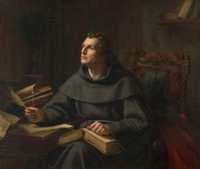
For Albert, Luther held both personal and dynastic significance through the reformer’s association with the Veste Coburg, where Luther was confined under imperial ban during the Diet of Augsburg in 1530, producing programmatic writings and maintaining his correspondence.[93] The ducal house of Coburg subsequently cultivated this memory—particularly in the nineteenth century—by creating a Reformer’s Room and planning a monument, while Albert himself assembled a Luther Collection of some 850 volumes, including early prints.[94] When the Duke of Wellington raised concerns about his possible Catholicism before his marriage to Queen Victoria, Albert compiled a detailed family history foregrounding Luther’s residence at the Veste.[95] Albert’s cultural interests likewise reflected this commitment: As a member of the Gotha art society, he acquired Clara Oenicke’s painting of Luther in 1857, depicting the reformer working on his translation of the Bible (fig. 17). With quill in hand and eyes raised in thought, Luther is pursuing inspiration—a representation consonant with Albert’s reverence for him. Whether Paton knew of this acquisition remains uncertain, but the episode illustrates Albert’s long-standing engagement with Luther’s memory, which Paton may have sought to evoke in his own work.[96] Despite widespread praise, Dawn: Luther at Erfurt remained unsold at the Royal Academy and was later shown in Liverpool and Glasgow, where it received a prize of fifty guineas for the best figure subject in oil.
The nineteenth century increasingly recast Luther as a figure of German national identity, in whom religious reform, intellectual achievement, and cultural memory converged. This shift is particularly pertinent in the case of Prince Albert, whose outlook remained deeply shaped by German Protestant culture. His commitment to moral seriousness, education, and self-cultivation would have made Luther an especially resonant figure, not merely as a reformer but as an embodiment of German cultural ideals.[97] Paton’s representation of the young Luther at Erfurt may therefore be understood in relation to this contemporary image of Luther as the germinating genius of the nation, whose solitary struggles foreshadowed a transformative historical destiny.[98] While Wandel’s suggestion that Paton chose the Luther motif with Albert in mind is compelling, the painting’s inner pictorial strategies make this argument even more persuasive when viewed through the lens of reception aesthetics. I contend that the composition is not merely iconographically “about” Luther; it is structured to reward a beholder possessing Albert’s particular knowledge and cultural background. The inclusion of the Wettin crest, for example, does more than locate the scene in Erfurt: It also alludes to Albert’s Saxe-Coburg and Gotha dynastic heritage, a reference he would have immediately recognized. Equally telling are the intellectual references on the spines of the books: The nod to Augustine and the open page evoking Paul were not generic theological citations but carefully chosen markers that someone versed in Luther’s thought would read as signaling his insight into sola fide. Albert, who had studied Luther extensively and amassed a substantial collection of Lutheriana, exemplified such a viewer. These semiotic cues create a privileged mode of engagement, tailoring the act of perception to an erudite viewer steeped in German historical knowledge. In this respect, Paton’s painting should not be read simply as an opportunistic gesture toward a Protestant patron, as Wandel maintains, but as a work deliberately designed to engage Albert as its ideal beholder.
Conclusion
Paton’s Dawn: Luther at Erfurt is neither a conventional Reformation subject nor merely an appeal to a Protestant patron but an unusually ambitious experiment in Victorian history painting. Eschewing the familiar iconography of Luther’s public defiance or translation of the Bible, Paton isolated an obscure moment of inner struggle and illumination, shifting attention from heroic action to spiritual awakening. The painting’s inscriptions, heraldic emblems, and light effects compel the beholder to move, look closely, and think historically, binding the act of viewing to the process of revelation it depicts. What most distinguishes the painting is its reception-aesthetic strategy. Long before reception aesthetics itself was formally theorized, Paton structured the canvas to create an extended, self-reflexive experience in which spectators oscillate between transparency and opacity, illusion and materiality. Dawn: Luther at Erfurt does more than invoke Prince Albert through dynastic and theological cues; it reconfigures the possibilities of Victorian religious art by fusing material and formal innovation with transnational historical consciousness to reflect and reframe the Reformation’s legacy for nineteenth-century Britain. The painting does not simply narrate Luther’s epiphany but reenacts it through the beholder, demanding the same attentive engagement that produced the reformer’s own revelation.
For Pre-Raphaelite scholarship, this reading is especially significant. Paton’s painting demonstrates that the movement’s historical works were not merely decorative or illustrative but conceptually ambitious experiments in spectatorship. Recognizing the reception-aesthetic dimension of Dawn: Luther at Erfurt opens a new way of understanding Pre-Raphaelite art: not simply as a revival of medieval detail and sincerity but as a laboratory for innovative modes of viewing that enlist the beholder in producing meaning.
Acknowledgments
This article has benefited from the generosity of many colleagues, several of whom are thanked for specific contributions in the notes below. I am especially grateful to Helen Smailes at the National Galleries of Scotland, and to Cat Berry and The Patons of Dunfermline Charity, for their research assistance and access to archival material; to Joanna Meacock at Glasgow Museums and Emily Learmont for sharing their expertise on related works; and to Elizabeth Prettejohn for wide-ranging conversations that shaped this article’s argument. I am also grateful to Elisabeth Ansel for comments on an earlier draft, and to the editors and anonymous reviewers of NCAW for their careful reading.
Notes
[1] Uwe Jens Wandel, “Morgendämmerung: Luther in Erfurt,” Mitteilungen des Vereins für die Geschichte und Altertumskunde von Erfurt 66 (2005): 131–43.
[2] Wolfgang Kemp, “Rezeptionsästhetik,” in Metzler Lexikon Kunstwissenschaft: Ideen, Methoden, Begriffe, 2nd ed., ed. Ulrich Pfisterer (J. B. Metzler, 2019), 388, 390.
[3] Johannes Grave, Bild und Zeit: Eine Theorie des Bildbetrachtens (C. H. Beck, 2022), 21–22; and Wolfgang Iser, Der Akt des Lesens: Theorie ästhetischer Wirkung, 4th ed. (W. Fink, 1994).
[4] Margaret Hamilton Noel-Paton and Jean Patricia Campbell, Noel Paton: 1821–1901, ed. Francina Irwin (Ramsay Head Press, 1990).
[5] Wandel, “Morgendämmerung,” 131–43.
[6] Noel-Paton and Campbell, Noel Paton, 94; and “Dawn–Luther in His Cell at Erfurt,” The Scotsman, April 8, 1861, 2. Paton noted that he “finished April 2d” on the upper right corner of the canvas.
[7] The note in Paton’s handwriting reads: “First sketch made at Arran 24th June, 1855.”
[8] Cordelia Warr, Dressing for Heaven: Religious Clothing in Italy, 1215–1545 (Manchester University Press, 2010), 118–19.
[9] “Fine Arts: The Royal Academy; Second Notice,” Daily News (London), May 6, 1861, 2.
[10] “Fine Arts,” 2.
[11] David George Goyder, My Battle for Life: The Autobiography of a Phrenologist (London, 1857), 275–76. Paton’s father, Joseph Neil Paton, maintained a collection containing several skulls. See Thomas Chapman, Catalogue of the Valuable Antiquarian and General Library of the Late Joseph N. Paton, Which Will Be Sold by Auction on November 10, 1874, auction cat. (n.p., 1874), 41, 43–44, lot nos. 733, 734, 786–89. The hourglass and rosary from this collection are now in the National Museum of Scotland (T.1978.108.1 and A.1905.908). I am deeply grateful to Cat Berry and to The Patons of Dunfermline Charity for their dedicated research on these objects.
[12] Joseph Noel Paton, Compositions from Shakespeare’s Tempest: Fifteen Engravings in Outline (London, 1845).
[13] The sculptor John Hutchinson wrote to his patron Fraser: “Mr. N. Paton has always been a great admirer of the large cross you have or rather that Mr. Marshall has at present. Mr. N. P. asked me one day if I thought you would (wanted?) (ever?) to part with it.” John Hutchinson to Patrick Allan Fraser, November 22, 1862 (transcript of letter, which includes the parenthetical words followed by question marks), picture dossier for Dawn: Luther at Erfurt, NG1230, National Galleries of Scotland, Edinburgh.
[14] Hans-Olaf Boström, “The Studiolo: Background and Tradition,” Nationalmuseum Bulletin 11, no. 2 (1987): 53.
[15] Boström, “The Studiolo,” 56.
[16] Boström, “The Studiolo,” 54–55.
[17] Although eighteenth-century critics such as Joshua Reynolds dismissed Dürer’s manner as rigid, Romantic and Victorian artists increasingly celebrated his combination of precision, symbolic density, and moral seriousness, as seen in John Runciman’s Christ Taking Leave of His Mother (1765; National Galleries of Scotland, Edinburgh), modeled on a woodcut from Dürer’s Small Passion. William Bell Scott (1811–90), Paton’s friend and a lifelong admirer of Dürer, emphasized the importance of the British Museum’s holdings of Dürer’s drawings and manuscripts, bequeathed by Hans Sloane in 1753. Through his close association with Dante Gabriel Rossetti and the Pre-Raphaelites—artists who repeatedly engaged with Dürer’s prints—Scott helped sustain the German master’s influence on nineteenth-century British art. See Christian Tico Seifert, Dürer’s Fame (National Galleries of Scotland, 2011), 9, 22, 26–28, 31–32; William Bell Scott, “Manuscripts of Albrecht Dürer in the Library and Print-Room of the British Museum, and Elsewhere,” The Art Journal, n.s., vol. 7 (1861): 106–7; William Bell Scott, Autobiographical Notes of the Life of William Bell Scott, vol. 1 (London, 1892); William Bell Scott, Albert Durer: His Life and Works (London, 1869); and William Bell Scott, The Little Masters (London, 1879).
[18] Paton maintained close ties with the Pre-Raphaelites, having met John Everett Millais during a brief period at the Royal Academy in London in 1843; the two remained lifelong friends. His acquaintance with Scott is less certain: Scott’s Autobiographical Notes places their introduction in the 1870s, describing Paton as his “newest friend,” suggesting that Paton’s engagement with early Renaissance art had developed independently. Scott, Autobiographical Notes of the Life of William Bell Scott, vol. 2 (London, 1892), 206. See also Noel-Paton and Campbell, Noel Paton, 12; and Joanna Soden, “‘This Kind of Art They Call Pre-Raphaelite’: The Response of Some Scottish Artists to the Paintings of the Pre-Raphaelite Brotherhood,” Journal of the Scottish Society for Art History 17 (2012–13): 43.
[19] Erwin Panofsky, The Life and Art of Albrecht Dürer (Princeton University Press, 2005), 151.
[20] Adam von Bartsch, The Illustrated Bartsch, vol. 10, Sixteenth Century German Artists: Albrecht Dürer, ed. Walter L. Strauss (Abaris, 1981), 141.
[21] Noel-Paton and Campbell, Noel Paton, 29, 95.
[22] See, for instance, Joseph Noel Paton to David Laing, March 3, 1869, La.IV.17, fol. 7354, University of Edinburgh Library, Edinburgh.
[23] David Laing Handlist of the David Laing Collection, n.d., University of Edinburgh Library, Edinburgh, https://library.ed.ac.uk/.
[24] Werner Hofmann, ed., Luther und die Folgen für die Kunst (Prestel, 1983), 208.
[25] Hofmann, Luther und die Folgen für die Kunst, 208.
[26] Noel-Paton and Campbell, Noel Paton, 29.
[27] Lyndal Roper, Martin Luther: Renegade and Prophet (Vintage, 2016), 207–8.
[28] “Royal Scottish Academy’s Exhibition,” The Scotsman, February 15, 1862, 2.
[29] Wandel, “Morgendämmerung,” 137–38; and Eric Russell Chamberlin, The Bad Popes (Dorset, 1969), 174.
[30] Roper, Martin Luther, 4–5; Chamberlin, The Bad Popes, 240–41; and Martin Brecht, Martin Luther: His Road to Reformation 1483–1521, trans. James L. Schaaf, vol. 1 (Fortress, 1985), 179.
[31] Kate Flint, The Victorians and the Visual Imagination (Cambridge University Press, 2000), 1–2, 7–8.
[32] Flint, The Victorians, 2, 20–21, 72–76, 213–15.
[33] Julia Thomas, Pictorial Victorians: The Inscription of Values in Word and Image (Ohio University Press, 2004), 136–37.
[34] Thomas, Pictorial Victorians, 137.
[35] Robert W. Scribner suggests that Luther’s posting of the theses likely stems from a sixteenth-century myth created to legitimize the Reformation’s origins. See Robert W. Scribner, with C. Scott Dixon, The German Reformation, 2nd ed. (Palgrave Macmillan, 2003), 1; and Roper, Martin Luther, 7, 47, 77.
[36] Brecht, Martin Luther, 29–30; and Roper, Martin Luther, 44–45.
[37] Brecht, Martin Luther, 48–50.
[38] Martin Luther, D. Martin Luthers Werke: Kritische Gesamtausgabe, Weimar ed., vol. 4, Tischreden aus den Jahren 1538–1540 (Böhlau, 1916), 440, no. 4707; Brecht, Martin Luther, 48; and Roper, Martin Luther, 47.
[39] Brecht, Martin Luther, 51–52; and Roper, Martin Luther, 51–52.
[40] I am grateful to Emily Learmont for her insightful discussion of this idea and for sharing her expertise on The Lullaby.
[41] Ulman Weiß, “Erfurt,” in The Oxford Encyclopedia of the Reformation, vol. 2, ed. Hans J. Hillerbrand, trans. Susan M. Sisler (Oxford University Press, 1996), 61–62.
[42] Roper, Martin Luther, 65, 100, 208.
[43] Luther, D. Martin Luthers Werke, vol. 54, Schriften 1543/46 (Böhlau, 1928), 179–87; and Martin Nicol, “Turmfrei und geistvoll: Zur Spiritualität in Luthers ‘Turmerlebnis,’” Pastoraltheologie 109, no. 3 (2020): 103–6.
[44] This expression is already articulated in “Fine Arts,” 2.
[45] Timothy Barringer, Jason Rosenfeld, and Alison Smith, eds., Pre-Raphaelites: Victorian Avant-Garde, exh. cat. (Tate, 2012), 134.
[46] “Royal Scottish Academy’s Exhibition,” 2.
[47] Grave, Bild und Zeit, 204.
[48] John Plotz, “Reading as a Resonant Cavity: John Stuart Mill’s Mediated Involvement,” in The Feeling of Reading: Affective Experience and Victorian Literature, ed. Rachel Ablow (University of Michigan Press, 2010), 73–86.
[49] Iser, Der Akt des Lesens, 263.
[50] Paul Barlow, Time Present and Time Past: The Art of John Everett Millais (Ashgate, 2005), 13, 36–37, 97.
[51] Grave, Bild und Zeit, 52, 155.
[52] Elizabeth Prettejohn, The Art of the Pre-Raphaelites (Tate, 2010), 148–56.
[53] “Dawn–Luther in His Cell at Erfurt,” 2.
[54] I am indebted to Joanna Meacock, curator of British art at Glasgow Museums, for pointing out the analogy between Ruskin and Luther in the anonymously written article “Pictures and Picture-Criticism,” The National Review, July 1856, 92–93.
[55] “Short Notices,” The Eclectic Review, February 1862, 188.
[56] “Exhibition of the Royal Academy: Third Notice,” The Illustrated London News, May 25, 1861, 497.
[57] “Dawn–Luther in His Cell at Erfurt,” 2.
[58] “Summer Exhibition of the Albert Institute,” from a currently unidentified newspaper, June 16, 1877, picture dossier for Dawn: Luther at Erfurt, NG1230, National Galleries of Scotland, Edinburgh. A handwritten note on the clipping suggests the source may have been the Edinburgh Courant; however, both the Edinburgh Courant and the Edinburgh Evening Courant had ceased publication by 1877.
[59] Wandel, “Morgendämmerung,” 140.
[60] Jean Marie Audin, History of the Life, Writings, and Doctrines of Luther, trans. William B. Turnbull, vol. 1 (London, 1854), 18.
[61] The Exhibition of the Royal Academy of Arts, 1861, exh. cat. (London, 1861), 5, cat. no. 10. For Sears’s biography, see Barnas Sears, Luther: His Mental and Spiritual History; With Special Reference to Its Earlier Periods and the Opening Scenes of the Reformation (London, 1857). Originally published in 1850.
[62] Exhibition of the Royal Academy of Arts, 1861, 5, cat. no. 10.
[63] Catalogue of the Valuable Antiquarian and General Library of the Late Joseph N. Paton Esq. F.S.A. Scot, Wooers’ Alley, Dunfermline (Edinburgh, 1874).
[64] Henrike Holsing, “Luther—Gottesmann und Nationalheld: Sein Image in der deutschen Historienmalerei des 19. Jahrhunderts” (PhD diss., Universität zu Köln, 2004), 388.
[65] Felix Imer, Luther in Martin Rades Zeitschrift “Die Christliche Welt”: Eine Studie zur Rezeptionsgeschichte des Reformators im “Freien Protestantismus” des deutschen Kaiserreiches (Evangelische Verlagsanstalt, 2026), 137; and Holsing, “Luther,” 342–43.
[66] Holsing, “Luther,” 269.
[67] Patrick Hayden-Roy, The Luther Myth: The Image of Martin Luther from Religious Reformer to Völkisch Icon (Oxford University Press, 2024), 1–2, 5–6.
[68] The Exhibition of the Royal Academy of Arts, 1867, exh. cat. (London, 1867), 16, cat. no. 271; and The Exhibition of the Royal Academy of Arts, 1869, exh. cat. (London, 1869), 18, cat. no. 223. Regrettably, there is no known reproduction of O’Neil’s painting.
[69] The Exhibition of the Royal Academy of Arts, 1844, exh. cat. (London, 1844), 27, cat. no. 558.
[70] The Exhibition of the Royal Academy of Arts, 1867, 27, cat. no. 570.
[71] Ronald Lessens and Dennis T. Lanigan, Henry Wallis: From Pre-Raphaelite Painter to Collector/Connoisseur (ACC ART Books, 2019), 117.
[72] The Exhibition of the Royal Academy of Arts, 1864, exh. cat. (London, 1864), 19, cat. no. 360; and Lessens and Lanigan, Henry Wallis, 19.
[73] I am deeply grateful to Elizabeth Prettejohn for drawing my attention to the parallels between Paton’s Dawn: Luther at Erfurt and Rossetti’s Fra Pace, and for many stimulating discussions that helped shape my thinking on this aspect of the painting.
[74] Alastair Grieve, “The Pre-Raphaelite Brotherhood and the Anglican High Church,” The Burlington Magazine 111, no. 794 (1969): 294–95.
[75] Joanna Scott Moncrieff, “The Queen’s Limner for Scotland: Sir Noel Paton; Part 1–His Art,” Chambers’s Journal 7 (1904): 805.
[76] “Dunfermline: Death of Mr. J. Paton,” The Scotsman, April 15, 1874, 4.
[77] Bryan D. Spinks, Reformation and Modern Rituals and Theologies of Baptism: From Luther to Contemporary Practices (Routledge, 2016), 114–20.
[78] Jonathan S. Rose, “Swedenborg’s Garden of Theology: Introduction to Swedenborg’s Published Theological Works,” in Scribe of Heaven: Swedenborg’s Life, Work, and Impact, ed. Jonathan S. Rose, Stuart Shotwell, and Mary Lou Bertucci (Swedenborg Foundation, 2005), 88.
[79] Joseph Noel Paton, Journal Entry in the Diary of Mr. Noel Paton Written in 1863 While in Residence at Windsor on a Commission to Sketch Queen Victoria and Members of Her Family, November 18, 1863, Acc.9591, National Library of Scotland, Edinburgh.
[80] Paton, Journal Entry . . . , November 18, 1863; and Michael Ledger-Lomas, Queen Victoria: This Thorny Crown (Oxford University Press, 2021), 181.
[81] “Punch’s Essence of Parliament,” Punch, June 20, 1863, 249.
[82] “Tallow-Candle-Ish Odour of Sanctity,” Punch, June 13, 1863, 245.
[83] “Tri-Centenary of the Reformation in Scotland,” The Scotsman, August 15, 1860, 2. I am deeply grateful to Helen Smailes, senior curator of British art at the National Galleries of Scotland, for drawing my attention to this fact through her meticulous research on Paton’s painting, as well as for the invaluable exchange of ideas, correspondence, and generous support she has extended to this project.
[84] John Tulloch, Leaders of the Reformation: Luther, Calvin, Latimer, Knox (Edinburgh, 1859), 1.
[85] Jean-Henri Merle d’Aubigné, History of the Great Reformation of the Sixteenth Century in Germany and Switzerland, etc. (Philadelphia, 1844). For the quotation from Merle d’Aubigné’s text in the entry for O’Neil, see Exhibition of the Royal Academy of Arts, 1867, 16, cat. no. 271. For the quotation from Merle d’Aubigné in the entry for Crowe, see Exhibition of the Royal Academy of Arts, 1864, 19, cat. no. 360. For the quotation from Merle d’Aubigné in the entry for Ward, see Exhibition of the Royal Academy of Arts, 1869, 18, cat. no. 223.
[86] “Lecture on Knox and Luther,” The Scotsman, December 19, 1860, 1.
[87] Joseph Noel Paton, “A Slight Sketch from the Glorious Reformation and the Only True Kirk: The Pure and Pious Kirk of Scotland Offered as a Morsel of Comfort for the Chickens of the Covenants; With 12 Illustrations,” London, 1838, unpublished manuscript, DUFDM:2010.88, OnFife Museums & Galleries, Glenrothes.
[88] Paton, “A Slight Sketch,” 1–2.
[89] Paton, “A Slight Sketch,” 14–19.
[90] Paton, “A Slight Sketch,” 17.
[91] Paton, “A Slight Sketch,” 14, 16, 20.
[92] Wandel, “Morgendämmerung,” 141.
[93] Roper, Martin Luther, 171, 323.
[94] Thomas Brockmann, “‘Dieses würdigste aller Lutherdenkmale . . .’: Die Coburger Luther-Bibliothek als Projekt und Typ reformationsbezogener Erinnerungskultur,” in Windsor—Coburg: Geteilter Nachlass—Gemeinsames Erbe; Eine Dynastie und ihre Sammlungen, ed. Franz Bosbach and John R. Davis (K. G. Saur, 2007), 106.
[95] Stanley Weintraub, Uncrowned King: The Life of Prince Albert (Free Press, 1997), 82.
[96] Wandel, “Morgendämmerung,” 141.
[97] Hayden-Roy, The Luther Myth, 13; and Holsing, “Luther,” 269.
[98] Hayden-Roy, The Luther Myth, 4, 13–14; and Holsing, “Luther,” 339, 358–59.