Zveřejnění umění: Vystavování v českých zemích a v habsburské říši v 19. Století (Making Art Public: Exhibiting in the Czech Lands and in the Habsburg Empire in the 19th Century) edited by Pavla Machalíková
Reviewed by Matthew RampleyMatthew Rampley
Masaryk University
Email the author: rampley[at]phil.muni.cz
Citation: Matthew Rampley, book review of Zveřejnění umění: Vystavování v českých zemích a v habsburské říši v 19. Století (Making Art Public: Exhibiting in the Czech Lands and in the Habsburg Empire in the 19th Century) edited by Pavla Machalíková, Nineteenth-Century Art Worldwide 25, no. 3 (Autumn 2026), https://doi.org/10.29411/ncaw.2026.25.3.15.
This work is licensed under a Creative Commons Attribution-NonCommercial 4.0 International License  unless otherwise noted.
Your browser will either open the file, download it to a folder, or display a dialog with options.
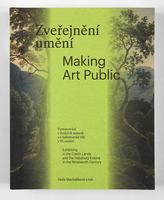
Pavla Machalíková, ed.,
Zveřejnění umění: Vystavování v českých zemích a v habsburské říši v 19. století (Making Art Public: Exhibiting in the Czech Lands and in the Habsburg Empire in the 19th Century).
Artefactum, 2025.
283 pp.; 68 color and b&w images; notes; bibliography; index.
CZK 590 (softcover)
ISBN: 9788053018050
The scholar with a passing interest in Czech and Bohemian art might be forgiven for assuming little had happened before 1900. Such is the dominance of Vienna in the art histories of central Europe—and of modernism—that with just a few exceptions, the nineteenth century lies mostly in the shadows when it comes to the art history of Bohemia and Moravia. This applies both to international literature and to research within the Czech Republic itself. Pavla Machalíková’s volume thus marks an important break from this pattern, and it is part of a welcome recent development. In 2022, the National Gallery in Prague opened a new permanent display, 1796–1918: The Art of the Long Century. This was the first time that this period had been presented thematically; then, in 2024, we saw publication of a major collective monograph, Criticism and the Autonomy of Czech Art (1859–1892).[1] The latter undertook an extensive and detailed examination of the emergence of Czech art and literary criticism in the nineteenth century, which had long been overshadowed by modernism.
Machalíková’s richly illustrated volume continues that process, and it has the advantage of being a dual-language (Czech-English) publication that will make it an invaluable resource for researchers, internationally. As the title indicates, it is a study of exhibitionary practices in the Czech lands during the nineteenth century, but it goes beyond merely documenting exhibitions. It maps out the institutional framework of the art exhibition as an instrument of the evolving public sphere, from aristocratic societies such as the Society of Patriotic Friends of the Arts (founded in 1796) to the Art Forum (Umělecká beseda, established in 1863), which was more thoroughly anchored in bourgeois society. For many decades, the Society of Patriotic Friends was the leading association, and its annual art exhibition, first staged in 1821, dominated and shaped the art world in the following decades, helping to create an art-consuming public. Yet as different contributors to the book demonstrate, the growth of other institutions, such as the Art Forum, art journals, art criticism, the art market, and auction houses, as well as exhibitions organized by private collectors, meant that the narrow circle of noble art lovers who dictated taste at the beginning of the century had become supplanted by a much more diverse audience for art by the end. Two case studies at the end of the volume indicate what this meant. The first is the display of Václav Brožík’s Jan Hus before the Council of Constance (1883; Old Town Hall, Prague), which shows the trial of the reformist cleric Jan Hus in Constance, Germany, in 1415. Due to the exhibitionary infrastructure that had developed in Prague, the painting’s display became a significant public event. The second is the brothers Adolf and Karel Liebscher, whose careers were intimately connected with the illustrated press that flourished at the end of the century.
The story the book tells mirrors in many respects the evolution of the art world in other European states such as France and Britain, except that it took place up to a century later. There were, however, crucial differences. For one, the period that the book covers was marked by factionalism and strife between the German- and Czech-speaking populations. Indeed, the historiography of the culture of nineteenth-century Bohemia has often been blighted by nationalistic narratives that present a whiggish story of Czech cultural ascendance in the face of imperial obstruction, a process symbolized in the tortured process that led to the building of the National Theatre in Prague between 1869 and 1881. Until relatively recently, even international scholars have sometimes internalized that understanding.[2] This book thankfully avoids such narratives, and its contributors recognize the role of Austrian Germans as well as Czech-speakers in the construction of the art world. Indeed, the editor should be commended for challenging the Pragocentric focus of most histories of Czech art and culture. Notably, the volume contains a valuable chapter on exhibitions and institutions in Liberec, the second-largest city in Bohemia, known as Reichenberg under the Habsburg Empire.
This is an important decision, for it emphasizes the significance of regional centers. As its Habsburg name indicates, Liberec was also a largely German-speaking city, and this highlights Bohemia’s multicultural as well as pluricentric character. In keeping with this approach, the book contains chapters on exhibitions, journals, and associations in other regions and centers, such as Moravia and Pressburg (now Bratislava). The former, centered on the cities of Brno and Olomouc, was mostly German in character; indeed, Brno was often referred to as a suburb of Vienna due to its cultural and geographical proximity. Pressburg, in contrast, which was part of Hungary after the Compromise of 1867, was mixed Hungarian and German, with only a very small Slavic-speaking population. When we find these centers included in a book on the “Czech lands,” we are reminded of their cultural complexity, a fact that the contributors to the volume articulate well.
The individual chapters of the book are meticulously researched examples of rigorous scholarship. The book should occupy a highly valued place in scholarship not only on Czech art but also on the art history of Habsburg central Europe more generally. That said, there are several areas where one might have wished the contributors had explored the subject a little further.
In her excellent introduction, Machalíková discusses various conceptual and methodological frameworks that have now become important for museological study. In particular, she points to the way in which, in the wake of Pierre Bourdieu and Michel Foucault, conflicts over the operations and exercise of power have become a central analytical theme. She also alludes to the ways in which exhibitions and art world institutions were used as instruments by social elites to secure or advance their status. It is a pity that many of the contributing authors did not really follow her lead and, instead, limited themselves to factual narratives. Indeed, the existence of “elites,” which several authors mention, is taken as unanalyzed social fact, when this period was one in which new, bourgeois elites sought to assert themselves against the old and claim a place in the cultural field.
Nearly fifty years ago, Carl E. Schorske argued that in Austria-Hungary the imperial court and aristocracy were considerably more successful at retaining control over culture than in neighboring states. The result, he argued, was the bourgeois aesthetic retreat of Secessionism.[3] Yet in Prague, further from the center of imperial power, this seems to have not been the case. Some kind of comparative discussion might have been informative, especially as several contributors refer to the larger Habsburg context. Indeed, while the title makes clear that larger background, it appears to function more as a chronological marker than as an active element of discussion and analysis in the book. The institutions and individuals discussed were active at a time when the Vienna administration was pursuing with some energy a cultural and artistic policy that would bolster official narratives of imperial cosmopolitanism. What impact did this have on art and culture in Bohemia and Moravia? A more extended exploration of this issue would have been welcome, especially as one of the key figures mentioned in the book, Count Leo Thun, a Bohemian aristocrat, was an imperial minister of education in the mid-century, and his mid-century reforms were of no small significance for art education across the Empire.
There is one final issue that one might have hoped to be further addressed. In contemporary France and Germany, the rapid changes in the exhibitionary and institutional landscape of art played a formative role in the development of art. It is a topic that has also been examined in relation to central Europe in, for example, Jeffrey Taylor’s study of the synergistic relationship between the emergence of modernism in Hungary and the evolution of the art market and exhibitions in nineteenth-century Budapest.[4] In this volume, we learn about works that were exhibited and about artists who were successful—and the accomplishments of the Liebscher brothers are linked to the rise of the illustrated press—but we learn little about how the shifting institutions and practices in the Czech lands, along with the new opportunities and impediments that were created, were exploited by or affected artistic practice.
It is important to view such comments in context, however. This volume remains an important publication, for it is the first of its kind. While the exhibitionary culture of the Habsburg Empire has become a subject of growing scholarly interest, it is still rare to find such detailed regional studies that give considerable added depth to larger narratives.
Notes
[1] Martin Hrdina, ed., Kritika a autonomie českého umění (1859–1892) (Akropolis, 2024).
[2] See, for example, Derek Sayer, The Coasts of Bohemia: A Czech History (Princeton University Press, 1998). For an important counter-narrative see Pieter Judson, The Habsburg Empire: A New History (Harvard University Press, 2016).
[3] Carl E. Schorske, Fin-de-Siècle Vienna: Politics and Culture (Alfred A. Knopf, 1980).
[4] Jeffrey Taylor, In Search of the Budapest Secession: The Artist Proletariat and Modernism’s Rise in the Hungarian Art Market (Helena History Press, 2014).