Orientalism: Between Fact and Fantasy
Reviewed by Patricia MainardiPatricia Mainardi
City University of New York
Email the author: pmmainardi[at]gmail.com
Citation: Patricia Mainardi, exhibition review of Orientalism: Between Fact and Fantasy, Nineteenth-Century Art Worldwide 25, no. 3 (Autumn 2026), https://doi.org/10.29411/ncaw.2026.25.3.23.
This work is licensed under a Creative Commons Attribution-NonCommercial 4.0 International License  unless otherwise noted.
Your browser will either open the file, download it to a folder, or display a dialog with options.
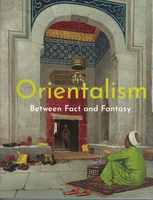
Orientalism: Between Fact and Fantasy
The Metropolitan Museum of Art, New York
June 12, 2026–February 28, 2027 (partial reinstallation in October 2026)
Catalogue:
Deniz Beyazit, Maryam Ekhtiar, and Asher Miller, eds.,
Orientalism: Between Fact and Fantasy.
Yale University Press, 2026.
256 pp., 197 color illus.; notes, bibliography, index.
$40.00 (softcover)
ISBN: 9781588398147
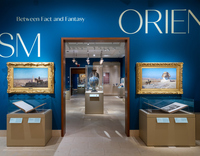
The Metropolitan Museum’s Orientalism: Between Fact and Fantasy marks a new stage in our understanding of this topic so essential to nineteenth-century culture (fig. 1). Its chronological scope is familiar, beginning with Napoleon, but its conclusion is innovative, focusing on the work of the Ottoman painter Osman Hamdi Bey. The standard tropes of sex and violence are all there: exotic costumes, dancing girls, fierce warriors. But what makes this exhibition different is the context within which these familiar images are displayed. Relegated to one gallery out of four, they are thus contextualized and diminished in their central importance to the topic.
The exhibition is accompanied by a lavishly illustrated catalogue that should be required reading for us all. It includes six essays by the three exhibition curators, Deniz Beyazit and Maryam Ekhtiar from the Islamic Collection and Asher Miller from European Paintings. Its introduction states that the exhibition adopts a prismatic viewpoint, treating cross-cultural encounters between Europe, North Africa, and the Middle East. A double-page map in the catalogue (but unfortunately not in the exhibition) entitled “Geopolitical Context of Orientalism 1867–1912” is an inestimable aid in understanding the many different locales included. Each of the four exhibition galleries focuses on a different arena: the dominant importance of the Alhambra in art and design; the dissemination of these visual traditions through the great nineteenth-century international expositions, the art market, and collectors; Western Orientalist painting; and, in the final gallery, the view from within, what we might call “Occidentalism,” or the way the Middle East adopted and adapted Western styles. Ekhtiar’s catalogue essay “Orientalisms?” (17–31) gives a valuable overview of the general background and history of the term orientalism, surveying its development through the foundational writings of Edward Said and Linda Nochlin, to the more recent emphasis on transcultural exchanges. She introduces the exhibition’s premise that there are many varieties of Orientalism, pointing out that the largest collections are now in predominantly Muslim countries and that what the West calls “Orientalism” ranges across three continents, from Greece to North Africa, Turkey to India, each with distinct visual traditions that were often confounded and misidentified in the West. Subsequent essays by Ekhtiar, Beyazit, and Miller open the field to a variety of works and interpretations.
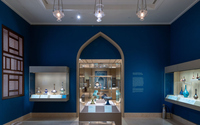
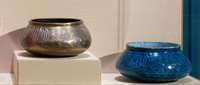
The exhibition design underscores the primacy of the sources rather than their Western adaptations. The collaboration of the Met’s exhibition designer Daniel Kershaw with the show’s curators has resulted in the exhibition’s setting asserting a dominant “speaking” role in the presentation of the objects on display. The many entrances to the exhibition, each of which provides the visitor with a different context for understanding the objects, materializes the exhibition’s widened perspective. The Met’s Orientalist paintings have traditionally been installed at the back end of its European Painting galleries, which abut the Islamic collection; here, the curators have capitalized on that proximity to underscore the interrelationship of the works. Entering the exhibition through either of the two Islamic gallery portals immediately recasts for the viewer the question of who is subaltern here, as thousand-year-old civilizations encounter nineteenth-century imitations and adaptations (fig. 2). On entering from the European Painting galleries, Western culture assumes primacy, and yet even the European Painting galleries have been reinstalled to underscore the interconnectedness of the cultures. The Met’s gallery of small eighteenth- and nineteenth-century landscape sketches, for example, has been rearranged to feature views of Middle Eastern sites flanking that entrance, and the exhibition entrance from the major European Painting gallery is dominated by Jean-Baptiste-Camille Corot’s monumental Hagar in the Wilderness (1835; The Metropolitan Museum of Art, New York), now displaying a new wall label informing us that Hagar’s son Ishmael is regarded as one of the Patriarchs of Islam. A more subtle, though insistent, note is struck by the wall color throughout the exhibition, a color that the French designer Joseph-Théodore Deck called Persian Blue and attempted to reproduce in his own work (fig. 3). This deep blue-green color reappears throughout the exhibition—in ceramics, in architecture and design illustrations, in textiles, and in paintings—always echoing the wall color and functioning as an enclosing environmental note that reminds the viewer of the ultimate source of the objects on display. In this way, it reverses the unconscious bias of prioritizing Western “Orientalism” over its sources that Western viewers might bring to the exhibition.
The main entrance to the exhibition is through the Islamic collection, its portal framed by two Jean-Léon Gérôme paintings: Napoleon in Cairo and Napoleon before the Sphinx (see fig. 1). The curators’ decision to install Napoleon’s vision of Cairo on the viewer’s left and Napoleon regarding the sphinx on the right, seems a prophetic warning of the doom of his Egyptian campaign, shades of Percy Bysshe Shelley’s poem “Ozymandias” (1818). The implications would have been very different were we to first see Napoleon regarding the sphinx and then proceeding to the capital city he occupied.
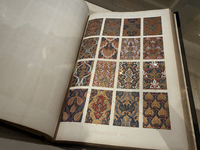
The first of the exhibition’s four galleries is dedicated to the Alhambra, the thirteenth-fourteenth century Nasrid Palace and fortress complex in Granada, Spain. In her catalogue essay, “Hard and Soft Power: Orientalism and Design” (61–79), Beyazit discusses the Alhambra as the gateway to Orientalism, a site that attracted nineteenth-century European and US tourists long before they dared to make the longer voyage to the Eastern Mediterranean and North Africa. The brilliant color and intricate design that so attracted Europeans can be seen in an original polychrome panel from the Alhambra’s summer palace that is juxtaposed with an architectural design model created in the later nineteenth century by Rafael Contreras, the architect Queen Isabella II hired to restore the Alhambra complex (fig. 4). Western architects looking for an alternative to Classical, Medieval, and Baroque styles were fascinated by the Alhambra’s architectural features and intricate design elements. This is apparent in the numerous photographs, prints, and objects displayed. Not only architects but designers and craftsmen as well strove to master Middle Eastern aesthetics and techniques. In the center of the Alhambra gallery, Owen Jones’s monumental and influential Grammar of Ornament (1856) lies open to a page offering numerous variations of “Moresque” design, which Jones saw as a buttress against what he called the “age of ugliness” (fig. 5). Nearby, a video, “The Global Alhambra,” demonstrates the palace complex’s lasting international appeal, showing its progeny throughout the world of mosques and synagogues, government buildings, and private dwellings.
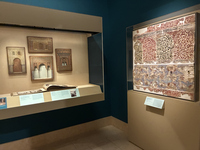
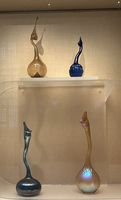
An alternate entrance to the Alhambra gallery is through the Persia/Iran collection in the Islamic Wing, its portal leading directly to the second focus of this gallery, a display of nineteenth-century European and US design objects juxtaposed with the works in glass, ceramics, and metal that inspired them (see fig. 2). This sets up a potent contrast between the older traditions and the arriviste Europeans and Americans who labored mightily to reproduce their forms and glazes. A particularly impressive display is of the traditional swan-neck “tear-catcher” bottles from Iran that inspired those later produced by Tiffany (fig. 6). Beyazit emphasizes this in her “Hard and Soft Power” essay, noting that in this arena roles were reversed with Europeans and Americans becoming acolytes of the architects, weavers, glass blowers, ceramists, and metalsmiths who inspired them.
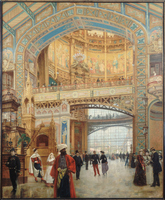
A smaller gallery adjoining the Alhambra area is dedicated to the roles of dealers and the century’s great international expositions in promoting the exchange of objects and designs. Pride of place here is given to Louis Béroud’s enormous Central Dome of the Gallery of Machines at the Exposition Universelle of 1889 (fig. 7). Béraud depicts Europeans, both urbanites and provincials, as well as men in Eastern dress, all promenading within the impressive interior space of that historic building. This gallery, as well as several of the catalogue essays, underscores the importance of these international events that not only attracted international travelers, but also led directly to the exchange of materials, techniques, imagery, and design. Well-to-do Middle Easterners traveled West to visit them just as their European and American counterparts traveled East. While European and US pavilions featured displays of modernization, Islamic pavilions, by contrast, showed their finest works of traditional design, many of which were sold after the expositions and entered major Western collections. This gallery has a jumble of such works, as befits the theme of galleries and fairs. Edward Said’s book Orientalism is on display, its cover reproducing Gérôme’s masterpiece of voyeurism, The Snake Charmer, displayed nearby (fig. 8). Dealers, in particular Albert Goupil, facilitated the market for Orientalist objects; his importance is demonstrated here by the splendid Salting carpet and military helmets that he sold to Gérôme, who used them to add authenticity to specific paintings that are also included in the exhibition (see fig. 8). Visitors to these grand events came for both inspiration and for acquisition: a nearby video, “Orientalist Interiors,” shows the homes of Westerners including Emile Zola, Frederic Edwin Church, and Doris Duke that strove to recreate a generalized “Orientalist” ambiance.
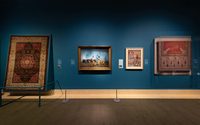
This melding of many distinct cultures into the singular Western concept of Orientalism is addressed by Ekhtiar in her essay “Persomania” (125–45). Persia (renamed Iran in 1935) was seen by the West as heir to the great ancient and biblical civilizations, with Persians considered more closely related to Europeans than Arabs and their art, therefore, more highly valued. As a result, the label Persian was regularly applied to very different civilizations, gradually subsuming all the art and design produced throughout a vast geographic area. This is underscored by a display in the art market gallery of a sheet from the celebrated Mughal Indian manuscript, the Hamzanama (Book of Hamza), which was exhibited as “Persian” in the Persian pavilion of the 1873 Vienna International Exposition and subsequently acquired and catalogued as “Persian” by the Vienna Museum of Applied Arts (see fig. 8).
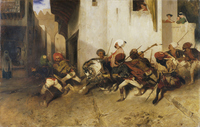
The third gallery, entitled “Facing the Orient,” features Orientalist paintings—mostly French and familiar to art historians and even to the general public. All the major Orientalists and themes are there, represented by Emile Jean Horace Vernet, Anne-Louis Girodet de Roucy-Trioson, Eugène Delacroix, Jean Auguste Dominique Ingres, Gérôme, Gabriel Alexandre Decamps, et alii. The works displayed offer a mix of what we might expect (sex and violence, exotic costumes, colonialism) but with the addition of other works that encourage us to reconsider these stereotypes. In his essay “Near and Far: Facing the Orient from Napoleon I to Napoleon III” (33–45), Miller has the unenviable task of discussing the traditional Western predilection for these scenes. He does so admirably by inserting nuance wherever possible. Decamps’s huge painting The Turkish Patrol (fig. 9), for example, offers, on closer inspection, a variety of racial types, both Middle Eastern and African, their clothing varying by region; some women, obviously Muslim, are veiled, others, probably Christian, are not. Despite the violent nature of the scene, it actually offers a more accurate rendition of the populace than do most Orientalist paintings. Miller’s analysis of the period from 1798 to 1870 is mapped directly onto the images on display: many of the Mameluke warriors, exiled from Egypt after 1801, relocated to Paris and then, inevitably, appeared in paintings along with other colorful Eastern types like the Bashi-Bazouks, the Ottoman army’s irregular forces. With the Greek War of Independence (1821–29), Greece was largely subtracted from the Western concept of Orientalism and grafted onto Europe. After 1830 and the French colonization of Algeria, many artists—Delacroix is the major figure here—traveled to North Africa rather than to the Eastern Mediterranean.
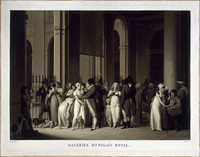
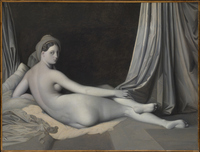
In a brilliantly sly move, the curators installed Louis Leopold Boilly’s grisaille painting, Galeries du Palais-Royal, directly opposite Ingres’s grisaille, Odalisque (figs. 10, 11). Ingres invites us to regard an Orientalized female nude seductively posed, while Boilly depicts a scene that took place daily in the courtyard of the Paris Palais-Royal, where prostitutes and their clients “did business.” But while we are regarding the voluptuous wares on offer here (Boilly has thoughtfully spot-lit them for our delectation), we might not immediately notice that, off to one side, an Ottoman man regards, with interest, the curious customs of these natives. As an uber-sly move, the curators installed Horace Vernet’s Portrait of a “Mamelouk” immediately adjacent to the Boilly (fig. 12): its figure is identically dressed, his steady stare engaging visitors as we alternately regard the Parisians in the Palais-Royal or his compatriot observing them. The juxtaposition offers a highly complex set of interactions that could serve as a metaphor for the entire exhibition.
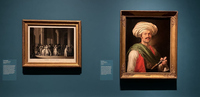
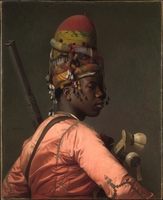
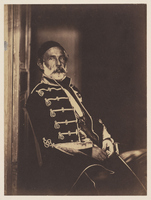
Three paintings in this gallery depict Bashi-Bazouks in their colorful costumes. Miller’s second catalogue essay, “Jean-Léon Gérôme’s Bashi-Bazouk: A Painting and Its World” (147–61), focuses on one of these paintings, Gérôme’s three-quarter view Bashi-Bazouk (fig. 13). Unlike other renditions of the subject, this painting dwells in the interstices of portraiture and genre painting, very different in tone from Charles Bargue’s A Bashi-Bazouk, exhibited nearby (fig. 14). Nonetheless, the placement of these paintings on either side of Roger Fenton’s photograph of Omar Pasha, the contemporaneous Commander of the Ottoman regular forces, in his military uniform, reinforces the Fact and Fantasy of the exhibition’s title (fig. 15).
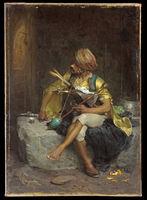
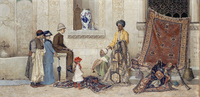
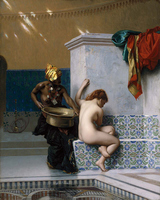
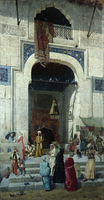
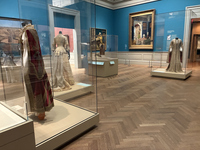
The final gallery of the exhibition, when entered through the Islamic wing (or its first gallery if entered through European Paintings), is dedicated to the Ottoman artist Osman Hamdi Bey, whose life and works are emblematic of this exhibition’s enterprise and his position within it. Beyazit’s essay “Osman Hamdi Bey: Depicting the Orient as an Insider” (175–87) states it succinctly: “Osman Hamdi Bey was a nineteenth-century Renaissance man: the first Ottoman director of the Imperial Museum, an administrator of archaeological excavations and antiquities, and a modern promoter of Ottoman culture within the empire and abroad” (175). The son of an Ottoman administrator whose own family had been massacred in the Turkish attack on Chios and who had then been adopted into a high-ranking Ottoman family, Hamdi was sent to Paris as a young man to study law in expectation that he would follow his father into a government career. Instead, he joined the studio of Gustave Boulanger as an aspiring young painter and went on to exhibit both in Paris Salons and Universal Expositions. Back in Constantinople, he balanced his career as a painter with a variety of official positions, eventually becoming the overseer of scholarly excavations throughout the Ottoman Empire. His paintings avoid the spatial depth of his Western artistic milieu and are instead reminiscent of Eastern models in their decorative flatness. He depicted domestic scenes of Ottoman family life, off limits to European artists, as well as realistic interchanges between Westerners and Middle Easterners, as in his Turkish Street Scene (fig. 16). What he eschewed, however, was the imagery of sex and violence, the staple of so many Orientalist painters. This contrast is heightened by the inclusion in this last gallery of several stereotypes of Orientalism—Gérôme’s Moorish Bath, for example, with its play on the delectable nudity of black and white female flesh (fig. 17) and Jean-Joseph Benjamin-Constant’s Scene in a Harem (1876; The Metropolitan Museum of Art, New York), a motif that was always a crowd pleaser for Western audiences. Unlike Orientalists whose scenes sought to invoke timeless “pre-contact” periods, with Western presence occluded, Hamdi depicted his own period of international crosscurrents. His At the Mosque Door shows Ottoman women in Western dress, some veiled but with bustles and parasol, standing among other figures in traditional dress (fig. 18). Following out the cultural cross-current theme, this gallery also exhibits a range of costume: a woman’s traditional Balkan wedding ensemble, a Parisian dress “orientalized” by the addition of decorative Islamic calligraphy, and an entari, the traditional robe worn by upper-class Ottoman women, here “occidentalized” by the addition of pockets (fig. 19).
By redefining cultural appropriation and conquest as intercultural encounters, the curators attempt to remove its byproducts from our contemporary culture wars. They focus instead on the visual results of intercultural contact: Orientalism in the West, Occidentalism in the East. These two dynamics were not actually parallel because of colonial power imbalances, but the exhibition nonetheless allows us to understand their interdependence and mutual attraction. While the West mourned the disappearance of traditional crafts and customs with the rise of the modern era, the East was attracted to that same modernity. Certainly, the rise of feminism in the West throughout the nineteenth century heightened the European obsession with harems, and the European shift from rural to urban masculine roles nurtured European fascination with these Eastern scenes of colorful and primitive male power and violence. The East also gained from this exchange: by the nineteenth century, traditional arts and crafts were dying out, at risk of disappearing, but the West’s interest resulted in their renewal, which became a source of cultural identity, national pride, and even an economic benefit to Middle Eastern economies. What the curators and designer of this exhibition have shown us is that cultural exchange is never simple, never a one-way street. And for that we thank them.