Potrzeba trwania. Zbiory ikonograficzne na ziemiach polskich w XIX wieku (The Need for Continuity. Iconographic Collections in the Polish Lands in the 19th Century) by Kamila Kłudkiewicz
Reviewed by Tomasz F. de RossetTomasz F. de Rosset
Uniwersytet Mikołaja Kopernika w Toruniu (Nicolaus Copernicus University in Toruń/Poland)
Email the author: tfrosset[at]umk.pl
Citation: Tomasz F. de Rosset, book review of Potrzeba trwania. Zbiory ikonograficzne na ziemiach polskich w XIX wieku (The Need for Continuity. Iconographic Collections in the Polish Lands in the 19th Century) by Kamila Kłudkiewicz, Nineteenth-Century Art Worldwide 25, no. 3 (Autumn 2026), https://doi.org/10.29411/ncaw.2026.25.3.11.
This work is licensed under a Creative Commons Attribution-NonCommercial 4.0 International License  unless otherwise noted.
Your browser will either open the file, download it to a folder, or display a dialog with options.
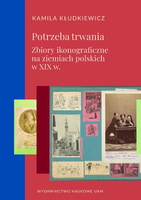
Kamila Kłudkiewicz,
Potrzeba trwania. Zbiory ikonograficzne na ziemiach polskich w XIX wieku (The Need for Continuity. Iconographic Collections in the Polish Lands in the 19th Century).
Wydawnictwo Naukowe Uniwersytetu im. Adama Mickiewicza, 2025.
670 pp.; 167 color illus.; index; notes.
90 PLN (hardcover)
ISBN: 9788323244882
Kamila Kłudkiewicz’s book constitutes a significant contribution to the study of historical visual culture, particularly to the history of collecting in the Polish lands, with its implications extending to European cultural history more broadly. The volume is devoted to iconographic collections assembled during the long nineteenth century. These are understood here as collections of prints and drawings, later expanded to include photographs. Selected primarily according to their subject matter, these works encompass virtually every category of image “depicting historical monuments, works of art, decorative arts, portraits of historical figures, landscapes, and folk types and artifacts” (7). Although such collections occasionally included genuine graphic works by the Old Masters, they consisted predominantly of images of varying quality and character, produced by nineteenth-century artistic and reproductive techniques, including drawings, engravings, sketches, prints, newspaper illustrations, postcards, and photographs. Together, these materials formed a visual documentation of cultural heritage in its broadest sense—of cities, regions, and nations. In this respect, they functioned above all as visual representations.
The book is important for two main reasons. First, it identifies and offers a penetrating analysis of this neglected collecting phenomenon, a subject that has hitherto occupied only a marginal place in historical scholarship. Second, it examines a period that may justifiably be regarded as the beginning of the “age of the image,” in which visual representation gradually became one of the defining features of modern visual culture. Drawings and prints—the principal objects of the author’s analysis—are almost automatically associated with the realm of art. Consequently, as objects of collecting they have generally been studied from the perspective of the collected artifacts themselves, with the emphasis on their aesthetic qualities, formal characteristics, technical virtuosity, and symbolic content. Kłudkiewicz adopts a markedly different perspective. Rather than treating aesthetic value as the primary criterion, she demonstrates that iconographic collections were shaped primarily by subject matter and documentary value.
Viewed solely from an aesthetic perspective, iconographic collections appear to be of only limited significance. This largely explains why they have occupied a rather marginal position in scholarship so far. As Kłudkiewicz argues, studies devoted to them as an autonomous collecting phenomena remain rare in both Polish and international historiography and, when they do exist, they tend to focus on selected aspects rather than offering a comprehensive and systematic account. By contrast, she treats this collecting practice as a coherent historical phenomenon. In doing so, it effectively shifts the focus of collecting studies, which have traditionally concentrated on collections of original works of art or historical memorabilia and natural specimens. It demonstrates that collections of images and reproductions also played a crucial role and served important cognitive functions in the nineteenth century. Although these collections grew out of the early modern tradition of assembling artistic drawings and prints, they gradually evolved into documentary repositories intended to record and organize knowledge about the cultural heritage.
Moreover, Kłudkiewicz emphasizes how the growing availability of prints and illustrations during the nineteenth century shaped the formation of iconographic collections. The development of graphic, reproductive, and later printing technologies initiated a process culminating in today’s image-saturated culture. The spread of lithography, steel engraving, wood engraving, photomechanical reproduction, and photography made images accessible to ever broader sections of society and transformed them into an increasingly ubiquitous component of visual culture. As a result, images began to be systematically collected, classified, and employed for a wide variety of purposes. As Kłudkiewicz demonstrates, this practice was no longer confined to connoisseurs and art collectors but spread across virtually all social groups, from aristocrats and scholars to craftsmen, clergy, and cultural institutions.
Drawing on extensive archival research and a wide range of published sources, Kłudkiewicz identified and analyzed approximately one hundred such collections and, in the course of her work, uncovered evidence of several dozen more. It should be added, however, that a complete inventory of these collections (now impossible to reconstruct) would undoubtedly have been larger. This exceptionally rich evidential base enabled Kłudkiewicz not only to reconstruct individual collections but also to identify broader patterns in their formation, development, and use. The geographical scope of the study, defined as the Polish lands, nevertheless requires some explanation. During the nineteenth century, the territory of the multiethnic Polish-Lithuanian Commonwealth was divided among the three partitioning powers: Russia, Prussia, and Austria. It was inhabited not only by Poles, Lithuanians, Ukrainians, Belarusians, Germans, and Jews, but also the institutions of the partitioning states who also played an active role. To provide a comprehensive account of the phenomenon, Kłudkiewicz therefore extends her analysis to the activities of representatives of these communities and their institutions as well.
The book’s subject matter, however, has a distinctly European dimension. The phenomena it examines form part of broader nineteenth-century developments, including the advancement of reproductive technologies, the democratization of access to images, the emergence of art history as an academic discipline, the development of museums, and the growing interest in national and regional heritage. In this respect, the monograph constitutes an important contribution to the study of nineteenth-century European visual culture. At the same time, one is left with a certain sense of incompleteness, as the discussion might have benefited from more extensive comparisons with collecting practices elsewhere in Europe.
The phenomenon of iconographic collections in the Polish lands is examined thoroughly and from a wide range of perspectives across the book’s eight chapters. In the introduction, Kłudkiewicz outlines the methodological assumptions underpinning her study and discusses the use of the term iconography in the contexts of art history, print collections, and collecting practices, relating it to the terminology employed in the nineteenth century (such as collections historiques and topographical collections). The subsequent chapters explore the principal aspects of the phenomenon within the broader context of the intellectual culture of the nineteenth-century Polish lands. In doing so, they address a series of fundamental questions: Who collected iconographic material, and what kinds of collections emerged from these activities? What types of images were collected, and what subjects did they depict? What was the material nature of these objects, and by what techniques were they produced? How were such collections formed, and how did they function socially, in terms of the art market and networks of collectors? According to what principles were they classified and organized? Finally, what purposes did iconographic collections serve, and wherein lay their broader historical and cultural significance? The book is carefully structured so that its successive chapters move from concrete historical examples, through thematic and methodological analyses, to a broader interpretation of the cultural role of iconographic collections. As a result, the individual case studies provide the foundation for a synthesis of nineteenth-century collecting practices and visual culture.
The analysis opens with studies of the collecting activities of ten individuals, supplemented by references to other collections and their creators. They are selected to illustrate the principal types of iconographic collections and the major functions they fulfilled in the nineteenth century, while at the same time introducing the main themes developed in the subsequent chapters of the book.
The discussion begins with early antiquarian collections, represented by Princess Izabela Czartoryska (née Fleming) and Ambroży Grabowski. These reveal both the origins of the phenomena under discussion and the characteristic coexistence, during the first half of the nineteenth century, of images and texts (including autographs) within albums and separate portfolios. The example of Józef Ignacy Kraszewski, in turn, demonstrates the transition from the antiquarian practice of gathering materials to more systematically organized collections designed to support scholarly research and publishing activities in which prints functioned as repositories of historical and cultural knowledge.
The subsequent case studies reveal the broad social reach of this form of collecting, ranging from aristocratic libraries (e.g., the Branicki family’s at Sucha and the Potocki family’s in Krzeszowice), through private commemorative albums (e.g., of Maria Celestyna Boczkowska), to the research collections of historians and scholars such as Zygmunt Gloger, Józef Łepkowski, Michał Federowski, and Stanisław Tomkowicz. Władysław Bartynowski’s collection, in turn, documents the results of his publishing experiments.
A separate category is formed by documentary collections intended to serve as visual records of monuments, works of art, and source materials for research and educational purposes in libraries, museums, learned societies, and university institutions. Particularly noteworthy is the collection of Dominik Witke-Jeżewski, which occupies the boundary between a collection of artistic prints and an iconographic collection, while at the same time documenting Poland’s artistic heritage. Finally, Bronisław Gębarzewski’s Iconographic Archive illustrates the evolution of such collections into modern documentary resources supporting scholarship, museum practices, and publishing—resources that acquired particular importance during World War I and the reconstruction of the Polish state.
An important complement to this part of the book is the Appendix, which presents forty-five collections in the form of a catalogue. The result of meticulous research, archival and otherwise, it provides concise descriptions of individual collections while substantially expanding the comparative material upon which the author’s broader conclusions are based. At the same time, the catalogue constitutes a valuable research tool whose significance extends beyond the interpretative framework of the book itself.
One of the principal issues requiring interpretation is the diverse content of iconographic collections. In the following chapter, the author identifies a set of themes that recur in nearly all iconographic collections: portraits (of rulers and historical figures), saints, views, landscapes, and monuments (including architecture, tombs, and memorials) as well as folk costumes and ethnic types. Taken together, these may be understood as different aspects of cultural heritage relating to “a shared history (heroes), its material remains (monuments), the surrounding landscape, and common folk roots” (171)—elements that acquired increasingly strong national significance over the course of the nineteenth century.
Kłudkiewicz reconstructs the origins of these individual categories of images and traces the changing functions they fulfilled. Portrait collections possessed the longest tradition, deriving from the early modern model established by Paolo Giovio’s Musaeum and flourishing in the eighteenth and nineteenth centuries through the expansion of reproductive printmaking when portraits served primarily educational and cognitive purposes. Collections of saints, views, landscapes, and monuments followed a comparable trajectory. During the nineteenth century, they became increasingly oriented toward documenting national and regional heritage, a development encouraged by the proliferation of illustrated publications and the widespread practice of cutting out and assembling printed reproductions. A distinct category was formed by representations of the common people, a relatively recent field of collecting that emerged only at the turn of the nineteenth century. Initially, collectors focused on intangible cultural heritage, but their interests gradually expanded to include folk costumes, ethnic types, and other aspects of material culture. The remaining categories of images reflected primarily the individual interests of collectors or their scholarly specializations. Considered as a whole, iconographic collections reveal an ambition to document cultural heritage as comprehensively as possible through images.
By bringing together portraits, monuments, landscapes, religious representations, ethnographic material, and many other categories of imagery, iconographic collections became distinctive visual archives of the past. In this respect, Kłudkiewicz convincingly demonstrates that their significance extended far beyond the aesthetic dimension of print collecting, revealing their role as instruments of documentation, memory, and knowledge.
The next part of the book explores the ideological principles that governed the selection of images. While the thematic structure of iconographic collections remained relatively stable throughout the period under consideration, the meanings ascribed to the collected images underwent significant change. Kłudkiewicz convincingly demonstrates how, over the course of the nineteenth century, these themes became increasingly subordinated to the ideas of the nation, transforming iconographic collections into instruments for documenting and shaping collective identity. To explain this process, she provides a concise overview of the European and Polish debates surrounding the concept of the nation. Under the conditions of the partitions, the Polish national community was initially understood primarily in terms of a shared history, language, and cultural heritage, rooted in the historical homeland. Over time, however, partly in response to changing historical circumstances, ethnic criteria assumed growing importance. This transformation was directly reflected in the content of iconographic collections, which focused predominantly on documenting Polish history, art, religion, and folk culture, while paying considerably less attention to the heritage of the other nations and ethnic groups of the former Polish-Lithuanian Commonwealth. The author also points out that a second important principle shaping the selection of images was regionalism, reflecting an interest in the “little homeland” and its cultural heritage.
In the following two chapters, Kłudkiewicz examines the availability of illustrations in the nineteenth-century Polish lands, together with the material and social conditions governing their circulation. A separate chapter is devoted to reproductive techniques, focusing less on their technological characteristics than on the ways in which the images they produced functioned in practice. She demonstrates how advances in reproductive processes, combined with the expansion of inexpensive, large-scale printing, created the conditions for the emergence and development of iconographic collections. Particular emphasis is placed on the steadily increasing number of impressions and their repeated appearance in a wide range of publications, developments that greatly enhanced the accessibility of images. Modern graphic technologies—including lithography, wood engraving, and photomechanical processes—together with the rapid growth of publishing, books, and the illustrated press, therefore played a decisive role in the formation of these collections. They provided collectors with either autonomous prints or illustrations cut from contemporary periodicals, such as Przyjaciel Ludu, Tygodnik Ilustrowany, and Kłosy, which were then mounted in specially prepared albums. Kłudkiewicz also considers the phenomenon of photography. Although it attracted considerable interest as a modern medium, photographs were incorporated into iconographic collections only exceptionally, perhaps because of their high cost, technical limitations, or limited durability. She further discusses the place of drawings, watercolors, and early Polish prints. While these frequently coexisted with iconographic collections assembled by the same collectors, their inclusion within this category—except where they had been commissioned specifically for documentary purposes—remains not entirely resolved.
A natural complement to these considerations is the analysis of the market for prints and illustrations. Kłudkiewicz demonstrates that the availability of iconographic material depended not only on advances in reproductive technologies but also on the organization of its circulation. The author examines the print market in the Polish lands, the availability of prints through bookshops and the antiquarian trade, publishing activity, and the importance of the personal networks connecting collectors, publishers, and print dealers. She also highlights the exchange of duplicate prints, collectors’ correspondence, and the specialist press, all of which contributed to the networks through which prints circulated and facilitated the formation of iconographic collections. Taken together, these two chapters offer a coherent account of the material and social conditions underpinning nineteenth-century visual culture and the mechanisms through which images were disseminated.
The next issue addressed in the book concerns the classification and cataloguing of collections. Because these collections belong to the broader domain of printmaking, Kłudkiewicz draws attention to the coexistence of two distinct principles of collecting in this field. On the one hand, prints were regarded as aesthetic objects and arranged according to the names of artists and artistic schools; on the other, they were organized according to their subject matter. In the Polish lands, this gave rise to two complementary criteria for collecting: the authorship of works by Polish printmakers and the representation of subjects relating to the history and culture of Poland. In some instances, both principles coexisted within the same collection, as in the case of Dominik Witke-Jeżewski.
The chapter begins by outlining the general principles of print cataloguing, discussing several European and Polish systems, including those developed by Karl Heinrich von Heineken, Jan Feliks Piwarski, and Hieronim Wilder. Kłudkiewicz also reviews several commonly employed methods of classification, based on alphabetical, chronological, and topographical arrangements, as well as the principles used to organize one of the most widespread categories of collections: portrait prints. She then turns to the origins and thematic systematics characteristic of iconographic collections, demonstrating their dependence on broader principles of classifying other types of collections and on the cataloguing practices employed in libraries for organizing book collections and classifying knowledge.
Finally, she points to the need, recognized at the beginning of the twentieth century, for new systems capable of organizing the rapidly expanding body of human knowledge. This applied both to new bibliographical systems and to the extension of the concept of iconography to encompass the full range of human activity. Among the most important attempts to address these challenges were the decimal classification system developed by the American librarian Melvil Dewey and the bibliographical work of the Belgian scholar Paul Otlet.
From the perspective of the book’s overall structure, this chapter might have been placed more effectively alongside the discussion of the content of iconographic collections. Moreover, it does not fully clarify how, in nineteenth-century Polish collecting practices, connoisseurship of artistic prints differed from the formation of iconographic collections organized according to the subject matter of images. Although Kłudkiewicz returns to this issue on several occasions, so that the distinction ultimately becomes clear, the overall structure of the book would have been more convincing had these considerations been brought together in a single, more coherent discussion.
One of the book’s most significant contributions is its analysis of the social functions of iconographic collections and the role they played in the private and professional lives of the inhabitants of the nineteenth-century Polish lands. According to Kłudkiewicz, iconographic collections served three principal purposes. They belonged to the sphere of leisure and entertainment, they functioned as means of acquiring and organizing knowledge, and, from the second half of the nineteenth century onwards, they increasingly formed part of specialized scholarly practice. In the first instance, they were part of the “leisure culture” of the aristocracy, landed gentry, and urban intelligentsia, which included the quasi-ritual practices of sorting, classifying, cutting out, and mounting prints in albums, much as embroidery, music-making, or newspaper reading structured other forms of domestic leisure. Contemporaries viewed this form of activity in an unequivocally positive light, considering it both enjoyable and intellectually beneficial. As Kłudkiewicz shows, collections of illustrations functioned as instruments of self-education. They provided visual material for the compilation of private compendia of history or art history and served as valuable resources for genealogical, heraldic, and numismatic research.
After the mid-nineteenth century, however, the growing specialization of scholarship brought about significant changes in the character of iconographic collections and ultimately led to the gradual disappearance of their traditional form. The professionalization of academic research and the emergence of new disciplines—such as art history, ethnography, anthropology, and prehistory—gave rise to specialized iconographic collections assembled by individual scholars and academic institutions. At the same time, methodological changes transformed the ways in which visual material was used, challenging its status as a fully fledged historical source. As a result, amateur collections with their traditionally broad thematic scope were increasingly marginalized, losing much of their scholarly standing and the authority associated with it, and gradually coming to be regarded as obsolete. The book could offer more about the relationship between iconographic collections and other areas of collecting—above all painting—comparable to that offered for their relationship with scholarship.
The book concludes by interpreting these collections as a response to the nineteenth-century experience of transience and rapid social and cultural change. Kłudkiewicz demonstrates that these collections arose not only from a fascination with the past but also from a desire to preserve the contemporary world, perceived as fragile and threatened by the destructive forces of modern transformation. Paradoxically, although they consisted mainly of products from the current graphic market, they mostly documented history, older objects, monuments and memorials, as well as important figures from the past. In this way, the nineteenth-century present was continually constructed from elements of the past, while iconographic collections became instruments for preserving the memory of a world undergoing irreversible change.
Kłudkiewicz links this attitude to the widespread European concern with the inventorying and documenting of historical monuments. In the Polish lands, it first found expression in the nineteenth-century antiquarian movement, then in the documentary activities of private individuals and scholarly and cultural associations, and finally, toward the end of the century, in the work of conservation commissions and heritage offices. The visual documentation of historical monuments—through drawings and prints and later photography—possessed not only scholarly value but, above all, sought to preserve their image against the ravages of time, war, and the advance of civilization. In the Polish context, this impulse was further reinforced by the experience of the loss of statehood and the determination to preserve the material remains of the former Polish-Lithuanian Commonwealth. Viewed from this perspective, iconographic collections emerge as an expression of a distinctly nineteenth-century historical consciousness, one that combined nostalgia with an attentive observation of the present. The preservation of images served not only to commemorate the past and anchor it in the present, but also to preserve a world that was itself receding into the past.
In conclusion, it is worth emphasizing once again that this monograph is an important contribution, and the shortcomings outlined above do not detract from its overall value. It brings to light a field of collecting that has so far attracted only limited scholarly attention and has generally been regarded as being of secondary significance. Yet this form of collecting may in fact have been more widespread than the highly esteemed elite practice of art collecting. More importantly, the book is not merely a study of one aspect of collecting in the Polish lands; it illuminates a pivotal moment in the emergence of a modern mode of image making and image use within culture. Its central argument is that iconographic collections served above all to preserve cultural memory. As Kłudkiewicz demonstrates, collectors sought to preserve images of a disappearing world, document national and local heritage, create visual archives of the past, and safeguard knowledge of earlier times for future generations. The “need for continuity” of the title thus refers to the aspiration to ensure the continuity of cultural memory through images. Kłudkiewicz successfully combines meticulous source-based research with a broad synthetic interpretation of nineteenth-century visual culture. Consequently, the monograph is far more than a catalogue of collections or a series of case studies; it offers a coherent and compelling interpretation of an important cultural phenomenon.
AI Disclosure Statement
The English translation was prepared with the assistance of ChatGPT-5.5, OpenAI, July 12, 2026, and subsequently reviewed and edited by the author.