Rodin’s Dancers: Art and Performance in Belle Époque Paris by Juliet Bellow
Reviewed by Jessie AlperinJessie Alperin
University of Chicago
Email the author: alperinj[at]uchicago.edu
Citation: Jessie Alperin, book review of Rodin’s Dancers: Art and Performance in Belle Époque Paris by Juliet Bellow, Nineteenth-Century Art Worldwide 25, no. 3 (Autumn 2026), https://doi.org/10.29411/ncaw.2026.25.3.8.
This work is licensed under a Creative Commons Attribution-NonCommercial 4.0 International License  unless otherwise noted.
Your browser will either open the file, download it to a folder, or display a dialog with options.
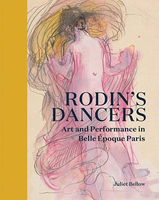
Juliet Bellow,
Rodin’s Dancers: Art and Performance in Belle Époque Paris.
Yale University Press, 2025.
256 pp.; 105 color illus.
$60.00 (hardcover)
ISBN: 9780300275162
Given the scale of Auguste Rodin’s sculptural oeuvre, readers may initially be surprised by the relatively limited attention paid to physical sculpture in Rodin’s Dancers: Art and Performance in Belle Époque Paris. Breaking from traditional monographs on Rodin’s large-scale work, Juliet Bellow brings his persona, artwork, and archive into conversation with art history and performance studies at the intersection of artistic media. Through case studies devoted to Loie Fuller, the Cambodian Royal Ballet, and Vaslav Nijinsky, Bellow demonstrates how dancers offered Rodin more than new subjects to depict. The dancers’ explorations of space, light, gravity, stillness, and movement prompted Rodin to reconsider the possibilities of sculptural form, while the dancers’ reception provided models for negotiating the increasingly fraught relationship between modern art and its publics. Central to Bellow’s argument is her rejection of influence as a one-way process. Rather than presenting dancers as passive muses for the sculptor, she reconstructs a dialogical exchange in which sculpture and dance mutually shaped one another. Rodin’s Dancers offers a methodological toolkit for future scholars of the growing field of intermedial aesthetics. Bellow not only models collaborative exchange but also demonstrates how to hold on to the tension of a mutually transformative relationship among artistic media and to the unequal power dynamics that inevitably shape such exchanges.
In Rodin’s Dancers, Bellow argues that dance allowed sculpture to reinvent itself, not as immobilized form, but as a mode of interrogating the medium’s association with traditional figuration and monumentality to create dynamic objects that resist fixity. Turning toward photography, drawing, exhibition design, and small-scale casts, she demonstrates that this reconsideration permeated the very process of sculptural making and display, rather than simply its finished forms. Just as dance helped Rodin experiment with sculpture, dancers in Belle Époque Paris turned to Rodin, and sculpture more broadly, to help legitimize dance as a high art instead of a commercial spectacle. Looking toward modern sculpture, dancers developed new modes of figural expression in which abstraction, stasis, and isolated movements became a part of their choreographic vocabulary.
Bellow is equally attentive to the ethical dimensions of her subject matter: Rodin’s artistic persona, built upon ideals of individual genius, combined with the ephemerality of dance often erases the individuality of the dancers who inspired his work, subsuming their labor into the construction of his own celebrity. Rather than reproducing that erasure, Bellow actively asks what Rodin’s art can tell us about the dancers themselves and about dance as an equally pivotal and important art form at the turn of the century. Throughout the text she carefully attends to the hierarchies of medium, gender, sexual orientation, race, and nationality that framed these encounters, asking how dancers experienced their interactions with Rodin and how their involvement shaped the process and results of his work.
Making these recoveries possible is Bellow’s turn to novel archival methods and performance archaeologies, through which she reconstructs perspectives that more conventional monographic approaches would have left invisible. Bellow is acutely aware that our access to the dancers is mediated by Rodin and his transformation of them into artwork. When turning to the dancers themselves, she attends carefully to their own archives, contexts, and practices alongside his. For example, in the second chapter, Bellow looks to documents from the Cambodian court originally written for a Khmerophone audience to expand her analysis beyond colonial accounts (105). Her thorough visual analysis draws attention to the relationship between Rodin and each dancer and to what she terms the relational practice between performer and spectator. Paired with her archival attentiveness, she deploys performance archaeology, or embodied research, to reconstruct the dancer’s position within their movements and poses. To further understand the relationship between the poses in Rodin’s drawings of Cambodian dancers and the original performances, Bellow consulted with Lucie Labbé, an anthropologist familiar with the Cambodian ballet. Together, they correlate the drawn postures with basic movement phrases and balancing poses (128). Bellow also asks performers “what it is like to dance a Rodin,” and uses their kinesthetic experiences to reveal how Rodin’s sculptures bear the imprint of these encounters: his emphasis on spinal torsion recalling Fuller, his attention to the upper body echoing the Cambodian dancers, his isolating poses rhyming with Nijinsky’s choreography (22). It becomes clear that these embodied forms of movement evolved from a genuinely reciprocal exchange.
The first chapter is devoted to Fuller. Bellow reconstructs a nuanced entrepreneurial partnership between the dancer and the sculptor in which each shaped the other’s public image while working to suppress the commercial dimensions of their respective practices. Central to this exchange was photography: Rodin collected over one hundred photographs of Fuller, many taken in his own garden, and Bellow demonstrates how Fuller’s photographs became a toolkit for staging sculptural bodies, transforming them through light, framing, and perspective. This culminates in Rodin’s 1898 exhibition in which ambient light was mobilized to pour over the surface of his sculptures from all sides, dissolving the boundaries between solid form and immaterial phenomena in ways directly indebted to Fuller’s swirling veils and choreographic experimentation. Bellow also offers an expertly nuanced account of Fuller’s relationship to Symbolist aesthetics, showing how her performances modeled a way of reclaiming the public for advanced art, an aspect of Symbolism rarely touched upon in art historical discourse. Fuller, Bellow argues, “scrambled distinctions between vanguard aesthetics and popular spectacle, leveraging her success in each domain against the other while emphatically staking a claim to high art and its attendant privileges” (44). Particularly illuminating is her analysis of why Rodin never sculpted Fuller despite perceiving her dance as deeply sculptural: her image was too widely reproduced and too closely associated with mass-market decorative objects to be claimed by a sculptor staging himself as a male genius.
The second chapter turns to Rodin’s encounter with the Cambodian Royal Ballet at the 1906 Exposition Coloniale in Marseille, where he produced around one hundred and fifty drawings of the dancers. This chapter expands on Bellow’s previously published research on the subject and benefits from the depth of engagement that comes with it. Bellow situates these drawings within their full colonial and political context, one in which Rodin’s presence and celebrity endorsement helped rally support for France’s protectorate in Indochina while King Sisowath simultaneously used the exposition as a platform to advocate for the repatriation of Cambodian ancestral lands, including Angkor Wat. What distinguishes Bellow’s account from previous scholarship is her insistence on crediting the dancers with an active role in the making of these images. Rather than treating them as passive models whose presence was incidental to Rodin’s artistic process, she reconstructs an affective and reciprocal encounter, reading both European and Cambodian sources to restore the dancers’ individuality and historical agency. Central to her argument is the observation that Cambodian dance was itself deeply sculptural and rooted in the temple programs of Angkor and perceived by Rodin as a living survival of ancient Khmer devotional practice. Drawing, rather than sculpture, emerges here as the crucial mediating practice: it allowed Rodin to align his aesthetic with the dancers’ choreographic vocabulary while avoiding the associations with mass production and direct copying that sculpture would have invited.
The final chapter centers on Rodin’s involvement in the scandal surrounding Nijinsky’s Afternoon of a Faun (1912) and Rodin’s own sexual watercolor drawings, situating both within the politicized atmosphere of the Third Republic and the Ballets Russes’s deliberate strategy of seeking high-profile cultural endorsements to elevate dance to the status of high art. Bellow argues that shared gender identity allowed Rodin to publicly support Nijinsky without threatening his own genius status and that Nijinsky’s self-conscious positioning of his choreography as sculptural—referencing ancient Greek and Egyptian sculpture, emphasizing stillness and authorial independence, and even looking to Rodin’s art—gave Rodin the vocabulary to finally produce a direct sculptural depiction of a dancer. Through archival research and comparison with drawings and casts at the Musée Rodin, Bellow was able to recover the small-scale cast of Nijinsky that had previously been called into question and link the sculpture directly to the movement of poses in Nijinsky’s dance (184). At the same time, she demonstrates that Rodin’s defense of Nijinsky cannot be separated from his campaign to preserve the Hôtel Biron and establish the future Musée Rodin. By situating the ballet scandal within contemporary debates over secularization, public morality, and cultural heritage, Bellow argues that Rodin mobilized support for Nijinsky as part of a broader effort to legitimize modern art and secure the Hôtel Biron as a museum for his own work. Returning to the reading of the sculpture itself, Bellow offers a particularly inventive analysis, demonstrating how it condenses several movements from the ballet into a single form that unfolds as the viewer turns it in their hand, creating an intimate and tactile experience that mirrors the erotic charge of the ballet. That the sculpture was assembled from pre-existing body parts drawn from Rodin’s earlier work further complicates the question of origin and authorship, as Bellow provocatively suggests: it is a copy with no original, a sculptural and choreographic work in which it becomes difficult to determine who the muse is and who the creator.
Throughout, Bellow consistently synthesizes complex networks of aesthetic, historical, political, and affective threads to create an impressive and layered analysis. That said, one might wonder whether a deeper contextual analysis of sculpture’s place within the fin-de-siècle artistic hierarchy would further underscore the stakes of Rodin’s experimentation. Bellow gestures toward this context briefly, most notably through Baudelaire’s dismissal of sculpture as an inherently boring medium but does not develop it into a sustained framework. Yet as Jacqueline Lichtenstein has shown in The Blind Spot: An Essay on the Relations between Painting and Sculpture in the Modern Age, the hierarchical rivalry between painting and sculpture was one of the defining tensions of modern art, and sculpture’s precarious position relative to painting’s dominance would only deepen the significance of Rodin’s intermedial experimentation, particularly in his turn toward actively engaging with the body in real space and performance.[1] Where Bellow compellingly traces how dancers turned to Rodin to legitimize dance as high art, the parallel struggle of sculpture to redefine and reinvent itself remains underarticulated. Scholarship on Rodin’s decorative work, such as in the Musée Rodin’s exhibition catalogue, Rodin: Les arts décoratifs, Corps et décors (2010), suggests an additional intermedial context with direct stakes in the questions Bellow raises, particularly in how the redefinition of sculpture and dance’s comparison to sculpture both pivot around the Tanagra figure and its associations with mass reproduction and feminized commodity culture.[2] Roger Marx’s repeated appearance throughout the book further deepens this context. As a critic who placed dance and the decorative arts at the center of his aesthetic thinking, he suggests that the relationship among Rodin’s sculptural practice, performance, and the decorative arts may be more foundational to Bellow’s argument than the book fully develops.
The Nijinsky chapter also invites reflection on a tension that runs quietly beneath all three case studies. With Fuller and the Cambodian dancers, Rodin consistently turned to drawing or photography rather than sculpture not simply to avoid the commercial associations of the Tanagra but because their dynamism resisted full sculptural translation. Rather than producing complete sculptures, Rodin selectively extracted aspects of their dances, absorbing poses, gestures, and movements into his broader sculptural lexicon and process. Drawing was the practice that made this partial and fragmentary assimilation possible. Nijinsky represented a different case. His choreography was sculptural in a specifically modern sense, referencing antiquity not to reproduce it but to break from it in ways that rhymed directly with Rodin’s own modernizing practice. Where Fuller and the Cambodian dancers had been perceived as sculptural through the mediating lens of classical antiquity, placing them at a certain remove from Rodin’s project, Nijinsky’s dance met Rodin’s art on its own terrain. Bellow’s explanation for why Rodin finally sculpted a dancer centers primarily on gender: shared masculine identity freed him from the threat of feminized commodity culture. But her own formulation of “a statue without sculpture,” a sculpted figure divested of stillness and fixed orientation, gestures toward something she does not fully name (154). It was the specific modern sculptural quality of Nijinsky’s choreography that made translation into three dimensions finally possible. The form the Nijinsky statue took was small-scale and tactile rather than monumental, quietly reframing rather than resolving the Tanagra tension that haunts the book throughout.
The unresolved Tanagra tension points to Bellow’s deeper intervention: that the choreographic dimensions of Rodin’s practice are found not in sculptures of dancers, but in his very process of making sculpture, transforming dance into a form of sculptural thinking. As Bellow writes, “Rodin treated his sculptural corpus not so much as a collection of objects, but as a conceptual gallery of poses subject to continual revision and adjustment. The open-endedness of this process allowed him to integrate insights generated by watching dance into his existing sculptural oeuvre . . . These dances, which re-presented to Rodin aspects of his sculptural aesthetic in live, vivid form, became intertwined with his art over time, imprinting themselves on his compositions” (22). Bellow’s account of Rodin’s practice of sculptural thinking as inseparable from choreographic experience opens productive questions about intermediality and inter-arts exchange that future scholarship on late nineteenth- and early twentieth-century sculpture has yet to fully pursue.
Rodin’s Dancers is a timely and important contribution to the fields of art history, performance studies, and intermedial aesthetics. One of its most original insights is that the relationship between sculpture and dance was never purely aesthetic; it was also a vehicle through which artists actively constructed and performed their own public personas. Rodin and Fuller mutually shaped each other’s public image; the Cambodian dancers and King Sisowath mobilized the Exposition for their own political ends; Nijinsky and the Ballets Russes sought Rodin’s endorsement to legitimize dance as high art. In each case, the intermedial exchange was simultaneously a strategic performance of identity, status, and cultural authority. By decentering Rodin’s genius and restoring the dancers to their rightful place as active interlocutors in the making of his art, Bellow not only offers a more complete account of Rodin’s late practice but also models a methodology that future scholars of collaborative and intermedial exchange will find indispensable. The book’s most lasting achievement may be its demonstration that the boundaries between artistic media are never fixed—that sculpture, dance, drawing, and photography were bound together in a web of mutual transformation that resists the kind of singular authorship that art history has traditionally rewarded. That Bellow herself acknowledges the difficulty of this project—noting that even an attempt to deconstruct the power of Rodin’s name ends up revealing just how tenacious that power is—speaks to the intellectual honesty that characterizes the book throughout. In this sense, Rodin’s Dancers does not simply recover the dancers from the shadow of Rodin’s genius; it asks whether that recovery is ever fully possible and leaves that question productively open for the scholars and performers who will inevitably follow.