Johann Heinrich Ramberg als Illustrator: Shakespeare, Amerika, Erotika, Berühmtheiten und Royals der Goethezeit (Johann Heinrich Ramberg as Illustrator: Shakespeare, America, Erotica, Celebrities and Royals of Goethe’s Time) edited by Waltraud Maierhofer and Peter-Henning Haischer
Reviewed by Philippe KaenelPhilippe Kaenel
University of Lausanne
Email the author: philippe.kaenel[at]unil.ch
Citation: Philippe Kaenel, book review of Johann Heinrich Ramberg als Illustrator: Shakespeare, Amerika, Erotika, Berühmtheiten und Royals der Goethezeit (Johann Heinrich Ramberg as Illustrator: Shakespeare, America, Erotica, Celebrities and Royals of Goethe’s Time) edited by Waltraud Maierhofer and Peter-Henning Haischer, Nineteenth-Century Art Worldwide 25, no. 3 (Autumn 2026), https://doi.org/10.29411/ncaw.2026.25.3.13.
This work is licensed under a Creative Commons Attribution-NonCommercial 4.0 International License  unless otherwise noted.
Your browser will either open the file, download it to a folder, or display a dialog with options.
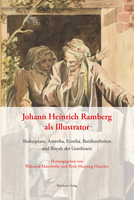
Waltraud Maierhofer and Peter-Henning Haischer, eds.,
Johann Heinrich Ramberg als Illustrator: Shakespeare, Amerika, Erotika, Berühmtheiten und Royals der Goethezeit (Johann Heinrich Ramberg as Illustrator: Shakespeare, America, Erotica, Celebrities and Royals of Goethe’s Time).
Wehrhahn Verlag, 2025.
234 pp.; 121 color illus.; notes & references.
€28.00 (hardcover)
ISBN: 9783988591272
The work of the German painter, engraver, and illustrator Johann Heinrich Ramberg reflects the growing importance of visual culture and the democratization of art through print on a transnational level. Ramberg’s illustrations were integral to the book culture of his time, serving not only as ornamentation but also as a major incentive for purchase, especially in almanacs and popular literature. Born in Hanover, Ramberg studied in London in 1781 with Benjamin West at the Royal Academy Schools. In 1782, he began exhibiting at the Royal Academy and visited the Netherlands, Germany, and Italy in the late 1780s before returning to Hanover as a court painter and decorator for the theater and various houses.
He is known today for participating in John Boydell’s Shakespeare Gallery and Thomas Macklin’s Poets’ Gallery as well as for his portraits of members of the British royal family. On the other hand, he also illustrated German almanacs and pocketbooks and became famous for his illustrations (which he himself etched) for Reineke Fuchs and Tyll Eulenspiegel in 1826. (He insisted on being credited as the original artist, even when others executed the engravings.) His illustrations were executed through various printmaking techniques, including copper engraving, etching, mezzotint, stipple engraving, aquatint for color images, and subsequently lithography, steel engraving, and woodcuts for more affordable publications. He later illustrated a deluxe edition of Christoph Martin Wieland’s works.
Ramberg was renowned for his versatility, producing illustrations for a wide range of genres, including literary classics (notably Shakespeare), popular almanacs, erotic works, and portraits of celebrities and royals of the Goethe era. Ramberg’s illustrations often combined narrative clarity with satirical undertones, earning him the nickname “the German Hogarth,” although his illustrations are arguably closer to the work of Daniel Nikolaus Chodowiecki. In the 1788 edition of Shakespeare published by John Bell, Ramberg contributed nineteen original designs, more than any other artist involved. Ramberg demonstrated a sophisticated understanding of the interplay between text and image. He created both character portraits (often depicting actors in specific roles) and vignette scenes that captured key dramatic moments, thus offering readers both a visual interpretation of the text and a reflection on performance. His approach to illustration—balancing originality, narrative clarity, and technical excellence—set a standard for contemporaries and successors. His oeuvre spanned from the 1780s to the 1830s, reflecting both the tastes of the burgeoning bourgeoisie and the demands of the book and exhibition markets.
From Jacob Christoph Carl Hoffmeister’s Johann Heinrich Ramberg in seinem Werken to Franziska Forster-Hahn’s Johann Heinrich Ramberg als Karikaturist und Satiriker, the studies on the artist have been limited to certain aspects of his work.[1] In 2013, Alexander Košenina edited Literature – Bilder. Johann Heinrich Ramberg als Buchillustrator der Goethezeit: a collective publication that has become a reference for scholars. In Košenina’s volume Johannes Roessler wrote an essay entitled “Im visuellen Reich der Literatur. Ramberg und die Kultur der Illustration um 1800” (“In the Visual Realm of Literature. Ramberg and the Culture of Illustration around 1800”) (9–28). Roessler’s study stressed the extent to which the images of Johann Wolfgang von Goethe, Friedrich Schiller, and Wieland in the first half of the nineteenth century were shaped by the illustrations of the Hanoverian artist. On the other hand, he fostered a deeper acquaintance with the authors based on his proto-philological expertise. Roessler shows how, in Ramberg’s art, elements of classicist imitation of antiquity (the compositional principles of classical history painting) mixed with the physiognomic and gestural exaggeration of characters by William Hogarth and Thomas Rowlandson. Ramberg’s understanding of the tableau, for example, differed from that of Denis Diderot, who transferred the tableau from painting to theater. Ramberg, in contrast, emphasized the autonomy of painting in relation to theatrical representation.
Waltraud Maierhofer and Peter-Henning Haischer, the two editors of Johann Heinrich Ramberg als Illustrator, also contributed to this 2013 book. Waltraud Maierhofer is professor of German and of Global Health Studies at the University of Iowa. She has recently published Johann Heinrich Ramberg / Dietrich Wilhelm Soltau: Reineke Fuchs – Reynard the Fox: 31 Originalzeichnungen und neu kolorierte Radierungen mit Auszügen aus der deutschen Übersetzung des Epos im populären Stil v. Soltau and is working on a digital catalogue of Ramberg’s work. Peter-Henning Haischer is a specialist of Wieland.[2]
In their brief introduction, “Grafik in der Goethezeit – Illustration und Reproduktion” (“Graphic Arts in the Time of Goethe – Illustration and Reproduction”), the two editors situate their volume within the continuity of Košenina’s collection of essays, while seeking to complement it by focusing on less extensively studied aspects of Ramberg’s illustrated oeuvre: US iconography, erotic prints, and portraits of celebrities and members of royal families in the Goethe era. It is worth noting that Ramberg’s most “popular” illustrated works—or at least those that have secured his lasting reputation to the present day—namely his illustrations for Reineke Fuchs (or, Tyll Eulenspiegel; 1826)—did not attract the attention of the contributors to either edited volume, presumably for precisely that reason: Goethe’s work, inspired by a fifteenth-century epic and satirical poem, is already very (perhaps too?) well known. This means that, even today, there is no comprehensive publication devoted to Ramberg’s oeuvre, which is both regrettable and difficult to understand.
The studies published in the most recent volume, like those in the earlier one, are nonetheless of considerable interest. Stuart Sillars’s contribution recalls the importance of Shakespeare for Ramberg, who not only made a modest contribution to Boydell’s famous Shakespeare Gallery, but, more importantly, published nineteen engravings in The Dramatick Writings of Will. Shakspere, edited by John Bell in 1788. Boydell’s enterprise is, of course, extremely well known, while Bell’s was particularly significant in terms of the dissemination, national reconstruction, and patriotic celebration of Shakespeare’s works during the years of the French Revolution. It is nevertheless unfortunate that these cultural and ideological dimensions are not given sufficient consideration.
Maierhofer’s two studies on portraits and their reproductions offer comparative analyses in the form of a kind of inventory, as does the chapter devoted to the American Revolution and to a comparison between Chodowiecki’s engravings and Ramberg’s illustrations of these events. One may, however, regret the highly uneven quality of the small-format reproductions, which do not always allow the details of the works to be adequately “read.”
This is followed by an essay by Thomas Mandl, Sebastian Diem, and Chanjong Im on the contribution of digitization to the study of historical illustrations. After a lengthy overview of the history of the “visual digital turn,” the investigation turns to Ramberg’s work, and specifically to his portraits, considered within a general corpus of 35,000 engraved portraits digitized by the University of Hildesheim and the Herzog August Bibliothek. Among other things, the study addresses the notion of “likeness,” although in terms that, from an art-historical perspective, would benefit from greater epistemological distance. The collection concludes with a study by Alexander Rosenbaum of a frontispiece by Ramberg for Wieland’s Oberon (1801). The volume ends there, without a conclusion, an index, or a comprehensive bibliography.
In the preceding pages, Haischer offers a study devoted to eroticism and satire in Ramberg’s oeuvre. This is a particularly interesting subject because it touches upon technical and aesthetic questions—the use of color, formats, prices, and modes of circulation—in relation to antiquity, Wieland, and Jean de La Fontaine’s Contes. This leads the author to compare French erotic imagery, particularly that of Charles Eisen, with Ramberg’s German production.
The question is fascinating because it concerns what might be called the “cultures of eroticism” around 1800, which were at once transnational and strongly dependent upon systems of censorship and political ideologies. Eroticism was often disqualified as a “minor genre,” as well as being construed in France as an expression of aristocratic decadence. The question of eroticism is also a media question. In 1792, the Leipzig publisher Georg Joachim Göschen wrote to Ramberg: “The artist will hardly be able to remain as decent as the poet” (52n16).[3] This extends the question of the differences between “poetry” and “painting” as formulated by Gotthold Ephraim Lessing in his polemical and seminal essay Laokoon oder über die Grenzen der Mahlerey und Poesie (1766).
Ramberg was certainly familiar with Lessing’s work. Yet what is most revealing is that Lessing did not consider the question of eroticism when seeking to articulate the distinction between verbal and visual art. It is true, however, that Lessing’s argument is primarily aesthetic and that, consequently, moral considerations, or the question of decorum, do not occupy a central place in his discussion. It is precisely on this point that his position differs from the Winckelmannian conception of ancient art. But that is another story.
Notes
[1] Jacob Christoph Carl Hoffmeister, Johann Heinrich Ramberg: in seinen Werken dargestellt (Karl Meyer, 1877); Franziska Forster-Hahn, Johann Heinrich Ramberg als Karikaturist und Satiriker, Hannoversche Geschichtsblätter, vol. 17 (1963); and Alexander Košenina, ed., Literatur – Bilder. Johann Heinrich Ramberg als Buchillustrator der Goethezeit (Wehrhahn Verlag, 2013). See also Doris Schumacher, Kupfer und Poesie. Die Illustrationskunst um 1800 im Spiegel der zeitgenössischen deutschen Kritik (Böhlau, 2000).
[2] Waltraud Maierhofer, Johann Heinrich Ramberg / Dietrich Wilhelm Soltau: Reineke Fuchs – Reynard the Fox: 31 Originalzeichnungen und neu kolorierte Radierungen mit Auszügen aus der deutschen Übersetzung des Epos im populären Stil v. Soltau (Verlag und Datenbank für Geisteswissenschaften, 2016); Peter-Henning Haischer, Historizität und Klassizität: Christoph Martin Wieland und die Werkausgabe im 18. Jahrhundert (Winter Verlag, 2011); and Peter-Henning Haischer, Christoph Martin Wieland: Ein Weltbürger in Weimar (Weimarer Verlagsgesellschaft in der Verlagshaus Römerweg, 2015).
[3] “Der Künstler wird schwehrlich so Deçent bleiben können als der Dichter.” Translation by the author.