Dealing in Splendour: A History of the European Art Market
Reviewed by Camille MestdaghCamille Mestdagh
Mobilier national, Paris
Email the author: camille.mes[at]googlemail.com
Citation: Camille Mestdagh, exhibition review of Dealing in Splendour: A History of the European Art Market, Nineteenth-Century Art Worldwide 25, no. 3 (Autumn 2026), https://doi.org/10.29411/ncaw.2026.25.3.24.
This work is licensed under a Creative Commons Attribution-NonCommercial 4.0 International License  unless otherwise noted.
Your browser will either open the file, download it to a folder, or display a dialog with options.
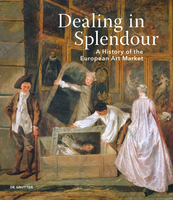
Dealing in Splendour. A History of the European Art Market
Liechtenstein Garden Palace, Vienna
January 30–April 6, 2026
Over the past two decades, the development of digital art history and digital tools such as the Getty Provenance Index has fostered data-driven methodologies that have transformed art-historical resources and research practices. These have opened new avenues for the study of the art market and have integrated art-historical inquiry into a global framework.[1]
Consequently, in the last decade, art market studies have expanded exponentially. An international association and a dedicated journal have been established, while publishers have launched specialized book series and online publications devoted to the field.[2] Despite this remarkable growth in research on the economic dimensions of art history, the challenge of organizing an exhibition devoted to the history of the European art market had yet to be undertaken. This gap has now been addressed by Dealing in Splendour, presented by the Princely Collections at the Liechtenstein Garden Palace in Vienna in the winter and spring of 2026.
The exhibition was curated by Stephan Koja and Iris Yvonne Wagner with Christian Huemer. Huemer, who has led several international research projects on the history of the art market, was able to bring together a range of art market studies experts from museums and academia. The three curators developed the exhibition with the support of an international committee of specialists, as evinced by the quality of the exhibition’s narrative.
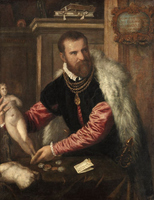
Indeed, the exhibition demonstrated that the art market as we know it today has existed for centuries—at least since antiquity, if only well documented since the Renaissance, when dealer-collectors are known to have already been supplying works of art and collectibles across Europe. Visitors were welcomed to the exhibition by Titian’s Portrait of Jacopo Strada, one of the most prominent figures of this early market (fig. 1). As the codex displayed near the portrait reminded visitors, Strada compiled extensive documentation and copies of antique busts. This section also evoked the tradition, since antiquity, of producing and selling copies, thereby forming an art market. The reproduction of Greek models also led to reinterpretations and motivated new artistic productions.

From start to finish, the exhibition emphasized the complexity of the relationship between art and the market, demonstrating how difficult it is to separate the two. The narrative concluded at the turn of the twentieth century with another prestigious loan: Gustav Klimt’s Nuda Veritas (fig. 2). The work reflects Vienna’s cultural prominence, a legacy that can be traced back to figures such as Strada, who worked for the Habsburg court. Presented in a white box, Klimt’s painting, alternatively titled Allegory of Truth, brought the exhibition to a close by illustrating the Vienna Secession artists’ attempt to create while being independent from popular taste and distancing themselves from market reception. This came across as somewhat ironic, as just last year a Klimt portrait became one of the most expensive artworks ever sold at auction.
More broadly, the exhibition invited reflection on a paradox that remains highly relevant today: the cultivation of artistic independence, ostensibly free from market expectations, and the careful staging of such distance has often allowed artists to multiply the value of their works. Beyond artists and market professionals, the third link in the chain was the collector, whose presence was felt throughout the exhibition. The show was, fittingly, held at the Liechtenstein Garden Palace and largely based on the collection of the Liechtenstein family, who have been collecting art since the beginning of the seventeenth century.
Following the introduction, the eight sections that form the core of the exhibition presented a chronological selection of works organized around thematic developments that reveal the key transformations and strategies shaping the history of the art market. The narrative began with antiquity before moving to the exchanges between Italy and the Low Countries during the Renaissance. The final section was devoted to the Parisian Salons and galleries of the late nineteenth century. Throughout, the exhibition benefited from clear signage: each room was introduced by a title and a concise explanatory text that contextualized the works and highlighted the pivotal moments, places, and actors in the history of the art market.
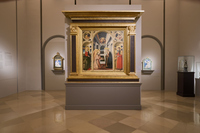
Some cities emerged as particularly important centers of artistic exchange during certain periods. Florence occupied a prominent place in the fifteenth century thanks to the wealth generated by trade and banking (fig. 3). The city was represented by two tondi of the Madonna by Sebastiano Mainardi, illustrating the growth of a secular market for devotional images and the strong demand that encouraged the serial production of similar compositions according to patrons’ choices. Church patronage was represented: an altarpiece by Neri di Bicci was displayed opposite a Flemish triptych, pointing to the artistic and commercial routes connecting northern and southern Europe while also highlighting the materials used. The gradual adoption of canvas over wood panels facilitated transportation and contributed to art trade growth across borders.
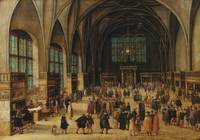
The focus then shifted to sixteenth-century Antwerp, another city that prospered through global trade networks and became renowned for its art fairs and “painters’ galleries,” where artists, dealers, and collectors gathered. A particularly striking work depicting Vladislav Hall in Prague Castle hung at center stage (fig. 4). This work shows stalls along the castle walls and groups of people gathering to negotiate and socialize. In addition to contextualizing commercial practices, the exhibition addressed questions of authorship and self-promotion through examples such as Albrecht Dürer’s signed prints and self-representations as well as the complex relationships between originals and copies in the work of the Bruegel family.
The section devoted to seventeenth-century Amsterdam was installed in the palace library. Landscapes were displayed against dark green panels and shared the space with bookshelves, creating an atmosphere of intimacy that reinforced the notion of art as a domestic consumption and reflected the development of a middle-class art market. Thanks to the study of inventories, historians know that Dutch households often owned numerous paintings, many of which were produced efficiently and at relatively low cost.
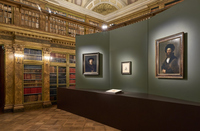
Amsterdam was also the terrain for the auction of prestigious collections and the home of great masters such as Rembrandt van Rijn. The influence of collecting and auction culture on artistic production was illustrated through the trajectory of Raphael’s Portrait of Baldassare Castiglione (ca. 1514–15; Musée du Louvre, Paris). Admired and sketched by Rembrandt when it appeared at auction in 1639 (collection of Lucas van Uffel), the painting had inspired a copy by Peter Paul Rubens, dated 1630, which was on loan for the exhibition from the Courtauld Gallery, London. Although it is unfortunate that the original and the copy could not be displayed side by side, the self-portrait by Rembrandt inspired by Raphael’s work (ca. 1642–43; Museo Thyssen-Bornemisza, Madrid) was very eloquent, and established a dialogue between these works and masters that constituted one of the highlights of the exhibition (fig. 5).
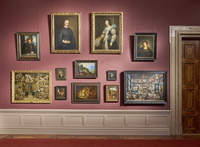
After the subtle light and shade of the Dutch Golden Age, visitors encountered the bright and colorful depictions of wealthy seventeenth-century collectors’ galleries from the Low Countries (fig. 6). Filled with Italian paintings, this section illustrated transnational networks and the pivotal role connoisseurs and agents played. The focus here was on the relationship between Prince Johann Adam Andreas of Liechtenstein and the dealer Marcus Forchondt, whose Antwerp-based family developed commercial networks extending as far as South America. Correspondence displayed in the gallery, alongside two rare Italian bronze sculptures of a horse and a bull, testified to discussions of acquisition opportunities.
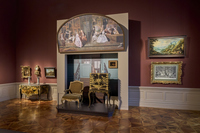
The next section moved to eighteenth-century Paris and London. The dealer and marchand-mercier Edmé-François Gersaint was represented through a reproduction of the famous shop sign painted by his friend Antoine Watteau, as the original (1720; Schloss Charlottenburg, Berlin) can no longer be moved. The legendary engraving after Watteau’s painting, which was also displayed in the gallery, demonstrated how the Parisian dealer displayed paintings, frames, and fine fabrics to his wealthy clientele. L’Enseigne was hung above a lacquer cabinet and a Louis XV giltwood chair, reminding us of the variety of artworks that could be found in these shops (fig. 7). Gersaint’s innovative approach in writing sale catalogues was on full display through his catalogues raisonnés, which list and comment on works, even referring in some instances to provenance. These catalogues reminded visitors that, in 1730s France, public auctions were already cultural events held in dedicated venues in the center of Paris.
A few decades later in London, James Christie would establish the auction house that still bears his name today. A rarely exhibited portrait of Christie was displayed near a self-portrait of Jean-Baptiste-Pierre Lebrun—the painter, dealer, and expert who operated a gallery from his Paris residence. Lebrun authored numerous auction catalogues for major collections and later worked for the Revolutionary government as a commissaire-expert, playing a key role in the selection of works for the Louvre.
Before entering the nineteenth century, the exhibition evoked the Grand Tour through the magnificent pietre dure monument known as the Badminton Cabinet. Commissioned in Florence and transported to England by the Duke of Beaufort during the first half of the eighteenth century, it was acquired through Christie’s by the Liechtenstein family in the twenty-first century, when it became the most expensive piece of furniture ever sold at auction.
The final space was devoted to the Parisian art trade of the nineteenth century. It first examined the Salon system, presented as a state instrument for regulating artistic production that had an overriding influence on artists’ careers. The Salon’s official taste was evoked through a copy of Alexandre Cabanel’s Birth of Venus (1863; Musée d’Orsay, Paris) by contemporary artist Adolphe Jourdan (1864; Dahesh Museum, New York). Indeed, the copyright was acquired by Goupil & Cie, which commissioned reproductions in various sizes and mediums and distributed them widely. Goupil thus built a highly profitable business based on painted copies and prints sold to middle-class consumers across Europe and beyond.
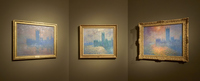
As a counterpoint, dealers and gallery-owners such as Paul Durand-Ruel and Hector Brame established alternative channels for promoting artists outside the Salon system, notably the Barbizon painters and the Impressionists. This period marks a significant shift in the construction of artistic value, increasingly tied to the individuality and recognizability of artists and their styles. The phenomenon was illustrated through examples of Claude Monet’s serial paintings, in which changing effects of light and weather created a recognizable artistic profile (fig. 8). As artists became more individualized, the image of the artist as an outsider likewise grew.
The penultimate room was devoted to the dealer Charles Sedelmeyer, a native of Vienna who established a picture shop in Paris before becoming an international businessman. Like many leading European dealers of his time, Sedelmeyer traded in Old Master paintings and exported works to the United States. His most innovative achievement, however, was his promotion of the Hungarian painter Mihály Munkácsy. Under an exclusive contract, Sedelmeyer obtained exhibition, sales, and reproduction rights to the artist’s works in exchange for a fixed annual payment and a share of the profits generated by touring exhibitions. The monumental painting Christ Before Pilate (1881; Déri Museum, Debrecen), which Sedelmeyer had commissioned, was first exhibited in his gallery at the same time as the Paris Salon and met with great acclaim. The strategy was successfully repeated with a new pendant Golgotha (1883; Déri Museum, Debrecen) at staged events in the dealer’s private mansion. Their popularity was such that they subsequently toured cities across Europe in the 1880s. While ticket sales generated substantial revenue, the example also shows the ties between artistic production, promotion, and commerce.
Dealing in Splendour succeeded in centralizing various information and research around major topics while maintaining a coherent chronological structure. As with any exhibition, curatorial choices meant there were certain gaps. The focus was largely on painting, when one might have expected more on the decorative arts market, although this dimension was suggested in several sections, particularly through the display of the Badminton Cabinet. Similarly, the emphasis fell primarily on the early modern period, and the nineteenth-century section might have been developed further. Such limitations, however, left room for a potential sequel. Historiographical debates were also largely absent although they were addressed in the accompanying publication, which will remain a reference in the field.
Although the subject of the exhibition was complex and intersected with art history and social and economic history, the exhibition succeeded in presenting its argument with remarkable clarity. Paintings and objects were consistently placed in dialogue with archival materials such as letters, invoices, auction catalogues, and exhibition catalogues, demonstrating that connoisseurship and scholarship are integral to the history of the art market. It was an exhibition worth visiting more than once to grasp the different layers constituting the history of the art market and to simultaneously enjoy the display of masterpieces, some rarely seen by the public.
Through interesting works from a variety of places and periods, the exhibition revealed hidden stories and demonstrated how works of art circulate, connecting artists, dealers, patrons, and collectors within networks that collectively contribute to the creation of value.
Notes
[1] Johanna Drucker, Anne Helmreich, Matthew Lincoln, and Francesca Rose, “Digital Art History: The American Scene,” Perspective 2, (2015), https://doi.org/10.4000/perspective.6021.
[2] The International Art Market Studies Association (TIAMSA) published the Journal for Art Market Studies, and the publishers Brill and Bloomsbury have launched specific series dedicated to art market studies.