Emil Holub’s African Exhibitions, Colonialism, and National Emancipation
by Tomáš WinterTomáš Winter is an art historian and director of the Institute of Art History of the Czech Academy of Sciences. He focuses on the history of Czech and global art of the nineteenth and twentieth centuries, on relations between European and non-European art, and on issues of caricature, folk art, and popular genres. He taught art history at the University of West Bohemia in Pilsen, Masaryk University in Brno, the University of South Bohemia in České Budějovice, Palacký University in Olomouc, and the Academy of Arts, Architecture and Design in Prague, where he completed his habilitation in 2015. He is the author, together with Martin Šámal, Ondřej Crhák, and Petr Valenta, of Emil Holub (2023). He has also written, with Michaela Pejčochová, Eagle Rips Eagle: Emil Filla, Chinese Art and Totalitarian Phantoms (2024).
Email the author: winter[at]udu.cas.cz
Citation: Tomáš Winter, “Emil Holub’s African Exhibitions, Colonialism, and National Emancipation,” Nineteenth-Century Art Worldwide 25, no. 1 (Spring 2026), https://doi.org/10.29411/ncaw.2026.25.1.5.
This work is licensed under a Creative Commons Attribution-NonCommercial 4.0 International License  unless otherwise noted.
Your browser will either open the file, download it to a folder, or display a dialog with options.
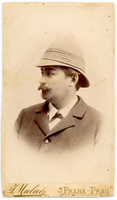
One of the most important figures responsible for introducing non-European cultures to Central and East European publics was Dr. Emil Holub (1847–1902) (fig. 1).[1] Between 1874 and 1892, this physician, explorer, collector, and ethnographer organized three exhibitions of his collections of African artifacts in Prague and Vienna (two of them in both locations), and one exhibition in Kimberley and another in Cape Town. This article presents a critical examination of the exhibition strategies employed by Holub in the presentation of his collections. It investigates his curatorial preferences in selecting objects acquired through various means during his travels in South Africa. Special attention is given to the previously overlooked analysis of the scenographic design of individual exhibitions, which adeptly drew upon contemporary exhibition practices and had a notable impact on both visitor engagement and the economic viability of the exhibitions. Moreover, the study explores how Holub’s exhibitions contributed to the formation of contemporary colonial discourse and simultaneously supported Czech national emancipation efforts during the final decades of the nineteenth century within the framework of the Austro-Hungarian monarchy.
Holub’s Travels and His African Exhibitions
Holub was born in Holice, a small town in the Kingdom of Bohemia, which at the time was part of the Austrian Empire (after 1867 the Austro-Hungarian Empire). He attended grammar school in Žatec before studying medicine at Charles-Ferdinand University in Prague, from which he graduated in 1872. Fascinated with the work of the Scottish missionary-doctor David Livingstone (1813–73), who had traveled to Africa to find the source of the Nile River, he went to South Africa to practice medicine and explore the continent. His first major expedition, from 1872 to 1879, was funded mainly by his father and Holub’s friend and patron Vojta Náprstek (1826–94). The latter was a prominent figure in Prague’s social circles and founder of the Czech Industrial Museum in Prague, which opened its doors in 1873.[2] Holub’s second journey, from 1883 to 1887, was supported by the Ministry of War and Ministry of Culture and Education under Emperor Franz Joseph I as well as by many societies and corporations, and private firms. The extensive equipment and supplies he carried with him on what was officially called the Austro-Hungarian Expedition facilitated not only his travels but also the steady acquisition of collections that remained his private property and that he exhibited.
Holub organized during his life a total of five exhibitions, two of which were repeated at another venue. None of them were held in established museums. With the exception of the first exhibition, Holub was the principal organizer of these displays, bearing full responsibility for their design, execution, and financial backing. Although other Czech travelers, such as Ottokar Feistmantel (1848–91) and Enrique Stanko Vráz (1860–1932), also organized exhibitions of their collections in the last quarter of the nineteenth century and did so without significant support from public institutions,[3] they could not match Holub in either the number of exhibitions or in the quantity and diversity of the objects on display.
This was true not only within the Czech lands but across the entire Austro-Hungarian Empire and probably the whole of Europe. Indeed, most of the well-known nineteenth century African explorers, including Livingstone, Richard Francis Burton (1821–90), Georg A. Schweinfurth (1836–1925), Gustav Nachtigal (1834–85), Heinrich Barth (1821–65), and Oskar Lenz (1848–1925), did not organize exhibitions of the objects and specimens they had collected. Although a large, representative exhibition titled The Stanley and African Exhibition was held during Henry Morton Stanley’s lifetime (1841–1904) at the Victoria Gallery in London in 1890, it was not organized by Stanley himself but by a specially appointed committee composed of representatives from various political, commercial, scientific, and missionary organizations.[4] A similar situation occurred with the presentation of collections from Central Africa in the Orangerie of the Jardin des Plantes in Paris in 1886, which were brought to Europe by the Italian-French explorer Pierre de Brazza (1852–1905) and his brother Jacques (1859–88). The primary responsibility for organizing the exhibition lay with the Muséum National d’Histoire Naturelle, which operated the exhibition pavilion, and the Ministry for Public Education, which took the event under its auspices.[5]
The first of Holub’s exhibitions took place in the Old Town Hall of Prague, while Holub was still in Africa. It ran for only a week at the beginning of November 1874, and Holub’s influence on its form was remote. This exhibition was the brainchild of Holub’s sponsor Náprstek and Alois Studnička (1842–1927), the curator of Náprstek’s Czech Industrial Museum.
Two major Holub shows were held in both Prague and Vienna in 1879–80 and 1891–92. The first premiered at the garden pavilion on Střelecký Island in Prague in mid-November 1879; in response to popular demand, the exhibition remained open until mid-January the following year. It was then moved to the Pavillon des Amateurs in Vienna. In contrast, the second exhibition opened at the Rotunda in Vienna’s Leopoldstadt district and ran from mid-May 1891 until mid-November of the same year. It was reprised in Prague at the Výstaviště Exhibition Grounds from the end of April 1892 until the end of November. All of these locations were highly esteemed, prestigious venues.[6]
Holub also organized two smaller exhibitions in South Africa: in 1877, an exhibition of his collections in Kimberley, and in 1884, an exhibition of expedition equipment in Cape Town.
Collecting
Leaving aside the Cape Town exhibition of 1884, the exhibitions associated with Holub’s name focused on his natural-history and ethnographic collections. The natural-history sections of Holub’s exhibitions were extremely diverse, featuring birds, amphibians, fish, reptiles, beetles, and small and large mammals, the latter represented most often by skulls, horns, and flayed, dried skins. Many different types of South African flora were also on show. The ethnographic sections included a wide variety of items—vessels, spoons, tobacco pouches, pipes, items of clothing, weapons, and musical instruments, among others—representing all the South African ethnicities that Holub came into contact with on his travels, most importantly the Ndebele, Ngwato, Lozi, Sotho, Tlhaping, Mbunda, Toka, and Subia.
In Africa, Holub collected and catalogued everything he encountered that could be removed and transported.[7] His goal was to form a natural history and ethnography collection that could be used to create exhibitions that would present microcosms of South Africa. He justified this collecting on scientific and educational grounds—specifically, the need to study the regions he visited in detail and to present the findings for the purpose of public enlightenment.[8] For that reason, he became a typical representative of scientific colonialism, a process “whereby the center of gravity for the acquisition of knowledge about the nation is located outside the nation itself,” as the Norwegian sociologist Johan Galtung described it.[9] Holub’s gathering of scientific data in southern Africa and the accumulation and cataloguing of a vast number of objects, which he transported to Europe (a total of more than seventeen thousand ethnographic items and more than sixty-five thousand zoological exhibits) was a form of appropriation of the explored territories and their inhabitants and a means of asserting control over them.[10]
Holub’s collecting strategy was to acquire multiple examples of specific ethnographic or natural objects in order to subsequently group them into smaller collections of multiple different examples of the same type of object. During the process of collecting, he already had in mind the future sale or donation of the collections to different museums and educational institutions, or, as he put it, “I will send the outcome of this research, i.e. the collections, home immediately. Whatever items of interest from the perspective of natural history or ethnography I collect, will be pored over by scholars, as in the case of my existing collections, and will then be distributed to national museums, institutes, schools, etc.”[11] Within the Austro-Hungarian Empire alone, Holub made donations to more than one hundred institutions including K.K. Naturhistorisches Hofmuseum in Vienna, the Museum of the Kingdom of Bohemia, and the Czech Industrial Museum in Prague.[12]
Holub acquired ethnographic items in Africa through purchases or in exchange for European goods of various types. Some he may have received as gifts. His diaries make few mentions of these exchanges, and such mentions that do exist are all broadly similar to that of August 11, 1875: “I bought 2 assegais [spears]—kinds new to me—for three yards of white calico,”[13] or an entry made the next day: “With the remainder of calico etc., I bought yet more items that included a tasteful tobacco box.”[14] As a result, in most cases it is not possible to reconstruct exactly how the exchange took place.
Instances in which Holub failed to obtain—or, as he often put it himself, to “plunder”—coveted items were rare. One such example was when he met Sipopa Lutangu, ruler of the Lozi people, in 1875. Although Holub had amassed a representative collection of over a hundred Lozi objects, he did not get his hands on absolutely everything he coveted:
Sipopa’s pharmacy and poison hut would make for a fascinating ethnographic collection if transferred to a European museum. It is unfortunate that it is not possible for a collector to acquire more of such items through exchange; the natives, unwilling to part with them, keep hold of them for the magic they harbor within.[15]
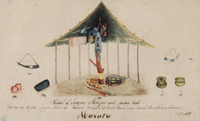
Holub created watercolor drawings of both the overall structure of Sipopa’s pharmacy and poison hut, as well as several individual medicine vessels (fig. 2). Although he had no formal artistic training, he was able to capture a fairly accurate likeness of ethnographic objects through careful observation, making his drawings of considerable documentary value. Holub’s drawings are currently preserved in the archival collection of the Náprstek Museum of Asian, African and American Culture in Prague.
Staging the Exhibitions: Objects, Animals and Mannequins
Holub’s growing ability to acquire objects as his experience grew was directly reflected in the form and scale of his exhibitions. The sheer number of objects on display increased with each new exhibition. Over five hundred objects were featured in the exhibition of 1874 in the Old Town Hall in Prague. In the exhibition of 1879–80, staged both in Prague and Vienna, the number was in excess of 12,500. This inevitably resulted in overcrowding, though this was not perceived negatively, as we see from a long review published in České noviny (Czech newspaper), whose author could not contain his enthusiasm upon seeing the installation for the first time:
We did not know whether to marvel at the richness, scientific importance and exquisite layout of the rarities on display, or the painstaking diligence, exemplary perseverance and impeccable scientific endeavors of the man who had collected such treasures and brought them back from a distant land to his beloved homeland. We do not believe we are being hasty or ill-advised when we say that there has never been an exhibition so original, so important and so instructive in Prague, ever.[16]
The absence of any criticism regarding the excessive number of exhibits—which defied the possibility of seeing them all during a single visit—encouraged Holub to include over thirteen thousand items in his final Vienna-Prague exhibition in 1891–92.
To convey a full understanding of the overwhelming character of Holub’s exhibitions, it must be noted that ethnographic and natural-history specimens were not the only items on display. For the first exhibition, Náprstek made available publications on Africa, including Stanley’s famous travelogue, from the museum’s own library. Since both Holub and Náprstek placed great emphasis on the educational character of the exhibition, they included materials that would help the viewer understand the broader context of the objects on display. In addition to the cabinet cards, maps, drawings, and African journals in English and Dutch, the most eye-catching exhibits were the fifty stereoscopic photographs that visitors could view using three stereoscopes. Similar accompanying materials, including Holub’s journals, maps, and notes, were included in other exhibitions. The presence of the traveler’s personal paraphernalia, including firearms, was undoubtedly related to his enthusiasm for self-promotion and the creation of an image of himself as a successful hunter of “scientific prey.”[17]
It is clear from the surviving written, drawn, and photographic sources that Holub tried to improve the overall mis-en-scène and staging of the individual objects with each subsequent exhibition. The design of the exhibitions became more and more complex and, at the same time, more effective in capturing the viewer’s attention, evidence that Holub was very well acquainted with the exhibition practices used in European museums and at world exhibitions at the time and knew how to make very effective use of them.
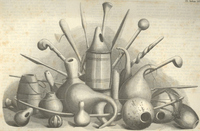
At the first exhibition in 1874 and the second in 1879–80, objects were organized in simple configurations, either in display cases or directly on the walls of the exhibition rooms. They were arranged in ornamental fashion, a common practice at that time which Náprstek could observe at the South Kensington Museum during his journey to London in 1862. This meant respecting symmetry and arranging the objects in accordance with simple geometric patterns, as can be seen in a drawing by the illustrator for the popular magazine Světozor (The world in view), Baltazar Kašpar Kutina (1853–1923). The image depicts vessels, spoons, and weapons of the Shona, Tswana, Tlhaping, Sotho, Lozi, and Mbunda peoples at Holub’s first exhibition (fig. 3).
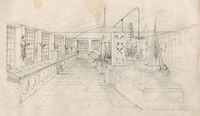
The layout of the exhibition of 1879 on Střelecký Island is documented in a pencil-and-ink drawing of a view into the exhibition hall by the Czech teacher and naturalist Bohumil Bauše (1845–1924), a member of the curatorium of the Czech Industrial Museum. It shows the use of various types of display cases (countertop, quadratic, and pyramidal) in the central part of the exhibition, which made the installation more dynamic and visually appealing than if only one type of case had been used (fig. 4). The installation of corals, sea sponges, and animals, conceived as picturesque scenery in a huge glass case, won special plaudits from most reviewers and visitors to the exhibition.[18] The appearance of this installation, reminiscent of a kind of triumphal glass monument built on a fabric-covered pedestal, was captured by Bauše in a watercolor (fig. 5). It is clear that Holub’s aim was to evoke in viewers as strong an illusion as possible that they were observing plants and animals in their natural underwater environment, a goal he largely succeeded in achieving. He made use of the scenographic effect of early natural-history dioramas (as the display case was referred to by contemporary reviewers), which lacked the painted backdrops characteristic of later habitat dioramas.[19]

The main wall of the exhibition room was dominated by a zebra skin forming the centerpiece of “an exceedingly beautiful arrangement”[20] made up of the skins and horns of other African mammals. This layout was based on an older tradition of installing hunting and military trophies in aristocratic mansions. It performed a dual function: On the one hand, it possessed strong decorative qualities, while on the other, it presented Holub as a successful hunter and the proud owner of these trophies, which brought him fame. Holub used the same layout for the Vienna reprise, as evidenced by the drawing published in the Illustriertes Wiener Extrablatt (Illustrated Viennese newspaper) (fig. 6). It is no coincidence that the illustrator—whose name remains unknown—chose to depict this particular section of the installation, which was among the most striking.
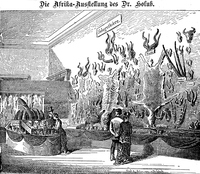
Perhaps the best-known example of the same installation principle within an ethnographic context was The Stanley and African Exhibition in 1890, which was interpreted by Annie E. Coombes.[21] She describes in detail various aspects of the trophy-style installation that also apply to Holub’s exhibitions:
The trophy method could be said to signify on a number of levels. As the name suggests, it served as a signifier of “capture” and “conquest.” On another level, the effectiveness of this type of display relied on specific connotations of “private” space. The effect of such a display in a public museum or exhibition was to replicate the sense of personal achievement and acquisition that such displays inculcated in the private domain. As a public display, this was effective precisely because it mirrored the sort of arrangement that was so popular in private and thus was able to exploit the same appeal to the individual, that feeling of intimacy and personal satisfaction.[22]
Coombes points out that the trophy method was used for the exhibition of specific types of objects (usually weapons and hunting trophies such as mounted antlers and animal hides) associated with masculine activities (hunting and warfare). Thus, within an ethnographic context these objects served to reflect the male presence in the colonies, as seen through the eyes of the white, middle-class male who finds himself in the role of “the ‘Great White Hunter’ in search of his ‘prey.’”[23]
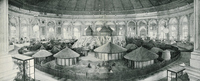
The highlight of Holub’s activities in terms of the most elaborate and ambitious staging was the Vienna-Prague exhibition of 1891–92. Only a single photograph of its premiere in Vienna in 1891 survives, taken by Raimund von Stillfried for the journal Světozor (fig. 7). The wide-angle perspective allows for a view of the entire installation in the central part of the Vienna Rotunda. For the most outstanding parts of the reprise in Prague in 1892, Holub arranged for documentation by the Czech photographer Jan Mulač (1841–1905). These photographs were modified for sale as cabinet cards and for donations as larger prints that were presented together in a representative album.[24]
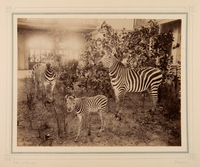
The photographs constitute valuable material that demonstrates how well-versed Holub was in the exhibition techniques of his time. They clearly show that the tanned animal skins, which were featured in Holub’s earlier installations, were now joined by taxidermy mounts, marking a shift from two- to three-dimensional displays. Moreover, Holub placed them in groups categorized by species, evoking their behavior in their original, natural habitat by means of scenic accessories (the surface of the ground modeled in clay; various plants, bushes and trees; and so on) (fig. 8). Holub thus again directly employed the installation principle of dioramas, which was beginning to be adopted at the time in European and North American natural-history museums. Instead of using painted backdrops, he usually placed the individual landscape scenes, populated with animals, in open space.
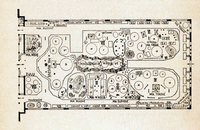
Holub used the same principle in the ethnographic section of the exhibition. In Vienna, this was placed at the very center of the Rotunda, while in Prague it occupied the right wing of the Industrial Palace (fig. 9). Holub had on show life-size models of dwellings and entire villages of the ethnic groups (among them the Ila, Toka, and Subia) (fig. 10). In these he placed thirty plaster figures of the village inhabitants (fig. 11), made by Johann Koloc, an Austrian sculptor originally from Bohemia.[25] Koloc did not have any members of the ethnic groups, or even depictions of them, as models to work with in Vienna. He used European models, which is evident in the bodily proportions and musculature of the figures, and only based the heads on drawings Holub provided him with.

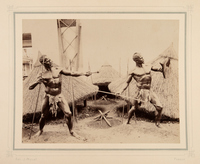
The figures were generally shown engaged in a specific activity (hunting, toiling in a field, sewing, and so on), often handling actual ethnographic objects. This meant that these objects were not displayed as separate items, to be studied for their own sake, but as artefacts directly linked to the way of life of the local population. This theatrical approach to display, which restores objects to their original context, served to reinforce the authenticity of the items presented by Holub.[26] For similar reasons, he also considered having African villages constructed at the Prague exhibition by members of Indigenous South African ethnic groups, but financial and logistical constraints ultimately made the plan unfeasible. Nevertheless, it was these ethnographic sections of the exhibition that were most popular and attracted the greatest amount of attention. Thanks to the life-size figures and dwellings, the visitor could feel like a real traveler, passing from village to village.
The use of dwelling models and mannequins in his presentations was not invented by Holub but was a widespread practice at least since the mid-nineteenth century. It was seen mainly in ethnographic exhibitions of both non-European cultures and European folk life. It was common in museums as well as in world’s fairs. Models of entire villages, albeit European, were first featured in Paris in 1867. Nearly two hundred buildings were erected on the Champ-de-Mars. While some countries put on display urban and technical buildings, others opted for rural architecture (Sweden, Norway, Denmark, and Switzerland, for example). The same approach was taken by the Austro-Hungarian monarchy, whose buildings at the exhibition were mock-ups of folk dwellings from various provinces.[27]
In 1878, at the Paris Exposition, the Swedish ethnographer Artur Hazelius presented a traditionally furnished and inhabited interior of a country house. In a room with a wooden table, a bed, and shelves for painted plates and other objects, he placed two life-size mannequins. Later, Hazelius used the same type of installation in the famous open-air museum he founded in 1891 at Skansen, near Stockholm.[28]
Bella: A Living Exhibit
Leaving aside the presentation of the live lion named Prince at Holub’s exhibition in Kimberley in 1877, it was the presence in Prague of an orphaned African girl that attracted the most attention.[29] She came from the Tswana ethnic group; Holub met her in the diamond fields thanks to the Kerr family, who supported him and at whose house she worked as a servant. At the end of his first stay in Africa in 1878, Holub hired her as a maidservant along with two other underage children, whose labor was cheaper than that of adults. She was able to speak German, as the Kerr family was of German origin. Holub initially wanted to take all three to Europe, but financial constraints allowed only for Bella. While he claimed to support her education, he simultaneously kept her in a position of servitude, using her as a maidservant and preserving her subordinate status.[30] Holub called her Bella, an act that, as Markéta Křížová has noted, “mimics the act of naming and of possession by Robinson Crusoe towards his ‘Man Friday.’”[31]
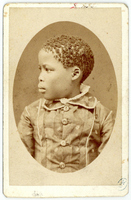
Bella’s arrival in Prague caused a sensation. Holub boosted her popularity by means of various activities. He was aware of the potential offered by Bella’s appearance alone, and made good use of it. He had cabinet cards of her made at the Prague photographic studio of Heinrich Eckert & Julius Müller’n, which he then sold (fig. 12). Holub introduced her as part of his public lectures and brought her to his Prague exhibition in 1879, where she basically acted as a human exhibit, a curiosity whose exotic presence heightened the exhibition’s appeal. In this way, Holub continued the tradition of the now infamous “human zoos,” first popularized by Carl Hagenbeck, who had been exhibiting the Sámi (Lapps) in various German cities since 1874, and by the Exposition Universelle in Paris in 1878, which established the concept of the “native village” (village indigène). These villages showcased the Indigenous inhabitants of French colonies, including Indochina, Senegal, and Tahiti.[32]
In Bella’s case, however, what was particularly noteworthy was her lively engagement with visitors, as reported by the contemporary press: “The living curiosity that Dr. Holub brought with him from Africa, eight-year-old Bechuana girl Bella, spends almost all day long at the exhibition, doing her best to explain the exhibits to visitors. In the short time she has been living in Prague, the little girl has learned both Czech and German with amazing rapidity, so that it is possible to communicate with her in either language.”[33]
It is clear from this that Bella was not merely present as a passive, silent object exposed to the gaze of a sensation-seeking public—a role likely assigned to the two boys, Gootoo and Inyokwana, who came from Swaziland and were displayed at The Stanley and African Exhibition.[34] Bella seemed to be a qualified interpreter of her own culture and history. The traditional roles of teacher and pupil, as they had functioned in colonized regions and had now been adopted by Holub, were thus inverted. A native of Africa was now educating Europeans, but this image has its limits. Bella should rather be considered someone speaking for the subaltern, as theorized by Gayatri Chakravorty Spivak.[35] While she interacted with audiences, her story was entirely framed and controlled by Holub. He appropriated her voice as that of a colonized subject and denied her true agency. She was made to perform her identity for European consumption, rather than define it on her own terms.
Bella’s presentation as both a charming helper and a cultural artifact embodied the colonial fantasy of benevolent tutelage—the notion that Indigenous people, especially children, could be “rescued” from their own world and “civilized” through European culture. This problematic approach resulted in a number of harmful consequences. Bella did not thrive in Prague as Holub had envisaged. As a result of the girl’s removal from her country of origin, she suffered from various health problems and contracted smallpox against which she had no natural immunity. The complex course of her illness persuaded Holub to have her baptized. Due to later health complications, he decided to return her to the Kerr family, something he did during his second journey to Africa, allegedly against the little girl’s wishes, as Holub’s wife Rosa (1865–1968) proved.[36] Although we do not know the exact reason Bella did not wish to be returned to the Kerr family since she left no testimony, it can be assumed that she had formed a very strong emotional attachment to Holub and to the circle of his friends through her subordinate position—an attachment she did not wish to break. In Africa, the Kerr family effectively replaced her own family, and with them she was likewise in the subordinate position of a servant. Her stay in Prague and later in Vienna may, despite all the difficulties, ultimately have seemed more bearable to her. It may also have been appealing to her that she was the center of attention, which had not been the case in Africa. Nevertheless, she eventually returned there, and her fate thereafter is unknown.
San Rock Engravings
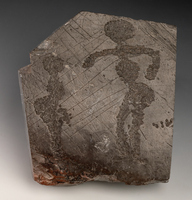
Of all the objects put on display by Holub, the engravings by the San people attracted the most interest. In line with period practice, Holub called the creators of the engravings Bushmen. For centuries, the San, whose ancestral territories are in current Angola, Botswana, Lesotho, Namibia, Zambia, Zimbabwe, and South Africa, had created engraved drawings on slate blocks, depicting mostly animal, figurative, or ornamental motifs (fig. 13).[37] That was also the reason why they attracted special attention. Of all the exhibited objects, they came closest to being understood as purely artistic works.
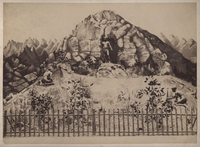
Holub presented over thirty of these slate blocks at the Prague-Vienna exhibitions in 1879–80.[38] It was probably the first time they had ever been publicly shown in Europe, which in itself was the reason why these works attracted increased public attention. The engravings were not installed in any special way. Like other ethnographic objects, they were placed in glass display cabinets (fig. 14). At the exhibition in 1891–92, more than one hundred rock engravings were installed in a similar manner. In addition, the exhibition included two San mannequins, set into a rocky landscape and depicted at work on the engravings (fig. 15).

The engravings exhibited in 1891–92 were acquired by Holub during his second African journey in the 1880s, under completely different circumstances than those of his first African expedition. Some individuals within the South African colonial regime shared concerns about the disappearance and eventual extinction of the San people. This was the reason why in 1880, the Cape government passed the Stone Artefacts Export Act, which included a ban on the extracting and export of rock engravings in the Cape Colony.[39] A few years later the purview of the Act was extended to sites in the Orange Free State, a fact registered by Holub.[40] Since he disagreed with these restrictions, for reasons discussed below, he appreciated the attitude of the English farmer Mr. Attwell, owner of the Gestoptefontein farm in Western Transvaal, who gave Holub permission to break off the engravings located on his land,[41] since “he refused to yield to the pressure that has generally been exerted since 1884 to restrict the breaking off and export of the Bushman engravings.”[42] In Holub’s mind, this was not an act of violence causing the loss of the original cultural and natural context of these artefacts but rather an act of preservation. He firmly believed that without these measures, these works would decay and never be appreciated or even known outside of the local context.
Though this was a clear case of the use of the now commonly scorned “rescue” argument as a justification for removal, Holub was nonetheless right about the potential for the engravings to be destroyed. Diamond deposits were eventually found on the Gestoptefontein farm, and the subsequent mining operations utterly decimated the natural environment and would not have spared the rock engravings had Holub not already removed them.[43] In the end, Holub brought two hundred such works over to Europe.[44] The vast majority of them came from the Gestoptefontein site, with the rest coming from various regions of the Cape Colony and Orange Free State. More than 170 engravings from Holub’s collection are currently in the collection of the Weltmuseum Wien; several pieces are held in other European ethnographic museums—in Dresden, Munich, Berlin, and Paris, for example.[45]
Given the nature of these works, reviewers of Holub’s exhibition tended to compare them to European art. For the reviewer of the Národní listy (National papers), these objects were proof that Africans did indeed possess a certain feeling for beauty and were in principle capable of creating objects that should not only be classified in terms of ethnography but also as specific types of art: “The drawings are rather good, which is the soundest proof there is that the natives were not entirely devoid of a feeling for beauty.”[46]
Other writers who have written about the San rock engravings have taken a similar approach, and their opinions well illustrate the views prevalent at that time. A reviewer writing in the Viennese newspaper Deutsche Zeitung (German newspaper) described the drawings as “testimony to the naive yearning for art on the part of these uncultivated, cave-dwelling people.”[47] In other words, these engravings were not seen as real art but as confirmation of the presence of a kind of childlike, instinctive desire, uncorrected by reason, to create art without any of the necessary preconditions in place. For the reviewer, these works represented a kind of “pre-art,” comparable in terms of development to the earliest prehistoric attempts to create images.
It was in a similar vein that Emanuel Kusý reported on the San rock engravings shown in Holub’s last exhibition: “It is interesting to find oneself convinced once more by this particular example that there is a certain instinct in the human mind that impels even the unskilled hand of the barbarian to independent creativity. The proud monuments to human genius, the eternally beautiful masterpieces of the old masters, and the childish doodles of primitive people all emerge from the same mysterious desire.”[48]
The cited reviews indicate that San rock engravings were positioned at the most rudimentary stage of representational art, a stage that in fact does not withstand comparison with what was regarded as progressive European art. Their reception provides a clear example of the construction of asymmetrical, hierarchical relationships grounded in the notion of progress, with “civilized” European society cast as its principal bearer. In a similarly evolutionist vein, Holub also interpreted the stylistic development of these engravings; however, his approach was considerably more detailed, and he himself refrained from direct comparison with European works.[49]
Popularization and Profit

Though Holub’s aim for the exhibitions was to educate the public, he was also much concerned with attendance figures. He understood that a certain degree of popularization was necessary to boost the number of visitors, which explains the flashiness of some of his exhibits (life-size models of African villages or spectacular installations of stuffed animals, for example) as well as the dramatic qualities of his advertising materials. This is especially clear in the poster advertising his last exhibition, which was the work of the Viennese graphic artist and illustrator Gottfried Sieben (1856–1918) (fig. 16). The typographic section of the poster was complemented by the half-naked figure of an African warrior with shield, spear, and a hairstyle that clearly identified him as a member of the Ila people. The poster thus refers to Holub’s encounter with the Ila or Mashukulumbwe, as he dubbed this ethnic group that was at the center of a fateful moment during his second stay in Africa. Holub set off for their territory, located in the southern part of what is now the Republic of Zambia, in July 1886. After crossing the Kafue River, he set up camp in the village of Galulonga. The Ila ambushed Holub’s party with tragic consequences. One of the expedition members was mortally wounded and Holub had to flee with the rest of the group, which included his wife Rosa, to save their lives.[50] Visitors to the exhibition may have been familiar with this story from Holub’s travelogue as well as from the exhibition guide, where it was briefly reiterated.[51] It is logical that Holub would have wanted the poster to refer to this most dramatic part of his journey. At the same time, Sieben’s depiction of the Ila man preparing to fight supported the widespread stereotypical image of the Indigenous people of Africa as “uncivilized” and violent “savages.”
Because Holub tried to cover as many of the costs of his exhibitions as possible through admission fees, visitor numbers also had a purely economic significance for him. The first exhibition in 1874 was seen by 5,703 visitors in just one week. It made a profit, which Holub donated to a charitable organization, namely, the Czech-American orphanage for girls in Prague.[52] The Prague exhibition of 1879 also ended up in the black, which was the reason it was reprised in Vienna. In terms of the number of items on show and the total exhibition space, the Vienna exhibition was far larger than the one in Prague, and its increased costs were no longer covered by the admission charged (the exact number of visitors is not known). The exhibition ended up recording a loss, and Holub was obliged to pay almost 4,500 florins out of his own pocket, which wiped out what he had made on the Prague premiere.[53] This is a good example of Holub’s inexperience when it came to organizing a large-scale exhibition. He was not competent enough to estimate the complexity involved and to budget accordingly. Although he had originally planned further reprises, the losses he incurred meant these had to be abandoned.
His last exhibition was undoubtedly his most successful in terms of attendance. In Vienna it was seen by 175,000 paying visitors, and in Prague by an additional ten thousand. This was thanks to a shrewdly selected strategy of offering discounts on admission to certain groups of the population (children and lower-ranked soldiers) and by offering season tickets for the entire duration of the exhibition. Holub himself, however, was disappointed by the figures. He had expected more people and knew that, under the circumstances, the income from tickets sold would not cover his considerable costs. Martin Šámal has shown that, in the case of the Viennese premiere, the financial support Holub received from Emperor Franz Joseph I, the City of Vienna, and private individuals covered only around 11 percent of the total cost.[54] Nor did the income from admission fees cover the costs of the Prague exhibition, which also ended up in the red. At the conclusion of both exhibitions, Holub found himself with about 80,000 florins in out-of-pocket expenses.
National Emancipation
To fully understand the significance of Holub’s exhibitions, it is essential to examine their relationship to the politics of Austro-Hungarian imperial rule, particularly with regard to colonialism. Although the monarchy was not a major colonial power or possessed any important colonies, it was part of a globalized colonial world, which was reflected in politics, economics, scientific discourse, and other areas of life.[55] Less obvious but more important for the argument made in this article, the monarchy developed its own imbalanced policies toward the lands and nationalities it encompassed. These policies were based on unequal relationships and an asymmetrical distribution of power. To enforce its interests, the monarchy employed violence, as was clearly demonstrated during the annexation of Bosnia and Herzegovina in 1878. For these reasons, some authors speak of Austro-Hungarian policy as a form of “internal colonization,”[56] which shares certain features with the colonization of non-European territories, particularly in framing its exertion of power as a civilizing mission aimed at bringing progress to regions deemed less developed.
Slavic nationals within the Austro-Hungarian Empire, including most importantly the inhabitants of the Kingdoms of Bohemia (mostly Czechs) and Croatia-Slavonia, were aware that their status was not equal to that of German-Austrians or Hungarians, and they perceived themselves as oppressed. For that reason, during the nineteenth century, the situation of colonized, subjugated, non-European cultures was not deemed completely dissimilar to that of the Slavs, living under the oppressive regime of the Habsburgs. As Křížová wrote, “the Czechs confronted real or imagined stereotypes that were supposedly considering them and the other inhabitants of Central and Eastern Europe as less developed, or even ‘barbaric’ in comparison to the ‘true Europeans’ of the West.”[57] Within the framework of national emancipation, however, the Czechs had a clear awareness of their developmental and cultural superiority over what were then called “primitive” peoples, including Native Americans as well as the Indigenous inhabitants of South Africa. They felt their position was on a par with the advanced European powers. This paradoxical situation, based on a double asymmetric identification, was succinctly characterized by Křížová:
Within the frame of the . . . sense of marginalization within Austria-Hungary, self-images of being “oppressed” or “colonized” by the Habsburgs were present in Czech public discourse and increased with the growth of the national movement. Yet, as the Czechs aspired to manifest their (supposedly) superior position on a developmental scale and their belonging among the European powers, distinguishing themselves from the non-European primitives was useful to ascertain their own advanced development.[58]
Holub is a clear example of this attitude. Through his exhibition activities, he contributed to shaping the image of Czechs as a people at a more advanced stage of development than “uncivilized” or “primitive” societies—one that could be compared with other advanced European nations. Holub was alert to the jostling for power between different nations at the time and often emphasized how his activities contributed to the prestige of the Czechs. This fact was also highlighted by an anonymous reporter with the Posel z Prahy (Prague herald). Writing about the first of Holub’s exhibitions in 1874, the journalist spoke of its inestimable significance for the self-esteem of the Czech nation. He celebrated Holub not only as the natural successor to Livingstone but as someone whose travels were comparable with the successes of German explorers in the Austro-Hungarian expedition to the North Pole in 1872–74.[59]
Holub’s nationalism and his contributions to the Czech nation were also emphasized during the Vienna exhibition of 1879. A reporter for the periodical Vídeňský Slovan (Viennese Slav) concluded his review with an appeal to Viennese Slavs to visit the exhibition: “Let us prove that we can appreciate the merits of the ‘man of scientific work,’ the man of scholarship and the ‘Czech,’ Dr. Holub, by ensuring that none of us Slavs in Vienna forgets to visit the African Exhibition in the Prater.”[60]
The response to Holub’s last exhibition, held in 1891–92, was a bit different but in the same context. The fact that it premiered in Vienna and only later was transported to Prague incurred the wrath of Czech nationalist-oriented periodicals, which accused Holub of having abandoned his patriotism and sold out to Vienna. Had the exhibition premiered in Prague, they sniffed, it would have enjoyed greater success and received more financial support. This point was asserted forcefully by Naše hlasy (Our voices):
This year offered ample opportunities for the organization of an African exhibition in Bohemia, and Dr. Holub, as a Czech traveler, would have received a most favorable reception from both the exhibition committee and the public. Notwithstanding, Dr. Holub chose—just when the Germans were vexing us most brutally—to mount his exhibition in Vienna. We hope that all the provincial periodicals will take a stand against such an enterprise. We must not allow our people to be deprived for the sake of foreign interests.[61]
Holub was dispirited by this harsh criticism and later justified the decision to open the exhibition in Vienna by saying that he had been unable to find suitable premises in Prague in 1891.[62]
Conclusion
Emil Holub’s exhibitions represent a complex intersection of personal ambition, scientific curiosity, colonial ideology, and national pride. They can be seen as the outcome of the ambitious efforts of a highly driven individual, who oversaw their ideological content and bore the main cost of organizing them. Although the shows were visited by a wide range of highly important personages at the time, including Emperor Franz Joseph I, Crown Prince Rudolph, Minister-President Eduard Taafe, and Czech Governor František Thun, there was very little financial support from public or private coffers. The financial burden was shouldered by Holub. The shows themselves were popular with the public and attendance figures reflected the enthusiasm with which the daily press reported on them. Professional critics actively encouraged their readers to visit these shows, promising a deep-dive experience of a sensational, educational, and aesthetic character. On the whole, the exhibitions were regarded as a unique testament to the successful efforts of an exceptional man.
This success was mainly due to the fact that the exhibitions were a direct consequence of Holub’s scientific colonialism, which was characterized above all by an insatiable desire to collect, due to his ever-increasing need to acquire more and more objects, which he took to Europe and presented to the public. Holub was well aware of the asymmetrical relationship between himself and the South African ethnic groups, and he was able to use—or misuse—it effectively for his own purposes. He approached Indigenous cultures from the superior position of a European wielding reason, power, and the ability to educate or control individuals deemed inferior. His scholarly endeavors concealed extractive practices that stripped cultural artifacts of their original context and distorted the identities of the people from whom they were taken. The San engravings and figures like Bella became manifestations of the exotic, rather than ambassadors of their own cultures.
When organizing the second African expedition in the 1880s, officially called the Austro-Hungarian Expedition, Holub’s personal approach was at odds with the interests of other, diverse actors. The Austrian Geographical Society justified its support for Holub by appealing to his interest in researching new areas, and the Austro-Hungarian Export Association believed that he would help it expand into new markets. The financial support received directly from the emperor and two ministries reflected Austria-Hungary’s interest in the colonial world. Although attempts to colonize certain specific territories (the Nicobar Islands, Northern Borneo, Guadalcanal) were rare and, moreover, unsuccessful, the monarchy wanted to maintain its position in international trade, an important part of which involved continuing the importation of raw materials and goods from colonial areas as the Austro-Hungarian Empire had done.
Holub’s exhibitions represented the outcome of the appropriation of the material wealth of various territories of South Africa, most of which had eventually succumbed to colonization, albeit not by Austria-Hungary. The territories in which Holub moved and from which he brought back the objects that formed the content of his natural-history and ethnographic exhibitions were mostly under British rule and control, or were set to be very soon. It is an open question as to whether the ruling establishment of the Austro-Hungarian monarchy saw Holub’s exhibitions as reflecting its own achievements in a globalized, colonial world. Holub’s activities involved, in particular, the acquisition of collections of valuable, non-European material of great interest from the perspectives of natural history and ethnography. The same thing was being done by other Austrian explorers whose collections found their way into museum institutions under various circumstances, in particular to the K.K. Naturhistorisches Hofmuseum in Vienna, founded in 1876.[63] In a relatively short period of time, this institution managed to collect a huge number of ethnographic objects, which led to the establishment of an independent department of ethnography and the opening of the specialized Museum für Völkerkunde in 1928. Its successor, the Weltmuseum Wien, at present owns around seven hundred items from Holub’s ethnographic collection.
In Prague, the same role was played by the Czech Industrial Museum. Its primary founding mission was the documentation of industrial progress. However, it very soon began to focus on the art industry in addition to machines, tools, and inventions.[64] How this concept was impacted by the interest in ethnographic objects that its founder, Náprstek, acquired for the museum has been explained by Zdeněk Šolle, who reminds us of Náprstek’s shared and purposefully presented evolutionism: “Náprstek’s original plan was to compare these primitive tools with the products of modern industry and thus document the progress that was gradually liberating man—and at this point one should say woman too—from the shackles of enslaving physical toil.”[65] The museum acquired nearly five hundred ethnographic items from Holub between 1880 and 1902.[66]
The K.K. Naturhistorisches Hofmuseum in Vienna and the Czech Industrial Museum in Prague operated in different contexts within the monarchy, and the same was true of Holub’s exhibitions. In Prague, they were seen as the outcome of the unique efforts of a Czech national who had earned the right to be spoken of in the same breath as notable representatives of other nations. Holub’s activities thus boosted the emancipatory efforts of the Czechs within the Austro-Hungarian monarchy. The catalogue accompanying the African exhibition of 1892 spoke of the event as a unique triumph. It compared its significance to the General Land Centennial Exhibition of 1891, which, boycotted by German exhibitors, became a showcase of the industrial and cultural achievements of the Czechs: “For this [Holub’s] exhibition was all down to Czech endeavor—and no less fruitful and triumphant than examples of the nation’s diligence and activities that we saw here at the time. We can therefore point to it with equal pride, and devote ourselves to its observation with no less interest.”[67]
Although the search for parallels between colonized, non-European peoples and the situation of the Czechs within the Austro-Hungarian Empire was a topic in nineteenth-century Czech society, Holub’s exhibitions did not support these ideas and made no reference to them in this context. On the contrary, they reinforced the awareness that the Czechs, like the actual colonial powers, were advanced actors in the civilizing mission. The Czechs were becoming Westerners.[68]
In Vienna, of course, Holub’s exhibitions were looked at from a broader perspective. This was bound up with the politics of the monarchy as a whole and its position in a world that was not only colonial but globalized. Holub’s exhibitions and his other activities played an important role in this context, which today should not be interpreted solely as the outcome of the heroic efforts of an exceptional individual who sought to enlighten society. Holub must be seen as part of the intricate web of relations existing at that time between Europe and the colonized world, which were based on inequality, power, and violence.
Acknowledgments
This article was written as part of the Czech Science Foundation project entitled Spaces, Objects, Authors: Building a Cultural Public in the Czech Lands 1790–1918 (reg. no. 24-12190S).
Notes
Article and notes translated by Phil Jones.
[1] The most comprehensive examination of Holub’s life and work to date is Martin Šámal’s Emil Holub: Cestovatel, etnograf, sběratel (Vyšehrad; Národní Muzeum, 2013). From the older literature, see especially Jan Vratislav Želízko, “Dr. Emil Holub a jeho výzkumné cesty v jižní Africe,” Sborník České společnosti zeměvědné 8 (1902): 89–104, 129–40, 166–77, 202–11, 225–45, 266–73; Bohumil Bauše, Život a cesty Dra Emila Holuba (J. Otto, 1907); Jindřich Maria Dlouhý, Dr. Emil Holub (Městská Rada Holice, 1940); Jindřich Maria Dlouhý, ed., Dr. Emil Holub, africký cestovatel: K stoletému výročí jeho narození (Kruh Rodáků a Přátel Města Holic, 1947); Ctibor Votrubec, Jihoafrické cesty Emila Holuba (Mladá Fronta, 1954); Jiří Baum, Holub a Mašukulumbové (ČSAV, 1955); Robert S. Burrett and Jaroslav Olša Jr., To the Upper Zambezi: Some 19th Century Notes of Czech Traveller Emil Holub (Zdeněk Rampas; Nová Vlna, 2021); and Tomáš Winter, ed., Emil Holub (Národní Muzeum; Artefactum, 2023).
[2] The museum was housed in the building U Halánků, which Náprstek inherited from his mother, who had until then used the premises as a brewery and wine press. Thanks to the sheer breadth of Náprstek’s activities, the museum became an important intellectual and educational hub. Through purchases and donations from Czech travelers sympathetic to the museum, the collection was gradually enriched with artefacts from Indigenous non-European cultures, transforming the museum from an industrial institution into an ethnographic one. Its official name is now the Náprstek Museum of Asian, African and American Cultures. See especially Milena Secká, Vojta Náprstek: Vlastenec, sběratel, mecenáš (Vyšehrad; Národní Muzeum, 2011); Klára Woitschová et al., Dějiny Náprstkova muzea I (Národní Muzeum, 2023); and Pavel Onderka, Adéla Tůmová, and Klára Woitschová, eds., Dějiny Náprstkova muzea II (Národní Muzeum, 2024).
[3] Vladimír Rozhoň, Čeští cestovatelé a obraz zámoří v české společnosti (Aleš Skřivan Ml., 2005), 138–39.
[4] Annie E. Coombes, Reinventing Africa: Museums, Material Culture and Popular Imagination (Yale University Press, 1994), 63–83. See also Nicoletta Brazzelli, “Fictionalizing the Encounter with the Other: Henry Morton Stanley and the African Wilderness (1872–1890),” in British Narratives of Exploration: Case Studies on the Self and Other, ed. Frédéric Regard (Routledge, 2016), 193–202.
[5] É. Riviére, “Enseignement des sciences: Exposition de la mission Brazza au Muséum,” Revue scientific: Revue hebdomadaire illustrée 38 (1886): 13–23; “Zoology,” The American Naturalist 20, no. 12 (1886): 1057–67; and Jean Paudrat, “From Africa,” in “Primitivism” in 20th Century Art: Affinity of the Tribal and the Modern, ed. William Rubin (Museum of Modern Art, 1985), 128–29.
[6] Both Vienna buildings had been built in the Prater for the 1873 World’s Fair. The pavilions at the Výstaviště Exhibition Grounds in Prague’s Stromovka Park were built for the General Land Centennial Exhibition in 1891. Holub’s exhibition took place in the Industrial Palace, designed by Bedřich Münzberger and František Prášil, and in two pavilions designed by Antonín Wiehl: the Art Exhibition Pavilion, which now houses the Academy of Fine Arts in Prague; and the Retrospective Exhibition Pavilion, which houses the Lapidarium of the National Museum.
[7] Regarding Holub’s activities as collector, see Jan Vratislav Želízko, “Osud přírodovědeckých a národopisných sbírek afrického cestovatele dra Emila Holuba,” Časopis Musea království Českého 105 (1931): 145–52; Josef Kandert, Kultura a společnost v Jižní Africe v sedmdesátých a osmdesátých letech 19. století očima dr. Emila Holuba / Culture and Society in South Africa of the 1870s and 1880s—Views and Considerations of Dr. Emil Holub (National Museum, 1997); and Jiří Mlíkovský, Emil Holub’s Collection in the National Museum, ed. Jana Jiroušková and Josef Kandert (National Museum, 2011).
[8] He was not the only figure to adopt this strategy at the time. One thinks, for instance, of Vojta Náprstek’s collecting and exhibition activities in the United States during the 1850s. In 1856, Náprstek organized an exhibition in Milwaukee that included American publications and ethnographic items as well as living and nonliving natural specimens, including mammals, beetles, and birds. The collection was created for the Museum of the Kingdom of Bohemia to increase public awareness and knowledge of American culture and nature. Given the close friendship between these two men, it is highly likely that Holub was inspired by Náprstek’s approach. Vladan Hanulík and Milena Secká, “Vznik Českého průmyslového muzea 1862–1907,” in Woitschová et al., Dějiny Náprstkova muzea I, 27.
[9] Johan Galtung, “Scientific Colonialism,” Transition, no. 30 (April–May, 1967): 13, https://www.jstor.org/stable/2934342 [login required].
[10] Regarding this issue in general, see James Clifford, “On Collecting Art and Culture,” ch. 10 in The Predicament of Culture: Twentieth-Century Ethnography, Literature, and Art (Harvard University Press, 1988), 215–51.
[11] “Výsledky těchto průzkumů – sbírky – pošlu hned domů. Co přírodopisného a národopisného nasbírám, bude vesměs odbornými učenci tak jako posavadní mé sbírky vědecky zpracováno a pak vlasteneckým museím, ústavům, školám aj. rozdáno.” Emil Holub, Sedm let v jižní Africe: Příhody, výzkumy a lovy na cestách mých od polí diamantových až k řece Zambesi (1872–1879), vol. 2 (Prague, 1881), 559.
[12] Šámal, Emil Holub, 354–57.
[13] “Koupil jsem 2 Assagaye – nové mi druhy – za 3 yardy bílého kalika.” Diary entry dated August 11, 1875, Emil Holub travel diary, July 11–September 27, 1875, box 3/30, Emil Holub fonds, Archive of the Náprstek Museum of Asian, African and American Cultures, Prague (hereafter cited as ANpM).
[14] “Já opět koupil za rest kalika etc. předměty, mezi kterými úhlednou tabatěrku.” Diary entry dated August 12, 1875, Emil Holub travel diary, July 11–September 27, 1875, box 3/30, Emil Holub fonds, ANpM.
[15] “Sama Sepopova lékárna a jedová chýše byla by zajímavou národopisnou sbírkou, kdyby se přenesla do některého evropského musea. Žel, že není sběrateli lze, aby více takových předmětů nabyl směnou; nechtějíc se domorodci od nich odloučiti pro kouzla, která v nich uschovávají.” Holub, Sedm let v jižní Africe, vol. 2, 371.
[16] “Nevěděli jsme, máme-li se dříve diviti bohatosti, vědecké důležitosti a skvělému uspořádání vystavených vzácností, nebo mravenčí píli, vzorné vytrvalosti a příkladné vědecké snaze muže, který takové poklady nashromáždil a z daleké země do milované vlasti přivezl. Myslíme, že nebude výrok náš ukvapený ani neoprávněný, řekneme-li, že výstavy tak originální, tak významné a poučné dosud v Praze nebylo.” “Holubova výstava na ostrově Střeleckém,” České noviny, November 25 (1879), clipping in Scrapbook no. 3: Afrika III (Dr. Emil Holub), 70, Scrapbooks collection, ANpM (hereafter cited as Scrapbook no. 3).
[17] There is, however, no evidence that contemporary modern artists responded to Holub’s rich “scientific prey,” as was the case with Belgian artists in relation to the colonial activities of Leopold II in the Belgian Congo. These activities had a profound influence on the Belgian Art Nouveau movement, which Debora L. Silverman accordingly described as “imperial modernism.” Debora L. Silverman, “Art Nouveau, Art of Darkness: African Lineages of Belgian Modernism,” pts. 1–3, West 86th: A Journal of Decorative Arts, Design History, and Material Culture 18, no. 2 (2011): 139–81, https://www.jstor.org/stable/10.1086/662515 [login required]; 19, no. 2 (2012): 175–95, https://www.jstor.org/stable/10.1086/668060 [login required]; and 20, no. 1 (2013): 3–61, https://www.jstor.org/stable/10.1086/670975 [login required]. Czech modern artists either never came into contact with Holub’s collection or did not find it inspiring. They only began to appropriate forms of African art in the first decade of the twentieth century, primarily as a result of their travels to Paris and visits to the Musée d’Ethnographie du Trocadéro. Tomáš Winter, Palmy na Vltavě: Primitivismus, mimoevropské kultury a české výtvarné umění 1850–1950 (Arbor Vitae; Západočeská Galerie; Artefactum, 2013).
[18] “Dr. Holub’s südafrikanische Austellung,” PragerTagblatt, December 23, 1879, clipping in Scrapbook no. 3, 65.
[19] Karen Wonders, Habitat Dioramas: Illusions of Wilderness in Museums of Natural History (Acta Universitatis Upsaliensis, 1993); and Claudia Kamcke and Rainer Hutterer, “History of Dioramas,” in Natural History Dioramas: History, Construction and Educational Role, ed. Sue Dale Tunnicliffe and Annette Scheersoi (Springer, 2016), 7–21.
[20] “Arrangementu nadmíru pěkném.” “Jižní Afrika na Střeleckém ostrově,” Národní listy, December 27, 1879, clipping in Scrapbook no. 3, 79.
[21] Coombes, Reinventing Africa, 63–83.
[22] Coombes, Reinventing Africa, 197–98.
[23] Coombes, Reinventing Africa, 198.
[24] Eva Paulová, Ateliér J. Mulač: Jan a Josef Mulačovi, fotografové kulturního života Prahy 1870–1914 / The Studio of J. Mulač: Jan and Josef Mulač, Photographers of the Cultural Life of Prague 1870–1914, vol. 3 (Národní Muzeum; Památník Národního Písemnictví – Muzeum Literatury, 2023), 1370–1427.
[25] Koloc’s best known work is The Slav on the façade of Neue Burg in Vienna. Older texts list this sculptor without his first name and without further identification as Kloc, Koloc or Kolocz. See Votrubec, Jihoafrické cesty Emila Holuba, 145; and Šámal, Emil Holub, 339.
[26] Cf. Masao Yamaguchi, “The Poetics of Exhibition in Japanese Culture,” in Exhibiting Cultures: The Poetics and Politics of Museum Display, ed. Ivan Karp and Steven D. Lavine (Smithsonian Institution Press, 1991), 67.
[27] Angela Schwarz, “The Regional and the Global: Folk Culture at World’s Fairs and the Reinvention of the Nation,” in Folklore and Nationalism in Europe During the Long Nineteenth Century, ed. Timothy Baycroft and David Hopkin (Brill, 2012), 104–5.
[28] Hazelius’s exhibitions supported Swedish nationalism. They not only evoked a nostalgic longing for the past, a lost world associated with security and ethical conduct, but also portrayed the Swedish nation as “guardian of the Scandinavian cultural heritage.” Daniel DeGroff, “Ethnographic Display and Political Narrative: The Salle de France of the Musée d’Ethnographie du Trocadéro,” in Baycroft and Hopkin, Folklore and Nationalism, 122. For other examples of similar Scandinavian exhibitions, see Adriaan de Jong, Die Dirigenten der Erinnerung: Musealisierung und Nationalisierung der Volkskultur in den Niederlanden 1815–1940 (Waxmann Verlag, 2007), 101–11; and Adriaan de Jong and Mette Skougaard, “The Hindeloopen and the Amager Rooms: Two Examples of an Historical Museum Phenomenon,” Journal of the History of Collections 5, no. 2 (1993): 165–78, https://doi.org/10.1093/jhc/5.2.165 [login required]. The “contextual” display method outlined above has been used to a far lesser extent in installations of traditional European art. Exhibitions at the museum in the Hotel Cluny in Paris in the 1830s and at the Kaiser Friedrich Museum in Berlin in 1904 were the exception to the rule. Stephen Bahn, The Clothing of Clio: A Study of the Representation of History in Nineteenth-Century Britain and France (Cambridge University Press, 1984); and Malcolm Baker, “Bode and Museum Display: The Arrangement of the Kaiser-Friedrich-Museum and the South Kensington Response,” Jahrbuch der Berliner Museen 38 (1996): 143–53, https://doi.org/10.2307/4125967 [login required].
[29] Martin Šámal, “Bečuánka Bella v Praze a ve Vídni: Osud africké dívky přivezené dr. Emilem Holubem do Evropy v roce 1879,” Genealogické a heraldické listy 33, no. 3 (2013): 15–23.
[30] Markéta Křížová, “Hidden Histories of Scientific Voyeurism: The Making of the ‘African Woman’ for Czech Spectators of the Late Nineteenth Century,” Journal of European Studies 55, no. 1 (2025): 14, https://doi.org/10.1177/00472441251316076 [login required].
[31] Markéta Křížová, “Noble and Ignoble Savages and Their Scientific ‘Colonization’ in the Making of the Nation,” in Central Europe and the Non-European World in the Long 19th Century, ed. Markéta Křížová and Jitka Malečková (Frank & Timme, 2022), 153, https://library.oapen.org/handle/20.500.12657/57705.
[32] Raymond Corbey, “Ethnographic Showcases, 1870–1930,” Cultural Anthropology 8, no. 3 (1993): 341, https://www.jstor.org/stable/656317 [login required]. Regarding human exhibits, see also Paul Greenhalgh, Ephemeral Vistas: The Expositions Universelles, Great Exhibitions and World’s Fairs, 1851–1939 (Manchester University Press, 1988): 82–111; Eric Ames, Carl Hagenbeck’s Empire of Entertainments (University of Washington Press, 2008); Pascal Blanchard, Nanette Jacomin Snoep, and Gilles Boëtsch, eds., Human Zoos: Science and Spectacle in the Age of Colonial Empires (Liverpool University Press, 2009); and Dagnosław Demski and Dominika Czarnecka, eds., Staged Otherness: Ethnic Shows in Central and Eastern Europe, 1850–1939 (Central European University Press, 2021).
[33] “Živá kuriozita, kterou Dr. Holub z Afriky s sebou přivezl, osmiletá Bečuánka Bella tráví téměř celý den ve výstavě a přičiňuje se co nejvíce, aby vystavené předměty návštěvníkům vysvětlovala. Děvče to přiučilo se za krátký čas svého pobytu v Praze s podivuhodnou rychlostí jak českému, tak německému jazyku, tak je možno v obou řečech s ní se dorozuměti.” “Africká výstava dra Holuba,” Národní listy, December 20, 1879, clipping in Scrapbook no. 3, 106.
[34] Coombes, Reinventing Africa, 80.
[35] Gayatri Chakravorty Spivak, “Can the Subaltern Speak?” in Marxism and the Interpretation of Culture, ed. Cary Nelson and Lawrence Grossberg (University of Illinois Press, 1988), 271–316.
[36] Šámal, Emil Holub, 282.
[37] J. David Lewis-Williams, The Rock Art of Southern Africa (Cambridge University Press, 1983); and Adelphine Bonneau, David Pearce, Peter Mitchell, Richard Staff, Charles Arthur, Lara Mallen, Fiona Brock, and Tom Higham, “The Earliest Directly Dated Rock Paintings from Southern Africa: New AMS Radiocarbon Dates,” Antiquity 91, no. 356 (2017): 322–33, https://doi.org/10.15184/aqy.2016.271.
[38] Dr. Holub’s Ausstellung: Katalog der im Pavillon des Amateurs ausgestellten Objecte. I. Theil: Der Mensch, exh. cat. (Vienna, 1880), 6–7.
[39] H. M. van der Walt, “South African Rock Art Abroad,” South African Journal of Art History 2, nos. 1–2 (1987): 48, https://hdl.handle.net/10520/AJA02583542_6.
[40] Emil Holub, Dra. Emila Holuba Druhá cesta po Jižní Africe: Z Kapského Města do země Mašukulumbův; Cesty v Jižní Africe vykonané v letech 1883–1887, vol. 1 (Prague, 1890), 117.
[41] Holub called this place Doppelhügel. These days it is called Gestoptefontein Mountain. Jeremy C. Hollmann and Robert Burrett, “New Perspectives in the Interpretation of South African Rock Engravings: The Emil Holub Collection in the Náprstek Museum,” Annals of the Náprstek Muzeum 30 (2009): 3–17; and Jeremy C. Hollmann, “Exploring the Gestoptefontein-Driekuil Complex: An Ancient Women’s Ceremonial Centre in North West Province, South Africa,” South African Archaeological Bulletin 68, no. 198 (2013): 148–49, https://www.jstor.org/stable/23631440?seq=1 [login required].
[42] “Nepoddal se nijak nátlaku, který od r. 1884 všeobecně byl provozován, aby odlamování a vývoz rytin křováckých byl zamezen.” Holub, Dra. Emila Holuba Druhá cesta, vol. 1, 115.
[43] Leila Henry, “A History of Removing Rock Art in South Africa,” South African Archaeological Bulletin 62, no. 185 (2007): 44, https://www.jstor.org/stable/20474945 [login required].
[44] An inventory of these works was published by J. V. Želízko, Felsgravierungen der Südafrikanischen Buschmanner: Auf Grund der von Dr. Emil Holub mit gebrachten Originale und Kopien (Brockhaus, 1924).
[45] Kandert, Kultura a společnost, 16–26.
[46] “Kresby jsou celkem dosti zdařilé, což je nejlepším důkazem, že domorodcům nebyl ponět o krasochuti neznámý.” “Africká výstava p. dra. Holuba,” Národní listy, November 23, 1879, clipping in Scrapbook no. 3, 63.
[47] “Svědectví naivní touhy po umění těchto nekultivovaných, jeskynních lidí.” “Die Ausstellungeines Afrika-Reisenden,” Deutsche Zeitung, May 4, 1880, clipping in Scrapbook no. 3, 216.
[48] “Jest zajímavo, u tohoto konkrétního příkladu znovu se přesvědčiti, že jest v mysli lidské zcela určitý pud, jenž nutí i neumělou ruku barbara ku samostatnému tvoření. Hrdé pomníky lidského genia, věčně krásná veledíla slavných mistrův a – dětinské čmárání zvířeckého pranárodu vyplývají ze stejné tajemné touhy.” Emanuel Kusý, “Holubova Jihoafrická výstava,” Národní listy, May 10, 1891, clipping in Scrapbook no. 5: Afrika V (Dr. Emil Holub), 286, Scrapbooks collection, ANpM.
[49] Holub, Dra. Emila Holuba Druhá cesta, vol. 1, 116. Cf. Josef Kandert, “Emil Holub, Getting Acquainted with Southern Africa and African People,” in Mlíkovský, Emil Holub’s Collection, 14–15.
[50] This dramatic event resulted, among other things, in the loss of Holub’s notebooks and diaries. Holub decided to abort his journey and to return to Vienna.
[51] Josef Kafka, Průvodce africkou výstavou cestovatele Dra Emila Holuba, exh. cat. (Prague, 1892), 28.
[52] Šámal, Emil Holub, 140.
[53] The Prague premiere earned 2,500 florins. Šámal, Emil Holub, 230.
[54] Šámal, Emil Holub, 334.
[55] Walter Sauer, ed., k.u.k. kolonial: Habsburgermonarchie und europäische Herrschaft in Afrika (Böhlau Verlag, 2007); Walter Sauer, “Habsburg Colonial: Austria-Hungary’s Role in European Overseas Expansion Reconsidered,” Austrian Studies 20 (2012): 5–23, https://doi.org/10.5699/austrianstudies.20.2012.0005 [login required]; and Matthew Rampley, “Decolonizing Central Europe: Czech Art and the Question of ‘Colonial Innocence,’” Visual Resources 37, no. 1 (2021): 1–30, https://doi.org/10.1080/01973762.2022.2087168.
[56] Johannes Feichtinger, Ursula Prutsch, and Moritz Csáky, eds., Habsburg postcolonial: Machtstrukturen und kollektives Gedächtnis (Studien Verlag, 2003).
[57] Křížová, “Noble and Ignoble Savages,” 139. Some writers drew attention to commonalities between the fate of the Slavs in Europe and the Native Americans in America, and even went so far as to remark on the similarity of their mythologies and their supposedly shared ethnic background. Václav Matěj Kramerius, “Historické vypsání, kterak čtvrtý díl světa Amerika skrze Kolumbusa vynalezena byla,” in Počátky české cizokrajné etnografie: Antologie textů 1791–1831, ed. Oldřich Kašpar (Státní Pedagogické Nakladatelství, 1983), 100.
[58] Markéta Křížová, “The Czech Traveler Emil Holub and His African Collection: Legacies of Colonial Aspirations and Civilizing Discourse,” MUSEA 1, no. 2 (2024): 95, https://doi.org/10.25364/32.1:2024.2.6 [login required].
[59] “Africká výstava dra Emila Holuba na Staroměstské radnici pražské,” Posel z Prahy, November 3, 1874, clipping in Scrapbook no. 241: Výstava africká, 93, Scrapbooks collection, ANpM.
[60] “Dokažme, že oceniti umíme zásluhy ‘muže práce vědecké,’ muže učence a ‘Čecha,’ dr. Holuba tím, že žádný z nás Slovanů Vídeňských neopomine navštíviti výstavu Africkou v Prater-u.” V. Š., “Jižní Afrika v Prater-u,” Vídeňský Slovan, May 8, 1880, clipping in Scrapbook no. 3, 224.
[61] “Letos věru bylo příležitosti dost uspořádati i africkou výstavu v Čechách – dr. Holub jako český cestovatel by byl našel nejvlídnějšího přijetí jak u výboru výstavního, tak u lidu. Dr. Holub však právě v těch dobách, kdy Němci na nás nejsurověji útočili, vytasil se svojí výstavou ve Vídni. Doufáme, že stanovisko odporu proti tomuto podniku zaujmou všechny venkovské časopisy. My nesmíme dopustit, aby lid náš byl vymačkán pro cizí zájmy.” “Pan dr. Holub...,” Naše hlasy, October 18, 1891, clipping in Scrapbook no. 5, 309.
[62] The exhibition pavilions in Prague’s Stromovka Park, which Holub acquired for his exhibition a year later, were only just being built and were intended for another event. In contrast, the Vienna Rotunda in the Prater, where the exhibition premiered, was vacant. Moreover, thanks to the Ministry of Commerce, Holub had been using these premises since the late 1870s to store all of his kit and armaments before his second African journey, and even had his own private apartment there. See Šámal, Emil Holub, 343.
[63] Barbara Plankensteiner, “African Art at the Museum für Völkerkunde in Vienna,” African Arts 38, no. 2 (2005): 13–92.
[64] Rozvrh sbírek Průmyslového musea českého, kteréž založila Anna Náprstková občanka pražská roku 1873 (Prague, 1878), n.p.
[65] “Náprstek původně chtěl srovnáním těchto primitivních nástrojů s výrobky moderního průmyslu dokumentovat pokrok, který postupně osvobozuje člověka, a tu zejména opět ženu, z pout zotročující fyzické dřiny.” Zdeněk Šolle, Vojta Náprstek a jeho doba (Felis, 1994), 179.
[66] Kandert, “Emil Holub, Getting Acquainted with Southern Africa and African People,” 11.
[67] “Než i tato [Holubova] výstava není než kusem české práce—a sice neméně plodné a vítězné, jakož byly ukázky oné píle a činnosti národa, jež jsme tehdy zde spatřovali. Můžeme k ní proto se stejnou hrdostí ukázati, a s nemenší zálibou oddati se jejímu pozorování.” Kafka, Průvodce africkou výstavou, 4.
[68] Christopher Campo-Bowen, Visions of the Village: Ruralness, Identity, and Czech Opera (Oxford University Press, 2025), 82–90.