Sargent in Paris / John Singer Sargent Éblouir Paris (Sargent. Dazzling Paris)
Reviewed by Isabel L. TaubeIsabel L. Taube
Independent scholar
Email the author: taubeisa[at]gmail.com
Citation: Isabel L. Taube, exhibition review of Sargent in Paris / John Singer Sargent Éblouir Paris (Sargent. Dazzling Paris), Nineteenth-Century Art Worldwide 25, no. 1 (Spring 2026), https://doi.org/10.29411/ncaw.2026.25.1.25.
This work is licensed under a Creative Commons Attribution-NonCommercial 4.0 International License  unless otherwise noted.
Your browser will either open the file, download it to a folder, or display a dialog with options.
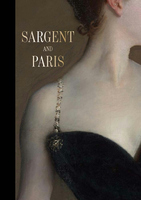
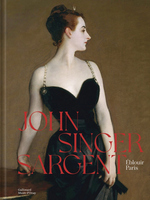
Sargent in Paris
The Metropolitan Museum of Art, New York
April 27–August 3, 2025
Catalogue:
Stephanie L. Herdrich, ed.,
Sargent and Paris.
Yale University Press, 2025.
256 pp.; 175 color illus.; contributors; lenders to the exhibition; works in the exhibition; notes; selected bibliography; index.
$50.00 (hardcover)
ISBN: 9781588397959
John Singer Sargent Éblouir Paris (Sargent. Dazzling Paris)
Musée d’Orsay, Paris
September 23, 2025–January 11, 2026
Catalogue:
Caroline Corbeau-Parsons and Paul Perrin, eds.,
John Singer Sargent: Éblouir Paris.
Gallimard, 2025.
256 pp.; 130 color illus.; chronology; list of works in the exhibition; selected bibliography; index.
€45.00 (hardcover)
ISBN: 9782073114907
While British and US museums have staged numerous monographic exhibitions of the expatriate US artist John Singer Sargent’s work during the last several decades—and especially in the past few years prior to and during the centenary of his death in 2025—major French museums have surprisingly overlooked it until now.[1] John Singer Sargent Éblouir Paris (Sargent. Dazzling Paris), co-organized by The Metropolitan Museum of Art (The Met) and the Musée d’Orsay, was on view in Paris from September 23, 2025, to January 11, 2026, after a run in New York as Sargent in Paris from April 27 to August 3, 2025.[2] This review begins with an analysis of the Musée d’Orsay’s iteration before comparing it to The Met’s. Though many of the same works were on view in both New York and Paris, the content and design of the two versions differed in notable ways that speak more broadly to how intended audiences and museum holdings can dramatically alter the exhibition of an artist’s work.[3] This review concludes with a few remarks about the US and French versions of the catalogue.
Sargent on View in Paris
Co-curated by Caroline Corbeau-Parsons, Curator of Drawings and Paintings, and Paul Perrin, Chief Curator and Director of Collections, both at the Musée d’Orsay, in collaboration with Stephanie Herdrich, the Alice Pratt Brown Curator of American Painting and Drawing at The Met, John Singer Sargent Éblouir Paris consisted of an introduction followed by eight sections organized roughly chronologically and primarily by genre. Though the exhibition focused on the work the artist created while living in Paris between 1874 and 1886, it made a wider claim about the significant impact Paris and France had on his entire career. It traced Sargent’s early development as an art student in Paris; his travels from Paris to destinations in England, continental Europe, North Africa, and the United States; his success as a society portraitist in Paris; the scandal at the French Salon involving his portrait of Madame X; his ongoing engagement with France after moving to London; and, finally, his “brilliant revenge” (as the wall text has it) on the French art world when he exhibited his portrait of La Carmencita (Carmen Dauset Maureno) (ca. 1890; Musée d’Orsay, Paris) to much critical acclaim at the Salon of 1892. To dramatize this narrative, the exhibition’s design employed striking shifts in wall color and spotlighting of individual works, clearly distinguishing Sargent’s studio portraits from his travel paintings, as well as carefully conceived sightlines between key works.
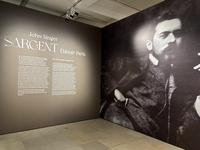
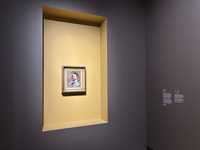
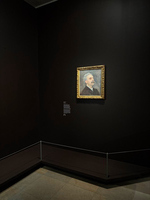
The exhibition began by introducing Sargent as a Belle Époque portraitist who also created landscapes and watercolors and as “one of the most important American artists of his generation.” The opening wall text in French and English established the overall aim of the show: to convey the essential role Paris, and France more broadly, played in Sargent’s development and success as an artist: the artist’s ambition was to “dazzle the world’s most prestigious art capital.” Two youthful images of the artist accompanied this introductory text: a photomural of Sargent, cigarette in hand, in a relaxed pose exuding an air of cultivated nonchalance and a small, head-and-shoulders self-portrait, one of only three he painted, in a gold-colored niche that somewhat overwhelmed the work (figs. 1, 2). While the photograph presented him as a self-confident, charming, and socially astute artist seemingly capable of “dazzling” the Parisian art world, the self-portrait with its stiff and serious expression suggested someone far less self-assured.
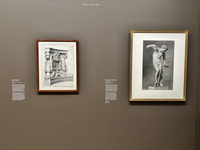
The entry area opened into the first section, “L’élève prodige de Carolus-Duran” (“Carolus-Duran’s Star Pupil”), which displayed works that introduced the major thematic concerns of the exhibition. It began with an arrangement of Sargent’s student drawings and paintings, showcasing the early development of his signature style in the atelier of the highly regarded French portrait painter, Carolus-Duran.[4] Sargent arrived in Paris well-trained in accurately copying ancient sculpture like The Dancing Faun (1st century CE; Uffizi Gallery, Florence), and he continued to excel in detailed rendering at the École des Beaux-Arts, winning a medal in a student competition, a first for a US artist, for his drawing of architectural ornaments (fig. 3). As demonstrated, it was in Carolus-Duran’s studio that he learned the alla prima (wet-on-wet) technique and the compositional approach of building volume from dark to light. The selection of paintings here suggested the young artist’s preference for painting “types” of different races and social statuses other than his own, including a “Mediterranean-looking” male model, “a Spanish Roma woman,” and a Parisian beggar girl (figs. 4, 5). A three-minute video titled “Sargent & Carolus-Duran, quand l’élève dépasse le maître” (“Sargent & Carolus-Duran, When the Student Surpasses the Teacher”) concluded the display of his student work by narrating Sargent’s arrival in Carolus-Duran’s atelier, his ascent as a star pupil, and his eventual eclipse of his teacher in the eyes of the French press. While Sargent’s much acclaimed portrait of Carolus-Duran (1879; The Clark Art Institute, Williamstown) was regrettably not on view here (or at The Met), it was briefly featured in the video and was illustrated in the US and French catalogues.
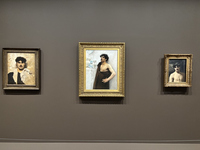
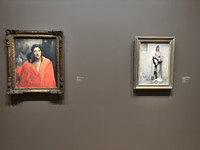
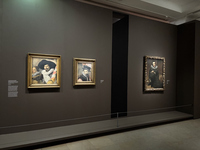
Part of this first section included a variety of portraits and genre scenes from the late 1870s and early 1880s done after his training. Copies after paintings by Diego Velásquez and Frans Hals were juxtaposed with portraits of close friends and intimates, Paul-César Helleu, Vernon Lee (Violet Paget), and Albert de Belleroche, all seemingly inspired by the loose brushwork and dramatic light effects of the seventeenth-century artists much admired and emulated by Sargent and his contemporaries (figs. 6, 7). Along with the figure paintings were two of the artist’s well-known, Impressionist-style scenes of Paris from US museum collections: Rehearsal of the Pasdeloup Orchestra at the Cirque d’Hiver (ca. 1879–80; Museum of Fine Arts, Boston) and In the Luxembourg Gardens (1879; Philadelphia Art Museum) (fig. 8). The wall label for the former introduced Sargent’s passion for music, and the text for the latter mentioned that he rarely represented Parisian subjects, but it was not entirely clear why these works were presented together with the portraits.
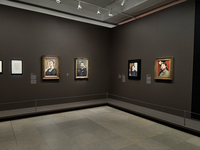
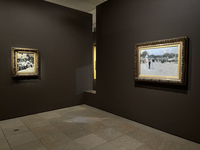
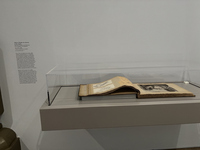
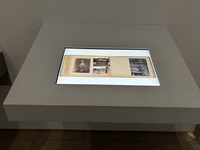
The second and third sections of the exhibition, as suggested by the titles—“Sargent, Paris et le monde” (“Sargent, Paris and the World”) and “Peintures ‘de voyage’” (“Travel Paintings”)—concentrated on the drawings, sketches, and finished compositions inspired by what the wall text described as the artist’s “myriad travels around France and in the southern Mediterranean countries of Italy, Spain and Morocco.” A wall-sized map in the third section helpfully indicated the locations where he traveled and that he depicted (fig. 9). In addition, the light sky-blue walls with enlarged reproductions of marine sketches in the second section alerted visitors to the shift in subject matter. The wall text explicated that “Sargent, despite being fully established in Paris, remained an inveterate roving painter” who typically created a finished composition based on travel sketches and showed it along with a portrait at almost every Paris Salon between 1877 and 1885. (This claim about Sargent’s exhibition practice was further detailed in an elaborate, six-minute, wall-sized video, “Sargent and the Salon,” later in the exhibition.) Sargent’s scrapbook, filled with travel sketches and reproductions of art and architecture, appeared alongside a digital recreation that progressively advanced its pages, providing evidence of the artist’s working method and his eclectic sources of inspiration, from canonical paintings by Velásquez to Gothic architecture (figs. 10–12). The installation in this gallery reinforced the connection between sketches and finished works: a dramatic view across the bow of a ship on the open scrapbook page reoccurred with only slight modification in the nearby painting Atlantic Storm (fig. 13).
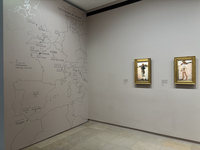
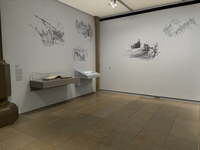
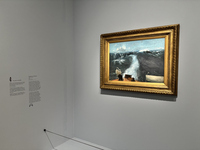
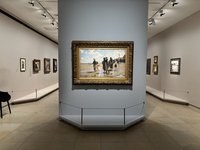
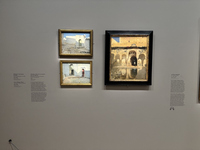
“Peintures ‘de voyage’” included both Salon-ready images and less finished sketches of architecture and figures in Cancale, Grez-sur-Loing, Capri, Granada, Tangier, and Venice. The presentation here underscored not only the diversity of Sargent’s destinations but also the variety of subjects, pictorial devices, and media he used. Setting Out to Fish (En route pour la pêche) and Smoke of Ambergris (Fumée d’ambre gris), two of his largest travel compositions, exhibited at the Salon in 1878 and 1880, respectively, served as bookends for section three (figs. 14, 15). These paintings revealed Sargent’s ongoing fascination with female types, understood generally as exotic even as they referenced geographically specific locales, Cancale in France and Tangier in Morocco, respectively. The former, “his first critical success at the Salon,” represents a group of Breton women in local dress walking on a beach with their children on the way to collect fish and shellfish at the edge of the shore, whereas the latter captures a solitary female figure dressed in shades of white inhaling the smoke of smoldering ambergris in the incense burner at her feet. Along with these more finished compositions intended for the Salon were smaller sketches, some without figures, such as a group of studies showing dramatic light and shadow effects on Moorish architecture at the Alhambra in Southern Spain (fig. 16). According to the wall text, Sargent’s Venice images, all displayed along one wall, departed from his earlier, more stereotypical representations of people and places. They were described as evoking a “sombre, more authentic and working-class face of the city” (fig. 17). Notably missing from this section because it cannot travel was El Jaleo (1882; Isabella Stewart Gardner Museum, Boston), one of Sargent’s most celebrated works inspired by his trip to Spain. It received numerous accolades at the Salon of 1882 for its striking depiction of an Andalusian dance. A significantly smaller painting with a similar subject, The Spanish Dance (La Dance espagnole), served as a sort of placeholder for El Jaleo, which featured prominently, albeit in a mediocre reproduction, in the video, “Sargent and the Salon,” on view in an adjacent gallery (fig. 18).
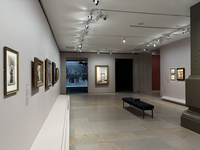
Another dramatic shift in wall color to a deep carmine along with Carolus-Duran’s The Lady with a Glove (La Dame au Gant), a full-length portrait of the artist’s wife Pauline Croizette painted in 1869 and exhibited at the Salon the same year, announced the fourth section dedicated to Sargent’s portraiture (fig. 19). The Carolus-Duran painting was the only work not by Sargent in the entire exhibition, and surprisingly, its wall label did not explain its inclusion. Perhaps the intention was to show one of the predecessors to Sargent’s portrayal of another so-called type of woman known as the “Parisienne,” defined on the wall label as “the woman of our time, the French woman” in the words of the nineteenth-century French art critic, journalist, and writer Marius Chaumelin.
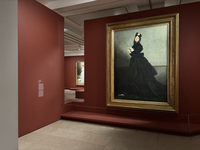
Sections four, five, and six were all dedicated to Sargent’s portraiture, ranging from full-length portraits intended for the Salon or commissioned by wealthy patrons to smaller-scale images of friends and colleagues, some gifted by the artist to the sitters. As the wall text for section four, “Sargent portraitiste” (“Sargent Portraitist”), explicated, “Every year from 1877 to 1884, [the artist] submitted a portrait to the Salon to attract the attention of enthusiasts.” Seven of those portraits were on display, starting with his first Salon submission in 1877, the portrait of his childhood friend Frances (Fanny) Watts with its striking salmon-toned background as well as his first full-length portrait of Marie Buloz Pailleron (Madame Edouard Pailleron) with its unusual, modern outdoor garden setting (fig. 20).
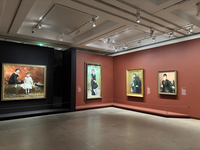
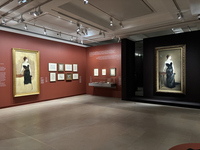
What stood out in the selection of paintings and in the interpretive comments in the accompanying labels was Sargent’s modern, Impressionist reimagining of a painting genre, which was “on the rise” at the Salon during this period. The installation offered a rare, arguably unprecedented, opportunity to compare four of his most innovative portraits of the Pailleron children, the Boit sisters, Madame X, and Dr. Pozzi, all spotlit and dramatically displayed on dark walls around the empty central core of the gallery space, creating unobstructed sightlines among them (fig. 21). The arrangement in the gallery also made it possible to compare Madame X with Sargent’s other depictions of Parisiennes, especially his portrait of Mrs. Arthur O’Connor (Marguerite de Ganay) from a private collection in France and on public view for the first time (figs. 22, 23). Painted in 1882, a year before Sargent started working on Madame X, it represents the daughter of the “art enthusiasts” the Marquis de Ganay and the US heiress Emily Ridgway. It shares several pictorial similarities with the infamous painting. Both women wear black evening dresses, have exposed shoulders, and appear in profile with a diamond crescent ornament in their pulled-up hair, but Marguerite’s half-length portrait does not expose her body to the same revealing degree as the full-length painting of Madame X.
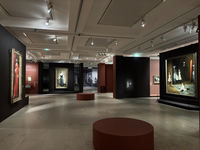
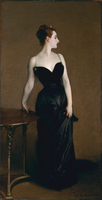
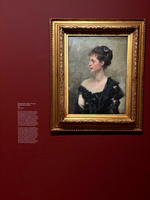
Section five, “Un succès de scandale: le portrait de ‘Madame X’” (“A Scandalous Success: The Portrait of ‘Madame X’”), was tucked into a corner area adjacent to the portrait of Madame X. Sargent’s attempt to break with convention in his portrayal of Virginie Amélie Avegno Gautreau, a US expatriate from New Orleans married to a French banker and renowned for her beauty, went too far, causing controversy at the Salon of 1884. An unfinished copy of the portrait of Madame X as well as two printed reproductions of the original painting and a caricature of it by Caporal in a nearby display case helped to visualize why the original fallen shoulder strap was so shocking (fig. 24). Sargent’s process was on display: ten preliminary sketches offered insight into Sargent’s struggle to settle on a pose for his sitter while his frustration with her “hopeless laziness” was spelled out in a letter he wrote to his close friend, Belleroche.
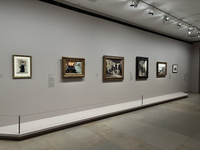
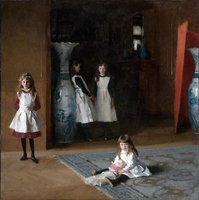
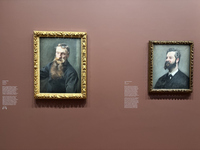
The Daughters of Edward Darley Boit, the much-celebrated painting of the four children of Sargent’s US expatriate friends Edward Darley Boit and Mary Louisa Cushing of Boston in the front hall of their apartment in Paris appropriately served as a prologue to section six, “Portraits d’amis et d’artistes” (“Portraits of Friends and Artists”) (fig. 25). Lined up and separated on opposing walls by gender, this group of paintings portrays his friends and close acquaintances, both men and women, including the French sculptor Auguste Rodin; the French writer, dramatist, translator, and art critic Madame Allouard-Jouan (Emma Marie Cadiot de Montbarbon); and the French fencing master who taught Sargent and Carolus-Duran at the Cercle de l’Union Artistique, a private club in Paris (figs. 26–28). Their identities, described in the wall texts, color in the artistic, literary, and social networks to which Sargent belonged.
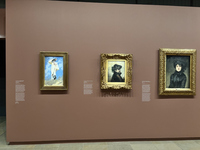
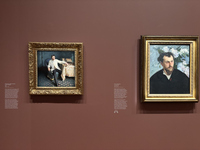
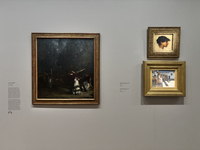
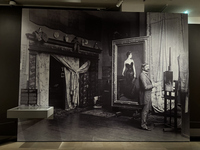
The penultimate gallery, “Après Paris, Sargent et la France” (“After Paris, Sargent and France”), presented only seven, mostly small scale, paintings and, by contrast, a large photomural of a much-reproduced image showing Sargent in his studio on the Boulevard Berthier in Paris around 1884 with Madame X on an easel behind him (fig. 29). (A similar photomural was used in the entry area of the New York version of the exhibition.) Confusingly, while the photograph showed Sargent in Paris, this section sought to demonstrate the curatorial claim that France remained significant to Sargent even after the kerfuffle with Madame X and his subsequent move to London (not directly precipitated by the painting’s “scandal,” as emphasized several times in both the US and French catalogues). Several genre-style portraits of artists at work and with their spouses or families reinforced his long-lasting friendships with French artists Albert Besnard, Claude Monet, and Helleu (fig. 30). Two other portraits of Helleu appeared in the first section of the exhibition (see fig. 7), so his reappearance attested to their lasting friendship even after Sargent’s departure from Paris. A bust portrait of the French composer Gabriel Fauré, whose music the artist admired, served as proof of Sargent’s return trip to Paris in the late 1880s (fig. 31), as he likely painted it when he was in the city for the Exposition Universelle in 1889.
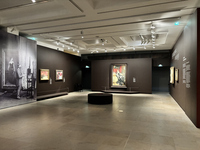
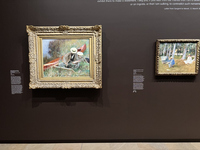
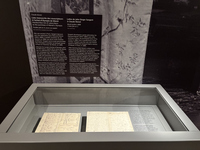
Sargent did more than record his French friends and acquaintances for posterity; he had a direct impact on the fate of an iconic work now in the collection of the Orsay. Together with Monet, he helped raise the funds to purchase Edouard Manet’s Olympia (1863; Musée d’Orsay, Paris) for the French state. In a display case attached to the lower left of the photomural of Sargent in his Paris studio were two documents: Monet’s handwritten list of subscribers, including Sargent, next to a letter from Sargent to Monet detailing several donations, including his own and that of the US heiress, Winnaretta Singer, whose full-length portrait by Sargent appeared nearby (fig. 32, 33). This gallery lacked the “dazzle” of the prior sections of the exhibition and required reading the wall texts for understanding how the paintings were connected to Sargent’s ongoing association with France.
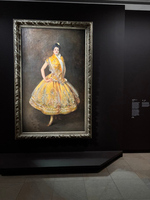
The concluding section, “‘Une revanche éclatante’” (“‘A Brilliant Revenge’”), in a tight, corridor-like space, brought Sargent’s relationship with the Parisian art world to a close with one last painting, La Carmencita (Carmen Dauset Moreno), exhibited at the Salon of 1892 and the first of the artist’s works purchased by the French state (and now in the collection of the Orsay) (fig. 34). Characterized in this exhibition as the artist’s “brilliant revenge” for the scandal caused by Madame X, this painting portrays the flamenco dancer Carmen Dauset Moreno, whose performances captivated Sargent and his contemporaries. Rather than showing her dancing, Sargent paints her in a dynamic, confident standing pose with hands on her hips and in an eye-catching, vibrant yellow costume decorated with an elaborate spangled and beaded pattern. While Sargent’s ambition to “dazzle” his audience seemed to be on full display here, the tight, corridor-like space sadly made it difficult to fully appreciate this final masterpiece.
Diverging Institutional Visions in New York and Paris
While this multi-venue exhibition owed a notable debt to a previous presentation of Sargent’s early works, Uncanny Spectacle: The Public Career of the Young John Singer Sargent, curated by Marc Simpson for the then called Sterling and Francine Clark Art Institute in 1997, it approached this material with current scholarly concerns in mind. The earlier exhibition and catalogue reconstructed Sargent’s early exhibition history and the critical reception of his works. These topics remained crucial to the current, multi-venue show and its catalogues, but an appraisal of Sargent’s personal and professional networks also served as a prominent throughline.
The two host institutions seized the opportunity to promote their own collections. As a result, there were not only significant differences in their presentations, but also imbalances in their treatment of particular works. In New York, much attention, perhaps too much in the context of a thematic exhibition, was lavished on Madame X, touted as “an icon of The Met collection” in the online description.[5] Three sections of The Met’s version, “La Parisienne,” “Madame X,” and “The Paris Salon of 1884,” were dedicated to exploring the painting and its creation, its artistic and social context, and its reception. “La Parisienne” included six portraits of the so-called Parisienne by Sargent’s contemporaries, whose work he knew and admired (fig. 35). These paintings set the visual context for Madame X, reinforcing by contrast why Sargent’s approach to this modern female type was regarded as so radical and shocking. In the succeeding gallery, Madame X, as the centerpiece, appeared surrounded by even more preliminary studies in graphite and oil than in Paris as well as reproductions of the original painting with the infamous, fallen shoulder strap (fig. 36). “The Paris Salon of 1884” featured a life-sized, digital recreation of the installation in gallery 31 at the Paris Salon where Madame X caused such a critical uproar. This visualization periodically shifted from color to black and white and highlighted groupings of paintings by genre, for example, female nudes and portraits, displayed alongside Sargent’s Madame X. This careful and extensive treatment of one painting was well done, but it seemed out of place in a broad, thematic exhibition about Sargent and Paris.
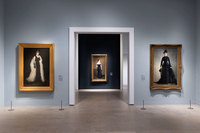
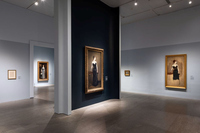
In Paris, Madame X appeared in the section devoted to Sargent’s Salon-style portraits with fewer preliminary drawings and press notices in the gallery corner beside it (see fig. 24). Instead, La Carmencita, the one painting by Sargent bought from him by the French state for the Musée du Luxembourg, then a museum for contemporary art, assumed pride of place in its own small gallery space at the conclusion of the exhibition (see fig. 34). Its importance as Sargent’s “brilliant revenge” on the Parisian art world and its “conjuring up [of] memories of the daring El Jaleo and Madame X” was overstated in the wall text.
Other differences in interpretation may have been the result of curatorial vision or even the broader missions of both museums. For example, rather generic language was used in New York and more dramatic turns of phrase in Paris: “Sargent and Paris” versus “Sargent. Dazzling Paris”; “In the Studio” versus “Carolus-Duran’s Star Pupil”; “Madame X” versus “A Scandalous Success: The Portrait of Madame X”; “Uncanny Spectacle” versus “‘A Brilliant Revenge.’” The Met’s interpretive texts retained a certain degree of objectivity, though they risked being too vague and understated whereas those at the Orsay had a more subjective character, albeit one that verged on being too sensational.
Assumptions about the intended audiences also may have contributed to the differences in the exhibitions and the US and French versions of the catalogue. The Met has already had several exhibitions of Sargent’s work, so the artist needed less of an introduction in New York than he did in Paris. The Met’s exhibition also participates in a broader reexamination of Sargent’s oeuvre as it relates to his travels and experience of place recently happening in the United States. Sargent and Paris followed Sargent and Spain, which was on view at the National Gallery of Art in Washington from October 2, 2022, to January 2, 2023, and at the Legion of Honor, Fine Arts Museums of San Francisco from February 11 to May 14, 2023.[6] The Orsay marketed its exhibition as an introduction to Sargent, though the wall texts assumed familiarity with the French artistic context, such as Carolus-Duran’s studio.
Similarly, the catalogues take their intended readers into consideration. Each catalogue has its own introductory essay by its respective curators, followed by several essays that elaborate the central themes of the exhibitions, considerably developing them by providing rich historical and art historical context.[7] One essay, “American by Birth, French by the Brush,” coauthored by Elaine Kilmurray and Richard Ormond, preeminent Sargent scholars who have collaborated on the artist’s catalogue raisonné for years, demonstrates that “his sensibilities were formed to no insignificant degree by French values and ideas” and “much of his artistic and cultural experience was seen through a French prism,” as attested by comments from friends, his critical reception, and his painting style (221).[8] Another essay, “Fellowship and Friendship: Sargent’s Artistic Networks” by Corbeau-Parsons used correspondence and early portraits to map out the social networks that Sargent built, from his early friendships with expatriate US artists, such as (James) Carroll Beckwith in Carolus-Duran’s atelier, to lifelong friendships with the artists Helleu (whom Sargent referred to as “Leuleu”) and Belleroche (whom Sargent affectionately called “Baby Milbank”), who also modeled for him, to his membership in the exclusive club, the Cercle de l’Union Artistique, which brought him into contact with many well-established French artists, musicians, and writers, including the novelist Paul Bourget, who may have introduced him to Rodin.
The travel paintings and portraits were addressed in two separate essays that concentrated on Sargent’s submissions to the Salon. In “Nomadism: Sargent’s Travel Paintings and ‘Types’ at the Salon,” French art historian Hadrien Viraben frames his argument about Sargent’s strategic representation of popular, often exotic “types” in his travel paintings around images in the scrapbook on view in New York and Paris, exploring how Sargent fused portrayals of actual people and places with ones informed by both personal and public imagination. In “Sargent the Portraitist: A French Reception,” Perrin traces the evolution of Sargent’s portraiture at the French Salon, from his first submission of Fanny Watts in 1877 to La Carmencita in 1892, in response to both the French critics’ embrace of this genre and the increasingly modern-looking portraits by French painters, including Carolus-Duran, Léon Bonnat, Manet, Monet, and Auguste Renoir.
Two additional essays, one on the Parisienne and the other on Madame X, examine Sargent’s representation of and friendships with women. Erica E. Hirshler, Croll Senior Curator of American Paintings, Museum of Fine Arts, Boston, in “Les Parisiennes: Sargent and the Women of Paris,” convincingly argues that the majority of Sargent’s Parisiennes (with the exception of Virginie Amélie Gautreau) were “women of substance . . . most attractive for their minds,” as proven by accounts of their intellectual pursuits and descriptions of them in correspondence (132). This essay with its extended discussion of the passion for art, literature, and music that Sargent shared with his female sitters as well as the role they played in helping the artist navigate Parisian society offered a welcome complement to the one on Sargent’s network of men by Corbeau-Parsons. In “Sargent and Gautreau: Fashioning Celebrity in Paris,” Herdrich gave a comprehensive analysis of the much-discussed portrait of Madame X, its relationship to Sargent’s earlier portraits that had garnered praise at the Salon, the struggle involved in capturing Gautreau’s likeness, the invention of a new version of the Parisienne, the painting’s failure at the Salon, and the impact of its critical reception on Sargent’s career.
Aligning with The Met’s greater emphasis on Madame X and its aim to give less seasoned scholars opportunities to publish, the US version of the catalogue includes an essay, “Echoes and Afterlives of ‘Madame X,’” by Caroline Elenowitz-Hess, a research assistant in The American Wing at the museum. It traces the visual legacy of Sargent’s controversial work from the French painter Gustave Courtois’s Madame Gautreau (1891; Musée d’Orsay, Paris), shown at the Salon of 1891, to more contemporary works in the United States.
The Orsay’s catalogue contains explanatory texts for readers presumed to be less familiar with Sargent: a chronology by Kilmurray, as well as individual essays on Cancale and Morocco, also by Kilmurray, and on specific paintings and their sitters: “The Pailleron Family” by literary scholars Emily Eels, Isabelle Gadoin, and Charlotte Ribeyrol; “Dr. Pozzi” by Herdrich; “The Daughters of Edward Darley Boit” by Hirshler, who already published a book on this painting; and “La Carmencita” by Corbeau-Parsons.[9]
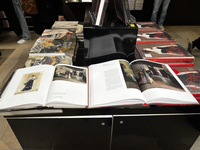
A final note about the design and production of both publications: the Orsay’s catalogue, as compared to that of The Met, is lacking in two aspects, as seen in this photograph of A Venetian Interior in both books (fig. 37). The reproduction of this Venice scene, as well as those of several other paintings, are spread across the gutter of the book, and even more disappointing, the catalogue inaccurately reproduces Sargent’s palette (note, in particular, the highly saturated pink on the dress of the woman on the left in the painting), one of the most celebrated aspects of his work.
Despite their differences, both the exhibitions and their accompanying catalogues accomplished several broad aims in tracing the impact of Sargent’s experience in Paris on his career. They confirmed Sargent’s ability to capture in paint both the personalities of his sitters and the distinct ambiences of landscapes and architecture. They reinforced his penchant for travel and for cultures other than his own Anglo-European one as well as his fascination with historical and modern art, fashion, music, and dance. They highlighted his youthful exuberance and social intelligence, which contributed to the success of his training abroad, his exhibition strategy, and his network building. On a more practical level, both venues brought together for the first time some of Sargent’s best-known paintings in public collections with lesser-known works from private ones. And significantly, the Paris presentation introduced the French public and Orsay visitors from across the globe to an artist who had previously received little attention in French museums. Since the exhibition focused on his early work, it leaves open the opportunity for another Sargent show in France.
Acknowledgments
I am very grateful to France Nerlich, préfiguratrice du Centre de Ressources et de Recherche Daniel Marchesseau du Musée d’Orsay and a member of NCAW’s Editorial Advisory Board, for her assistance in gaining access to John Singer Sargent Éblouir Paris on a Monday when the Musée d’Orsay was closed to the public.
Notes
[1] NCAW has published reviews of two recent Sargent exhibitions: Gretchen Sinnett, exhibition review of Fashioned by Sargent, Nineteenth-Century Art Worldwide 23, no. 1 (Spring 2024), https://doi.org/10.29411/ncaw.2024.23.1.20; and Barbara Dayer Gallati, exhibition review of Heiress: Sargent’s American Portraits, Nineteenth-Century Art Worldwide 24, no. 3 (Autumn 2025), https://doi.org/10.29411/ncaw.2025.24.3.20.
[2] This review includes the titles in French and English that the Musée d’Orsay used for promotional purposes on their website.
[3] The Met’s website provides extensive written and photographic documentation of the installation in New York, see “Sargent and Paris,” The Metropolitan Museum of Art, accessed January 28, 2026, https://www.metmuseum.org/.
[4] The section titles and wall labels were in French and English. The English translations that appeared in the exhibition are used throughout this review.
[5] See “Sargent in Paris: Inside the Exhibition,” The Metropolitan Museum of Art, accessed January 30, 2026, https://www.metmuseum.org/.
[6] For another addition to this current trend in Sargent scholarship, see Jeffrey Richmond-Moll, “‘Complete Cut-off-Ness’: John Singer Sargent’s Tyrolean Sojourn,” Nineteenth-Century Art Worldwide 25, no. 1 (Spring 2026), https://doi.org/10.29411/ncaw.2026.25.1.4.
[7] The US version of the catalogue essay titles appear here.
[8] All page numbers are from the US version of the catalogue.
[9] Erica E. Hirshler, Sargent’s Daughters: The Biography of a Painting (MFA Publications, 2009).