Lifeblood—Edvard Munch
Reviewed by A. David SmithA. David Smith
Oxford University
Email the author: david.smith[at]pharm.ox.ac.uk
Citation: A. David Smith, exhibition review of Lifeblood—Edvard Munch, Nineteenth-Century Art Worldwide 25, no. 1 (Spring 2026), https://doi.org/10.29411/ncaw.2026.25.1.24.
This work is licensed under a Creative Commons Attribution-NonCommercial 4.0 International License  unless otherwise noted.
Your browser will either open the file, download it to a folder, or display a dialog with options.

Lifeblood—Edvard Munch
Munch Museum, Oslo
June 27–September 21, 2025
Catalogue:
Allison Morehead, Heidi Bale Amundsen, eds.,
Lifeblood—Edvard Munch.
340 pp.; 92 color and 90 b&w illus.; list of exhibited items.
Munchmuseet, 2025.
$50.00 (hardcover)
ISBN: 9788284620534
We can be so overwhelmed by great art that we sometimes feel that it exists outside of the real world. Lifeblood—Edvard Munch, at the Munch Museum in Oslo, is a strong corrective to this view. It vividly shows how Edvard Munch was powerfully influenced by his health and that of those around him, illustrating how he was aware of medical progress. It does this by showing his works side-by-side with medical artifacts of the time. The exhibition included some seventy paintings, thirty-one drawings, twenty-six prints, twenty-nine photographs, and thirty-nine artifacts occupying eight rooms on one floor of the thirteen-floor Munch Museum. The physical space was well organized, and every consideration was given to the comfort of visitors, including those with disabilities. The rooms were color-coded. After an “Introduction,” the rooms in turn covered “Family Medicine,” “Sickness and Death,” “Gender of Melancholy,” “Self and Technology,” “Wellness and Tourism,” “Great Art for Great Doctors,” and, finally, “Care.” The concept and research for this exhibition were developed by the curator, Allison Morehead (Queen’s University, Kingston), and she had highly professional support from the staff of the Munch Museum. The result was an outstanding exhibition.
The exhibition was accompanied by a large book that is both less and more than a catalogue. Although it includes a list and illustrations of the objects on display, it does not systematically discuss them, so a reader will not find many descriptions of individual works. Rather, it includes several articles by writers who are not art historians, but who are provoked by the exhibition or by a particular work. These chapters provide valuable background to the exhibition and are often insightful, but they are uneven in interest and, indeed, I found that the meaning of some was obscure. Unfortunately, the book does not have an index.
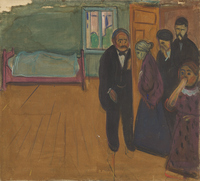
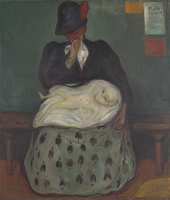
During Munch’s lifetime, most people were born and died at home; they visited a hospital only when they were seriously ill. Death in the Sickroom and The Smell of Death (fig. 1) vividly shows the atmosphere after death in a home. Munch’s father was a doctor, and, as a boy, Munch often went with him on visits to patients. Thus, from an early age he was highly conscious of illness and death, and his family was not spared: Munch’s mother died when he was five and his sister Sophie died at the age of fifteen, when Munch was aged fourteen; tuberculosis was the cause of death in both cases. Indeed, tuberculosis was the leading cause of illness and death in Europe for much of the nineteenth century and remains the main cause of death from infectious diseases in the world today. The exhibition vividly includes sputum bottles sufferers used to store the material that they coughed up. In 1882, Robert Koch showed tuberculosis to be due to a microbial infection: the first disease attributed to a “germ.” This led to the search for other diseases caused by germs, a major medical advance. An earlier advance was René Laennec’s invention of the stethoscope in 1816, which greatly helped in the diagnosis of tuberculosis and later of diseases of the heart; several early stethoscopes were included in the exhibition. Another medical concept that was developing strongly in the nineteenth century was that of inherited disease. It was the theme of Henrik Ibsen’s play Ghosts (1881) in which a son develops syphilis from his father’s activities. Munch’s painting Inheritance (fig. 2) showing a woman holding a sick-looking newborn was done after he had visited a museum about syphilis in Paris; two gruesome wax models from this museum were on display. A moving piece by the novelist Thorvald Steen, inspired by this painting, is in the accompanying book (207–09).
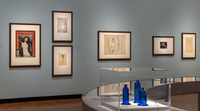
A striking example is that in which Munch’s famous lithograph Madonna is juxtaposed with molds for contraceptive devices (fig. 3). The lithograph shows a half-naked Madonna surrounded by swimming spermatozoa that lie outside a border. In one corner is a bony fetus. This lithograph can be interpreted as illustrating contraception and was one of the most frequently printed of Munch’s works, with more than a hundred impressions known.
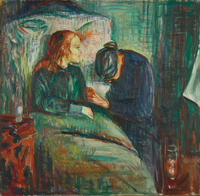
The death of his sister Sophie had a deep and lasting impression on Munch, and several years later he created one of his greatest works, The Sick Child (1885–86; National Museum, Oslo). Over a period of forty years, Munch made six versions of this painting, including one in 1927 (fig. 4), and he derived some etchings and many lithographs; some of the latter were on display.[1] A great deal has been written about this work, and it is a pity that there was no summary of these writings in the book. There is a short and thoughtful piece by Morehead in which she writes: “While the sick child is often associated with Munch’s memories of his sister Johanne Sophie Munch dying of tuberculosis, the artist only encouraged that connection long after he painted the first version of the work” (173). “When I paint illness,” Munch wrote around his seventieth year, “it is a healthy reaction that one can learn from and live by.”[2] Munch thus situated his art, retrospectively, as a form of medicine, claiming that works like The Sick Child, in its multiple painted and printed iterations, might have the capacity to heal.
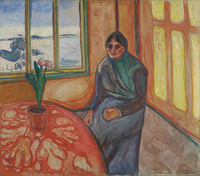
Munch was concerned about mental health as well as physical health, and, worried about his addiction to alcohol, he referred himself to a psychiatric clinic in Copenhagen at the age of forty-four; he stayed for eight months. Many of his paintings also reflect this interest. Several works have the title Melancholy and depict people suffering from depression. One of the most striking is a painting of his sister Laura, who was four years younger than he was (fig. 5). She is depicted in a mental hospital at the age of thirty-three. In the exhibition, this painting is dramatically exhibited behind a window with thick bars to indicate that Laura is imprisoned in a hospital. The book also includes a portrait done of Laura at the age of fifteen (144)—a striking contrast (1883; Munch Museum, Oslo). It would also have been interesting to see another of Munch’s paintings of Laura, Evening (1888; Thyssen-Bornemisza National Museum, Madrid), done when she was twenty-one, since this shows a woman who is meditating in solitude in a garden. The exhibited work is vividly described by the Swedish novelist Sara Stridsberg in the accompanying book:
Motionless and frozen as though in a dream, Laura sits alone in a burning room . . . She cannot defend herself, she has become an immovable object. Her eyes are black hollows into which the world pours unhindered. There is no gaze from within that might protect her . . . The painting of Laura is not just a picture of her and all those in hospitals, it is a picture of what the painter would have been without his paintings, shadowless. Her brother paints as a means of driving the ghosts out, to avoid sinking into melancholy himself. In the painting, Laura has no shadow, she belongs to the shadowless. The shadow Edvard leaves on the world is massive: his paintings, the people in them, the screams. (196)
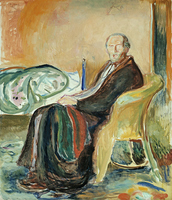
Munch was continuously afraid that he might become ill, and he did indeed contract Spanish influenza. During that time, he painted Self-portrait with the Spanish Flu (fig. 6), which vividly shows his ill state. In the exhibition, by the side of the painting, was shown the apparatus, including an oxygen cylinder, that Munch used to treat himself while he was ill. He survived for another twenty-five years, to die of pneumonia in 1944, aged eighty, following a heavy cold.
The exhibition shows us that physical and mental illness were part of the lifeblood that drove Munch to paint and that they impart much of the greatness we find in his art.