Van Gogh: The Immersive Experience
Van Gogh Inside: Love, Vincent
Garden
Reviewed by Jung E. Choi
Jung E. Choi
Duke Kunshan University
Email the author: jung.choi[at]dukekunshan.edu.cn
Citation: Jung E. Choi, exhibition review of Van Gogh: The Immersive Experience; Van Gogh Inside: Love, Vincent; Garden, Nineteenth-Century Art Worldwide 25, no. 1 (Spring 2026), https://doi.org/10.29411/ncaw.2026.25.1.13.
This work is licensed under a Creative Commons Attribution-NonCommercial 4.0 International License  unless otherwise noted.
Your browser will either open the file, download it to a folder, or display a dialog with options.
Van Gogh: The Immersive Experience
GIDC Gwangmyeong, Gyungki-do
September 22, 2023–March 3, 2025
Van Gogh Inside: Love, Vincent
Ground Seesaw Myeongdong, Seoul
May 3–December 15, 2024
Garden
Arte Museum, Jeju
September 30, 2020–June 30, 2021
The Paradox of Digital Sublime: Immersive Digital Exhibitions of Impressionism
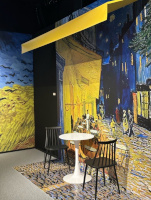
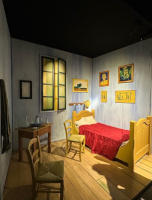
As you step into a dim, somewhat mysterious space, a seat awaits you under a large yellow awning—just like in the café depicted in Vincent van Gogh’s Café Terrace at Night (1888; Kröller-Müller Museum, Otterlo), set in the Place du Forum, Arles, France. Sitting there, gazing out at the night street, you become the protagonist of a masterpiece (fig. 1). On one side, a familiar bust of the famous painter is ceaselessly brought to life with bold, textured brushstrokes. On the other, a large screen plays a video with an explanation of Van Gogh’s iconic work The Starry Night (1889; Museum of Modern Art, New York). The journey into Van Gogh’s world continues. A bas-relief vase becomes a canvas onto which various still lifes with vases by Van Gogh are projected one after another. After passing through the entrance of the house where he spent his childhood, you sit on the red-sheeted bed inside the small room in Auvers-sur-Oise, where Van Gogh spent his final days (fig. 2). At the end of the journey, you enter a vast, five-walled space where Van Gogh’s diverse paintings are brought to life through immersive projections. Surrounded by vivid brushstrokes and bold colors, you feel as if you are stepping inside his works, listening to the stories he has to tell.
Van Gogh: The Immersive Experience, a highly popular traveling exhibition of Van Gogh’s work, has toured more than fifty-six venues, achieving great success in cities like Seoul, Tokyo, Beijing, and Shanghai in Asia—urban centers that actively brand themselves as tech-savvy and future-oriented cultural hubs. In Seoul, notably, the exhibition has a semipermanent venue, reflecting the sustained popularity of immersive digital exhibitions (IDEs) featuring Impressionist painters across Asia.[1] In Shanghai, exhibitions have been held annually since the COVID-19 pandemic, including Meet Monet: Immersive Light and Shadow Exhibition (2022), Van Gogh Alive: The Experience (2023), Bon Voyage with Claude Monet (2023), Monsieur Vincent (2024), Meet Monet: Immersive Light and Shadow Exhibition (2024), and Monet Inside: An Immersive Exhibition (2025). In Seoul, too, several exhibitions have drawn large audiences in addition to the ongoing Van Gogh: The Immersive Experience, such as Lasting Impressions (2021), featuring Monet, Edgar Degas, Georges Seurat, Pierre Auguste Renoir, and Van Gogh; Monet Inside (2023); Monet in Seoul (2024); Theatre of Light: From Vermeer to Van Gogh (2024); and Van Gogh Inside: Love, Vincent (2024). In various cities across Japan, even more immersive exhibitions of Impressionist art have been presented in recent years. These include Van Gogh Alive, held in Nagoya (2022–23), Kobe (2023), and Tokyo (2024); Immersive Museum Tokyo 2023: Post-Impressionism, featuring Van Gogh, Paul Gauguin, and Paul Cézanne; Immersive Museum Tokyo Vol. 3: Impressionism and Japonism (2024), exploring the visual dialogue between European Impressionism and Japanese art; Monet: I Can See the Lights—An Immersive Journey (2024–25); and Monet & Friends Alive, held in Tokyo (2024) and Kobe (2025).
This essay was initially motivated by the growing popularity of IDEs featuring Impressionist art, which has risen largely without scholarly commentary. While a handful of recent studies have started exploring the impact of such exhibition formats, most are still in their early, exploratory stages. Nevertheless, this project takes up the subject deliberately, motivated by the particularly advantageous role Impressionism plays within immersive exhibition practices, where the works’ aesthetic characteristics, along with their canonical status, appear to guarantee audience appeal and commercial success. This essay aims to unpack that relationship, asking why Impressionist works have become the default content for many immersive exhibitions, and what this suggests about the shifting dynamics between historical art, visual spectacle, and digital mediation.
Despite ongoing debates over the merits of these exhibitions, they now serve as one of the most recognizable forms through which the general public encounters Impressionism. First, this essay reads the phenomenon in which painted virtuality enters physical reality, transforming itself beyond the traditional canvas supports. Virtuality is often considered a concept unique to digital technology; however, it has long existed in the arts as a way of evoking space, light, and presence beyond the visible surface. Impressionism has always been invested in capturing the fleeting, the immaterial, the perceptual—a kind of proto-virtuality grounded in bodily experience. The essay then explores what this extension of virtuality into immersive space signifies for Impressionist art today, and how it shapes audiences’ modes of reception.
I also examine how immersive, multisensory representations of Impressionist paintings reconfigure the traditional relationship between audience and artwork, drawing on the concept of phantasmagoria and its connection to the digital sublime. I ask whether such representations operate as a meaningful engagement with art or merely as spectacle of pictorial space—substituting technological “wow” for aesthetic complexity and cultural context. Building on this critique, I argue that IDEs mark a shift away from the emotionally and perceptually grounded engagement that defines Impressionist aesthetics, as well as the artists’ auratic presence, toward a digital sublime structured by technological spectacle, immersive scale, and commodified affect. In such environments, the audience’s sense of wonder is often redirected—not toward the artwork itself, but toward the spectacle of digital representation. These exhibitions unfold in phantasmagoric spaces shaped by projection, surround sound, and sensory saturation, raising critical questions about what is gained and what is lost when aesthetic experience is reorganized around technological immersion and scale.
Thus, I consider how IDEs reshape the audience’s relationship to art—not by expanding the possibilities of the art sublime, but by reducing them to fleeting, consumable moments shaped by the logics of contemporary visual culture and the commodifying effects of immersive spectacle of technological representation under the spell of the digital sublime. The discussion, however, also moves forward to examine the diverse and evolving formats of digital exhibitions, suggesting that not all immersive experiences inevitably fall into the trap of aesthetic flattening. While many rely on a phantasmagoric aesthetic—foregrounding sensory spectacle and technological wonder—others adopt alternative strategies that resist or reframe this tendency. Narrative-driven IDEs, for instance, shift the focus from technological awe to contextual understanding by weaving together historical documents, artist correspondence, and curatorial storytelling within immersive environments. I argue that these formats have the potential to foster a reflexive mode of engagement rather than passive consumption, inviting audiences to situate the artwork within broader historical and cultural narratives. Like the dual nature of phantasmagoria, they can also function as critical spaces in which heightened immersion and awareness of mediation open possibilities for deeper interpretation.
Finally, I examine how the rise of IDEs has reinforced the mechanisms of the canon by shaping public perceptions of Impressionism—not as a historically situated art movement, but as a visual brand embedded within the experience economy. It further interrogates how repeated exposure to a narrow selection of works—amplified through technological rebranding and the aesthetics of the digital sublime—across immersive exhibitions, advertisements, merchandise, and social media platforms, sustains a specific political and cultural topography. This process not only influences aesthetic preferences but also actively participates in constructing a contemporary cultural economy of visibility, in which certain artists and artworks are continually elevated while others remain excluded—both within Impressionism and in the broader field of art history.
Virtuality Beyond the Frame: How Painted Virtuality Enters Reality
“Virtuality is everywhere.”[2] Nicholas Mirzoeff underscores both the antiquity and ubiquity of virtuality. While the term is often associated with cyberspace or the digital realm behind the screen, virtuality—as defined by Mirzoeff—refers to an image or space that is not real but appears to be; it designates something that exists without physical tangibility, something imagined or considered rather than materially real. Referencing Goethe’s account of being “transported out of reality” upon seeing a torso of the Apollo Belvedere—a surviving fragment of the full-sized statue, Mirzoeff introduces the notion of virtual antiquity: an unreal space that audiences of classical art felt themselves to inhabit.[3] This concept allows us to approach virtuality not merely as a digitally produced space, but in its broader and more ontological sense: as a condition of potentiality, or what Brian Massumi describes as the “about-to-happen.”[4] In this view, virtuality is not limited to simulated environments or screen-based immersion, but includes the internal, affective, and imaginative experiences that images evoke in the mind of the audience. A painting, for example, can transport the audience into a contemplative, unreal space—where perception and memory are intertwined in a nonactual yet felt experience. Indeed, immersive experiences of virtuality have deep roots in art history. As Oliver Grau notes, such enclosed image spaces of illusion can be traced back to ancient fresco painting, Baroque ceiling murals, and nineteenth-century panoramas—each reflecting a continuous lineage of representational strategies designed to envelop the audience in the potentiality of the virtual.[5] Mirzoeff further reminds us that the desire to access something real from another time or place—a longing for presence through absence—has always accompanied the history of visual representation.[6] In this sense, the immersive logic of contemporary digital environments builds upon, rather than departs from, earlier modes of affective and spatial engagement through images.
Contemporary IDEs render this once-imagined virtuality behind the frame in a three-dimensional, enveloping space, allowing it to interact directly with the audience’s body. As seen in figures 3 and 4, audiences engage with the projected images as if they are dwelling in the site of virtuality that the paintings deliver. For some, there seems to be no boundary between the virtual and the real. Mirzoeff continues to draw connections between historical art experiences and today’s immersive virtual environments.[7] The desire for heightened realism—more vivid, more present experiences—propelled audiences to seek immersive encounters. The panorama, first developed in 1792, marked a key turning point: transforming the imagined spaces of virtual antiquity into more immediate and embodied forms of spectatorship—thus laying the foundation for contemporary immersive environments, even as today’s digital forms differ significantly in technological complexity, sensory range, and modes of bodily engagement. This shift also signals a broader evolution in the concept of virtuality itself—from a purely mental or perceptual space to one increasingly materialized and spatialized, anticipating the virtual architectures of our present.
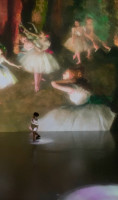
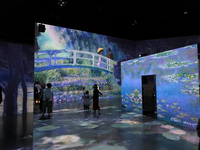
While Mirzoeff notes that the desire to visualize what lies beyond immediate perception—to bring the distant, the past, or the imaginary into present visual experience—was a driving force behind classical and neoclassical art and led to the invention of the panorama and diorama (developed in 1822), today’s IDEs are overwhelmingly centered on Impressionist art. Earlier forms such as the O-rama referred to events and places in the real world and encouraged viewers to forget they were looking at a representation and instead experience the “real.” In this way, as Vanessa R. Schwartz has observed, nineteenth-century Paris experienced a profound spectacularization of everyday life.[8] Contemporary projection-based immersive exhibitions, however, operate quite differently. They focus on representing representation itself, or a spectacularization of the already mediated. Projected light-space becomes the central visual element, inviting audiences into a pictorial, dreamlike environment that hides the real. Today’s IDE audiences—already deeply accustomed to mediated hyperreality—are no longer seeking “reality” in any traditional sense. Instead, they pursue a virtual, aesthetic encounter, an experience often described as akin to stepping into the painting itself. It is, thus, less about pursuing “realness” than it is about escaping into a sensorially rich unreality. Van Gogh Alive promises to “transport visitors to another time and place,” immersing them in the artist’s world and “transcending traditional installations.”[9] In this way, the exhibition and others like it break from the historical lineage of panoramas and dioramas, aligning instead with the sensorial ethos of Impressionism. Seen this way, Impressionist art provides the aesthetic and experiential framework that both producers and consumers of IDE experiences draw upon. Though this represents a simplified view of Impressionism, its emphasis on light, movement, and emotional immediacy lends itself to immersive digital environments that offer sensory escape into illusory and highly mediated spaces.
So, how do IDEs featuring Impressionist art redefine the audience’s relationship with the original paintings? Are these IDEs merely reproductions that alter the works’ scales and materialities? How do they differ from conventional Impressionism exhibitions in terms of reception? Visual experience itself is not immediate or universally shared; rather, it is mediated by social and historical frameworks that shape how we see. Ways of seeing are not innate, but culturally conditioned; they are learned perceptual habits informed by collective knowledge and convention. Vision, then, is not purely optical, but ideological: it positions the audience in specific relationships to the visible world, constructing them as subjects within a broader sociocultural order. Impressionism, perhaps more than any other movement in Western art history, makes this entanglement between vision, subjectivity, and social context central to its aesthetic project.
While the Impressionists’ techniques and styles varied, they were united by a sustained engagement with the visual conditions of modernity. For them, the landscape was not merely scenic nature but a lived, changing environment shaped by human presence. Their paintings captured the ephemeral rhythms of urban life, the shifting qualities of light and atmosphere, and the visual instability of the modern experience. This sensitivity to flux and transience defined the Impressionist mode of seeing. Painting outdoors with quick, gestural brushstrokes, they prioritized matière—the texture and physicality of paint—over photographic realism, creating surfaces where light, color, and form blur into a perceptual whole. Among other factors—such as social and economic ones—what makes Impressionism particularly resonant in today’s IDE scenes is, in its aesthetics, its capacity to evoke this fleeting perceptual experience—an aesthetics of the moment—that aligns seamlessly with the immersive, time-based logic of digital exhibition formats. Its focus on color and light, depictions of modern urban leisure, and atmospheric landscapes offers contemporary audiences a kind of pictorial refuge—a temporary escape from the overstimulation or banality of daily life. Moreover, Impressionism’s resistance to fixed form and its emphasis on the fleeting and intangible directly align with the logic of digital imagery, which favors fluid transitions, shifting luminosity, and all-encompassing visual fields. This sensibility translates well into projection mapping, which renders light and motion into a spatial experience.
Contemporary IDEs are no longer merely about visually presenting digitized paintings; instead, they invite the spectator’s body into the pictorial space and actively engage it through multisensory inputs and outputs. These include ambient sound and music, dynamic lighting, projected motion, and sometimes even the manipulation of temperature or scent. In doing so, the audience is transformed from a passive observer into a corporeal participant—one whose bodily presence becomes integral to the artwork’s unfolding experience. Even without contextual knowledge, audiences can engage with these works through the sheer affective power of monumental scale, synchronized music, and dynamic animation. It is precisely this adaptability—this ability to oscillate between historical specificity and sensory immediacy—that makes Impressionism uniquely suited to the technological and experiential demands of immersive exhibitions. However, this very adaptability often erases the presence of the original work. These exhibitions rely less on the historical depth or interpretive frameworks surrounding the original works and focus more on immersive spectacles where light, sound, and scale captivate audiences. Building on existing discussions, I use the term “digital sublime” to describe a form of awe not directed at the original artworks but produced through their overwhelming representation via light, scale, and immersive digital technology.
Mirzoeff notes that the experience of virtuality in the nineteenth century involved not only a sensation of mobility but also an encounter with the modern sublime.[10] The shock of speed and movement in modern life and visual culture, he argues, constitutes an intensified version of the sublime. The visuality of contemporary IDEs translates the modern sublime into a digital sublime. In A Philosophical Enquiry into the Origin of Our Ideas of the Sublime and Beautiful, Edmund Burke explains that the sublime is marked by sensations of astonishment and terror—an affective response grounded in the perception of our own insignificance when confronted with vast, distant forces, such as nature’s overwhelming presence.[11] While the sacred terror of nature in classical and neoclassical art evolved into the modern sublime through the panoramic spectatorship of nineteenth-century virtuality, today’s IDEs reconfigure it as the digital sublime.[12]
The overwhelming sensory encounter of the digital sublime does not, however, function in isolation. It converges with what Walter Benjamin describes as phantasmagoria: illusion shaped by collective desire and commodified spectacle.[13] If the digital sublime operates through technological scale and immersion, phantasmagoria captivates through fantasy and longing. In IDEs, these forces come together, drawing audiences into a space where sensory impact and social aspiration intertwine. IDEs are especially known to mesmerize audiences through a kind of technological fascination—an affective state in which viewers are entranced not only by the images on display but by the utopian promise embedded in the technology itself. This suspended, euphoric sensation is amplified in the materially rich, atmospheric spaces of Impressionist imagery. Jae Yeon Park points out that Impressionism already contained many of the key elements of digital storytelling—not only technically, but psychosocially.[14] In his essay on the relationship between digital storytelling and Impressionism, he argues that one reason Impressionist painting continues to resonate is its ability to elevate the audience’s emotional state. This uplifting effect is evident not only in the techniques but also in the subject matter and iconography. From the 1870s, when the Impressionists were fascinated by the newly transformed Paris and repeatedly portrayed it as a lively bourgeois metropolis, to their later, more focused explorations of fleeting sensations and sensory experiences, their works reflected the desires of the nineteenth-century bourgeoisie, which closely align with a core characteristic of storytelling in cultural content, that of illusion,[15] which I would argue mirrors the logic of phantasmagoria—an illusion tied to collective desire, stemming from the urge to escape everyday monotony, the yearning for what is absent, and the pursuit of playful or imaginative experiences. Today’s IDEs tap into a similar psychology, offering digital experiences that gratify contemporary desires for cultural belonging and aesthetic stimulation. In the following section, I examine how the digital sublime intensifies this phantasmagoric mode of spectatorship, shaping the popular reception of Impressionism in the digital age.
Phantasmagoria and the Paradox of the Digital Sublime
The experience of entering a space filled with vivid, moving images can feel like a magical encounter with ghostly apparitions in the dark: it is phantasmagorical. Benjamin likened the deceptive spectacle of commodity culture, in which material and historical realities are transformed into dreamlike illusions, to a phantasmagoria. For him, such illusions are not merely visual tricks but ideological veils—technologically mediated forms of enchantment that obscure the social and economic structures underlying modern life. As Margaret Cohen notes, Benjamin once described visual technologies such as the diorama as expressing “a new feeling about life”; phantasmagoria, in this context, serves as the visual emblem of that feeling.[16]
In this sense, today’s immersive exhibitions—whether digital interactive projections of Impressionist paintings or large-scale, multimedia experiences inspired by Impressionist paintings—can be seen as contemporary phantasmagorias. They mesmerize audiences with sensory spectacle, intensifying the blur between art and entertainment, historical reference and visual fantasy in grand scale. The immersive scale of digital projections exerts a powerful sensory impact, surrounding viewers with vivid imagery that appears to come alive. This experience, defined by visual intensity and technological magnitude, extends the logic of modern phantasmagoria and gestures toward what can be called the digital sublime: a sensation of awe and disorientation produced not by nature, but through the overwhelming force of technological spectacle. What does this shift mean?
To better understand audience responses to IDEs, a useful reference is the comparative study of differences in the aesthetic experience between traditional Impressionist exhibitions and hybrid forms that incorporate digital elements. Boa Rhee, Sumin Choi, and Yong Seok Hong, for example, conducted a survey to gauge audience experiences across these two exhibition formats.[17] Their findings suggest that while the digital exhibition enhanced audience immersion and, consequently, satisfaction, it also emphasized entertainment-oriented qualities, whereas traditional exhibitions foregrounded the aesthetic and contemplative aspects typical of fine art experiences. The study further notes that digital exhibitions elicit a more distributed mode of perception that invites playful forms of interaction in which viewers engage bodily rather than contemplatively, as is more typical of analog exhibition formats. Interestingly, focused perception did not necessarily correlate with immersion; in fact, audiences reported higher levels of immersion in the digital exhibition, despite more fragmented perceptual engagement. What demands closer attention, however, is the object of this immersion. In digitally remediated exhibitions, immersion often stems from technological spectacle—such as the addition of interactive and playful elements, motion graphics, and large-scale screens—rather than from the artworks themselves. By contrast, in traditional painting exhibitions, audiences tend to concentrate on elements tied to the authenticity and material presence of the original works, including their physical presence and historical singularity.[18]

It is interesting to note that while traditional exhibitions tend to emphasize artworks themselves, digital exhibitions often direct the audience’s attention toward the spectacularization of technological mediation. This shift in focus transforms the act of viewing into an experience of sensory spectacle in which the medium becomes the message. In such settings, the original artwork risks being overshadowed by the dazzling effects of projection, animation, and sound. This aligns with the notion of phantasmagoria in which commodified visual experiences and technological displays create an illusion that detaches the audience from critical engagement. In Van Gogh: The Immersive Experience, for example, audiences find themselves immersed in a torrent of rapidly shifting, large-scale projections of the artist’s paintings (fig. 5). Unlike Benjamin’s conception of aura, which was tied to authenticity and distance, the spectacularization of technological mediation is constructed through proximity, saturation, and sensory overwhelm. On the relationship between technological mediation and phantasmagoria, Cohen argues that Benjamin replaces Marx’s metaphor of the camera obscura (where ideology inverts reality) with phantasmagoria, emphasizing the imaginative, affective, and technologically mediated nature of ideology.[19] The phantasmagoria projects not a reflection of the real, but a subjective, ghostly spectacle, more suited for understanding the illusions of a commodity culture. By foregrounding the spectacularization of technological mediation, digital exhibitions may inadvertently diminish the contemplative and interpretive space traditionally afforded by the artwork itself. In the audience’s experience, technology becomes an object of enchantment, obscuring its constructed nature and reproducing a phantasmagoric condition in which the image captivates, while the historical contexts, labor, and technical and institutional systems behind it remain invisible. Here, technology becomes both the object and vehicle of wonder, reorienting aesthetic experience around its own spectacle. As a result, what appears as expanded access to culture is often entangled with a deeper form of ideological mystification—one that masks its double mediation behind sensory overwhelm.[20] While these exhibitions often claim to democratize access to art, they also risk reproducing the same ideological mystifications Benjamin warned against, turning cultural memory into consumable and sensationalized experience.

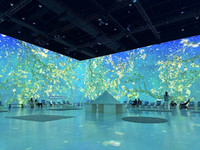
However, alongside the widespread proliferation of immersive theaters centered on Impressionism, their formats have also become increasingly diversified and sophisticated; figures 6 and 7, for example, illustrate different approaches in IDEs. The first (fig. 6) surrounds the audience with projection mapping, allowing them to feel as though they are moving within the painting—petals drifting around them, brushstrokes flowing beneath their feet. The second (fig. 7) adopts a more cinematic mode of spectatorship, offering a reduced sense of spatial immersion despite similar technological means. When IDEs of Impressionism first emerged, they were primarily composed of large-scale digital reproductions of Impressionist paintings that created visually overwhelming environments through animated brushstrokes, color, and music. These early exhibitions focused on amplifying the visual pleasure of Impressionist aesthetics rather than offering historical or narrative depth. Moreover, by centering primarily on the large-scale digital reproduction of original paintings, they failed to harness the critical affordances of contemporary media, which, as Mark B. N. Hansen theorized, actively intervene in perception through real-time, affective, and embodied engagement.[21] However, as more technologically experimental and interactive immersive experiences—such as those by teamLab[22] and d’strict[23]—have gained prominence, a notable shift has also occurred among immersive Impressionist exhibitions. In contrast to the abstract, sensor-driven, and often ahistorical nature of those collectives, recent Impressionist-themed exhibitions have started emphasizing art-historical storytelling and personal narratives to differentiate themselves. For example, narrative-centered immersive theaters grounded in art-historical research—such as Van Gogh Inside: Love, Vincent (2024)—reconstruct the relationships among artists, audiences, and digital mediation. In Van Gogh Inside, Van Gogh’s paintings depicting the spaces and subjects referenced in his letters are projected into an immersive environment and accompanied by voiceover narration drawn directly from his correspondence. Through this synthesis of image, text, and space, audiences are invited not only to experience artworks through large-scale technological spectacle, but to engage with them from the artist’s own perspective. Rather than merely consuming visual spectacle, the audience is guided into a contemplative space where they can trace the emotional and narrative threads woven into each work. These narrative-driven approaches situate the artworks within their original social, psychological, and biographical contexts, transforming the IDEs into a space not just of sensory wonder, but of historical reimagination. This approach fosters a sense of relationality that encourages reflection on the deeper meanings embedded in Van Gogh’s visual and written expressions.
Indeed, Benjamin’s phantasmagoria is not inherently devoid of critical potential. As Cohen reminds us, once the illusion is recognized, the spectacle can become a site of tension and awareness.[24] When effectively designed, such spaces can heighten spectators’ sensitivity to the mechanisms of vision and mediation, enabling a more conscious navigation of digital spectacle. For this reason, more effective art-historical storytelling becomes a crucial element in immersive theater exhibitions. Framed with richer and historical context, these exhibitions can move beyond reducing Impressionist art to a mere commodity within contemporary visual culture. Instead, they can offer opportunities for audiences to engage more deeply with cultural contexts, thus transforming spectacle into a platform for expanded reflection and meaning making.
The Politics of the Digital Sublime
As Nikita Mathias has pointed out, the popularity of IDEs is deeply entangled with the logic of the contemporary experience economy.[25] Likewise, as Rhee, Choi, and Hong’s study demonstrated, the practice of exhibition viewing is increasingly reframed as a more intensified, fleeting experience. The immersive spectacle, achieved through techniques akin to phantasmagoria, offers both affective appeal and cultural drawbacks. On the one hand, this format expands the potential audience base, attracting audiences who might not otherwise engage with fine art. On the other hand, many attend not out of a genuine interest in the artworks themselves, but for the opportunity it presents to capture and share visually arresting moments on social media. As Mathias writes, “A visit to Atelier des Lumières is not about engaging with the art and artists as topics of scholarly interest; it is about the excitement and novelty of experiencing this technologically enchanted art space.”[26] Within the framework of the experience economy, these immersive environments become high-yield investments, backed by the allure of guaranteed success. This success can contribute to a shift in how Impressionism is received—not as an art-historical movement, but as a source of visual and emotional stimulation tailored to contemporary consumer habits.
When certain works are repeatedly reproduced at monumental scale and recontextualized through immersive technologies, a select subset of Impressionist paintings is further granted a kind of canonical status. Often, it is the canonicity of already famous works that is reinforced, but the selection of artworks in IDEs is driven less by scholarly deliberation than by visual immediacy and compatibility with digital spectacle. The resulting effect is a technologically curated canon, shaped by market demands and mass appeal. As Anna Brzyski has observed, the canon functions as a discursive structure that organizes knowledge according to hierarchical principles.[27] It not only confers and withholds value but produces cultural meaning and legitimizes certain histories. While the canon can occasionally serve a productive role—structuring disciplines or expanding access to underrecognized histories—it more often functions as “a mechanism of oppression, a guardian of privilege, a vehicle of exclusion.”[28] As both product and producer of cultural hegemony, canons legitimize dominant narratives while marginalizing others.
The global success of Impressionist-themed IDEs suggests the emergence of a new kind of canon—one formed not through scholarly consensus, but through algorithms of visual appeal, investment logic, and technological remaking. Even in conventional museums, exhibitions of Impressionist and Post-Impressionist works are often seen as surefire successes. IDEs capitalize on this by digitally remediating and amplifying those works most likely to attract crowds. The immersive format itself becomes part of this canonizing process. As these experiences are shared and reproduced across cities and continents, their content—already filtered through selective historical lenses—is further reduced to the most recognizable and photogenic elements. The logic of “mere exposure,” as psychologist James Cutting describes it, plays a crucial role here.[29] In his studies, participants rated artworks more favorably when they were repeatedly exposed to them—regardless of their historical significance or aesthetic merit. What emerges is an inversion of aura affect: rather than eroding aura, mechanical (now digital) reproduction may paradoxically produce a new kind of aura—what we might call the “digital aura”—through monumental scale, multisensory immersion, and repetition. The digital sublime heightens the emotional resonance of these images, even as it conceals the ideological mechanisms behind their selection and circulation.
Crucially, this process often takes place without meaningful input from art historians or curators. In many IDEs, decisions about image selection, sequencing, and narrative are made by commercial producers, engineers, or designers. This tendency is particularly evident in Van Gogh: The Immersive Experience, produced by Exhibition Hub in collaboration with Fever. The show draws on a recurring formula: a vast digital projection of Van Gogh’s most famous works, accompanied by cinematic music, VR experiences, and selfie-ready environments. Artistic or historical context is minimal. The project’s creative direction favors visual spectacle over critical engagement. This raises concerns about how aesthetic decisions are being made and who gets to shape the public’s encounter with art. What we see, then, is not simply the democratization of art, but a shift in the gatekeeping function—from scholarly institutions to market-driven production teams. As such, nonspecialist criteria increasingly shape what is remembered, celebrated, or rendered canonical. This shift signals a broader crisis in art history: when visual popularity and ease of digital adaptation outweigh critical historical context, a distorted version of art history emerges—flattened, decontextualized, and commodified.
Exclusions and marginalizations are amplified in these practices. While conventional museum institutions have made notable strides in recovering once-marginalized figures—such as Berthe Morisot and Mary Cassatt—IDEs continue to overwhelmingly focus on the most famous male Impressionists: Monet, Van Gogh, Renoir, and Degas. This is not a mere curatorial oversight, but a structural pattern driven by financial risk management. Because these exhibitions require large-scale investment, producers often fall back on artists with mass recognition, ensuring ticket sales and media coverage. For example, Monet & Friends Alive, held in Kobe, Japan from January to March 2025, featured only Monet and his male contemporaries—Camille Pissarro, Renoir, Degas, and Cézanne—omitting women artists entirely. The repeated projection of these male artists’ works—magnified, animated, and layered with immersive soundscapes—grants them a renewed cultural aura shaped by digital spectacle. This aestheticization, while captivating, conceals the ideological labor it performs. As audiences are drawn into these sensory environments, the spectacle naturalizes historical exclusions. As feminist art historian Linda Nochlin reminds us, the absence of women from the canon is not a reflection of their lack of contribution but a result of structural and institutional barriers.[30] IDEs, despite their technological novelty and apparent democratizing potential, risk reinscribing these exclusions by presenting a narrow, market-friendly canon as if it were inevitable.
In this light, the popularity of IDEs must be understood not merely as a trend in exhibition design, but as a site where cultural memory, historical authority, and economic interest intersect. Their seductive but immersive power may reshape and affect how art is seen, remembered, and valued while simultaneously reinforcing the very hierarchies they claim to transcend, even as they lower the threshold of museum access. This is precisely where critical, scholarly engagement is urgently needed. Rather than dismissing IDEs as merely entertainment-oriented or outside the domain of art history, we must recognize their growing influence and intervene through appropriate scholarly critique and contextualization. Such engagement can help recalibrate public perceptions of Impressionism, correcting distortions and offering alternative narratives. As previously discussed, interactive and narrative-based IDEs may serve as a productive model—one that combines immersive technologies with historical depth and curatorial intentionality. If developed and circulated in a more critically informed and inclusive direction, IDEs have the potential to foster broader public interest in Impressionism and contribute meaningfully to its role in culture.
Conclusion
The aesthetic characteristics of Impressionism align particularly well with the experiential and visual logic of IDEs, and this inherent compatibility has played a key role in the continued success of Impressionist-themed IDEs. Some may regard such exhibitions—often branded as “edutainment”—as innocuous appropriations of artistic elements for entertainment purposes or as well-intentioned gestures aimed at broadening public access to art. However, the influence of IDEs is extensive, and they play a significant role in shaping public perception of what Impressionism is and what it means. These exhibitions may indeed lower the threshold of access to museums and blur the boundaries between so-called high and low art. Notably, the aforementioned empirical study found that audiences rated their willingness to revisit IDE exhibitions higher than traditional Impressionist exhibitions and noted that IDEs exhibit qualities of both traditional artworks and digital media.[31] While this single case study does not establish a definitive relationship between the two formats, it suggests that audiences who engage with Impressionist IDEs may be more receptive to traditional exhibitions as well. The success of IDEs, directly or indirectly, appears to foster increased interest in the original artists and their works. Yet, they risk reducing the audience to gawkers immersed in a commodified image-space, evoking a sense of sublimity not through the artworks themselves, but through the spectacularization of technological mediation. The cultural and historical depth of the artworks is often displaced by surface-level immersion, and their meanings are overwhelmed by sensory intensity. Moreover, the repeated reproduction of a narrow selection of Impressionist works in digital formats reinforces their canonical status while furthering processes of exclusion and marginalization. Considering this, it is crucial to closely examine the art-historical implications of IDEs and consider what forms of scholarly and critical intervention might be necessary to engage with their expanding influence.
Notes
[1] Nikita Mathias, “Meta‑artistic Immersion in Digital Exhibitions. History–Mobilization–Spectatorship,” Journal of Aesthetics & Culture 14, no. 1 (2022): article 2129160, https://doi.org/10.1080/20004214.2022.2129160. While I acknowledge that current forms of immersive digital exhibitions have evolved beyond what Mathias initially observed—now incorporating more theatrical elements such as narrative structures and interactive bodily engagement—I continue to use the term as she defines it. The notion of immersion can reintroduce affective dimensions of spectatorship that are central to the appeal and impact of these exhibitions. According to Mathias, these exhibitions can be classified as IDEs because: 1) their aesthetic is fundamentally grounded in immersive principles; 2) they rely primarily on digital media as their technological foundation; and 3) their recognizable association with traditional art exhibitions and gallery practices plays a key role in shaping audience reception.
[2] Nicholas Mirzoeff, “Virtuality: From Virtual Antiquity to the Pixel Zone,” in An Introduction to Visual Culture (Routledge, 1999), 91.
[3] Rainer Michael Massa, Pygmalion Photographé (Musée d’Art et d’Histoire, 1985), quoted in Mirzoeff, “Virtuality,” 91.
[4] Brian Massumi, “Envisioning the Virtual,” in The Oxford Handbook of Virtuality, ed. Mark Grimshaw (Oxford University Press, 2014), https://doi.org/10.1093/oxfordhb/9780199826162.013.010.
[5] Oliver Grau, Virtual Art: From Illusion to Immersion (MIT Press, 2003), 5.
[6] Mirzoeff, “Virtuality,” 94–95.
[7] Mirzoeff, “Virtuality,” 95.
[8] Vanessa R. Schwartz, Spectacular Realities: Early Mass Culture in Fin-de-Siècle Paris (University of California Press, 1998).
[9] “Van Gogh Alive,” EventAVision, 2024, https://eventavision.com/ (video discontinued).
[10] Mirzoeff, “Virtuality,” 95.
[11] Edmund Burke, A Philosophical Enquiry into the Origin of Our Ideas of the Sublime and Beautiful, ed. James T. Boulton (University of Notre Dame Press, 1968).
[12] The term digital sublime was most prominently developed by Vincent Mosco in his book The Digital Sublime: Myth, Power, and Cyberspace. Mosco examines how digital technologies foster ideological myths about cyberspace, information society, and network capitalism. While Mosco’s usage is grounded in political economy and discourse analysis, I adopt the term here within a visual-cultural framework, focusing on the affective and aesthetic intensity generated by immersive digital representations of historical artworks. See Vincent Mosco, The Digital Sublime: Myth, Power, and Cyberspace (MIT Press, 2004).
[13] Walter Benjamin, “Paris, the Capital of the Nineteenth Century,” in The Arcades Project, trans. Howard Eiland and Kevin McLaughlin (Belknap Press, 1999), 3–13.
[14] Jae Yeon Park, “디지털 스토리텔링 기법을 활용한 인상주의 전시 연구 [Étude de l’exposition numérique de l’impressionnisme],” 프랑스 문화 연구 [Études de la Culture Française] 41, no. 1 (2019): 353–68, https://doi.org/10.18022/acfco.2019.41.1.013.
[15] Park, “Etude de l’exposition numérique.”
[16] Margaret Cohen, “Walter Benjamin’s Phantasmagoria,” New German Critique 48 (1989): 95, https://doi.org/10.2307/488234.
[17] Boa Rhee, Sumin Choi, and Yong Seok Hong, “A Study on Differences of Aesthetic Experience in the Exhibition of Artworks and the Remediated Exhibition of Artworks: A Comparative Study between Monet’s Impressionism Exhibition 2016 and Impressionist Landscapes,” Journal of the Korea Contents Association 17, no. 5 (2017): 153–62, https://doi.org/10.5392/JKCA.2017.17.05.153.
[18] Rhee et al., “Study on Differences,” 158–59.
[19] Cohen, “Walter Benjamin’s Phantasmagoria,” 93–95.
[20] The broadened accessibility of IDEs has been noted by many researchers in the field. Isabella de Souza writes, for example, “While digital art venues and immersive installations have democratised access to art, breaking down geographical and socio-economic barriers that traditionally limited audience reach, critics argue that the digital nature of immersive art may dilute the authenticity and intrinsic value of traditional art forms.” While IDEs have also been concentrated in urban areas with strong technological infrastructure, the barriers to accessing traditional museums remain significantly higher for many, making immersive exhibitions comparatively more accessible. See Isabella de Souza, “The Rise of Digital Art Venues and Immersive Installations,” My Art Broker, February 16, 2024, https://www.myartbroker.com/.
[21] Mark B. N. Hansen, Feed-Forward: On the Future of Twenty-First-Century Media (University of Chicago Press, 2015), 38.
[22] teamLab, accessed June 26, 2025, https://www.teamlab.art/.
[23] d’strict, accessed June 26, 2025, https://www.dstrict.com/.
[24] Cohen, “Walter Benjamin’s Phantasmagoria,” 102–04.
[25] Mathias, “Meta‑artistic Immersion,” 2.
[26] Mathias, “Meta‑artistic Immersion,” 3.
[27] Anna Brzyski, “Introduction: Canons and Art History,” in Partisan Canons, ed. Anna Brzyski (Duke University Press, 2007), 3.
[28] Brzyski, “Introduction,” 1.
[29] James Cutting, “Mere Exposure, Reproduction, and the Impressionist Canon,” in Brzyski, Partisan Canons, 79–98.
[30] Linda Nochlin, “Why Have There Been No Great Women Artists?” Art News 69, no. 9 (January 1971): 22–39, 67–71.
[31] Rhee et al., “Study on Differences,” 162.