Monet and Venice
Reviewed by Willam BarchamWillam Barcham
Professor Emeritus, Fashion Institute of Technology
Email the author: williambarcham[at]gmail.com
Citation: Willam Barcham, exhibition review of Monet and Venice, Nineteenth-Century Art Worldwide 25, no. 1 (Spring 2026), https://doi.org/10.29411/ncaw.2026.25.1.18.
This work is licensed under a Creative Commons Attribution-NonCommercial 4.0 International License  unless otherwise noted.
Your browser will either open the file, download it to a folder, or display a dialog with options.

Monet and Venice
The Brooklyn Museum, New York
October 11, 2025–February 1, 2026
The Fine Arts Museums of San Francisco
March 21–July 26, 2026
Catalogue:
Lisa Small and Melissa Buron, eds.,
Monet and Venice.
Rizzoli/Electa, 2025.
264 pp.; 1 map; numerous color and b&w illus.; notes; checklist of works in exhibition; authors’ biographies; selected bibliography; index.
$75.00 (hardcover)
ISBN: 9780847875962
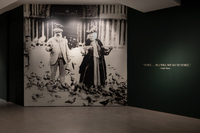
The Brooklyn Museum and the Fine Arts Museums of San Francisco have jointly mounted an outstanding exhibition uniting two icons of Western beauty: the art of Claude Monet and the city of Venice. Put Monet in Venice—the institutions may have thought—and surely something wonderful will result, and the public will rush in.[1] Both goals have been met. At the insistence of his wife Alice, Monet made his first trip to the lagoon city in 1908, at nearly seventy years old, and although convinced that he could not add to its pictorial tradition, he produced thirty-seven urban views during his two-month visit there, nineteen of which the Brooklyn Museum has gathered to commemorate the centenary of the artist’s death. (San Francisco will have one or two more.) The show acknowledges at its entrance the couple’s dual responsibility for the realization of the series with an immense photograph of them standing together amid pigeons in Piazza San Marco (fig. 1). Alice’s resolve and tenacity pushed her husband to go to Venice; her constant companionship during their stay encouraged him daily, and—not least—Claude’s loving memory of her after her death in 1911 moved him, alone and despondent, to complete or rework the paintings. Venice has a way of doing that, of compelling visitors to relive and cherish the special moments they enjoyed there.
Organized by Lisa Small and Melissa Buron, the first a curator in Brooklyn and the second formerly in San Francisco but now at the Victoria and Albert Museum, London, the exhibition does more than display nineteen of Monet’s Venetian canvases—although obtaining the loans was an ambitious undertaking, as was procuring several of them from private collections. The show sets the works among many others by Monet, together with dozens of paintings, drawings, and prints by predecessors and contemporaries, adding literary publications, guidebooks, letters, photographs, and postcards. Three brief film clips from the turn of the twentieth century render the city palpable with scenes of boat traffic and throngs of Venetians milling about, all especially vivid in the film of 1912 where color was added. As a result of this encyclopedic and multimedia wealth of material, the two curators have effectively brought Monet into Venice. Videos of the city today, a sort of immersive Venice, greet museumgoers upon arrival, and in a large gallery with ten of the artist’s views at the climax of the exhibition, they hear a four-movement symphonic tone poem by Niles Luther, composer-in-residence at the Brooklyn Museum, discreetly accompanying their absorption of Monet’s art.
Monet in Venice is supplemented by an excellent catalogue brimming with color photographs of Monet’s paintings; all the works in the show are reproduced in color or black and white. The catalogue’s ten stimulating essays were written by Buron, Small, Luther, and six other specialists in the field who discuss subjects ranging from the genesis of the series and Monet’s knowledge of Venice before traveling there to considerations of how the painter achieved the sensation of suspended time in his paintings, the presence of modernity in centuries-old Venice, and the consequences of modernity for the painter’s treatment of the city. I address seven of the essays below in tandem with the exhibition’s itinerary. The three others—by Buron, Small, and Luther—tackle in part issues each faced while preparing the exhibition. Buron’s is an extended and general introduction to the material (17–29); Luther’s, briefer, explains his specific challenge in transforming Monet in Venice into sound (239–42); and Small’s is an overview of Monet’s art and Monet and Alice (31–69; see below for her second essay).
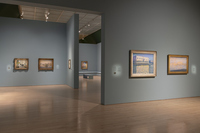
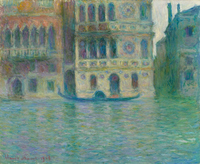
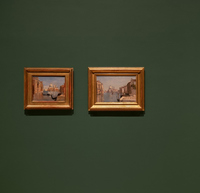
The Brooklyn Museum organized the exhibition into seven galleries. Painted in subdued but attractive hues, the galleries varied in size and shape, and the layout offered a multiplicity of striking viewpoints and perspectives (fig. 2). The first gallery displayed a map of the city pinpointing the sites Monet had visited and painted, postcards he and Alice bought there, and the three film clips noted above. Visitors also encountered John Singer Sargent’s sparkling Interior in Venice, a view of Palazzo Barbaro’s salone, where the Monets initially lodged as guests of Mary Hunter, who had leased the building from its owners, Ariana and Daniel Curtis, shown seated in the painting (fig. 3). Sargent and Monet knew each other, and the American artist’s own views of Venice hang in a later gallery. This section also contained Monet’s Red House and Palazzo Dario (figs. 3, 4), two small canvases that offered a first look at how the artist transformed the city built of wood, brick, and stone into blotches of kaleidoscopic color realized with the dynamic swirls or jabs and dashes and mere touches of his brush. Monet’s lifelong interest in water quickly took hold of him in Venice, determined his compositions so that water always foregrounds—quite literally—the building he portrayed, while it changes tonality, communicates time of day, and reflects or absorbs light. Like most artists picturing the lagoon city, Monet achieved all this often while sitting in a gondola, bobbing about in a canal.
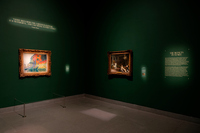
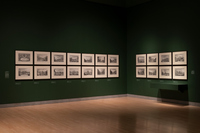
Three of the walls of the second gallery, larger than the preceding one, were covered with eighteenth-century views of Venice. Two show Michele Marieschi’s twenty-two large etchings comprising his series Magnificentiores Selectioresque Urbis Venetiarum Prospectus of 1741, on loan from San Francisco (fig. 5). Depicting the Grand Canal and individual monuments in the city, these impressive works alert viewers that, 175 years before Monet got to Venice, affordable prints were disseminating its image. Of course, the Venetian-born Marieschi had his hometown always at hand, unlike Monet and Alice who, to get there, had to prepare trunks, organize lodgings in advance, procure traveling papers, and undergo a tiring twenty-four-hour rail journey demanding at least one change of trains. And whereas Marieschi could approach his workday with some spontaneity, Monet had to organize and plan his meticulously; more on this below.
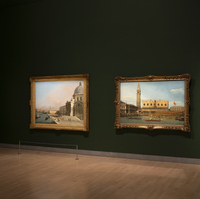
Antonio Canaletto dominated a third wall in the gallery (fig. 6). A pair of his large canvases capture the city’s architectural splendor in magnificent color. One of the two depicts the church of Santa Maria della Salute whose presence foreshadows, as it were, Monet’s several interpretations of the same building. The decision to reserve the Frenchman’s versions of the Salute for later in the show so as to create a cumulative impact might seem reasonable, yet museumgoers would have benefited from direct comparison of the two artists’ views of the church. Illuminated by a brief explanation, a comparison of the two works would have clarified for visitors that both painters manipulated Venice and adjusted viewpoints, the Italian just as surely as Monet, thereby highlighting that viewscapes were an interpretive enterprise even from their early days, well before the invention of photography. Monet was following a long-established custom but approached it differently.
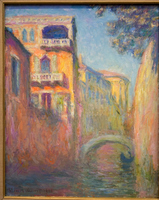
Galleries 3 and 4 focused principally on Monet’s enveloppe, as he termed it, or his “ephemeral, colored atmosphere that surrounded, unified, and transformed a motif” (31), and on his handling of water in venues other than Venice. The two galleries enhanced the visit for anyone unfamiliar with the artist’s general trajectory. The exhibition’s subject was Monet in Venice; this section widened the lens. Of special interest here were his attention to light and shadow so as to divide foreground from distance, his brushwork that subtly separates land from water, as in the Seine near Giverny (1885; Denver Art Museum, Denver), and his spectacular transformation of water into solid blocks of ice as shown by the Break Up of Ice (1880; University of Michigan Museum of Art, Ann Arbor). The fourth gallery contained one of Monet’s three versions of the Rio della Salute, an instance of his foray into a small side canal to paint (fig. 7). Strange that he did this for just one scene because so many of his colleagues of the mid- to late nineteenth century adventurously investigated the city’s tiny byways in order to vary their art, appeal to a new middle-class clientele wanting intimate works of art, and, importantly, to break from Canaletto’s model of clutching onto major monuments. But Monet never thought, as the catalogue notes (180–83), like the Frenchmen Emmanuel Lansyer and Alfred Smith, the Norwegian Frits Thaulow, the Englishman James Holland, or the Italian Guglielmo Ciardi. He had no desire to avoid broad watery expanses—quite the contrary—and no need to rid himself of Canaletto. Indeed, following his Venetian forerunner, Monet portrayed only the city’s famous sites but never—curiously enough—Piazza San Marco and its basilica or the Rialto Bridge. In addition, he did not contemplate in 1908 selling his canvases in Parisian galleries, considering them at the time but beginnings. In any case, when he produced Rio della Salute, he was quite close to the usual tourist itinerary, having taken a shortcut between the Grand Canal (just beyond the recognizable Gothic apse of San Gregorio in the distance) and the Giudecca Canal (behind us). Monet painted eight views of San Giorgio Maggiore and seven of the Ducal Palace looking from San Giorgio where the Giudecca Canal empties into the Basin of St. Mark. But any gondolier, then or now, would opt to pass through the small Rio della Salute to or from the Monets’ accommodations in Palazzo Barbaro or from the Hotel Britannia, where they later stayed. The shortcut avoided the tricky currents and the numerous large ships entering or anchoring in the two bodies of water.[2]
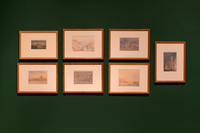
The long fifth gallery took visitors on a tour of Venice through nineteenth-century views by Frenchmen other than Monet, by British and US artists, and one Italian, Emma Ciardi (daughter of Guglielmo noted above), who—often overlooked today—was and is still admired in Italy and was so in the United States during her lifetime. The respected international newspaper Art News devoted a long article to Signorina Ciardi, as the publication called her, on page 1 of the May 3, 1924, issue. (She died in 1933.) Hanging on the same wall are several of Joseph Mallord William Turner’s atmospheric watercolors of Venice (fig. 8), Jean-Baptiste-Camille Corot’s two small and exquisite views of the Grand Canal looking toward the Salute (fig. 9), and paintings by Pierre Auguste Renoir and Paul Signac, among others. Donato Esposito skillfully explains in his catalogue essay that Monet knew pictorial Venice well before he got to the city (165–73). Canaletto’s canvases hung in the Musée du Louvre, as did Francesco Guardi’s, though museums sometimes confused their identities in the nineteenth century, and Venetian views came up for sale in Parisian auction houses. Esposito rightly stresses the importance of Félix Ziem’s art for Monet. Now often disregarded, Ziem visited Venice about fifteen times between 1842 and 1897, produced hundreds of city views there, enjoyed immense public success, was named chevalier in the Legion of Honor by his government in 1857, and, having worked at Barbizon, painted in a modern style. Monet’s several stays in London also gave him the opportunity to see Venetian views, not just by Italians but also by the unique Richard Bonington, and most notably by Turner, whose canvases impacted his own later visions of the Serenissima. Is it any wonder that Alice had to force her husband to visit Venice? He knew that if he painted there, he would face the doubly high bar of the city and its earlier interpreters. While still at home, he had in fact said, “I will not go to Venice” (see fig. 1).
Following Esposito’s inquiry into what Monet likely saw in Paris and London, Richard Thomson’s essay and Small’s second essay question how the painter’s works relate to and depart from earlier and contemporary interpretations. Their investigations overlap with Esposito’s—Canaletto and Turner return—but they introduce many new names as well. Thomson examines literary Venice, and Small takes a focused look at James McNeill Whistler and Sargent, each of whom, like Monet, ruptured the Venetian view tradition. Whistler did so with his “intimate and often fragmentary visions of the lagoon city’s canals and architectural details” (206), and Sargent’s watercolors in particular feature skewed viewpoints and restricted sightlines that convey the instability we all feel at times when onboard boats pitching about in the city’s waters. Both Thomson and Small mention Eugène Boudin, Monet’s mentor in Normandy, who concentrated on painting water, too. Naming Whistler, Sargent, and Boudin sends us back to the fifth gallery, where fifteen of Whistler’s memorable prints faced a set of eight works by Sargent and one by his sister Emma. Yet nothing by Boudin was there or elsewhere in the show, a marked absence, I feel. Two other absences were notable, though this may be quibbling on my part considering the challenges the curators faced in realizing their panoramic exhibition. An oil painting by Whistler was sorely lacking. His Venetian views do not look like Monet’s, but both artists were searching for tonal solutions to the city’s special light. The American expatriate was concerned with nocturnal inkiness; Monet mostly focused on daytime luminosity. Another presence this visitor wished for was that of the American Maurice Prendergast, who had visited Venice in 1898 and returned in 1911–12—exactly when Monet was completing his Venetian views and showing them publicly in Paris. Prendergast’s joyously colored Venetian balloons, umbrellas, or lanterns would have contrasted dynamically with Monet’s works.
Gallery 6 held a handful of Monet’s Water Lilies dating to both before and after the Venetian views, allowing the public to see how the Venetian views did or did not impact Monet’s later art. Yet gardens are so unlike urban views; Monet’s familiarity with each genre diverged, and he encountered disparate time constraints in painting each set. He could visit his lilies whenever he wanted; his Venetian stay was temporary. André Dombrowski’s essay “Monet’s Venetian Hours”—its title taken from Henry James’s Italian Hours, published a year after Monet’s visit—examines the painter’s rigorous work schedule in the city (165–45). In order to achieve as much as possible in one day, husband and wife rose daily at 6:00 a.m. and breakfasted. Monet began work in a gondola at 8:00 a.m. as Alice sat nearby. At 10:00 a.m., they were rowed to another locale, lunched from noon to 2:00 p.m., and moved on again. Monet worked in his room from 4:00 p.m. to 6:00 p.m. in the late afternoon. As a result of this peripatetic and daunting timetable, Dombrowski sees in Monet’s canvases “seemingly ‘timeless’ views of Venice [as] paradoxically generated by a modern schedule, and as the product of that schedule. Time was therefore not fully submerged or hidden but merely transformed” (139, emphasis added).
Is it possible that Monet’s immutable city was not the product of a single factor? His “timeless” Venice, devoid of people and movement, is “quiet and depopulated” (54). Though for different reasons, so are the daguerreotypes of Venice from the 1840s, despite the city’s increasing economic growth, its burgeoning maritime trade, and the railroad that made its way across the lagoon, almost to the edge of the Grand Canal. The city’s economy ticked up and accelerated exponentially following the Habsburg monarchy’s suppression of the Venetian insurgency of 1848–49, as confirmed in the three film clips mentioned above. Hustle and bustle were everywhere: boat traffic intensified; ships arrived, anchored, and departed; public vaporetti (water buses) plied the Grand Canal; steam engines of many sorts belched dirty smoke into the air; museums charged entry prices; and the Biennale began in 1895. Electricity replaced gas in the streetlamps illuminating the city at night, and many small iron bridges newly crossed canals to complement the two innovative and much larger iron bridges that had spanned the Grand Canal since the 1850s; throngs were everywhere. Elena Marchetti correctly explains in her essay that “the Venice that Monet encountered was transforming into the city we know today” (127). Venice was not at all static as Monet’s paintings assert; only his light seems to vibrate with life. The apparent emptiness typifying Venetian daguerreotypes resulted from limited technology—the need to avoid movement at all costs while the camera lens was open. Early photographers had been forced mechanically to stop the city in its tracks, so to speak; Monet chose to do so artistically.
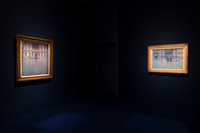
Is the timelessness perceived in his views solely the outcome of a demanding workday? We must remember that in a letter dated December 7, 1908, when about to leave Venice, Monet noted he was returning home with “some studies, some beginnings” (148); his works were incomplete, and there was more to do. He would finish his canvases where he could follow a different schedule and had no need to rush from site to site. Further to Dombrowski’s thesis, do all thirty-seven scenes actually suggest timelessness? What about the two of Palazzo Contarini and the pair depicting Palazzo de Mula, three of which were in the final room of the show (fig. 10)? The two palaces lie on the Grand Canal facing north; the Contarini stands opposite Palazzo Barbaro—where the Monets initially lodged—and the second is slightly further east. One might posit that the deeply shadowed archways and window openings that Monet painted on the two simply remind us that he was working these canvases on late autumnal afternoons after returning from a day spent elsewhere. The scenes evoke a very specific time of day, the fleeting moments of twilight edging toward dusk.
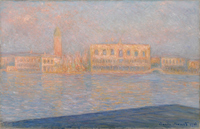
Several of Monet’s Venetian views depict moving gondolas, and seven have gondolas tied up before a palace. A pair in this second group depicts the de Mula building, and a third shows its Contarini counterpart (just mentioned); but this trio of boats extends bizarrely across almost the entire width of their massive Renaissance palaces behind them. Monet at times seemed to worry little about the relative size of objects and the exact distance between one point and another. The Ducal Palace is not nearly as close to San Giorgio as is implied by the six views composed from the paved podium in shadow before the church (fig. 11). Except for a few tiny, sticklike gondoliers, Monet chose to empty Venice of human life, exactly as he opted to alter size and manipulate space across his series. The idiosyncratic automatonophobia—the fear of representing what might seem a figure—that distinguishes his Venetian paintings renders the works almost unique in the history of views of the city; almost no one before Monet conceived of Venice as absolutely motionless.[3] To that point, let us remember that his Rouen cathedrals lack worshippers, his haystacks have apparently self-assembled, and his Japanese bridges of Giverny never have foot traffic. He likewise wiped Venice clean of human movement.
Such immobility contrasts with Monet’s earlier Garden at Sainte-Adresse (1862; The Metropolitan Museum of Art, New York) and Boulevard des Capucines (1874; Nelson-Atkins Museum of Art, Kansas City). The first painting’s noisy steamships and the second’s urban commotion remind us that he was a keen observer of his times, a fact Jonathan Ribner astutely underscores in his essay (147–53). Having studied the research of atmospheric scientists who have investigated historical emissions data of the period, and then enlarging his scope to look at industrial expansion in Venice before Monet’s visit, Ribner examines the 1908 series of pictures to find that both color and value work to impart “tonal unity [. . . to] enforce perception of the image as a cohesive whole, rather than as a sum of its parts” (149). He judiciously concludes that “awareness of the environmental conditions in which Monet worked can only tighten our grasp on an elusive—albeit seemingly direct—art, both ingeniously wrought and resolutely of its time and place” (153).
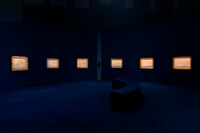
The exhibition brought this forcefully home in the large elliptically shaped room at the end containing ten of Monet’s views, five of San Giorgio, three of the Ducal Palace, and two of the Salute. When six of the ten are seen in one photograph (fig. 12), it becomes apparent that Ribner’s “tonal unity” characterizes not just individual canvases but the harmony Monet imposed across most of the series, above all on those views, panoramic in scope, where one building is seen from afar. Yet when dealing with a single monument lying close by, Monet altered his approach, as with his views of individual palaces (e.g., Dario, Contarini, and de Mula), the Rio della Salute, and the Red House—in other words, for twelve of the thirty-seven works of the series. Félicie Faizand de Maupeou ably recounts in her informative essay the success Monet enjoyed when he showed twenty-nine of the entire group in the Bernheim-Jeune Gallery in Paris in 1912 (155–61). Critical and public reaction was enthusiastic, and audiences who visited the show in Brooklyn and San Francisco will surely have repeated that response. Of course, no matter the artist, every Venetian view is highly valued nowadays, even overvalued; suffice it to look at the inflated sums that even modest paintings of the city may earn in galleries and auction houses. Yet Monet’s views stand among the most individual of Venice’s artistic realizations. His output from his two-month stay there is testimony to his capacity to meet the challenges that both the city and its eminent pictorial tradition imposed. The canvases also witness Alice’s belief in her husband’s art, his love for her, and his memory of their shared hours in the lagoon city.
Notes
[1] The Brooklyn Museum has allotted the show very generous spaces for the large numbers of visitors circulating within and has hung the loans and placed the vitrines so deftly that little crowding or bunching up before the displays impedes the sightlines.
[2] Monet painted the Ducal Palace ten times in all, three of whose compositions were viewed, not from San Giorgio, but from a place somewhere near the Punta della Dogana, the old customs house. It is possible that Monet’s change in compositional arrangement reflects his lodgings at that moment as the Hotel Britannia, now the Westin Europa-Regina, which stands almost facing the Dogana. Regarding the observation in the show that the trees on the right of Rio della Salute are unique among Monet’s Venetian views: they belong to the garden of the Salute’s Somascan monastery on the other side of the wall.
[3] One example comes to mind: Jean Jacques Henner’s small oil study of a totally empty and anonymous campo, 1860, in the study collection of the Musée national Jean Jacques Henner, for which see Isabelle de Lannoy, Catalogue raisonné, Henner (Paris, 2003), vol. 1, 175, cat. B147, and in Willam Barcham, Venice Reimagined, The Resurgence of View Painting in Venice after the Fall of the Serenissima between 1797 and 1866 (Brepols, 2026), fig. 138.