Raimundo de Madrazo
Reviewed by Andrew GingerAndrew Ginger
Independent Scholar
Email the author: andrew.j.ginger[at]gmail.com
Citation: Andrew Ginger, exhibition review of Raimundo de Madrazo, Nineteenth-Century Art Worldwide 25, no. 1 (Spring 2026), https://doi.org/10.29411/ncaw.2026.25.1.20.
This work is licensed under a Creative Commons Attribution-NonCommercial 4.0 International License  unless otherwise noted.
Your browser will either open the file, download it to a folder, or display a dialog with options.
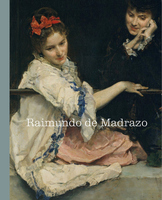
Raimundo de Madrazo
Fundación Mapfre, Madrid
September 19, 2025–January 18, 2026
Meadows Museum, Dallas
February 22–June 21, 2026
Catalogue (Spanish):
Amaya Alzaga Ruiz, ed.,
Raimundo de Madrazo
Fundación Mapfre, 2025.
304 pp.; 130 color illus.; list of works exhibited; bibliography.
€39.30
ISBN: 9788498449129
Catalogue (English):
Amaya Alzaga Ruiz, ed.,
Raimundo de Madrazo
Fundación Mapfre/Meadows Museum, 2025.
255 pp.; 130 color illus.; list of works exhibited; bibliography.
$55.00
ISBN: 9788498449150
Throughout the nineteenth century, the Madrazo family exercised extraordinary power and influence over art in their native Spain and figured prominently in European and transatlantic networks of painting and patronage. The founder of the dynasty, José de Madrazo, had studied in Paris under Jacques-Louis David at the very start of the century, thanks to funding from the King of Spain, Carlos IV. The court then financed a journey to Rome, where José met Jean Auguste Dominique Ingres. With Napoleon Bonaparte’s invasion of Spain in 1808 and the overthrow of the Spanish Bourbons, José had his journey involuntarily prolonged. He remained in exile in Rome, still loyal to Carlos IV after the final defeat of the Bonapartists in 1814. With the death of the exiled monarch at the end of the 1810s, José returned to Madrid as a royal chamber painter to Fernando VII, to whom Carlos IV had been forced to abdicate shortly before the Bonapartist assault. Having served as an influential professor at the Royal Academy of San Fernando—the state training-ground for artists—José eventually became Director of the Prado Museum in 1850. José’s European connections opened the way for his sons—not least Federico de Madrazo, who had been born in Rome, and whose godfather was none other than Frederick of Saxony. Federico traveled to the Paris of King Louis-Philippe—first in 1833, and then from 1837 to 1839—where he too met Ingres and other artists and participated in Salons. From Paris, Federico proceeded to Rome, where he encountered Nazarene art, before returning to Madrid and the royal court, following his father’s footsteps into the role of chamber painter and royal portraitist for the young Queen Isabel II. He became not just Director of the Prado like his father but also Director of the Academy of San Fernando and a portraitist to Spain’s high society.[1]
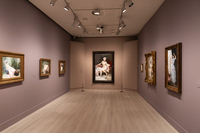
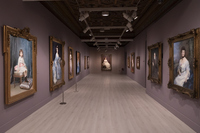
Federico’s son Raimundo—the subject of twin exhibitions at the Mapfre Foundation in Madrid (figs. 1, 2) and the Meadows Museum Dallas—was born into this privileged family in 1841 and, like his father, in Rome.[2] Raimundo had an even more cosmopolitan career than his well-networked progenitor.[3] Of the Madrazos, he was the most internationally successful painter, as Amanda W. Dotsteth’s preamble to the catalogue observes, insofar as success is measured by sales and commissions and by visibility in exhibitions, reviews, and chronicles of high society. To this reviewer’s mind, he was also the finest painter among the Madrazo dynasty, more inventive than his grandfather, father, or uncle Pedro, all of whom were more constrained by their academicism and routine. After studying at the Royal Academy—run, of course, by his father—Raimundo received paternal financing to go to Paris in January 1862, repeating Federico’s youthful journey to the French capital (75). Unlike his father, Raimundo made Paris his home for the rest of his life. He swiftly abandoned Federico’s hopes that he might become a painter of academic grandes machines (95), turning instead to small-scale, playfully anecdotal scenes for the commercial market—known as tableautins—and then, like Federico before him, aristocratic and society portraits (20, 29). The latter dominate his work from the 1880s onward.
Raimundo’s connections to buyers and collectors extended not just to London—where his work appeared regularly at the French Gallery (24)—and continental Europe but to wealthy Americans who were ever-more present on the Paris scene. From 1897, Raimundo traveled frequently to the US, where he was now a renowned, much-sought-after portraitist, undertaking annual winter visits to New York City (67, 222). Raimundo’s repeated physical presence in the US ended only in 1910 with the vicissitudes of old age and then war; he would return just once more in 1916 (223). Through France and the US, Raimundo intensified his links to wealthy Latin Americans, who, in turn, were well connected to French elites. His second wife was the Venezuelan María Hahn, whom he met in the high-class French resort Biarritz in 1884 and wed in 1889 (35).
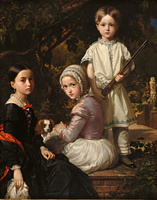
Raimundo de Madrazo’s transatlantic destiny is mirrored in that of the exhibition, on view on both sides of the ocean, beginning in Madrid in September 2025 and relocating to Dallas in February 2026. It heads from the Mapfre Foundation with its excellent record of innovative displays of nineteenth-century painting to the Meadows Museum with its historic connections to Spain: the museum takes its name from Algur and Virginia Meadows, wealthy twentieth-century Americans who collected Spanish art. Despite the stellar career and fame that he enjoyed in his lifetime, Raimundo has never received the same level of scholarly or curatorial attention as his father and grandfather. The present exhibition is unprecedented in scope and scale, tracing his trajectory and connections from childhood—as seen in Federico’s group portrait of his own offspring (fig. 3)—through to paintings from the little-known final decade of Raimundo’s life.
Along with her colleagues, curator Amaya Alzaga Ruiz—a professor at the National University of Distance Learning (UNED) in Spain—has achieved a remarkable feat of research and logistics in locating and sourcing over one hundred works dispersed across nearly sixty museums and collections on both sides of the Atlantic. The exhibition is divided into eight sections, setting out major aspects of Raimundo’s trajectory. In the first three, we see key stages of the painter’s early development: “Raimundo de Madrazo’s Family, Environment, and Artistic Training,” “The Early Years in Paris,” and “Fortuny and Madrazo: Friendship, Preciosity, and the Image of Spain.” The latter deals with Raimundo’s close artistic and personal relationship with his brother-in-law, the great nineteenth-century Spanish and Catalan painter Mariano Fortuny. From here, the exhibition turns to four important dimensions of Raimundo’s art: “Nonchalance,” “The Model Aline Masson” (addressing Raimundo’s obsessive depiction of one woman), “The Portraitist Par Excellence,” and “Americans in Paris and Portraiture Tours in America.” The show concludes with “The Final Years: Between Paris, New York, and Versailles,” the latter being Raimundo’s last place of luxurious residence.
This impressive visual reconstruction of Raimundo’s oeuvre is complemented by a meticulous reconstruction of his life and artistic career in the richly illustrated catalogue, which includes essays by Alzaga, Mathilde Assier, and Daniel Sobrino Ralston. Alzaga’s “Raimundo de Madrazo, Painter” provides a detailed overview of the artist’s trajectory, while Assier’s “Paris, the Beautiful Escape of Raimundo de Madrazo: Relationships and Critical Reception” takes an in-depth look at Madrazo’s decades in France preceding his permanent move to Versailles in 1910. In “Raimundo de Madrazo, William Hood Stewart, and the Taste for Spain in the United States,” Ralston offers an extensive exploration of the transatlantic dimension of the painter’s career. While these opening essays present us with the principal pillars of Raimundo’s life and work, further essays by Alzaga zoom in on each section of the exhibition, offering more knowledge and insights.
Taken as a whole, the catalogue echoes the return to scholarly biography championed over the past two decades by several prominent historians of Spanish nineteenth-century politics and writing, from Isabel Burdiel’s influential tomes on Isabel II to Adrian Shubert’s life of the revolutionary General Espartero and Anna Caballé’s account of the female reformist Concepción Arenal.[4] Like these studies, the catalogue essays engagingly integrate the agency and contingencies of an individual life with economic, political, and social patterns; personal networks; and the specifics of a given vocation or role—in this case, a painter’s material and stylistic preoccupations. This variegated approach seeks to avoid two risks: that of the old vie et oeuvre method—reducing the work to the individual biography—and that of subjecting the diverse dimensions of our existences to a single base structure—whether socioeconomic or discursive—“in the final analysis” as Marxists were once wont to say. Opportunistic responses to markets played a decisive role in Raimundo’s career. Assier describes him as the paradigmatic example of the many mid-to-late nineteenth-century Spanish artists who crossed the frontier to France to make their fortunes in a way that was impossible at home. The state-backed Spanish National Exhibitions and local patronage could scarcely rival this foreign fountain of funds. Many of Spain’s most talented artists from the mid-century were therefore openly commercial, crowd-pleasing painters, and they took little part in Spanish public spaces (39–41). Outside Spain, in contrast, the international framework of Universal Exhibitions provided a public showcase that Raimundo eventually came to value—and in which he participated in 1878 (when his father was one of the organizers of the Spanish section) and 1889 (29, 34). In producing tableautins at the start of his career, Raimundo took advantage of a combination of market opportunity, prevailing Parisian tastes, and family ties: the breakthrough Spanish artist of tableautins was his brother-in-law and friend, Fortuny. Alzaga argues that the need to produce sufficient art to meet demand affected Raimundo’s style of painting as he gradually simplified his compositions (131). As the fashion for tableautins declined, so Raimundo stepped up his lucrative work in society portraiture, drawing on his extensive personal and professional network. When his portraiture began to seem dated in Paris, he shifted his focus to the US market (35), where, Ralston notes, his family had had contacts since the 1860s (54). The rise of US industrial magnates, their tastes, and the decoration of their luxurious residences were thus major factors in Raimundo’s art (35). Once he succeeded his father as head of the Madrazo clan in 1894, Raimundo led the sale of the family art collection to rebalance the Madrazos’ collective finances, sales that—combined with advice on other purchases—drew him close to the great US collection of Samuel Huntington, founder of the Hispanic Society of New York (34, 36–37).
The catalogue essays reveal a beguiling web of such connections in the interplay of commerce, taste, and shared artistic interests. As early as 1867, sales had brought Raimundo into the orbit of merchants as significant as Adolphe Goupil and George Aloysius Lucas (21–22). This visibility, and the association with Fortuny, led him into the circles of the influential collector and critic Baron Davillier (24). We then find him in the Salons, not just of Davillier, but of the Princess Mathilde Bonaparte and the Goncourt Brothers (41). Through the patronage of the Basque industrialist Ramón de Errazu on the latter’s sojourns in Paris, Raimundo met not only wealthy Latin Americans, but also the Marquise d’Hervey de Saint-Denis—with whom Errazu was intimate—and the Chilean courtesan Laure de Hayman. These two women would respectively inspire Marcel Proust’s characters the Princesses Orvillers and Nassau and Odette de Crécy (175, 206). Proust—in turn—was a family connection of Raimundo’s second, Latin American wife, María Hahn, as was Alphonse Daudet (35). María Hahn’s brother, the composer Reynaldo Hahn, was Proust’s lover and then close friend; coincidentally, Sotheby’s auction of their correspondence was announced in December 2025.[5] Indeed, the story of Raimundo’s life and work reads like a cascade of dropped names. His career as a Belle Époque portraitist for the US elite begins with commissions for the Vanderbilts no less, to whom he was introduced by Samuel Putnam Avery, a merchant to the millionaires (207).
All this leads us to two obvious questions. Why, after a lifetime of success, was Raimundo’s work of so little interest to subsequent art history—even compared to his father’s and grandfather’s oeuvres? And why should his paintings merit our attention now? Two topics come to the fore here: on the one hand, the way nineteenth-century art history has been written and, on the other, the way distinctions are drawn between what is deemed valuable and what is deemed frivolous and superficial.
In a podcast arising from the exhibition, Alzaga argues that Raimundo’s career simply did not fit into nation-based histories of art.[6] He was far too much a Parisian painter—and far too concerned with the United States—to be properly part of Spanish art history; but, as a Spaniard abroad, neither did he really belong to the story of nineteenth-century French art nor to that of the United States. Alzaga recalls in the catalogue that “a citizen of the world” is how Raimundo’s contemporary, the US critic Lena Cooper, described him in her article, “A Spanish Painter in America” (35). As Assier remarks—and as the title of Cooper’s article suggested—Raimundo played with his various possible identities: this “citizen of the world” accentuated his Spanish side when it suited him, affecting a strong accent when he spoke French (42). Likewise, Alzaga notes, if he initially portrayed the (French) model Aline Masson as exotically Spanish, he then switched to presenting her as the image of Parisian elegance (149). This fluid, sometimes international, sometimes multinational identity served Raimundo extremely well in his lifetime but poorly in posterity.
Equally, Raimundo’s historiographical fate followed that of Spanish art of the mid- to late nineteenth century. Historians of nineteenth-century Western art have often described the vast influence exercised by Spanish painters: one has only to think of Edouard Manet’s interest in Diego Velázquez.[7] But they have in mind earlier Spanish painting: that of the sixteenth and seventeenth centuries, supplemented by that of Francisco Jose de Goya Lucientes, who had died in 1828. The fascination was fueled variously by the plunder and purchase of historic Spanish art from the Napoleonic Wars onward as well as by visits to the country and its art collections.[8] It is as if Spanish art interested nineteenth-century Westerners entirely in retrospect and as if Spanish artists after Goya were of little account on the international stage until the arrival of Pablo Picasso.
That narrative is, quite simply, a distortion of the facts brought about by subsequent art historians. Among the merits of the present exhibition and catalogue is that it brings home what is becoming ever clearer in historical studies: many Spanish artists were highly visible and much admired from at least the time of Fortuny’s La Vicaría (1870; National Museum of Art of Catalonia, Barcelona), known in France as Le mariage espagnole (The Spanish Wedding). Goupil sold Fortuny’s famous painting for the huge sum of seventy-thousand francs. It is telling that Charles Dickens snapped up a work by another member of Fortuny’s circle—Eduardo Zamacois y Zabala—in 1872 (26). Assier lists a host of such internationally lauded Spanish artists including Vicente Palmaroli y González and Martín Rico y Ortega (39). This was not a brief Spanish wave but a sustained phenomenon, exemplified in the following generation by Joaquin Sorolla y Bastida. Saving the obvious variation in artistic taste, Picasso, Joan Miró, and Salvador Dalí continued a well-established international Spanish school when they arrived in Paris and sold their wares to the wealthy. The difference is that art history solemnly records the international impact of the Spanish high modernists but not that of their predecessors. In Alzaga’s words, following Fortuny’s untimely death in 1874 aged just 36, Raimundo became known as “the leader of the Spanish School on the banks of the Seine” (32).[9] He was relegated from history along with the school he led.
All of which raises the question of what is deemed to be valuable and what is deemed to be transient and superficial. After all, Picasso, like Raimundo, spent most of his career outside Spain selling to international markets, but, unlike Raimundo, was still deemed significant by historians of French, Spanish, and Western art. The catalogue documents the reputational warning signs long before Raimundo’s death. As Antonio Huertas Mejías observes in his preliminary remarks to the catalogue, “his refined taste, his precious depiction of interiors, his skill in the representation of the tactile qualities of objects and fabrics brought him as much fame in his lifetime as they did discredit from the final part of the nineteenth century onwards.”[10] Alzaga describes the condemnation uttered by David Hannay in The Magazine of Art in 1883: Raimundo’s paintings were mere trivial delights. Hannay’s voice was joined by others who deemed his art frivolous, affected, and repetitive (28–29). In Alzaga’s account of the backlash, there are suggestions of some conflation between Raimundo’s alleged triviality and his cosmopolitanism: some critics decried his abandonment of the historic Spanish school in pursuit of boudoir themes (31).
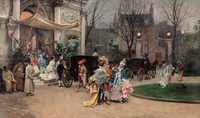
It is not hard to see what these critics disliked or why high modernist scholarship would later have so little time for Raimundo and his colleagues, presuming them to be unserious. The paintings are a dazzle of surface effects and eye-catching colors, from the polychrome scattering of detail and delicate brushwork in tableautins such as Departure from the Masked Ball (fig. 4) to the boldly colored sweeps of fabric and background in portraits such as that of the Duchess of Alba (fig. 5). A pervasive air of uncomplicated, leisured delight arises from combining these brilliant decorative effects with the painter’s treatment of subject matter and setting. When Raimundo was not depicting doyens and doyennes of high society at luxurious ease, he was conjuring up putatively attractive women in moments of untroubled idleness—reading, playing cards, lounging, daydreaming—or groups of enchanted partygoers. Alzaga aptly describes him as a painter of nonchalance, a subject to which an entire section of the exhibition is dedicated. For Alzaga, Raimundo extended widespread artistic interest in female elegance and gracefulness into an evocation of the private, relaxed leisure time of well-to-do nineteenth-century women (130–31).

Raimundo’s carefree world is often imbued with a sensual eroticism free of emotional turbulence or graphic physicality. As the catalogue essays emphasize, this aspect of his work is entwined with aestheticist eighteenth-century revivalism, both at the mid-century (the time of the Goncourt Brothers) and during Proust’s turn-of-the-century France (51). Raimundo returns frequently to the Rococo, at times in subject, at times in style, just as he chose Versailles as his final place of residence. Alzaga observes how the late nude After the Bath (see fig. 1) is situated firmly in the time of Louis XV (131). We find ourselves before a naked woman busy at her toilette upon a chaise-longue, her face turned away from us to observe her powder brush, a slinky stretch of cloth at once discreetly covering her genitals while insinuating penetration.
The significance of Fortuny and Raimundo’s school of painting lies in what most annoyed their critics. “The soul and passion side of things seemed to escape him,” lamented Charles Yriarte in 1889 of Fortuny’s tableautins. “The bewitchings of form and spectacle preoccupied him more than the interesting and moving subjects that compel the soul,” bemoaned the Iberian Josep Yxart in 1881.[11] Yriarte, Yxart, and others like them assumed that art should express and explore the vicissitudes of the spirit, both of persons and nations. Art, in their eyes, is an expression of Being and of its personal and historical fate. For Fortuny, on the contrary, art is in every sense a distraction—that is, a source of pleasure but also, and above all, a continual deflection. It releases us, takes us away, from obsessions with notions of spirit and Being and enables us to see a world freed from such conceptions. It presents a vision of our lives in which humans have no more importance than the objects that surround them or those that they wear. The hierarchy of the human spirit over material and manufactured objects is overturned as our eyes are drawn to the many distractions of the image. These were features of Fortuny’s compositions that Yriarte and Yxart truly disliked, just as critics of Raimundo objected to his lingering on what they deemed mere trivialities.
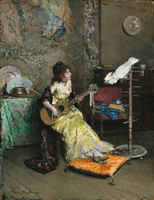
The early works by Raimundo displayed in the exhibition clearly show such effects. The guitar-playing Lady with Parrot (fig. 6) may be at the physical heart of her painting, but she is only a small part of the overall image. Our eyes are drawn to the complex, multidirectional colored patterns of the wall decorations; the shimmering, nuanced greens of the tablecloth; the latter’s proximity to the shock of orange that is the foot cushion; and then the velvet purple of the chair and the textured blue fabric lain across it. The woman’s tiny face is turned away from us, its size and orientation impeding engagement—we have better eye contact with the looming bright-white parrot—while our gaze is struck by the brilliant yellow of her dress contrasting with the blacks, reds, and silvers of her shawl. Similarly in Departure from the Masked Ball (see fig. 4), a group of figures occupies a central, foregrounded position, but they are relatively small and their faces barely visible. There is so much else that catches our eyes and draws us away from them: the scattering of disconnected gatherings in a multitude of costumes—their faces again tiny and often occluded—the range of dispersed, contrasting color patches and decorative effects made of organic and inorganic material, from textiles to flower arrangements to facades. We might be pulled to the artificial light on the gateposts or, in the opposite direction, to that which pours from the decorative doorway of the ball.
Critics and later historians might well assume that such effects neglected historic Spanish art’s true significance for modern painting, whether as a source for rugged, contemporary realism or—with its broad brushstrokes and nondescript background—as an exemplar of serious attention to the medium of paint and canvas itself. The preciosity and endless detail seem far removed from even as colorful an evocation of the Hispanic as Manet’s Lola de Valence, with its painterly monumentality and thick brushstrokes (1862; Musée d’Orsay, Paris). But Fortuny and Raimundo’s art was consistent with how some influential Spaniards understood what nineteenth-century Spanish beaux-arts and letters could be, and why they might matter.
Their preoccupations might be described as a concern with externality. By this, I mean that the continual piecing together of images, styles, and objects trumped efforts to plunge into some inner soul or spirit or to uncover some transcendent abstract principle that would underpin the modern era (e.g., that art should be about the medium of art). On the one hand, the true inheritance of Spanish culture was—for some at least—an aesthetic concern with image-rich fantasias. As the politician and writer Nicomedes Pastor Díaz had declared in 1837, “Our genius is the imagination . . . ; what elsewhere is love of truth, is in us enthusiasm for beauty.”[12] On the other hand, Spanish culture itself was often understood as a continual, ongoing assemblage and reassemblage of cultural elements garnered from history, the present, and a diversity of civilizations. National art was understood as a kind of historical mélange. In the words of the influential Romantic writer Agustín Durán, Spanish civilization had come together as an “amalgam and fusion of heterogeneous parts,” sourced locally from the Arabs and from northern Europe, and would continue to be adapted to the influx of external sources.[13]
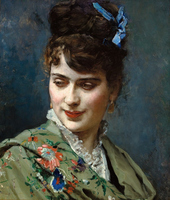
A cosmopolitan aestheticism, emerging from such a mélange, was entirely compatible with a concern for national glory. Raimundo’s uncle, Pedro, offered the following instructive description of the oval room in which disparate European masterpieces hung together at the heart of Spain’s national museum of painting, the Prado: “That the Oval Room offers promiscuity itself must never occasion censure . . . for it is expressly set out such that, as with a bouquet of select flowers, or in a treasure of unusual jewels, it delights sight and the aesthetic sense . . . in the marvels of color and light.”[14] Such sentiments echo the Madrazos’ extraordinary cosmopolitan networking, so fascinatingly described in the catalogue of the present exhibition and so characteristic of Spain’s cultural elite, as historians such as Raquel Sánchez have increasingly shown.[15] Raimundo’s and Fortuny’s paintings offer an artistic counterpart to and consequence of such networking. Individually and together, they present a mutable visual network of aesthetic reference points. Fortuny’s Spanish Marriage was hailed not least for marrying Goya to the then-popular French artist Jean Louis Ernest Meissonier; Fortuny’s oeuvre explores a range of aesthetic connections across Europe, Morocco, and Japan.[16] As Alzaga astutely points out, not only did Raimundo and his model Masson shift between cultural identities—traditional Andalusian or fashionable Parisian, for example—they also combined them: for instance, the Manila shawl in one portrait of Masson (fig. 7) blends japoniste design with typical Hispanic dress (150).
The material textures of decorative objects are fundamental to Raimundo’s “externality.” His brushwork evinces a sensuous appreciation of their surfaces. In his tableautins, such as Lady with Parrot (see fig. 6), Raimundo began to depart from Fortuny’s signature tiny curls of paint, deploying somewhat thicker, though still delicate, strokes that dwell on the folds and modulated patterns of materials, not least fabrics. Alzaga outlines Raimundo’s growing independence from Fortuny’s style, especially after the latter’s death, as he turned to distinct subject matter—society ladies in the present and in the eighteenth century—and tended to build each image around one nonchalant woman (28). In these paintings, and in his later portraiture, fashion comes to the fore as Raimundo explores the world of artificial objects in which elegant lives and societies are constituted. In her catalogue essay, Assier observes Raimundo’s meticulous depiction of fashionable cuts and colors (63).
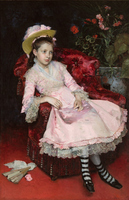
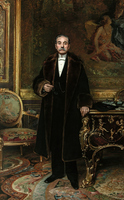
In Portrait of a Girl in a Pink Dress (fig. 8), Raimundo lavishes attention not just on the pattern of the outfit itself but on how the materials fold and take shape when the dress is worn. He explores the ruffling on the arms, the shadowed dip between the lap and knee, and the slight irregularity as the right-hand side of the skirt rests on the plush, velvety upholstery of the armchair. Similarly, in his portrait of Masson in a Manila shawl, Raimundo entrances us with the irregular, gently undulating folds of the garment as it rests around the shoulders, with how the carefully conceived patterns of colorful flowers are altered once it is no longer lain out flat. The deep concern with decorative lives is apparent in Raimundo’s male portraiture too. His Alexandre Mora y Reira: 2nd Marquess of Casa Riera (fig. 9) is enveloped in a plush ochre gown that is one more bold accoutrement among the many others in which the aristocrat nests: the metallic arabesques of the table, the extravagantly colored patterns of the fabric of the carpet and chair, and the subdued echoes of the former in the huge painting adorning the wall.
It is telling that a deep concern for such matters in their own right could be dismissed as frivolous. As the art historian Carlos Reyero has recently shown, influential posthumous critics condemned Fortuny for being too feminine, what with his shimmering delicate brushwork, his delight in objects and their detail, and his luxurious surface effects. That contempt, loaded as it was with gendered presuppositions, helped destroy Fortuny’s deserved reputation as one of Europe’s finest nineteenth-century artists.[17] (No doubt the sexual fluidity of Fortuny’s own oeuvre, which eroticizes both male and female bodies, played its part too.) It is only recently that historians of nineteenth-century Spanish culture such as Henriette Partzsch have begun to reassert the enormous significance of fashion culture, and especially feminine fashion culture, in its own right. The world of fashion mattered not only as a crucible of aesthetic taste but also as a complex arena of agency and expression through decorative objects and outfits and as a hotbed of cosmopolitan cultural life.[18] Raimundo’s determined attention to the textures, cuts, and patterns of materials is very reminiscent of the illustrations, descriptions, and instructions we find in nineteenth-century fashion magazines targeted at female audiences. His vivid evocation of, and obsession with, the intense, sensual materiality of textures—with the experience of fashionable items as objects—sets him apart even from the style of some other high-society portraitists of the time: Giovanni Boldini’s near-ethereal visions of fashionable femininity, with their fine, luminous silver-grays and lightening-like brush stokes,[19] or the soft, silky, sweeping paint of John Singer Sargent’s portraiture.
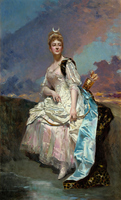
Alzaga underscores the distinctive visual force of strident colorism with which Raimundo evoked the “tactile qualities” of objects. She recounts several critics’ alarm at the discordant palette of Portrait of a Girl in a Pink Dress (see fig. 8) in the 1878 Universal Exhibition, with its shock of pink on a bright-red chair and carpet. The painting found a defender in Paul de Fort who saw instead a new kind of harmony, a “symphonic” tour de force (173). Alzaga argues that de Fort was correct: Raimundo pursued new refinements of beauty, derived—through Fortuny’s influence—from combinations of colors in non-European arts (31). The influx of Japanese prints and Fortuny’s interest in Moorish artistry are likely sources. In the portrait of Masson in a Manila shawl, the deep green fabric is set against a dark blue background (see fig. 7). In an image of the Marquise d’Hervey Saint-Denys, swathes of the painting are occupied by a garish combination of blues, purples, and pinks (fig. 10). Raimundo shared his concern for intense, sensual colors with other Spaniards, notably the leading Spanish poet of the late nineteenth-century Colorist school, Manuel Reina. Tellingly, Reina took to publishing in Spain’s long-running women’s magazine Moda Elegante (Elegant Fashion). In the April 22, 1882, edition, he offered its readership a series of what he called “impressions and watercolors” from the annual Seville Fair, filled with overpowering combinations of richly colored materials and light, and voluptuous sound and scent.[20] Similar preoccupations led Emilia Pardo Bazán, the outstanding female writer of Spain’s late nineteenth century, to enjoy the Goncourt Brothers above all other nineteenth-century novelists. In her influential, polemical treatise La cuestión palpitante (The Burning Question, 1882), Pardo Bazán proclaims her “colorist temperament” and coins the term sensationists to describe the Goncourts and their delight in “vivid chromatic sensations.”[21]
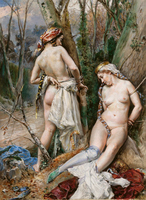
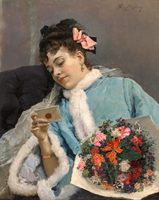
Less attractively, Raimundo’s obsession with the sensual pleasures of decorative objects strays continually into an objectification of women, a trait he also shares with Reina. In those poems about Seville for Moda Elegante, for example, Reina describes how a bullring is “adorned with delicious women,” as if they were just one more decorative object.[22] Raimundo’s fleeting, early attempt to be a grand history painter took him revealingly to the subject of El Cid’s daughters (fig. 11). He shows them tied up and abandoned by their husbands in a scene of light bondage, posed to offer the public a front and rear view of partially naked women, their remaining clothes coyly concealing and revealing, a serpent-like coil of head scarf at once obscuring genitals while phallically suggesting penetration. More subtly, in Birthday Congratulations (fig. 12), Masson lounges back, gazing at a lover’s correspondence while proffering an explosion of flowers upward from her groin. Raimundo similarly delights in glimpses of the demi-monde. In the virtuoso gas-lit night of Departure from the Masked Ball (ca. 1867; Carmen Thyssen-Bornemisza Collection, Málaga), a top-hatted gentleman has his arm about a young woman—presumably a grisette—whose scandalous skirt terminates well above her knees; he gestures toward his carriage. If, in his society portraits, Raimundo tended to avoid the off-the-shoulder poses and exposed flesh of Boldini—a fellow follower of Fortuny—he seems unable to hold back on winks of eroticism. The Duchess of Alba curls an ungloved finger at groin-level (see fig. 5); a haughty Marquise d’Hervey Saint-Denis as the Goddess Diana (see fig. 10) is poised to shoot an arrow from her midriff, while a quiver disappears deep behind her bustle.
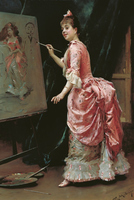
Like several other cultural historians of the nineteenth century, Alzaga explores the complexities of such objectification. Masson played a decisive part in the creation of Raimundo’s imaginary. The catalogue pays welcome, extended attention to Masson, dedicating an entire essay to her role, which Alzaga seeks to reconstruct from visual sources. On the one hand, Masson was Raimundo’s “fetish model” (131).[23] On the other, Alzaga points to evidence of a “complicit relationship” between the model and the artist, in which Masson exercised agency (151).[24] Alzaga refers, for example, to The Model’s Mischief (fig. 13), in which Masson is depicted holding a paintbrush in front of Raimundo’s incomplete portrait of her. Masson not only replaces Raimundo in the position of the painter before the canvas but also defaces his painting with a caricature of him. While Masson is shown here asserting her power as an important model, she nonetheless does so by playing the piquant role of naughty young woman. Similarly, Raimundo’s immersion in fashion culture, the role of his female sitters, and their likely audience might be viewed in light of Sharon Marcus’s subtle account of fashion illustrations. Such nineteenth-century “iconography disproves the still influential claims that men look and women are looked at, that only male viewers enjoy corporeal spectacles of femininity,” Marcus remarks. But equally, she observes, “fashion plates became popular because women who wanted to turn themselves into spectacles of femininity took pleasure in looking at images that reduced women to lovely bodies filling out beautiful clothing.”[25]
In the end, the exhibition and catalogue are firm but measured in their reassessment and reassertion of Raimundo’s importance as a painter. In Assier’s evaluation, Raimundo was not the prophet of an artistic revolution, but rather a painter who sought a moderate position between modern innovations and artistic tradition (51). The press pack for the exhibition presents him as a juste-milieu painter who, like other middlebrow artists of the nineteenth century, is now receiving greater recognition for his merits. Certainly, in the second third of the nineteenth century, Fortuny’s endless, nonhierarchical patterns of echoes and reflections went far further than his brother-in-law’s art ever did in reimagining the structure of a painting. By the turn of the century, a host of painters born in Spanish territories—from Darío Regoyos to Isidre Nonell and Sorolla, not to mention a young Picasso—were unleashing an unprecedented wave of innovations in composition and style from which Raimundo remained remote.
We might, though, pause before emitting too definitive a sentence on Raimundo’s achievements. His concern with “externality” clashed with several assumptions about what great nineteenth-century art should do. He immersed himself in the objects of (female) fashion culture, a topic that is of increasing importance to contemporary scholars. His paintings sit uneasily with influential presuppositions about Spanishness in art and its true significance for modern painting. He championed a nineteenth-century Hispanic cosmopolitanism that historians are only now beginning to appreciate. The assessment of Raimundo’s value will involve a great deal of rethinking about what matters and what is merely superficial. It was high time he received the large, monographic exhibition that his work deserves, and which—along with its rich catalogue—offers such an unprecedented opportunity to reflect upon his legacy.
Notes
[1] More detailed biographies may be found on the Prado’s website. See “Madrazo y Agudo, José de,” Museo Nacional del Prado, accessed February 9, 2026, https://www.museodelprado.es/; and “Madrazo y Kuntz, Federico de,” Museo Nacional del Prado, accessed February 9, 2026, https://www.museodelprado.es/.
[2] There are a few variations between the selection of works in the exhibitions in Madrid and Dallas. These differences are signaled in the list of exhibited works in the catalogue.
[3] From this point onward, I use the first names, rather than the surname Madrazo, to avoid confusion. In addition to José, Federico, and Raimundo, the family also included other painters: Pedro who was Federico’s brother, Raimundo’s brother Ricardo, and Federico Carlos de Madrazo (known as Cocó) who was Raimundo’s son.
[4] Isabel Burdiel, Isabel II: Una biografía (1830–1904) (Taurus, 2010); Adrian Shubert, The Sword of Luchana: Baldomero Espartero and the Making of Modern Spain, 1793–1879 (University of Toronto Press, 2023); and Anna Caballé, Concepción Arenal: La caminante y su sombra (Taurus, 2018).
[5] See Sudip Bose, “The Man Who Loved Proust,” The American Scholar, May 24, 2018, https://theamericanscholar.org/.
[6] The podcast episode, “Raimundo de Madrazo en exposición: La elegancia que conquistó Europa” (Raimundo de Madrazo Exhibited: The Elegance that Conquered Europe)—is available on iVoox. See: Amaya Alzaga, guest, “Raimundo de Madrazo en exposición: La elegancia que conquistó Europa,” El Curioso Parlante, November 14, 2025, iVoox, https://www.ivoox.com/.
[7] Gary Tinterow and Genevieve Lacambre, eds, Manet/Velázquez: The French Taste for Spanish Painting (Metropolitan Museum of Art, 2003).
[8] Among important contributions to our understanding of these processes is David Howarth, The Invention of Spain: Cultural Relations Between Britain and Spain, 1770–1870 (Manchester University Press, 2011).
[9] “el jefe de la escuela española a orillas de la Sena.”
[10] “su refinado gusto, la captación preciosista de los interiores y la destreza en la representacion de las calidades táctiles de objetos y textiles le procuraron tanta fama como descrédito a partir de finales del siglo XIX.”
[11] Cited in an extended discussion of Fortuny’s innovations in Andrew Ginger, Instead of Modernity: The Modern Canon and the Incorporation of the Hispanic (c. 1850–75) (Manchester University Press, 2020), 208–17.
[12] “Nuesto genio es la imaginación . . . ; lo que en otras partes es amor a la verdad, es en nosotros entusiasmo por la belleza.” “Del movimiento literario en España,” in Obras completas, ed. José María Castro y Calvo (Rivadeneyra/Real Academia, 1969–70), vol. 1, 103.
[13] “amalgama y fusión de las partes heterogéneas.” Romancero de romances caballerescos e históricos anteriores al siglo XVIII, Parte I (Madrid: Imprenta de Don Eusebio Aguado, 1832), xxix.
[14] “Que el Salón Ovalado presenta la misma promiscuidad no deberá nunca censurarse . . . porque está expresamente dispuesta para que, como ramillete de selectas flores, o en tesoro de joyas pereginas, recreen la vista y el sentido estético . . . en las maravillas de color y luz.” Catálogo descriptivo del Museo del Prado: Parte primera. Escuela italiana y española (Rivadeneyra, 1872), xvi.
[15] For an important example of such work, see Raquel Sánchez’s account of the lifework of Eugenio de Ochoa, who was Raimundo’s uncle by marriage to Carlota de Madrazo: Raquel Sánchez, Mediación y transferencias culturales en la España de Isabel II: Eugenio de Ochoa y las letras españolas (Iberoamerican, 2017).
[16] Ginger, Instead of Modernity, 215, 217.
[17] Carlos Reyero, Fortuny; o, El arte como distinción de clase (Cátedra, 2017), 214–24.
[18] Partzsch has dedicated several studies to this topic, including recently Henriette Partzch, “Las revistas de moda y la circulación transnacional de la cultura de vestir en el siglo XIX. Apuntes acerca de las relaciones entre La Moda Elegante (Cádiz/Madrid, 1842–1927) y La mode illustrée (Paris, 1860–1937) en el contexto de la red de revistas centrada en Der Bazar (Berlin, 1854–1937),” in Saber y crear en feminino: Genero, cultura y modernidad entre los siglos XVI–XX, eds. Mónica Burguera López and Gloria Espigada Tocino (Comares, 2024), 133–46.
[19] Francesca Dini, “Giovannin Boldini, 1842–1931,” in Boldini: El espíritu de una época y la pintura española a finales del siglo XIX, exh. cat. (Fundación Mapfre, 2020), 56. This earlier, revelatory exhibition at the Mapfre Foundation presented not only an insightful overview of Boldini’s career, but also of his Spanish contemporaries.
[20] “Impresiones y acuarelas.”
[21] “Temperamento de colorista,” “sensacionistas,” “vivas sensaciones cromáticas.” La cuestión palpitante (Madrid: Imprenta Central, 1883), 97, 99, 104.
[22] “Adornada de mujeres deliciosas.”
[23] “Modelo fetiche.”
[24] “Relación cómplice.”
[25] Sharon Marcus, Between Women: Friendship, Desire, and Marriage in Victorian England (Princeton University Press, 2007), 135.