Homecoming: Walter Osborne’s Portraits of Dublin, 1880–1900
Reviewed by Margaret MacNamidheMargaret MacNamidhe
School of the Art Institute of Chicago
Email the author: mmacna2[at]saic.edu
Citation: Margaret MacNamidhe, exhibition review of Homecoming: Walter Osborne’s Portraits of Dublin, 1880–1900, Nineteenth-Century Art Worldwide 25, no. 1 (Spring 2026), https://doi.org/10.29411/ncaw.2026.25.1.21.
This work is licensed under a Creative Commons Attribution-NonCommercial 4.0 International License  unless otherwise noted.
Your browser will either open the file, download it to a folder, or display a dialog with options.
Homecoming: Walter Osborne’s Portraits of Dublin, 1880–1900
Raclin Murphy Museum of Art, University of Notre Dame
August 19–December 7, 2025
Catalogue:
Cheryl K. Snay, ed., assisted by Judith Stapleton,
Homecoming: Walter Osborne’s Portraits of Dublin, 1880–1900.
D Giles Limited, 2025.
192 pp.; 116 color illus.; bibliography.
$49.95 (hardcover)
ISBN: 9781913875961
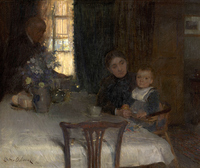
The gleaming new galleries of the entirely refurbished Raclin Murphy Museum of Art (previously the Snite) on the University of Notre Dame’s South Bend campus hosted a landmark exhibition this fall. Curated by Cheryl K. Snay, working closely with the National Gallery of Ireland (NGI), Homecoming: Walter Osborne’s Portraits of Dublin was the first exhibition in the US devoted to the Irish painter Walter Frederick Osborne. In fact, prior to the Raclin Murphy show, the span of Osborne’s work had not been seen in public for forty-two years. The principal focus of Snay’s exhibition was Osborne’s responses to a city he remained close to throughout his short career, even as it encompassed frequent travel in the 1880s and 1890s. Osborne returned to Dublin for good in 1894. The family reasons that brought him back—the exhibition title’s first word indicates this emphasis—were evoked by one painting in particular, At the Breakfast Table (fig. 1). The transformation in Osborne’s life marked by this canvas told a family story that was at the exhibition’s heart: Osborne’s return to new responsibilities sharpened his already acute awareness of deprivation in the city around him, culminating in the “masterpiece” of In a Dublin Park, Light and Shade (see fig. 7).
Paintings of late nineteenth-century Dublin? Examples may not flock to mind unless one is a specialist, a reminder that Ireland is still associated with rural imagery. And yet, as Kathryn Milligan has argued in her account of artists who depicted Dublin during the late nineteenth century and later, there is no shortage of examples—the exhibition at the Raclin Murphy provided one of the most extended studies to date.[1] In general, research on the art and visual culture of Ireland and its diaspora has expanded enormously over the past forty years. With Homecoming, the Raclin Murphy Museum of Art offered an important new contribution to the development of that research.
But my first order of business is telling Osborne’s family story, which entails a description of At the Breakfast Table. Osborne returned to Dublin because in 1893, his sister, Violet Stockley died giving birth to her daughter, also called Violet.[2] Caring for Violet’s daughter became the responsibility of Osborne, his mother Anne-Jane (née Woods), and father William, also a painter. At the Breakfast Table depicts the transformed family’s new center of gravity. Perched on a high chair at one side of the table in a first-floor room of the house in which Osborne grew up, the infant Violet, wide-eyed, looks out of the composition. A white tablecloth stretching across the scene adds illumination. As Snay notes in the catalogue, Osborne’s “whites are not white at all”: streaks of pale greenish gray and navy put them in a cool register (114).[3] They illuminate Stockley beginning her day, grandmother by her side. Drawing on years of experience across four countries, Osborne brings his already celebrated skills in the handling of light to set a new place at the table.
Art History in Ireland
Hanging At the Breakfast Table against a background of dark-red walls to deepen this painting’s effects of shadow was characteristic of the care given to Osborne’s work throughout Homecoming—a small example of Snay’s ambitions for the Raclin Murphy to contribute to what Fintan Cullen and Róisín Kennedy call the “dramatic upsurge” of research and publishing on Irish art.[4] Helping out greatly here is the University of Notre Dame: that its campus presence in Ireland, for example, is divided among several landmark buildings indicates the resources in play.[5] One of its centers, in fact, overlooks St. Stephen’s Green, depicted by Osborne for In a Dublin Park (see fig. 7).[6]
The scholarly revival of this painter’s fortunes, initiated by the NGI’s 1983 retrospective Walter Osborne, coincides with the beginning of the upsurge Cullen and Kennedy describe. And the current energy they evoke is demonstrated by the fact that forty years ago only one art historian wrote the NGI’s catalogue (the distinguished scholar Jeanne Sheehy, pioneer of research into Osborne, was solely at the helm), while six wrote for the Raclin Murphy exhibition.[7] The lavishly produced catalogue, edited by Snay and assisted by Judith Stapleton, presents five meticulously researched essays, beginning with one on the context in Notre Dame by Snay and another by Stapleton on Osborne’s Dublin. The NGI’s chief curator Brendan Rooney’s essay is about the prominence Osborne awarded figures of children in his paintings. Logan Sisley (from Dublin’s Hugh Lane Gallery) contributes a fine-grained account of the powerful personalities shaping Dublin’s artistic circles in the 1890s, and Milligan builds on her research into the city’s specificity among developments familiar to historians of nineteenth-century art, such as population growth and the proliferation of suburbs. The care for late nineteenth-century primary sources throughout makes Homecoming the gold standard for future studies into late Irish painting of the period. A 110-page catalogue of Osborne’s work and a bibliography round out Snay’s publication.
Scholarly activity on nineteenth-century Irish art in the 1980s provided extraordinary initial momentum for this activity, but, as Kennedy has pointed out, rapid economic expansion a decade later was a catalyst for further development. She reminds us that from the mid-1990s onward no part of Irish society was unaffected by the boom.[8] Irish art became valuable as never before. A new category emerged, dubbed “modern Irish fine art.” Although it stretches into the late nineteenth century, easel paintings from the century of Irish independence, the twentieth, dominate this category. Oils on canvas—along with a host of other objects made in Ireland over the centuries such as furniture, porcelain, and silver—might have once incurred nationalist suspicion (they decorated landowners’ homes), but along with “modern Irish fine art” they acquired new associations of achievement.
Within two decades, the boom was over, but by the time the Irish economy plummeted in the 2008 mortgage crisis, study of nineteenth-century art in Ireland and in the diaspora had been firmly established. Existing departments of art history had expanded, new ones had been opened, and the study of material culture in Ireland developed.[9] The visual arts gained new respect following serious long-term denigration.
As for the future: scholarship will likely continue to be shaped by philanthropy and collecting across Ireland and the US. Twenty-three years ago, Dublin’s innovative Irish Art Research Centre (TRIARC) was founded thanks to Fred and Kay Krehbiel and their philanthropic foundations. In 2015, a mammoth exhibition on the long eighteenth century in Ireland (at the Art Institute of Chicago) left a viewer in no doubt as to the scale of the Krehbiels’ collection. No wonder curators and collectors currently work “hand in hand,” as Snay puts it in her essay (13). At Notre Dame and elsewhere, a vital role is also played by the Naughton Foundation.[10]
Collections can be broken up, however. The Raclin Murphy has benefited from one instance of this and can fill a void left by the dispersal of another. In 2018, Brian P. Burns sold his collection; it included At the Breakfast Table (14). Already four years into a new acquisition policy covering Irish art from three centuries, the Raclin Murphy bought the painting whose story Homecoming tells. Notably, Snay decided on a monographic exhibition, an approach taken at Quinnipiac University by Niamh O’Sullivan in 2016 for another short-lived painter, Daniel Macdonald. But three years following the auction that included At the Breakfast Table, the collection in O’Sullivan’s care disappeared from view, its funding cut. The museum O’Sullivan directed had been devoted to the defining event of nineteenth-century Ireland, the Great Famine (1847–52).[11] Potential therefore abounds—for increasingly specialized exhibitions, for example, in the mold of O’Sullivan’s from 2016 and Homecoming. Opportunities have already come the Raclin Murphy’s way. More (it is to be hoped) are likely to follow, including those that could direct attention again to the Famine.
Cultural Nationalism
If philanthropy allied with collecting continues as one crucial context for the surge of interest in nineteenth-century Irish painting, another is the association of Ireland with rural imagery, exemplified by landscape motifs from the western seaboard, an area of great impoverishment during Osborne’s lifetime. Milligan has argued that painters who, like Osborne, depicted Dublin lost out in twentieth-century art-historical studies compared to artists attuned to this landscape due to cultural nationalism’s freight.[12] In the catalogue, Snay nimbly distances Homecoming from engaging with the much discussed cultural investment in landscapes from the west coast.[13]
The elevation of Ireland’s western seaboard both matches Ernest Gellner’s influential formulation of cultural nationalism as a nineteenth-century phenomenon and goes beyond it. Gellner points out how, as the twentieth century approached, the galleries, concert halls, theaters, and publishing houses of cities like Budapest, Oslo, and Dublin began to fill with works unmarked by ruling forms and languages (whether German, Danish, or English). This allowed them to participate in the modernist privileging of regional and folk customs, identified by linguistic, musical, and material motifs that were taken as authentic. Most importantly for the understanding of Ireland’s cultural nationalism, this authenticity persuaded because it was about survival (songs and stories tied to subsistence agriculture and fishing) or belief (for instance, rural Catholicism). Gellner describes this as the transfer of context-dependent motifs into “context-free” pursuits such as painting or poetry; markets enable people to buy paintings or poetry collections.[14]
Just how much Osborne was involved in cultural circles of late nineteenth-century Dublin busily expanding “context-free” pursuits comes across in Stapleton’s and Sisley’s essays for the Homecoming catalogue. These circles included some of the best-known cultural figures from Ireland who were developing modernism in accord with Gellner’s definition—motifs determinedly different from English traditions on account of their context-determined origins. This modernism is not marked in Osborne’s work; only two paintings from the west of Ireland appear in Homecoming.
But over the last fifteen years in Ireland, the rapid ascendance of cultural nationalism in the decade or so after Osborne’s early death became a topic of public discussion. In 2014, when the Naughton-supported survey appeared (weighty proof of the activity Cullen and Kennedy describe), the Decade of Centenaries Programme was entering its third year. A host of research projects and publications as well as public commemorations, exhibitions, documentaries, and so on, addressed “painful legacies” by revisiting the events, many violent, on the island of Ireland from 1912 to 1923.[15] The Raclin Murphy’s contribution to the Decade of Centenaries was its commemoration of a remarkable exhibition of Irish art, held in Paris in 1922, a tumultuous year that included the Free State’s founding.
The First Gallery
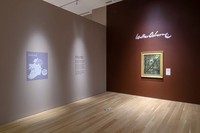
This exhibition received a mention in the first gallery’s wall text.[16] Through a reference to modernity in Ireland, it is linked to the “inflection point” of Osborne’s career in 1894, marked by At the Breakfast Table. On the facing wall was a map of Ireland. Galway, Roundstone (a fishing village in Connemara), and Limerick were located on this map as well as Dublin (fig. 2).[17] The journeys Osborne made to Connemara are represented by paintings in Homecoming, but Osborne more frequently painted places in rural England, as well as in France and Belgium. I understand that wall texts disallow the nuanced interpretation characteristic of Snay and achieved throughout the catalogue. Nonetheless, the identification of Connemara on the map and the attachment of Osborne’s painting to cross-century signifiers seemed misleading, especially since the cultural investment in the west coast of Ireland expanded during the years commemorated by the Decade of Centenaries.[18] I take this appearance of the west in Homecoming as a sign of the rapid expansion of scholarship. Given the wealth of partnerships supporting the 2022 exhibition, future projects are bound to build on and develop the complex challenge of going from intensities across the nineteenth century in Ireland to different but related intensities in the island’s twentieth-century history with Homecoming’s thoroughness and polish setting the stage for the Raclin Murphy’s future initiatives.
I turn now to questions specific to nineteenth-century Dublin. Studies of nineteenth-century art and visual culture have long been shaped by the century’s growing urbanism—with its construction booms, spreading railways and suburbs, and retreating farmland and wilderness. Recent research on this urbanism has added findings on colonialism, material agency, the Anthropocene, and systems of time regulation to longer established emphases on gendered forms of labor and the mixing of social classes in the anonymous crowd of new public spaces.[19] As cities changed, so did their artistic institutions; the hierarchical Academy changing or giving way to exhibitions organized by artists, informally organized drawing studios, design education, and artist colonies, marking a reaction against urbanism and the Academy alike. Painting among peers in rural and coastal villages appealed more than drawing from the model in urban institutions. From this perspective, the Raclin Murphy’s walls testified to an artist who was equally at home among informal settings and in the Academy. The catalogue contributions by Stapleton and Sisley disclose cultural circles of the 1890s availed of by a painter unmarked by any binary between Academy and the avant-garde. And throughout the galleries, a viewer saw recurring features of nineteenth-century urbanism: most importantly here, as I saw it, was the park.
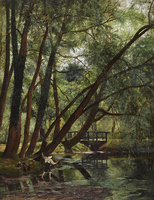
A Glade in the Phoenix Park (fig. 3) was the only work in Homecoming’s first gallery. A dark-red wall (as noted, this effective background color was given to key works) set off this landscape’s vivid greens. A Glade earned its prominence because it launched Osborne’s career in 1881 with a lucrative award designed to permit the winner to leave Dublin—a reminder that, in a place deemed peripheral, one goal of artistic education and ambitious artists was departure, often permanent.[20]
Homecoming’s eye-catching first painting, with its evocation of sun and shade in a verdant landscape, prompted viewers to reflect on how this canvas had emerged from a country with the Famine in its recent history, and from an artist whose investment in the Academy would be lifelong. The latter seems to have made Osborne quite keen on institutional awards; he was later a judge for the same prize that had launched his career. Its Dublin version, the Royal Hibernian Academy (RHA), where Osborne trained, was a familiar combination of school and public exhibition. In 1881, the travel money A Glade earned for Osborne had been on offer for just three years. But the fund had been there for decades. It had languished since its establishment just after the Famine, a sign of Ireland’s slow institutional regrouping and society-wide change from 1852 (72).[21]
A Glade oriented the viewer to the rest of the exhibition by showcasing the occasion that enabled Osborne to study outside Ireland. It also introduced the artist’s exploration of his signature lighting effect. The dark trunks and branches A Glade depicts stretch to the top of the canvas, arching over the diminutive figure of a boy fishing in the pool below. The light that picks him out appears vivid because it is interrupted by a canopy of foliage (described evocatively by Snay in the catalogue); dappled light is cast on the glassy pool (74). The dark trees, schematic and unmodulated, did not reappear in later paintings, but the effects yielded by its canopy did. As Snay emphasizes, Osborne returned again and again to the potential of this kind of light.
A Glade, however, offered no early indications that Osborne was open to the complexities of the city around him. This painting closes itself off from the park around it. As Snay points out, nothing about A Glade hints at the vast expanses that permitted urban recreation to take off here in the nineteenth century. A zoo, a cricket club, and a racecourse all found room in the Phoenix Park (74). To be sure, these typical examples of nineteenth-century urbanism are distant from A Glade. I would add to Snay’s observations that there is no evidence of the park as a place radiating the power of the Union either. Although more ceremonial than administrative, the park was so closely associated with the grand Viceregal Lodge, home to the lord lieutenant, that it was made the target of a violent attack by a republican society two years after A Glade was painted.[22] In what became known as the Phoenix Park Murders, the victims were two leading civil servants, one of them, Thomas Henry Burke, was Under-Secretary to Ireland and the brother of Augustus Burke, Osborne’s teacher at the RHA.[23] Osborne had good reason to find a nook as secluded as the one in A Glade.[24] The painting blankets out any link to power structures of which he was well aware. Rooney describes insulation as a default mode of the middle-class background in which Osborne grew up (41). A Glade shows the twenty-one-year-old painter’s response, or lack of response, to the city around him. The following galleries in the exhibition would show Osborne overcoming the distance from Dublin he seemed ready to enforce in A Glade.
From An October Morning to Saint Patrick’s Close
The next gallery represented the years in which Osborne often painted in places away from Dublin.[25] While the extent of this artist’s travels from 1881 to 1894 was beyond Homecoming’s scope, it is worth emphasizing how their variety exemplifies how institutional structures ceded authority to groups of likeminded artists in the late nineteenth century. Osborne’s sociability was a perfect match for this development. From the Académie Royale in Antwerp to time spent painting in Brittany and, eventually after 1884, trips to fishing villages in southwest England: this itinerary indicates an individual who thrived in groups.[26] Brought up in a family with a public presence thanks to his father’s career and devoted to a sister whose outgoing personality is noted throughout the catalogue, Homecoming brought Osborne’s capacity for friendship to the fore. His almost yearly visits to villages in southeast England, for example (a fixture of his career from 1884 to 1896), resulted from a camaraderie with other artists painting there (even as they founded influential artists’ societies and exhibitions in London). Osborne made this mix of sociability and professionalism his own, busily participating in Dublin’s artistic circles even during his travels.[27]
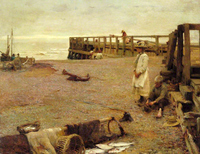
Osborne’s time among those fishing villages in England was made prominent in the spare hang of Homecoming’s second gallery. The arresting canvas An October Morning (fig. 4) was for me the painting that best met the challenge of representing his years of travel within the Dublin narrative. Two children are seen on a pebbly beach. They ignore each other and their surroundings.[28] The painting exemplifies the same atmospheric mode—cool, dispersed light under overcast skies—as Saint Patrick’s Close, which I will consider below (see fig. 5).[29] Osborne submitted them together to the 1888 RHA exhibition, further connecting them.
Broadly speaking, Osborne depicted two different kinds of light in his paintings. On the one hand, there is the interrupted light that initially appeared in A Glade. On the other, there are evenly lit scenes; these are likely to date from before 1894. In a compliment from the writer and politician Stephen Gwynn, one of Osborne’s closest friends, quoted in the catalogue and used in the exhibition as wall text, Osborne’s handling of light is called “pearly” (96), a response to the unifying effect of this second mode of light, called by Stapleton “a sense of total atmosphere” imparted by Osborne to An October Morning, Saint Patrick’s Close, and, two years later, Dublin Streets: A Vendor of Books (1889; National Gallery of Ireland, Dublin).
All these paintings are scenes of impoverishment. As I saw it, the roots of the painter’s social awareness argued for by Homecoming begin with An October Morning and proceed to Saint Patrick’s Close. The life of the harbor was apparently what attracted Osborne to these English coastal communities in the first place. Yet no labor is performed in An October Morning, and fish have been allowed to spill out wastefully from an abandoned creel, an effect Stapleton notes (102). Indeed, the coastline portrayed in An October Morning was neglected because its harbor had silted up.[30] The subject itself obviated the possibility of depicting newer urbanized or industrial forms of labor. In fact, the appeal a languishing coastal village exerted over Osborne may be part of the answer to a question raised by Milligan about why his trips to England did not include places that were “active and prolific” and why, a year after painting An October Morning, he gravitated to a part of Dublin also untouched (yet) by modernization.[31]
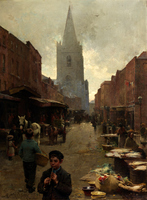
Saint Patrick’s Close (fig. 5) depicts an impoverished street among a warren that also hosted busy markets, described in the exhibition as a “hodge-podge of dilapidated buildings.” This canvas has become one of Osborne’s best-known, arguably on account of its prominent foreground figure, a boy wearing presentable if frayed clothes and playing a tin whistle. On the exhibition’s advertising banner, he appeared solo. This sense of removal from surroundings is integral to the figure’s effect. While the day ahead must be the only thing on the mind of the seated boy in An October Morning, lacing up what Stapleton describes as “worn footwear,” his counterpart in Saint Patrick’s Close is given the musical wherewithal to ignore the shadowed and littered street on which he turns his back (96). Milligan fills out the picture of Osborne’s attention to what a child wore and did. According to her, keeping an eye on such things as caps and “worn footwear,” or their lack, was how governmental authorities assessed fluctuations in poverty. Clothing guided intervention.[32] The boy in Saint Patrick’s Close thus meets nineteenth-century criteria for plucky, inner-city children.
At the Breakfast Table
Over the course of the long gallery ahead, around the corner from Saint Patrick’s Close, the hang, wall text, and labels imparted the gravity of 1894 for the Osborne family while filling in the complicated context needed for full appreciation of Saint Patrick’s Close and related paintings. For me, the interweaving of themes in Homecoming was at its most concentrated in this section—a long continuous set of walls rather than a single, unified space—containing At the Breakfast Table. On a dark-red background, homages appeared to Violet Stockley, who gazes out from a rapidly painted portrait, as well as to Anne Osborne. The Artist’s Mother Reading (ca. 1900; Collection of Michael Corrigan HRHA) is rendered with an affecting, dry technique unusual for Osborne; the marks of a rag on canvas show that he scrubbed in the forms of a fireplace and mantlepiece. Across from these paintings, the introduction to Violet’s daughter and to the new daily routines of the family home appeared in At the Breakfast Table, awarded a wall to itself. Preparatory sketches in the accompanying glass case showed off the distinctive precision of Osborne’s drawing. One gem was a piece of correspondence where the artist’s delighted opinion of At the Breakfast Table could be read beside a rendering of the painting itself in miniature, with perfectly scaled-down hatching delineating the back of the poignantly empty chair in front.[33]
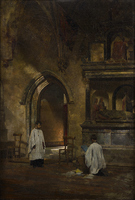
On light gray walls immediately following, a viewer was brought beyond the family home’s interior and right back to the area introduced by Saint Patrick’s Close. The narrative here was another ambitious weaving of home and city together. This section showed the indelible imprint of this part of Dublin on Osborne’s life, in large part due to St. Patrick’s: a Gothic cathedral that had been a powerful and historically Protestant center of worship for centuries by the time Osborne’s family were attending services there. The perspective of the working-class and poverty-stricken Catholic inhabitants of this area on the cathedral is offered in Saint Patrick’s Close, where its monumental spire rises in the background. What it looked like from the inside is shown in Interior, St. Patrick’s Cathedral (fig. 6). In contrast to the later painting’s gray skies, Osborne’s dappled light appears in Interior, especially in its “sun-soaked corridor” in Aoife-Marie Buckley’s description (124). Music is evoked in both paintings, as the distraction I discussed previously, compared to its inherent role in the earlier composition, where two choristers from St. Patrick’s storied choir school appear, neither “singing nor praying,” but instead sifting through sheet music for a future performance (124).
St. Patrick’s is in central Dublin, but Osborne and his family lived in the city’s expanding suburbs. Such neighborhoods surrounded many nineteenth-century cities, but the Dublin difference was again a religious one. While the exodus from the center included middle-class Catholics as well as Protestants, the suburb where the Osbornes lived began as an enclave separated from Catholicism.[34] To attend services in St. Patrick’s, the family traveled from a new Protestant outpost to an old one. Not surprisingly, this section of Homecoming brought home the divisions of Osborne’s Dublin.
This gallery had one more crucial historical layer to reveal about the part of Dublin around St. Patrick’s. Narrow streets, a Gothic cathedral: these motifs rendered it picturesque and touristic. An expanding railway system encouraged tourism; St. Patrick’s was the subject of commercial photography, too, as part of the countrywide campaigns of entrepreneur William Mervyn Lawrence.[35] An album of Dublin views in a glass case represented Lawrence’s work, reminding viewers that urban imagery has indeed a long record in Ireland, even as the ascent of the cultural nationalist attraction to Connemara was underway. And at the same time, shadows cast by the Famine and subsequent shocks lingered; in 1900, enormous deprivation still weighed on rural communities in the west, Connemara included.[36]
In a Dublin Park
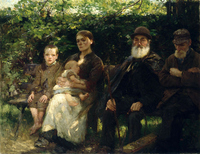
The photographic illustrations in the case included a view of St. Stephen’s Green, priming viewers for the next gallery’s introduction of In a Dublin Park (fig. 7). The exhibition’s didactic effort was palpable in the wall text introducing this gallery, which conveyed the sweep of Dublin’s nineteenth-century development in a few well-chosen paragraphs.
For a painter redoubling his efforts to leverage sociability into sales and portrait commissions, the economic aspects to these changes became newly relevant. Few names were more successful here than those of Arthur and Edward Guinness, “heirs to the famous brewery,” as Milligan describes them, and behind much urban planning in late nineteenth-century Dublin. In fact, the streets near St. Patrick’s were, as a result of their efforts, slated for demolition in 1899 (128).[37]
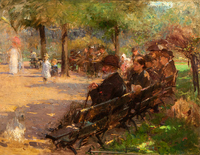
Fourteen years after his professional debut with a bucolic scene of the Phoenix Park (see fig. 3), Osborne directed his attention to another park. In a Dublin Park was hung beside two preparatory canvases. They were given a wall to themselves to indicate their significance: the last time these three works had been exhibited together was during Osborne’s lifetime. For me, the sequence was revelatory. In St. Stephen’s Green (ca. 1895; O’Brien Collection, Chicago) showed the composition Osborne first thought of for In a Dublin Park, but this initial approach hung at the end of the wall, after the final painting, not before it (fig. 8). This made all the difference. In fact, this painting of a park, one Osborne walked through every day, emerged for me not only as a highlight of Homecoming but as a way to summarize the entire exhibition. That is because, unlike the continuity from preparatory sources in At the Breakfast Table, for example, the compositional study for In a Dublin Park contrasts completely with the final painting in a way that bears on contemporary beliefs about parks. A park disperses people and offers them opportunities for activity as well as rest. By “people,” however, what reformers like Arthur Guinness had in mind were poor people. As Mary Poovey has shown, in nineteenth-century Britain and Ireland, morality was fused to public-health policy and urban planning to a unique extent. The watchword was overcrowding, which connoted lax character and susceptibility to contagious disease among impoverished inhabitants in cramped inner cities. They were envisioned as the beneficiaries of a park’s fresh air and open spaces promoted by the sanitary movement that began just before mid-century and shaped attitudes for decades to come.[38] For Osborne, the question seems to have been whether he would depict the range of dispersal, activity, and rest that the sanitary movement required. The compositional study (fig. 8) shows this range but the later painting does not.
In St. Stephen’s Green shows an open area in the park generating its effect of “class mixing,” as noted on the wall label, based on contrasts in dress that seem derived from depictions of public parks in Paris going back to Edouard Manet’s 1860s sketches of the Tuileries.[39] A familiar Impressionist emphasis on recreation appears in the scene’s most brightly lit figure (a well-dressed girl in the middle ground) who also conjures Impressionism’s promise of constantly changing moments (her plaything is a hoop, ready for instant movement). This figure poised for play in the lighted central area contrasts with those seated on peripheral benches whose disinclination for play is conveyed by age (the white-bearded, bowler-hatted figure resting his hands on a cane) as well as by responsibilities and impoverishment (the baby held by the drably dressed female figure to his right).
Scholarship on nineteenth-century French painting has noted the discomfited perceptions by contemporary art critics of class mixing in public spaces. With its juxtaposition of social class through dress and the contrast of recreation with rest, In St. Stephen’s Green looked like a variation on a Paris theme, while its arraying of diminutive figures within a scene echoes Osborne’s earlier compositional approaches. However, In a Dublin Park shuts off any suggestion of a park’s open spaces due to the figures’ imposing dominance. The three familiar figures, the bowler-hatted male and the female with an infant, are joined by a barefooted boy and a gray-bearded elder in shapeless clothing, all of whom face the viewer from a shallow foreground.
Described in the exhibition as Osborne’s “masterpiece,” In a Dublin Park did register with me as the summa of the show. The vastly scaled-up command of pictorial space by its figures was unlike any seen earlier. At the same time, features and approaches from earlier paintings came to mind. I thought of what had lingered or developed and what was gone. Vistas and skies had disappeared, for example, as had any “pearly light.” Osborne had instead developed the other kind of illumination described by Gwynn: the “light pierced through heavy foliage” (137). In fact, fifteen years after the sunlight and canopy of A Glade (see fig. 3), In a Dublin Park (see fig. 7) puts “light pierced through heavy foliage” to intriguingly schematic use. A veridian banner of sorts runs over the heads of the figures, dipping into the dark wall behind them and forming an arch around the boy. The imposing figures are adamantly not dispersed in alignment with the sanitary movement but set shoulder to shoulder. In a Dublin Park seems to reprise in a different key the adventurousness of An October Morning with its “sense of total atmosphere” (96).
I agree, then, with Stapleton’s perception that the originality of In a Dublin Park does not lie in “class mixing,” an effect familiar from the scholarship on Impressionism (140). Indeed, a contemporary description does not remark on any contrasts of social class.[40] Homecoming brought to the Raclin Murphy an Irish painter with a particular vision of nineteenth-century Dublin. Elizabeth Prettejohn has remarked that it is important for art historians of that century not to “underestimate the difficulty” that painters had in “finding compositional techniques for representing” new or recent phenomena such as the “busyness of the urban street,” and, especially salient for In a Dublin Park, the “congested environment” of a city.[41] Snay and the rest of the curatorial team behind Homecoming took up the challenge of identifying and acknowledging what counted for Osborne as pictorial innovation.
The Last Galleries
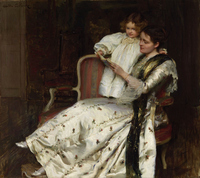
I find it challenging to turn to the final part of this review, covering Mary Guinness and Her Daughter Margaret (fig. 9) as well as other prominent portraits in the last galleries of the exhibition. The catalogue’s scholars rightly refuse the Irish art historian Thomas Bodkin’s 1920 blanket disparagement of these works, as well as the reservations of later commentators (38).[42] Homecoming fuses Osborne’s personality with his achievements as an artist, acknowledging the panoply of challenges outside the studio, from family grief to income revenue. We learn, for example, that the Osbornes rented rather than owned their house (48). Snay, Stapleton, Milligan, Rooney, and Buckley make Osborne’s obviously winning sociability palpable and weave it together with his work as a painter and guardian to Violet Stockley. The literature on Camille Pissarro conjures similar issues. Pissarro could not be more unlike Osborne in many ways, not least his avoidance of cities. Yet no scholarship on Pissarro’s paintings is complete without a sense of his lifelong and deeply ethical commitments, including those to his children.[43]
Nonetheless, it is necessary to shift my response to a slightly less weighty register for the late portraits. The shift reflects one that occurs in the accounts of Mary Guinness and Daughter and other portraits in the exhibition’s wall labels and catalogue. The social art history approach Snay identifies in the catalogue somewhat retreats in comparison to the previous galleries’ detailed contextualization of Dublin history.[44]
Mary Guinness and Daughter earned critical acclaim in 1899 mainly because of its contrast between the illusionistic satin and dark background. According to Stapleton, Osborne arrived at this effect by deepening shadowed backgrounds and eliminating features such as the gleaming ceramic bowls and silverware vital to the effect of At the Breakfast Table (174). Diego Velázquez’s portraits of philosophers are the canonical source for this approach. Demonstrating the parallel development of public and family portraiture in these years, Snay identifies Velázquez’s dark backgrounds in an arresting three-quarter-length depiction of a somber Violet Stockley gazing out at the viewer, painted two years after Mary Guinness and Daughter. A full-length portrait, Miss Mollie, Daughter of J. G. Nutting (1893; private collection), with its standing child in a white-smocked dress best anticipates the later work’s creamy white expanse of the mother’s satin dress spreading out across the lower third of the painting.
Rooney points out that as a result of the daily responsibility of Violet Stockley’s upbringing, Osborne had become more adept than ever in establishing a rapport with sitters, especially children (41). He was apparently keen to have that rapport come through in Mary Guinness and Daughter, where the shared activity of reading tilts each face down to a book held open by a circle of hands and arms.
A note of sheer survival had been struck in At the Breakfast Table. That the infant Violet had made a transatlantic journey in order to appear in this room was marked in the scene’s central gesture—a carefully held spoonful of food. That focus dimmed the palpability of everything that surrounded her. In the later portraits, Violet Stockley moves into the socializing dimensions of her upbringing—the role of play, for example, or the companionship of animals. Everywhere materials are tangible: a background play of wallpaper, the glow of wood, the grain of a cotton pinafore. Still-lifes—a jug, a goldfish bowl, and glazed and glass objects—move into a spotlight that Osborne obviously loved to give them. Because of Homecoming’s careful contextualization of Osborne’s family story, a viewer approached these objects not as displays of affluence but as the result of the painter overcoming less-than-optimal financial circumstances in order to meet standard Protestant middle-class expectations for his niece’s upbringing.
Postscript
I have focused here on the exhibition; the accompanying catalogue deserves a review of its own. Here I evoke two of several points that it raises, which I hope will be subjects of future conversations. First, I admire the authors’ disinclination to employ contemporaneous stylistic categories as they were used on the continent. Impressionism and Naturalism, in particular, tend to be treated in the catalogue as style labels best kept at a distance. This is a prudent skepticism given that, as Snay adroitly points out, artists like Osborne traveling to France and Belgium in the 1880s were initially lobbed together as Impressionists.[45] Contributors refer occasionally to those categories as necessarily anterior to the substance of their discussions, again admirably giving pride of place to detailed contextualization by date or place, or in relation to friendships or other connections to Osborne. What happens then, is that there are individual figures whose connection to Osborne is undisputed but whose relation to various “isms” is ambiguous, because the terms are not themselves contextually defined, but seem to come from a general background. The difficulty, and opportunity for focus, comes from the fact that Impressionism and other labels varied in their uses continue to change in the proliferating scholarship on Impressionism and the late nineteenth century.
A second point has to do with the traditional pitfalls of social art history. Two in particular are relevant. First, such scholarship tends to present the work under review in terms of illustrations of ideas or events; and second, opinions about the work on the part of the writer (e.g., about how effective paint handling is, or whether it might be aesthetically successful) coexist with detailed social contexts. In that case there can be a mismatch between descriptions of the facts of a work and judgments made from twentieth or twenty-first century viewpoints, which necessarily reflect the author’s position in history, not the work’s.
Neither of these observations is a criticism of the extraordinarily thorough primary research and documentation in the catalogue, which sets the standard for scholarship on nineteenth-century Ireland and is an indispensable source, but as indications of ways that this publication can enter into larger conversations about the history of the reception of the nineteenth century, which is an ongoing project for all of us.
Notes
[1] Kathryn Milligan, Painting Dublin, 1886–1949 (Manchester University Press, 2020), 3. I note also Niamh O’Sullivan’s generosity in reading this review. David O’Brien and Kaylee Alexander improved it greatly. Thanks also to Aoife-Marie Buckley, James Elkins, Marty Fahy, Seth Rydelnik, Logan Sisley, and Cheryl K. Snay.
[2] According to Milligan’s catalogue essay, Violet Stockley accompanied her husband William Stockley to Canada after he got a job at the University of New Brunswick (50).
[3] In this case, Snay’s comments are about Osborne’s Portrait of Violet Osborne (1866–1893), the Artist’s Sister (ca. 1885).
[4] Fintan Cullen and Róisín Kennedy, “Introduction,” in Sources in Irish Art 2: A Reader, eds. Fintan Cullen and Róisín Kennedy (Cork University Press, 2021), 2.
[5] In Dublin, the Keough-Naughton Notre Dame Centre and the O’Connell House are on eighteenth-century Merrion Square; in Connemara, Kylemore Abbey Global Centre is in a well-known nineteenth-century mansion.
[6] Notre Dame’s Newman Centre for Faith and Reason is in a celebrated nineteenth-century church on St. Stephen’s Green.
[7] Jeanne Sheehy, Walter Osborne, exh. cat. (National Gallery of Ireland, 1983).
[8] Róisín Kennedy, Art and the Nation State: The Reception of Modern Art in Ireland (Liverpool University Press, 2021), 2–4.
[9] Two examples suffice. The National Museum of Ireland: Decorative Arts and History opened in 2005 and the History of Art department at University College Cork was founded around 2003.
[10] The publication of a monumental survey of Irish art in 2014 under the auspices of the Royal Irish Academy testified to their support.
[11] The eminent historian Christine Kinealy still leads Quinnipiac’s Great Hunger Institute.
[12] Milligan, Painting Dublin, 3.
[13] Snay addresses cultural nationalism and stylistic labels, saying that “we do not seek to situate Osborne within a nationalist debate about Irish identity or increase his appeal by characterizing him as an Impressionist” (17).
[14] Ernest Gellner, Nations and Nationalism (Cornell University Press, 1983). My interpretation of Gellner is from Scott Richard Lyons, X-Marks: Native Signatures of Assent (University of Minnesota Press, 2010), 115–21.
[15] Catherine Martin, “Foreword,” in Government of Ireland, Department of Tourism, Culture, Arts, Gaeltacht, Sport, and Media, Decade of Centenaries, 2023 Programme (Stationery Office, 2023), 3. An overview of the commemorations is in Maurice Manning, “Reflections of the Chair of the Expert Advisory Group (EAG) on Centenary Commemorations,” in Government of Ireland, Decade of Centenaries, 4.
[16] Entitled Who Do We Say We Are? Irish Art 1922–2022, this exhibition looked back to an initiative, Exposition d’art irlandais, that included figures in the cultural circles analyzed by Sisley. It accompanied the Irish Race Congress in Paris (1922). Who Do We Say We Are? was part of the project, “States of Modernity: Forging Ireland in Paris, 1922–2022.” Led by Trinity College Dublin, the Raclin Murphy (then the Snite) was among numerous contributors. According to organizer William Shortall, as a result of the dramatic course of 1922, the Paris exhibition “got squeezed out of art history.” Although 1922 included the establishment of the Free State, because partition from Northern Ireland had been accepted in the previous year’s Anglo-Irish Treaty (the 1916 Proclamation of the Irish Republic claimed the island), a year-long Civil War began before the year was out. Anti-Treaty forces considered that the Proclamation was not honored. The Exposition d’art irlandais happened in a breathing space before the descent into war. Shortall emphasizes that representatives from the Free State chose works by artists they considered modernist, forsaking the cultural nationalism of exhibitions back in Ireland. Shortall, “Irish Art and Politics in Paris in 1922,” IMMA Texts 1 (2023): 18–34.
[17] As well as Galway and Connemara, Osborne’s summer destinations (1892–97) included Limerick. The links between a drawing made by Osborne of that city’s docks and one of Roundstone from five or so years later put Limerick on the opening gallery’s map (148–51; 154–55).
[18] The nineteenth-century rise of cultural nationalism meant that such motifs as the harp, shamrock, and round tower, were joined by signifiers specific to the west coast; thatched cottages, stacks of turf, mountainous landscapes, and so on. Niamh O’Sullivan, Aloysius O’Kelly: Art, Nation, Empire (Field Day, 2010), 2–3.
[19] See, for example, Alison Syme, “Morisot’s Urbane Ecologies,” in A Companion to Impressionism, ed. André Dombrowski (Wiley Blackwell 2021), 375–92; Michael Lobel, Van Gogh and the End of Nature (Yale University Press, 2023), 45–85, 132–60; Marnin Young, Realism in the Age of Impressionism: Painting and the Politics of Time (Yale University Press, 2015), and Dombrowski, Monet’s Minutes: Impressionism and the Industrialization of Time (Yale University Press, 2023).
[20] The peripheral position of Ireland’s artists is discussed in Nicola Figgis, “Preface,” Painting, 1600–1900, in Art and Architecture of Ireland, ed. Andrew Carpenter (Yale University Press, 2014), xiv.
[21] The Taylor Art Prize and Scholarship was the source of this award, named for Captain George Archibald Taylor. It was not given by the RHA, but by the Royal Dublin Society. During Osborne’s student years (at the school of the RHA), he scooped up prizes. Sheehy, Walter Osborne, 12. Mention is made of The Tempting Bait, an outdoor scene depicting a small boy with a terrier, as winning the Taylor Prize in 1882 (35).
[22] This society (the Invincibles) is discussed in Luke Gibbons, Joyce’s Ghosts: Ireland, Modernism, and Memory (Chicago University Press, 2015), 216–19.
[23] Rooney, “Augustus Nicholas Burke,” in Figgis, ed., Painting, 194.
[24] Snay uncovers an exhibition review from 1903 that suggests Osborne found this spot near the Royal Dublin Zoological Society, founded 1830. But the wooded Furry Glen, a traditionally secretive area, is more likely to be the location, its Glen Pond—formed by nineteenth-century damming—the pool. See J. M. Caffrey, J. Coyne, and T. Gallagher, Ponds of the Phoenix Park: Current Ecological Status and Future Management (Central Fisheries Board and Office of Public Works, 2008), 100–3, https://www.phoenixpark.ie/.
[25] Whereas the NGI’s 1983 Walter Osborne charted each place as part of Sheehy’s re-introduction of Osborne through a retrospective, Homecoming reflects the thesis-driven approach of exhibitions four decades later.
[26] Two works (etchings) in the exhibition came from Osborne’s time in Antwerp, two were painted in Brittany, and seven reflected stays in England.
[27] The year before Osborne painted Saint Patrick’s Close, the influential New English Art Club was established in London. Osborne was a founding member in 1886 of the Dublin Art Club, later called the Dublin Arts Club (58–59, 96).
[28] Interaction between children, Rooney says, is more typical of Osborne’s paintings (37–38). For Stapleton, October Morning conveys extended inactivity (96). The link between traditions of realist painting and effects of duration was first pointed out by Michael Fried, Courbet’s Realism (University of Chicago Press, 1987), 6–46, 85–110, 131–39, 179–80.
[29] This scene’s depiction of light is discussed in Gabriel P. Weisberg, Beyond Impressionism: The Naturalist Impulse (Harry N. Abrams, 1992), 141–2.
[30] The harbor was in Walberswick, one of the communities in southeast England that attracted Osborne. Milligan, Painting Dublin, 33.
[31] Milligan wonders why Osborne did not go to the artists’ colony in Newlyn, a busy fishing port. See Milligan, Painting Dublin, 33.
[32] Milligan, Painting Dublin, 38.
[33] Osborne was writing to William Stockley (50).
[34] Milligan explains that the residents of Rathmines set themselves apart from the Catholic municipal council (48).
[35] William Mervyn Lawrence, The City and County Dublin: Sixty-Four Platinatone Views with Descriptive Guide and Map of the District, from Photographs (Emerald Isle Album Company, 1900).
[36] O’Sullivan argues that “attempts to represent the desolation of the west of Ireland on canvas” were “notably few” in the nineteenth century because “grim social realities” and “manifold miseries” called for “denunciation rather than representation.” O’Sullivan, Aloysius O’Kelly, 87.
[37] Milligan, Painting Dublin, 50.
[38] The term pauper, for example, referred to a moral condition, not one with an economic cause. Mary Poovey, Making a Social Body: British Cultural Formation 1830–1864 (University of Chicago Press, 1995), 11.
[39] See, for example, the discussion of Manet’s Children in the Tuileries Gardens (ca. 1861–62), in Denise Murrell, Posing Modernity: The Black Model from Manet and Matisse to Today, exh. cat. (Wallach Art Gallery and Yale University Press, 2018), 17–19.
[40] According to Milligan, a reference to the painting in the “annual Academy Notes,” published in London, calls In a Dublin Park a “group of poor city folk sitting on a bench.” H. Blackthorn, ed. Academy Notes, 1895, with Facsimiles of Sketches by the Artists (Chatto and Windus, 1895), 22, quoted in Milligan, Painting Dublin, 57.
[41] Elizabeth Prettejohn, The Art of the Pre-Raphaelites (Princeton University Press, 2000), 92.
[42] See the contextualization of Bodkin in Julian Campbell, “Introduction,” in Thomas Bodkin, Four Landscape Painters (Irish Academic Press, 1987), iv–xxx.
[43] See, for example, Richard R. Brettell, “Pissarro’s Family,” in Pissarro’s People, exh. cat. (Clark Art Institute and DelMonico, 2011), 83–127; and Martha Ward, Pissarro, Neo-Impressionism, and the Spaces of the Avant-Garde (University of Chicago Press, 1995), 46. Sibling bonds and bereavement are studied in Samuel Raybone, Gustave Caillebotte as Worker, Collector, Painter (Bloomsbury, 2024), 38–53.
[44] Snay notes that the contributors “adopt a social-history approach” (17).
[45] Snay may be remarking on an exhibition that, although characterized by groundbreaking research, referred to artists in the generation of Osborne and later as “Impressionist.” Julian Campbell, The Irish Impressionists: Irish Artists in France and Belgium, 1850–1914, exh. cat. (National Gallery of Ireland, 1984). Appraisal of Impressionism in a global context includes Marnin Young, “Impressionism and Imperialism in Maurice Cullen’s African River,” RACAR: revue d’art Canadienne/Canadian Art Review 46 (2021): 76–8, 82–94. See also Raybone, review of Globalizing Impressionism: Reception, Translation, and Transnationalism, eds. Alexis Clark and Frances Fowle and Mapping Impressionist Painting in Transnational Contexts, eds. Emily C. Burns and Alice M. Rudy Price, Nineteenth-Century Art Worldwide 20 (Autumn 2021), https://doi.org/10.29411/ncaw.2021.20.3.19.