Blanche Hoschedé-Monet: In the Light
Gustave Caillebotte: Painting Men / Gustave Caillebotte: Painting His World
Manet: A Model Family
Mary Cassatt at Work
Paris 1874. Inventer l’impressionnisme (Paris 1874: The Impressionist Moment)
Reviewed by Alexis Clark
Alexis Clark
North Carolina State University
Email the author: aclark5[at]ncsu.edu
Citation: Alexis Clark, exhibition review of Blanche Hoschedé-Monet: In the Light; Gustave Caillebotte: Painting Men / Gustave Caillebotte: Painting His World; Manet: A Model Family; Mary Cassatt at Work; Paris 1874. Inventer l’impressionnisme (Paris 1874: The Impressionist Moment), Nineteenth-Century Art Worldwide 25, no. 1 (Spring 2026), https://doi.org/10.29411/ncaw.2026.25.1.14.
This work is licensed under a Creative Commons Attribution-NonCommercial 4.0 International License  unless otherwise noted.
Your browser will either open the file, download it to a folder, or display a dialog with options.
Blanche Hoschedé-Monet: In the Light
Eskenazi Art Museum, Indiana University Bloomington
February 14–June 15, 2025
Catalogue:
Haley S. Pierce, ed.,
Blanche Hoschedé-Monet: In the Light.
Giles, 2024.
144 pp.; 153 color illus.; notes; selected bibliography; index.
$32.00 (hardcover)
ISBN: 9781913875718
Gustave Caillebotte: Painting Men
Musée d’Orsay, Paris
October 8, 2024–January 19, 2025
J. Paul Getty Museum of Art, Los Angeles
February 25–May 25, 2025
Gustave Caillebotte: Painting His World
Art Institute of Chicago
June 29–October 5, 2025
Catalogue:
Scott Allan, Gloria Groom, and Paul Perrin, eds.,
Gustave Caillebotte: Painting Men.
Getty Museums, 2024.
247 pp.; 195 color illus.; appendices; maps; biographical notes; references; index.
$50 (hardcover)
$47.50 (ebook)
ISBN: 978160609448 (hardcover)
ISBN: 9781606069455 (ebook)
Manet: A Model Family
Isabella Stewart Gardner Museum, Boston
October 10, 2024–January 20, 2025
Catalogue:
Diana Seave Greenwald, ed.,
Manet: A Model Family.
Princeton University Press, 2024.
223 pp.; 122 color illus.; notes; bibliography; index.
$34.00 (hardcover)
ISBN: 9780691260662
$32.00 (ebook)
ISBN: 9780691260655
Mary Cassatt at Work
Philadelphia Museum of Art
May 18–September 8, 2024
Legion of Honor Museum
October 5–January 26, 2025
Catalogue:
Jennifer A. Thompson and Laurel Garber, eds.,
Mary Cassatt at Work.
Philadelphia Museum of Art, 2024.
303 pp.; 240 color illus.; selected bibliography; selected index.
$35.00 (hardcover)
ISBN: 9780876333044
Paris 1874. Inventer l’impressionnisme (Paris 1874: The Impressionist Moment)
Musée d’Orsay, Paris
March 26–July 14, 2024
National Gallery of Art, Washington
September 8, 2024–January 19, 2025
Catalogue:
Sylvie Patry and Anne Robbins with Kimberly A. Jones and Mary Morton, eds.,
Paris 1874: The Impressionist Moment.
Yale University Press, 2024.
288 pp.; 230 color illus.; reference list.
$37.50 (hardcover)
ISBN: 9780300278484
In the first edition of Art through the Ages, author and Art Institute of Chicago slide librarian Helen Gardner offered a few pages surveying Impressionism: “The paintings of the impressionists are truly and sincerely realistic as the work of Jan Van Eyck or Durer . . . The French recorded what the eye actually saw of things blurred by the envelope of light and air. Technically, the French method required not only keen powers of observation but also a scientific knowledge of the properties of color.”[1] Gardner concluded that despite being “charming” optical records, the French Impressionists’ paintings displayed “little or no imaginative quality, design element, or spiritual significance.”[2] In contrast to this relatively faint praise, she positively assessed Impressionism’s art-historical impact. “The most important tendency of the second half of the nineteenth century,” she wrote, “was the revolt against the tyranny of the Academy and a return to naturalism both in subject matter and in technique.”[3] Impressionism was at once revolt and return.
A century has passed since Gardner first published her account of the grand arc of art history. Today, the textbook story of Impressionism is—and is not—the same. The growing ability of large language models (LLMs) to summarize and synthesize our indiscipline knowledge, transforming it seemingly effortlessly (albeit at incredible environmental cost) into ever more abbreviated snippets and sound bites, presents a test especially, I think, to more popular specialisms such as Impressionism. If ChatGPT, Gemini, and Claude can “author” the story of French Impressionism (or at least recount its common episodes, plot points, and protagonists), it is now paramount to meditate on the role of scholarly inquiry moving forward. In our technocapitalist present, when clicks and profile views are increasingly proxies for the worthiness of our ideas and so our worth to the discipline, how will our ideas and our labor—so often invisible until its appearance on printed or electronic pages—be evaluated and valued? This revolutionary moment in artificial intelligence necessitates a revolution in our intellectual labor.
I offer this framing because the five exhibitions reviewed in this essay raise timely questions about Impressionism and labor—manual, mnemonic, and academic. This includes the work of artists (and their models) to produce works of art, often with an emphasis on materiality, process, and physicality; the work of artists’ descendants to maintain legacies and record memories; and the work of art historians whose métier has laid the foundations for much of the current state of the field. As such, these exhibitions and their catalogues form their own unfolding stories of Impressionism. All five took place in the United States between April 2024 and June 2025; all focused on artists primarily situated in France; four focused on a single artist; and most traveled across state or national borders, extending public access to these artists, artworks, and stories. For intext citations, I have abbreviated catalogue titles as follows:
BHM: Blanche Hoschedé-Monet: In the Light
GCPM: Gustave Caillebotte: Painting Men
MCW: Mary Cassatt at Work
MMF: Manet: A Model Family
P1874: Paris 1874
Amateurism, Ambition, and the Work of Making Art
Being an artist in nineteenth-century France typically required considerable education. Despite their fabled rebellion against academic and state-sponsored institutions, the Impressionists’ eyes and hands were well trained. Given their education in the studios of Charles Gleyre and Léon Bonnat or their studies with Jean-Léon Gérôme and lessons from Camille Corot, as well as their participation, however uneven, in the Paris Salon, it may be surprising to learn that historically, some Impressionists would have been appraised not as professionals but categorized as amateurs. In his superlative essay for Gustave Caillebotte: Painting Men, Hadrien Viraben offers a paradigm and definition of “amateurism” relevant to all the reviewed exhibitions. Arising as an elite status in the ancien régime, amateurism implied a certain social and economic status. Amateurs were members of the “idle aristocracy and upper bourgeoisie,” men with primary occupations (other than their secondary and therefore amateur pursuits), and, by default, women (who confronted challenges in claiming professional status) (GCPM 53). A subcategory of amateurs, whom Viraben usefully labels “career amateurs,” demonstrated “skill with material objects” and “particular attachment to an object of expertise” (GCPM 52). Amateurs were not motivated by remuneration but by their personal fulfillment and the symbolic compensation that recognition provided.

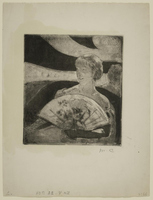
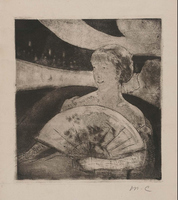
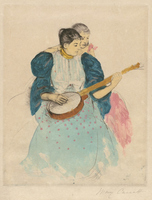
Nonetheless, as the catalogue essayists for Mary Cassatt at Work emphasize, receiving that recognition was not easy. Transgressing historical tendencies to consign women who practiced art to amateurism, Mary Cassatt at Work shows its titular artist to have been ambitious, accomplished, and committed to strenuous and serious work. The exhibitions respectively dedicated to Caillebotte and Cassatt thereby make for an interesting comparative study in the gendered dynamics of amateurism and ambition. “How,” the catalogue introduction to Mary Cassatt at Work asks—almost as though responding to Gustave Caillebotte: Painting Men—“might Cassatt’s articulation of her artistic labor help us better understand her personality as an artist as well as the products of that labor? And how can training our eye on the ‘work’ in and of her art further our appreciation of her interventions into the emergent field of modern art?” (MCW 11). Determined to be independent—from family, social expectations, and artistic conventions—Cassatt’s physically demanding processes in inking her plates and wielding her brush are here interpreted as signaling her dedication to “hard, serious, and effortful” work (MCW 23). While in some prints and paintings her manual and mental strain is concealed “beneath layers of ink, paint, and pastel,” in others, her marks and modifications materially reveal her industriousness (MCW 24). As co-curator Laurel Garber discusses, the peintre-graveur’s print series, in experimenting with combining multiple techniques (soft ground, drypoint, aquatint, and color inking), led to the production of multiple originals (figs. 1–3). Originality, of course, has long been a tenet associated with Impressionism, but, in these multiple originals (see, e.g., fig. 4), Garber observes how:
the serial transformations to her plates register the working of the artist’s mind, but they do so in such a way that returns us to the materiality of that ‘working,’ its exercise as ongoing exchange between mind, hand, matter, collaborators, machine, and subject. In this respect, the position of the modern artist is not so much critiqued or transgressed as put back in touch with the workers—from wet nurses, to seamstresses, to models, to printers—that its legibility is meant to obscure. (MCW 160)
Building on this necessarily “loose parallel” between the incredibly affluent Cassatt and working-class women, Nicole Georgopulos’s essay details how Cassatt’s highly skilled hands went to work representing women busying their own hands in the “doing of modern life” (MCW 89 and 14). Not all the mundane tasks Garber and Georgopulos discuss, it should be said, seem especially modern in this late-nineteenth-century moment. Still, coincident with Cassatt’s relocation from Philadelphia to Paris, initially in 1865 and, following the Franco-Prussian War and Paris Commune, once more in 1874, France convulsed with polemical debates around the status of the ouvrière (female worker)—in debates extending from publications, to the Chambre des députés, to the International Congress of Women’s Rights in 1878, and to, one expects, Cassatt’s own immediate circles.
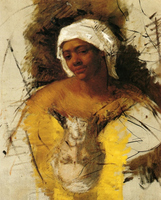
As the catalogue introduction by Garber and co-curator Jennifer A. Thompson reminds readers, Cassatt relied on women working as artist models, paid to pose and play the part of respectably occupied bourgeois women. Notably, though, as Thompson acknowledges, Cassatt did not paint a full picture when it came to the social and historical realities of all working-class women. Black women performing care work went almost entirely unrecorded. Exceptional in Cassatt’s oeuvre is the Portrait of Mrs. Curry; Sketch of Mr. Cassatt (fig. 5), a double portrait of her Black domestic servant and white father. In showing at least some of the artist’s portrayals of women and children to be manufactured intimacies, modeling the day-to-day realities of mothering, Garber, Thompson, and their team prompt catalogue readers to question whose impressions and experiences of modernity and modern labor Cassatt really represented.
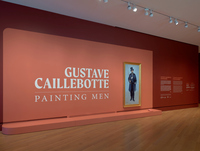
Whereas Cassatt’s corpus is largely dedicated to the representation of women, the curators and catalogue essayists for Painting Men embrace fraternity as a framework through which to see and study Caillebotte (fig. 6). In this emphasis on fraternity over masculinity, Painting Men abstains from making potential connections to recent debates on gender and sexuality. The third principle in the French Republican motto—fraternité—here facilitates discussions of Caillebotte’s biography and especially his participation in single-sex organizations (e.g., his enrollment in an all-boys school, enlistment in the Mobile National Guard, and instruction under Bonnat). From Caillebotte’s life and work, the curators and catalogue essayists extend this discussion of fraternité to historical contexts including national identity and gendered conceptions of citizenship, and emergent theories of same-sex desire.
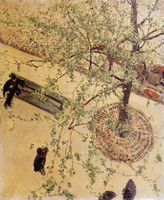
As room after room at the Getty Museum’s installation of Painting Men revealed, in Caillebotte’s circle, “the doing of modern life” included active looking (figs. 7–9). Caillebotte primarily observed and painted men doing all sorts of looking: reflecting before their own work or monitoring the work of others (The House Painters [1877; private collection]), reading open books (Portrait of Mr. Eugène Dufresne [1878; private collection]), studying railroad infrastructure between bolted beams and iron trusswork (On the Pont de l’Europe [1876; Petit Palais, Geneva]), peering from Haussmannian apartment balconies onto the boulevards below (Man on a Balcony [1880; private collection]), and, on rarer occasion, meeting the artist’s gaze (e.g., Portrait of Mr. Gallo).
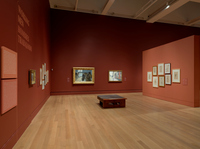
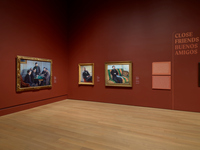
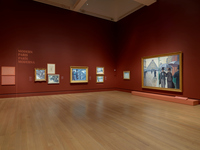
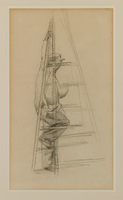
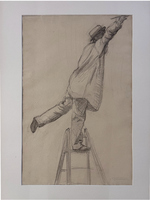
Before 1883, Caillebotte captured what co-curator and catalogue essayist Gloria Groom refers to as the “mini-narratives” and “everyday experiences” of modern life (GCPM 70, 68) (fig. 10). On the streets surrounding his Paris apartment, “career amateur” Caillebotte met and observed fellow members of the bourgeoisie as well as wage workers. Accordingly, at the Getty Museum, walls of Caillebotte’s exquisite pencil studies document the latter almost heroically climbing ladders or elegantly swinging one leg behind them to cantilever their opposite hand stretching to paint a shop sign. Including all this preparatory work makes the case for the artist’s sedulous enterprise in capturing the fleeting moments, movements, and moods of manual labor, informed by his studies of Naturalism and its theory—physiognomy and bodily mechanics—and what catalogue essayist Samuel Raybone here refers to as his commitment to “corporeal realism” (figs. 11, 12).
Caillebotte also depicted bourgeois ouvriers de la pensée (intellectual workers) with the tools of their respective trades: paints and brushes as well as books. But while his paintings of manual workers make their skills and specialisms apparent—the house painters wear smocks, stir pots of paint, and brush that paint onto buildings—his portraits of lone men do not always supply viewers with particular signs of their individual interests and expertise. This, of course, is what distinguishes manual from mental labor. Projects such as building bridges produce more immediate and material outputs than, say, the latent effects of writing or editing a book on Impressionism. Yet, much like looking is doing, thinking, writing, and organizing are all also working.
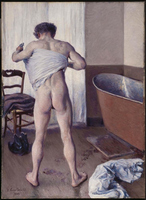
Following the rooms devoted to Caillebotte’s family, workers and urban scenes, and then his confreres, the Getty Museum installation turned to two paintings of women (one of them nude) and two paintings of nude men. In their co-written essay, André Dombrowski and Jonathan Katz read Man at His Bath (fig. 13) in relation to the late nineteenth century history of the psychology of sexuality. Standing with his back turned and his legs astride revealing a shadowy hint of his scrotum, viewers intrude “unseen onto a private moment with all the suggestion of a violation” (GCPM 96). About this painting and the closely related Man Drying His Leg (1884; private collection), Dombrowski and Katz interrogate how the two canvases invert “normative gender looking,” seeing Man at His Bath especially as an “open invitation” to homoeroticism that may have provoked historical viewers to reflect on their own desire (GCPM 98–99). Destabilizing prevailing codes of masculinity and heteronormative sexuality, Caillebotte’s paintings of nude men are discussed as enacting an inversion that defies binaries and thereby revels in the messiness of desire. Around 1900, psychologists—as Dombrowski and Katz synopsize in their historicized analysis—had taken to debating notions of unconsummated same-sex desire. Psychologists allowed that the desire to look at but not touch members of one’s own sex was “naturalized,” albeit a mistake or inversion of nature.
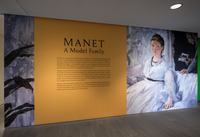
The gendered dynamics of home and work (as well as work at home) constitutes a theme cutting across these exhibitions. Against tendencies to discuss Cassatt in relation to domesticity and tender intimacy, Mary Cassatt at Work underscores the muscularity of her artistic labors. In opposition to the propensities to concentrate on Manet’s Salon paintings as political critiques presented in the public sphere, Manet: A Model Family (fig. 14) situates the artist in his home and with his family who “deserve long-overdue credit for their role in [his] career” (MMF 13). At the Isabella Stewart Gardner Museum, the Hostetter Gallery provided its own intimate space within which to closely study paintings, photographs, and works on paper for which Suzanne Leenhoff, Léon Koella (Leenhoff), Berthe Morisot, and other members of the Manet family posed for their portraits and sometimes dressed (or undressed) to transform into biblical women at their bath à la Titian (Suzanne) or boys balancing trays after Vélasquez or blowing bubbles after Chardin (Léon) (figs. 15, 16). Manet’s family members, of course, were not paid professional models, making it curious to think about how doing this work affected their relationships (and vice versa). Whether theirs was a collaboration, compulsory domestic duty, or a labor of love remains open to discussion.
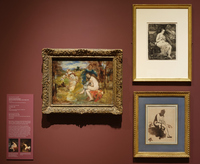
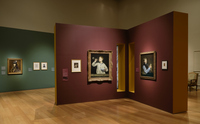
Rather than domesticating modern art’s enfant terrible, Manet: A Model Family, however, ultimately shifts the drama surrounding the artist from its typical locus at the Salon to the family home. Where Dombrowski and Katz, in their emphasis on historical context, deflate any intrigue around Caillebotte’s sexuality, and Mary Cassatt at Work passingly mentions the artist’s late-in-life female companion without speculating on her sexuality, Manet: A Model Family almost revels in salacious detail. Who fathered Léon remains unknown—a tiresome question raised by too many of the essayists. Only in 1871 did Léon learn that Suzanne, who had long posed as his sister, was his biological mother. While perhaps meant to provide a human-interest story or to flag differences between twenty-first century values and nineteenth-century social strictures, the catalogue’s repeated reference to this supposed scandal distracts from its more interesting exploration of the family’s lived dynamics.
Paperwork, or Making the Archives of the Impressionists
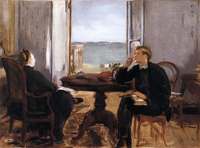
For Caillebotte, Cassatt, and Manet, as for Blanche Hoschedé-Monet, family homes doubled as studios. It would seem to be more than a coincidence that the attention these exhibitions pay to the Impressionist home as a site for creativity and sociability—nevertheless fraught with strained relations—follows quickly after the recent pandemic, when so many people, confined to their homes, transformed cardboard boxes and kitchen tables into remote classrooms and workstations. Thus, Manet: A Model Family recounts physical and psychological disruptions to the family home: as the Franco-Prussian War approached, Suzanne and Léon fled Paris to safety in the South of France (fig. 17). Following Manet’s death, Suzanne lost both her place in the Manet family and her home. In contrast to her housing insecurity, Caillebotte’s paintings, as Groom discusses, drew closely from his neighborhood. He largely limited his strolls, sights, and so his paintings of Paris streets to a six- or seven-block radius around his home on the rue de Miromesnil.
Discussing the Manet clan, curator Diana Seave Greenwald notes that “families are complicated” (MMF 13). The same could be said about the family of Claude Monet, whose stepdaughter Blanche was also his daughter-in-law and, with the death of her stepbrother and husband, his final caretaker. Writing for the exhibition catalogue, Nancy Mowll Mathews importantly recounts how, as the Impressionists aged into infirmity and disability, they relinquished their independence to:
caretakers [who] were a combination of younger relatives and long-time household managers, each one taking on the elevated tasks of communicating with dealers, collectors, journalists, and artistic pilgrims while at the same time being responsible for the physical wellbeing of an aging artist. (BHM 45)
In 1882–83, before filial duty demanded taking a prolonged break from her own art, Hoschedé-Monet, sketchbook in hand, had rambled with Monet around the Normandy coast. Presumably working in proximity, perhaps even side by side, the two had painted poplars, haystacks, water lilies, and the Seine (figs. 18, 19). The Monet estate in Giverny proved as integral to her art as to his (fig. 20). While some of Hoschedé-Monet’s paintings show remarkable similarities to those by Monet, she nonetheless worked to assert her individuality. Writing for the catalogue, Paul Piguet, a distant relative who retains much work by Hoschedé-Monet, discusses her paintings as recording a “suspended, condensed moment of time,” making them akin to but still independent from Monet’s series (BHM 61).
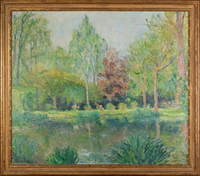
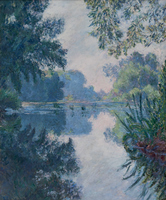
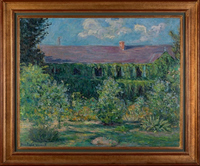
Clearly, for Hoschedé-Monet, Monet was an important role model, mentor, and collaborator. Through him, she met artists, writers, and politicians visiting the family estate at Giverny; and, due to him, she met members of the international artist colony that had settled in the vicinity. This intimacy obviously makes it difficult to wrest Hoschedé-Monet from the Impressionist’s long shadow. Difficult but not impossible. As an introduction to Hoschedé-Monet, the Eskenazi Museum’s monographic exhibition has laid a foundation for future scholarship. Arguments about her independence could be strengthened by thinking about amateurism through the type of framework supplied with regard to Caillebotte. Similarly, as noted on the exhibition walls and in the catalogue, Hoschedé-Monet showed her paintings in the Salon des indépendants, exhibition societies in Rouen, and interwar gallery exhibitions—participation in an exhibition circuit modulating claims of her storied humility and again attesting to her independence. Future research more thoroughly analyzing her exhibition strategies, coordination of the early visitor experience at Giverny, and negotiations to protect the family estate during WWII would all be welcomed. In her catalogue essay, Galina Olmsted raises her curious practice of alternately signing her paintings as “Hoschedé,” “Monet,” and “Hoschedé-Monet.” Studying this practice in more depth may reveal ambivalence toward her Impressionist inheritance, complicating her claims of independence, individuality, and originality. In its own use of the hyphenated “Hoschedé-Monet,” the Eskenazi Museum of Art replicates a strategy used in a poster promoting the artist’s 1947 exhibition at the Galerie d’Art Drouot in which the white-bearded Monet warmly wraps his arm around Hoschedé-Monet, emphasizing the continuation of both her familial and artistic lineage into the twentieth century (fig. 21). Despite its limited expansion of the Impressionist circle, Blanche Hoschedé-Monet: In the Light traces the artist’s life and work across the initial four decades of the twentieth century, significantly extending the usual timeline of French Impressionism. In this way, the Eskenazi Museum installation interestingly compares to Gustave Caillebotte: Painting Men and Cassatt at Work, both of which trace their respective titular artists’ work into the 1890s and beyond, showing what their Impressionism would become. For its part, Cassatt at Work similarly records its artist as working to produce paintings and prints contemporaneously with artists and followers encamped at Giverny, or “late impressionists” (MCW 212) like John Henry Twatchman and Elmer MacRae who took their inspiration from her pastels.

Preserving the legacy of Manet or Monet required other sorts of work. Following the death of their artist-relatives, Suzanne, Léon, Berthe, Julie Manet (daughter of Berthe and Eugène Manet), and her husband Ernest Rouart (son of the artist Henri Rouart), Hoschedé-Monet, and Jean-Pierre Hoschedé-Monet expended considerable effort organizing papers and correspondence; sharing memories with early biographers and writing their own accounts; building archives; and disseminating remaining works of art. Nonetheless, these responsibilities could conflict with the descendants’ own needs. As Emily A. Beeny sympathetically recounts in her essay for Manet: A Model Family, Suzanne, hoping to alleviate her financial difficulties following the death of her artist-husband, divided and sold individual sheets from his sketchbooks. Less forgivably, she concealed photographic evidence that certain paintings had been “reworked,” admitting to Julie Manet that “she had [also] authenticated at least one doubtful work” (MMF 57, 60). In her art-historical sleuthing, Beeny names Suzanne’s nephew—the amateur artist and minor salonnier Edouard Vibert—as potentially culpable for this “reworking.” Vibert had copied Madame Manet in the Conservatory (fig. 22), before Suzanne sold the original. The tale of this posthumous retouching and copying becomes more tangled, as it would be Léon, Manet’s “sort-of son,” who took on inventorying the remaining works, hiring a photographer to document those works, and so confirming them as produced by Manet (MMF 160).
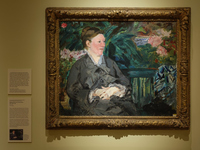
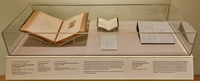
In its inclusion of the copy by Vibert, along with a vitrine of documents, Manet: A Model Family alludes to an interesting line of art-historical interrogation (see figs. 22, 23). Like Blanche Hoschedé-Monet, the Boston exhibition prompts reflection on how the story of Impressionism has tended to promote ideals such as originality and independence over copying, collaboration, and cooperative work. (Richard Shiff has been one notable exception in critically engaging with questions of Impressionism and originality.[4]) More locally and immediately, though, the Vibert copy and the questions it raises share something with the institutional history of the Isabella Stewart Gardner Museum, whose collection was assembled under the expert advice of Bernard Berenson. On occasion, though, fakes and forgeries slipped past Berenson’s acclaimed eye, eluding even his ability to distinguish the real from the imitation.
The Politics of Memory
Despite Suzanne’s questionable dealings, Léon, as Manet: A Model Family notes, deserves recognition for the “archives he held and created [that have been] essential to telling the story of Manet’s artistic greatness and centrality to art history” (MMF 32). Echoing the importance of this type of work, Mathews underlines Hoschedé-Monet’s and other Impressionist caretakers’ significant contributions in establishing “the final reputation and legacy of the artists we revere,” for example, through such monographs as Manet: reconté par lui-même (Henri Laurens, 1923) and Jean-Pierre Hoschedé’s Blanche Hoschedé-Monet, peintre impressioniste (Lecerf, 1961). Through their mnemonic labor, the descendants toiled to ensure Impressionism entered the art-historical annals and so, too, future art history textbooks like Gardner’s Art through the Ages.
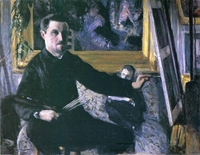
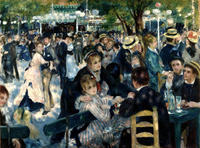
In tandem, the artists and their descendants made significant donations of original work to museums. Most notably, Caillebotte, upon his death in 1894, bequeathed his personal collection—although not any works by him (or Cassatt or Morisot)—to the French state. As Gustave Caillebotte: Painting Men mentions, much of his collection of Impressionist paintings and works on paper now lines the walls of the Musée d’Orsay, including such canonical examples as Renoir’s Bal au Moulin de la Galette, which can be seen in the background of Caillebotte’s self-portrait of 1879–80 (figs. 24, 25). Following its display at the 1877 Impressionist Exhibition, Renoir’s painting hung in Caillebotte’s home and then, following the latter artist’s death, at the Musée du Luxembourg. Caillebotte, as Olmsted notes, contributed much to “the group he helped make and that made him” (GCPM 65). It was he who advocated for adopting the name “Impressionist” for their exhibition in 1877.
Yet, as discussed in the catalogue for Paris 1874, the questions of who, what, when, where, why, and how in relation to Impressionism are more involute than always appreciated. Paris 1874 seeks to tell a more complicated story about the Salon and the Société anonyme des artistes peintres, sculpteurs, graveurs, etc. and the entanglement between them. While reserving one room exclusively for history paintings at the Salon and the final room for landscapes by members of the Société Anonyme, the National Gallery otherwise integrated the two exhibitions. This approach encouraged visitors to engage more with the art, leaving them, at least before consulting the wall labels, to debate which artworks were shown where.
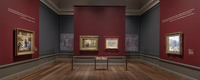
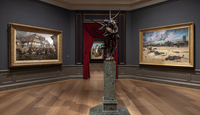
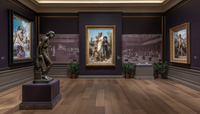
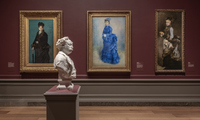
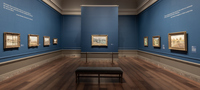
The National Gallery exhibition opened with a pair of paintings, one by Gérôme serving as representative of the Salon and one by Monet serving as representative of the Société Anonyme. However exaggerated, the comparison impresses upon visitors the legendarily stark division between the two exhibitions. It is this same breach that the National Gallery exhibition soon renders more nuanced (fig. 26). In its second room, filled with paintings, caricatures, prints, photographs, and sculpture related to the Franco-Prussian War and Paris Commune, the National Gallery placed the exhibitions in their historical context (fig. 27). From there, Paris 1874 proceeded to a room dedicated to Salon paintings and sculptures of Orientalist, mythological, and historical subjects (fig. 28), followed by a series of rooms divided by subjects and subthemes: urbanites and entertainments; domestic interiors, complete with Orientalist scenes shown at the Salon and paintings filled with Japanese objets d’art by critic, amateur artist, and Impressionist ally Zacharie Astruc shown at the Société Anonyme; landscape paintings at both exhibitions (including a superb painting by Charles François Daubigny that, except for its large scale, could have as easily appeared at the Société Anonyme as the Salon); religious art at both exhibitions (including a small painting of a synagogue by Edouard Brandon); works on paper and sculptures; and a final room trumpeting the triumph of Impressionist landscape in keeping with more evolutionary art-historical models, including a pair of paintings by Paul Cézanne placed at the exhibition’s end and so leading visitors back to the National Gallery’s permanent collection and still more Impressionist paintings (figs. 29, 30).
In the introduction to the catalogue for Paris 1874, entitled “Impressionism: A Redefinition,” Sylvie Patry and Anne Robbins, with Kimberly A. Jones and Mary Morton, trace how Impressionism as a style came into existence a “few years” before 1874 (P1874 5). By comparison, Impressionism as a movement, “it goes without saying . . . did not precede the [Société Anonyme] exhibition in the spring of 1874” and ended with the eighth exhibition in 1886 (P1874 12). For the nonspecialist public, Paris 1874, in this definition of the style and the movement, usefully avoids collapsing the Société Anonyme with Impressionism, while perhaps not radically so for specialist readers. Indeed, to the question of who participated in the Société Anonyme, readers learn that critics classified “fewer than a quarter” of the artists there as “impressionist” (P1874 108). As Patry and Robbins write in their introduction, visitors to the 1874 Société Anonyme would have instead surveyed work by well-remembered Impressionists, salonniers, and those “now forgotten,” some of whom nonetheless proved formative to the group (P1874 5).
Why those who participated in the Société Anonyme mounted this independent exhibition in 1874 has long been recited. These artists “shared a desire to break away from the rules of the official Salon, with its obligatory subjects and styles” (P1874 5). (Except, of course, that some of these artists also submitted to those rules, hence their inclusion in both exhibitions in 1874.) How the Société Anonyme broke with the Salon proves the more interesting question. Resisting tendencies to reduce all the Société Anonyme artists into committed revolutionaries, Robbins shows that, among their ranks were more moderate members who wished to avoid appearing “too radical” (P1874 109). Still, behind closed doors, the Société Anonyme operated according to a relatively new model. Catherine Méneux attributes the practical formation of the Société Anonyme to the now obscure sculptor Auguste Louis Marie Ottin who, along with Gustave Courbet, had taken part in the Fédération des artistes, which, amid the Commune, rallied for more democratic organization of the arts and mutual aid to artists. From this experience, along with his foundation of the Cercle de l’Union Syndicale Ouvrière, Ottin helped to organize the Société Anonyme as a joint stock company. Camille Pissarro chaired the new organization’s board; some shareholding artists served on that board, and some additional shareholding artists took up seats on the supervisory committee. In defiance of the Salon, whose exclusionary structures had been long decried, the Société Anonyme instituted its own more representative bureaucracy.
What Paris 1874 most importantly reveals, on its walls and in its catalogue, is that the boundaries between the Salon and the Société Anonyme are blurrier than typically acknowledged. The latter was a “reaction to” but not exactly “anti-Salon”—notably, one in three artists who showed at the 1874 Société Anonyme also exhibited at that year’s Salon (P1874 13). In turn, each exhibition was more committed to eclecticism than any one subset of artists or styles. That there were overlapping exhibiting artists between them, that both included a heterogeneous mix of those artists, and that the Société Anonyme was not synonymous with Impressionism are critical takeaways. Even so, as Patry and Robbins caution, the Salon and the Société Anonyme “were in no way comparable”—neither in ambition, nor in the number of artists and artworks exhibited, nor in the number of attendees or column inches of dedicated criticism (P1874 13). Interestingly, the Salon included higher percentages of women and international artists. Toward the end of the catalogue, Georgopulos’s essay on other early 1870s artist societies, auctions, and smaller-scaled outlets notes that while art-historical narratives have been dominated by the false binary of the Académie versus the avant-garde, reconstituting the Paris exhibitionary environment in which these artists participated leads to a fuller picture of the art world of the early Third Republic in all of its variety (P1874 248). One looks forward to future discussion of the 1874 Société Anonyme in relation to this network. Until then, though, it seems worth reflecting on why it has taken so long to mount an exhibition exploring the known complicated coincidences between the Salon and Société Anonyme. One can only congratulate Jones and Morton for finally and successfully doing so.
Coda: Work to be Done
As anniversaries often act as points of reflection and inflection in a subfield, Paris 1874 especially served to commemorate contributions to Impressionism’s historiography, many informed by social history, that continue to frame how we still largely see and study this art. Thus, to see Monet’s Boulevard des Capucines (1874; Nelson-Atkins Museum of Art, Kansas City) was to recall Jane Mayo Roos’s Early Impressionism and the French State (1866–1874), which reproduced that painting on its cover.[5] To see works on paper related to the Franco-Prussian War was to remember Hollis S. Clayson and André Dombrowski’s edited volume Is Paris the Capital of the Nineteenth Century? and Clayson’s own Paris in Despair: Art and Everyday Life under Siege (1870–1871).[6] To see Edouard Detaille’s painting of that war and Antonin Mercié’s sculpture commemorating French defeat was to recollect June Hargrove and Neil McWilliam’s edited volume Nationalism and French Visual Culture, 1870–1914.[7] Finally, to see Paris 1874 was to recall Patricia Mainardi’s The End of the Salon.[8]
Already when Gardner wrote Art through the Ages, the story of French Impressionism had started to consolidate into one of avant-garde artists and outmoded academicians. Once more, with Impressionism, Gardner saw not only revolution but also return. Transitioning from the art to the study of Impressionism, one could question whether this anniversary year (2024–25) itself constituted a return, a revision, a revolution, or something else entirely. Indeed, all the exhibitions reviewed here prompt deeply philosophical questions about reality and the work of art, artists, and art historians: What does it mean to do “real work” then and now? What is the work accomplished by the Impressionists and, by extension, those who research them and their art?
These final queries return us to the world in which we now write. Rapid transformations to research and teaching threaten to make our labor ever more precarious and our authority ever more undervalued. In a very real way, LLMs are transforming what it means to be a humanist. Drastic cuts to US federal and state funding to the arts and the ongoing ideological and textbook wars are leading to the further elimination of professional positions and scrambling academic and exhibitionary priorities. That the public, authorities, and, at times, university administrators perceive art historians to be expendable exacerbates these conditions. Nonetheless, this year’s exhibitions and their accompanying publications prove Impressionism to be an area of continued vigorous inquiry and valuable research. As we look forward fifty years, to when the Société Anonyme will surely be fêted on its two hundredth anniversary, the task before us, then, is to resist the divisive and competitive urges of austerity and to intellectually—and even materially—support our fellow knowledge workers. As Jones observes regarding Impressionism, “momentous change was on the horizon” (P1874 75). Let it be so for us as well.
Notes
[1] Helen Gardner, Art through the Ages: An Introduction to Its History and Significance (Harcourt, Brace, and Co., 1926), 371.
[2] Gardner, Art through the Ages, 373.
[3] Gardner, Art through the Ages, 375.
[4] Richard Shiff, Cézanne and the End of Impressionism (University of Chicago, 1984).
[5] Jane Mayo Roos, Early Impressionism and the French State (1866–1874) (Cambridge University Press, 1996).
[6] Hollis S. Clayson and André Dombrowski, eds., Is Paris Still the Capital of the Nineteenth Century? Essays on Art and Modernity (Routledge, 2016); and Hollis S. Clayson, Paris in Despair: Art and Everyday Life Under Siege, 1870–1871 (University of Chicago Press, 2002).
[7] June Hargrove and Neil McWilliam, eds., Nationalism and French Visual Culture, 1870–1914 (Yale University Press, 2005).
[8] Patricia Mainardi, The End of the Salon: Art and the State in the Early Third Republic (Cambridge University Press, 1993).