“Complete Cut-Off-Ness”: John Singer Sargent’s Tyrolean Sojourn
by Jeffrey Richmond-MollJeffrey Richmond-Moll is the George Putnam Curator of American Art at the Peabody Essex Museum. He is the editor and lead author of Edmonia Lewis: Said in Stone (2026), Reckonings and Reconstructions: Southern Photography from the Do Good Fund (2022), and Extra Ordinary: Magic, Mystery, and Imagination in American Realism (2021). His essays have appeared in numerous journals and exhibition catalogues, including Winterthur Portfolio, Archives of American Art Journal, and Panorama: Journal of the Association of Historians of American Art. Richmond-Moll received his PhD and MA in art history from the University of Delaware and a BA in art and archaeology from Princeton University. He is a former chair of the Association of Historians of American Art.
Email the author: Jeffrey_richmond-moll[at]pem.org
Citation: Jeffrey Richmond-Moll, “‘Complete Cut-Off-Ness’: John Singer Sargent’s Tyrolean Sojourn,” Nineteenth-Century Art Worldwide 25, no. 1 (Spring 2026), https://doi.org/10.29411/ncaw.2026.25.1.4.
This work is licensed under a Creative Commons Attribution-NonCommercial 4.0 International License  unless otherwise noted.
Your browser will either open the file, download it to a folder, or display a dialog with options.
On July 28, 1914, John Singer Sargent (1856–1925) became trapped in Austria. The Florence-born, Paris-trained, London-dwelling US painter relished his ability to travel freely across geopolitical boundaries among an international cohort of artists, intellectuals, and patrons, some of them family and many of them close friends. That summer, as had become an annual habit, he journeyed to the Alps on a routine sketching trip. His permeable cultural world ruptured, however, with the outbreak of World War I, when Austria’s borders closed to anyone without proper travel papers—and Sargent, as usual, had not brought a passport. During a four-month alpine sojourn in the South Tyrol, Sargent addressed his newfound immobility by portraying humble acts of devotion and painting wayside shrines and graveyards, places where wanderers pause for refuge and prayer amid a longer journey.
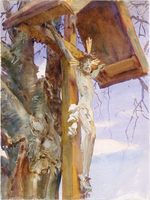
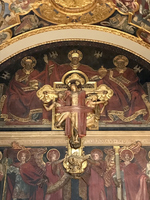
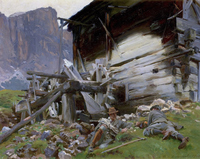
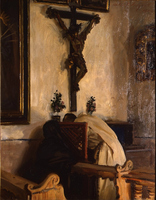
Understudied, often misunderstood, and scarcely published, Sargent’s religious-themed pictures emerge as reflexive statements about the artist’s lifelong itinerant existence, accentuated in 1914 by the unmooring effects of global war.[1] For Sargent, who, with his British traveling companions, was now a foreigner in a hostile land, sites of wandering and regrounding allowed him to construct spiritual equivalents for his own movements in the world as a perpetual expatriate. The wayside Tyrolean shrines in paintings like Tyrolese Crucifix (fig. 1) also gesture toward Sargent’s exploration of the Crucifixion as an aesthetic and symbolic form at key points throughout his career, especially in his later years, and most emphatically in the colossal polychrome crucifix he designed in 1903 as a keystone to his Boston Public Library murals (fig. 2). In one sense, then, to paint a solitary alpine crucifix in 1914 was also to reflect on the breadth of his artistic and touristic lifetime. At the same time, the Crucifixion, as an image of both abandonment and hoped-for deliverance, exemplified his stinging isolation from family and homeland during those summer and fall months. While detained in the Tyrol, Sargent continued to produce watercolors and oils typical of his alpine travels in years past: sketches of dramatic mountain terrain, a picture of leisure along a quiet mountain stream, or a painting of figures resting beside a humble wooden mill (fig. 3).[2] But the majority of his oil paintings and his most ambitious watercolors (in both subject and scale) were focused on the region’s religious landscape: its wayside shrines, graveyards dotted with crosses, and local residents engaging in quiet acts of devotion. A careful examination of these paintings from this four-month period in the Tyrol lays bare Sargent’s anxieties and his use of religious subjects in reckoning with his alpine entrapment.
In considering Sargent’s Tyrolean paintings as rooted in a particular time and location, this article will demonstrate how pictures like Tyrolese Crucifix—alongside previously unpublished materials in the Sargent Archive at the Museum of Fine Arts (MFA), Boston—controvert traditional accounts of the artist as a freewheeling global citizen who bore little connection to any one place. These long-held understandings of Sargent’s cosmopolitan nomadism became entrenched even during the artist’s lifetime, and they have remained persistent in the century since. “Sargent is not of the world in which he plays so conspicuous a part,” wrote Anglo-American critic Charles Caffin in 1902. “He was the slave of no school of painting, the product of no local environment,” declared an anonymous journalist in 1954. “[The Sargents] conducted an energetic nomadic existence, settling nowhere for more than a few months at a time, because they needed to be nowhere specific,” remarked the artist’s biographer Stanley Olson in 1986.[3]
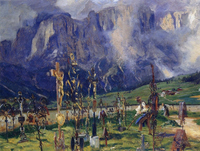
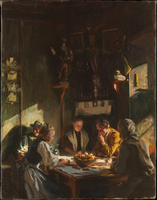
Having been conditioned to understand Sargent’s oeuvre even by the 1910s as a montage of dispassionate visions accumulated across years of relentless travel, numerous critics in Sargent’s day saw nothing exceptionally different in his Tyrolean religious scenes. In reviews of shows to which Sargent submitted several of those works, such as the Royal Academy exhibition of 1915, US expatriate writer Elizabeth Pennell regarded Graveyard in the Tyrol (fig. 4) and Tyrolese Interior (fig. 5) as “mere notes”—impressions of the play of light across a mountain range or through a window, which Sargent captured, in Caffin’s words, “with the collectedness of an onlooker interested in the moving show.”[4] To his contemporaries, Sargent’s detached visions seemed to extend from a near-pathological need to travel: Sargent was “incapable of idleness,” wrote an anonymous US critic.[5] Collectively these authors overlooked what made Sargent’s experience in the Tyrol, and the pictures that resulted during that period of intense isolation, so unique. More recently, scholars have come to insist on the predictive power of Sargent’s alpine pictorial campaign in 1914, asserting that his Tyrolean religious pictures were largely anticipatory of later wartime events—many of which Sargent could not have fully known so early in his alpine isolation that summer and fall.
Rather than read these paintings from 1914 solely as foreshadowings of the death and devastation to come at the height of war, this article thinks more carefully about the artist’s immediate human response to his sudden alienation that fateful July. In other words, why did Sargent turn so quickly to the spiritual landscape of the Tyrol in his pictures? If, as Richard Ormond and Elaine Kilmurray have observed, “[r]eligious imagery offered solace and hope in a time of grief and danger,” what was it about that imagery generally and the sites of Tyrolean folk religion specifically that so aptly offered him this consolation?[6] As this article will argue, these Tyrolean scenes reveal how Sargent, in coming to terms with his own sense of isolation and dislocation, sought out religious subject matter to provide a sense of grounding amid precarity and a sense of rootedness for his lifelong itinerant artistic practice.
In this way, this article joins recent reappraisals of Sargent’s career, such as the exhibition Sargent and Spain at the National Gallery of Art in Washington, DC, curated by Sarah Cash with Ormond and Kilmurray, and Stephanie L. Herdrich’s exhibition Sargent and Paris at the Metropolitan Museum of Art, which similarly emphasize the interplay between the artist’s lifelong travels and his sustained, intimate engagement with place.[7] In Cash’s project, we learn how Sargent’s itineraries through Spain and his voracious accumulation of source materials, including a rich archive of travel photographs, informed his views of the land and its peoples across decades. We also discover, for example, how Sargent mined the landscape of Spanish Catholic devotion and absorbed it into his own painterly idiom in later projects, most of all in his Triumph of Religion murals at the Boston Public Library. In a parallel vein, Herdrich traces how Sargent’s early life in the French capital and his ongoing connections to Parisian art and society were integral along his path to artistic celebrity. As French art historian Hadrien Viraben notes in the accompanying catalogue, “Sargent’s style of nomadism . . . was distinct from that of other travel painters, for unlike pioneering visitors to unexplored lands, he preferred to wander well-worn paths in good company.”[8] The art of return became an aesthetic practice for Sargent. Whether traveling on the French coast, in the Austrian Alps, or along a Venetian canal, he embraced a process of quotation and iteration—so much so that, at times, something strange and new might, at first, appear to our eyes like a timeworn subject or motif well-trodden. Only upon more careful inspection and recontextualization do we uncover peculiarity and innovation in the seemingly familiar.
Though they might recall alpine pictures painted during so many European sketching trips in previous years, Sargent’s Tyrolean pictures from 1914 similarly demand a grounded, immersive approach that attends to the particularities of the spaces and immediate experiences of his painting holiday gone awry. Today, as art historian John Davis has noted, the field of art history tends to consider “the study of layered intersecting phenomena in a single region” as “backward and limiting” in comparison with more global studies of phenomena across space. In attending, in careful detail, to the drudgery and complications of Sargent’s travels in 1914, this article takes up Davis’s call for micro-art histories, whose sensitive attention to more localized mobilities and transnational connections produce “the necessary building blocks for the more sweeping interpretive thrusts that often change a field of study.”[9]
To comprehend the utter rupture wartime caused in Sargent’s oeuvre and the insights his Tyrolean pictures offer in this moment of rupture, this article begins by offering a short history of Sargent’s peripatetic life up until summer 1914 and by laying out the broader nature of artistic nomadism in his day. What follows is a careful, step-by-step account of the chronology and geography of Sargent’s sojourn that summer and fall, reconstructing through primary sources what he painted and where and when. Through these details we can attend to the ways that his travel made itself felt in these pictures and can begin to answer the question as to why he took up religious subjects at each turn. The next section considers the sense of entrapment that pervades Sargent’s letters and, in turn, his pictures, and considers how his failures to connect with loved ones and his stinging sense of alpine isolation marked his alpine religious paintings. I then turn to the medium that motivated Sargent’s late-career sketching holidays: watercolor. Contemporary critics considered watercolor a freewheeling medium perfectly suited to this freely mobile artist. Cut off and immobilized, how did Sargent’s watercolors of wayside shrines offer a motif for this entrapped artist that was inherently about physical movement as much as spiritual transcendence? In other words, as waypoints in a wider network of alpine travel and as sites of refuge for road-worn travelers, how can we see these shrines as pictorial subjects that might have spurred the artist into motion once again? If these crucifixes pointed to local networks of mobility, the following section examines how the form of the crucifix also offered a metonym for Sargent’s lifelong mobility as an artist-wanderer. As we will see, the crucifix afforded Sargent a metaphoric language to reckon with his lifetime of travels (the crucifix, as a visual form, appears in a wide body of his paintings across time and space, including in the most ambitious projects of his late career).
How, ultimately, did Sargent get away from the Tyrol? By answering this question, the article concludes by considering how such an extraordinary, even painful episode came to be understood as a mere blip in Sargent’s artistic lifetime. In so doing, we learn how his Tyrolean religious pictures—as overlooked as they often have been over the past century, and as fleeting as these four months in the Alps might now seem—can truly transform our understanding of his career and his lifelong artistic project.
John Singer Sargent, an Artist “Astride the Atlantic”
Raised in Europe by two parents from the United States, Mary and FitzWilliam Sargent, John and his family epitomized those new types of “pilgrims” (as biographer Evan Charteris would call the Sargents), who followed a reverse flow of migration in search of a new home in “the old world.”[10] As they took up residence in various European countries, Sargent’s family also ensured that the young artist felt no language impediments. Childhood friend Vernon Lee called Sargent—who spoke English, French, German, and Italian—an “accentless mongrel.”[11] His art likewise came to be associated with an international style, unconstrained by national schools or boundaries. In short, as one critic remarked, Sargent’s paintings occupied a “position astride the Atlantic.”[12]
Of course, at the turn of the century, mobility and US identity had become inextricable. As literature scholar Mark Simpson observes, late nineteenth-century authors, critics, and thought leaders in the United States envisioned “mobility as the key to national temperament,” whether as a strategy of political contestation, a means of social mobility, or a form of cultural expression. To Sargent’s allies and critics, the artist embodied this intrinsic relationship between “the need to move (freedom as geographical expansiveness)” and the concept of “the American.”[13] Sargent’s freewheeling cosmopolitanism also epitomizes what cultural critic Jean-Pierre Criqui has termed “artistic nomadism.” By “always carrying along . . . a part of [his or her] native country,” Criqui argues, the artistic nomad remains “a mobile and polymorphous entity, . . . independent of the melancholy one ordinarily associates with uprooting.”[14]
More recently, however, art historians like T. J. Demos have highlighted the privilege, unevenness, and inequities of the romantic, boundless travel and exchange in which Sargent and many of his contemporaries engaged. Indeed, the “lyrical and romantic tendency” of nomadism, Demos contends, “is a noncritical one, wherein the poetic flight of fancy . . . fails to reflexively consider the institutional, historical, and geographical parameters in which the nomadic exists.”[15] Sargent certainly enjoyed the privileges of a nomadic childhood and mature professional life. Unlike other Anglo-American expatriates, who found themselves strangers abroad, unable to speak local languages upon arriving in Europe and thus refused admission to national art academies like Paris’s École des Beaux-Arts, Sargent was equipped with the resources and cultural pedigree to seamlessly crisscross linguistic and geopolitical borders in the pursuit of artistic growth and experimentation.
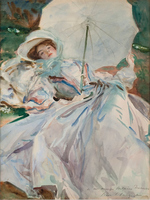
Sargent’s landscapes, figures, and genre pictures, particularly from the early 1900s, seem similarly unburdened by daily life and modern experience. Art historian Donelson F. Hoopes notes the “mood of abandonment,” “sensual relaxation,” and “languid ease” of oils and watercolors like The Lady with an Umbrella (fig. 6), which Sargent painted on summer sketching trips between 1900 and 1914.[16] Absent of the burdens of narrative, such paintings manifest the artist’s ideal world, in which Sargent could lead a self-contained, “unhampered life.”[17] To his contemporaries, the realism of Sargent’s pictures stemmed from this desire and ability to remain aloof from his surroundings.
Shortly after his arrival in the Austrian Tyrol in late July 1914, however, Sargent was confronted with the unevenness of cosmopolitan movement and global travel and could no longer remain aloof. In this moment, at the outbreak of war, the terms of Sargent’s artistic nomadism fell apart. Now unable to wander freely across cultural and national boundaries, he came face to face with his own isolation and inability to move. An examination of his Tyrolean sojourn participates, then, in a recent move within the history of art and the humanities more broadly to consider how artists have confronted the traditional conceptualization of boundaries and borders and how artworks and artistic activity have been inspired and/or inhibited by such borders and the crossing of them.
“Painting Away While Rome Is Burning”
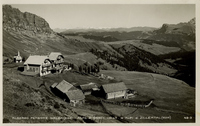
On July 25, 1914, Sargent arrived in Bozen (Bolzano) in Austria’s South Tyrol, after traveling from London via Bologna with his valet Nicola d’Inverno.[18] Sargent went by car the following day to Campitello in the Val di Fassa, where he spent the night, and then, on July 27, journeyed on horseback to Franz Dialer’s Seiseralpenhaus, a remote mountain refuge nestled in the Dolomites above the Duron Valley (fig. 7). Sargent likely discovered Dialer’s inn in Karl Baedeker’s handbook for the Tyrol and Dolomites, which noted the guesthouse’s summertime post office, the chapel and alpine garden, and its picturesque location.[19] There Sargent met his traveling companions: the artist-couple Adrian and Marianne Stokes (and Marianne’s maid) and the British watercolorist and retired military officer Colonel Ernest Armstrong. The Stokes and Armstrong had accompanied Sargent on previous alpine sketching holidays (1911–14), including at a remote hotel in Switzerland’s Simplon Pass in 1911.
The party had only just settled in at the Seiseralpenhaus when, on July 28, Austria-Hungary declared war on Serbia. The Austrian borders quickly closed and the various alliances that Europe’s major powers had established in the preceding decades fell into mobilization. Germany moved against Russia on one front and France on the other, Russia mobilized to fight Austria in Serbia and halt a German invasion, and, by August 4, England and France declared war on Germany as the German army poured through Belgium and Luxembourg and across the French border. On August 3, Sargent and his companions left the Seiseralpenhaus for Campitello. But they found the train stations there impossible to enter, with tourists and locals alike camped out waiting for trains to evacuate them. Sargent, Armstrong, and the Stokes decided to leave Campitello the next day, August 4, and traveled through the Passo Gardena to the village of Colfuschg (Colfosco), where they convinced mountain guide Josef Kostner not to close down his hotel, the Albergo Cappella, and rent them rooms.[20] There the group remained for nearly two months, working and waiting, waiting and working.
What made travel entirely impossible for Sargent and his companions following the outbreak of war, however, was that none of them had brought passports on the trip.[21] Sargent had never needed his passport before. In peacetime he had been able to move freely across Europe’s permeable borders, as had his fellow travelers throughout their many years of sketching holidays together. While his lack of a birth record in childhood had posed an obstacle when his father could not present a birth certificate upon John’s entrance into the École des Beaux-Arts and would lead to a lifetime of trouble securing identifying documents, it had never foiled his travels in the past. Sargent “knew the inconvenience,” Olson casually observes, and had grown accustomed to it.[22] Yet the crisis of early August 1914 presented more than just an inconvenience. “You had to have a passport to take a train (and I haven’t got one) when in Austria,” Sargent wrote in a letter later that fall, “not to speak of crossing frontiers.” Hence, even two and a half months after he and his friends first became trapped in the Tyrol, Sargent would admit, “I still don’t know when or how to make a move.” And so “we are painting away while Rome is burning.”[23]
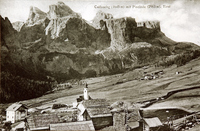
Sargent painted most of his alpine views from the garden at the Cappella Inn or other local sites, like the graveyard behind the nearby Chiesa Colfosco, with its onion-domed bell tower and churchyard just visible to the left of center in an early twentieth-century postcard (fig. 8).[24] In paintings of the Chiesa Colfosco’s cemetery, such as Graveyard in the Tyrol (see fig. 4), the flat bluffs of the Dolomites’ Sella massif south of Colfuschg rise dramatically through a cloudy haze. Groundskeepers clip the grass between an array of baroque wrought-iron and humbler wooden memorials, all of which prominently feature crucifixes, those ubiquitous regional symbols. Such paintings demonstrate Sargent’s detailed on-site research in constructing his landscapes and highlight the need for directing equally precise attention to the region’s local particularities.
Early critics and biographers nevertheless dismissed the sincerity and complexity of Sargent’s Tyrolean pictures. “The War was outside his ken,” wrote Charteris of pictures like Tyrolese Crucifix (see fig. 1). “It was as if his imagination had suffered a complete breakdown” and produced “nothing more than mild boredom.”[25] This despite the fact that Sargent gifted Tyrolese Crucifix to the Metropolitan Museum of Art in December of that year, and, in a letter to museum director Edward Robinson, called his Tyrolese Interior (see fig. 5) “the best oil picture I did in Tirol [sic] last summer,” which “strikes me as worthy of the Museum.”[26] In this period, Sargent was strategically depositing groupings of his work at a number of major US institutions, including the Brooklyn Museum and the MFA in Boston. As part of this package of ten watercolors for the Metropolitan, such Tyrolese pictures must have been central to Sargent’s self-perceived artistic legacy as it was being aggregated and enshrined in major US cultural institutions.
More recently, scholars have interpreted Sargent’s watercolors and oils of crucifixes, graveyards, and folk Catholicism as oblique yet somber references to war and meditations on death. Ormond notes the “gloomy and premonitory mood” of paintings like Graveyard in the Tyrol (see fig. 4), where two gardeners scythe the grass like “emblems of the grim reaper,” and myriad memorials offer meditations on religion and mortality, sacrifice, and redemption. “The unfolding catastrophe” of global war appears “immanent” in these pictures, while the field of death in his graveyards and the bloodied flesh of his crucifixes present Sargent’s own “forebodings of what lay in store.”[27]
Still, one must be careful about giving Sargent—and artists more generally working in these early months and years of the war—a kind of oracular, extrasensory perception of the world and the unfolding conflict. In fact, Sargent had already begun painting all but two of his religious-themed oils and watercolors—Tyrolese Interior and The Confession (fig. 9)—by the time he and his party left Colfuschg for the lower-lying town of Sankt Lorenzen (San Lorenzo) on September 30, 1914, to escape the encroaching cold and snow of alpine winter. There they stayed in the home of Sargent’s childhood friend Carl Maldoner, with whom he had reconnected amid the crisis.
It was at Sankt Lorenzen that Sargent learned via telegram on October 18—nearly three weeks after the move—of the death of his beloved niece’s husband and his friend, the art historian Robert André-Michel, who had been killed in battle on the French line of the Soissons Front five days earlier. For art critic and traveling companion Adrian Stokes and, consequently, many later scholars, it was only then that the war became “real” for the artist.[28] If the image of a crucifix and the wayside shrines of Tyrolean Catholicism had already permeated his pictures well before mid-October when that tragic news arrived, what might such imagery have offered to Sargent as he reckoned with his sudden experience of alienation and his attempts to recover any sense of connection to a wider world?
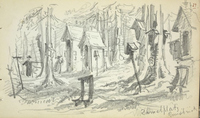
In one sense, amid the outbreak of a global armed conflict, the Tyrolese wayside shrine offered Sargent a familiar kind of war memorial. During a walking tour of the Tyrol with the German-American artist Theodore Charles Welsch in 1871, a fifteen-year-old Sargent visited and sketched the Tummelplatz, a forest glade near the Ambras Castle southeast of Innsbruck (fig. 10).[29] The woods are dotted with full-scale shrines and a range of small, gabled crucifixes, hanging on trees and perched on poles, as well as a few scattered wooden stands for kneeling in prayer. Sargent may have called this particular visit to the Tummelplatz to mind in 1914 because of the dual purpose these forest shrines had come to serve by the time of his visit in the early 1870s. When the Habsburgs dissolved their residence at Innsbruck in 1797, Ambras Castle was converted into a military hospital and the Tummelplatz—once the exercise grounds of the Tyrolean cavalry—became a cemetery for soldiers who had died at Ambras from injury or disease. Following the Austro-Prussian War of 1866, however, the Tummelplatz became a Landessöhnegedächtnisstäte (Memorial to Sons of the Country), where family members could erect memorial crosses for soldiers who had died far from home.
By marking absent bodies, fallen on foreign battlefields, these shrines at Innsbruck pointed not only to the loss of life in wartime but also to the distancing and alienating character of warfare. Following the advent of a global war in 1914, families lost tangible, proximal contact with their loved ones, sometimes temporarily and sometimes permanently. The shrines dotting the pathways around Colfuschg and Sankt Lorenzen would have served a similar purpose for Sargent during his four-month detention in the Tyrol. They provided sites of imagined connection amid his own dislocation from family and friends, as well as his continued uncertainty as to when and how he might see or hear from them again.
Though not unusual in the sacred and physical landscape of Catholic Europe, and though popular as subjects among generations of artist-tourists, wayside shrines were a particularly potent symbol for Sargent in 1914 because of one key purpose they served on the mountainous routes that coursed across the Tyrol.[30] In short, crucifixes were ubiquitous in the region because travel in the Alps was so arduous and perilous. These altars, whether small statues or large architectural niches, provided a site of temporary, physical and spiritual refuge for the weary wanderer. The two figures in Sargent’s sketch of the Tummelplatz from 1871 and their alternating postures—one walking and one kneeling—diagram the dialectical relationship between motion and arrested movement that came to be associated with these shrines. The geographical and bureaucratic obstacles and the climate of uncertainty that constrained Sargent’s own travels in summer and fall 1914—that is, his own alternating “postures” of traveling and dwelling—similarly found expression in these physical spaces of refuge while wandering.
Of course, apart from his decades-long campaign on the religious program at the Boston Public Library, institutional religion and conventional religious conviction seem to have been distinctly absent from Sargent’s personal history. The artist’s peripatetic childhood prevented sustained involvement in a local faith community; nor would Sargent participate regularly in any religious organizations after settling in London as an adult. Instead, as art historian Sally M. Promey writes, when it came to religion, Sargent was more of an “intrigued spectator” than an “active participant,” who painted “with the detachment of a perpetual tourist rather than the intimacy of a believer.”[31] His fascination with the pageantry and visual language of Catholicism also echoed that of many US Protestants of the day, who desired to engage with the sensory power and ceremonial dimensions of Catholic culture while refusing any sense of religious conversion or commitment.[32] Sargent’s turn to world religions at the Boston Public Library has often been interpreted, then, as a strategy to take on the monumental theme of the history and progress of Western civilization and thereby establish his intellectual credentials as equal to his technical skill.[33] Yet his Tyrolean pictures from 1914 suggest something more personal, more intimate, more immediate. In this spiritual environment, Sargent the impartial observer or intrigued consumer had suddenly become the invested participant.
The oblique perspective of Tyrolese Crucifix (see fig. 1) connects the grounded immediacy of local travel to the function of these shrines. Pointing the eye upward toward the knotted trunk, leafless branches, and attenuated figure of the crucified Christ, this tightly cropped watercolor at first implies an unstable perspective, dislocated from any embodied point of view, as if underscoring Sargent’s “preoccupation with the instability of his world.”[34] But when read in light of this shrine’s purpose—as a site of refuge for the traveler—the picture itself and the viewer’s perspective become regrounded. The watercolor’s skyward orientation and diagonal thrust evoke the arrested movement and halted glance of a passerby, embedding the crucifix within a larger itinerary of wayside shrines across the Tyrol that were temporally and spatially linked together by the locomotion of a mobile observer. In this way, Tyrolese Crucifix offers a meditation upon a lifetime as an artist-traveler.
The crucifix on the wall in The Confession (see fig. 9) is similarly connected to histories of alpine travel. The sculpture still hangs today in the chapel of St. Johann im Spital (San Giovanni dell’Ospedalle) at Sonnenburg, just across the river from Sankt Lorenzen, where Sargent and his party traveled on September 30, 1914. This small church, which stands at the foot of the Sonnenburg Castle—once a Benedictine monastery but by this time a derelict farmhouse—was built in the twelfth century by the Knights of Saint John as a sanctuary and lodge for travelers.[35] The confraternity chose to erect their hospice at this particular site because it sat along an arterial roadway that connected to the Via Claudia Augusta, the ancient road that linked the capital of the Holy Roman Empire in Augsburg to the papal seat of power in Rome. Even the unassuming church interior in The Confession participates, then, in a larger regional network of sites of respite and relief for road-worn wanderers.
Sargent’s intimate familiarity with the intricacies of his own travel plans suggests just how much he might have valued these places for dwelling in the midst of traveling. Although some scholars have suggested that Sargent delegated many of his traveling arrangements, especially in his later years, he in fact relied little on personal servants or assistants for these logistics, with the exception of his manservant D’Inverno, who physically transported his art materials on sketching trips and often primed old canvases.[36] Instead, according to Sargent’s friend Thomas A. Fox, who later helped catalogue, promote, and disperse the artist’s work after his death, Sargent handled travel plans much the same way that he did his correspondence and financial affairs: “He wrote all his many letters and correspondence by himself in longhand. Checks were made in the same way, and he usually packed and unpacked his trunks, bags, and paraphernalia, all of which were large, both in number and volume, and contained implements, tools of trade, and gadgets, altogether too numerous to mention in detail and more than ample to meet every conceivable condition and emergency.”[37] This habit, of course, was a vestige of a nomadic childhood that had been cluttered with crates and luggage as the family moved from place to place. Hence his “only” concern regarding the climb up to Dialer’s Seiseralpenhaus in a letter to his sister Emily that July was about “getting our baggage there.”[38]
In fact, Sargent had traveled to the Dolomites in late August 1913 to scout painting locations, plan his itinerary, and determine where best to leave his luggage and painting supplies along the way the following year.[39] On this trip he learned that, in order to paint near the border between Austria and Italy, which zigged and zagged through the Alps, one needed to arrange for special government permissions. “There are strict military laws against photographing, drawing or painting whenever you are near the frontier,” Sargent wrote to his friend William Gair Rathbone in September 1913, “& the frontier wiggles almost everywhere—I believe however you can get permission by applying for it months beforehand to some K. K. Hauptkommando in Innsbruck.”[40] Though at the time these meandering borders throughout the Alps provided a steady line of international demarcation, the South Tyrol remained a contested space in contemporary geopolitics, perhaps contributing to the challenges Sargent and his party faced trying to escape the region and even precipitating the arrest and ten-day detention of the one enemy alien in their party, Colonel Armstrong, in a prison at Trento.[41] Following World War I, the region where Sargent was painting would be transferred from Austria to the allied government in Italy.
Sargent’s impressions of the unpredictable meanderings of the Austrian frontier, coupled with the increasingly unstable geopolitical climate of late July 1914, open interpretation of his works from the Tyrol to what art historian Jennifer Roberts calls the “friction of distance.” Citing economic geographers, Roberts describes how the transportation of a work of art exposes that object “to the contingencies of topography, seasonality, and territorial politics.”[42] Though Sargent, as a seasoned traveler, was already well-acquainted with the demands and so-called inconveniences of passing through the world, the war amplified his awareness of such constraints on his movements as well as on those of his artworks and materials. For example, when Sargent and his company decided to leave the Seiseralpenhaus for Campitello, the artist found the difficulty of “getting away from this height with our luggage” even greater than when they had first arrived in peacetime. “Dialer’s mules and carts and men have been commandeered for the war,” Sargent told his sister Emily in another letter, which, like the others, would go unanswered for weeks. “[I]t is so all over the country for the present—motors, trains and everything grabbed.”[43]
“Two Months of Complete Cut-Off-Ness”
In the days and weeks after the war began, Sargent’s letters to friends and to his beloved sisters were filled with the language of futility and the failure to connect. “It seems hopeless to travel, very difficult to get over frontiers, and probably useless trying to go to Italy,” he wrote in one letter to Emily. “[T]raveling still seems very difficult—and getting to England probably impossible,” he later informed Ariana Curtis.[44] Yet even when Sargent knew that he was on the verge of returning home in mid-November, a letter to Emily revealed how he continually resigned himself to separation and delay. “For more than two weeks I have been sitting here waiting for my passport without knowing why it has tarried for so long,” he lamented. “I write and telegraph and nothing comes—hopefully tomorrow.”[45]
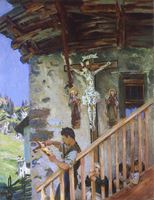
A Tyrolese Crucifix (fig. 11) conveys Sargent’s feeling of entrapment during these months. A local woodcarver, Francesco (Franciasch) Alton, stands at the foot of the outer stairway to the chalet where he lived, while three children, likely his niece and two nephews, sit further up the steps.[46] These figures, and especially the children, appear ensnared within the tight confines of the staircase. The planes of moss-covered eaves above, the impenetrable stucco wall behind them, and the banister and tightly clustered balusters below seem to seclude the figures from their surroundings. Meanwhile, the fence at lower left barricades the foreground from the verdant hillside beyond, just as the railing separates the children from our own space. The young girl at the foot of the cross peers through the gap between two wooden uprights, reaching through and grasping the posts like a prisoner does the bars of a cell. She is trapped in a space of strife and struggle as the two boys wrestle beside her, their brotherly scuffle offering a juvenile parallel to the global conflict at hand.
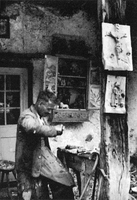
During his two months of idleness at Colfuschg—as he continued working and waiting for word from afar—Sargent perhaps felt a sense of artistic kinship with Alton, whose house, shown in A Tyrolese Crucifix, stood on a small hillock directly behind Sargent’s temporary home at the Cappella Inn. Alton had turned to woodcarving once he could no longer farm or work due to his two bad legs.[47] Yet Sargent conveys Alton’s creative powers not only in the muscular, vigorous, and confident act of carving but also, by implication, in the looming, painted crucifix on the chalet’s exterior wall above. The portable, handheld scale of Alton’s craft finds more monumental and multimedia expression, in other words, in a large, seventeenth-century painted prototype: a crucifix of the Pest-Christus (or Christ of the Plague) type with Saint John and the Virgin Mary below. If the act of making finds one expression in the carved surface of Alton’s wooden cross, it also emerges in the heavily worked, painted surface of the crucifix high on the wall and its spotted, bloodied flesh. Based on the slightly elevated perspective of Sargent’s painting, it also appears that the artist painted A Tyrolese Crucifix from just outside the door of Alton’s humble studio, visible in an archival photograph from around 1920 (fig. 12). Sargent thus modeled his own Tyrolese crucifix from pigment in the very same space where Alton often whittled crosses from wood. In A Tyrolese Crucifix, then, Alton’s “carving” of one crucifix and Sargent’s painterly treatment of another become aligned.
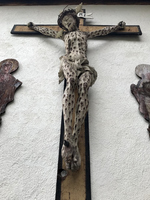
Sargent’s focus on these two crucifixes, one life-size and one handheld, further connected his painting to the power of religious imagery in the face of war. The iconography of the Pest-Christus was popular in the South Tyrol during the sixteenth and seventeenth centuries, a period of successive wars, when a wave of plagues swept across the region, brought by soldiers from Germany, Italy, and France as they passed through the Dolomites. The pestilential appearance of Christ—his white flesh spotted with plague-like red sores from his flagellation (fig. 13)—would have provided solace to those suffering a similarly tortuous fate and lacking access to modern forms of medicine.[48] There is no evidence that Sargent knew the regional history of this iconographic tradition. But at the very least, it is a striking coincidence that he should have included it in this painting. Both the Pest-Christus and Sargent’s portrait of a crucifix maker were the products of artists reckoning with the perils of war: The former offered a means for this alpine community to make sense of their own wartime plight through religious imagery when they installed the crucifix in the town church in the 1600s to find solace, divine compassion, and the hope of deliverance; the latter was the work of an artist trapped in Austria during the advent of World War I, similarly hoping for rescue.
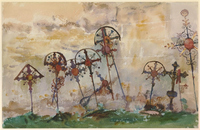
The tightly confined space of A Tyrolese Crucifix, with its connotations of entrapment, recalls the intensely shallow foreground of Sargent’s watercolor, Graveyard in the Tyrol (fig. 14). Here, eleven wrought-iron crosses and one crucifix hover above a patch of dark green grass and against the misty backdrop of a stone churchyard wall. Likely painted at the cemetery of the Chiesa Colfosco (see figs. 4, 8), the elaborate, foliated ironwork is typical of traditional Tyrolean memorial crosses. The tomb markers in Sargent’s watercolor, however, lean precariously in their plots, none perfectly erect, seemingly abandoned tributes to the no-longer living. The stone wall behind them initially appears evanescent, nothing more than drifting clouds of lavender, burnt orange, and gray vapor; however, the interstices of mortar between the bricks (delineated by the open reserves of the white paper) solidify this floating mist into an unyielding stone barricade. Rather than signs of permeability, the crisscrossing embrasures of white mortar trace out a physical and visual barrier, reiterating the impenetrability of this alpine landscape in 1914 and forcing the viewer to confront what these rusting memorials also represent: the fleeting nature of human life and memory.
A Tyrolese Crucifix and Graveyard in the Tyrol resound with themes of entrapment and death because, with the outbreak of war, Sargent was forced to reckon with his own sudden sense of isolation and endangerment as well as with the question of his family’s safety. His beloved sisters Emily and Violet had also planned to travel from London to Sotteville, France, and then to Italy just before the war began, and Sargent remained unsure of their whereabouts. For nearly two months, his letters to his sisters and his niece Rose-Marie Ormond were returned or went unanswered.[49] Finally, on August 28, Sargent received a letter from Emily written from Paris on July 31. Yet it would take six more weeks for him to receive a second letter from Emily confirming that she, Violet, and the rest of the family had, in fact, returned safely to London.[50] And it would not be until September 24 that he received any word from his niece Rose-Marie—a two-month delay following his first letter to her.[51] In the meantime, Sargent learned, through a wire on September 11 from Walter Hines Page, the US ambassador in London, via Vienna, that Emily and Violet had returned to London and Rose-Marie was safe in Switzerland.
All along, from late July through early October, Sargent remained unsure whether any of his messages were reaching his family members—and whether they knew that he, too, was safe in the Tyrol. “Ever since the first of August, when my friends the Stokes and I got to Tirol [sic], we have been without any direct communication with England and have had our letters returned and have received none,” Sargent wrote to Curtis that September. With his correspondence consistently returned to sender, he declared to Curtis that he had attempted “every conceivable means” to dispatch his letters: ambassadors, foreign banks in neutral countries, and returning English citizens.[52] Relying largely upon local Austrian papers for news of the war, Sargent came to imagine troops blocking mail from crossing every frontier: “The letter boats on the channel are patrolled by warships, and loaded with torpedoes,” Sargent told Rose-Marie. “I tried every way to send letters to Emily,” he continued, “and I hope she got some. I still have nothing of her. Perhaps you will accomplish the miracle of sending me a letter from her.”[53]
Meanwhile, friends, acquaintances, and the press at large were unaware of what had happened to the artist and assumed the worst. “John S. Sargent, the painter, is somewhere in Austria,” read a cable from London published in The New-York Tribune and The New York Times on August 22, 1914. It continued, “His friends are greatly worried as to his safety. He was last heard from on August 4. . . . It is believed probable that he has been detained by the Austrian authorities and not permitted to return to England.”[54] It took another month and a half for these papers to publish an update, which stated—perhaps far too optimistically—that his work had not been “interfered with” or “interrupted in any way” and that he planned to return to England the following month.[55]
The stubborn impenetrability of these newly closed international borders and a persistent sense of isolation seem to have marked Sargent’s Tyrolean pictures, with the pervasive symbol of the Crucifixion offering a particularly potent symbol not only of desolation and abandonment, but also of spiritual deliverance. The figure of Christ in Tyrolese Crucifix (see fig. 1) is confined within a very small space: The margins of paper narrowly crop the vertical beam of the cross and the horizontal expanse of the canopy, confining this crucified figure to a slim slice of tree and sky. Christ’s sagging eyes and canted head meanwhile initiate eye contact with the viewer, humanizing this isolated figure, who seems to lament, as Jesus cried out on the cross, “My God, my God, why hast thou forsaken me.”[56] The wilderness isolation of these wayside shrines and the meager shelter of their gabled canopies reinforce this feeling of desertion and the painful silence of a cry for rescue gone unanswered. We might consider the resonance of this Christ figure, abandoned and anguished, with Sargent’s own forsaken condition in the Alps. For he would suffer through “more than two months of complete cut-off-ness . . . during [which] time my letters were all returned” before he eventually succeeded in getting letters to and receiving news from his sister Emily.[57]
The artist’s feeling of isolation would have been exacerbated by the fact that most other tourists to the Tyrol had cut their alpine holidays short. As art historian Janet Chen observes, Sargent’s images of summer leisure from the early 1910s “coincided with a booming tourist industry in the Alps that had started with the late nineteenth century.”[58] Thanks to improved mountain train lines and new hotels and amenities, the region became more accessible and hospitable to a large holiday crowd. Mass tourism had so eliminated the region’s reputation of remoteness that, as one traveler lamented in 1864, “wandering across glaciers has lost its harrowing repute and is now reckoned as almost humdrum.”[59] But after Austria declared war on Serbia in late July 1914, guests vanished, businesses closed, and hotels shut down. Sargent’s yearslong familiarity with this thriving tourist region at its height likely made the evacuation from the Tyrol by fellow travelers that much more palpable.
Compare, for example, the languid pose, sumptuous excess of fabric, and lush bed of grass of the figure holding a parasol in The Lady with the Umbrella (see fig. 6)—painted at the peak of the region’s tourism boom—to the emaciated and contorted posture of Christ, his bloodied and nearly nude body, and the bleak environment in Tyrolese Crucifix (see fig. 1). For this luxurious lady, silence means peace and tranquility. For the crucified Christ, silence means utter forsakenness. She is carefree and perfectly unburdened. He is utterly careworn, bearing all the weight of humanity’s burdens. Even so, in the shade of this shrine, as Christ looks down on the viewer from above, Sargent’s crucifix suggests the possibility of deliverance: Here, perhaps, is an intercessor who knows affliction and answers the traveler’s pleas. In this way, Tyrolese Crucifix joins several pictures from Sargent’s sojourn—each of them quotidian moments of Catholic piety—in conveying not only the silent emptiness of the Tyrol that season but also a longing for transcendence and connection that could break that silence.
Eventually Sargent developed a system to communicate with his faraway family members. At Maldoner’s suggestion, he would place each letter with a twenty-five-cent international postage coupon inside a second, unsealed envelope, which would allow authorities to inspect the contents and another agent—often in a neutral country like Switzerland—to then seal and send the inner note.[60] These highly mediated forms of communication amid physical separation seem to find expression in The Confession (see fig. 9). A female figure, shrouded in black, whispers through a wooden lattice to a stooping, tonsured Dominican priest in creamy white robes with a rosary at his waist. All lines converge on their sacred conversation in this small corner of the Sankt Lorenzen chapel: the horizontal bar of the altar rail, the S-shaped scroll at the end of the pew, the streak of blue along the wall at left, the vertical axis of the crucifix, and even the slanted gaze of the crucified Christ. Just as the woman speaks through a screen with the priest, so too is her confession mediated by him. His head is physically interposed between the kneeling woman below and the feet of the crucifix above, transforming the horizontal conversation between priest and penitent into a vertical connection between earth and the heavens. These mediations—lattices, rails, and earthly and heavenly bodies—seemingly echo the various levels of intervention and translation—double envelopes, postage coupons, bank agents, wires, and written words—that Sargent had to navigate as he sought to connect with distant family and friends. The silence of the picture is barely broken by the two figures’ hushed words.
The contemplative family at a midday meal in Tyrolese Interior (see fig. 5) offers another scene of silence, though apparently of a different kind. Scholars have typically interpreted the painting as an oblique reference to war.[61] The dark palette, the cool light that filters through an unseen window at right, and the pensive, even melancholic expressions of these local residents suggest the somber mood of a family waiting for news of their young soldier off on the field of battle. With heads bowed, and with the three women clasping their hands, they do not pray over the meal—the empty place settings and hollow glass jug suggest that their repast is finished, as Ormond and Kilmurray have also observed.[62] Instead, they seem to ruminate over something else, something absent from the gathered household. The cosmic import of this humble domestic ritual is amplified by the looming presence of the crucifix in the darkness above, the small, prayerful figure of the Virgin Mary at its feet, and the two saints on either side, who float above the human group as if the heavenly intercessors of their lowly entreaties.
It was also at Sankt Lorenzen, where Sargent painted Tyrolese Interior, that the artist exchanged letters with his niece Rose-Marie regarding the well-being of her husband Robert. In a painful bit of irony, on October 14, one day after Robert was killed, Sargent had written to reassure Rose-Marie: “[D]on’t be surprised if you receive no letters [from Robert]—here also the wives of officers remain without news of their husbands, who are not even across the border.”[63] Four days later he received a telegram that Robert had died.
This was not Sargent’s first confrontation with the death of a loved one in the space of a transnational delay. The artist was traveling in Palestine on January 24, 1905, when he received word of his mother’s passing. “[T]he telegram was brought to me, far in the interior, the very day that a boat left Jaffa—and there is about a week to wait for another boat,” he wrote to his friend Mary Hunter. He continued, “With the telegram came a charming letter from my mother, and this was the first I knew of that dreadful burning, which was, I suppose, the thing that proved too much for her strengths.”[64] The disproportionate speeds at which news traveled—a letter on the ground versus a wired telegraph—and the slow pace of overland and maritime travel would have amplified Sargent’s own feeling of physical distance from his family in 1905. The delay between that diplomatic telegram on September 11, 1914, which first informed Sargent of his family’s safety, and the mailed letters from them stating the same, which arrived two and three weeks afterward, would have similarly intensified the artist’s sense of alpine remoteness and even helplessness.
If the figures in Tyrolese Interior appear “uncommunicative” and “quite unconscious of attention,” as critics labeled them at the time, this was not because Sargent painted them with “comparative detachment, as interesting passages of tone and color” in “sun and shadow.”[65] To the contrary, Sargent seems to have focused our view upon members of a family who sit mutely and in relative isolation from one another because they, too, are waiting for a word from afar, and because, if silence and delay meant physical distance and separation, it could very well also mean death. Likewise, if silence implies absence, in The Confession it also suggests anxiety and sorrow. Sargent juxtaposes the anguish of the crucified Christ at center with a partial view of a painting at left of the Madonna of Sorrows, pierced with seven swords. The black-robed female figure below finds a heavenly corollary—both visually and spiritually—in the suffering figure of Mary directly overhead, who could offer empathy with her pain and, like the very act of her confession itself, a means of atonement for sin and rescue amid tribulation.
“He Swings His Brush from Continent to Continent”
To retrospective readers, Sargent’s trip to the South Tyrol in late July 1914 may appear to have been a foolish, even dangerous gamble by the artist, particularly given the rising tensions across Europe following the assassination of Austria-Hungary’s Archduke Franz Ferdinand one month prior. The clarity of twenty-first-century hindsight notwithstanding, Sargent’s resolve to pursue an alpine excursion that summer stemmed from his increasing embrace of watercolors in the later decades of his career. Having grown tired of painting portraits, Sargent looked to watercolor as a respite from the creative limitations of commissions and as a new means of promoting himself as a painter. After the turn of the century, as his travels became more restless and prolonged, Sargent embraced the watercolor medium for its portability and rapidity. Between 1900 and 1914, he habitually devoted three months for a sketching holiday on the European Continent, often beginning in the Alps during the hottest part of summer and then descending to the countries of southern Europe in early autumn.
With watercolor having now become a central feature of his late-career travels, critics came to interpret this transition in technique as a larger shift that might allow him to transcend the constraints of transnational travel and physical distance. New York art critic Catherine Beach Ely characterized Sargent’s “incisive rapidity,” diversity of subject matter, and “free play” in the medium as evidence of his “American wanderlust.” Whether picturing a Tyrolean cemetery or a Venetian canal, Ely declared, his paintings display an “American power of accomplishment, directness of aim, keen observation, nervous vigor, independence and ingenuity.” She concluded, “Remarkable is the range of his talent—the American adaptability with which he swings his brush from continent to continent without passion and yet with unfailing verve and magic.”[66]
Yet Sargent’s Tyrolean sojourn in 1914 reveals the insufficiency of Ely’s characterization of this artist-traveler and of watercolor as a freely mobile medium that facilitated transcontinental swings of a brush. In peacetime, Sargent might have been able to move more “restlessly hither and thither,” in Ormond’s words.[67] In wartime Austria, however, the artist was increasingly hung up on how to move his baggage about from the mountain heights of Dialer’s Seiseralpenhaus or Kostner’s Cappella Inn to the plains of Campitello and Sankt Lorenzen and then, eventually, with how to get it out of the country and back to England. Although Sargent’s simplest painting materials in this period may have involved “an ordinary folding tin box of colours in pans,” he had arrived in the Tyrol that summer with a stool, easels, paper, paint, a camera, and three enormous sketching umbrellas all for his own use, not to mention his clothing and other luggage.[68]
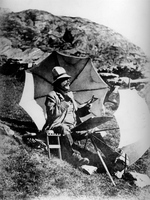
Critical and biographical accounts often emphasize the rapidity and directness of his working method in watercolor by undercutting the encumbrances of this plein-air sketching equipment. Photographs of Sargent working out-of-doors (fig. 15) demonstrate the complex logistics required for him to be settled out in the field before he could realize with speed and immediacy any vision in aquarelles. And as he strategized how to leave the Tyrol in fall 1914 with all his luggage, his plans were repeatedly foiled. Sargent would write acquaintances in Venice to see if foreigners could travel with luggage through Italy to Genoa, where he hoped to catch a boat toward England—“to take my things round a stick would not be easy.”[69] Not even watercolor, what Ely believed to be the most portable of painting media, could allow Sargent to glide freely across continents and frontiers.
According to his traveling companion Adrian Stokes, Sargent was also harassed by the military, despite having prearranged permissions to paint in restricted areas along the Austrian border. On one occasion, soldiers confiscated his paints, easels, and bundles of watercolors for inspection at Innsbruck.[70] Exactly when Sargent’s materials and paintings were returned to him is unclear. But his friend Maldoner was a retired imperial circuit-court judge, and his high standing in the Austrian government at Innsbruck certainly would have helped in resolving the matter.
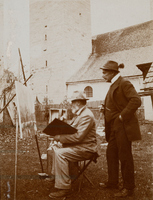
Perhaps while awaiting the return of his papers and equipment, and perhaps using borrowed materials, though certainly while still waiting to learn when and how he might leave Austria with all his belongings in tow, Sargent posed for a photograph in the churchyard at Sankt Lorenzen (fig. 16). Seated before an easel on which rests his Graveyard in the Tyrol (see fig. 4), Sargent stares at the canvas with brush raised, as if this cemetery at Colfuschg lay right before him. Yet the photograph is a work of fiction. The graveyard pictured on his easel is actually over thirty kilometers south of the triangular patch of grass where he sits. Only a few feet in front of his easel, just outside the frame, is the solid stone wall of the Sankt Lorenzen post office. In this photograph, which seems to be the only surviving image of the artist at work in the Tyrol that year, perhaps Sargent hoped he could begin to conceal the trials he had faced. Here, in other words, is that famous artist-traveler freely painting a cemetery sur le motif (on the ground, directly from life), as if nothing had stood between him and his plein-air project. The facts say otherwise. Static and cut off from the world he knew, Sargent sits, awaiting news from loved ones by post, still seeking a means of connection across borders and barriers and continuing to paint those crosses that offered him and others a distinct, material means of dwelling-in-traveling.
As this photograph begins to suggest, Sargent’s Tyrolean religious scenes recognized the connective power of wayside shrines. As much as the forlorn Christ in Tyrolese Crucifix (see fig. 1) summons the forsaken fate of Jesus on the cross, the crucifix’s direct visual engagement with the viewer envisions these religious objects as an alternate means of communication and transport for the traveler—a means of communion and communication on a celestial plane, of the sort that the kneeling woman in The Confession also seeks (see fig. 9). So too might the leaning crosses in Graveyard in the Tyrol (see fig. 14) transmogrify into divine, antennae-like beacons, floating in an ethereal lavender and amber mist, linking mortal life with a sacred sphere.
If a memorial, as art historian Erika Doss argues, provides an archive of public and private affect and a material means to negotiate complex moments, feelings, and events, from trauma and death to anger and fear, Sargent might have looked to the Tyrolese crucifix as a similarly effective and affective way to reckon with his own wartime anxieties.[71] The outbreak of war placed unusual physical and aesthetic constraints on his painting process, forcing the normally freewheeling artist and his mobile methods into a state of arrest and contemplation. Like the memorials at the Tummelplatz, and like the roadside crosses, which map the spatiotemporal dimensions of human life onto sacred space and time, Sargent’s Tyrolean religious scenes were not merely a means of refuge. They were also images of transformative objects, able to rescue viewers from the perils of mortal life and connect them with a realm beyond their own.
In Retrospect
As Sargent reflected upon Graveyard in the Tyrol on the lawn at Sankt Lorenzen that October and, in turn, upon the trials and trauma of his months in Austria, his paintings of wayside shrines and graveyards also would have offered a means to look back on critical moments throughout his career. Indeed, the iconography of the crucifix reaches across his oeuvre and lifetime of travels. These range from an oil sketch of a Spanish crucifix in 1879 to illustrate a series of folk songs translated by poet Alma Strettell to studies of apse mosaics in Sicily, Rome, and Ravenna in the 1890s for his Boston Public Library program, which featured its own prominent crucifix (see fig. 2).[72] The three cruciform memorials arrayed across the mountainside at the center of Graveyard in the Tyrol (see fig. 4) catalogue these various journeys and regional styles, from the simpler, squared wooden bars of the cross at left that recall his Spanish studies to the much more elaborate, trifoliate cross at right that echoes the Byzantine manner of his public library design. If Sargent was reflecting upon subjects of death and suffering during his marooned months in Austria, perhaps he was also dwelling on the course of his life, work, and travels, now forced to reckon with his own seemingly imminent mortality and the mortality of loved ones. What better subject to facilitate such personal and professional reflection than that persistent image across his nomadic career, the crucifix.
A Tyrolese Crucifix (see fig. 11) makes this link between the wayside cross and Sargent’s lifelong artistic project even more explicit. In simple terms, Sargent pictures Alton at the center of the composition, engaged in the act of creation, aligning the work of the sculptor’s hand with Sargent’s own creative act of painting. As such, Sargent’s depictions of religious statuary in the Tyrol perhaps allowed him to consider the relationship of his career as a painter to the enterprise of sculpture.[73] Having finished much of his public library commission by 1914, Sargent must have been reflecting on his own identity as a painter and sculptor throughout his decades of work on the library project. Sargent’s Triumph of Religion murals in fact contain over six hundred relief elements, from tiny pieces of glass to life-size plaster sculpture.[74] The gilding and rich textures produced a unified, monumental message across the mural program and suggest that Sargent saw sculpture as a means toward the grandness of his intellectual and artistic program, capable of moving painting into the colossal scale of architecture. Stranded in a foreign and hostile country, contemplating his peripatetic past, and anxiously awaiting an uncertain future, Sargent must have found in the Tyrolean crucifix an emblem of his continued artistic ambitions and his professional lifetime.
“Getting Away”
“It was not very easy getting away from Austria,” Sargent wrote to his cousin Ralph Curtis with typical understatement.[75] The artist would wait for nearly a month at Sankt Lorenzen for his passport, and, since there was no American consul in nearby Innsbruck he ultimately traveled to Vienna on November 19 to acquire it in person. He took his temporary passport, good for one week, and rode by rail to the Austrian port of Trieste and then by boat to Venice, where he likely consigned his paintings and luggage to Thomas Cook and Sons.[76] Since travel by steamer from Italy directly to England was no longer possible, he traveled by rail from Venice through Milan and Turin, then Geneva and Dijon, until he arrived in Paris at the Gare de Lyon.[77] By November 27, he had arrived at Le Havre on the northern coast of France, where the American consul issued him a new temporary passport. His previous one had expired the day before. Finally, on November 29, Sargent set foot again on English soil when his boat arrived at Portsmouth.
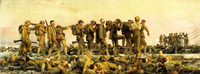
That Sargent returned to England just one week later than he had originally planned at the start of his trip that summer may explain, at least in part, why his Tyrolean sojourn has never been considered consequential in the literature. This was merely a detour, a minor inconvenience, which, as journalists and critics at the time declared, did little to interrupt his work that fall.[78] Certainly Sargent’s—and the art historical discipline’s—ambivalent attitude toward spiritual matters, and the celebrity of later wartime works, like his monumental commission Gassed (fig. 17), have also overshadowed his Tyrolean religious pictures.
Sargent painted Gassed in 1919 after traveling to France and Belgium the previous summer as an official war artist for Britain. During his four months on the Western Front, he wrestled with how to convey the war’s magnitude and its tragedies. Six-and-a-half meters long and over two-and-a-half meters high in its frame, Gassed depicts a line of soldiers, blinded by mustard gas, as they are led to treatment at a British dressing station in Bailleulval, near the French city of Arras. Its epic scale and classical, frieze-like form monumentalize the harrowing magnitude and human toll of the war, yet also its ironies: In the far background, a football match goes on uninterrupted, conveying the sadly routine nature of chemical warfare and its aftermath. Meanwhile, an engulfing mass of blindfolded men blanket the foreground and middle ground, languid and immobile. Painted five years earlier, Sargent’s Tyrolean pictures seem deeply personal, meditative, even intensely private by comparison.[79] But they are no less haunting. Both Gassed and his Tyrolean religious scenes suggest the bewildering and dissevering power of modern war and an attendant longing for deliverance. The men in Gassed fumble and grasp for contact as they traverse the scene, in hopes of healing and redemption.
As meditations on stillness as much as on mobility, and as products of the artist’s relationship with a specific place at a specific moment, these Tyrolean religious paintings challenge the standard account of Sargent, the cosmopolitan artist-nomad, who, in the summation of one critic, was “the product of no local environment.”[80] A probing microhistory of Sargent’s four-month detainment in Austria thus offers a new, more nuanced, yet no less transnational account of this artist-traveler and the place he envisioned for himself in the world.
Such an approach also transforms our understanding of Sargent’s relationship to the subjects he depicted. When commemorating Sargent shortly after his death, his friend Vernon Lee admitted, “the summing up of a would-be biographer [of Sargent] must, I think, be: he painted. To some of us he seemed occasionally to paint to the exclusion of living.”[81] Yet Lee ultimately realized that this common impression was a false one. Instead, after “looking over portfolios and portfolios of his sketches,” she realized “that his life was not merely in painting, but in the more and more intimate understanding and enjoying of the world around him.”[82] We, too, must consider Sargent’s Tyrolese pictures—and particularly their religious content—as intimate, in-the-moment expressions of his local environment, of his anxiety and uncertainty during the advent of war, and of his attendant desire for refuge and regrounding as the cosmopolitan world he knew was now coming undone.
Acknowledgments
This article originated as a chapter in my dissertation at the University of Delaware and is especially indebted to my advisor Wendy Bellion, who firmly believed in its earliest form. Thanks to generous funding from the Smithsonian American Art Museum, where I was the Joshua C. Taylor Fellow in 2017–18, I traveled to Italy to retrace Sargent’s path through the Tyrol. Ingrid Castlunger and Oliver Mersa were especially hospitable during my time there. Funding from the Henry Luce Foundation also supported archival research and writing on Sargent’s Tyrolean sojourn. Finally, I thank the many scholars who have lent their ears, eyes, and expertise to this piece, including: Taylor Acosta, Lacey Baradel, Sarah Cash, Karen Corsano and Daniel Williman, Robert Cozzolino, John Davis, Rachael Z. DeLue, John Fagg, Eleanor Harvey, Stephanie L. Herdrich, Erica Hirshler, Ethan Lasser, Alex Mann, Richard Ormond, Chloe Sharpe, Miriam Stewart, Shannon Vittoria, and Spencer Wigmore.
Notes
[1] Sargent’s Tyrolean religious scenes have received largely superficial commentary in the vast literature on the artist, from early biographies and a century’s worth of survey exhibitions to thematic studies from the last half century, including texts on Sargent and religion. Perhaps their only sustained treatment was in the ninth and final volume of Richard Ormond and Elaine Kilmurray’s catalogue raisonné, John Singer Sargent: The Complete Paintings, which surveyed Sargent’s figures and landscapes painted between 1914 and 1925 and which published several of these pictures for the first time. Ormond is also the only author to have returned to Sargent’s religious pictures from 1914 on several occasions. See especially the object entries in Richard Ormond and Elaine Kilmurray, John Singer Sargent: The Complete Paintings, vol. 9, Figures and Landscapes, 1914–1925 (Yale University Press, 2016), which summarize observations from several of Ormond’s earlier essays, all of which are cited below.
[2] In addition to several pure landscapes in watercolor, like Mountain Scene (1914; Princeton University Art Museum) and Woodsheds, Tyrol (1914; Art Institute of Chicago), Sargent painted two oils that would feature prominently in later exhibitions during his lifetime: In the Austrian Tyrol (1914; private collection) and Trout Stream in the Tyrol (1914; Fine Arts Museums of San Francisco).
[3] Charles Caffin, “Masters of American Paintings” (1902), in Retrospective Exhibition of Important Works of John Singer Sargent, February 23rd to March 22nd, 1924, exh. cat. (New York: Grand Central Art Galleries, 1924), 9; W. F. P., “John Singer Sargent,” The American Society of the French Legion of Honor Magazine (Summer 1954): 167; and Stanley Olson, “On the Question of Sargent’s Nationality,” in John Singer Sargent, ed. Patricia Hills, exh. cat. (Whitney Museum of American Art in association with Harry N. Abrams, 1986), 15.
[4] N. N. [Elizabeth Pennell], “Art: The Royal Academy, London, April 30,” The Nation, May 20, 1915, 279; and Caffin, “Masters of American Paintings,” 9.
[5] “John Singer Sargent,” Museum of Fine Arts Bulletin 14, no. 83 (June 1916): 22.
[6] Ormond and Kilmurray, John Singer Sargent: The Complete Paintings, vol. 9, 84.
[7] Sarah Cash, Elaine Kilmurray, and Richard Ormond, Sargent and Spain, exh. cat. (Yale University Press, 2022); and Stephanie L. Herdrich, ed., Sargent and Paris, exh. cat. (Metropolitan Museum of Art, in association with Yale University Press, 2025).
[8] Hadrien Viraben, “Nomadism: Sargent’s Travel Paintings and ‘Types’ at the Salon,” in Herdrich, Sargent and Paris, 58.
[9] John Davis, “Only in America: Exceptionalism, Nationalism, Provincialism,” in A Companion to American Art, ed. John Davis, Jennifer A. Greenhill, and Jason David LaFountain (Wiley-Blackwell, 2015), 331.
[10] Evan Charteris, John Sargent (Charles Scribner’s Sons, 1927), 4.
[11] Vernon Lee [Violet Paget] to her mother, June 16, 1881, in Vernon Lee’s Letters, ed. Irene Cooper Willis (London: privately printed, 1937), 61.
[12] Charles Merrill Mount, “The Works of John Singer Sargent in Washington,” Records of the Columbia Historical Society 49 (1973/1974): 444.
[13] Mark Simpson, Trafficking Subjects: The Politics of Mobility in Nineteenth-Century America (University of Minnesota Press, 2005), xxv.
[14] Jean-Pierre Criqui, “Like a Rolling Stone: Gabriel Orozco,” Artforum (April 1996): 88.
[15] T. J. Demos, The Migrant Image: The Art and Politics of Documentary During Global Crisis (Duke University Press, 2013), 11, 13.
[16] Donelson F. Hoopes, Sargent Watercolors (Watson-Guptill, 1970), 17.
[17] Thomas A. Fox, “On John Singer Sargent, His Character (Sketch),” unpublished manuscript, p. 3, MSS .L324, folder 24, box 2, David McKibbin Collection on John Singer Sargent, Boston Athenaeum, Boston (hereafter cited as McKibbin Collection).
[18] Once part of Austria-Hungary, the region of the Tyrol that Sargent visited in 1914 is now in northern Italy. In this essay, I refer to all place names with their spellings as of summer and fall 1914, though, for clarity, I will also occasionally include their present-day names parenthetically.
[19] Karl Baedeker, Südbayern: Tyrol und Salzburg, Ober- und Nieder-Österreich, Steiermark, Kärnten und Krain (Verlag von Karl Baedeker, 1906), 433.
[20] Baedeker, Südbayern, 467.
[21] Charles Merrill Mount, John Singer Sargent: A Biography (W. W. Norton, 1955), 321. Passports, as we know them today, were not strictly implemented to regulate travel and control the crossing of borders in Europe until after World War I, with the establishment of the League of Nations, and not fully mandated until the 1940s. As letters from Sargent and his traveling party make clear, however, travel during peacetime before 1914, and travel in contested territories like the Tyrol during wartime that summer, were two very different things.
[22] Olson, “On the Question of Sargent’s Nationality,” 24.
[23] John Singer Sargent to Mrs. Charles Hunter, October 18, 1914, folder 7, box 1, John Singer Sargent letters, Archives of American Art, Smithsonian Institution, Washington, DC (hereafter cited as Sargent letters).
[24] Richard Ormond, “In the Alps,” in Sargent Abroad: Figures and Landscapes, by Warren Adelson, Donna Seldin Janis, Elaine Kilmurray, Richard Ormond, and Elizabeth Oustinoff (Abbeville, 1997), 77.
[25] Charteris, John Sargent, 203–4.
[26] John Singer Sargent to Edward Robinson, December 24, 1914, Purchases – Authorized – Paintings – Sargent “Tyrolese Interior,” 1914–1916, Office of the Secretary Records, Metropolitan Museum of Art Archives, New York.
[27] Richard Ormond, John Singer Sargent: Paintings, Drawings, Watercolors (Phaidon, 1970), 77; and Ormond, “In the Alps,” 77.
[28] Adrian Stokes, “John Singer Sargent, R.A., R.W.S.,” in The Old Water-Colour Society’s Club 1925–1926 Third Annual Volume, ed. Randall Davies (London: The Club, 1926), 59.
[29] Richard Ormond, “Sargent and Watercolor,” in John Singer Sargent Watercolors, ed. Erica E. Hirshler and Teresa A. Carbone, exh. cat. (MFA Publications and Brooklyn Museum, 2012), 15.
[30] Another famous mountain shrine, the Chapel of the Virgin—located on a similarly perilous route through the Sabine Mountains to Subiaco in Italy—was also the subject of great interest among US painters, as in Samuel F. B. Morse’s Chapel of the Virgin at Subiaco from 1830 in the collection of the Worcester Art Museum, Worcester, MA.
[31] Sargent’s father was a member of the American Church at Nice, and his ancestors were Puritans and Moravian Brethren. But, as Promey notes, “his father made a point of allowing the children some latitude and flexibility in religious training.” Sally M. Promey, “‘Triumphant Religion’ in Public Places: John Singer Sargent and the Boston Public Library Murals,” in New Dimensions in American Religious History, ed. Jay P. Dolan and James P. Wind (W. B. Eerdmans, 1993), 7, 11.
[32] John Davis, “Catholic Envy: The Visual Culture of Protestant Desire,” in The Visual Culture of American Religions, ed. David Morgan and Sally M. Promey (University of California Press, 2001), 105–28.
[33] Regarding Sargent’s decision to take on the subject of the Triumph of Religion at Boston, see Sally M. Promey, “Sargent’s Truncated Triumph: Art and Religion at the Boston Public Library, 1890–1925,” The Art Bulletin 79, no. 2 (June 1997): 222–23.
[34] Hoopes, Sargent Watercolors, 76.
[35] The monastery closed in 1785. It has since been converted into the Hotel Schloss Sonnenburg.
[36] Rebecca Hellen and Joyce H. Townsend, “‘The Way in Which He Does It’: The Making of Sargent’s Oils,” in Ormond and Kilmurray, John Singer Sargent: The Complete Paintings, vol. 9, 29–55.
[37] Fox, “On John Singer Sargent, His Character,” 3. See also Thomas A. Fox, “Collections and Recollections (of Sargent),” unpublished manuscript, MSS .L324, p. 16, folder 28, box 2, McKibbin Collection.
[38] John Singer Sargent to Emily Sargent, July 27, 1914, folder 11, box 1, John Singer Sargent Archive, Museum of Fine Arts, Boston (hereafter cited as Sargent Archive). A duplicate and typescript of this letter are found in folder 18, box 1, McKibbin Collection.
[39] In a letter to Ariana Curtis, Sargent asked if he might leave some luggage at their home in Venice, the Palazzo Barbaro, before a ten-day journey into the mountains. John Singer Sargent to Mrs. Daniel Curtis, August 18, 1913, folder 9, box 1, McKibbin Collection.
[40] John Singer Sargent to William Gair Rathbone, September 1913, William Gair Rathbone papers, RP XXV.1.129, University of Liverpool Library, quoted in Ormond and Kilmurray, John Singer Sargent: The Complete Paintings, vol. 9, 81. Sargent reiterated his confidence in having the necessary paperwork in a letter, written the day he arrived in the South Tyrol: “Thanks to my having wired from London yesterday morning to the Generalstadchef here, and from Bologna to Karl [sic] Maldoner to enquire whether my military permission was ready. I have now got it. . . . It is good till the 23rd of Sept . . . but I can have it reissued if necessary.” John Singer Sargent to Emily Sargent, July 25, 1914, McKibbin Collection, folder 18, box 1.
[41] “He [Armstrong] left here when England declared war, but he was arrested & put in a fortress at Trient for ten days and questioned to see if he was a spy. Now he is released but must remain at Trient Hotel Bristol.” John Singer Sargent to Emily Sargent, September 2, 1914, folder 10, box 1, Sargent Archive. A duplicate and typescript of this letter are found in folder 18, box 1, McKibbin Collection.
[42] Jennifer Roberts, Transporting Visions: The Movement of Images in Early America (University of California Press, 2014), 1.
[43] John Singer Sargent to Emily Sargent, August 2, 1914, folder 19, box 1, Sargent Archive. A duplicate and typescript of this letter are found in folder 18, box 1, McKibbin Collection.
[44] John Singer Sargent to Emily Sargent, September 2, 1914, folder 10, box 1, Sargent Archive; and John Singer Sargent to Ariana Curtis, September 25, 1914, folder 9, box 1, McKibbin Collection.
[45] John Singer Sargent to Emily Sargent, November 17, 1914, folder 7, box 1, Sargent Archive. Translated from the original German by the author.
[46] Known today as the Tito Alton house, the house was built in 1481 by the Pecei family. When Sargent visited Colfuschg, five families were living in different parts of the house, including Alton and the Mersa and Pescosta families. See Angela Castlunger, Colfuschg und seine Leute, 4th ed. (Colfosco, Italy: n.p., 2013).
[47] Castlunger, Colfuschg und seine Leute, 39–40.
[48] The crucifix lacks a precise date, though it was originally placed in the Chiesa Colfosco (erected in 1515). When the church was renovated in 1760, the crucifix was removed from the sanctuary and ended up in the possession of the Mersa family, whose descendants still owned it as of my visit with them in May 2018. Castlunger, Colfuschg und seine Leute.
[49] See, for example, John Singer Sargent to Emily Sargent, August 12, 1914, folder 4, box 1, Sargent Archive.
[50] John Singer Sargent to Emily Sargent, August 28, 1914, folder 5, box 1, Sargent Archive; and John Singer Sargent to Emily Sargent, October 7, 1914, folder 13, box 1, Sargent Archive.
[51] John Singer Sargent to Rose-Marie Ormond, September 24, 1914, folder 16, box 1, Sargent Archive.
[52] John Singer Sargent to Ariana Curtis, September 25, 1914, folder 9, box 1, McKibbin Collection.
[53] John Singer Sargent to Emily Sargent, September 2, 1914, folder 10, box 1, Sargent Archive; and John Singer Sargent to Rose-Marie Ormond, September 24, 1914.
[54] “John S. Sargent Lost in Austria,” New-York Tribune, August 22, 1914, 7.
[55] “Sargent Paints amid War,” New York Times, November 3, 1914, 1.
[56] Matthew 27:46 (King James Version).
[57] John Singer Sargent to Mrs. Charles Hunter, October 18, 1914, folder 7, box 1, Sargent letters.
[58] Janet Chen, “Mountain Landscapes,” in Hirshler and Carbone, John Singer Sargent Watercolors, 127.
[59] Paul Grohmann, Verhandlungsschrift des österreichischen Alpenvereins (1864), 49, quoted in Tait Keller, Apostles of the Alps: Mountaineering and Nation Building in Germany and Austria, 1860–1939 (University of North Carolina Press, 2016), 17.
[60] John Singer Sargent to Emily Sargent, September 11, 1914, folder 12, box 1, Sargent Archive.
[61] Art historian Doreen Bolger Burke suggests that Sargent painted this scene in the old monastery turned farmhouse at Sonnenburg near Sankt Lorenzen. Doreen Bolger Burke, American Paintings in the Metropolitan Museum of Art, vol. 3, A Catalogue of Works by Artists Born Between 1846 and 1864 (Princeton University Press, 1980), 270. My firsthand examination of the original farmhouse in May 2018 found no evidence of this. Another large stone farmhouse stands across from Sankt Johann im Spital, and Sargent might have painted a local family there, but the property is privately owned and was inaccessible. See also Ormond and Kilmurray, John Singer Sargent: The Complete Paintings, vol. 9, 114.
[62] “The still and reverent way in which the figures sit, eyes cast downwards, arms on the table in front of them, suggests that a prayer is possibly being said.” Ormond and Kilmurray, John Singer Sargent: The Complete Paintings, vol. 9, 114.
[63] John Singer Sargent to Rose-Marie Ormond, October 14, 1914, folder 18, box 1, Sargent Archive. Translated from the original French by the author.
[64] John Singer Sargent to Mrs. Charles Hunter, January 24, 1905, quoted in Mount, John Singer Sargent, 303.
[65] C. H. Collins Baker, quoted in William Howe Downes, John S. Sargent: His Life and Work (Little, Brown, 1925), 244.
[66] Catherine Beach Ely, “Sargent as a Watercolorist,” Art in America, February 1923, 97–98.
[67] Ormond, John Singer Sargent, 68.
[68] Martin Birnbaum, John Singer Sargent (New York, 1941), 10; and Stanley Olson, John Singer Sargent: His Portrait (Macmillan, 1986), 245–46.
[69] John Singer Sargent to Emily Sargent, October 25, 1914, folder 16, box 1, Sargent Archive.
[70] Stokes, “John Singer Sargent,” 57.
[71] Erika Doss, Memorial Mania: Public Feeling in America (University of Chicago Press, 2012), 13, 71.
[72] See Chloe Sharpe, “Painting Photographed Sculpture: John Singer Sargent’s Spanish Photographs and the Boston Public Library Murals,” Sculpture Journal 26, no. 2 (2017): 175–92.
[73] See Karen A. Sherry, “The Quarry,” in Hirshler and Carbone, John Singer Sargent Watercolors, 169.
[74] Angela Chang, “Relief Elements,” in John Singer Sargent’s Triumph of Religion at the Boston Public Library: Creation and Restoration, ed. Narayan Khandekar, Gianfranco Pocobene, and Kate Smith (Harvard Art Museums, 2009), 68–69.
[75] John Singer Sargent to Ralph Curtis, December 25, 1914, folder 9, box 1, McKibbin Collection.
[76] See a letter from John Singer Sargent to Mrs. Charles Hunter, November 9, 1914, quoted in Mount, John Singer Sargent, 322.
[77] Thanks to Karen Corsano and Daniel Williman for sharing their research and insights on Sargent’s travel itinerary, which they partially based on Bradshaw’s Continental Railway Guide (1913).
[78] “Sargent Paints amid War,” 1.
[79] Stephanie L. Herdrich, “John Singer Sargent and World War I: Public Art and Personal Loss,” Perspectives (blog), the Metropolitan Museum of Art, https://www.metmuseum.org/perspectives/john-singer-sargent-world-war-i.
[80] W. F. P., “John Singer Sargent,” 167.
[81] Vernon Lee, “J. S. S.: In Memoriam,” in Charteris, John Sargent, 254 (emphasis in original).
[82] Lee, “J. S. S.: In Memoriam,” 254–55.