Millet: Life on the Land
Reviewed by Barbara Dayer GallatiBarbara Dayer Gallati
Curator Emerita, Brooklyn Museum
Email the author: barbaragallati[at]googlemail.com
Citation: Barbara Dayer Gallati, exhibition review of Millet: Life on the Land, Nineteenth-Century Art Worldwide 25, no. 1 (Spring 2026), https://doi.org/10.29411/ncaw.2026.25.1.19.
This work is licensed under a Creative Commons Attribution-NonCommercial 4.0 International License  unless otherwise noted.
Your browser will either open the file, download it to a folder, or display a dialog with options.
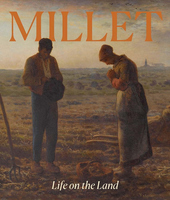
Millet: Life on the Land
The National Gallery, London
August 7–October 19, 2025
Sarah Herring with Simon Kelly,
Millet: Life on the Land.
National Gallery Global Limited, 2025.
64 pp.; 50 color illus.; bibliography; notes.
£16.99
ISBN: 9781857097382
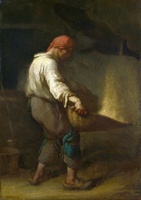
Millet: Life on the Land was a small focus exhibition highlighting a single aspect of the oeuvre of the French artist Jean-François Millet: the imagery of rural French peasantry at work. Inspired by research documenting the National Gallery’s important canvas, The Winnower (fig. 1), the display consisted of only nine oils and six drawings, all of which were from UK collections except for the famed The Angelus (fig. 2), on loan from the Musée d’Orsay, Paris. Curated by Sarah Herring, associate curator at the National Gallery, the show was announced as the first in the UK devoted to Millet in nearly fifty years (without mentioning Robert Herbert’s landmark exhibition of the artist’s work held in 1976 at the Hayward Gallery, London, a show that marked the last time The Angelus had been seen in the UK).[1] In this respect, the exhibition provided the rare opportunity to introduce two generations of viewers to a central thematic facet of Millet’s paintings and drawings as well as the chance to see the often-reproduced (and popularized) Angelus first hand.
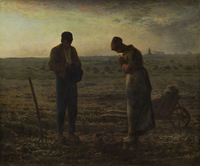
Upon entering the gallery visitors came face-to-face with the celebrated Angelus whose global reputation extends beyond the field of art history into the commercialized realm of coffee mugs, needlepoint kits, and the like.[2] The painting was an obvious draw for the general public and the Gallery’s press release capitalized on its fame by using only a single image of the iconic couple at prayer to promote the show. Going directly to the painting was a predictable outcome; it was, in any case, the most famous work in the room and the cornerstone of the installation. As a result, traffic flow in the gallery was sometimes chaotic because viewers then had to turn to find their way to the introductory didactic panel on the opposite wall.
The introductory panel opened with the declaration that Millet was “the foremost painter of rural life in France during the 19th century” and then provided a necessarily condensed outline of Millet’s life until mid-century: his early years on the prosperous family farm in Grouchy, Normandy; his training with the portrait specialist Paul Dumouchel in Cherbourg and with the history painter Paul Delaroche in Paris; and his relocation from Paris in 1849 to the village of Barbizon near the Forest of Fontainebleau, a move that intensified his interest in portraying the rural French peasantry at work.[3] This was followed by a paragraph describing Millet’s treatment of the human form, concluding that “the dignity with which he depicted his subjects demonstrates an acknowledgment on the part of Millet of the hardship of their lives.” The panel text closed with a statement about Millet’s popularity in Britain and the United States and referred to his influence on such artists as Vincent van Gogh and Salvador Dalí. Extraordinarily baffling was the absence of any reference to the French Revolution of 1848, which saw the July Monarchy replaced by the Second Republic in what was perhaps the century’s most disruptive social and political event in France until the Franco-Prussian War and the Paris Commune. Furthermore, there was no mention of the ongoing debate about Millet’s political leanings or the reception of his art in some quarters which led the republican art critic Pierre Petroz to announce in 1855 that Millet had forged “a new path for art.”[4]
Troubling as well was the seeming reluctance to bring up the thorny issue of the Realist movement in the wake of the 1848 ructions; nowhere did the word realism (or the concept of it) appear in the wall texts, thus ignoring Millet’s place as a pivotal figure in the transition from Romanticism to Realism in the arts.
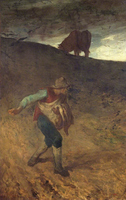
The rationale for the installation was clear-cut inasmuch as it was divided between depictions of men engaged in physically challenging labor and works showing women going about less taxing, but nonetheless vital tasks of rural existence. The two sections were bridged by The Angelus, the only work on view to include a man and a woman. Hanging immediately to the right of the introductory panel was The Sower (fig. 3), the first version of Millet’s more famous iterations of the image, one of which (now in the Museum of Fine Arts, Boston, and reproduced on the wall label) brought him to considerable critical attention when it was shown at the Salon of 1850. Here, unlike the compositions of his later variations, the sower is confined—essentially swallowed up—by the earth itself as if to emphasize the unremitting hardship of life on the land from which there was no escape. The harshness of such existence is registered in the contorted angularity of the body that lends a grotesque, somewhat medieval sensibility to the anatomy. And, as the wall label pointed out, Millet took his inspiration partly from the art of Pieter Brueghel the Elder, who often depicted peasants at work and at leisure. Absent, however, was the acknowledgment of the painting’s “savagery” (discovered by viewers in response to later versions of the image), which stoked the fears of the bourgeoisie or, in other instances, affirmed Millet’s republican values through these “portrait[s] of a class,” as T. J. Clark put it.[5] Then, too, this painting, with its ungainly sower, pitted soil, and murder of crows, provided the ideal (but unrealized) opportunity to cite Van Gogh’s later interpretations of Millet’s art.[6]
Millet’s The Winnower (see fig. 1) held the other end of the same wall. Described in the label as “Millet’s first great depiction of rural labour,” the painting was displayed at the Paris Salon in 1848. What we were not told is that the work was purchased that year by Alexandre Ledru-Rollin, former Minister of the Interior and then member of the Constituent Assembly for Seine, a fact that strongly suggests the work’s Republican content for Ledru-Rollin if not for Millet. What was also missing in connection with The Sower and The Winnower is that both paintings allow for a religious reading. A devout Catholic, Millet was well-versed in biblical texts and occasionally painted religious subjects (e.g., Hagar and Ishmael in the Desert, 1848–49; The Mesdag Collection, The Hague).
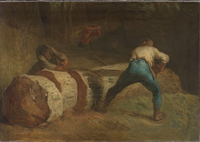
Painted in Paris, well after leaving Cherbourg and before moving to Barbizon, The Winnower depicts a worker from the Paris suburb of Saint-Ouen, an area rapidly undergoing a demographic shift owing to the exodus of laborers from the countryside. Millet instilled the figure with a raw, heroic masculinity and, as Théophile Gautier wrote, “the painting has everything it takes to horrify the bourgeois. . . Nothing could be more rugged, ferocious, bristling, and crude.”[7] Once in Barbizon, Millet transferred this sense of physical power to the woodcutters of the Fontainebleau in such works as The Wood Sawyers (fig. 4), in which two men saw a massive tree trunk, attacking it as if it were something to be conquered. The painting and two drawings that also feature woodcutters, capture the impression of brute force, and register the effects of the repetitive exertions of that force that eventually shaped the muscles, sinews, and joints of their bodies. Millet’s positive portrayal of these gnarled, powerful forms glorified the idea of the French peasant. Yet, as Linda Nochlin observed, “the choice of the image of the peasant to embody contemporary labour was also a function of Realist myth.”[8] Nochlin’s ideas about the changing perception of the French peasant are consonant with those of Alexandre Dumas, who wrote: “Millet’s woodcutter. . . is not the peasant of 1660, but the proletarian of 1859.”[9]
Of course, much can be said about the fluctuating iconographic interpretations attached to Millet’s peasant imagery and it is impossible to squeeze into a seventy-five-word label format anything but the most basic information. However, to exclude even the slightest mention of the sociopolitical environment in France at the time in favor of simply describing clothing, poses, and activity (all of which are readily apparent without direction from a wall label) seems unadvised. Another problematic issue arose here and throughout the exhibition: the Barbizon colony was not identified. Consequently, the mere statement that Millet moved to Barbizon in 1849 does not provide a context for his interactions with other artists who frequented the area nor does it shed light on his stylistic and thematic choices.
The mood within the installation altered when viewers reached The Angelus. Although the subject of hard work was not discarded, the image of the praying couple introduced the important place held by religion for the French peasantry. In this instance the explanatory label did well to describe the narrative circumstances of the painting, although it might have been of interest to viewers to learn that the work had been commissioned by an American, just as it would have been thought-provoking to learn that The Winnower was sold by Ledru-Rollin to the American artist Robert Loftin Newman in 1854.
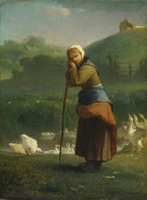
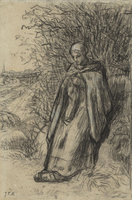
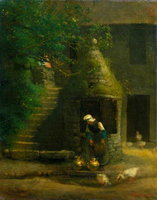
The remainder of the exhibition was dedicated to works depicting the various types of rural labor done by women—milkmaids, goose girls, shepherdesses, and faggot gatherers. For the most part these paintings and drawings were executed on a small scale and portrayed single figures of young women and girls whose daily lives were spent in isolation while they tended their flocks. In contrast to the dynamism of his images of laboring men, Millet’s depictions of farm girls manifest an unexpected charm that elicits feelings of empathy in the viewer as in, for example, The Goose Girl at Gruchy (fig. 5), which possesses an idyllic sensibility bordering on nostalgia despite the girl’s look of exhaustion or boredom. The placement of drawings throughout the installation did much to vary the rhythm of the installation design and offered welcome reminders of Millet’s nuanced touch as a draftsman and an important part of his output over the length of his career (fig. 6). The Gruchy landscape itself was that of Millet’s youth, a place to which he returned in 1853 (when his mother died) and in 1854 for an extended time. The artist’s renewed contact with Gruchy heightened his attentiveness to the seemingly trivial, undramatic episodes attached to working life as shown in The Well at Gruchy (fig. 7), a “portrait,” as it were, of a woman drawing water from the well near the Millet family house.
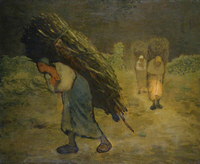
The one exception to the quietude permeating the section featuring women’s work was The Faggot Gatherers (fig. 8), the final painting in the exhibition.[10] Despite its being unfinished, the large painting underscored the grueling nature of the task that was usually carried out by older women, those who were the lowest in the peasant hierarchy because they were generally the poorest and most vulnerable within that segment of the population. The painting fully expresses the physical strain involved in carrying the faggots; Millet’s strategy of pushing the large main figure close to the picture plane accentuates the woman’s struggle and, even in the painting’s present state, the harsh outlines and lack of detail augment the dehumanizing aspects of this existence. Indeed, it was a fitting final note in the exhibition.
But what could viewers take away from this one-gallery presentation of such a narrow slice of Millet’s art? Where was the artist whom Van Gogh considered to be “that essentially modern painter who opened a new horizon to many.”?[11] Granted, the exhibition accomplished its aim, having gathered works whose subject matter corresponded to the single theme of “life on the land.” However, it was empty of meaningful content beyond that. Had the ideas contained in the modest catalogue that accompanied the exhibition been incrementally incorporated into the wall texts, the exhibition could have been more stimulating.
The catalogue, also titled Millet: Life on the Land, includes three short, well-crafted essays covering topics germane to the thrust of the exhibition, each of which is richly illustrated with works in the exhibition and numerous comparative images. The first, “Millet at Work,” by the exhibition’s curator, Sarah Herring, provides a brief survey of the types of work the French peasantry performed, as depicted in the paintings and drawings on view. Information is given regarding the two segments of rural workers (independent agricultural workers who farmed small plots of their own land and landless workers, exemplified by woodcutters, who also hired themselves out for seasonal jobs). Here, Herring delivers the political context engendered by the 1848 revolution and some of the societal shifts that transformed perceptions of those who worked the land. Herring maintains the theme of work with a thoughtful discussion of Millet’s own working practice, focusing especially on the artist’s reliance on memory in tandem with knowledge of the human form derived from direct observation and study. Of interest to Americanists in particular, Herring’s research into Millet’s practice depended in part on the accounts of Will Hicok (or Hicock) Low and Wyatt Eaton, both of whom were dedicated followers of Millet and American members of the Barbizon colony of artists. Perhaps in response to Alfred Sensier’s characterization of Millet as a “peasant painter,” Herring aptly concludes the essay stating that “the question of Millet’s attitude toward his subjects persists: his possible ambivalence, his acceptance of their lot, versus an evident sympathy and a desire, which he criticized in others, not to idealise” (29).[12]
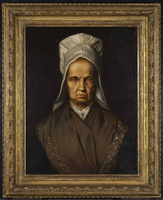
The second essay, “Millet, God, and ‘The Angelus,’” was written by Simon Kelly, Curator of Modern and Contemporary Art at the Saint Louis Art Museum. Of the three essays, Kelly’s is the most innovative because it fixes on what he considers to be the “marginalized” position of religion in Millet studies (31). Kelly puts The Angelus at the heart of his discussion, pointing out that it was in some ways a memory piece, as indicated by Millet’s own words: “The idea for the Angelus [painting] came to be because I remember that my grandmother, hearing the church bell ringing while we were working in the fields, always made us stop work to say the Angelus prayer for the poor dead, very piously and hat in hand” (33). Kelly points to Millet’s unflinching portrait of his grandmother (fig. 9) as expressive of the strict moral values the artist inherited from her (34). From there he traces Millet’s early study of the Bible under the guidance of his great-uncle (a priest) and the extent of his readings, which ranged from Saint Augustine’s Confessions to the writings of Jansenist philosophers, the archbishop François Fénelon, and the bishop Jacques Bénigne Bossuet. The ubiquity of the cult of Mary is also cited, especially in terms of how it surfaced in Millet’s subject matter throughout his career. In the case of The Angelus, Kelly suggests that the light shining on the woman’s abdomen might symbolize fertility, thus aligning her with Marian imagery.
Stating that “there are no specific formal artistic sources for The Angelus,” Kelly asserts that Millet arrived at a new type of composition that required the use of models to achieve (35). One such model was a family servant, Adèle Moschner, who later gained a modicum of attention for having inspired the famous work’s female figure and for her memories regarding the painting’s development. The essay closes with a section highlighting the painting’s reception, a summary of its late nineteenth-century exhibition history, and a condensed assessment of its impact on other artists—primarily on Pierre Henri Puvis de Chavannes and Dalí. Most relevant in this respect was Kelly’s observation that the art dealer Paul Durand-Ruel (himself a devout Catholic) fostered the notion that the painting should be read in religious terms, thereby increasing its marketability (41). Essentially, the piece accomplishes its stated aims, and Kelly is safe in concluding that “The Angelus reminds us that. . . [Millet] was also an artist who consistently explored profound religious themes” (43).
The final essay, “Millet and Britain,” by Herring, offers a synopsis of the artist’s reputation in Britain beginning in 1851, when Breaking Flax (1850–51; Walters Art Museum, Baltimore) was shown in London at the Exhibition of Pictures by Painters of all Nations. She points out, however, that it was not until Durand-Ruel arrived in London in 1870 and his subsequent formation and exhibitions of the Society of French Artists that Millet’s work became known to any significant degree in Britain.[13] Needless to say, the topic of this essay is acutely relevant to the exhibition it accompanies given that it offers a justification (if need be) for the preponderance of British lenders to the exhibition.
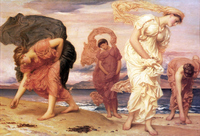
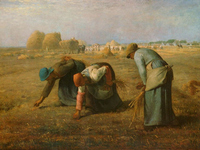
Herring illustrates several British artworks that reveal Millet’s influence, some that were clearly imitative, such as Edgar Barclay’s etching A Shepherd on Salisbury Plain (1894). Another locus of influence noted is far less obvious with iconographic connections establishing Frederic, Lord Leighton’s Greek Girls Picking up Pebbles by the Sea (fig. 10) as a more-or-less distant visual cousin of Millet’s The Gleaners (fig. 11).
The remainder of the essay highlights the activities of major collectors (primarily Scottish) in acquiring Millet’s paintings, drawings, and pastels. Particular attention is given to tracking the provenance of the oil and pastel versions of The Angelus in a relatively lengthy passage so detailed that it might appeal only to a highly specialized audience. Nonetheless, the compilation of facts is extremely valuable as is the catalogue itself. If only some of this information could have been filtered into the exhibition.
Notes
[1] Robert L. Herbert, Jean-François Millet (Arts Council of Great Britain, 1976).
[2] An online search for commercial uses of The Angelus yields all manner of products.
[3] Delaroche’s Execution of Lady Jane Grey (1833) is prominently displayed at the National Gallery in Room 38. A brief reference to it in the introductory wall text might have been of interest to the viewers of the Millet exhibition since Millet studied with him.
[4] Cited in Patricia Mainardi, Art and Politics of the Second Empire: The Universal Exhibitions of 1855 and 1867 (Yale University Press, 1987), 83.
[5] See T. J. Clark, The Absolute Bourgeois: Artists and Politics in France 1848–1851 (New York Graphic Society Ltd, 1973), 82–95 for a discussion of The Sower in which Clark cites several contemporaneous critics who described the Boston version in terms of its “savagery.” For “portrait of a class,” see 80.
[6] By coincidence Van Gogh’s The Sower (1888; Kröller-Müller Museum, Otterlo) was on view at the National Gallery in Radical Harmony: Helene Kröller-Müller’s Neo-Impressionists for much of the time that the Millet exhibition was up. It would have been nice to alert viewers to the fact by placing a small note to that effect next to Millet’s painting.
[7] Quoted in Clark, Absolute Bourgeois, 74.
[8] Linda Nochlin, Realism (1971; repr., Penguin Books, 1976), 115.
[9] Alexandre Dumas, L’Art et les Artistes Contemporaines au Salon de 1859 (Librairie Nouvelle, 1859), 118.
[10] For many years The Faggot Gatherers was believed to have been part of Millet’s Four Seasons series. It is still titled Winter: The Faggot Gatherers in the records of the Amgueddfa Cymru – Museum Wales. However, it is now generally accepted that the painting is not part of the series. See Stephanie Constantin, “Millet’s ‘Four Seasons’ and the Cardiff ‘Faggot Gatherers,’” The Burlington Magazine 139, no. 1129 (April 1997): 257–61.
[11] Vincent van Gogh to Theo van Gogh, Nuenen, ca. December 1883 to November 1885, letter 355, in The Complete Letters of Vincent Van Gogh, vol. 2, 2nd ed. (Thames & Hudson, 1999), 260.
[12] Alfred Sensier, Millet’s friend and biographer, has been credited with creating the myth of Millet’s peasant identity.
[13] See Simon Kelly and Andrew Watson, “The Origins of the Taste for Barbizon Painting in Britain: Paul Durand-Ruel’s Exhibitions of the Society of French Artists,” Nineteenth-Century Art Worldwide 23, no. 2 (August 2024), https://doi.org/10.29411/ncaw.2024.23.2.3.