Introduction
by Herwig TodtsHerwig Todts is honorary curator of the Royal Museum of Fine Arts Antwerp. He was a visiting lecturer at Utrecht University’s Faculty of Humanities from 2009 to 2015. He initiated the Ensor Research Project at the KMSKA in collaboration with the University of Antwerp. He is co-editor of the Brepols series XIX Studies in the Art and Visual Culture of the Nineteenth Century. He obtained his PhD with a thesis entitled “James Ensor, Occasional Modernist” at Ghent University. His publications include works on late nineteenth-century naturalism in Europe, Henri De Braekeleer, James Ensor, and Rik Wouters.
Email the author: herwig.todts3[at]gmail.com
Citation: Herwig Todts, “Introduction,” Nineteenth-Century Art Worldwide 25, no. 2 (Summer 2026), https://doi.org/10.29411/ncaw.2026.25.2.2.
This work is licensed under a Creative Commons Attribution-NonCommercial 4.0 International License  unless otherwise noted.
Your browser will either open the file, download it to a folder, or display a dialog with options.
The interpretation of the enigmatic paintings, drawings, and etchings of the Belgian artist James Ensor (1860–1949) began during his lifetime by critics and art historians in northwestern Europe and continues today by scholars from across the globe. The effort to come to terms with his work has gone through several significant phases, featuring approaches which may be characterized, in chronological order, as psychological, psychoanalytical, and biographical.
Early Art Historical Approaches to Ensor: The Artwork as Psychogram
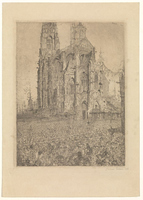
As I have written elsewhere, the German art historian Wilhelm Fraenger’s (1890–1964) analysis of Ensor’s etching The Cathedral (fig. 1), first published in Die graphischen Künste (The graphic arts) in 1926, has led to an understanding of the artist’s work as a reflection of his inner psyche.[1] In his text, Fraenger addressed the three most important components of the print: the crowd pushed forward from the background to the left, qualified by Fraenger as the expression of “a panicked state of consciousness”;[2] the imposing Gothic cathedral, which reminds Fraenger of an etching in which Ensor portrayed himself as a skeleton (Skeletonized Self-Portrait, state II/II, 1889); and the representation of space, dominated by a dynamism that threatens the three-dimensionality of the space itself. (However, when we look at The Cathedral in reverse, as Ensor rendered it on the etching plate, the paradoxical movements disappear and the composition looks balanced.) Fraenger understands Ensor’s etchings as “strange psychograms . . . born out of inner necessity.”[3] “Psychogram” may well be an outdated term, once used to describe a diagram or a map that visualizes a person’s mental state, but the idea that Ensor’s art is an expression of the mental state of the artist as well as an expression of the “mental state” of society inspired many interpreters of Ensor’s art to search for evidence of his state of mind and personality and then use this information to analyze his work.
Family Romances
In 1951, Libby Tannenbaum was arguably the first to point to disguised references to Ensor’s family members and close friends in paintings such as Scandalized Masks (1883; Royal Museums of Fine Arts of Belgium, Brussels), in which the artist’s alcoholic father, according to Tannenbaum, is caught in a bar by his carnival-loving grandmother; or The Intrigue (1890; Royal Museum of Fine Arts, Antwerp), in which his frivolous sister Mitche has snagged her Chinese husband, who would later abandon her with a child.[4] For Francine-Claire Legrand, the many early depictions of women in interiors, such as Afternoon in Ostend (1881; Royal Museum of Fine Arts, Antwerp) and The Bourgeois Salon (1881; Royal Museum of Fine Arts, Antwerp), are not tributes to the peaceful existence of coquettish bourgeois ladies (as claimed by Eugène Demolder [1862–1919], Camille Lemonnier [1844–1913], and other contemporaries of the artist) but are evocations of an oppressive world permeated by a malaise comparable to that in the dramas of Henrik Ibsen (1828–1906) or August Strindberg (1849–1912).[5] Tannenbaum and Legrand have been joined by Diane Lesko, Gert Schiff, and Lydia Schoonbaert, who found in Ensor’s family romances explanations for certain situations and motifs in his work.[6] In their wake followed various attempts by psychoanalysts to uncover the fundamental oedipal causes of Ensor’s self-expression.[7]
Ensor’s Personal Mythology
Much of the Ensor scholarship of the last few decades, consisting mostly of monographic studies and exhibition catalogues, has focused on analyzing the artist’s work in biographical terms, always with the understanding that these terms do not necessarily reflect the verifiable biographical data for the artist’s life but rather his personal mythology. Few artists have curated their own images, created their own reputations, and constructed their own myths as deliberately and strategically as Ensor. Much recent research on him and his works has attempted to dispel this mythology, including the fallacies so deliberately spread by the artist himself and the art historians, critics, dealers, and descendants who have managed and contributed to his legacy.
In the special issue of the French art magazine La plume in 1898 devoted to Ensor, the contributions of the artist’s friends and acquaintances provided many relevant anecdotes for interpreting his work in biographical terms. However, we now know from Ensor’s letters to some of those writers that he not only attempted to control the evaluation and interpretation of his work but also strategically shaped his own reputation. Ensor knew the power of the media. As he wrote to Louis Delattre, a contributor to the left-wing cultural magazine Le coq rouge (The red rooster), “Episodes from the life of an artist, etc., are of great interest, and who knows, perhaps later biographers will consult your study to find accurate information.”[8] Thus, Ensor convinced Delattre to transform his fantasy about “l’enfant aux masques” (the child with the masks) into an authentic story from Ensor’s childhood, in which the eccentric nightclub owner Kate Moustache would also play a role.[9] Ensor’s verbal manipulation of Delattre should certainly encourage all researchers to subject the latter’s biography of the artist to critical fact-checking: Can we attach any credence to the famous story that Ensor himself shared with the world about the black bird that flew through an open window into his bedroom to threaten him when he was still in his cradle? Are his other childhood memories reliable and relevant? Contrary to what has been claimed to date, the young Ensor did not work with packaging material from his family’s souvenir shop but rather on standard, prepared, study cardboard (with a pink back), like that used by many plein-air painters. No, he did not travel to London in 1886 to study the work of Joseph Mallord William Turner (1775–1851);[10] in fact, he regretted not being able to accompany his friends there, and he may not have traveled to London for the first time until October 1892. No, The Entry of Christ into Brussels in 1889 (1888; J. Paul Getty Museum, Los Angeles) was not rejected in 1889 by his colleagues in the avant-garde group Les XX (The Twenty; 1884–93) since he did not complete the large painting until July 1890,[11] and the painting was not mounted on a stretcher until 1918. No, Ensor did not offer the entire contents of his studio for sale for 8,500 francs in 1893; there is only a brief mention of such an option in a completely different context in 1898.[12] Noémie Goldman also taught us that Ensor was one of the most successful members of Les XX.[13] No, The Intrigue cannot possibly be a disguised representation of the love affair of his sister Mitche with Alfred John (Hee-Tseu) Taen, whom she married on August 31, 1891.[14] And did Ensor really live at odds with Mitche, his mother, and his Aunt Mimi (who, in 1887, helped him mount the sketchbook pages containing fragments of The Temptation of Saint Anthony onto a large canvas so the work would be ready in time for an exhibition in February 1888)?[15] Or, did the burden of family worries only begin to weigh on him after his father’s death in 1887? Did he really have to wait until his father died to become fascinated by skeletons, like so many artists of the late nineteenth century?
New Perspectives: “Les Manières les Plus Opposées” (The Most Contrasting Manners)
In 1894, Ensor candidly confessed to the Belgian art critic Pol De Mont (1857–1931) why it was so difficult to recognize a common thread in the artist’s output of barely fourteen years: “I went on to study carefully the most contrasting approaches in order to continue finally my exploration into light.”[16] Thereafter, the diversity of his artistic endeavors continued to grow and to astound enthusiasts and connoisseurs of his work.
With the exhibition In Your Wildest Dreams: Ensor Beyond Impressionism, we sought to place Ensor’s highly varied artistic output in a new, international context, with particular attention given to the all-too-often-neglected importance of French Impressionism for his production.[17] We also set him and his work in a broader social and cultural framework by including the activities of the Brussels zwanseurs (jokers) and other aspects of late nineteenth-century popular culture. These new perspectives are further explored in the contributions to this special issue of Nineteenth-Century Art Worldwide. The articles it contains originated as presentations at the symposium “Celebrating James Ensor’s Modernity: New Perspectives” held at the University of Antwerp, in collaboration with the Royal Museum of Fine Arts in Antwerp, on December 9–11, 2024. Together they provide a substantial addition to the essays in the exhibition’s catalogue. Some of the authors are seasoned Ensor scholars, while others are researchers whose specific fields of study provide them with unique outlooks on Ensor’s work and its sociohistorical context. Their articles are arranged in three groups. The first two essays highlight key aspects of Ensor’s work: light (Susan M. Canning) and humor (Lotte Kremer). The second group homes in on individual works: The Temptation of Saint Anthony (1887; Art Institute of Chicago) (H. R. Blakeley); Comical Repast (Feast of the Lean) (ca. 1917–18; The Metropolitan Museum of Art) (Alison Hokanson); and Portrait of the Artist’s Niece in Chinese Costume (1899; Art Institute of Chicago) (Petra ten-Doesschate Chu). The third group deals with the international expansion of Ensor’s reputation both during and after his lifetime, with a special focus on Italy (Patricia Berman), Germany (Lieven Van Den Abeele), and the United States (Sabine Taevernier).
Throughout his life, Ensor emphasized the importance of light for the development and expression of his “vision.” He belongs to the group of Western European artists who believed in plein air as a concept and a practice. However, after being introduced to light effects in French Impressionism and Neoimpressionism, art movements then so popular in Belgium, he sought out alternative ways of dealing with light. This fundamental aspect of Ensor’s art is explored by Canning in her contribution “James Ensor’s Vision and the Social Narrative of Light.”
A common thread running through Ensor’s work is humor in all forms. While his numerous self-portraits naturally have played an important role in the analysis of his works as psychograms, Kremer offers a new perspective on the humorous intent in some of his self-portraits by moving beyond biographical interpretations to reveal how he used comedy to express his relationships with friends, art critics, the art historical canon, and his national heritage. For Blakeley, a delirious aesthetics derived from Friedrich Nietzsche’s (1844–1900) concept of frenzy serves as the starting point for an analysis of Ensor’s creative process in The Temptation of Saint Anthony) (1887; Art Institute of Chicago) and other works depicting intoxication.
Like so many artists at the turn of the century, Ensor was inspired by art from the Far East, especially from Japan and China, as seen in works that he frequently referred to as “Chinoiseries.” His beloved niece Alexandrine was the daughter of his sister Mitche and her husband Alfred John Taen, the son of a British mother and a Chinese father. Ensor often called her “la petite Chinoise” (the little Chinese girl). Unraveling her Chinese heritage and identifying the Chinese objects around her, Chu explores Ensor’s portrait of his young niece as an example of modernist chinoiserie.
In a handful of works, such as The Lively and the Radiant: The Entry of Christ into Jerusalem (1885; Museum of Fine Arts, Ghent) from the series The Halos of Christ or The Sensibilities of Light, and The Vile Vivisectors (1925; private collection), Ensor clearly denounced the sensitive social issues of his day. To properly assess his artistic activism, systematic research is needed. During the occupation of Belgium by the troops of the German Empire during the course of World War I, Ensor painted The Comical Repast (Feast of the Lean), the meaning of which is interpreted in the article by Hokanson, a curator of European paintings at the Metropolitan Museum of Art.
A desire for artistic innovation lay at the heart of the Italian critic Vittorio Pica’s (1864–1930) love for the art of Aubrey Beardsley (1872–98), Edvard Munch (1863–1944), and Ensor. Patricia Berman explains how Pica, closely involved in the organization of the Venice Biennale, may have encouraged Munch’s interest in Ensor’s work. She also discusses Pica’s hope that Munch and Ensor would help Italian art lovers and artists appreciate the possibilities of early modernism.
It is well known that the innovative aspects of Ensor’s art were first fully appreciated by German artists and critics. Drawing on his research done in preparation for the exhibition Erich Heckel in Flanders, Van den Abeele presents surprising new material regarding the German artist Heckel’s (1883–1970) friendship and support of Ensor both during and after World War I.
Ensor and his early critics succeeded in creating a powerful myth of the artist as a misunderstood genius who stubbornly continued to create his unsaleable works. Gradually, archival material is emerging that demonstrates just how inaccurate that image is. Ensor was the best-selling artist among the members of Les XX; he arguably was long considered an artist’s artist, but after 1900 he became, without a doubt, the national hero of modern art in Belgium. How his art reached collectors in Belgium, Europe, and the United States after 1920 is described by Taevernier.
With the exhibition In Your Wildest Dreams: Ensor Beyond Impressionism; the symposium “Celebrating James Ensor’s Modernity: New Perspectives”; and this special issue, “Reconsidering James Ensor’s Work in National and Transnational Contexts,” we aim to encourage future research that critically evaluates Ensor’s “contrasting approaches” with minds open to countless possibilities.
Notes
All translations are by the author.
[1] Herwig Todts, “La Plume, Wilhelm Fraenger en Ensors bedrieglijk-modernistische spiegelbeelden,” in De verbeelder verbeeldt: Boekillustratie en beeldende kunst, ed. Anna Cecilia Koldeweij and Jos Koldeweij (Uitgeverij Van Tilt, 2017), 206–12; and Wilhelm Fraenger, Von Bosch bis Beckmann: Ausgewählte Schriften (Dumont Buchverlag, 1985), 283–309. Fraenger’s text titled “James Ensor: Die Kathedrale” was originally published in Die graphischen Künste 49 (1926): 81–98. It has been reprinted several times since.
[2] “einem panische Bewusstseinszustand.” Fraenger, Von Bosch bis Beckmann, 291.
[3] “Fremdartigen Psychogrammen . . . mit inner Notwendigkeit.” Fraenger, Von Bosch bis Beckmann, 285.
[4] Libby Tannenbaum, ed., James Ensor, exh. cat. (New York: Museum of Modern Art, 1951), 50–51, 83–84.
[5] Francine-Claire Legrand, James Ensor, précurseur de l’art moderne (La Renaissance du Livre, 1999), 68.
[6] Diane Lesko, James Ensor: The Creative Years (Princeton University Press, 1985), 8–9; Gert Schiff, “Ensor the Exorcist,” in Art, the Ape of Nature: Studies in Honor of H. W. Janson, ed. Moshe Barasch and Lucy Freeman Sandler (Abrams, 1981), 730–31; and Lydia Schoonbaert, “L’après-midi à Ostend,” in James Ensor, exh. cat. (Paris-Musées, 1990), 123–24.
[7] For a comprehensive analysis of the reception and critical study of Ensor and his art from 1881 to 2005, see Herwig Todts, James Ensor, Occasional Modernist: Ensor’s Artistic and Social Ideas and the Interpretation of His Art (Brepols, 2018), 39–110.
[8] “Les épisodes de la vie d’un artiste etc. intéressent beaucoup et qui sait que plus tard les biographes consulteront peut-être votre étude pour y trouver des renseignements qui seront exacts.” James Ensor to Louis Delattre, August 30, 1898, quoted in Herwig Todts, “‘Les Épisodes de la Vie d’un Artiste Intéressent Beaucoup’: The Power of the Media and How to Use It; An Exploration of Ensor’s Self-Mediatization,” in The Mediatization of the Artist, ed. Rachel Esner and Sandra Kister (Palgrave Macmillan, 2018), 59.
[9] Louis Delattre, “L’enfance d’Ensor, peintre de masques,” in James Ensor, peintre et graveur, (Paris, 1899), 95.
[10] Ensor wrote to his friends the Rousseaus in the summer of 1886: “J’ai écrit à la grand’mère lui annonçant notre voyage à Londres. Elle a répondu que si nous allions à Londres, nous ne pouvions manquer d’aller lui faire une visite.” (I wrote to Grandma to tell her about our trip to London. She replied that if we were going to London, we should not forget to visit her.) James Ensor to Ernest and Mariette Rousseau, June 9, 1886, in “Avec le noble crayon”: Lettres de James Ensor à la famille Rousseau, ed. Jean-Philippe Huys and Xavier Tricot (Peter Lang; Musées Royaux des Beaux-Arts de Belgique, 2021), 218. He wrote to the Rousseaus again a few weeks later, on August 16: “Pourrons-nous nous revoir à votre retour d’Angleterre?” (Can we see each other after your return from England?) Huys and Tricot, “Avec le noble crayon,” 220. He also told the Rousseaus, in a letter written sometime after August 16 and before August 28: “J’ai écrit à la Grand’mère qu’elle peut parler à Mme Rousseau (la dame du recteur de l’Université) comme à moi-même. Je vous prie, Madame, de ne pas trop chercher. Si c’est trop loin, n’y allez pas, vous pouvez vous fatiguer. Déjà nous sommes impatients et attendrons votre retour et toutes les nouvelles. Amusez-vous!” (I wrote to Grandmother that she can speak to Mrs. Rousseau [the university president’s wife] just as she would to me. Please, Madam, don’t overdo it. If it’s too far, don’t go, you might tire yourself out. We’re already eager and will be waiting for your return and all the news. Have a good time!) Huys and Tricot, “Avec le noble crayon,” 221.
[11] “J’ai fini le grand tableau et suis fatigué.” (I’ve finished the big painting and I’m tired.) James Ensor to Mariette Rousseau-Hannon, July 1890, in Huys and Tricot, “Avec le noble crayon,” 284.
[12] Ensor wrote to Ernest Rousseau’s son that year: “Je m’empresse de vous faire savoir que le bon Gérardy . . . me fait des propositions picturales brillantes et scintillantes. Il est question d’acheter toutes mes peintures à des conditions très acceptables.” (I hasten to inform you that the good Gérardy . . . is making me brilliant and inspiring artistic proposals. The idea is to purchase all my paintings on very favorable terms.) James Ensor to Ernest Rousseau Jr., May 2, 1898, in Huys and Tricot, “Avec le noble crayon,” 463.
[13] Noémie Goldman, “Ensor and Les XX’s Public: A Shared Visual Culture,” in James Ensor: Wildest Dreams; Beyond Impressionism, ed. Herwig Todts, exh. cat. (Hannibal; KMSKA, 2024), 54–63.
[14] Xavier Tricot, James Ensor: Leven en werk; Oeuvrecatalogus van de schilderijen (Mercatorfonds, 2009), 110. Tricot may be one of the last to list Mitche’s marriage to Alfred John (Hee-Tseu) Taen as having taken place in 1892 rather than 1891. “Le mariage se fera vers onze heures dans la maison du consul anglais. Il n’y aura pas de cérémonie religieuse catholique. Mitche et son mari devront simplement se rendre à l’église anglaise pour complaire à la mère du futur. Le tout ne durera pas cinq minutes.” (The wedding will take place around 11:00 a.m. at the British consul’s residence. There will be no Catholic religious ceremony. Mitche and her husband will simply have to go to the Anglican church to please the groom’s mother. The whole thing won’t last five minutes.) James Ensor to Mariette Rousseau-Hannon, August 21, 1891, in Huys and Tricot, “Avec le noble crayon,” 308, 610.
[15] “La tante Mimi colle parfaitement dessins. Résultat magnifique! La Tentation sera probablement entièrement collée pour demain.” (Aunt Mimi is doing a great job gluing the drawings. The result is magnificent! The Temptation will probably be completely glued together by tomorrow.) James Ensor to Mariette Rousseau-Hannon, January 28, 1888, in Huys and Tricot, “Avec le noble crayon,” 242.
[16] “J’ai étudié alors attentivement les manières les plus opposes pour continuer finalement mes recherches de la lumière.” James Ensor to Pol De Mont, probably very late 1894, in James Ensor: Lettres, ed. Xavier Tricot (Éditions Labor, 1999), 132.
[17] The exhibition was reviewed by Lotte Kremer in Nineteenth-Century Art Worldwide’s Autumn 2025 issue, https://doi.org/10.29411/ncaw.2025.24.3.23.