Volume 25, Issue 2 | Summer 2026

Special Issue
Reconsidering James Ensor’s Work in National and Transnational ContextsHerwig Todts and Cathérine Verleysen, Editors
James Ensor’s Vision and the Social Narrative of Light
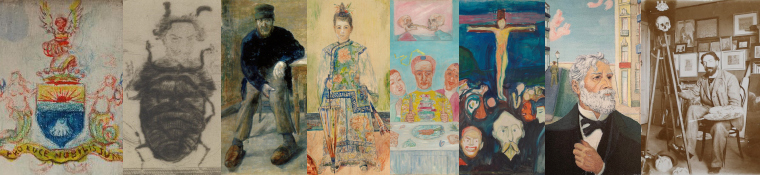
As James Ensor declared in his motto Pro luce nobilis sum (“I am noble for the light”), light serves as a central component of his artistic practice, articulating his vision of the perceptual, subjective, and expressive dimensions of the modern world. His early landscapes and interior scenes fuse the atmospheric light of observation with the social circumstances of modern Belgian life, while other works adopt a more subjective and symbolic approach. In this ongoing exchange between experience and environment, Ensor invests light with both the materiality of observation and the evocative, associative possibilities of allegory.
DOI
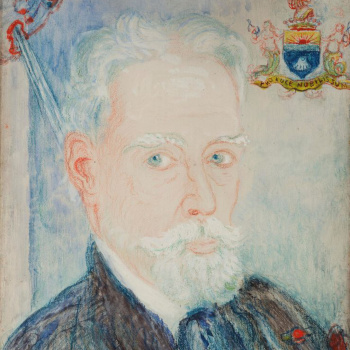
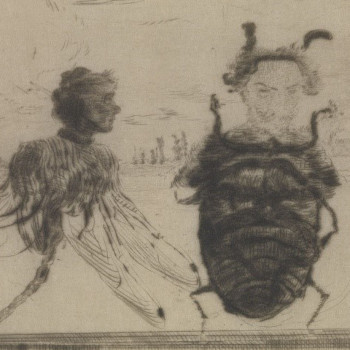
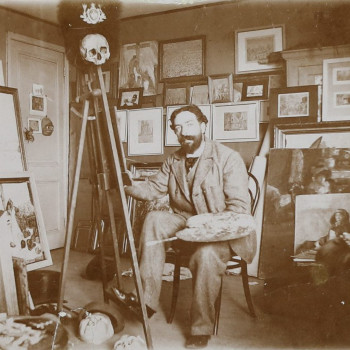
Positioning the Artist: James Ensor’s Use of Humor in His Self-Portraits
James Ensor’s self-portraiture can be seen through the lens of humor as a strategy of artistic self-positioning. Moving beyond the biographical, this article approaches these works as sites where identity and meaning are constructed interactively. Situating Ensor within the fin-de-siècle Belgian cultural biotope, the article analyzes how comedy mediates his relationships with friends, art critics, the art historical canon, and national heritage. In doing so, it provides new and nuanced insights into both Ensor’s active self-fashioning and the layered meanings of the artworks themselves.
DOI
The Delirious Aesthetics of James Ensor
James Ensor often used delirium as both subject matter and creative catalyst in his work. Drawing on Friedrich Nietzsche’s concept of Rausch—frenzy or intoxication—this article examines how Ensor engaged with turn-of-the-century anxieties about alcoholism, madness, and social degeneration. Close visual analysis elucidates how Ensor’s delirious aesthetics visualize altered states of consciousness that transgress everyday perception. Rather than merely depicting the perils of intoxication, Ensor positioned delirium as essential to artistic vision, claiming the transformative power of hallucinatory experience in materializing inner visions into external forms.
DOI
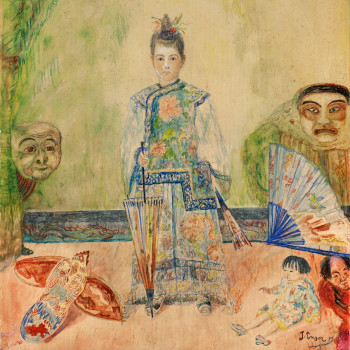
James Ensor’s La petite Chinoise: A Case Study of Modernist Chinoiserie
In this article, James Ensor’s Portrait of the Artist’s Niece in Chinese Costume is presented as an example of modernist chinoiserie. The illusory, whimsical character of traditional chinoiserie is mostly absent in this work, which evokes a new and ambiguous notion of China hovering between the outworn fantasy of “Cathay” and the new, realistic view of China as a failed empire, its culture hollowed out by modernization resulting from external imperialist pressures.
DOI
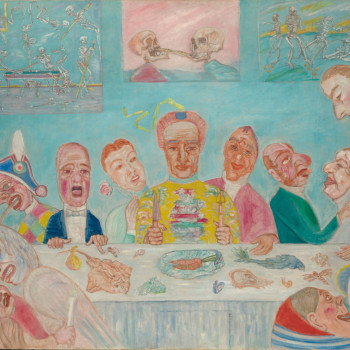
The Feasts of War: Ensor’s Comical Repast (Feast of the Lean)
James Ensor’s painting Comical Repast (Feast of the Lean), ca. 1917–18, bears a close relation to his experience of World War I in German-occupied Ostend. The painting has long been described as Ensor’s response to the war, but the nuances of its meaning remain elusive. The article tightly connects Comical Repast with Ensor’s imprisonment in 1915 for creating an artwork about the Belgian food crisis, and his emancipation thanks to a German curator and artists serving in Ostend. An exploration of Ensor’s wartime milieu and visual culture yields an understanding of Comical Repast as a tribute to his earlier allegory of wartime hunger and the exploits that surrounded it.
DOI
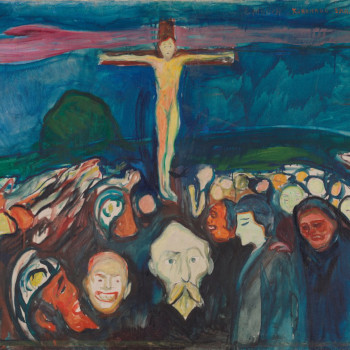
Connecting James Ensor and Edvard Munch: Vittorio Pica as a Champion of Two Eccentric Artists
The Neapolitan critic Vittorio Pica identified Edvard Munch and James Ensor as some of the “exceptional artists” whose work he marshaled as provocations to the contemporary Italian art community. In early 1900, Pica corresponded with Munch, informing him of his plan to publish the artist’s work along with that of Jan Toorop, Aubrey Beardsley, and Ensor, prompting or perhaps rekindling the Norwegian’s interest in the Belgian artist. Using Munch’s painting Golgotha (1900) as a point of departure, the article examines Pica’s role in championing Munch and Ensor.
DOI
James Ensor’s Friendship with Erich Heckel During World War I
When the German artist Erich Heckel was stationed in Flanders as a Red Cross orderly during World War I, he met James Ensor in Ostend. Over a period of approximately three years, from 1915 to 1918, he developed a friendship with the artist, becoming his greatest supporter and confidant. Heckel’s 150 unpublished letters to his friend Walter Kaesbach and the collector Gustav Schiefler give unique insight into Heckel’s emotional and material support of Ensor and his work during a difficult time in his life.
DOI
Ensor’s Agents and Collectors After 1920 and the Liquidation of His Estate upon His Death
Though James Ensor actively marketed his own work during his early years, he increasingly relied on intermediaries after 1920. He turned first to close friends and later to a few international dealers who helped to promote his work in Europe and establish a market for it in the United States. At the time of his death in 1949, only a limited number of works—though several important ones—remained in his studio. They were rapidly sold to Belgian collectors by his niece and sole heir.
DOI