Ensor’s Agents and Collectors After 1920 and the Liquidation of His Estate upon His Death
by Sabine TaevernierSabine Taevernier is an art historian and independent curator of late nineteenth- and early twentieth-century Belgian art. She has organized collaborative exhibitions with museums in Ghent, Antwerp, Milan, Frankfurt, and Rotterdam dedicated to Symbolism, Expressionism, and James Ensor. After ten years as an expert in the Impressionist and Modern Department at Christie’s, she established herself as an independent expert and curator. As a specialist on James Ensor, she created the Ensor Advisory Committee in 2002. Between 2014 and 2024 she was part of the Committee on Movable Cultural Heritage in Flanders, Belgium, and is now a board member of the King Baudouin Foundation (KBF), Belgium.
Email the author: sabine[at]sabinetaevernier.be
Citation: Sabine Taevernier, “Ensor’s Agents and Collectors After 1920 and the Liquidation of His Estate upon His Death,” Nineteenth-Century Art Worldwide 25, no. 2 (Summer 2026), https://doi.org/10.29411/ncaw.2026.25.2.10.
This work is licensed under a Creative Commons Attribution-NonCommercial 4.0 International License  unless otherwise noted.
Your browser will either open the file, download it to a folder, or display a dialog with options.
Introduction
Though James Ensor produced very few paintings (just over 850) during his sixty-six-year career, he managed to make a living from his art and to provide for his family.[1] He sold many works during his lifetime, and only a limited number remained in his studio after his death, suggesting that, contrary to the legend of the misunderstood artist that he zealously perpetuated,[2] he was a successful artist, at least from the point of view of sales.[3] Though quite a bit is known about the circulation of Ensor’s early work, little research has been done on the dispersal of his works after 1920, when he increasingly began to rely on intermediaries. This article explores the various national and international agents who mediated these sales and analyzes the role of his descendant in the management of his estate.
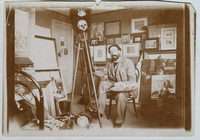
At the outset of his career, Ensor was an active advocate for his own work, engaging in exhibitions and cultivating relationships with critics. He strategically positioned himself within influential social and artistic networks to facilitate the circulation of his work. Between 1878 and 1910, he resided for extended periods in Brussels—then a major cultural metropolis—and subsequently in Antwerp and Liège. In addition, he traveled to Amsterdam, London, and Paris, to both expand his artistic knowledge and establish his reputation.[4] The artist thus played an active and deliberate role in the promotion and sale of his own production (fig. 1).
From the 1920s onward, as his mobility diminished, Ensor became increasingly reliant on intermediaries for the sale of his works. Initially, this role was assumed by members of his inner circle, specifically a small number of women who supported him, and subsequently by international dealers. Following his death in 1949, his heir proceeded with a rapid liquidation of the estate, a process facilitated in large part by a small number of dedicated Ensor collectors.
Augusta Boogaerts
Throughout his career, Ensor surrounded himself with women who were captivated by his sharp, unpredictable wit and charmed by his blend of shyness and eccentric humor.[5] His mental fragility stimulated them to take care of the artist and his oeuvre. Mariette Hannon Rousseau (1850–1926), his patron and confidante between 1880 and 1906; Emma Lambotte (1876–1963), his collector and promoter between 1904 and the end of 1920; and finally, Augusta Boogaerts (1870–1951), his lifelong companion, were all deeply involved in his creative life. Mariette in Brussels and Emma in Antwerp were married, independent, educated, and passionate women who lived in a socially stimulating environment. They not only inspired and supported the artist but also deeply engaged with his work and a network of interested collectors. While both, thanks to important correspondences with Ensor, have been extensively studied and considered as the artist’s soulmates,[6] Augusta, whose relationship with Ensor was closer and more intimate, has remained somewhat in the shadows.
The daughter of an Ostend hotel owner, Augusta was a saleswoman in the Ensor family’s souvenir shop, where she met Ensor in 1888. Though he was ten years younger than she, they became romantically involved. They never married but they remained lifelong close friends. Ensor called her La Sirène (The Siren). According to Paul Haesaerts (1901–74), a Belgian critic and friend of Ensor, Augusta was “caustic, an alert observer, with an enigmatic smile forever on her lips, she was capable of unexpectedly sharp repartee, which made her attractive, but also a bit awesome.”[7]
After World War I, Augusta settled in Brussels and became Ensor’s agent. More than sixty paintings and numerous drawings and etchings passed through her hands. Not only did she take charge of selling his works but she also supervised the printing of his etchings and encouraged him to paint to the point where he found her tyrannical.[8] In many ways, she assumed the role played by Mariette Hannon Rousseau early in his career, after his relations with the latter became more distant after 1906.
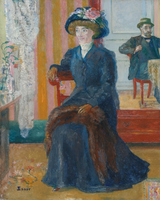
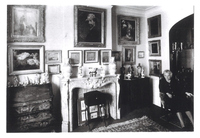
Around 1905, Ensor painted a double portrait of Augusta and himself (fig. 2). She looks a bit old-fashioned as she gazes into the mirror of a wardrobe, in which Ensor, dressed as a gentleman, is reflected, looking kindly at his friend. Later, after Ensor’s mother had died, she appeared more often in his paintings, notably in Les fumeurs drolatiques (The Comical Smokers) (1920; destroyed by fire in 2021), in which she appears alongside the Belgian painter Willem Paerels (1878–1962). Ensor died in 1949, at age eighty-nine, Augusta followed in 1951. Looking at the works in Augusta’s estate at the time of her death, of the sixty-four paintings, and perhaps more, that passed through her hands, thirty belonged to her, including the famous Autoportrait au chapeau fleuri (Self-Portrait with Flowered Hat) (1883; Mu.ZEE, Ostend). Add to this the magnificent drawings on panel prominently displayed above the mantelpiece in her interior (fig. 3) and the complete collection of etchings, and one realizes that Augusta was not only Ensor’s agent but also one of his most distinguished collectors during his later years.[9]
The Production and Sale of Replicas
During his mature period and driven by his popularity, Ensor’s works were acquired by several private collectors who often were less knowledgeable and less discerning in their choices.
They included Camille Snauwaert (1878–1938), a Brussels-based collector about whom very little is known; Athanase de Broqueville (1868–1949), the brother of Belgian Prime Minister Charles de Broqueville (1860–1940); and Jean Florent Van Missiel (1857–?), the owner and director of the Théâtre de la Renaissance in Liège. Although all three collectors owned numerous works by Ensor (Snauwaert and Van Missiel owned almost twenty works; De Broqueville owned over thirty), Van Missiel’s collection is worth discussing in some detail. Probably between 1908 and 1910, he amassed almost twenty paintings by the artist, two of which are now in the collection of the Royal Museum of Fine Arts in Antwerp.[10] The remaining eighteen include thirteen second versions of Ensor’s early works, all of which were created between 1906 and 1910. Ensor’s catalogue raisonné by Xavier Tricot lists a total of twelve second versions of major subjects.[11] That means that Van Missiel acquired nearly half of the artist’s replicas, representing Ensor’s major themes, right after they were created.[12] In a letter to Van Missiel dated March 27, 1910, Ensor refers to two replicas that he had sold to the collector. Each required a month of work and was sold at a fixed price. He further adds: “As for additional replicas, . . . I cannot make any commitment, being mindful of my artistic reputation. . . . I have never wished to accept commissions or enter into binding agreements.”[13] This letter makes clear that the replicas had been commissioned by Van Missiel and that Ensor was reluctant to deliver them, though he went at least halfway to please Van Missiel, as he was clearly willing and able to acquire a significant number of his works.
In response to an inquiry by Leo Van Puyvelde (1882–1965) in a letter of June 1939 regarding the works belonging to Van Missiel, Ensor stated that he did not remember their dates, suggesting a tendency on the part of the artist to distance himself from these copies. Van Missiel’s collection was short-lived: On March 30, 1918, seventeen of the works by Ensor that he owned were sold at the Galerie Royale in Brussels.[14]
Sam Salz
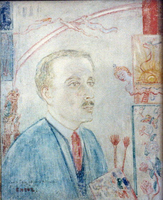
In addition to Boogaerts, the artist-dealer Sam Salz (1894–1981) was an important agent for Ensor after 1920. Salz was born into a Jewish family in Galicia (then part of Austria-Hungary, later Poland) (fig. 4). He studied painting and history before moving to Cologne in 1920. At the age of thirty-two, he relocated to Brussels, where he lived between 1926 and 1930. In 1926 he befriended Ensor and became his principal dealer. Given the central role of Paris and London in the international art market at the time, he traveled regularly between the two capitals from 1930 until 1936. Forced to flee Nazism, he settled in New York in 1936. A cosmopolitan figure, he worked with artists such as Chaim Soutine (1893–1943), Marc Chagall (1887–1985), Hans Arp (1886–1966), Edouard Vuillard (1868–1940), and Pierre Bonnard (1867–1947) and was personally acquainted with Pablo Picasso (1881–1973) and Henri Matisse (1869–1954). His clientele in the United States included Alfred Barnes (1887–1974), Paul Mellon (1907–99), Henry Ford (1863–1947), and David Rockefeller (1915–2017), among many others.
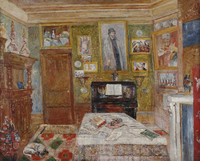
Among the 856 paintings documented in Ensor’s catalogue raisonné, more than eighty were acquired directly from the artist by Salz. In addition, he successfully placed numerous oil paintings—already held in private collections—into major institutions and prominent collections. Among them is L’assassinat (The Murder) (1890; Columbus Museum of Art, Columbus), a major work that is little known in Europe because it was sold by Marcel Mabille (1902–86) to Sam Salz in the 1960s. Salz placed it in the collection of Howard and Babette Sirak, who offered it to the Columbus Museum of Art in Ohio, along with their entire collection. Another important work, Ma chambre préférée (My Favorite Room) (fig. 5) was sold by Salz to the Jewish diamond dealer Oscar Fischer (1875–1947), who at the time lived in Antwerp. This very personal painting remained in Ensor’s studio until after his retrospective of 1929 in Brussels and was probably acquired by Salz and sold to Fischer during the 1930s, before the latter retired to Tel Aviv in 1937. Ten years after his death, it was donated to the Tel Aviv Museum of Art by his children Oscar and Shulamit Fischer.
Salz had a wide network in Belgium, where he was very close to Walter Schwarzenberg (1885–1964), owner of the gallery Le Centaure.[15] He also had many contacts in Germany, including the dealer Curt Valentin (1902–54).[16] Valentin had begun his career working for the dealer Alfred Flechtheim in Berlin, where he also worked closely with Daniel-Henry Kahnweiler (1884–1979), the promoter of cubist art in France. When Nuremberg Race Laws imposed by the Nazi government made it impossible for Valentin, a Jew, to remain employed, he moved to New York.
As an employee of Karl Buchholz in Berlin, Valentin was sent to New York in 1936, where he opened the Buchholz Gallery in September 1937. He played a key role in the dissemination of so-called degenerate art (Ensor’s oeuvre was considered degenerate). Ensor’s painting La mort et les masques (Death and Masks) (1897), which belonged to the Mannheim Museum, was bought by the Musée d’Art Moderne (today La Boverie) in Liège at the auction Paintings and Sculptures by Modern Masters from German Museums, held in Lucerne in June 1939.[17] At the same sale, Valentin bid on behalf of Alfred H. Barr Jr. (1902–81) on works looted by the Nazis, with funds donated by the trustees of the Museum of Modern Art in New York.[18] After the United States declared war on Germany in December 1941, Valentin was considered an enemy alien and was forced to sever ties to Buchholz. From then the gallery was renamed the Curt Valentin Gallery.
Valentin was also the owner of Ensor’s “Liber Veritatis,” a fifty-nine-page sketchbook produced around 1929 containing small sketches of works still in the artist’s collection at the time. He almost certainly had bought it from Salz. He owned it in 1951 when it was exhibited at the Museum of Modern Art (MoMA) in New York. In 1955, after his death, it was sold by his widow to the Art Institute of Chicago.
“Perhaps the Boldest Living Artist”
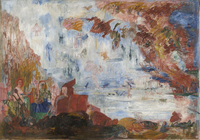
When Barr, the founding director of the Museum of Modern Art in New York, decided in 1940 to buy Ensor’s Les tribulations de saint Antoine (The Tribulations of Saint Anthony) of 1887 (fig. 6) from German dealer Karl Nierendorf (1889–1947), he was aware of the artist’s worldwide reputation. He once wrote that, by the time Ensor painted Les tribulations de saint Antoine, he was “perhaps the boldest living painter.”[19] The painting was originally bought from Ensor by the collector-dealer Herbert von Garvens-Garvensburg (1883–1953),[20] who visited the artist in 1910 and played an important role in promoting the artist in Germany. He wrote the first German monograph on the artist, James Ensor, Maler, Radierer, Komponist, in 1913, a publication which was very successful. Seeking refuge from the rising political tensions in Germany during the 1930s, he relocated to the Danish island of Bornholm, bringing with him part of his art collection, including the magnificent Les tribulations de saint Antoine sold to MoMA through Nierendorf.
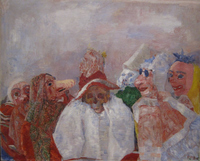
In 1951, the Museum of Modern Art in New York, in collaboration with the museums of Boston, Cleveland, and St. Louis, organized the first major retrospective of Ensor in the United States. During the retrospective, the museum decided to acquire one of Ensor’s masterpieces, Les masques raillant la mort (Masks Mocking Death) (fig. 7), whose first owners had been none other than Ernest Rousseau and Mariette Hannon Rousseau. The work then belonged to the Belgian couturier Gustave Van Geluwe (1883–1962), who lent it for this retrospective before selling it to them.
The Legacy for Alexandrine
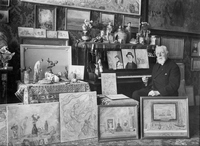
Around fifty paintings remained in Ensor’s studio after his death. The well-known photograph by Maurice Antony of Ensor in his blue salon (fig. 8), made four years before he stopped producing new paintings, presents the artist surrounded by a diverse array of objects that nourished his artistic imagination, alongside recent works and works from earlier periods. Above Ensor’s head appears the large drawing La tentation de saint Antoine (The Temptation of Saint Anthony) (1887; Art Institute of Chicago), which had already been sold to the Antwerp collector Maurice Speth (1887–1938) on the condition that it would remain in Ensor’s home until his death. Above the piano hangs the large composition Set for the Ballet La Gamme d’Amour, Second Act (1912; private collection).
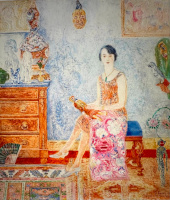
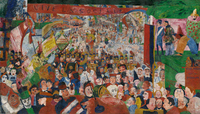
Upon Ensor’s death in 1949 at the age of eighty-nine, his niece Alexandrine (Alex) Daveluy, born Mariette Alexandrine Jeanne Taen-Hee-Tseu (1893–1966) (fig. 9), the daughter of his sister Mitche (1861–1945), inherited the artist’s substantial estate. This included Ensor’s masterpiece L’entrée du Christ à Bruxelles en 1889 (The Entry of Christ into Brussels in 1889) (fig. 10) as well as La dame à l’éventail (Lady with a Fan) (1880; Royal Museum of Fine Arts, Antwerp); Portrait de Willy Finch (Portrait of Willy Finch) (1882; Mu.ZEE, Ostend); La vierge consolatrice (The Consoling Virgin) (1892; Museum of Fine Arts, Ghent); Au conservatoire (At the Conservatory) (1893; Musée d’Orsay, Paris); and both sets for the ballet La gamme d’amour (The Gamut of Love) (1912; private collections), to name the most important works, accompanied by a treasure trove of drawings and engravings. It appears that Alex administered the estate for the sake of expediency and financial gain rather than for optimizing Ensor’s artistic legacy.[21] Given the artist’s reputation in Belgium and abroad, it is unsurprising that she succeeded in selling nearly the entire estate—including all the sketchbooks and substantial portions of the graphic work—within the span of just two years. When the Royal Museum of Fine Arts in Antwerp mounted the first posthumous exhibition of Ensor in June 1951, none of the works on display originated from the estate, and the artist’s sole descendant was not even mentioned. When, in the same year, the Museum of Modern Art in New York opened a second retrospective on September 25, Alex Daveluy is listed among the lenders. She lent one work, Ma mère morte (My Dead Mother) (1915; private collection), which she had kept for herself. All the major buyers of works in Ensor’s estate were Belgian: Gustave Nellens (1907–71), Mabille, and Jozef Janssen (1913–96); all were able to buy impressive collections of significant works from the estate. Alex’s eagerness to dispose of the estate is clear from the fact that, even when the Museum of Modern Art and the Royal Museums of Fine Arts of Belgium in Brussels showed interest in acquiring L’entrée du Christ à Bruxelles en 1889 (see fig. 10) in 1950, Alex accepted an offer for the painting by Nellens, the owner of the Knokke Casino. For a short time, Nellens hung the painting in the casino, where, in the 1950s, Knokke’s golden youth danced in front of the monumental work. Nellens loaned L’entrée in 1951 to the Royal Museum of Fine Arts in Antwerp and the Museum of Modern Art in New York.[22] After the painting’s return, the Royal Museums of Fine Arts of Belgium in Brussels exhibited it from July 1952 until March 1953 in a room exclusively dedicated to Ensor.[23] In 1954, Nellens, who needed money to improve his casino and develop Knokke, decided to sell the painting. The buyer, Louis Franck Jr., the son of one of the patrons of the Antwerp society Kunst van Heden (Art of Today), lent the painting to the museum in Antwerp. The long-term loan ended in 1983, and the J. Paul Getty Museum acquired the work in 1987.
In addition to Nellens, Mabille, the owner of the decoration shop Van der Borght in Brussels, was a great Ensor lover. He met the artist in the 1940s and regularly bought his works. Mabille had a special liking for Ensor’s series of small, extremely refined panel paintings with satirical subjects, all dating from the early 1890s. Some were bought before Ensor’s death, but most were acquired from his estate. The Ensor retrospective held at the Royal Museum of Fine Arts in Antwerp in 1951 included twenty-five works from the Mabille collection.
Finally, Janssen, a successful businessman and art lover, was keenly aware of the investment potential of Ensor’s work. When the opportunity arose to acquire the artist’s archives and sketchbooks, he did not hesitate to purchase them all, together with La dame à l’éventail, Portrait de Willy Finch, and the second set for the ballet La gamme d’amour. He subsequently donated part of the archives to the Royal Museum of Fine Arts in Antwerp but sold Ensor’s sketchbooks containing some 450 drawings in 1952 and La dame à l’éventail in 1955. He then sold Portrait de Willy Finch to the Ostend Museum in 1956.
Conclusion
After 1920, Ensor increasingly relied on others to help promote and sell his work. He turned first to intimates, including Boogaerts, and then to European dealers, such as Salz and Valentin, who sold his work in Europe and helped to establish a market for it in the United States. Following Ensor’s death in 1949, his niece took advantage of the artist’s already established reputation and network of collectors and quickly sold almost the entire estate. While major sales during the artist’s lifetime and the early dissolution of the estate have complicated provenance research, as much of the work became widely scattered, the international dispersion of Ensor’s work helped spread his reputation across Europe—especially in Germany and the Netherlands—and to the United States.
Notes
All translations are mine unless otherwise indicated.
[1] “Ci-inclus, vous trouvez la somme de deux cents francs pour les besoins du ménage, car je suppose que les sommes que je vous ai envoyé sont à peu près épuisées.” (Enclosed, you will find the sum of two hundred francs for household needs, as I assume that the amounts I previously sent you are more or less spent.) James Ensor to Marie Ensor, July 4, 1923, A4991, James Ensor Archives, Royal Museum of Fine Arts, Antwerp.
[2] The image of Ensor as a “suffering artist” is best understood as a coproduced myth—initiated by Ensor himself and then perpetuated by critics such as Eugène Demolder and Émile Verhaeren and even recently by experts such as Ensor specialist Xavier Tricot in James Ensor: Kroniek van zijn leven, 1860–1949 (Mercatorfonds, 2020), 90–91.
[3] Noémie Goldman, “Ensor et le public des XX: Une culture visuelle partagée,” in James Ensor: Rêves fantasques, ed. Herwig Todts, exh. cat. (Royal Museum of Fine Arts, Antwerp, 2024), 55–63; and Sabine Taevernier, “Ensor, ce révolutionnaire qui désirait être incompris et admiré,” in Todts, James Ensor, 254–56.
[4] Thanks to Eugène Demolder and the artist Armand Rassenfosse, Ensor held his first one-man show in Paris at the Salon des Cent from December 15, 1898, to January 15, 1899.
[5] For example, Blanche Rousseau described Ensor in 1899 as “this tall, thin, pale, black figure . . . his agile eyes . . . shy, provoking, soft, sarcastic and shifting.” Quoted in Susan M. Canning, The Social Context of James Ensor’s Art Practice: “Vive la Sociale!” (Bloomsbury, 2024), 18.
[6] Jean-Philippe Huys and Xavier Tricot, “Avec le noble crayon”: Lettres de James Ensor à la famille Rousseau (Royal Museums of Fine Arts Belgium; Peter Lang, 2021).
[7] “D’esprit caustique, l’œil en éveil, un sourire continuel et énigmatique aux lèvres, elle a des réparties inattendues et vives, qui la rendent attachante mais parfois aussi redoutable.” Paul Haesaerts, James Ensor (Elsevier, 1957), 137.
[8] Francine Claire Legrand, Ensor, la mort et le charme: Un autre Ensor (Fonds Mercator, 1993), 46–47.
[9] Augusta presumably received some works in return for her services and purchased others independently. Conversely, she also produced complete series of prints, which remained in her possession until her death; the extent to which Ensor was aware of this practice remains uncertain.
[10] Masque et crustacés (Mask and Crustaceans) (1891; Royal Museum of Fine Arts, Antwerp) and Squelettes se disputant un pendu (Skeletons Fighting Over a Hanging Man) (1891; Royal Museum of Fine Arts, Antwerp).
[11] Xavier Tricot, James Ensor: Catalogue raisonné des peintures (Fonds Mercator, 2009), 430, 431, 438, 444–45, 447, 451–57.
[12] La mangeuse d’huîtres (The Oyster Eater) (1908; private collection); Le salon bourgeois (The Bourgeois Salon) (1911; Clemens Sels Museum, Neuss); L’intrigue (The Intrigue) (1911; Minneapolis Institute of Arts, Minneapolis); Le chou (The Cabbage) (ca. 1910; currently unlocated); and Le lampiste (The Lamp-Lighter) (1910; private collection).
[13] “Quant à d’autres répliques . . . je ne puis prendre aucun engagement car soucieux de bonne rénommée. . . . Je n’ai jamais voulu accepter des commandes ou prendre des engagements.” James Ensor to Jean Florent Van Missiel, March 27, 1910, A3978, James Ensor Archives, Royal Museum of Fine Arts, Antwerp.
[14] Collection Van Missiel, auction cat. (Brussels: Galerie Royale [Breckpot], 1918), lots 1–17.
[15] Jean Milo, Vie et survie du Centaure (Éditions Nationales d’Art, 1980), 177–85.
[16] Curt Valentin, Biographical note, 2022, Museum of Modern Art Archives, Museum of Modern Art, New York, https://www.moma.org/.
[17] Ines Rotermund-Reynard, ed., “The Auction in Lucerne, June 1939,” trans. Jonathan Michaelson, December 8, 2023, Répertoire des acteurs du marché de l’art en France sous l’occupation, 1940–1945 (RAMA), AGORHA, https://agorha.inha.fr/.
[18] “On Friday, June 30, 1939, the auction was held at the Grand National Hotel in Lucerne. . . . There were many well-known figures amongst the buyers: Alfred Frankfurter . . . advisor to the American collector Maurice Wertheim, Pierre Matisse, the art dealer and son of the painter, Joseph von Sternberg, a Hollywood filmmaker and collector, Joseph Pulitzer Jr., editor and publisher . . . , Curt Valentin, a German Jewish art dealer who fled Nazi Germany in order to open a branch of the Buchholz Gallery in New York.” Rotermund-Reynard, “The Auction in Lucerne, June 1939.”
[19] “Ensor lived all his very long life at Ostend, but by 1887, when he painted the Fireworks and the Tribulation of St. Anthony, in The Museum of Modern Art, he was already familiar with the work of the Paris vanguard through the annual exhibitions of the Brussels Societe des XX, then the most progressive art society in the world. . . . He was half-English and probably knew J. M. W. Turner’s luminous reds and yellows and bold handling of light. As in the St. Anthony, he uses any color he pleases, and his brush swirls and slashes over his canvas with a freedom which matches the audacity of his imagination. Indeed, at this moment in his career, Ensor was possibly the boldest living painter.” Quoted in Alfred H. Barr Jr., Masters of Modern Art (New York: Museum of Modern Art, 1954), 34.
[20] Thomas Röske, “Herbert von Garvens, ein radikaler Individualist,” in Revonnah: Kunst der Avantgarde in Hannover; 1912–1933, ed. Karin Orchard (Snoeck, 2017), 76–82.
[21] After Ensor’s death, Paul Van der Perre (1895–1970), a bookseller and specialist in prints, was one of the principal distributors of Ensor’s prints. In this capacity, he frequently visited Alexandrine Daveluy. His widow accompanied him on these visits and explained to me that Alexandrine, who struggled with alcohol, was constantly short of money.
[22] Walther Vanbeselaere, ed., James Ensor Retrospectieve, exh. cat. (Royal Museum of Fine Arts, Antwerp, 1951), 72; and Libby Tannenbaum, ed., James Ensor, exh. cat. (New York: Museum of Modern Art, 1951), 27.
[23] Davy Depelchin and Sarah Van Ooteghem, “Ensor in het museum van frustratie naar consecratie,” in James Ensor & Brussels, ed. Daan Van Heesch, exh. cat. (Brussels: Royal Library, 2024), 55.