Connecting James Ensor and Edvard Munch: Vittorio Pica as a Champion of Two Eccentric Artists
by Patricia G. BermanPatricia G. Berman is the Theodora L. and Stanley H. Feldberg Professor of Art at Wellesley College and was a professor II at the University of Oslo. Her books include James Ensor: Christ’s Entry into Brussels in 1889 (2002 and 2013); A Fine Regard: Essays in Honor of Kirk Varnedoe, (2008); and In Another Light: Danish Painting in the Nineteenth Century (2007 and 2013). Exhibitions she has organized, and their accompanying catalogues, include Edvard Munch and Women: Image and Myth (1997); Luminous Modernism: A Centennial Retrospective of the Scandinavian Art Exhibition of 1912 (2011); Munch|Warhol, and the Multiple Print (2013); The Experimental Self: Edvard Munch’s Photography (2017–21); Munch: Inner Fire (2024–25); and The Scandinavian Home: Art and Identity, 1880–1920 (2025).
Email the author: pberman[at]wellesley.edu
Citation: Patricia G. Berman, “Connecting James Ensor and Edvard Munch: Vittorio Pica as a Champion of Two Eccentric Artists,” Nineteenth-Century Art Worldwide 25, no. 2 (Summer 2026), https://doi.org/10.29411/ncaw.2026.25.2.8.
This work is licensed under a Creative Commons Attribution-NonCommercial 4.0 International License  unless otherwise noted.
Your browser will either open the file, download it to a folder, or display a dialog with options.
It was winter 1900. Edvard Munch (1863–1944) had journeyed to Italy to recuperate from a severe lung infection, but with his health deteriorating, he abruptly broke off the trip to seek treatment first in Switzerland and then at Kornhaug Sanatorium in the mountains of central Norway. There, he had an exchange of letters with Italian critic Vittorio Pica (1864–1930), who he had arranged to meet in Florence. Pica had previously borrowed some of Munch’s prints and, while at the sanatorium, Munch received Pica’s request to retain the works longer than anticipated, because he was preparing an article about Munch, Jan Toorop (1858–1928), Aubrey Vincent Beardsley (1872–98), and James Ensor (1860–1949), soon to appear in print. In addition, Pica enclosed a page from his recent volume on the Third International Art Exhibition in Venice, ending the note with the words “je m’occupe de vous” (I’ll take care of you).[1] In that exchange, Pica may have kindled, or rekindled, Munch’s possible interest in Ensor’s work by associating the two artists. Moreover, the epistolary exchange, and the article that Pica planned and finally published, represents the curious case of Munch and Ensor enlisted into a campaign to modernize Italian art.
Munch’s Ensor
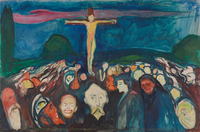
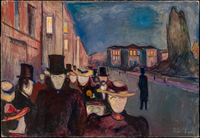
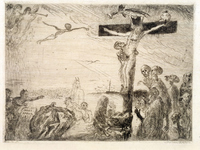
Munch spent the autumn and winter of 1899–1900 at Kornhaug Sanatorium, initially ill, unable to work or sleep, and seemingly devoid of inspiration.[2] Kornhaug, a fashionable private hospital noted for its innovative management of respiratory ailments, provided the artist with rest and relative isolation.[3] It is possible that in Munch’s fragile state, Pica’s letter offered the artist a direction for reengaging with his art. In the midst of Munch’s malaise, he produced Golgotha (fig. 1). The painting, which pictures a chaotic crowd surrounding and surging toward a crucified figure, was perhaps in part the result of Munch’s recent visits to the Vatican and other sites where he viewed Italian sacred art.[4] The image is at once a grotesque parody of the crucifixion and an embodiment of suffering.[5] An undulating, red cloud hovers about the mass of figures and above it are the inscribed words “Kornhaug Sanatorium 1900,” mapping the historical site of Jesus’s crucifixion onto the landscape of modern medical care. Incorporating the mask-like faces from his painting Evening on Karl Johan (fig. 2), Munch stretched and exaggerated the bodies and faces of his figures in a manner long described as reminiscent of Ensor’s work.[6] Munch’s scenes of crowds in works such as Evening on Karl Johan, and his inclusion of masks and skeletons in some of his deathbed scenes, have suggested parallels or intersections with Ensor’s motifs.[7] Likewise, Arne Eggum and Frank Høifødt, among others, have assumed that Munch’s figure of Jesus in Golgotha is a veiled self-portrait, not unlike that in Ensor’s etching Christ Tormented by Demons (fig. 3).[8] Munch’s vitiated figure on the cross, in proximity to the familiar toponym, is the consummate symbol of artistic agonism, much like Ensor’s motif.[9]
Munch had many opportunities to view Ensor’s works, which were perhaps first brought to the former’s attention via reproduction or promotion by two Norwegians who exhibited with Les XX (The Twenty) in the 1880s: Ole Fredrik Kolstø (1860–1945) in 1886, and Munch’s mentor, Frits Thaulow (1847–1906), in 1887. Munch traveled through Antwerp and Brussels in 1885, 1890, and 1891, each time missing the exhibitions of Les XX.[10] In August 1896, a postcard sent to Munch in Paris from a contact in Brussels alerted the artist that William Picard, the son of Edmond Picard (1836–1924), who directed the gallery La Maison de l’Art (The House of Art), wished to organize a two-week exhibition with Constantin Meunier (1831–1905), starting in February 1897.[11] In January 1897, the German critic and Munch’s supporter Julius Meier-Graefe (1867–1935) reported from Brussels that La Libre Esthétique (The Free Aesthetic) was willing to exhibit ten of Munch’s works at its annual exhibition and also mentioned the Maison de l’Art’s plan for an exhibition, now pushed to June.[12] That winter, Munch wrote to his aunt that he expected to exhibit lithographs and etchings in Brussels,[13] later realizing that plan by exhibiting seven prints at La Libre Esthétique, facilitated by Meier-Graefe and Edmond Picard, where Ensor also exhibited half a dozen works.[14] In August, Munch wrote to his aunt, describing the fresh sea air in Knokke (about thirty kilometers from Ostend), where he had summered.[15] Given Meier-Graefe’s intervention, and the numerous sites where Munch could have encountered Ensor’s work in Belgium or elsewhere, the artist’s knowledge of the latter’s art seems likely. Direct evidence for the matter, however, is absent.
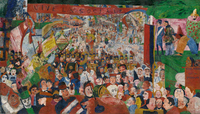
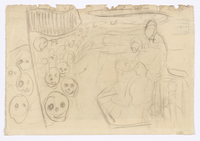
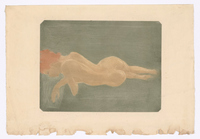
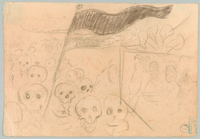
Superseding such a record of near misses and speculative sightings are two motifs that the artist drew onto the backs of two of his prints. Based on these, Arne Eggum speculated that Munch may have had direct access to Ensor’s The Entry of Christ into Brussels in 1889 (fig. 4) and used it as a basis for Golgotha.[16] One drawing (fig. 5) was rendered on the reverse side of Reclining Nude (fig. 6), and a similar one (fig. 7) was sketched on the verso of Standing Nude (1896; Munch Museum, Oslo), mezzotints dating to 1896, likely printed in Paris by Alfred Porcaboeuf.[17] Each drawing features a parade of skull-like heads that winds across the page into the background. Curling above both crowd scenes are banners, and in the foreground of each are reviewing stands that seem to recapitulate the structure on the right-hand side of The Entry of Christ into Brussels.[18] While the similarity of these elements to Ensor’s canvas is compelling, it is also possible that Munch saw Ensor’s intaglio version of the motif from 1898 and adapted some of the details. The undated drawings can be dated to sometime after 1896. They might have been rendered in Paris around the time that the mezzotints were created or at a later date, as Munch retained the impressions in his collection.
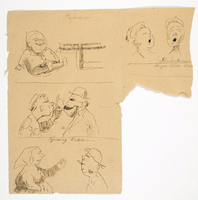
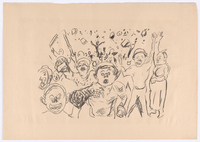
When Pica mentioned Ensor to Munch in his letter of 1900, he may have reminded Munch of an earlier chance encounter between the two artists or rekindled in him a deeper recognition of Ensor and his work. Munch rarely mentioned contemporary artists, so it is not surprising that Ensor’s name does not appear in his correspondence or literary notes. Munch, who shared with Ensor an appreciation for theater, spectacle, and other forms of popular culture, would have been particularly receptive to the carnivalesque dimensions of Ensor’s work. From Munch’s juvenile drawings, in which he parodied doctors, teachers, and people on the street (fig. 8) to a series of drawings and lithographs from circa 1938 recalling an attack from a neighbor’s dog (fig. 9), the artist enlisted caricature mirroring that found in popular publications. Both the childish transformation of humans into hybrids and the reimagining of crowds into freakish masses were part of that thread of parodic and ironic image making that ran throughout his career.
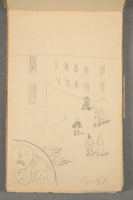
Munch’s parade motifs may also have carried memories from festivals he witnessed, such as the carnival in Nice. In 1891, while residing in Paris, Munch traveled to Nice to restore his ailing health and seek saleable motifs.[19] In the period when efforts were underway to rename the Mediterranean coast of France the Côte d’Azur, the centuries-old carnival in Nice was reanimated by the Comité des Fêtes (Committee of Festivals), filling the city with floats, marching bands, and all manner of costumes and eccentricities.[20] Postcards and broadsides, published by the committee, pictured the events in all of their dizzying plenitude to advertise the city in the off-season. Munch’s visit, while the streets swelled with masked revelers, must have been an appealing source of inspiration. He reported to his aunt Karen from Nice that “carnival is taking place these days . . . the streets are continually full of masked crowds—extremely lively—During the day, I have to walk the streets with a mask and a coat – because people bombard one another with sweets. . . . Now I am immediately heading out to paint.”[21] A small pencil sketch, dated February 10, 1891, pictures a marching band approaching an intersection where a few costumed onlookers and an embracing couple stand (fig. 10). At the bottom left, the artist uncharacteristically drew a small cluster of masks vignetted to mirror the promotional materials published to attract winter tourists.
In 1900, with Pica as a conversant, it is likely that Munch, newly returned from viewing sacred art in Italy and perhaps prompted by Pica’s intent to ally his work with Ensor’s, invested in Golgotha something of the Belgian artist’s sensibility. With Pica as an interlocutor, Ensor entered or reentered Munch’s imaginary at this critical moment in his career.
The Facilitator
Pica was one of the first critics to focus on Munch and Ensor as a critical pairing. One of the most prominent and prolific critics in Italy following Italy’s Risorgimento, Pica invested in his books, articles, and curatorial projects a sustained effort to internationalize contemporary Italian art. His plan to publish an article on Munch, Toorop, Beardsley, and Ensor was part of the larger project to shape a local vanguard. With a wide circle throughout Europe—including Meier-Graefe in Paris and Berlin and Eugène Demolder (1862–1919) in Brussels—and through travel and networking, Pica was a critically important international connector.[22] He sought renewal in the art world, suggesting that the embrace of international modernist practices was directly tied to cosmopolitanism in the broader cultural and political spheres. In a still-consolidating country whose intellectual leadership was divided between a vision tied to past greatness on the one hand and a future-oriented promotion of European progressivism on the other,[23] Pica made important contributions to the period’s cultural production as both aesthetic- and nation-building enterprises.
Pica’s influential articles were rife with jibes at Italian political and critical positions that embraced nostalgia as embodying an old-fashioned “pernicious dream” of Italian primacy.[24] In his introduction to an article on the “L’Espositione di Bianco e Nero a Roma” (The Black and White Exhibition in Rome) (1902), he challenged the Italian audience to embrace modern art: “[I]n a country like ours, so lukewarm toward any manifestation that does not take the form of a theatrical spectacle,” he disparagingly wrote, progressive international art exhibitions could foster elevated taste and the embrace of international art and progressive values.[25] With a particular penchant for Dutch, Belgian, and Nordic art, Pica singled out Ensor and Munch for their eccentricities. Ensor, he wrote, was “the most original of all for a strange mixture of the fantastic, the macabre, and the grotesque,”[26] and in his commentary about Munch, he asked, “cosa si può ideare di piu bizzaramente fantasioso” (what could be more bizarrely imaginative) than this artist’s works?[27]
Pica’s most influential platform was the periodical Emporium, an important agent of cultural transfer, for which he served as editor from 1900 until his death in 1930 and in which he introduced his “exceptional artists and writers,” figures whose works he used to break through what he saw as Italian provincialism.[28] He had been among the first foreign critics to write about Ensor, inviting him to participate in several editions of the Venice Biennale.[29] When Ensor planned his solo exhibition at the Salon des Cent (Salon of the One Hundred) in Paris in 1898, Pica was among the writers whom the artist invited to contribute to the special monographic issue of the journal La plume, which was organized, in part, by Ensor to promote his own work.[30] Pica, however, did not in the end deliver.[31]
Like his promotion of Belgian artists, Pica was interested in raising the profiles of artists from Scandinavia. The Norwegian painter Thaulow, who exhibited frequently at the Venice Biennale, served as one of the members of its selection committee in 1899. Through his connections with Thaulow and with Meier-Graefe, Munch seems to have garnered Pica’s interest after exhibiting close to four dozen graphic works at Siegfried Bing’s (1838–1905) Maison de l’Art Nouveau (House of New Art) in Paris in 1896. A letter from Pica to Munch in fall 1898 urged the artist to lend original prints for reproduction:
I would be grateful if you would send me, as soon as you are able, your lithographs, etchings, and woodcuts, as well as photographs of your paintings, as my article on the work is due to appear in December or January. I will send back all of the illustrative material that you have been kind enough to share with me.[32]
In 1900, while Munch wintered at Kornhaug Sanatorium, he asked Pica to return his prints.[33] As noted above, Pica was not yet ready to relinquish the works, as he planned a more elaborate article, now extended to include Ensor, Toorop, and Beardsley. That promised article, no longer including an analysis of Toorop, was finally published in 1904 in Emporium and in 1905 in the Mercure de France.[34]
In 1900, Pica’s article and Munch’s profile in Italy were yet to be realized. Yet that winter, with Pica’s prompting, Ensor’s works—with their combination of satire and self-seeking, and their caricatural presence—may have tantalized Munch at a moment when he, ill and in despair, most needed inspiration. Perhaps Munch’s parade motifs had already come into being as potential tokens of his interest in Ensor’s work. In them, his pencil acted as a translator and transmitter of Ensor’s imaginary into his own. Pica’s letters to Munch in 1900 may have served as a parallel form of transmission. What began for Pica as a project to enhance modern Italian art made him an unlikely agent in a Norwegian-Belgian pairing that continues in scholarship today.
Notes
Unless otherwise noted, all translations are my own. Italian translations were generated by Google Translate and edited by the author.
[1] Vittorio Pica to Edvard Munch, February 1, 1900, MM K 1905, Munch Museum Archives, Oslo, reproduced at eMunch, https://emunch.no/.
[2] A letter to Munch from his aunt Karen Bjølstad, dated January 11, 1900, includes suggested remedies for his sleeplessness. On February 7, she lamented the fact that his strength and desire to work had ebbed and hoped fervently that he would recover. Inger Munch, ed., Edvard Munchs brev: Familien (Tanum, 1949), letters 197 and 198, 167–68. In a letter Munch wrote to his lover, Tulla Larsen, presumably from Kornhaug, he stated in despair, “I have neither the moral nor physical strength left to exhibit my own paintings.” Quoted in Iris Müller-Westermann, “Golgotha,” in Edvard Munch: The Frieze of Life, ed. Mara-Helen Wood, exh. cat. (London: National Gallery, 1992), 104.
[3] Patricia G. Berman, “Edvard Munch’s Maladie du Siècle,” in Edvard Munch, ed. Nozomi Endo, exh. cat. (Setagaya Art Museum, 1997), 212–13.
[4] As he left Italy, Munch reported to his friend and critic Julius Meier-Graefe that his visits to the Vatican inspired him to return to Norway and paint monumental canvases. Julius Meier-Graefe, “E. Munch,” Dekorative Kunst (1899): 133.
[5] See Frank Høifødt, “Kunsten, kvinnen og en ladd revolver: Edvard Munch anno 1900” (PhD diss., University of Bergen, 1995); and Frank Høifødt, Kunsten, kvinnen og en ladd revolver: Edvard Munch anno 1900 (Press, 2010).
[6] Arne Eggum described Golgotha as rendered in “an unadulterated Ensor style.” Arne Eggum, “James Ensor and Edvard Munch, Mask and Reality,” in James Ensor, Edvard Munch, Emil Nolde, exh. cat. (Norman MacKenzie Art Gallery, University of Regina, 1980), 22. See also Iris Müller-Westermann, ed., Munch by Himself, exh. cat. (London: Royal Academy of Arts, 2005), 66.
[7] See, for example, Gösta Svenæus, Edvard Munch: Im männlichen Gehirn, vol. 1 (Gleerup, 1973), 91–92.
[8] On the crucified figure’s resemblance to Munch, see Eggum, “James Ensor and Edvard Munch,” 22; Reinhold Heller, Edvard Munch: His Life and Work (University of Chicago Press, 1984), 173; Høifødt, “Kunsten, kvinnen og en ladd revolver,” 155–56; and Jay A. Clarke, who draws a parallel with Ensor’s motif in her Becoming Edvard Munch: Influence, Anxiety, and Myth, exh. cat. (Art Institute of Chicago, 2009), 165.
[9] Patricia G. Berman, “Edvard Munch’s Topographic Codes,” Venezia Arti 26 (December 2017): 215–29.
[10] Eggum, “James Ensor and Edvard Munch,” 23.
[11] Unsigned postcard, stamped Brussels August 5, 1896, MM K 04193, Munch Museum Archives, Oslo. Librarians at the Munch Museum Archives have suggested, but cannot confirm, that the writer of the postcard is likely Rolf Andvord.
[12] Julius Meier-Graefe to Edvard Munch, Brussels, 24/1 [January 24, 1897], MM K 2944, Munch Museum Archives, Oslo, reproduced at eMunch, https://emunch.no/.
[13] Edvard Munch to Karen Bjølstad, 1897, MM N 826, Munch Museum Archives, Oslo, reproduced at eMunch, https://emunch.no/.
[14] La Libre Esthétique, catalogue de la quatrième Exposition à Bruxelles du 25 Février au 1 Avril 1897 (Brussels, 1897).
[15] “det . . . bliver i det bedste uds . . . tillingslokale der og kan bringe mig ind en del mynt.” (it . . . will be in the best . . . exhibition space there and can bring in some money for me.) Edvard Munch to Karen Bjølstad, undated, in Munch, Edvard Munchs brev, letter 188, 159.
[16] Eggum, “James Ensor and Edvard Munch,” 24.
[17] Gerd Woll, Edvard Munch: Complete Graphic Works (Orfeus, 2012), 76–79.
[18] Eggum published one of the drawings without a citation. See Eggum, “James Ensor and Edvard Munch,” 28. I am grateful to Munch Museum curator Ute Kuhlemann Falck for identifying the drawings and examining them with me.
[19] See Edvard Munch to Karen Bjølstad, undated, in Munch, Edvard Munchs brev, letter 92, 96.
[20] Christian Rinaudo, “Carnaval de Nice et carnavals indépendants: Les mises en scène festives du spectacle de l’authentique,” Sociologie et sociétés 37, no. 1 (Spring 2005): 55–68, https://www.erudit.org/.
[21] “Her har i disse dage været karneval—gadernr fulde a maskerte hele dagen—mye leven-Jeg måtte en dag gå på gaden med maske osså ulsterenfor man bombarderte hinanden med bonbons. . . . Nu kommer jeg strax til at male ude.” Edvard Munch to Karen Bjølstad, April 1, 1891, in Edvard Munchs brev, 104.
[22] Davide Lacagnina, “Through the Lens of Vittorio Pica: Art Criticism and Collecting at the Venice Biennale, 1912–1926,” Journal of Modern Italian Studies 26, no. 4 (2021): 402.
[23] Rosario Forlenza and Bjørn Thomassen, Italian Modernities: Competing Narratives of Nationhood (Palgrave Macmillan, 2016), 3–10.
[24] Vittorio Pica, “Rettorica decorativa,” in L’arte mondiale a Venezia nel 1903 (Istituto Italiano d’Arti Grafiche, 1903), reprinted in Paola Barocchi, Testimonianze e polemiche figurative in Italia: L’ottocento dal Bello ideale al Preraffaellismo (G. D’Anna Editore, 1972), 191–93. Pica’s essay is translated in Maria Mimita Lamberti, “International Exhibitions in Venice,” OBOE 1, no. 1 (2020): 43.
[25] “in un paese come il nostro così tiepido per ogni manifestazion ethetica che nom si presenti soto forma di spettacolo teatrale.” Vittorio Pica, “L’Espositione di Bianco e Nero a Roma,” Emporium 16 (1902): 24.
[26] “originalissimo fra tutti per una strana miscella di fantastico, di macabro e di grottesco.” Pica, “L’Espositione di Bianco e Nero,” 31.
[27] Pica, “L’Espositione di Bianco e Nero,” 32.
[28] “artisti d’eccezione.” Martina Marolda, “Emporium: Politiche editoriali e prassi redazionali nel carteggio Pica-Gaffuri,” in L’officina internazionale di Vittorio Pica: Arte moderna a critica d’arte in Italia (1880–1930), ed. Davide Lacagnina (Torri del Vento Edizioni di Terra di Vento, 2017), 45.
[29] Laura Fanti, “Vittorio Pica: L’incontro con l’opera di Henry de Groux e James Ensor,” in Lacagnina, L’officina internazionale, 163.
[30] Herwig Todts, “Ensor’s Art: A New Perspective,” in James Ensor: Wildest Dreams, Beyond Impressionism, ed. Herwig Todts, exh. cat. (Hannibal; Royal Museum of Fine Arts Antwerp, 2024), 20.
[31] Ensor’s dwindling hope of enlisting Pica as an interlocutor is reflected in his correspondence of fall 1898. See Xavier Tricot, ed., James Ensor: Lettres (Labor, 1999), 216, 217, 218–19, 617.
[32] “Je vous remercie, cher Monsieur, de votre aimable letter et je vous prie de vouloir m’envoyer, le plus tôt que vous pourrez, vos lithographies, vos eaux-fortes, vos gravures sur bois, les photographies de vos tableaux, car mon article sur l’Emporium doit paraître en décembre ou en janvier. Je vous restituirai très exactement tout le matériel illustrative que vous aurez eu l’amabilité de m’envoyer.” Vittorio Pica to Edvard Munch, Naples, November 20, 1898, MM K 1904, Munch Museum Archives, Oslo, reproduced and translated into English at eMunch, https://emunch.no/.
[33] Edvard Munch to Vittorio Pica, Kornhaug Sanatorium, January 15, 1900, offered by Nate D. Sanders Auction, lot 14, closing bids on January 31, 2019, https://natedsanders.com/ (outcome of sale unknown).
[34] Vittorio Pica, “Trois artistes d’exception: Aubrey Beardsley, James Ensor, Edvard Munch,” Le mercure de France 56, no. 196 (1905): 517–30. The article was also extracted in L’art modern 25, no. 37 (1905): 296–97.