James Ensor’s Friendship with Erich Heckel During World War I
by Lieven Van Den AbeeleLieven Van Den Abeele is the author of Erich Heckel in Flanders (Yale University Press, 2024) and curator of the exhibition of the same name (Museum of Fine Arts, Ghent, 2024). After studying art history at Ghent University, he was art critic for the daily newspaper De Standaard (1982–2012), a lecturer in modern and contemporary art at the Écoles Supérieures des Beaux-Arts in Nîmes and Bordeaux, and a lecturer at KASK in Ghent (1990–2022). He was an education officer at the Museum of Fine Arts in Ghent from 2012 to 2022.
Email the author: lievenvandenabeele[at]skynet.be
Citation: Lieven Van Den Abeele, “James Ensor’s Friendship with Erich Heckel During World War I,” Nineteenth-Century Art Worldwide 25, no. 2 (Summer 2026), https://doi.org/10.29411/ncaw.2026.25.2.9.
This work is licensed under a Creative Commons Attribution-NonCommercial 4.0 International License  unless otherwise noted.
Your browser will either open the file, download it to a folder, or display a dialog with options.
During World War I, the German Brücke (Bridge) artist Erich Heckel (1883–1970) and James Ensor (1860–1949) developed a close friendship, which has been virtually unexplored in scholarship on either artist. From March 1915 to October 1918, Heckel served in Flanders as a Red Cross orderly and spent most of that time in Ensor’s hometown of Ostend, except for two brief periods in Roeselare and Ghent.[1] The nature of their relationship is documented in 150 unpublished letters that the German artist wrote to his friend Walter Kaesbach (1879–1961), a curator at the Berliner Nationalgalerie, and to Gustav Schiefler (1857–1935), a collector in Hamburg.[2] These letters, which I came across during my research on Heckel’s time in Flanders, reveal that Heckel became a close friend and fierce supporter of Ensor during and after World War I. He offered the Belgian artist both material and emotional support during and after the war, and he continued to commemorate their friendship in portraits decades later.
“My Successful Portrait”
Heckel and Ensor met for the first time just after the German artist arrived in Ostend in March 1915. Heckel was already familiar with Ensor’s work, but he had seen it only in reproduction. From their first meeting to their last—a period of ten years—their relationship deepened into a friendship based on mutual artistic appreciation. During his first visit to Ensor, Heckel acquired a print of L’entrée du Christ à Bruxelles (The Entry of Christ into Brussels) (1898; Erich Heckel Estate, Hemmenhofen). Ensor dedicated it to “Monsieur Heckel / en sympathie d’art / Mars 1915” (Mr. Heckel / in artistic sympathy / March 1915). Years later, in autumn 1924, they met for the last time. Returning to Flanders after the war, Heckel and his wife, Siddi, were warmly welcomed in Ostend by an old friend. On this occasion, Ensor gave Heckel a hand-colored drypoint etching of Le combat des pouilleux Désir et Rissolé (Combat of the Rascals Désir and Rissolé) (1888; Erich Heckel Estate, Hemmenhofen). This time the dedication reads: “À mon ami E. Heckel / En souvenir de bonne confraternité d’art / 1924” (To my friend E. Heckel / In memory of a fine artistic brotherhood / 1924).
After 1924 they never met again in person, but they continued to correspond. A letter from Ensor to Heckel dated April 18, 1931, begins: “Your kind letter has deeply moved me. I, too, have wonderful memories of our many meetings in Ostend.” It ends with a salute to the other artists he had befriended during the war: “I was delighted to hear from my painter friends [Anton] Kerschbaumer, [Max] Kaus, and Dr. [Ernst] Morwitz. I send them my warmest greetings. Delighted by your friendly letter, I am, my dear friend Heckel, yours faithfully.”[3]
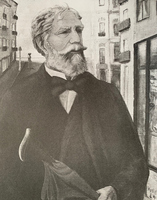
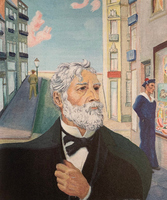
Heckel also memorialized their friendship in paint. Back in his Berlin studio in 1924, he painted Ensor’s portrait from memory (fig. 1). He depicted his friend as a dignified figure. The Flemish master stands at the intersection of Vlaanderenstraat and Van Iseghemlaan in Ostend, facing away from the sea, as if just returning from a walk. He has an authoritative gaze, combed-back hair, a trimmed mustache, and a beard. He wears a black cape and a bow tie and holds an umbrella. To the right, we can see the window of his family’s souvenir shop. Unfortunately, the painting was destroyed when Heckel’s Berlin studio was bombed in 1944. Heckel created a second version of the portrait in 1930, which he also painted from memory (fig. 2). Although he again pictured Ensor facing away from the sea, the street appears more spacious due to the figure being depicted closer to the viewer, occupying only the lower part of the composition. This leaves more room for the clear blue sky with scudding clouds, and the sailor, dressed in blue and standing by the shop window, which adds a lively touch to the composition. The red pom-pom on his hat provides a colorful accent. Ensor seems older in the work of 1930; his beard looks unkempt and his gaze is less assured, even slightly quizzical. He appears to be cold, as evidenced by the way he pulls his coat closed with his left hand.
When Heckel showed his portrait of Ensor in Brussels in 1931, the artist reacted enthusiastically. “My successful portrait, which you worked on with such care as a memento of our friendship . . . will be noticed, and I’m sure of the well-deserved success that will be coming your way.”[4] It is believed that Heckel painted this portrait of Ensor on the occasion of his seventieth birthday. It is one of a series of three portraits that Heckel painted the same year to commemorate his closest artist-friends. In addition to Ensor, he painted Christian Rohlfs (1849–1938) (Porträt von Christian Rohlfs [Portrait of Christian Rohlfs], 1930; Suermondt-Ludwig Museum, Aachen), who celebrated his eightieth birthday in Hagen on December 22, 1929; and Otto Müller (1874–1930) (Porträt von Otto Müller [Portrait of Otto Müller], 1930; Brücke-Museum, Berlin), who died on September 24, 1930, at the age of fifty-six.
The War Years
During the war years, Ensor had to cope with a number of personal and professional difficulties. He lost his mother in 1915 and his aunt Mimi the following year. As tourism came to a halt in Ostend, his family’s souvenir store lost business and, in turn, he saw a significant drop in his income. His art production also slowed. Ensor only painted thirty canvases in this four-year period and abandoned printmaking altogether.
Despite these downturns, he was fortunate to receive assistance not only from Heckel but also from Kaesbach, the commander of the Red Cross unit, and occasionally from the other German artists stationed in Ostend: the painters Anton Kerschbaumer (1885–1931), Max Kaus (1891–1977), and Otto Herbig (1889–1971) as well as the poet Ernst Morwitz (1887–1971). They invited him to dinner, bought his paintings, encouraged him to work, provided him with painting materials and frames, saved his etching plates from the forced metal collection, and negotiated his release from prison after he was arrested for making a caricature showing the kaiser as a vulture.
A Friendly Neighbor with a Deeper Connection
When Heckel and the other artists from his Red Cross unit were transferred to Ostend in May 1915, they lived in the railway station, which had been converted into an emergency hospital. In November of that year, they moved into a hotel on Van Iseghemlaan, from where Heckel could see Ensor’s house. As Heckel wrote to Schiefler:
Can see the shop full of rare shells and other souvenirs, and I can hear the parrot chattering. However, I haven’t been to visit him since then, because his old aunt is very sick. And besides, I have little time. But it was very interesting during our three or four previous meetings. He played dance music for a ballet that he had composed himself, for which he had also designed the costumes and backdrops in pastels. One experiences a deeper connection with his art when getting to know him in his remarkable environment.[5]
A week later, Heckel wrote to Kaesbach: “I’m going to visit Ensor today; it’s fantastic that Osthaus is buying something from him.”[6] The works that Karl Ernst Osthaus (1874–1921) purchased for his Folkwangmuseum in Hagen are not easy to identify, but a letter from Heckel to Osthaus can shine some light on this matter. In early December 1915, Heckel wrote to Osthaus from Berlin: “A few days ago, on the initiative of Dr. Kaesbach, I sent you several woodcuts I made in Ostend. I also included the two Ensor etchings I brought with me.”[7] Osthaus kept the two etchings and asked Heckel how he could transfer the money. Heckel responded: “Dear Mr. Osthaus, due to the difficulties with sending money to Belgians and to us, I propose that you send 64 marks for the two Ensor etchings to my wife in Steglitz, Mommsenstraße 60 IV, for the two Ensor etchings I have sent you. I will then pay Ensor the 80 francs he is owed from my own money.”[8]
A letter from Heckel to Kaesbach, who wanted to know how much a drawing or painting would cost, also gives an idea of Ensor’s prices during this period. “Once, Ensor told me that he usually charged the ‘bourgeoisie’ 3,000 to 4,000 francs for a painting and 300 to 500 francs for a colored drawing. I guess that the work you mention is a repetition that Ensor made after a colored gouache or pastel of ‘himself between delicate female bodies with marguerites.’ I would suggest 300 francs, but if you prefer a painting, it will cost you at least 2,000.”[9]
Ensor Receives a Commission
Heckel also tried to negotiate a commission from Kaesbach, who had unsuccessfully tried to buy works from Ensor on several occasions. Ensor refused to sell any of the paintings in his studio, but finally, in June 1917, he told Heckel that he would accept a commission from Kaesbach. Heckel wrote to Kaesbach to inform him of Ensor’s intent: “He is quite prepared to paint something for you on commission. He has already made an interesting colored sketch for his mask painting.”[10] A month and a half later, Heckel received word from Ensor that he was still waiting for confirmation of the commission, especially regarding Kaesbach’s preferred subject matter. That very day, the message was passed along by Heckel: “For your commission to Ensor, it would be best if you came yourself. Perhaps he will paint something based on a drawing, such as a scene from the life of Christ, which you could then choose yourself. I saw him again last night. I found it very pleasant.”[11] But the work did not progress during the winter months, as Heckel explained: “Progress on your painting is slow. Ensor is as cold as we are right now, and the days are also without light. But it will still be very beautiful.”[12] In February 1918, Heckel noted that “Ensor hasn’t worked for a long time now.”[13] But as spring arrived, Heckel announced: “Ensor has finally resumed work. Your picture will be beautiful.”[14] Since Kaesbach had not seen any results by April, he asked Heckel to submit to Ensor an offer for a purchase. But, as Heckel wrote, Ensor was not interested: “Dear Kaesbach, I visited Ensor yesterday. But he said he would never separate from his ‘dead mother’ [Ma mère morte (My Dead Mother), 1915; Mu.ZEE, Ostend]. He’s glad that you appreciate this work, but unfortunately, he has the same taste.”[15] Kaesbach was not amused. He insisted that Heckel try again. But Ensor dug in his heels and refused to sell. As Heckel detailed in his letter, “[Ensor] even got angry, and I left without achieving anything. He’s unlikely to change his mind, as he’s deeply attached to all these works.”[16] A few days later, Heckel informed Kaesbach: “You can’t get anywhere with Ensor these days. He’s angry and anxious; he’s compiling an inventory and register of his paintings and refuses to sell anything; he paints for his own pleasure. The English attacks have strengthened his resolve to keep hold of his possessions.”[17] And Ensor was right not to give in. As the Allies were approaching, in early October 1918 the German artists prepared to leave, as Heckel explained: “I said goodbye to Ensor. He wants to give you both pictures in peacetime. That would be good. I gave him your address. Ostend is more beautiful than ever, and the vast and eternally swaying sea makes me deeply regret to leave this coast. Perhaps there will be a human reunion after the military farewell. Yours sincerely, E. H.”[18] Whether or not Ensor kept his promise we will never know, though Kaesbach did acquire other works by the artist.
The Red Cross Orderlies as Collectors
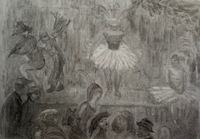
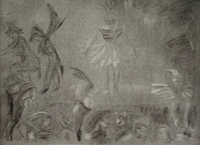
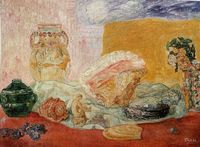
According to art historian Inge Herold, Kaesbach owned at least two paintings by Ensor and a small caricature in pastels.[19] The first one was probably the second version of Petit théâtre (Little Theatre) from 1917 (figs. 3, 4), mentioned by Heckel in a letter to Kaesbach as “a small, very beautiful painting of a dancer he [Ensor] had made based on a colored drawing and now felt like painting the same one for you again.”[20] The other was Coquilles, roses et vases (Seashells, Roses and Vases) (fig. 5).[21] This pastel may have been the work that Kaesbach purchased in 1915 for 300 francs.[22] In an interview with the German art dealer Roman Norbert Ketterer, Kaesbach reported in 1959 that he had once owned “a very beautiful painting by Ensor. Unfortunately, I had to pawn it against my house here in Hemmenhofen. A Swiss collector took the wonderful Ensor from me.”[23] Unfortunately, nothing more is known about this painting.
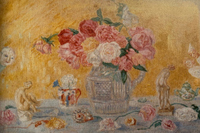
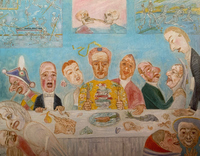
Another member of the Red Cross unit, Kerschbaumer, who was also an admirer of Ensor, owned at least three of his paintings. In addition to the painting he later acquired through Kaesbach, Kerschbaumer, according to Kaus, is said to have commissioned two paintings from Ensor in Ostend, “a smaller very delicate still life [Roses, tanagras et coquillages (Roses, Tanagra Figures and Seashells), fig. 6[24]] and a larger one, depicting an eccentric dinner. In the middle of the table sits a man, unmistakably Goethe, before a plate containing a gnawed herring bone. The other figures—the table is crowded—sit before empty plates and a few meager scraps. Ensor had found his own way to poke fun of the food shortages in Germany; it was 1918.”[25] Comical Repast (Feast of the Lean), with its grotesque characters, is a parody of the Last Supper (fig. 7).[26] Contrary to Kaus’s claims, we tend to view this work as a denunciation of the German occupation, since the figures’ meager meal does not evoke the situation in Germany but rather the near starvation that prevailed in Belgium. According to Herold, Kerschbaumer himself appears as a waiter on the right-hand side of his painting.[27]
The Child in the Town Hall
Another dimension of Heckel’s esteem for and friendship with Ensor was expressed in his efforts to promote Ensor’s work in Germany. He wanted to curate an exhibition, an intention he shared in a letter to Schiefler in the summer of 1916: “After the war, I would love to organize an excellent exhibition for Ensor. He, too, would be happy about it. When you are conversing with him, you get the impression that he believes that those who are indebted to him—he cites [Emile] Claus and [Fernand] Khnopff as examples—were given preferential treatment and that he himself has been forgotten. Although for that he deserves some of the blame, too.”[28]
Heckel used his own connections to get Ensor’s work publicized in a new German art magazine and, simultaneously, preserved in photographs. During the war, art historian Paul Westheim (1886–1963) founded a new art magazine, Das Kunstblatt. The first edition was published in January 1917, and the June issue was dedicated to Heckel, with an important contribution by Westheim himself. Heckel attached great importance to high-quality images and organized, with the assistance of Kaus, the photographing of the artworks. He explained his reasoning in a letter to Kaesbach: “I wrote to Westheim that he should only print half as much text and double the number of images. This would encourage the painters to collaborate. The magazine would become an archive for their works, which would then make their case, instead of the writers singing their praises.”[29] Inspired by Heckel, Westheim was interested in publishing an article about Ensor, who was completely won over by the idea. As Heckel explained to Kaesbach: “As soon as the vexed question of the photographer is resolved, I should like to have several works photographed. Das Kind im Stadthaus (The Child in the Town Hall) and so on. Westheim . . . with his entire Kunstblatt is, of course, wholly unworthy of Ensor, but at least this means that his [Ensor’s] paintings are finally registered; if only in case there were to be a fire here, this would offer a faint reminder of his extraordinary works.”[30]
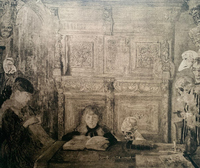
Das Kind im Stadthaus is most probably Le meuble hanté (The Haunted Dresser) (fig. 8), that was bought by the city of Ostend in 1906. In his memoirs, Kaus stated that he and Heckel came across this work by accident: “Heckel and I once saw a very beautiful, dark early painting by Ensor in the town hall of Ostend, on the Place d’Armes. It depicted a girl standing in front of a magical cabinet. It was hanging, as if banished, in some clerk’s office on the top floor.”[31] When the Germans bombed Ostend in 1940, the town hall caught fire, destroying Le meuble hanté and two other paintings by Ensor as well as 118 of the artist’s etchings. Looking back, we can say that Heckel’s insistence on photographing Ensor’s works (in case of a fire) was extremely prescient.
Intrinsic Expressionism
The article about Ensor and his work in Das Kunstblatt was published in January 1918. It was written by Wilhelm Hausenstein (1882–1957), a writer, journalist, and art critic, and was dedicated to two artists who found inspiration in Ensor’s work, namely Alfred Kubin (1877–1959) and Paul Klee (1879–1940).[32] During World War I, Hausenstein worked in Brussels for the Generalgouvernement (German administration) of occupied Belgium. This gave him the opportunity to see Ensor several times in Ostend, where he visited the artist’s studio and the two men talked about Ensor’s work.
The starting point of Hausenstein’s argument is that despite Ensor’s vivid imagination, his drawings and paintings show the world as it is. His depictions, according to Hausenstein, present something tangible and visible to everyone, even though the images are the result of “a random and inevitable play of the pen as it draws its extravagant curves and curls, leaving one in doubt as to whether it is merely scratching the surface or revealing a dreamlike profundity.”[33] The fact that Ensor’s vision of the world is not purely imaginary but actually exists is, for Hausenstein, a mystery, one that makes Ensor a vitally important artist.
In his article, Hausenstein takes Ensor’s works as his starting point, situating them in the history of art. He notes the artists who inspired Ensor and, in turn, those who were influenced by his work. In doing so, he mentions Hieronymus Bosch (ca. 1450–1516) and Pieter Brueghel the Elder (ca. 1525–69) but also David Teniers II (ca. 1610–90), Jacques Callot (1592–1635), Odilon Redon (1840–1916), August Strindberg (1849–1912), Edouard Vuillard (1868–1940), and Pierre Bonnard (1867–1947). Recognizing Ensor’s impact on the future of the art and artists who followed him, he mentions not only Kubin and Klee but also Ludwig Meidner (1884–1966) and Oskar Kokoschka (1886–1980). Ensor’s background is also discussed: his birth in Ostend to an English father and a Flemish mother. His work is regarded as a combination of English hardheadedness and satire, as seen in the works of William Hogarth (1697–1764) and Thomas Rowlandson (1757–1827) as well as in the work of Antoine Wiertz (1806–65), an elusive Belgian artist. Although Ensor rarely left his hometown of Ostend, his imagination was nourished and stimulated by his curiosity about foreign lands. Through the port of Ostend, as Hausenstein points out, the whole world came to him, from Chinese and Japanese goods to tourists from New York, Moscow, Berlin, Budapest, and Buenos Aires. Alongside this art historical approach, Hausenstein also advances a subjective interpretation of Ensor, whom he describes as a hypochondriac who is obsessive and, above all, lonely.
The essay was accompanied by no fewer than eleven works: two engravings, two drawings and seven paintings, including L’entrée du Christ à Bruxelles (The Entry of Christ into Brussels) (1888–89; J. Paul Getty Museum, Los Angeles); Vieille dame aux masques (Old Woman with Masks) (1889; Museum of Fine Arts, Ghent); and the German artists’ favorites, Le meuble hanté and Squelettes se disputant un hareng saur (Skeletons Fighting Over a Pickled Herring) (1891; Royal Museums of Fine Arts of Belgium, Brussels).
By virtue of his position in the German administration, Hausenstein was also the publisher of Der Belfried, a propaganda magazine that promoted the German Flamenpolitik (Flemish policy).[34] In December 1918, Der Belfried published an essay on Ensor by art historian Grete Ring (1887–1952). She was the first to relate Ensor’s work to expressionism, stating:
Although the “expressionist” tendencies in Ensor’s art increase with the years, he by no means presents the image of an artist who, as he ages, feels obliged to follow the fashions of youth. His “expressionism” was not retroactively grafted onto him by the younger generation but rather signifies a form of expression that has always been intrinsic, which has only become more resolute over the years. It is obvious that a personality of Ensor’s dazzling diversity cannot have a school-forming, standard-setting effect; despite the remarkably early appearance of expressionist traits in his work, he does not belong in the ranks of the ancestors that the younger generation has chosen for itself. Nevertheless, his influence can be felt as far away as Germany—like, for instance, in Emil Nolde’s mask paintings.[35]
The publications on Ensor’s oeuvre that appeared in Germany during the war, thanks to Heckel’s efforts, are important examples of the appreciation of his work by early twentieth-century German artists and critics.
Conclusion
For most art historians, Ensor and Heckel belong to two distinct movements in European art: Franco-Belgian Postimpressionism and Symbolism on the one hand, and German Expressionism on the other. Their intersection is not immediately apparent. However, a closer examination of the intimate friendship between Ensor and Heckel points to the risks inherent in the boundaries historians construct to shape art history, as these may limit their ability to perceive artistic connections.
This article serves as a case study demonstrating the importance of examining the details of artists’ lives in order to trace the social networks to which they belonged or into which they were unexpectedly drawn. The encounter between Ensor and Heckel helps to explain the interest in Ensor’s work within German artistic circles in the 1920s and 1930s and may also shed light on specific aspects of German Expressionist art, such as the fantastic and satirical imagery found in the work of Klee, Kubin, and George Grosz (1893–1959); the apocalyptic urban landscapes of Meidner; the psychological portraits of Kokoschka; or the preference for masks in the works of Emil Nolde (1867–1956).[36]
Notes
All translations are by Helen Simpson.
[1] My research culminated in the exhibition Erich Heckel in Flanders, KMSK Ghent, 2024–25, and my monograph with the same title (Yale University Press, 2024).
[2] The original letters from Erich Heckel to Walter Kaesbach are in the Deutsches Kunstarchiv des Germanischen Nationalmuseums, Nuremberg. The letters from Heckel to Gustav Schiefler are in the Staats- und Universitätsbibliothek, Hamburg. Transcriptions of the letters were kindly made available by the Erich Heckel Estate, Hemmenhofen. The transcriptions do not include specific information about the locations of the original letters in the archive and the library.
[3] “Votre bonne lettre pleine d’amabilités me touche vivement et moi aussi je garde un excellent souvenir de notre [sic] fréquentes rencontres à Ostende.” “J’ai reçu avec joie les nouvelles des peintres amis Kerschbaumer, Kaus, Dr. Morwitz et je leur présente mes bons souvenirs et ravis de votre lettre si amicale je suis mon cher ami Heckel votre tout dévoué.” James Ensor to Erich Heckel, Ostend, April 18, 1931, EJ123, Archive, Royal Museum of Fine Arts, Antwerp.
[4] “Mon portrait si bien venu que vous avez travaillé avec tant de soins en souvenir de notre amitié . . . sera remarqué, et j’ai certitude du succès qui vous est dû.” James Ensor to Erich Heckel, Ostend, April 18, 1931. Given that the date of the portrait is not noted in the catalogue, it is not clear which of the two portraits this refers to, although it is most likely that it was the most recent version that was shown in the exhibition L’art vivant en Europe (Palais des Beaux Arts, 1931).
[5] “Sehe seinen Laden voll seltsamer Muscheln und Andenken, höre den Papagei pfeifen. Doch war ich noch nicht wieder bei ihm, da seine alte Tante schwer krank war. Und außerdem hatte ich selbst wenig Zeit. Es war aber bei den 3. oder 4. Besuche bei ihm sehr interessant. Er spielte mir selbst komponierte Tanzweisen vor zu einem Ballett, das auch in Kostümen und Szenen in Pastellen festgelegt ist. Man findet ein größeres Verhältnis zu seiner Kunst, wenn man ihn selbst in seiner seltsamen Umgebung kennen lernt.” Erich Heckel to Gustav Schiefler, November 11, 1915.
[6] “Zu Ensor gehe ich heute; das ist doch famos, dass Osthaus etwas von ihm kauft.” Erich Heckel to Walter Kaesbach, November 22, 1915.
[7] “Auf Anregung von Dr. Kaesbach sandte ich ihnen diesen Tagen einige Drucke von Holzschnitte, die in Ostende entstanden sind. Die beide Radierungen von Ensor brachte ich mit und legte sie nun bei.” Erich Heckel to Karl Ernst Osthaus, December 14, 1915, Kr 59, Karl Ernst Osthaus Archiv, Hagen.
[8] “Sehr geehrter Herr Osthaus, da Geldsendungen an Belgier und auch uns hier große Schwierigkeiten haben, möchte ich Ihnen vorschlagen, den Betrag von 64 M [80 Frs] für die beiden Ensorschen Radierungen, die ich ihnen sandte, an meine Frau Steglitz, Mommsenstr. 60 IV zu schicken, so könnte ich dann von Geld, das ich hier habe, Ensor den Betrag geben.” Erich Heckel to Karl Ernst Osthaus, January 30, 1916, Kr 59, Karl Ernst Osthaus Archiv, Hagen. I am grateful to Katja Knicker of the Osthaus-Museum Hagen for bringing these two letters to my attention.
[9] “Ensor sagte einmal, dass er gewohnt sei, vom ‘Bourgeois’ etwa 3-4000 Frs für ein Bild und 3–500 Frs für eine farbige Zeichnung zu verlangen. Ich vermute, es handelt sich in dem fraglichen Falle um eine Wiederholung, die Ensor nach einem farbigen Gouache-Pastel ‘er selbst zwischen zarten Frauenkörpern die Margeriten haben’ anfertigte—300 Frs wäre wohl zu raten—sollte es ein Bild sein, dann sicher 2000 mindestens.” Erich Heckel to Walter Kaesbach, August 15, 1918.
[10] “Er ist durchaus bereit, etwas für Sie zu malen im Auftrag. Für sein Maskenbild hat er schon eine interessante farbige Skizze gemacht.” Erich Heckel to Walter Kaesbach, June 2, 1917.
[11] “Für Ihre Bestellung bei Ensor ist es besser Sie kommen selbst. Vielleicht dass er Ihnen etwas nach einer Zeichnung malt. Z.B. eine der Scenen aus dem Leben Christi, die sie selbst hier heraussuchen. Ich war gestern Abend noch bei ihm. Es war sehr angenehm.” Erich Heckel to Walter Kaesbach, July 14, 1917.
[12] “Ihr Bild schreitet jetzt nur langsam vorwärts. Ensor hats so kalt wie wir und die Tage sind dazu ohne Licht. Aber es wird doch sehr schön sein.” Erich Heckel to Walter Kaesbach, December 11, 1917.
[13] “Ensor hat jetzt lange nicht gearbeitet.” Erich Heckel to Walter Kaesbach, February 12, 1918.
[14] “Ensor hat endlich die Arbeit wieder aufgenommen. Ihr Bild wird sehr schön.” Erich Heckel to Walter Kaesbach, March 20, 1918.
[15] “Lieber Kaesbach, Ich war gestern bei Ensor. Aber er sagte, er würde sie nie von der ‘tote Mütter’ trennen. Er freut sich ja, dass Sie diese Arbeit so schätzten, aber zum Unglück habe er denselben Geschmack.” Erich Heckel to Walter Kaesbach, April 16, 1918.
[16] “[Ensor] wurde sogar ärgerlich und ich ging unverrichteter Sache weg. Es ist kaum anzunehmen, dass er sich ändert, da er eben an allen diesen Arbeiten sehr hängt.” Erich Heckel to Walter Kaesbach, April 24, 1918.
[17] “Mit Ensor ist jetzt gar nichts anzufangen. Er ist verärgert, ängstlich; er macht ein Inventar und Verzeichnis seiner Bilder und will überhaupt nichts verkaufen. Er male zu seinem Vergnügen. Die Angriffe der Engländer haben ihn so gestimmt, dass er noch fester am Besitze hält.” Erich Heckel to Walter Kaesbach, April 27, 1918.
[18] “Vom Ensor nahm ich Abschied. Er will Ihnen beide Bilder in Frieden geben. Das wäre ja recht gut. Ich gab ihm Ihre Adresse. Ostende ist schöner, denn je und das Meer weitatmig und ewig, lässt das Verlassen dieser Küste sehr bedauern, aber vielleicht gibt es nach dem militär. Abschied ein menschliches Wiedersehen.” Erich Heckel to Walter Kaesbach, October 5, 1918.
[19] Inge Herold, “James Ensor and His Reception in Germany Pre-1945,” in James Ensor, ed. Inge Herold and Johan Holten, exh. cat. (Kunsthalle Mannheim, 2021), 33.
[20] “Ein kleines sehr schönes Bild einer Tänzerin nach einer farbig. Zeichnung hat er gemacht und nun Lust dasselbe nochmals für sie zu malen.” Erich Heckel to Walter Kaesbach, October 2, 1917.
[21] In Le Roy’s monograph of James Ensor, a painting called Fleurs et coquilles (Flowers and Seashells) (1917–18), is listed as “à M. Kasbach, Berlin.” Grégoire Le Roy, James Ensor (G. Van Oest, 1922), 195.
[22] See note 9.
[23] “Sehr schönes Gemälde von Ensor. Ich mußte es leider in Pfand geben für meinen Hausbau hier in Hemmenhofen. Das wunderbare Bild von Ensor hat mir ein Schweizer Sammler abgenommen.” Roman Norbert Ketterer, Dialoge, vol. 2, Bildende Kunst, Kunsthandel (Belser, 1988), 25.
[24] Herold, “James Ensor and His Reception in Germany Pre-1945,” 34.
[25] “Ein kleineres, sehr delikates Stillleben und ein größeres, ein seltsames Gastmahl darstellend. In der Mitte saß ein Mann, unverkennbar Goethe, vor einem Teller mit einer abgenagten Fischgräte. Die anderen Figuren, es war eine ganze Tischrunde, hatten leere Teller und kleine Reste vor sich liegen. Ensor machte sich auf seine Weise über die Essensnot in Deutschland lustig, es war 1918.” Max Kaus, “Mit Erich Heckel im ersten Weltkrieg,” in Brücke-Archiv, no. 4, Erich Heckel zum Dank und Gedenken, ed. Leopold Reidemeister (Hartmann, 1970), 10.
[26] For more information about this painting, see Alison Hokanson’s “The Feasts of War: Ensor’s Comical Repast (Feast of the Lean)” in this special issue.
[27] Herold, “James Ensor and His Reception in Germany Pre-1945,” 35.
[28] “Nach dem Kriege möchte ich sehr gern Ensor zu einer guten Ausstellung in Deutschland verhelfen. Er ist auch gern bereit. Man hat ihm gegenüber im Gespräch doch das Gefühl, dass er glaubt, auch, die von ihm lernten, er nennt Claus oder Khnopff, sind ihm vorgezogen worden und er ist vergessen. Daran ist er selbst ja auch etwa schuld.” Erich Heckel to Gustav Schiefler, July 16, 1916.
[29] “An Westheim schrieb ich, dass er halb so viel Text und die doppelte Zahl Abbildungen bringen müsste, dadurch gewönne er die Maler als Mitarbeiter, die Zeitschrift würde ein Archiv für ihre Arbeiten und diese können sprechen statt der Lobesposaunen der Schriftsteller.” Erich Heckel to Walter Kaesbach, March 3, 1917.
[30] “Sobald die schwierige Frage des Photographen gelöst ist, will ich einiges aufnehmen lassen. Das Kind im Stadthaus u.s.w. . . . Westheim . . . ist mit seinem ganzen Kunstblatt natürlich Ensor gar nicht wert, aber so werden doch seine Bilder endlich aufgenommen, schon für den Fall eines Brandes hier, gäbe es eine schwache Erinnerung an seine wunderbaren Dinge.” Erich Heckel to Walter Kaesbach, March 3, 1917.
[31] “Heckel und ich guckten uns einmal im Rathaus Ostende an der Place d’Armes ein sehr schönes, dunkles, frühes Bild an, ein Mädchen vor einem Zauberschrank. Es hing, wie verbannt, in irgendeinem Schreiberzimmer im obersten Stockwerk.” Kaus, “Mit Erich Heckel im ersten Weltkrieg,” 10.
[32] Wilhelm Hausenstein, “Ensor, Alfred Kubin und Paul Klee gewidmet,” Das Kunstblatt, January 1918, 11–23.
[33] “Bloß zufälliges und notwendiges Spiel des schnörkelziehenden Stiftes ist, von dem man nicht zu sagen wagt, ob er die Oberfläche ritzt oder geträumten Tiefsinn offenbart.” Hausenstein, “Ensor, Alfred Kubin und Paul Klee gewidmet,” 11.
[34] Flemish policy was the German strategy during World War I and II to exploit linguistic tensions in Belgium by supporting Flemish separatism to weaken the Belgian state and achieve Germanization.
[35] “Obwohl die ‘expressionistischen’ Tendenzen in der Kunst Ensors mit den Jahren zunehmen, bietet er keineswegs das Bild des Künstlers, der alternd sich verpflichtet fühlt, die Moden der Jugend mitzumachen. Sein ‘Expressionismus’ ist nicht rückwirkend von der jüngeren Generation aufgepfropft, sondern bedeutet eine ihm von jeher immanenter Ausdrucksart, die nur im Laufe der Jahre entschlossener hervortritt. Es ist einleuchtend, dass eine Persönlichkeit von Ensors schillernder Vielfältigkeit nicht schulbildend, normenprägend wirken kann; er gehört denn auch—trotz des bemerkenswert frühen Auftretens expressionistischer Züge in seinem Werk—nicht in die Reihen der Ahnen, die die junge Generation sich gegeben hat. Immerhin sind Ausstrahlungen seiner Wirkung selbst bis nach Deutschland zu spüren—ich erinnere an die Maskenbilder Emil Noldes.” Grete Ring, “James Ensor,” Der Belfried, December 1918, 281–82.
[36] Both Ensor and Grosz were acclaimed draughtsmen and shared the same distaste for authority and the bourgeoisie, whom they exposed through biting satire and grotesque caricature. One of Grosz’s most important paintings, Widmung an Oskar Panizza (The Funeral, [Dedicated] to Oskar Panizza) (1917–18; Staatsgalerie, Stuttgart), clearly owes a debt to Ensor’s L’entrée du Christ à Bruxelles. On the influence of Ensor on Grosz, see Lieven Van Den Abeele, “George Grosz, James Ensor gewidmet,” in Hommage Robert Hoozee, ed. Johan De Smet et al. (Museum voor Schone Kunsten Gent, 2014), 134–37.